MBTI Thinking vs Feeling: An In-Depth Comparison for 2026

So, are you the person who makes a detailed pro-con list for picking a new blender, or the one who just "gets a feeling" about which one will bring joy to your kitchen? This is the heart of the MBTI Thinking vs. Feeling debate.
Let's be crystal clear: this isn't about being smart versus being emotional. It's about the operating system you naturally run when it's time to make a call. Thinkers (T) default to impersonal, objective logic. Feelers (F) , on the other hand, prioritize personal values and how a decision will land with the people involved.
Head vs. Heart: The Core of T vs. F Decision Making
Welcome to the ultimate showdown between Thinking and Feeling. This isn't a contest to see who's more intelligent or emotionally stable. It's simply about the first question your brain asks when faced with a choice. Do you instinctively take a step back to get an impartial, bird's-eye view, or do you step into the situation to feel out the human dynamics?
Think of a Thinker as a courtroom judge. Their job is to remain detached, sift through the evidence, and arrive at a verdict that is logical, consistent, and fair based on established principles. Their driving question is usually, "What is the most rational and truthful conclusion here?"
• Practical Example: • A Thinker named David is deciding whether to accept a job offer. He creates a spreadsheet comparing salary, benefits, commute time, and potential for advancement. The decision is based on which option scores highest on his objective criteria, even if it means moving away from friends.

Now, picture a Feeler as a skilled diplomat. They walk into a room and immediately read the emotional temperature. They're wired to consider how a decision will impact group morale, individual feelings, and overall harmony. For them, the most important question is, "How will this affect the people I care about?"
• Practical Example: • A Feeler named Emily is offered the same job. Her first thought is how the long hours would affect her family and if the company culture feels supportive. She might turn down a higher salary if the work environment feels cold or uncooperative, prioritizing her team's well-being.
This plays out in real life all the time. Imagine a company announces layoffs. A Thinker might immediately focus on the hard numbers and see the brutal logic—it's a necessary evil to keep the company afloat long-term. A Feeler in the same meeting would be instantly consumed with empathy for the employees, imagining their stress and anxiety. Neither view is wrong; they're just focusing on different, equally valid parts of the picture.
Getting a handle on this dynamic is a huge step in self-awareness. If you're curious to explore this classic internal conflict further, there's a lot of great insight into head vs heart decision-making .
Decision-Making At A Glance: Thinker vs. Feeler
To put it all in perspective, here's a quick cheat sheet comparing how Thinkers and Feelers approach the decision-making process.
| Decision Aspect | Thinking (T) Approach | Feeling (F) Approach |
|---|---|---|
| Primary Goal | To find the objective, logical truth. | To create harmony and consensus. |
| Core Question | "Is this logical and fair?" | "How will this affect everyone?" |
| Focus | On facts, principles, and consistency. | On values, relationships, and empathy. |
| Communication Style | Direct, concise, and analytical. | Tactful, encouraging, and diplomatic. |
This fundamental difference helps explain some interesting social patterns. For example, studies often show that roughly 75% of men lean toward a Thinking preference, while a majority of women tend to prefer Feeling. This is just a statistical trend, not a hard-and-fast rule, but it definitely shapes how we all interact.
Knowing where you stand is a game-changer for personal growth. If you're looking to explore your own patterns, learning how to measure emotional intelligence can offer some powerful insights.
Meet The Cognitive Functions Driving T and F
So, you know if you're a Thinker or a Feeler. Cool. But that 'T' or 'F' on your results page is just the concert poster—the cognitive functions are the actual rockstars on stage. This is where we get into the how and why of your decision-making.
Think of it this way: "Thinking" and "Feeling" are like two different operating systems for your brain. The cognitive functions are the specific apps running on that OS. There are two "Thinking" apps and two "Feeling" apps, and each one has a completely different user interface.
The Thinking Functions: Ti vs. Te
Both Introverted Thinking (Ti) and Extraverted Thinking (Te) are all about logic, but they don't live in the same universe. One builds a world of logic inside their head, while the other builds it out in the real world.
Introverted Thinking (Ti): The Internal Architect
Ti is obsessed with creating a perfectly interlocking, internally consistent model of how things work. It's a deep, deliberate process that constantly checks to make sure every new piece of information fits flawlessly into a personal framework of truth. The goal isn't what's fastest; it’s what's most accurate and consistent .
• Practical Example: • Picture a programmer, Maria, who isn't just trying to make the code run. She'll spend hours refining a single algorithm until it's a thing of logical beauty—pure, elegant, and airtight. No one else might ever see how perfect it is, but • she • knows. That’s the only approval she needs.
Extraverted Thinking (Te): The External CEO
Now, flip that coin over and you get Te. Te couldn’t care less about a perfect internal model; it’s laser-focused on organizing the external world for maximum efficiency and results. It asks, "What's the most logical and effective way to get this done, right now, with the resources we have?"
• Practical Example: • Think of a project manager named Ben who lives and breathes spreadsheets, timelines, and clear metrics. Ben will structure the entire team's workflow to produce a logical outcome. Are we hitting our deadlines? Are we on budget? He isn't theorizing; he's executing.
The Feeling Functions: Fi vs. Fe
Just like the Thinkers, the Feelers have their own internal and external divide. Both Introverted Feeling (Fi) and Extraverted Feeling (Fe) make choices based on values. The big question in the mbti thinking vs feeling debate is: are those values coming from an inner compass or a social radar?
Introverted Feeling (Fi): The Inner Compass
Fi is a deeply personal, non-negotiable set of core values. It’s a quiet, internal compass that ensures every single action aligns with who a person is at their core. An Fi user isn't trying to keep the peace; they're trying to stay true to themselves.
• Practical Example: • An artist, Leo, with strong Fi will create work that expresses a raw, personal truth about social justice, even if it's not popular or commercially viable. He might walk away from a huge commission if the project feels like a sell-out or violates his sense of integrity. The decision comes from an unshakeable internal standard of what feels • right • .
Extraverted Feeling (Fe): The Social Harmonizer
Fe, on the other hand, is tuned into the emotional frequency of the room. It’s all about sensing the feelings of the people around you and acting to maintain group harmony. The first question for an Fe user is often, "How is everyone doing, and what can I do to make things better for us?"
• Practical Example: • You know that person at a party, let's call her Chloe, who spots the one guest standing awkwardly alone? The Fe-dominant individual will swoop in, draw them into a conversation, and seamlessly connect them to others. She is constantly, and often unconsciously, managing the emotional well-being of the group.
Seeing how these functions operate can also shed light on other personality models. If you're curious about how these mental processes link up with core fears and desires, you'll want to check out our guide on Enneagram vs MBTI .
T vs. F in the Wild: Real-World Scenarios
Alright, let's move past the theory. The real "aha!" moments happen when you see the Thinking/Feeling dynamic play out in real life—at work, with friends, and even when you’re just picking a movie. This is where the rubber meets the road.
Let's drop a Thinker and a Feeler into a few classic situations and see what happens. Take giving tough feedback to a friend. A Thinker's brain is wired for clarity and improvement, so they’ll likely get right to the point. A Feeler, on the other hand, is all about preserving the relationship, so they'll probably wrap that same feedback in layers of encouragement to cushion the blow.
These different instincts are driven by four core mental processes, or cognitive functions : Ti, Te, Fi, and Fe.
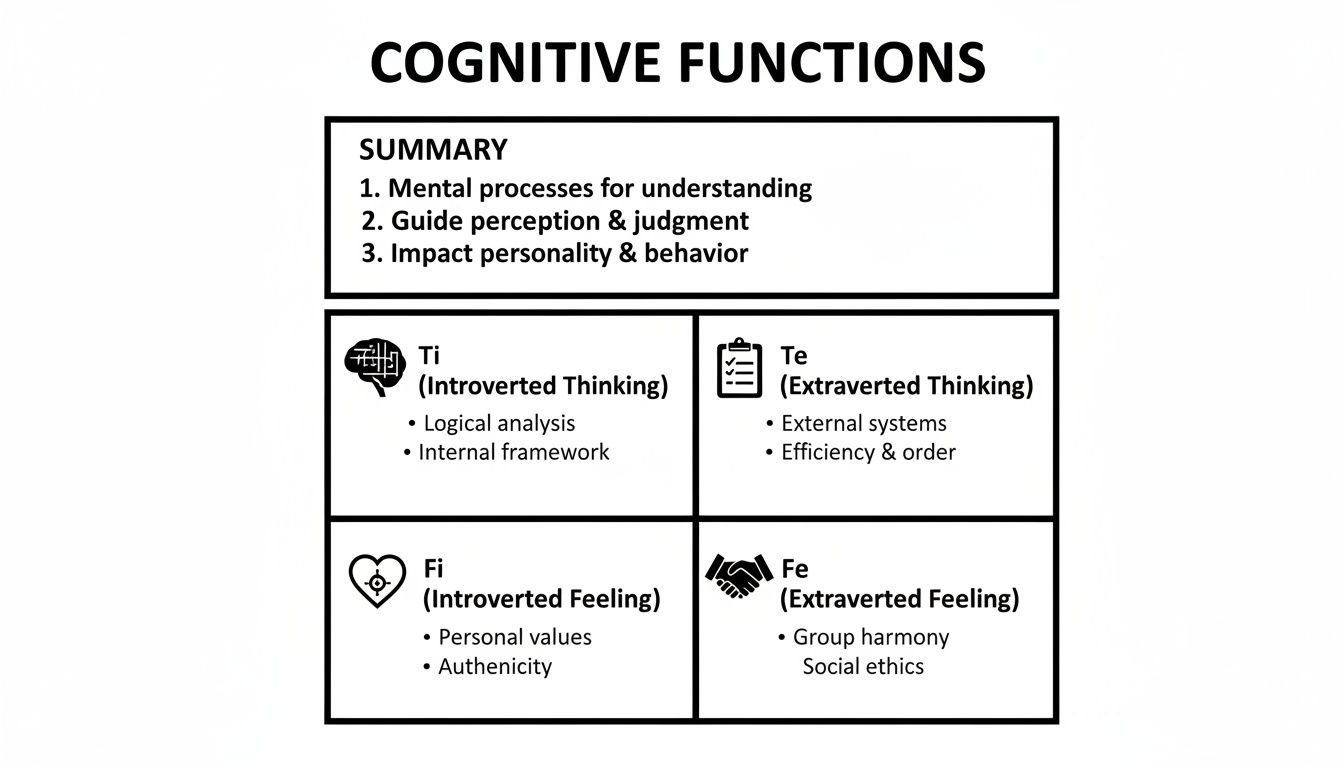
Think of it this way: Thinking functions (the architect and clipboard) are all about organizing systems, whether in your head or in the real world. Feeling functions (the compass and handshake) are about navigating values—your own or the group's. This fundamental difference is the engine behind everything we're about to see.
Picking a Career Path
Imagine two friends, Mark (a classic Thinker) and Sarah (a quintessential Feeler), trying to figure out what to do with their lives. Their internal monologues say it all.
The Thinker's Playbook: Mark, our Thinker, cracks open a spreadsheet. He's deep into comparing average salaries, 10-year growth projections, and the cold, hard math of tuition versus starting income. It's a process of elimination, and the data will tell him the answer.
The Feeler's Playbook: Meanwhile, Sarah is busy with her journal. She's exploring big questions about purpose, impact, and what a fulfilling day would feel like. She's picturing jobs that align with her values and offer a supportive team.
Here's the thing: neither of them is wrong. They're just using entirely different toolkits to build a life that feels right to them . Mark is building a logical, efficient system; Sarah is building a life rooted in personal values and human connection.
Reacting to a Sad Movie
The lights come up after a tearjerker, and you can practically see the T/F split in the air.
• The Feeler's Reaction: • There’s a good chance tears are involved. Their first move is to process the emotional rollercoaster with everyone. They'll say things like, "That was absolutely devastating! Can you believe she had to do that? My heart is just broken for them." They’ve climbed inside the story and are feeling it all.
• The Thinker's Reaction: • They’re probably quieter, already dissecting the plot mechanics and character arcs. They'll point out the "brilliant foreshadowing in the first act" or how "logically, that ending was inevitable given the protagonist's fatal flaw." They appreciate the emotion as a well-executed part of the film's machinery, but they aren't necessarily drowning in it.
It's not just a stereotype. There's a noticeable gap in how these types express emotion. Studies show that only about 20% of Thinkers report crying often, compared to over 50% of Feelers. This isn't about having emotions or not; it's about how close to the surface they live. For more fascinating patterns like this, you can discover more insights about these personality traits in the wild.
Planning a Group Trip
Our final scenario: a Thinker and a Feeler are put in charge of planning a vacation for six friends. It's a masterclass in project management versus vibe management.
The Thinker is on it. They’ve already created a shared doc with a budget tracker, a poll for destinations based on flight costs, and a color-coded itinerary. The mission is clear: create a fair, efficient, and well-organized trip that maximizes everyone's time and money.
The Feeler , on the other hand, has started a group chat to take the emotional temperature. They're asking, "Hey everyone, what kind of vibe are we going for? Relaxing on a beach or a fast-paced city adventure? What's the one thing that would make this trip amazing for you?" Their goal is to make sure everyone feels happy and included, even if the final plan isn't the most "optimal" one on paper.
Navigating The Workplace As A Thinker Or Feeler
From high-stakes negotiations down to who refills the coffee pot, the office is a grand stage where the mbti thinking vs feeling dynamic is always on display. These deep-seated preferences dictate how we lead, talk to each other, and handle the inevitable disagreements, either creating a beautiful symphony of collaboration or a jarring cacophony of misunderstanding.
It’s easy to spot. Your Thinker colleague probably sees their main job as solving problems—optimizing a workflow, hitting a target, or delivering critique that’s brutally honest but gets the job done. Meanwhile, their Feeler counterpart is the team’s glue, instinctively working to boost morale and make sure every voice is heard and every person feels valued.
Neither way is inherently right or wrong, but boy, do they lead to some different days at the office.

Leadership and Management Styles
When you put a Thinker or a Feeler in charge, you get two very different kinds of leaders: the sharp, task-focused strategist and the warm, people-centric mentor. Figuring out which one you work for (or which one you are ) is a massive shortcut to a more successful and less stressful career.
The Thinker as a Leader: A Thinker boss runs on a currency of pure logic. They are masters of the grand strategy, with an eagle eye on goals, metrics, and efficiency. Competence is king, and clear, measurable results are what earn their respect.
• Practical Example: • Your Thinker manager, Kevin, walks into your quarterly review armed with spreadsheets detailing your performance metrics against your KPIs. The feedback is direct: "Your conversion rate is down 5%. Let's brainstorm three strategies to get it back up by next month." Pro tip: they’ll love you if you bring them a well-researched solution, not just a problem.
The Feeler as a Leader: On the flip side, a Feeler boss leads from the heart. They’re naturals at building a loyal, tight-knit team where people feel safe enough to be creative and take risks. Their first priority is cultivating a positive atmosphere where everyone can truly shine.
• Practical Example: • When a team member, Jessica, is obviously struggling, a Feeler manager’s first move is to pull them aside and ask, "Hey, I've noticed you seem a bit stressed lately. What’s going on? How can I support you?" They know that celebrating small wins and fostering genuine connections is the secret sauce to incredible team engagement.
Resolving Workplace Conflict
Nowhere does the T/F divide show up more starkly—or more explosively—than in conflict. For Thinkers, conflict is just a messy but necessary part of finding the truth. For Feelers, it often feels like a direct threat to the harmony they work so hard to maintain.
A Thinker jumps into a disagreement like it’s a debate club championship. They want to get all the facts on the table, dissect the pros and cons, and land on the most rational, defensible conclusion. They can argue their point with fiery passion one minute and go out for a beer with you the next—it’s not personal.
A Feeler , however, is busy trying to find a compromise that leaves everyone’s dignity intact. They’ll work tirelessly to find a middle ground to ensure relationships aren't damaged. For them, how you arrive at a decision is just as critical as the decision itself.
Communication At The Office
Ever received an email so blunt you wondered if you’d done something wrong? Or sat in a meeting that started with 15 minutes of personal check-ins? You can probably thank the T/F preference of the person in charge.
This is where the rubber really meets the road. Thinkers are all about efficient, crystal-clear communication. Feelers are all about tact and connection. Here’s a quick look at how that plays out.
Professional Communication Styles: A T vs. F Comparison
The table below breaks down the subtle—and not-so-subtle—differences in how Thinkers and Feelers communicate on the job.
| Communication Type | Thinker Preference | Feeler Preference |
|---|---|---|
| Giving Feedback | "Your report is missing the Q3 data. Add it." | "This report is a great start! To make it even stronger, could we add the Q3 data?" |
| Running a Meeting | Sticks to a tight agenda. The goal is to make decisions and assign action items. | Starts with a quick personal check-in. Tries to get everyone's input and build consensus. |
| Writing an Email | Gets right to the point. Often uses bullet points and direct requests for maximum clarity. | Usually includes a friendly opening and closing. The language feels more personal and encouraging. |
Honestly, understanding these styles is a professional superpower. It gives you the ability to decode your colleagues, tailor your message for maximum impact, and build way stronger relationships by bridging the gap between pure logic and pure empathy.
Debunking Common Thinker And Feeler Stereotypes
When it comes to the great mbti thinking vs feeling divide, we've all seen the tired old cartoons. The Thinker is a cold, calculating robot, and the Feeler is an irrational, weepy mess who can’t be trusted near a spreadsheet. Honestly, it's not just wrong; it's boring.
The truth is that both Thinking and Feeling are incredibly sophisticated ways of making sense of the world. Reducing them to these lazy caricatures misses the point entirely and robs us of appreciating what people actually bring to the table. Let’s set the record straight on a few of these.
Myth 1: Thinkers Are Emotionless Robots Who Cannot Love
This one is probably the most common and, frankly, the most damaging. The idea that Thinkers don't have emotions is just plain false. They feel every bit as deeply as their Feeling counterparts; they just don’t use emotion as their primary decision-making compass.
A Thinker’s emotional world is often a more private affair. While a Feeler might need to talk through their feelings to process them, a Thinker tends to sort through them internally. Their heart isn't on their sleeve, but that doesn't mean it isn't there.
Think about it this way: Steve Wozniak, the brilliant American co-founder of Apple, is a great example. His logical genius is the stuff of legend, but his passion for engineering and deep loyalty to his friends were powerful emotional forces in his life. He simply expressed that love and passion through his actions—building incredible things and being a steadfast friend—rather than through overt emotional displays.
Myth 2: Feelers Are Irrational and Bad With Logic
And what about the Feelers? They get an equally bad rap. The myth that Feelers are allergic to logic is just as silly. This stereotype confuses a preference for people-focused outcomes with an inability to think critically. Feelers can be every bit as analytical and data-driven as any Thinker.
The real difference is their starting point. A Feeler will absolutely analyze a situation with cold, hard logic, but they’ll weigh the logical conclusion against their core values and the impact it will have on people. For them, logic is just one tool in the box, not the only one.
Practical Example: Look at Oprah Winfrey, a textbook ENFJ and American icon. She's a master of empathy and human connection, but you don't build a global media empire on feelings alone. That took immense strategic thinking, business savvy, and countless logical decisions. Her genius lies in her ability to blend sharp, analytical thinking with a profound understanding of what makes people tick.
Of course, this focus on harmony can have its downsides. Many Feelers wrestle with the pressure to keep everyone happy, which can slide into people-pleasing. Figuring out how to stop being a people-pleaser is often a huge area of growth as they learn to assert their needs.
Myth 3: T Is For Men and F Is For Women
Ugh, this one. We need to put this stereotype to bed for good. Yes, there are statistical trends, but they've been twisted into some kind of gender-based rulebook, and it causes a lot of unnecessary pain.
While population data shows a slight lean—with more men identifying as Thinkers and more women as Feelers—it’s nowhere near a hard-and-fast rule. Globally, about 40.2% of people are Thinkers, while 59.8% are Feelers. These numbers show that both preferences are incredibly common across all genders. You can even see a more detailed breakdown of these personality type statistics and how varied they are.
Think about the real-world impact. A woman with a Thinking preference often feels misunderstood in a world that expects her to be more emotionally expressive. A man with a Feeling preference can face unfair judgment for showing empathy in cultures that celebrate stoicism. Your MBTI thinking vs feeling preference is about your brain's wiring, full stop. It has absolutely nothing to do with your gender.
How To Discover Your Own T or F Preference
Alright, time to hold up the mirror. Figuring out your own spot in the mbti thinking vs feeling lineup isn't about acing a test—it's about becoming a detective of your own mind. It’s about catching yourself right in that split second of decision and asking, "Okay, where did my brain instinctively go just now?"
This whole process requires a bit of honest self-reflection. In fact, learning how to increase self-awareness is probably the most powerful tool you have for figuring this out.
We're not here to judge your choices. We’re just trying to identify the default program your brain runs when you aren't actively trying to perform for someone else.
Ask Yourself The Right Questions
Let's get down to brass tacks. To find your factory settings, you have to put yourself in a few common, slightly sticky situations. Be brutally honest about your knee-jerk reaction—not what you think the "right" answer is.
• A coworker is clearly spiraling out over a project deadline. Your first move is to...
• You're offered a fantastic promotion with a huge pay bump, but your family would have to move to a new state. Your first thought is...
• A good friend shows off a new haircut that is... not great. They ask for your honest opinion. Do you...
Think of your answers like breadcrumbs. A single one doesn’t mean much, but a consistent trail will lead you right back to your natural decision-making style.
Tips For Answering Personality Tests Honestly
Taking an official assessment can be a game-changer, but its usefulness hinges entirely on your honesty. It’s shockingly easy to let your ego or aspirations fudge the results. Here’s how to get a true reading.
Your Top T vs. F Questions, Answered
Alright, even after we've broken down the whole mbti thinking vs feeling divide, a few questions always seem to hang in the air. Let's clear the smoke and tackle the big ones. My goal here is to give you those final "aha!" moments that make everything click.
So, Can You Be Both a Thinker and a Feeler?
This is probably the number one question I get. And the answer is a resounding yes... and no. Think of it like being right-handed. You absolutely can use your left hand to write your name—you have one!—but it’s going to feel clunky, take more concentration, and the result probably won't be as clean.
We all use both Thinking and Feeling every single day. The distinction is about your preference , your natural, go-to function that runs on autopilot. A healthy, mature Thinker isn't someone who has stamped out their feelings; they're someone who has learned when to consult their values. And a well-developed Feeler hasn't abandoned logic; they've simply learned how to use it as a powerful sounding board.
How Does This T/F Thing Mix with Enneagram Types?
Now, this is where personality theory gets really fun. If MBTI explains the how —the cognitive hardware you use to process the world—the Enneagram explains the why —the core motivation that’s driving the car. When you put them together, you get a spectacularly clear picture of a person.
Same core motivation, completely different expression. The T/F preference acts like a filter, changing how that fundamental drive shows up in the world.
What's a Good Growth Path for a Thinker?
For my fellow Thinkers, the biggest level-up comes from intentionally developing empathy. This doesn't mean you have to become less logical! It just means adding another incredibly effective tool to your arsenal.
• Bite Your Tongue and Listen: • When someone comes to you with a problem, fight that powerful impulse to immediately offer a solution. Your first move should be to ask questions like, "Wow, how did that feel?" or "What was that like for you?" Just listen.
• Validate Before You Ventilate (Your Plan): • You don't have to agree with someone's emotional reaction to acknowledge it. Simply saying, "That sounds incredibly frustrating," is often more helpful than a five-step action plan. It tells them they're seen, which is what they need before they can even hear your brilliant solution.
What's a Good Growth Path for a Feeler?
For my Feelers out there, growth often looks like building stronger internal boundaries. It’s about learning the hard lesson that keeping the peace at all costs often creates a different, more internal kind of conflict.
• Learn to Love Healthy Friction: • Reframe constructive criticism. It's not an attack; it's a gift that helps people improve. Practice stating what you need directly and kindly, even if your stomach is in knots worrying about their reaction.
• "No" Is a Complete Sentence: • This is a tough one, I know. But you have to learn to say "no" to things that drain you or pull you away from what's important. Your needs, your energy, and your well-being are just as important as everyone else's.
Understanding your mbti thinking vs feeling preference reveals how you operate. But are you ready to uncover the "why"? To get to the core motivations that drive your decisions and unlock a much deeper layer of self-awareness, take the free, scientifically-validated personality assessment at Enneagram Universe .