Choosing Leadership Style Assessment Tools for Your Team

Leadership style assessment tools are more than just corporate jargon; they're the secret decoder rings for understanding what makes leaders—and their teams—tick. These aren't your average personality quizzes. They’re strategic instruments designed to map out a leader's go-to patterns for motivating people, communicating ideas, and making tough calls. By putting strengths and weaknesses under a microscope, they create a clear path toward better team chemistry and, ultimately, getting more done.
Why Leadership Assessments Are No Longer Optional
Ever feel like you and your team are on completely different planets? You lay out what seems like a crystal-clear plan, yet deadlines whoosh by. You champion collaboration, but a weird friction between key players keeps grinding important projects to a halt. This isn't a sign you've failed as a leader. It's just a classic symptom of the modern workplace disconnect, where a mashup of work styles and personalities can clash without a common language to bridge the gap.

This is exactly why leadership assessment tools have gone from a "nice-to-have" HR trend to a must-have strategic tool. They’re less like a quiz and more like a diagnostic scan for your organization's health.
Building Bridges in Communication
Picture this: a manager who lives and breathes data, charts, and bottom-line directness is leading an employee who thrives on creative brainstorming and building personal connections. Without a shared framework, the manager probably sees the employee as unfocused, while the employee just sees a boss who’s cold and impossible to please. A practical example would be a weekly check-in where the manager asks for a bulleted list of metrics, while the employee wants to talk about team morale and new ideas. Both are trying to do good work, but they're speaking different languages.
A good assessment tool is the key that unlocks this all-too-common misunderstanding. It translates these seemingly random individual behaviors into predictable, understandable patterns. Suddenly, teams can start appreciating their differences instead of letting them become a source of resentment.
Turning Conflict into Cohesion
These tools aren't just for patting people on the back for their strengths. They are absolutely essential for navigating conflict and fostering genuine psychological safety. When you understand the core motivations driving someone's behavior, you can step in to mediate disagreements with a whole lot more empathy and precision.
For example, knowing a team member’s knee-jerk reaction to stress comes from a deep-seated fear of failure lets a leader offer reassurance instead of criticism. So when a project hits a snag, instead of saying, "Why isn't this done yet?" the leader can say, "This is a tough problem. Let's walk through it together and figure out the next step." That small shift is huge. It builds a more connected, cohesive, and emotionally intelligent team. If you want to dive deeper into this, check out our guide on How to Measure Emotional Intelligence: Real Assessment Guide .
The real power of an assessment isn't just in the individual report; it's in the shared language and collective self-awareness it creates across an entire team.
The proof is in the numbers. The corporate leadership training market is expected to explode by USD 31.40 billion by 2029, and these assessments are a huge part of that growth. This isn't just a fad; it’s a global recognition that businesses need better ways to find and fix leadership gaps, often using tools like 360-degree feedback to get the full picture.
In a world that moves at lightning speed, pinpointing and nurturing specific traits like visionary leadership skills has become a top priority. When you invest in these tools, you're not just playing psychologist. You're actively building a more productive, communicative, and bulletproof organization.
A Practical Introduction to Popular Assessment Tools
Before we toss the top leadership assessment tools into the ring, let's get a feel for the main contenders. Think of this as a quick meet-and-greet with each player, where we get to see their unique playbook for understanding what makes people tick. Knowing their core philosophies is the first real step to figuring out which one will give your team that winning edge.
Each of these tools offers a different lens. Some look at what you do on the surface, while others dig into the deep-seated motivations driving your every move. This variety is great because it means there’s a framework out there for almost any goal you have in mind.
The Classics and The Upstarts
First up, we have the Myers-Briggs Type Indicator (MBTI) . This is the OG of personality frameworks, the one everyone’s heard of. It sorts people into one of 16 types based on how they prefer to think and operate—like whether they get their energy from being around people (Extraversion) or from quiet reflection (Introversion). It’s fantastic for getting conversations started about our different mental wiring.
Then there's DiSC , the no-nonsense, action-oriented tool. It’s all about observable behaviors and categorizes people into four primary styles: D ominance, i nfluence, S teadiness, and C onscientiousness. DiSC is incredibly easy to grasp and is a rockstar at improving team communication almost overnight by highlighting how different styles prefer to interact.
For instance, a high 'D' (Dominance) leader in a fast-paced startup is probably direct and all about the results. A team member with a high 'S' (Steadiness) profile, on the other hand, craves stability and loves to collaborate. DiSC gives them a shared language to close that gap without getting lost in abstract theory. A practical application is the 'D' leader learning to start emails with a quick "Hope you're having a good week" before diving into the action items, a small change that makes the 'S' team member feel more valued.
Some tools focus on how you think or act. Others go deeper to uncover the fundamental why behind those patterns. That distinction is everything when you're trying to pick the right assessment for your team.
Shifting gears from behavior to raw talent, we have CliftonStrengths (you might remember it as StrengthsFinder). This assessment completely flips the script by telling you to forget your weaknesses and double down on what you're naturally good at. It identifies your top five "talent themes" out of a possible 34 , helping leaders build roles and teams around their people’s innate gifts.
Finally, there’s the Enneagram , which cuts right through behavior and preferences to explore the core motivations and fears that truly drive us. It maps out nine fundamental personality types, each with its own distinct worldview and emotional engine. The Enneagram isn’t just about what you do; it explains why you do it, opening up a seriously profound path to self-awareness and empathy.
Figuring out which of these models works best as a personality test for business leaders is the secret to unlocking your team’s real potential. It's not about finding the single "best" tool, but the right tool for the specific challenge you're facing right now.
Alright, let's get into the nitty-gritty of these leadership tools. You've met the main players, but now it's time to see how they stack up against each other in the real world. We're going beyond a simple pros-and-cons list to see how each framework answers the tough questions you face daily.
How does a tool actually change the way your team communicates? What does it really tell you about how a leader will react when the pressure is on? And, most importantly, how can you use it to turn a heated argument into a productive breakthrough?
This isn't about finding one tool to rule them all. It's about figuring out which tool is right for the specific job you need to get done.
This handy visual gives you a quick snapshot of where each tool focuses its energy.
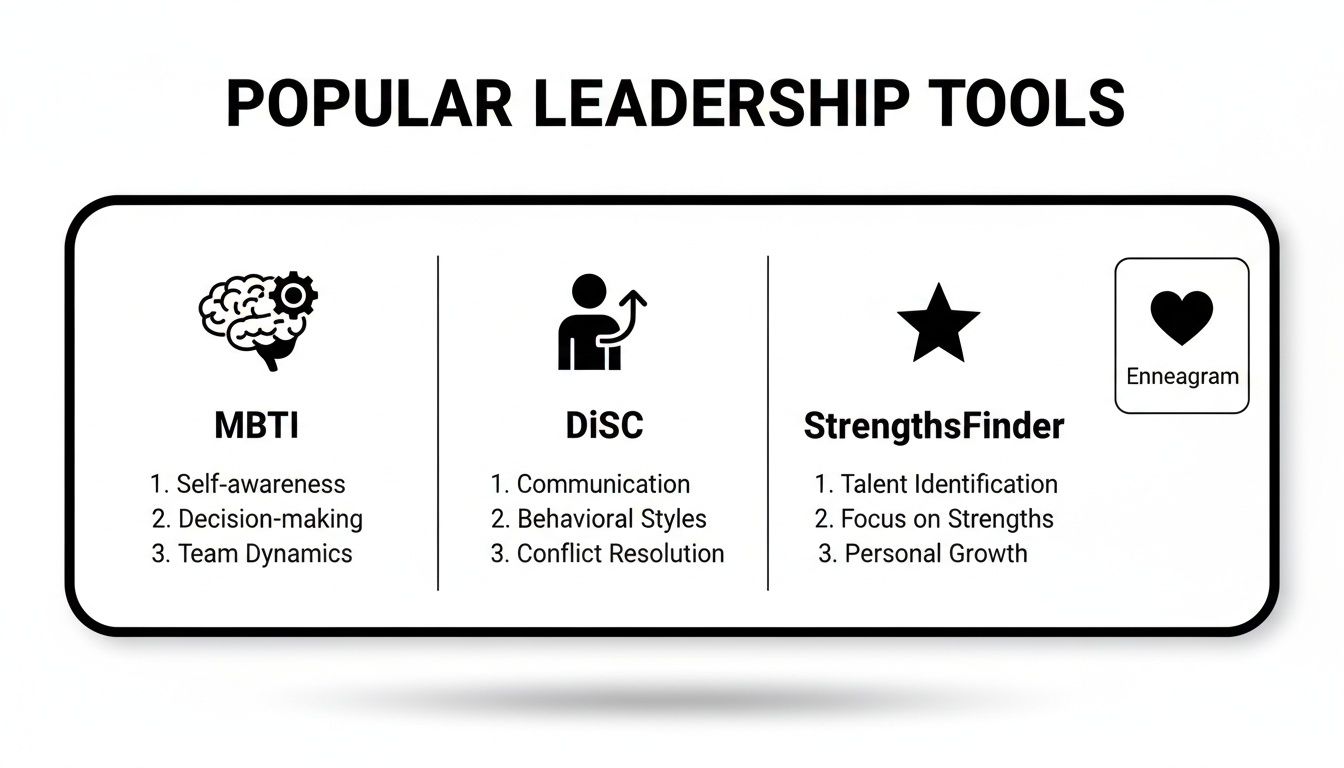
As you can see, each one offers a unique lens—some look at the mechanics of the brain, while others dive straight into the motivations of the heart.
To help you sort through the options, here’s a quick side-by-side look at the heavy hitters.
Leadership Assessment Tools: A Side-By-Side Comparison
This table cuts to the chase, comparing the top tools across the criteria that matter most when you're trying to build better leaders.
| Assessment Tool | Primary Focus | Best For | Key Limitation |
|---|---|---|---|
| DiSC | Observable behavior and communication preferences | Quick communication wins and reducing team friction | Lacks depth on why people behave the way they do |
| StrengthsFinder | Innate talents and areas of natural gifting | Job role alignment and maximizing individual potential | Can overlook blind spots or areas for development |
| MBTI | Cognitive processing and decision-making styles | Understanding intellectual diversity and problem-solving | Can feel rigid; doesn't account for personal growth or stress |
| The Enneagram | Core motivations, fears, and unconscious drivers | Deep personal development and transforming team dynamics | Requires more introspection and skilled facilitation to apply effectively |
Think of this table as your cheat sheet. It’s a great starting point, but the real magic happens when you see how these tools play out in real-life scenarios.
DiSC vs. StrengthsFinder: How Behavior Meets Talent
At first glance, DiSC and CliftonStrengths (formerly StrengthsFinder) look like they're in different weight classes. DiSC is all about observable behaviors —what you can see and hear. StrengthsFinder is about innate talents —the natural gifts someone possesses. In the messy reality of teamwork, these two are constantly intertwined.
DiSC is your go-to for a quick communication tune-up. It provides a simple, shared language for teams to talk about their interaction styles without making it personal. A leader with a high 'D' (Dominance) style is direct and wants to get things done, while their team member with a high 'S' (Steadiness) style craves a predictable, supportive environment. DiSC helps that 'D' leader see the need to slow down and give context, while it helps the 'S' employee understand the leader's focus on results isn't an attack.
StrengthsFinder, on the other hand, zooms out to reveal a person’s raw potential. A leader might have "Achiever" as a top strength, meaning they get a genuine buzz from ticking things off a list. This isn't the same as a 'D' style, which is about exerting control. The Achiever just loves the feeling of completion, no matter their communication style. A practical example: two people might have the "Achiever" strength, but one expresses it with a loud, dominant communication style (high 'D') while the other does so quietly and methodically (high 'C').
MBTI vs. The Enneagram: How Cognition Meets Motivation
The Myers-Briggs Type Indicator (MBTI) and the Enneagram are often lumped together, but they’re looking at personality from opposite ends of the telescope. The MBTI describes how your brain is wired—your preferences for taking in information and making decisions. The Enneagram digs into why you do what you do—your core motivations, fears, and desires that run the show from behind the scenes.
The MBTI is brilliant for mapping out how a team thinks. An INTJ leader, for instance, is probably a strategic, long-range planner who defaults to logic. That tells you how they solve problems. It's an amazing tool for building cognitive diversity and making sure you have both the dreamers and the doers in the room.
But the Enneagram goes deeper. That same leader might be an Enneagram Type 5, "The Investigator." Now you know their strategic thinking isn't just a mental preference; it's driven by a deep-seated fear of being incapable. They hoard knowledge to feel competent and safe. This insight is a game-changer for personal growth. Under pressure, that Type 5 might withdraw and hold information close, a defensive reaction the MBTI alone can’t predict. In practice, this means that during a crisis, team members might see their INTJ leader disappear to "think," when in reality, their Type 5 fear has taken over, causing them to isolate.
While DiSC and MBTI are great at predicting what a person might do, the Enneagram uncovers the fundamental why behind their actions, offering a much deeper and more compassionate path to understanding.
For a more detailed look at how these two powerhouses differ, you can explore our detailed breakdown of the Enneagram vs. MBTI .
And make no mistake, these tools are big business. The global leadership development market, where assessments are a cornerstone, is on track to hit USD 16.2 billion by 2033 . This boom underscores just how vital these insights have become for everything from executive coaching to planning the next generation of leaders.
The Enneagram vs. StrengthsFinder: How Motivation Meets Talent
Now this is a fascinating matchup. Pitting our deepest "why" against our natural "how" reveals so much about our internal wiring. Take an Enneagram Type 3 leader, "The Achiever." Their entire world is driven by a need to feel valuable and worthwhile. They run from failure and chase success to earn the admiration of others.
Let's give this Type 3 leader the "Developer" strength from the StrengthsFinder model. Developers are all about spotting and nurturing the potential in people. Sounds like a perfect combination, right? A success-driven leader who loves to build up their team.
But here’s where it gets interesting.
Imagine it's performance review season. The leader's Type 3 motivation for fast, measurable success starts to clash with their Developer talent. They genuinely want their people to grow (Developer), but they need that growth to show up on the bottom line—and fast (Type 3).
If a team member is struggling, the Type 3’s fear of failure can hijack the conversation. Their feedback might become impatient or hyper-focused on hitting targets, completely overriding the patient, nurturing instinct of their Developer side. You’ll hear things like, "I see your potential, but we need you hitting these numbers by next quarter, or we're going to have a problem."
Unpacking this internal conflict is where true transformation happens. A coach using both tools could help this leader see that their fear is driving the bus. This awareness creates space for them to consciously lean into their Developer strength, offering real mentorship instead of just pressure. The result? More sustainable growth and, ironically, better long-term results.
Choosing Your Tool Based on the Challenge
Look, there’s no silver bullet here. The best tool is the one that solves the problem you actually have.
• Need to reduce team friction and get people talking more effectively, like, yesterday? • • DiSC • is your tool. It’s simple, practical, and delivers immediate results.
• Trying to get the right people in the right seats and tap into their natural genius? • • StrengthsFinder • is the obvious choice. It helps people do what they do best, every single day.
• Want to build a team that can attack problems from every possible angle? • • MBTI • gives you a rich map of different thinking styles, perfect for innovation and strategy.
• Ready to do the deep work of building self-aware leaders and emotionally intelligent teams? • The • Enneagram • is in a class of its own. It gets to the heart of what makes people tick, making it an incredible tool for profound, lasting change.
Ultimately, the sharpest leaders learn to layer these tools. DiSC can fix the "what" of a communication breakdown, but the Enneagram is what heals the "why," creating a team that’s not just effective, but truly resilient and connected.
Putting Assessments to Work: Stories from the Trenches
Comparison charts and theories are great, but let's be real—leadership tools only prove their worth when they solve actual, messy, human problems. It's time to step out of the textbook and into the chaotic, wonderful world of the modern workplace.
These stories show how different assessments can be paired up to tackle the kinds of challenges leaders face every single day. Seeing them in action is the best way to figure out which tool might be the right fit for whatever you're up against.

Scenario One: The Brilliant but Overwhelmed New Manager
Meet Sarah. She's a coding genius who just got promoted to lead a team of developers at a buzzing tech startup. While she can architect a flawless system, she’s finding it impossible to connect with her new reports. Her attempts at motivation fall flat, and team meetings have all the energy of a Monday morning dentist appointment.
The company starts her off with a DiSC assessment to get a handle on communication styles. Sarah quickly sees her own high 'C' (Conscientiousness) style, which loves data and precision, is clashing with team members who are high 'i' (influence) and thrive on freewheeling, collaborative brainstorming. It’s a solid start; she learns to tweak her language to be more engaging.
But the real problem persists. One of her most promising developers—another high 'C' like herself—is completely disengaged and pushes back on every piece of feedback. This is where the Enneagram comes in to peel back another layer.
DiSC tells you what someone is doing, like shutting down in a meeting. The Enneagram shows you why they’re doing it—it gets to the heart of their motivation.
Using an Enneagram assessment, Sarah discovers this developer is a Type 5, "The Investigator." His deepest fear is being incompetent or useless. When Sarah gives him direct, data-driven feedback (a classic 'C' to 'C' move), he doesn't hear a helpful critique. He hears a direct challenge to his core identity. His withdrawal isn't defiance; it's a defense mechanism.
This changes everything for Sarah. She completely flips her script.
• Before: • "Your code has three critical errors. I need them fixed by EOD."
• After: • "I've been wrestling with this problem, and I'm really curious to get your expert take on it. How would you approach solving for X?"
The new framing isn't just softer—it's smarter. It honors his expertise and plays directly to his core desire to be seen as capable and knowledgeable. The tension melts away, and he quickly becomes one of her most valuable and collaborative team members.
Scenario Two: The Project That Ground to a Halt
Now, let's head over to an established marketing agency where a team is staring down the barrel of a major campaign deadline. The project is completely stalled. They’re drowning in creative friction and personality clashes, and the frustration is palpable.
The team lead, David, decides to bring in the big guns, combining two powerful tools: StrengthsFinder and the Enneagram .
First, he uses StrengthsFinder (now CliftonStrengths) to map out the team's raw talent. He finds out his lead graphic designer’s top strength is "Ideation," meaning she’s a powerhouse at dreaming up new concepts. But she’s been stuck executing mind-numbing design tweaks, which is totally draining her creative battery.
At the same time, another team member has "Arranger" as a top strength, making him a natural at logistics and organization. He’s been tasked with high-level creative strategy, which is way outside his sweet spot.
Boom. An easy win. David simply reassigns their tasks to align with their natural gifts. The designer is set free to generate incredible new ideas, while the "Arranger" happily dives into building out project timelines and managing deliverables. The energy in the room shifts almost overnight.
But a deeper interpersonal conflict is still simmering. The brilliant designer (an Enneagram Type 4, "The Individualist" ) feels her unique artistic vision is being steamrolled. The project manager (an Enneagram Type 1, "The Reformer" ) is getting more and more agitated by what he perceives as a chaotic disregard for the project brief.
Using the Enneagram, David gets them talking. It’s a breakthrough.
• The Type 4 suddenly understands that the Type 1’s obsession with rules isn't a personal attack on her creativity; it comes from a deep-seated need for excellence and doing things the "right" way.
• The Type 1 finally sees that the Type 4's need for self-expression is essential to her producing her best work, not just a rebellious whim.
With this new understanding, they build a process that works for both of them. They lock in the non-negotiable project requirements (which satisfies the Type 1) while carving out dedicated time for creative exploration and wild ideas (which fuels the Type 4). The project roars back to life, and the final campaign is both breathtakingly innovative and perfectly executed.
How to Choose and Implement the Right Tool
Picking the right leadership assessment tool feels a lot like being a detective. It's not about finding the one "best" tool on the market, but about finding the one that solves the specific mystery your team is wrestling with. So, before you dive in, grab a coffee and get brutally honest with yourself and your leadership team.
Start by asking the big questions. Are you just trying to smooth out some day-to-day communication snags and make meetings less painful? Or are you playing the long game, aiming for deep personal development and building real emotional intelligence? Your answer will immediately point you toward completely different types of tools.
Next, you have to get real about your resources. What's your budget? More importantly, how much time and energy can you actually commit to this? A quick, behavior-focused tool like DiSC is relatively low-lift. But something that digs into core motivations, like the Enneagram, really sings when you have a professional debrief and ongoing conversations.
A Step-By-Step Guide to Implementation
Once you've made your choice, the real work begins. Just rolling out an assessment without a plan is like handing someone a map with no destination—it might be interesting for a minute, but it's ultimately useless. A great implementation creates lasting change, not just a one-off "aha!" moment.
Here’s a simple framework that works:
The goal of any assessment isn't to put people in a box. It’s to give them a toolkit to understand the box they've already put themselves in—and show them how to work from a place of more freedom and awareness.
Weaving Insights into Daily Routines
The single biggest mistake leaders make is treating the assessment like a one-and-done event. To make these insights stick, you have to weave them into the fabric of your team’s culture. This is where the magic really happens.
This could be as simple as starting a weekly meeting with a quick check-in using the language of your tool. Think, "As a Type 9, I’m making a point to voice my opinion earlier today." It could also mean restructuring your feedback process to honor different motivational drivers. For instance, knowing you have a team member driven by achievement (Enneagram 3), you might offer public praise for a job well done, whereas for someone motivated by security (Enneagram 6), you might provide private reassurance about their value to the team.
By 2026, these tools are at the heart of leadership trends, with AI-powered analytics offering personalized insights that sharpen decision-making. Behavioral assessments, in particular, have fueled a 10% annual industry expansion by directly improving metrics like succession planning and employee engagement. Enneagram Universe is a perfect example of this evolution, providing tailored reports that spark deep, meaningful team analysis. You can discover more insights about leadership trends on sganalytics.com .
For more practical advice on making these tools a part of your daily operations, it’s worth checking out various insights from industry blogs . The key is continuous application. When the language of self-awareness becomes part of your team's everyday vocabulary, you’ve graduated from a simple assessment to building a truly conscious, high-performing culture.
Got Questions About Leadership Assessments? Let's Clear the Air.
Even after seeing all the benefits laid out, I get it. Stepping into the world of leadership assessments can feel like you're about to open a Pandora's box of corporate jargon and awkward team-building exercises. It's totally normal to have questions and a healthy dose of skepticism.
So, let's tackle the big ones I hear all the time. My goal is to help you move past the uncertainty and feel genuinely confident about this.
"Are These Things Even Accurate?"
This is always the first question, and it's a good one. How reliable are these assessments, really ?
The honest answer is: it completely depends on the tool and the person taking it. Some are fluff, but high-quality, scientifically-backed instruments like the Enneagram can be shockingly insightful. That's because they aren't measuring your mood today; they're digging into the deep, consistent patterns that drive why you do what you do.
But let's be clear: no assessment is a crystal ball. Think of it as a brilliantly detailed map, not a rigid set of directions. It’s the starting point for a conversation, not the final verdict on who someone is or what they're capable of.
"Can I Use This to Hire People?"
This is a minefield. It's so tempting to think you can use a personality tool to find the "perfect" candidate, but it's almost always a terrible idea. Using assessments like the Enneagram or MBTI as a hiring filter is a fast track to creating a team of clones and screening out brilliant people who just don't fit a preconceived mold.
So where do they fit? They are absolute gold for onboarding and team integration. Imagine knowing from day one what motivates your new hire, how they handle stress, and the best way to give them feedback. For example, if a new hire's assessment shows they are a DiSC 'S' type who values stability, you can make sure their first week includes a clear, structured schedule and introductions to key team members to help them feel secure. You can slash their ramp-up time and help them build real connections with their new teammates almost immediately.
The smartest way to use leadership assessments isn't to screen people out. It's to bring them in more thoughtfully and set them up to win from the very beginning.
"How Do I Get My Team on Board Without Them Rolling Their Eyes?"
Ah, yes. The collective groan when you announce, "We're all going to take a personality test!" If you've thought it, I guarantee your team has. Getting genuine buy-in is everything, and it all comes down to how you roll it out.
Here’s the game plan that actually works:
• Frame It as a Tool, Not a Test: • Make it painfully clear this is for • development • , not evaluation. Say it out loud: "This has nothing to do with your performance review. This is for us to get better at working together."
• You Go First: • Take the assessment yourself and share your results. Be open about your own type—the good, the bad, and the ugly. When you show that kind of vulnerability, you signal that it's a safe space for everyone.
• Answer the "What's In It For Me?" Question: • Don't talk about corporate synergy. Talk about what they actually care about: fewer frustrating meetings, easier collaboration on projects, and a clearer path for their own career growth. When they see how it helps • them • personally, the eye-rolls stop.
By getting out ahead of these questions, you can strip away the mystery and show your team what this process is really about: becoming a smarter, more connected, and way more effective group of people.
Ready to see what’s really driving you and your team? Discover your core leadership motivations with the Enneagram Universe assessment. Start your journey toward smarter, more human leadership today at Enneagram Universe .