Which Leadership Personality Test Best Fits Your Style?

Ever feel like you're just winging it as a leader? You're not alone. We often lead based on gut feelings and old habits, which can feel like trying to navigate a maze in the dark. A leadership personality test is like someone handing you a flashlight and a map.
It's a strategic tool that gets under the hood to see your internal operating system—what drives you, how you communicate, and what you do when the pressure is on. It’s less about a label and more about a blueprint for why you lead the way you do.
What Exactly Is a Leadership Personality Test?

Think of a symphony conductor who has no idea what each instrument does. The result would be pure chaos, right? A leadership personality test is like your personal conductor's score. It shows you what instrument you naturally play and how you contribute to the team's overall harmony (or occasional cacophony).
This isn't about boxing you into a rigid category. It's a powerful way to get honest about your natural tendencies at work. It illuminates the hidden strengths that give you an edge and, just as importantly, the potential derailers that might be holding you back without you even realizing it. For example, a marketing director in Chicago might realize her natural inclination for big-picture thinking means she often overlooks critical details in campaign execution. A test reveals this pattern, allowing her to partner with a detail-oriented project manager, turning a potential weakness into a team strength.
The Foundation of Intentional Leadership
Without this kind of self-awareness, most of us are accidental leaders. We react to situations, often confused why one approach gets a standing ovation while another falls completely flat. A solid personality framework gives you the language and insight to start leading with intention.
For example, a leader might learn their natural sense of urgency makes them rush decisions, accidentally steamrolling valuable input from the team. Once they see that pattern, they can consciously build in pauses for collaboration. That's how a potential weakness becomes a structured, intentional strength.
This process peels back the layers to reveal:
• Your Core Motivations: • What actually gets you out of bed in the morning?
• Communication Style: • How you prefer to share and absorb information.
• Stress Responses: • Your go-to behavior when things get heated.
• Decision-Making Patterns: • Are you a data-driven analyst, a gut-feel intuitive, or a collaborative consensus-builder?
A leadership personality test doesn't change who you are; it illuminates who you are so you can lead more effectively. It’s the difference between navigating in the dark and having a detailed map of your internal landscape.
A Validated Approach to Growth
These aren't your average online quizzes. The best leadership assessments are built on decades of psychometric research to ensure they're both reliable and genuinely insightful. Some of these frameworks have deep roots, with validation studies confirming strong links to well-established psychological tools.
For instance, a 2022 analysis of 22,877 professionals found that specific personality profiles consistently excelled in different leadership roles—from empathetic mentorship to high-stakes, decisive action. You can read the full research on these leadership personality findings.
Ultimately, taking a leadership personality test is the first real step in your journey from being an accidental manager to becoming a deliberate, self-aware, and truly effective leader.
Comparing The Top Leadership Assessment Frameworks
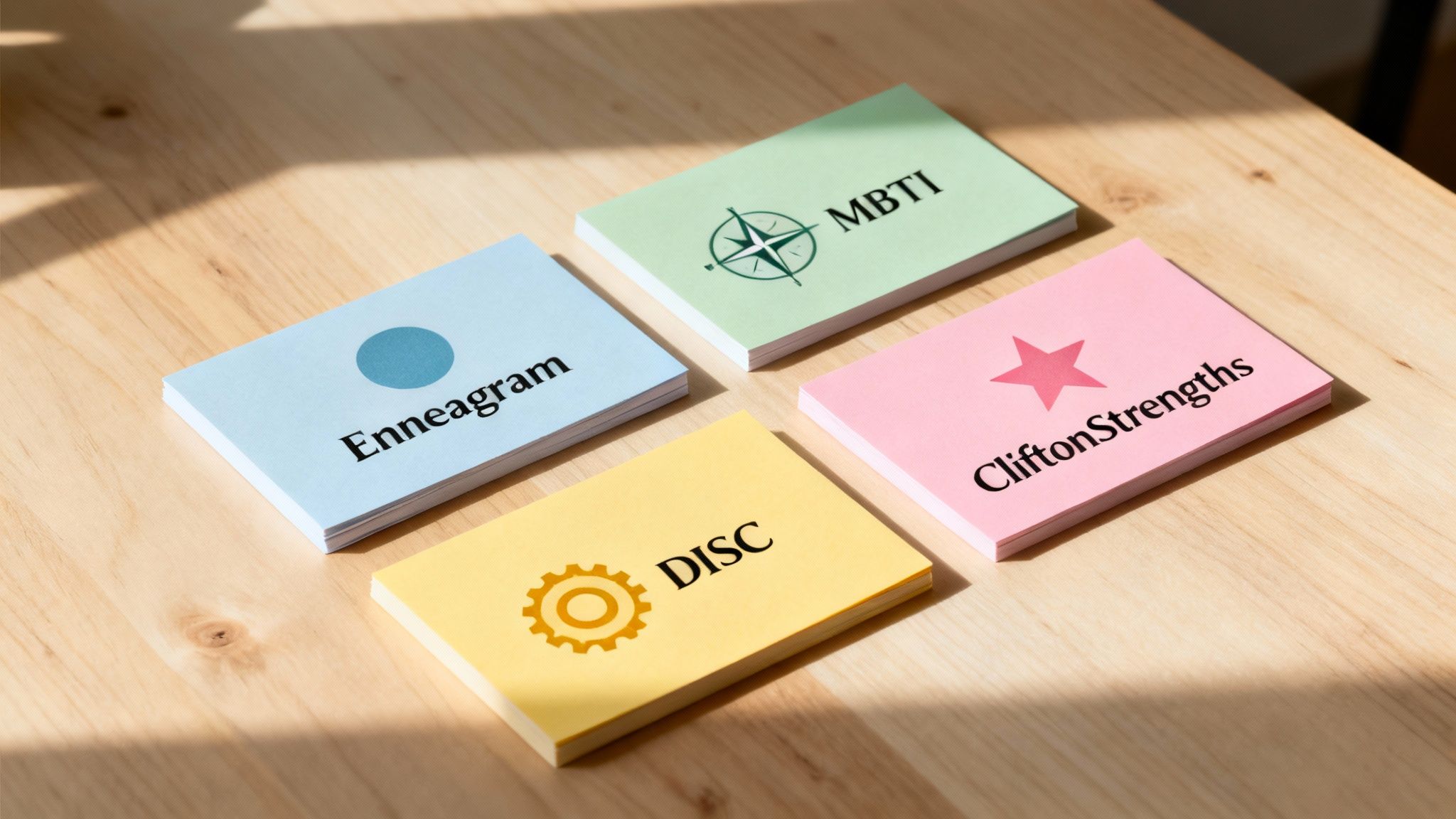
So, you’re ready to find a leadership personality test that actually works for you. Fantastic. But you'll quickly notice a few big names keep popping up. Think of them like different diagnostic tools in a mechanic's garage. One tool reads your engine's horsepower, another checks the electrical system, and a third analyzes fuel efficiency. All are valuable, but they're measuring completely different things.
Let's pop the hood on the four most common frameworks—Enneagram, Myers-Briggs Type Indicator (MBTI), DiSC, and CliftonStrengths—to see what they really tell you about yourself and your leadership. Each offers a unique lens, and picking the right one can give you a serious strategic edge.
The Enneagram: Digging into Your “Why”
The Enneagram is the ultimate "why" specialist. Forget surface-level behaviors for a moment. This tool gets right to the heart of the matter, uncovering the subconscious motivations—those deep-seated fears and desires—that are secretly running the show. It tells you why you do what you do, especially when the pressure is on.
• What it measures: • Your fundamental worldview and the inner engine that powers your decisions, conflicts, and path to growth.
• Practical example: • An Enneagram Type • 8 • leader, like a tough but fair plant manager in Detroit, is driven by a powerful desire to protect their people and stay in control. When a supply chain crisis hits, they're the one making the decisive call without flinching, because that core motivation empowers them to take charge when everyone else is frozen.
The Enneagram Universe platform offers a scientifically validated assessment designed to pinpoint your type with incredible accuracy.
The Myers-Briggs Type Indicator (MBTI): Mapping Your Preferences
The MBTI is all about your preferred ways of being and doing. It creates a map of how you naturally gain energy, process information, make decisions, and organize your outer world. The result is a four-letter code that acts as a handy cognitive shorthand.
A quick heads-up: The MBTI identifies preferences , not permanent, unshakeable traits. A leader might prefer Introversion ( I ), but they can absolutely learn to crush a keynote speech when the situation calls for it.
• What it measures: • Your natural leanings across four pairs—Introversion/Extraversion, Sensing/Intuition, Thinking/Feeling, and Judging/Perceiving.
• Practical example: • An • ENFJ • hospital administrator in Houston has a superpower for sensing team morale, thanks to their Extraverted Feeling. They can walk into a department, feel the burnout from a tough week, and rally the group with an inspiring speech that connects with everyone on an emotional level. For a deeper dive, check out our comparison of the • Enneagram vs. MBTI • .
DiSC: Understanding Your Observable Behaviors
If you want a simple, memorable snapshot of how you come across at work, DiSC is your go-to. It focuses squarely on your observable behaviors, making it incredibly practical for smoothing out team communication and dialing down conflict.
• What it measures: • Your tendencies toward • D • ominance, • i • nfluence, • S • teadiness, and • C • onscientiousness.
• Practical example: • A tech lead in Silicon Valley with a high " • C • " (Conscientiousness) style is the person who ensures a software release plan is airtight and bug-free before launch. Their team relies on them for that rock-solid accuracy and quality control.
CliftonStrengths: Unleashing Your Innate Talents
Formerly known as StrengthsFinder, this assessment flips the script. Instead of dwelling on weaknesses, it shines a spotlight on what you do best. It identifies your top innate talents from a pool of 34 and encourages you to build your entire leadership style around them. It's all about playing to your strengths.
• What it measures: • Your naturally recurring patterns of thought, feeling, and behavior that can be used to your advantage.
• Practical example: • A startup founder in Austin whose top strength is " • Futuristic • " is a master at painting a vivid, compelling picture of where the company is headed for investors and new hires. They keep their team inspired by constantly connecting today’s coding sprints to a brilliant long-term vision.
Why The Enneagram Unlocks Deeper Leadership Insights
Look, plenty of personality tests are great at telling you what you do. They'll peg you as organized, decisive, or maybe a "big-picture" thinker. And that's useful, sure. But the Enneagram digs deeper. It's the only mainstream framework built from the ground up to reveal why you do what you do.
That single distinction—the shift from behavior to motivation—is the secret sauce. It’s what separates a neat little label from a genuine, actionable roadmap for your leadership journey.
Beyond Behavior to Core Motivation
Think of it this way: other assessments might describe the car you're driving, but the Enneagram pops the hood to show you the engine. It gets right to the core fears and desires that secretly steer your decisions, often in ways you haven't even noticed yourself.
Its real power is in its structure. It introduces brilliant concepts like the Centers of Intelligence , also known as the Triads , which explain your default operating system for processing the world.
• The Gut Triad (Types 8, 9, 1): • Leaders here run on instinct. They’re driven by a deep need for control and justice, filtering everything through a lens of what feels viscerally right or wrong. For example, a Type 9 school principal in Ohio instinctively seeks consensus among teachers before implementing a new policy.
• The Heart Triad (Types 2, 3, 4): • These leaders are wired for connection. Their primary drivers are feelings and the need for validation, so they interpret situations based on how they affect relationships and their own sense of worth. A Type 2 non-profit director in Atlanta will always prioritize a donor's emotional connection to the cause.
• The Head Triad (Types 5, 6, 7): • It's all about analysis for these leaders. Motivated by a need for security and certainty, they respond to just about everything with logic, foresight, and a whole lot of contingency planning. A Type 6 financial advisor in Boston will create multiple market scenarios to prepare a client for any possibility.
Figuring out your dominant Triad is like discovering whether your internal GPS defaults to your gut, your heart, or your head. It’s a game-changing insight that explains so much about how you show up, especially under pressure.
A Dynamic Path for Leadership Growth
Here’s another thing that sets the Enneagram apart: it’s not static. It uses a concept called Health Levels , which explains why two leaders of the same type can look completely different. One might be operating from a place of incredible self-awareness and strength, while the other is stuck in reactive, unhealthy patterns.
This gives you a clear path forward. The framework doesn't just label you; it shows you exactly what your healthiest, most effective self looks like and shines a big, bright spotlight on the blind spots that trip you up when stress hits.
A leadership personality test should do more than just describe you; it should guide you. The Enneagram provides a clear, personalized path from unconscious patterns to conscious, effective leadership.
Let's imagine a classic American CEO. She's an Enneagram Type 3 (The Achiever) , driven by a core desire to be valuable and worthwhile. In the beginning, she was all about the external wins: the awards, the glowing press, the soaring stock price. And it worked, for a while. But her team felt like cogs in a machine, and turnover was through the roof.
After discovering her Enneagram type, a lightbulb went on. She finally understood that her relentless chase for validation was completely overshadowing her team's need for real connection. So, she made a conscious pivot. She shifted her focus from looking successful to being a leader of true substance. She started celebrating team wins, sharing her own vulnerabilities, and building a culture that people actually wanted to be a part of. Morale and innovation skyrocketed.
That’s the strategic power of knowing your 'why.' You can dive deeper into these kinds of applications in our guide on the Enneagram for business leaders .
You might think one or two types would dominate the business world, but the data says otherwise. In a massive dataset of 189,957 results, the distribution is surprisingly balanced. This just proves how valuable a mix of motivational drivers is for any organization. In fact, studies have shown that teams blending driven Type 3s with security-focused Type 6s see 25% higher project success rates because their motivations complement each other so well. You can see more fascinating data in the Enneagram's population distribution here .
Turning Your Test Results Into Actionable Strategies
So, you've taken the test. That big reveal moment is exciting, but let’s be real: an assessment is only as good as what you do with it. The real work begins now, turning those fascinating insights into tangible, day-to-day improvements in how you lead.
First thing’s first: you have to approach this with the right mindset. When you sit down for an assessment like the one from Enneagram Universe, radical honesty is required . There are no "right" answers, only your answers. This isn’t a test you can pass or fail. Think of it more like a mirror reflecting what makes you tick.
Interpreting Your Leadership Blueprint
Once you get your results, you'll see more than just a number or a label. You’ll get a detailed dashboard breaking down your dominant type, your wing, and the core motivations driving you. This isn't just a fun fact about yourself—it's your personal leadership blueprint. It reveals the "why" behind your actions, connecting your gut reactions to your dominant Center of Intelligence.
This is what we're talking about—getting to the very core of your "why" by understanding how you process the world through your Head, Heart, or Gut.
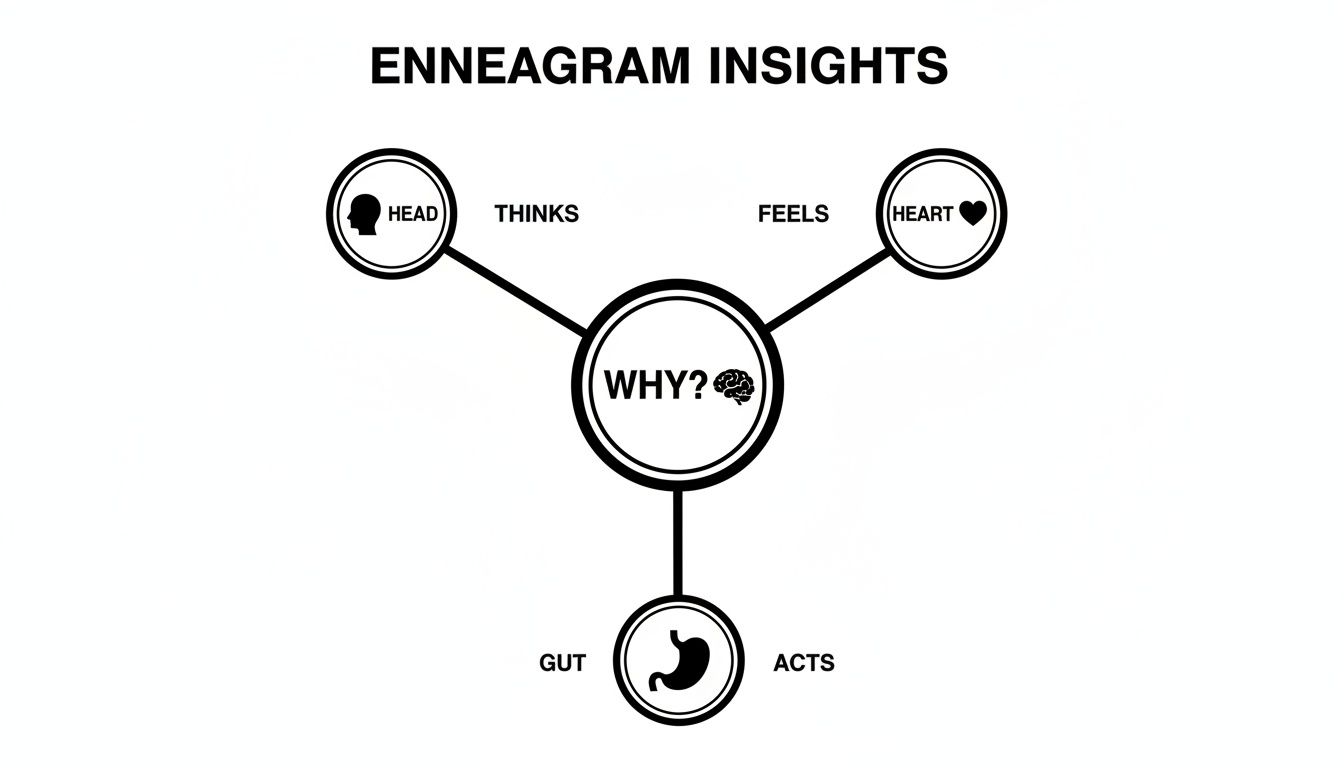
It shows that your motivations aren't random at all. They spring from how you're wired to think, feel, and act.
Now, here’s the biggest trap leaders fall into: using their type as a get-out-of-jail-free card. Saying, "Well, I'm a Type 8, so of course I'm blunt," completely misses the point. The real power comes from turning that awareness into action: "As a Type 8, I know my directness can steamroll people. I'm going to make a conscious effort to pause and invite other opinions before I make the final call." See the difference?
A Practical Example: The Type 1 Reformer
Let’s make this real. Imagine your results show you're an Enneagram Type 1, The Reformer . Your core desire is to be good, to have integrity, to make things right. This drive gives you an incredible work ethic and an eagle eye for quality. Fantastic. But it also means you have a relentless inner critic screaming in your ear, which can make something like delegation feel downright impossible.
So, what do you do? Here are a few actionable strategies for a Type 1 leader:
• Talk Back to the Inner Critic: • The moment you hear that voice saying, "It's faster if I just do it myself," recognize it for what it is—a Type 1 pattern. Reframe it immediately: "Delegating this is an investment in my team's growth and my own sanity."
• Define "Good Enough": • Your perfectionism is a superpower, but it can also be kryptonite, stalling progress indefinitely. For any new project, sit down with your team and define, in no uncertain terms, what "done" and "successful" actually look like. This creates a clear finish line and stops you from tweaking things into oblivion.
• Empower Through Genuine Trust: • Give a project to a team member and then... let go. Give them full ownership, including the freedom to make mistakes. You have to accept that their process won't be your process, and that's okay. Focus on the final outcome, not on micromanaging every single step.
This is the whole game: shifting from being run by your automatic patterns to consciously choosing your actions. By understanding your internal wiring, you can stop being a passenger in your own career and start steering your leadership journey with real purpose.
If you want to dig deeper into this, check out our guide on the personality test for business leaders .
Using Personality Insights To Build An Unstoppable Team

A leader's real impact isn't just about their solo performance; it’s about their ability to make the entire orchestra play in harmony. Once you’ve got a handle on your own leadership personality, the real magic begins when you apply that same lens to your team. This is where individual insights combine to create a powerful, collaborative force.
Using a leadership personality test across your team isn't about slapping labels on people. It's about learning to speak everyone’s unique motivational language. When you know what genuinely drives each person, you can put them in roles that light them up, deliver feedback that actually lands, and build a culture of real respect and understanding.
This awareness can transform a group of people working side-by-side into a cohesive, high-performing unit that trusts and "gets" one another on a much deeper level.
A Real-World Team Building Scenario
Let's see how this actually plays out. Imagine a project manager, Sarah, is leading a high-stakes product launch in New York City. Her core team is a classic mix of talent, each with a distinct Enneagram type:
• David, the Type 4 (The Individualist): • He’s the creative genius from Brooklyn, driven by a need to express his unique vision and build something meaningful.
• Maria, the Type 1 (The Reformer): • She is the quality control expert from Queens, motivated by an unshakable desire to do things the • right • way and uphold high standards.
• Ben, the Type 6 (The Loyalist): • He’s the pragmatic risk-assessor from the Bronx, always thinking three steps ahead to anticipate problems and ensure the team is secure.
Without these insights, Sarah might see David as overly sensitive, Maria as a rigid perfectionist, and Ben as a worrier who’s always pointing out what could go wrong. But with the Enneagram, she sees their core motivations—and that changes everything.
Putting Insights Into Action
Armed with this knowledge, Sarah maps out her strategy. She knows exactly how to get the best from her team while sidestepping potential blow-ups before they even start.
An effective leader doesn't try to change their team's personalities. Instead, they learn to orchestrate those personalities, ensuring every instrument contributes its unique and essential sound to the final performance.
Here’s how Sarah puts her team’s strengths to work:
Understanding these dynamics is key. Globally, while Enneagram Type 9 (the Peacemaker) is the most common at 16.2% , making them natural team stabilizers, the rarest types like the Type 5 (the Investigator) at just 4.8% bring critical, out-of-the-box thinking. Smart leaders who blend these varied types—like the 12% of the population who are Type 6s for their rock-solid loyalty—can see up to 25% better team cohesion . This approach is how you turn a group of talented individuals into a truly unstoppable force. Learn more about how Enneagram types correlate with team dynamics .
Let's Get Growing: Putting Your Results to Work
Getting your leadership personality test results isn't the final chapter—it's page one. Think of it as being handed a detailed, personalized map to your own leadership potential. Now, you get to explore the terrain.
The real magic happens when you start connecting the dots. It’s about finally understanding why you do what you do, leaning into the strengths that come naturally, and having the guts to look your blind spots straight in the eye. This isn't just self-help fluff; it's the bedrock of leading with purpose.
Your Game Plan for Growth
So, you've got this shiny new report. Don't just let it sit in your downloads folder! It's time to make it work for you.
• Find a Sparring Partner: • Grab a mentor, a coach, or even a trusted peer and walk them through your results. For instance, a tech CEO in San Francisco could review her results with her executive coach to identify how her Type 8 tendencies might intimidate her engineers during brainstorming sessions.
• Bring the Team In: • This stuff is gold for team dynamics. Run a workshop where everyone shares their type (voluntarily, of course). Watching the "aha!" moments happen as people understand their colleagues better is priceless for building empathy and teamwork.
• Pick One Thing: • Don’t try to boil the ocean. Look at your results and choose • one • specific, measurable goal to tackle this quarter. Maybe it's being a better listener in meetings or delegating one task you always hoard. Start small, win big.
To keep the momentum going, digging into the essential leadership skills for managers is a fantastic next step to build on what you've learned.
Frequently Asked Questions
Still got a few questions rattling around in your head? Perfect. Let's tackle some of the most common things people wonder about before they jump into a leadership personality test.
Are Leadership Personality Tests Actually Accurate?
Look, it's a fair question. We've all taken those silly online quizzes that tell you which type of bread you are. But here's the deal: many modern, serious assessments are built on some heavy-duty psychometric research.
Reputable tools, like the one we've built at Enneagram Universe, use carefully validated questions and sophisticated scoring to make sure the results are both reliable and consistent. They're designed to pinpoint the stable patterns in what drives you and how you act, giving you a surprisingly accurate snapshot of your leadership tendencies.
The trick is to stick with a scientifically-backed assessment and steer clear of the "Which Disney Villain Are You?"-style quizzes. That's how you get insights you can actually count on.
Can My Leadership Personality Type Change?
Short answer: not really. Your core personality—the deep-seated "why" behind what you do, as defined by frameworks like the Enneagram—is generally considered pretty stable throughout your life. But here's the good news: your behavior and effectiveness as a leader can change dramatically.
The whole point of these tests isn't to fundamentally change who you are. It’s about becoming the healthiest, most self-aware, and most effective version of your natural type. Growth means expanding your range and learning new skills, not trying to get a new label.
If you're serious about this, you'll need to know how to build a leadership development framework that actually works for you and your team.
How Do I Introduce These Tests To My Team?
This is a big one. The key is to frame it as a tool for connection and collaboration, not for judgment or putting people in boxes. Seriously, make it crystal clear that this is about understanding each other better, not about performance reviews.
Lead from the front. Take the test first, then openly share what you learned—including the messy, vulnerable parts. This shows it's a safe exercise. For example, a manager could say, "My Type 7 results showed I sometimes avoid tough conversations. I need your help holding me accountable to that."
Make it a totally voluntary group activity focused on collective growth. Once people get their results, steer the conversation toward improving team dynamics and figuring out how you can all support each other more effectively.
Ready to finally uncover the "why" behind your leadership style? The Enneagram Universe assessment is your first step toward deeper self-awareness and intentional growth. Take our free, scientifically validated test today .