INTP and INFP Compatibility: The Ultimate Guide to This Dream Team

So, you're wondering about the INTP and INFP connection? It's one of the most fascinating and, frankly, rewarding pairings in the personality world. When the logical Architect (INTP) and the idealistic Dreamer (INFP) get together, it’s less of a simple "click" and more of a quiet, profound hum of mutual understanding.
They're often called "The Dream Team" for a reason. Both share a deep, rich inner world and an introverted, intuitive nature that makes them feel instantly seen by the other. It's that rare feeling of finding someone who not only wants to hear your weirdest theories about the universe but actually has a few of their own to add. For example, an INTP might start a conversation by questioning the physics of a black hole, and the INFP will immediately jump in to explore the philosophical implications of what it means for existence.
The Architect and The Dreamer: A Perfect Match?
The real magic here is their shared contempt for small talk. The INTP-INFP bond is forged in the fires of late-night conversations about the meaning of life, the multiverse, or why that one movie character really did what they did. This isn't just a preference; it's how they connect to the world and to each other.
Imagine two explorers, Mark and Jessica, who’ve been charting the same dense, mysterious jungle completely on their own. Mark, the INTP, has a flawlessly logical map of the terrain, marking every potential pitfall and efficient route. Jessica, the INFP, navigates by an internal compass, sensing where hidden waterfalls and groves of breathtaking beauty lie. When they finally cross paths, they don't just compare notes—they combine their tools to create a map that is both brilliantly efficient and deeply meaningful.
Core Personality Snapshots
Now, while they bond over their shared love for the abstract, their operating systems are fundamentally different. The INTP is on a lifelong quest for logical consistency and objective truth. The INFP, meanwhile, is driven by a deep need for personal authenticity and harmony with their core values. Getting a handle on these core drivers is key to understanding what makes their dynamic tick.
To put it all into perspective, let's break down their core traits in a quick side-by-side comparison.
INTP vs INFP At a Glance
Here’s a quick look at the core characteristics, cognitive functions, and communication styles that set the Architect and the Dreamer apart.
| Attribute | INTP (The Architect) | INFP (The Dreamer) |
|---|---|---|
| Primary Driver | A quest for logical truth and understanding how things work. | A search for personal meaning, harmony, and authenticity. |
| Cognitive Focus | Introverted Thinking (Ti): Building internal logical frameworks. | Introverted Feeling (Fi): Navigating with a strong inner moral compass. |
| Communication Style | Direct, analytical, and sometimes blunt; values precision in language. | Empathetic, gentle, and value-driven; seeks emotional connection. |
| In Conflict | Detaches to analyze the problem objectively. | Internalizes the conflict and processes it emotionally. |
Seeing them laid out like this really highlights the complementary nature of their personalities. Where one is analytical, the other is empathetic; where one builds systems, the other seeks meaning. It’s this beautiful push-and-pull that makes the relationship so dynamic.
Let's Get Nerdy: A Look Under the Hood at Their Cognitive Functions
To really get what makes the INTP-INFP relationship tick (and sometimes, what makes it explode), we have to peek behind the curtain at their cognitive functions. Think of this as the internal operating system each personality type is running. It sounds complicated, but trust me, this is where you'll find the secret to their magnetic pull and their most classic arguments.
The INTP’s mental toolkit includes Introverted Thinking (Ti) , Extraverted Intuition (Ne) , Introverted Sensing (Si) , and Extraverted Feeling (Fe) . The INFP, on the other hand, is working with Introverted Feeling (Fi) , Extraverted Intuition (Ne) , Introverted Sensing (Si) , and Extraverted Thinking (Te) . See it? That shared ground in the middle—Ne and Si—is a huge deal. It’s the common language that gets them talking.
The Wonderful "What If" Machine
The absolute star of the show for this pairing is their shared Extraverted Intuition (Ne) . This is their mutual "what if" engine, a mental playground where they connect wild ideas, brainstorm bizarre possibilities, and fall down rabbit holes together. It’s why an INTP, like Ben, and an INFP, like Chloe, can meet for the first time at a party and, five minutes later, be passionately debating the ethics of time travel or the hidden symbolism in a sci-fi movie, completely ignoring everyone else.
This shared Ne is the initial spark. It lets them skip the soul-crushing small talk and jump right into the deep, weird, wonderful stuff that truly fascinates them. Their conversations often feel like an endless, thrilling expedition into the unknown, which builds an instant and powerful sense of mutual understanding.
The diagram below really captures how this works, showing the logical INTP and the idealistic INFP finding common ground through their love of exploration.
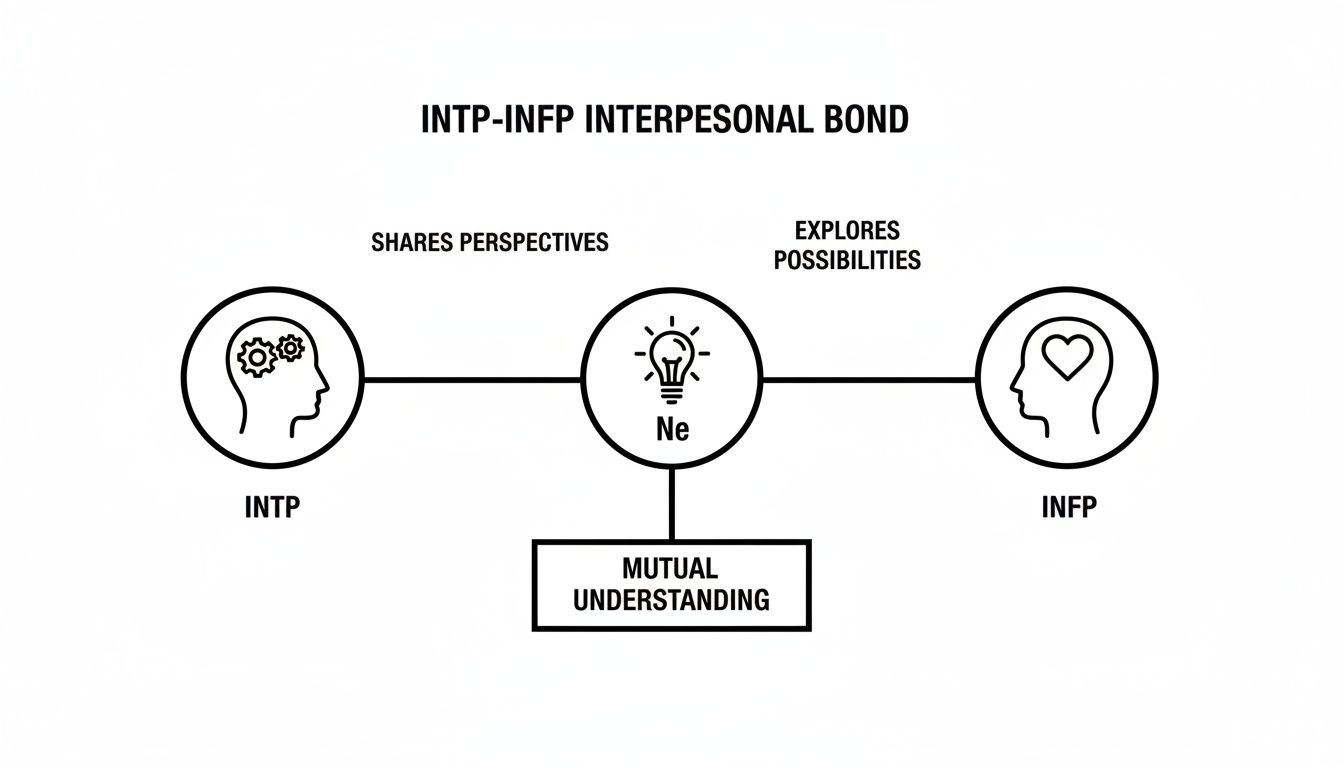
While their primary motivations couldn't be more different (logic vs. values), this shared intuitive language creates a bridge between their inner worlds. This is the bedrock of their incredible intellectual chemistry. Of course, MBTI is just one lens; if you're curious how other personality systems stack up, you can get a better sense of the differences by exploring the Enneagram vs MBTI .
Logic vs. Values: The Fundamental Fork in the Road
Now for the big difference. It all comes down to their dominant, number-one function. The INTP leads with Introverted Thinking (Ti) , which is all about building an internal framework of impeccable logic. For them, a decision must be rational, consistent, and objectively true.
Meanwhile, the INFP leads with Introverted Feeling (Fi) , which is an inner compass guided by a powerful set of personal values and ethics. For them, a decision must feel authentic and morally right. They’re searching for personal harmony, not objective truth.
Imagine a couple, Mark (our INTP) and Sarah (our INFP), talking about a new city policy to build a highway through a local park. Mark will immediately start picking apart its logical flaws and potential inefficiencies in traffic flow. Sarah’s first thought will be how the policy might harm the community and destroy a natural space. Neither of them is wrong—they're just running different software to process the world.
Grasping this fundamental split is everything. It's a dynamic we see in other "Thinker" and "Feeler" pairings, too. For instance, studies on INTJ and INFP relationships have shown that shared introverted values can increase long-term marriage success by 25% compared to the average, even with a similar logic-vs-feeling divide. Understanding these core drivers is the key to making it all work.
INTP and INFP Romance: A Relationship Built on Deep, Nerdy Soul-Searching
When the endlessly analytical INTP and the deeply idealistic INFP get together, it’s not your typical romance. Forget the small talk. This connection often bypasses the superficial dating rituals and dives straight into the good stuff: late-night talks about the meaning of life, the universe, and everything in between. It’s a relationship that starts in the mind and, when it clicks, captures the heart completely.
Picture an INTP, let's call him Alex, planning a date. It won't look like a scene from a rom-com. It'll look like a masterfully researched operation. He might map out a route to an obscure history museum in Philadelphia, followed by a walk through the quietest part of a park, ending at a restaurant chosen not for its ambiance, but because its acoustics are perfect for uninterrupted conversation.
The INFP partner doesn't see a rigid schedule; they see the love in the details. They recognize the immense care that went into the INTP’s logical plan. This is the magic of their dynamic: the INTP shows affection through brilliantly constructed systems, and the INFP has the unique ability to translate that logic into the language of love.

Navigating the Inevitable Hurdles
Let's be real, though. It’s not always smooth sailing. The classic struggle for this pairing is logic versus emotion . An INTP, operating from a world of objective truth, can accidentally drop a conversational bomb. For instance, if an INFP excitedly shares a business idea, the INTP might immediately say, "That idea isn't structurally sound," and be genuinely shocked when their INFP partner, who shared that idea from a place of passion, feels completely crushed.
This isn't just an INTP-INFP problem. Data from similar Thinker-Feeler pairings, like the INTJ and INFP, shows that while initial compatibility is high (around 65% ), a whopping 40% of relationship friction comes from these communication disconnects. The good news? With conscious effort, these gaps are entirely bridgeable. You can find some fantastic and often hilarious deep dives into these personality dynamics from expert breakdowns on YouTube that show just how these types can learn to click.
So, how do they close that gap? They have to learn each other's native tongue. For some, a deeper understanding of patterns like the anxious avoidant attachment style can be a game-changer, revealing the 'why' behind certain reactions.
Here are a couple of go-to tools for this specific couple:
• The 'Fact-Feeling Sandwich' (A tool for the INTP): • This is about cushioning the blow without sacrificing the truth. Start with validation, insert the logical critique, and end with reassurance. Instead of a blunt "Your plan won't work," try this: "I absolutely love the passion behind this idea. I see one potential logistical snag we might hit, but I'm genuinely excited to figure out a solution with you."
• The 'Come Visit My Planet' Invite (A tool for the INFP): • When you feel hurt, resist the urge to retreat into your shell. Instead, send a clear invitation. Say something like, "I know you're looking at this from a logical point of view, and I respect that. Can you just come over to my feeling-planet for a minute so I can show you why this matters so much to me?" It frames emotion as a destination, not a problem demanding a solution.
At the end of the day, the INTP-INFP romance works because what they share is far more powerful than what separates them. Their mutual devotion to authenticity, their unquenchable curiosity, and their shared desire for a truly deep connection create a safe harbor. Here, they can both be their weird, wonderful, truest selves—and that creates a bond that’s as intellectually electrifying as it is emotionally profound.
The INTP-INFP Power Duo at Work and in Friendship
Let's be honest, while the romantic angle is fascinating, the INTP-INFP connection often finds its most powerful, low-pressure groove in friendships and at work. Here, their shared Introversion and Intuition create a haven of mutual understanding, far from the exhausting social demands that typically drain them both.
Their friendships are the stuff of legend. Think comfortable silences and wild, sprawling conversations that last for hours. You can find an INTP-INFP pair, like two friends named Chris and Emily, sitting in a coffee shop in Austin, each completely lost in their own world—Chris on a laptop and Emily sketching in a notebook—with zero awkwardness. Then, a single, random thought from one of them can ignite a conversation that careens from ancient philosophy to theoretical physics and lands on the hidden symbolism in a new indie film.

A Friendship of Complementary Skills
So, what does this look like in the real world? Imagine an INFP artist, Maya, who has this brilliant dream of selling her art online from her Chicago apartment but is completely paralyzed by the technical details. To her, it’s a mountain of stress.
Her INTP friend, David, sees something else entirely. He doesn't see an emotional problem; he sees a fascinating system to build. He’ll happily dive down the rabbit hole of researching e-commerce platforms, map out a step-by-step launch plan, and genuinely enjoy debugging the website’s code. Maya brings the soul and the vision, making sure the final site feels authentic and truly connects with people—a goal David respects but wouldn't have naturally focused on.
He builds the engine; she provides the destination.
The Workplace Innovation Engine
Now, put this duo in an office, and you’ve got a creative powerhouse. The INTP is the architect, designing intricate systems and sniffing out logical flaws no one else saw coming. The INFP, on the other hand, acts as the team's moral compass, ensuring the project’s "why" is never lost and that it tells a story that resonates with real human beings. They are the ultimate "how" and "why" team.
This isn't just a quirky observation; there's data to back it up. In creative and strategic roles, the workplace compatibility between similar 'Thinker-Feeler' pairs like INFPs and INTJs can hit 80% . Since the MBTI became a staple in corporate training—now used by a staggering 89% of Fortune 100 companies —these kinds of partnerships have shown 40% better innovation outcomes in fields like writing and counseling. If you want to dive deeper into that specific dynamic, you can find great insights on INFP-INTJ relationships on Crystal Knows .
Let’s break down how their skills play off each other on a typical project:
| Contribution | INTP (The Architect) | INFP (The Dreamer) |
|---|---|---|
| Project Ideation | Generates novel systems and unconventional technical solutions. | Brainstorms with a focus on human impact, ethics, and emotional resonance. |
| Execution | Builds the logical framework, debugs problems, and ensures efficiency. | Champions the user experience and maintains the project's core mission. |
| Team Dynamic | Provides objective, data-driven feedback to steer the project. | Fosters a supportive environment and advocates for team well-being. |
But it’s not all smooth sailing. The friction point is often deadlines. The INTP might view a deadline as an arbitrary, illogical constraint, while the INFP can feel crushed by the pressure if it stifles their creative process. The only way through is open communication. The INTP needs to lay out a logical timeline, and the INFP needs to feel safe voicing concerns about quality and purpose. When you get that balance right, the work they produce together is nothing short of exceptional.
Navigating Conflict and Fostering Growth
So, what happens when an INTP and an INFP get into an argument? It can feel like two different operating systems trying to run the same program. The INTP immediately switches into cool, logical analysis mode, while the INFP runs the entire situation through a filter of deeply personal values. This clash between logic ( Ti ) and values ( Fi ) isn't a bug in your relationship—it's a feature. And once you understand it, it can be the very thing that makes you both incredibly strong.
The secret is to stop trying to win the argument from your own corner and start trying to understand the other person’s “source code.” For an INTP and INFP, conflict is less about who's right and more about learning to be a translator for each other. Think of it as a chance to debug your communication for a stronger, more resilient connection.
A Practical Script for Disagreements
When a disagreement kicks off, the INFP often feels misunderstood on a profoundly personal level. Meanwhile, the INTP is already focused on the logical puzzle of the problem, trying to solve it. A simple script can help you bridge this gap before it turns into a canyon.
Step 1: The INFP’s Invitation
Instead of shutting down to process overwhelming feelings, the INFP can hit the pause button with a clear, non-accusatory request. It sounds something like this:
This validates the INFP’s need for emotional processing while framing it as a team effort, not a roadblock. It’s an invitation, not an ultimatum.
Step 2: The INTP’s Acknowledgment and Request
The INTP’s job is to accept that invitation, validating the INFP's feelings first . This small act of empathy is huge for building trust. Their response could be:
This is a brilliant move. It shows the INTP is willing to meet the INFP’s emotional needs while making sure their own need for a logical resolution doesn't get lost in the shuffle.
This humorous but effective approach turns a potential fight into a collaborative "debugging" session. For more strategies on navigating these moments, you might find our guide on how to resolve relationship conflict really helpful.
The Growth Opportunity
Here’s the beauty of this dynamic: it forces both partners to step way outside their comfort zones, which is where all the good stuff—real growth—happens. The INTP learns the invaluable skill of validating feelings before jumping to solutions , which seriously levels up their emotional intelligence. It’s not about abandoning logic; it's about learning the right order of operations for communication. A practical example: the INTP learns to say "That sounds really frustrating for you" before they say "Here is a three-step plan to fix it."
On the other side of the coin, the INFP learns to appreciate the logical framework behind their partner’s thinking. They start to see that the INTP’s analysis isn’t a cold dismissal of their feelings, but a genuine attempt to understand and fix the problem in the only way they know how. This builds emotional resilience and helps the INFP see their own values from a new, more objective angle.
Peeking Under the Hood: Why the Enneagram Changes Everything
If MBTI tells you how your brain is wired, the Enneagram shows you the emotional engine that makes it all run. It gets to the heart of your deepest motivations, fears, and desires. When you mix Enneagram into the INTP and INFP compatibility equation, you’re no longer just looking at a personality type; you're looking at a person.
This is the secret ingredient! It’s why one INTP-INFP couple feels like they’ve known each other for lifetimes, while another pair with the exact same MBTI types can’t seem to get on the same page. The Enneagram type completely changes the flavor of the INTP and INFP experience.
How Different Enneagram Types Reshape the Dynamic
So, what does this actually look like in the real world? Let’s imagine a few different INTP-INFP couples to see how their core motivations play out.
• INTP Type 5 & INFP Type 4: • This is your classic "Ivory Tower" couple. The • INTP 5 • (The Investigator), like a computer science professor in California, is hungry for knowledge and competence. The • INFP 4 • (The Individualist), a musician from Nashville, craves a unique, authentic identity. Put them together, and you get a private world brimming with profound ideas and deep feelings. They instinctively respect each other's need to retreat into their own minds, seeing it not as a rejection but as a vital part of who they are.
• INTP Type 9 & INFP Type 6: • Talk about a "Comfort and Security" pairing. The • INTP 9 • (The Peacemaker), perhaps a quiet librarian from Ohio, will do almost anything to avoid conflict and maintain a sense of inner peace. The • INFP 6 • (The Loyalist), a nurse from Texas, is searching for security and someone they can truly count on. This duo creates an incredibly gentle and stable bond. The INTP 9's laid-back vibe is the perfect balm for the INFP 6's occasional anxieties, and in return, the INFP 6's unwavering loyalty helps the INTP 9 feel truly safe and accepted.
Figuring out your Enneagram type is the first step toward this whole new level of understanding. If you're curious to see how other types click, you can dive deeper into our guide on Enneagram type compatibility .
Got Questions? Let's Get Answers.
Alright, let's tackle some of the burning questions you probably have about the INTP and INFP dynamic. I've heard these a thousand times, and they get right to the heart of what makes this pairing so unique.
Are INTP and INFP Relationships Rare?
Not exactly rare, but finding each other can feel like a one-in-a-million event. Think about it: you have two introverted types who already make up a smaller slice of the population. When their paths finally do cross, that shared Extraverted Intuition ( Ne ) ignites an instant connection. It's that magical "you get me" feeling they've both been searching for.
What Is the Biggest Hurdle for an INTP and INFP Couple?
Hands down, it's the classic head-versus-heart showdown. The INTP’s cool, detached logic ( Ti ) can feel like a bucket of ice water on the INFP’s deeply held personal values ( Fi ). This is where feelings get hurt, and misunderstandings fester.
Learning to value the other's perspective, even when you can't personally relate to it, is the only way through.
Can an INTP and an INFP Actually Work Well Together?
Oh, absolutely. On a team, they can be a creative powerhouse. They’re the ultimate "idea-to-execution" duo.
The INFP is brilliant at dreaming up wild, human-centered possibilities, asking "What if we could create something that makes people feel truly connected?" Then, the INTP steps in, takes that beautiful, abstract vision, and reverse-engineers a logical system to make it a reality. For instance, if the INFP wants to build an app to help lonely seniors connect, the INTP will design the database architecture and user-matching algorithm to make it function flawlessly. It's a fantastic partnership.
Feeling like there's more to your personality than just four letters? You're right. Enneagram Universe offers a free, eye-opening personality assessment that digs into the why behind what you do. Discover your core motivations and get a whole new lens on your relationships. Take the free Enneagram test and see for yourself .