INTJ and Relationships: A Guide to the Mastermind's Heart

Most advice about INTJ and relationships gets one thing wrong. It assumes INTJs need to become warmer, softer, and more visibly emotional to love well. That’s lazy advice.
An INTJ usually doesn’t love badly because they think too much. They love awkwardly because their feelings travel through a maze before reaching daylight. If you mistake that pause for indifference, you’ll miss one of the most loyal, deliberate, and subtly romantic personalities in the MBTI world.
The stereotype says “cold genius.” Real life is messier and more interesting. Many INTJs are very sensitive, fiercely private, and surprisingly tuned in to relationship systems. They often care so much that they start optimizing the bond like it’s a shared startup, a ten-year plan, and a sacred mission all at once. Charming? Sometimes. Intense? Frequently. Confusing to a more expressive partner? Absolutely.
If you’re an INTJ, or you love one, the trick isn’t forcing a fake personality transplant. It’s learning how the INTJ mind palace works, especially the parts hidden behind the steel door marked “I’m fine.”
The INTJ Relationship Blueprint: A Quest for a Mindmate
INTJs rarely fall in love just because the vibes are nice and the person has good lighting. They’re looking for structure, substance, and long-term fit. While many people date to explore chemistry, INTJs often date to answer a quieter question: Can we build a life that makes sense together?
That’s why the usual “just go with your heart” advice can feel absurd to them. For an INTJ, the heart is invited. It just has to pass security.

The Architect’s Mindset in Love
A useful metaphor is this: an INTJ approaches relationships like a life architect . They don’t want random additions slapped onto the building. They want a design that holds up in bad weather, supports growth, and won’t collapse because nobody checked the foundation. That can make them seem slow to commit. But slowness isn’t a lack of interest. It’s quality control.
Research summarized by MyPersonality’s INTJ compatibility guide notes that INTJs often view love as a strategic obligation rather than a purely emotional pursuit, with delayed commitments but strong devotion once they choose a partner. The same guide says top matches like ENFP and INTJ are often placed in 83-99% chemistry rankings .
What INTJs want isn’t endless romance theater. It’s a mindmate .
What “Mindmate” Really Means
A mindmate isn’t just someone smart. Plenty of smart people bore INTJs in under six minutes.
A mindmate usually has a mix of traits like these:
• Intellectual stamina • . They can follow abstract conversations without glazing over halfway through a theory about human motivation, city design, or why everyone misuses the word “authentic.”
• Emotional steadiness • . They don’t force instant vulnerability on demand.
• Competence • . They handle life well enough that the INTJ doesn’t feel drafted into permanent repair duty.
• Independence • . They have a strong inner life and don’t confuse space with rejection.
Here’s a plain example. A partner says, “I made us a playlist because it reminds me of us.” Sweet. The INTJ appreciates it. But the INTJ may feel even more bonded when that same partner says, “I noticed your workload pattern, and I think we can redesign our week so you get real recovery time.” That lands like poetry with better logistics.
Why Superficial Dating Feels Painful to INTJs
Small talk isn’t evil. INTJs know society runs on it. But too much of it feels like being trapped in an airport gift shop when you came to discuss civilization. They usually want a connection that has weight. Shared ideas. Shared standards. Shared direction. If they sense that a relationship will stay performative, chaotic, or emotionally loud without depth, they often step back fast.
That’s also why many INTJs stay single longer than people expect. They aren’t waiting for perfection. They’re waiting for resonance. And once they find it, they’re not casual. They might not write sonnets on a napkin, but they’ll remember your goals, solve practical problems, protect your time, and stay loyal in a way that feels less like fireworks and more like reinforced steel.
The Mastermind in Love: Strengths and Common Challenges
Dating an INTJ can feel like having a partner who is part strategist, part bodyguard, part human search engine. It can also feel like dating someone who answers your emotional distress with a troubleshooting memo. Both experiences can be true.
TraitLab’s interpersonal model describes INTJs as Assured-Dominant and Cold-Aggressive , combining high assertiveness with analytical detachment. In warmth-seeking pairings, that style can create 40-60% higher conflict rates , especially when a partner reads logic-first responses as neglect, according to TraitLab’s INTJ relationship analysis .
The Strengths People Fall For
INTJs bring a rare kind of steadiness to relationships. Not the bubbly, reassuring kind. The kind that says, “I’ve thought about this, I’m staying, and I’ll help us make it better.”
A few strengths show up over and over:
| Strength | What it looks like in daily life |
|---|---|
| Loyalty | They don’t bond lightly, but once they do, they protect the relationship seriously. |
| Problem-solving | When life gets messy, they often get clearer. Bills, logistics, plans, crises. They engage. |
| Foresight | They think ahead about housing, careers, routines, and long-term compatibility. |
| Honesty | They usually prefer uncomfortable truth over soothing nonsense. |
That honesty is underrated. An INTJ often won’t play games, manufacture jealousy, or create drama for attention. If they’re in, they tend to mean it.
The Challenges That Confuse Partners
Now the other side of the sword. An INTJ may care intensely and still look unimpressed, preoccupied, or emotionally hard to read. They can walk into a room wearing their neutral face and accidentally project “I’ve evaluated this entire household and found it inefficient.”
Three friction points show up often:
• Emotion arrives filtered. • They usually process first and express later.
• Space is indispensable. • They need solitude the way some people need background music.
• Fixing can replace comforting. • A partner says, “I had a terrible day,” and the INTJ says, “You should stop saying yes to that coworker.” Useful, yes. Cuddly, not always.
Their calm face isn’t always distant. Sometimes it’s active concentration with poor marketing.
Why Does One Trait Look Like Two Different People
The same trait that makes INTJs capable partners can make them hard partners. Take assertiveness. It helps them set boundaries, make decisions, and lead during uncertainty. But in a tender moment, that same directness can land like a courtroom cross-examination. Take detachment. It helps them stay calm and objective. But if their partner wants warmth before analysis, detachment can feel like standing outside in socks.
A common real-life scene looks like this:
• One partner says, “I need you to tell me I matter.”
• The INTJ hears, “There’s instability in the relationship system.”
• So they offer evidence, plans, and solutions.
• The partner wanted softness first.
Nobody’s evil. They’re just speaking different dialects of care.
A More Accurate Expectation
If you’re with an INTJ, don’t expect constant visible emotion. Expect consistency, competence, and depth , then learn how to request warmth in ways they find useful. If you are an INTJ, don’t assume your loyalty is always obvious. It may be radiant in your head and nearly invisible on the outside. Your partner can’t grade the exam you never turned in.
How to Communicate and Connect with an INTJ
Communication with an INTJ works best when it’s clean, direct, and grounded in reality. Not cold. Just clear. If you lead with accusation, dramatic vagueness, or emotional booby traps, the INTJ usually won’t melt into closeness. They’ll go into analysis mode, defense mode, or quiet mode. Sometimes all three at once, like a very elegant panic room.

Use Direct Language, Not Emotional Smoke Signals
Many INTJs respond well when you make your point specific. They don’t need robotic communication. They need communication that they can work with.
Compare these two approaches:
| Less effective | More effective |
|---|---|
| “You never care about my feelings.” | “When I told you I was upset and you switched to solutions immediately, I felt alone.” |
| “Why are you being weird?” | “You’ve been quieter than usual this week. Are you stressed, upset, or just overloaded?” |
| “You should just know what I need.” | “I need reassurance first, then solutions.” |
That doesn’t mean INTJs only understand spreadsheets with legs. It means clarity lowers defensiveness. If your communication style tends to spiral, borrowing a few structured habits helps. A guide on improving relationship communication can give you extra language for those moments when both people mean well and still miss each other by a mile.
Don’t Poke The Porcupine When They’re Overloaded
One of the biggest blind spots in discussions about INTJ and relationships is hidden sensitivity.
A 2018 study found that 20-30% of INTJs self-identify as Highly Sensitive Persons , which helps explain why some INTJs react strongly to sensory overload, such as strong scents or loud noises, as discussed in Introvert, Dear’s piece on INTJs in love . That matters in relationships because overload often looks like irritability, retreat, or bluntness.
In plain English, your INTJ may not be “overreacting to nothing.” They may be trying to think while the TV is blaring, the kitchen smells like ten competing candles, and you’ve asked a deep emotional question right after a chaotic family event.
A Simple Communication Decoder
When an INTJ is receptive, these moves usually help:
A practical example:
• Instead of: “I feel like you always disappear when things get real.”
• Try: “When conflict starts, you go quiet. I know that may help you think, but I experience it as distance. Can we agree on a check-in phrase before you take space?”
That kind of sentence is catnip for healthy INTJs. It respects reality and creates a plan.
Talk to Their Sensitivity Without Making it a Shame Issue
This part matters. INTJs often hate feeling fragile. So if your partner gets overloaded, skip lines like “Why are you so sensitive?” or “You’re making a big deal out of nothing.” That pushes them further behind the wall. Try language that preserves dignity:
• “You seem overloaded. Want quiet first, then conversation?”
• “Is this an emotional issue, a sensory issue, or both?”
• “Would it help if we changed the environment before we keep talking?”
Later in the conversation, this video offers another lens on INTJ emotional logic and timing:
What INTJs Can Do on Their Side?
INTJs don’t get a free pass to become mysterious weather patterns.
If you’re the INTJ, try these upgrades:
• Signal your state early • . “I’m not angry. I’m overloaded and need twenty minutes.”
• Translate your care • . “I’m offering solutions because I care, but I can listen first.”
• Name your sensory triggers • . Noise, clutter, interruptions, crowded schedules. Your partner can’t adapt to secrets.
• Practice reassurance in plain language • . Not a thesis. One sentence works. “I’m with you.” “I care about this.” “We’re okay, I just need time to think.”
That last one has saved many relationships from unnecessary detective work.
Navigating Conflict and the INTJ's Inner World
Conflict with an INTJ often looks strange if you expect instant emotional processing. You bring up a hurt. They go quiet. Their face becomes unreadable. You wonder whether they’ve left the chat, the relationship, or possibly the planet. Usually, they’re still there. They’re just inside.
Why Do They Withdraw During Conflict
For many INTJs, withdrawal isn’t punishment. It’s an analysis. They want to know what happened, why it happened, what pattern it belongs to, and what response won’t make things worse. That can be maddening for a partner who wants immediate repair. But the silence often means the INTJ is trying not to react carelessly.
A better approach is to distinguish between space and abandonment . If an INTJ can say, “I need time, and I will come back,” conflict becomes far less frightening. If they vanish with no signal, their partner often fills in the blanks with worst-case theories.
If you need concrete methods for those moments, this guide on how to resolve relationship conflict offers practical ways to keep disagreements from turning into cold wars.
The Hidden Engine Called Strategic Empathy
INTJs often “lead from the back” in relationships. They influence the mood, the structure, the timing, and even the decision flow without making a speech about it. That can look suspicious if you don’t understand the motive.
Data discussed in MBTI Fiction’s analysis of INTJs says INTJs score 25% higher in “strategic empathy” than average introverts , which helps explain why they can read people with subtlety and steer situations with precision.
That doesn’t automatically mean manipulation. More often, it means the INTJ has spotted a pattern and is trying to improve the system from the shadows, like a relationship stage manager who forgot to mention they joined the production.
How to Respond Without Feeling Managed
If your INTJ partner subtly shapes things, don’t jump straight to “You’re controlling.” Get curious first. Try questions like:
• “What outcome were you hoping for there?”
• “Did you change course because you saw a problem coming?”
• “Can you let me in on the strategy instead of running it unilaterally?”
That last line is gold. It respects their foresight while insisting on partnership. If you’re the INTJ, the relational upgrade is simple but not easy. Narrate more. Your partner shouldn’t need a decoder ring to understand your intentions.
For example, instead of subtly steering every family plan to reduce chaos, say: “I’m trying to keep the weekend from becoming overwhelming for both of us. Here’s the pattern I’m seeing.” Now the same behavior feels collaborative, not covert.
INTJ Relationship Compatibility With MBTI and Enneagram
People search for compatibility content because they want certainty. Personality systems can help, but they’re better as maps than verdicts.
Still, patterns matter. INTJs tend to do best with partners who appreciate depth, independence, and future-oriented thinking. They often struggle more when a partner wants frequent emotional display, a highly social connection, or a very concrete, routine-first style without much appetite for abstraction.
The Strongest MBTI patterns
Research summarized by Personality Data’s INTJ relationship page reports an 86% compatibility rate with fellow INTJs , and places INTJ-ENTJ at 83% . That “like-minds” pattern makes sense. INTJs often relax with partners who understand strategy, autonomy, and long-range thinking without needing a translation service.
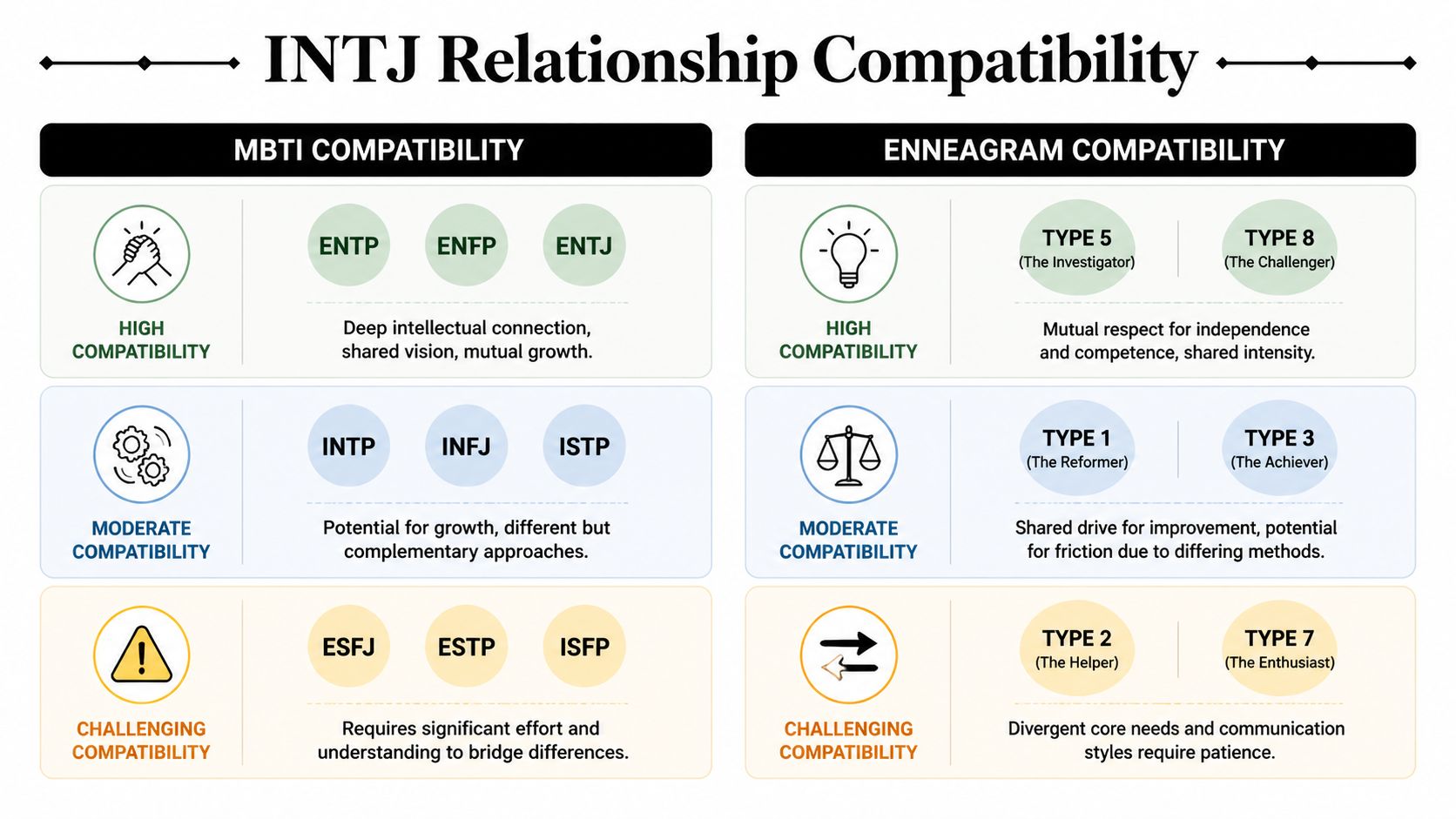
Here’s the practical version:
| Tier | Likely dynamic | Types often discussed |
|---|---|---|
| High compatibility | Shared intuition, strong ideas, growth-oriented bond | ENTP, ENFP, ENTJ, INTJ |
| Moderate compatibility | Good potential with effort and translation | INTP, INFJ, ISTP |
| More challenging | Different priorities around emotion, pace, and communication | ESFJ, ESTP, ISFP |
Why do intuitive types often work well? Because they usually enjoy abstraction, future thinking, and conceptual conversation. INTJs feel seen when someone can meet them in that territory.
Why can some sensing pairings feel harder? Because both people may value different kinds of evidence, different rhythms, and different definitions of quality time. That doesn’t doom the match. It just means more translation work.
The Enneagram Layer Changes The Picture
Here, compatibility gets more interesting.
MBTI tells you a lot about how someone processes the world. The Enneagram tells you more about why they do what they do. If you’ve ever wondered why two INTJs can feel wildly different in love, this is often the missing piece.
A deeper comparison of Enneagram vs MBTI helps clarify why one INTJ may seem more guarded and cerebral while another feels more forceful or perfectionistic.
Common relationship flavors for INTJs often include:
• Type 5 themes • . Privacy, independence, depth, competence, and a need to conserve energy.
• Type 1 themes • . High standards, restraint, and frustration when things feel sloppy or irrational.
• Type 8 themes • . Protectiveness, intensity, directness, dislike of vulnerability without trust.
• Type 3 themes • . Goal focus, performance awareness, and a stronger drive toward visible achievement.
A Simple Way to Combine Both Systems
Think of MBTI as the vehicle and Enneagram as the driver motivation .
An INTJ with a Five-ish pattern may withdraw because they feel invaded or depleted. An INTJ with an Eight-ish pattern may push harder and get more confrontational. An INTJ with One-ish traits may become critical under stress because they want things corrected. Same basic type. Different relational atmosphere.
Compatibility isn’t just “Who matches my letters?” It’s “Whose motives, pace, and emotional style can I respect for a long time?” That question is far more useful than chasing a mythical perfect pair.
The Ultimate Guide for Loving an INTJ
Loving an INTJ gets much easier when you stop trying to turn them into a more decorative extrovert. They don’t need to become fluffier. They need a relationship where their depth, privacy, and odd blend of steel and sensitivity can breathe.

Do This More Often
If you want to trust an INTJ, focus on behaviors that read as real.
• Respect their solitude without dramatizing it. • Give space, but keep the connection intact. “Take your hour. Let’s check in after dinner.” That works better than “Fine, disappear then.”
• Appreciate substance, not just sweetness. • Many INTJs light up when you notice competence, insight, or integrity. “You saw that problem before anyone else did” may land better than a generic compliment.
• Be a sounding board for ideas. • Let them test their thoughts out loud. You don’t have to agree with every theory about urban planning, nutrition, or why three meetings could’ve been one email. Engagement matters.
• Ask for romance in concrete ways. • Don’t hope they’ll magically intuit your preferred style. Say, “I’d love a planned date this week,” or “Can you send me one affectionate text during the workday?”
Don’t Make These Mistakes
A lot of relationship friction comes from preventable habits.
| Mistake | Better move |
|---|---|
| Taking their need for space as rejection | Treat it as recovery unless behavior shows otherwise |
| Forcing emotional immediacy | Ask for a return time and continue later |
| Responding to bluntness with more drama | Slow down and restate the issue clearly |
| Assuming they don’t care because they aren’t gushy | Look at consistency, effort, and follow-through |
How to Encourage Their Hidden Romantic Side
INTJs often have a romantic streak, but it tends to wear practical shoes. They may express love by fixing your laptop, remembering an offhand goal you mentioned months ago, or building a better routine around your stress points. If you want more tenderness on the surface, appreciation helps more than criticism.
For example, if your INTJ plans a thoughtful evening but forgets to say anything overtly sentimental, don’t swat the effort away with “You’re still not emotional enough.” Try: “I loved how intentional that was. It made me feel cared for.” That gives them a usable map.
What Thriving With an INTJ Actually Looks Like
A strong relationship with an INTJ often has these qualities:
• Clear agreements
• Mutual respect
• Intellectual companionship
• Room for privacy
• Low tolerance for games
• A growing ability to name feelings without drowning in them
That last point matters most. The happiest INTJ relationships aren’t the ones where the INTJ becomes a different species. They’re the ones where both people learn to translate love into forms the other can recognize.
Frequently Asked Questions About INTJ Relationships
How do I know if an INTJ secretly likes me?
Look for steady investment, not flashy flirting. An INTJ who likes you often gives time, attention, thoughtful questions, practical help, and access to their ideas. If they keep inviting you into their inner world, that usually means something.
Do INTJs get over breakups?
Yes, but often slowly and privately. They may look composed long before they feel resolved. Because they analyze patterns thoroughly, they can revisit a relationship in their mind for a long time, especially if it ended without clarity.
Why did my INTJ partner suddenly go quiet and distant?
The most common reasons are overload, unresolved hurt, or a need to process before speaking. Quiet doesn’t always mean loss of love. It can mean they don’t trust themselves to respond well yet. The best move is calm clarity: ask what’s happening, ask when they can talk, and avoid chasing them with panic.
Can an INTJ have a successful relationship with a very emotional person?
Yes, if both people are mature and willing to translate. The emotional partner has to communicate clearly instead of expecting mind-reading. The INTJ has to offer reassurance and warmth before jumping into solutions. Different styles can work well when neither person treats the other’s wiring as a defect.
Are INTJs manipulative in relationships?
They can be strategic, which isn’t the same thing. Many INTJs try to improve systems discreetly and may steer situations without announcing it. Healthy INTJs learn to explain their reasoning so their partner feels included, not managed.
If you want to understand your relationship patterns at a deeper level, Enneagram Universe is a smart next step. Their assessment helps you explore the motives underneath your personality style, so you can communicate better, spot recurring conflict patterns, and build relationships with more self-awareness and less guesswork.