Inner-Child-Healing-Exercises: 7 Powerful Ways to Reconnect and Heal in 2026

Remember what it felt like to be a kid? The unfiltered joy, the boundless curiosity, the sting of scraped knees? That version of you, your inner child, is still a huge part of who you are today. Sometimes, though, that inner kid is carrying around some heavy baggage from the past, influencing our adult reactions, relationships, and self-worth in ways we don't even realize. The good news? It's never too late to go back and offer the comfort, validation, and love that were needed.
This isn't about blaming the past; it's about empowering your present. Think of it as becoming the wise, caring adult your younger self always needed. By engaging in targeted inner child healing exercises , you can soothe old wounds and reclaim the spontaneity and joy that are rightfully yours.
We're about to dive into seven powerful and distinct practices, each a unique key to unlock a different aspect of your healing journey. Forget vague advice. We're giving you actionable, step-by-step guides for everything from letter writing and visualization to somatic work and playful reconnection. Get ready to meet, understand, and finally heal the most vulnerable part of you.
1. Inner Child Meditation and Visualization
Imagine having a direct line to your younger self, a chance to be the caring, protective adult you needed back then. That’s the magic of inner child meditation and visualization, one of the most powerful and direct inner child healing exercises available. This practice involves creating a safe mental space where you can meet, listen to, and comfort the little you that still lives inside.
Popularized by luminaries like John Bradshaw and Dr. Margaret Paul, this technique is more than just a daydream. It's an active process of reparenting yourself by offering the love, validation, and security that may have been missing. By visualizing this connection, you begin to repair old emotional wounds, calm deep-seated anxieties, and build a foundation of self-compassion.

How to Get Started
Embarking on this journey is simpler than it sounds. The goal is to create a nurturing dialogue, not to confront trauma head-on immediately.
Key Insight: This practice works because your brain often doesn’t distinguish between vivid imagination and reality. By consistently visualizing a safe and loving connection, you are literally rewiring neural pathways associated with your childhood experiences.
A 35-year-old woman, for example, used daily visualizations to heal from childhood neglect, reporting significantly decreased anxiety and stronger relationships after just six months. The key is consistency and gentleness. This exercise is perfect for anyone looking to build self-love, understand the root of their emotional triggers, or offer themselves the comfort they have always deserved.
2. Letter Writing to Your Inner Child
What if you could send a message back in time, delivering the exact words of comfort and validation your younger self desperately needed to hear? Letter writing is one of the most profound inner child healing exercises because it creates a tangible, focused dialogue between your past and present. This practice involves writing letters from your wise, compassionate adult self to the little you who still holds onto old hurts and fears.
Pioneered by therapists like Dr. Lucia Capacchione and championed by modern healers like Dr. Nicole LePera, this technique is a powerful form of reparenting. By putting pen to paper, you give voice to unspoken emotions and offer the reassurance that may have been absent. This isn't just journaling; it's an active exchange that rewrites your internal narrative, replacing self-criticism with profound self-compassion and understanding.

How to Get Started
The beauty of this exercise lies in its simplicity and emotional depth. The goal is to build a bridge of communication and offer unwavering support to your younger self.
Key Insight: Using your non-dominant hand to write as your inner child can bypass the critical, analytical parts of your brain. This technique, advocated by Dr. Lucia Capacchione, taps into the right hemisphere, which is more connected to emotion, creativity, and subconscious feelings, allowing for a more authentic and surprising dialogue.
For example, therapy programs for adult children of alcoholics frequently use letter writing, with participants often reporting breakthrough moments of self-forgiveness. This exercise is ideal for anyone seeking to process specific memories, validate past emotions, and build a stronger, more loving relationship with themselves.
3. Inner Child Play Therapy and Reconnection
What if the secret to adult healing was simply learning how to play again? That's the core idea behind inner child play therapy, a joyful and deeply effective practice among inner child healing exercises. This isn't about forced fun; it's about intentionally engaging in the activities your younger self craved or missed out on, reconnecting with the pure, unadulterated joy that is your birthright.
Pioneered by figures like Virginia Axline and championed in modern wellness by researchers like Brené Brown, play is recognized as a fundamental human need. For adults, it’s a powerful tool to dismantle the rigidity and seriousness that often come with responsibility. By allowing yourself to swing on a swing, build with Legos, or simply color outside the lines, you give your inner child a voice and heal the parts of you that were told to "grow up" too soon.

How to Get Started
Unlocking your playful side is about permission, not performance. The goal is to experience joy and spontaneity, freeing yourself from the pressure of a specific outcome.
Key Insight: Play rewires the brain for creativity, joy, and resilience. When you engage in unstructured play, you activate neural pathways associated with pleasure and spontaneity, directly countering the brain's stress and threat responses that may have been overdeveloped since childhood.
A 42-year-old executive, for instance, began dedicating one hour each Sunday to building with Legos. He reported a significant reduction in chronic anxiety and a noticeable boost in creative problem-solving at work. This exercise is perfect for anyone feeling stuck, creatively blocked, or disconnected from joy, offering a direct path back to their most authentic, spontaneous self.
4. Reparenting Affirmations and Mirror Work
What if you could become the loving, encouraging parent your younger self always craved? That’s the core of reparenting affirmations and mirror work, a deeply transformative practice that involves looking yourself in the eye and speaking the words your inner child desperately needed to hear. It’s about replacing old, critical inner monologues with messages of unwavering love, safety, and acceptance.
Pioneered by self-help icon Louise Hay, this technique is a powerful form of self-reparenting. Making direct eye contact with your own reflection creates an undeniable connection, forcing you to be present with yourself and your emotions. As you speak affirmations of validation and encouragement, you are actively giving your inner child the security and worthiness that may have been absent in your past, effectively mending deep-seated emotional wounds.
How to Get Started
Beginning mirror work can feel awkward, but its impact is profound. The goal is to build a consistent, compassionate dialogue with the person in the mirror.
Key Insight: This practice is so effective because it directly confronts self-criticism and shame. By looking yourself in the eyes and speaking words of love, you interrupt the brain's default negative pathways and build new ones rooted in self-compassion and acceptance.
A man struggling with severe self-esteem issues, for instance, practiced daily mirror work for 90 days, reporting a life-changing shift in his self-image and relationships. The key is to show up for yourself with consistency. This exercise is perfect for anyone battling a harsh inner critic, healing from emotional neglect, or seeking to build an unshakeable foundation of self-worth.
5. Timeline Regression and Age-Specific Healing
Ever feel like different parts of your childhood hold different kinds of pain? Timeline regression is a structured therapeutic exercise that allows you to become an emotional archaeologist, carefully excavating and healing your past, one stage at a time. Instead of a general approach, this powerful technique lets you meet your inner child at specific ages where wounds occurred.
This method, supported by the work of trauma experts like Bessel van der Kolk and Richard Schwartz, recognizes that a 5-year-old’s unmet needs are vastly different from a 15-year-old’s. By creating a timeline of your life and methodically visiting each developmental stage, you can offer tailored healing, address age-specific beliefs, and consciously reparent the younger you in the precise way they needed.
How to Get Started
Embarking on this journey requires patience and self-compassion. The goal is to systematically understand and heal the root causes of current patterns, not to rush through your history.
Key Insight: This practice is potent because trauma is developmental. A challenge at age 4 can shape the brain and belief systems differently than one at age 14. By healing chronologically, you address foundational wounds first, which often makes healing later wounds much easier.
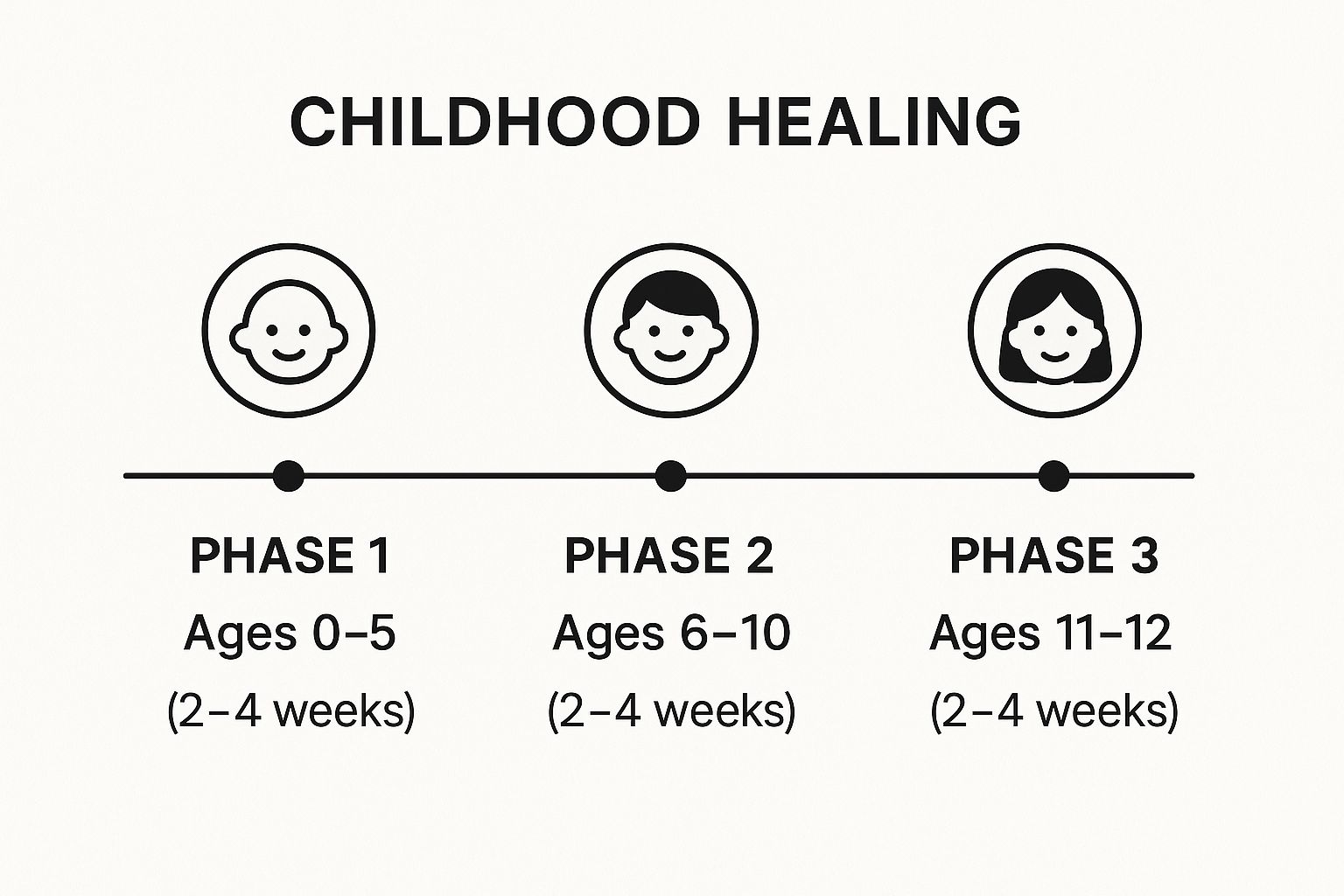
This visual timeline breaks down a potential healing journey into manageable phases, assigning dedicated time to explore the unique needs of each developmental stage.
This structured approach prevents overwhelm by allowing you to focus deeply on one period before moving to the next. For instance, a 40-year-old man struggling with commitment issues used timeline work to discover a fear of abandonment rooted in his parents' divorce when he was seven, allowing him to finally heal the specific wound driving his adult behavior. This exercise is perfect for those who feel "stuck" and want a structured, methodical way to unpack the layers of their past for lasting change.
6. Somatic Inner Child Work and Body-Based Healing
What if your body holds the memories your mind has forgotten? That's the core idea behind somatic inner child work, a powerful body-based healing approach. It recognizes that unresolved childhood emotions and traumas are stored not just as mental narratives but as physical tension, posture, and nervous system patterns. This practice is about tuning into your body to release what words alone cannot touch.
Pioneered by experts like Dr. Peter Levine and popularized by Dr. Bessel van der Kolk, somatic work teaches you to listen to the language of your body. Instead of just talking about feeling scared as a child, you learn to notice the corresponding tightness in your chest or the knot in your stomach. By addressing these physical imprints, you allow your inner child's frozen emotional energy to finally be processed and released, completing a healing cycle that talk therapy sometimes misses.
How to Get Started
This approach invites you to become an archaeologist of your own physical sensations. The goal is gentle awareness and release, not forcing an outcome.
Key Insight: This work is based on Polyvagal Theory, which explains how our nervous system responds to safety and threat. Somatic inner child healing exercises help shift your nervous system out of a chronic "fight-or-flight" state (often established in childhood) and into a state of safety and connection.
For instance, a woman who couldn't access childhood memories through talk therapy found that gentle somatic work allowed her to release decades of jaw tension. As the tension unwound, fragmented memories surfaced, and her chronic anxiety began to dissolve.
This exercise is essential for anyone who feels disconnected from their body, experiences unexplained physical symptoms, or feels "stuck" in their healing journey. It offers a profound path to wholeness by honoring the wisdom your body holds.
7. Inner Child Dialogue and Parts Work
What if your mind were less like a single entity and more like a bustling inner family? That’s the core idea behind Inner Child Dialogue and Parts Work, a transformative practice based on the Internal Family Systems (IFS) model. This exercise invites you to see your inner child not just as a concept, but as a distinct 'part' of you with its own feelings, fears, and wisdom.
Pioneered by Dr. Richard Schwartz, this technique empowers your wise, compassionate adult self to become a mediator for your internal world. By engaging in direct, respectful dialogue with your wounded child parts, you can understand their burdens, validate their experiences, and release them from roles they were never meant to carry. It's about becoming the leader of your own inner team.
How to Get Started
Initiating a conversation with your parts is a gentle process of tuning inward. The goal is to listen with curiosity and compassion, not to fix or silence.
Key Insight: The IFS model posits that there are no "bad" parts. Every part, including a scared or angry inner child, has a positive intention, even if its actions are dysfunctional. By understanding its intention, you can offer it a new, healthier role.
For example, a business executive used this method to dialogue with a 'people-pleasing' child part. He discovered it was trying to keep him safe from rejection. By reassuring that part that he, the adult, could handle disapproval, he dramatically improved his ability to set boundaries at work.
This approach is invaluable for anyone who feels internally conflicted or wants to transform self-sabotaging behaviors into sources of strength and self-awareness.
Inner Child Healing Exercises Comparison
| Method | Implementation Complexity 🔄 | Resource Requirements 💡 | Expected Outcomes 📊 | Ideal Use Cases 💡 | Key Advantages ⭐ |
|---|---|---|---|---|---|
| Inner Child Meditation and Visualization | Moderate (guided imagery, practice required) 🔄🔄 | Low (quiet space, optional guide) 💡 | Emotional regulation, self-compassion, trauma processing 📊⭐ | Trauma healing, emotional intelligence, self-compassion 💡 | Accessible anywhere, customizable, builds emotional safety ⭐ |
| Letter Writing to Your Inner Child | Low (writing skills needed) 🔄 | Low (pen, paper or digital) 💡 | Emotional processing, clear healing documentation 📊 | Those who process emotions better in writing, reflective work 💡 | Concrete progress record, flexible pace, revisitable ⭐ |
| Inner Child Play Therapy and Reconnection | Moderate (materials and time for play) 🔄🔄 | Moderate (toys, art supplies, space) 💡 | Mood boosting, creativity, direct emotional access 📊 ⚡ | Non-verbal emotional expression, involving play and creativity 💡 | Bypasses defenses, creates positive new memories, joy enhancement ⭐ |
| Reparenting Affirmations and Mirror Work | Low to Moderate (daily practice with self-talk) 🔄 | Low (private space with mirror) 💡 | Self-love, rewiring negative self-talk, accountability 📊 ⚡ | Daily routine integration, quick self-compassion development 💡 | Fast, accessible, builds neural pathways, nurturing self ⭐ |
| Timeline Regression and Age-Specific Healing | High (systematic, multi-modal, long-term) 🔄🔄🔄 | High (professional support recommended) 💡 | Comprehensive trauma healing, root cause identification 📊⭐ | Complex and developmental trauma, structured long-term healing 💡 | Thorough, validates all experiences, structured roadmap ⭐ |
| Somatic Inner Child Work and Body-Based Healing | Moderate to High (body awareness, skilled guidance) 🔄🔄 | Moderate to High (trained therapist, session space) 💡 | Trauma release, nervous system regulation, body trust 📊 | When talk therapy is insufficient, pre-verbal trauma healing 💡 | Accesses deep trauma, physiological healing, body literacy ⭐ |
| Inner Child Dialogue and Parts Work | Moderate to High (internal system exploration) 🔄🔄 | Moderate (journaling, therapist optional) 💡 | Integration, unmet needs addressed, emotional differentiation 📊 | Complex trauma, identity integration, IFS-based therapy 💡 | Evidence-based, empowers adult self, reduces fragmentation ⭐ |
Your Healing Journey is Just Beginning
And there you have it, a veritable playground of possibilities for reconnecting with the most authentic part of you. We’ve journeyed through the quiet stillness of Inner Child Meditation , poured our hearts out in Letter Writing , and unleashed our joy with Play Therapy . Each of these practices offers a unique doorway back to yourself.
Remember, this isn't a race to a finish line or a problem to be "fixed" overnight. Healing your inner child is more like learning a new language, one of self-compassion, patience, and radical acceptance. Some days, the conversation will flow easily. Other days, you might only manage a whisper. Both are perfectly okay.
The Power of Consistent Practice
The real transformation doesn't come from trying one of these inner child healing exercises and then shelving it. The magic is in the commitment, the gentle return, day after day. It's in the small, consistent acts of showing up for that little one inside you who has been waiting patiently for your attention.
Think of these tools as your personal healing toolkit:
• For Emotional Overwhelm: • Turn to • Somatic Work • to ground yourself in your body.
• For Negative Self-Talk: • Practice • Reparenting Affirmations • in the mirror.
• For Understanding Triggers: • Use • Inner Child Dialogue • to uncover the root of a reaction.
• For Celebrating Joy: • Make time for unstructured • Play • .
Mastering these approaches is about more than just feeling better; it's about reclaiming your power. It's about dismantling the old, limiting beliefs that were programmed in childhood and consciously building a new foundation of self-worth, resilience, and authentic joy. As you integrate these practices, you'll notice you're no longer just reacting to life. Instead, you'll be responding from a place of centered, integrated wholeness.
Your Journey, Your Pace
The most important takeaway is this: You are the expert on your own healing. Listen to your intuition. If one exercise feels too intense, put it aside and try another. If playful activities feel more nourishing than deep meditative work right now, honor that. Your inner child knows what it needs; your job is simply to listen and respond with kindness.
This journey is a profound act of self-love, a declaration that you are worthy of a life filled with peace, creativity, and connection. You are rewriting your story, one compassionate action at a time. Keep showing up, keep listening, and keep celebrating every single step. The little you is so incredibly proud of the person you are becoming.
Ready to uncover the core motivations and childhood messages that shaped your personality? Understanding your "why" can supercharge your healing. Discover your Enneagram type with the free, in-depth test from Enneagram Universe and give your inner child work a powerful new dimension of clarity. Start your free test here: Enneagram Universe .