INFJ in Relationships: Desires and Compatibility
When it comes to INFJ in relationships , forget about surface-level stuff. These are the people known as ‘The Advocate,’ and they aren't scanning the room for a casual fling. They’re searching for a profound, almost spiritual bond—a true soul-to-soul partnership built on shared values and an unspoken emotional language.
Decoding the INFJ Approach to Love
Think of an INFJ in love as an emotional architect. They don't just stumble into a relationship; they see the blueprint for it in their mind's eye long before the first brick is laid. They’ll spend an incredible amount of time just observing and understanding a potential partner, quietly piecing together what a shared life could look and feel like. This whole process happens deep within their rich inner world, completely invisible to everyone else.
This is exactly why INFJs can seem so picky or take forever to commit. They aren't playing hard to get—they're meticulously checking the foundation. For them, a relationship is a sacred space, and they need to know it’s strong enough to hold the weight of two souls being completely, unapologetically themselves.

The Rarity Factor
This intense need for depth makes a lot more sense when you realize just how rare they are. INFJs make up a tiny sliver of the population, just 1-2% of people globally. It gets even more specific when you look at gender: only about 1.5% of women and a minuscule 0.5% of men identify as INFJ. You can dig deeper into these numbers with Truity's great research on the INFJ personality .
Imagine walking through life feeling like you speak a slightly different language than everyone else. That's the INFJ experience. So, when they finally find someone who "gets" them, they don't take it for granted. They hold onto that connection with fierce loyalty, because they know just how precious it is.
Strengths and Challenges at a Glance
So, what does this actually look like day-to-day? Every relationship has its highs and lows, and a partnership with an INFJ is no different. Here’s a quick look at the beautiful strengths and common hurdles you might encounter.
| INFJ Relationship At A Glance | | :--- | :--- | | Core Strength | Common Challenge | | Unparalleled empathy and emotional support. | Can have sky-high, idealistic expectations. | | Deeply loyal and committed to long-term growth. | Prone to burnout from giving too much. | | Incredible listeners who want to understand you. | May internalize conflict instead of talking it out. | | Passionate about creating a meaningful shared life. | Can be hurt easily by perceived slights. |
While they bring so much depth to the table, their idealism can sometimes set the stage for disappointment if reality doesn't match the vision in their head.
By the way, if you find the Myers-Briggs system helpful, you might also get a lot out of a different personality framework. We put together a guide on the differences between Enneagram and MBTI that can open up another fascinating path to self-discovery.
Ultimately, the INFJ's approach to love is a powerful mix of starry-eyed idealism and grounded realism. They see the breathtaking potential of what a relationship could be, and they are more than willing to do the hard work to build it—but only if they believe the core connection is real and built to last. This is what makes a partnership with them an incredible journey of support, depth, and mutual growth.
What an INFJ
Really
Wants in a Partner
Forget the usual checklists. If you want to understand what makes an INFJ’s heart beat faster, you have to look past things like "good sense of humor" or "shared hobbies." They're on a quest for something much rarer: a partner who can truly see, grasp, and connect with their vibrant, complex inner world.
For an INFJ, a relationship without that deep-down connection feels like a stunningly decorated house with no furniture. It might look impressive from the outside, but it’s impossible to live in. They're not looking for surface-level fun; they're looking for a home for their soul.
This is why they crave conversations that dive deep into dreams, philosophies, fears, and the messy, beautiful mechanics of being human. That kind of intimacy isn't just a "nice-to-have"—it's the very air they breathe in a relationship.
Finding a Co-Director for Their Life's Movie
At the heart of every INFJ is their Introverted Intuition (Ni). The best way to picture Ni is as a private movie theater inside their mind, constantly playing a vivid film of what the future could be. It’s not just a daydream; it’s a rich, long-term vision for their life, complete with a distinct feeling, a sense of purpose, and a powerful narrative.
Their most profound desire is to find someone who doesn't just want to buy a ticket and watch the movie, but who wants to jump into the director's chair right alongside them.
This explains why casual dating often feels so jarring and hollow to them. It’s like being asked to audition for a background role in a cheap sitcom when you’re busy trying to cast the co-star for your life's epic.
Think of Sarah, an INFJ artist from Chicago who spent years feeling lonely, even when she was dating someone. Her partners loved her finished paintings, but none ever showed interest in the chaotic, doubt-filled, deeply personal process behind them. The late nights, the creative blocks, the sudden bursts of inspiration—it was all invisible.
Then she met David, a programmer from Austin, who didn't just admire the canvas; he asked about the story behind her color choices and celebrated her courage for sticking with such a difficult vision. For the first time, Sarah felt truly seen. Not just as an artist, but as a whole person.
The Allergic Reaction to Shallowness
This hunger for depth gives INFJs a unique quirk: they have a full-blown commitment phobia to anything shallow. They would genuinely rather be alone than settle for a relationship that feels like an empty echo.
Their relational patterns back this up. They overwhelmingly prefer to pursue fewer, deeper bonds. In fact, research shows that around 83% prefer having only one to three short-term relationships in their entire lifetime, a huge contrast to the 55% reported for more novelty-seeking types. You can see more fascinating stats on how INFJs build trust through this in-depth personality data .
Because they're so selective, they build trust slowly, piece by piece. As the rarest personality type, they often construct a detailed mental blueprint of their ideal partner and might wait 6 to 12 months longer than average before they feel safe enough to truly open up their innermost world.
The Idealist's Double-Edged Sword
This powerful idealism is both an INFJ’s greatest superpower and their potential kryptonite.
• The Superpower: • Their visionary nature lets them see the absolute best version of their partner. They are natural-born champions who can inspire their loved ones to become people they never even dreamed they could be.
• The Kryptonite: • That same idealism can crash into reality, hard. When their real-world partner inevitably fails to live up to the perfect image in their mind, the INFJ can feel deeply disappointed and may even pull away emotionally as they struggle to bridge that gap.
One of the biggest journeys for an INFJ in love is learning to balance their beautiful ideals with the messy, imperfect reality of human connection. They aren't looking for perfection, but they absolutely require authenticity and a partner who is just as committed to growth as they are.
Who Is the Best Match for an INFJ?
When we talk about the INFJ in relationships , everyone wants to know the secret compatibility formula. But here’s the truth: for an INFJ, finding "the one" isn't about checking off boxes on a personality chart. It's about finding someone who operates on their unique energetic and intellectual wavelength.
They're searching for a partner who can dance with them across multiple planes of existence—someone who gets excited about exploring abstract ideas, can read the emotions between the lines, and truly wants to build a meaningful life together. It's a tall order, but when they find that person, it's nothing short of magic.
The Celebrated Golden Pairs
In the Myers-Briggs world, you’ll often hear the INFJ-ENFP and INFJ-ENTP pairings referred to as the "golden pairs." And for good reason! There's a natural, almost magnetic pull between them, all thanks to their shared love for Intuition. They might lead with different functions, but they speak the same fundamental language of possibilities, patterns, and "what-ifs."
Think of it like this: Emily, our INFJ from Seattle, and Jack, her ENFP partner from Miami. Their life together is a beautiful mess of deep, 3 a.m. conversations about the meaning of life, followed by a spontaneous road trip to nowhere in particular. Emily provides the deep, steady anchor, while Jack brings a whirlwind of new ideas and social energy that gently coaxes Emily out of her shell.
This dynamic just clicks because they complement each other so well:
• Shared Intuition: • They are both endlessly fascinated by hidden meanings and future possibilities. They'll never, ever run out of things to talk about.
• Balancing Energies: • The extroverted spark of an ENFP or ENTP introduces a sense of adventure and fun that the typically reserved INFJ secretly craves.
• Heart and Head: • The ENFP's deep, value-driven feeling (Fi) resonates with the INFJ's empathy, while the ENTP's sharp, logical framework (Ti) challenges and hones the INFJ's own thinking.
The secret sauce for these pairings is a profound, mutual respect for their different ways of moving through the world.
Let's break down the top contenders for an INFJ's heart.
Top 3 Romantic Matches for an INFJ
| MBTI Type | Why It Works (Synergy) | Potential Friction Point |
|---|---|---|
| ENFP | This is the classic "golden pair." The ENFP's vibrant, exploratory energy pulls the INFJ into new experiences, while the INFJ provides the depth and stability the ENFP needs. Their shared Intuition creates an endless well of conversation and understanding. | The ENFP's spontaneity can sometimes feel chaotic to the structured INFJ. The INFJ's need for alone time might be misinterpreted by the highly social ENFP. |
| ENTP | Another "golden pair," this duo connects on an intellectual level. The ENTP loves to debate and challenge ideas, which sharpens the INFJ's mind. The INFJ's insight into people and emotions can help ground the ENTP's more detached logic. | The ENTP's love for debate can sometimes feel like criticism to the sensitive INFJ. The ENTP may struggle to understand the depth of the INFJ's feelings. |
| INFJ | A "mirror soul" connection. Two INFJs understand each other on a fundamental level without needing to explain themselves. They share the same core values, need for depth, and vision for a purposeful life, creating a peaceful and validating bond. | This pairing can be an "echo chamber." Both partners may avoid conflict, get lost in idealism without a grounding force, or enable each other's reclusive tendencies. |
While these pairings are often celebrated, it's crucial to remember that any two mature individuals can make a relationship work.
The Powerful Mirror of an INFJ-INFJ Pairing
While opposites attract, sometimes you just want someone who gets it . In the world of romance, some data suggests INFJs form their most stable partnerships with their own type, with some sources claiming compatibility rates as high as 90-95% . This makes sense—they're reflecting each other's values, intuition, and emotional depth. They also pair well with ENFJs and ENFPs, though energy levels can be a sticking point; for example, INFJs often need 40-50% more alone time per week than their ENFJ partners. For more on this, check out some great insights about highly compatible matches for the INFJ personality on Introvert, Dear .
An INFJ-INFJ relationship feels like looking into a mirror and seeing your soul reflected back. It's a space where you're instantly understood without having to translate your inner world.
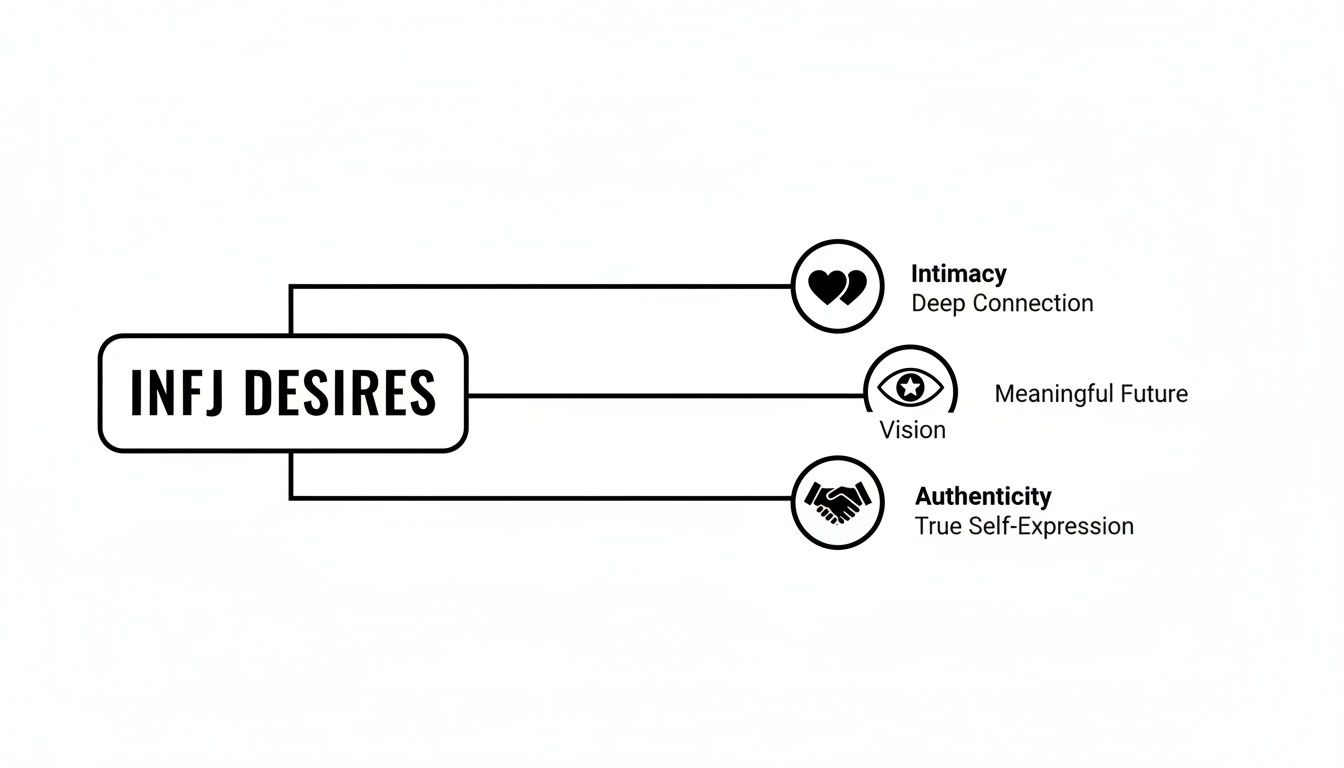
As you can see, the core desires an INFJ has—intimacy, a shared vision, and raw authenticity—are things another INFJ can provide almost instinctively.
The danger, of course, is getting a double dose of the INFJ's less-than-helpful traits. Both partners might sidestep conflict, retreat into their shells when hurt, and spin beautiful fantasies together without a practical plan to make them happen.
Why Challenging Pairings Can Still Work
Here's a little secret: compatibility isn't destiny. Even pairings that look like a train wreck on paper can grow into incredible, life-changing relationships. An INFJ might find a wonderfully grounding force in a practical ISTJ, or a vibrant, in-the-moment partner in an ESTP.
The key to making these "mismatched" pairs thrive is self-awareness and a shared commitment to personal growth.
It absolutely requires more conscious communication and a real effort to learn each other's operating systems. But the payoff is a beautifully balanced partnership where both people help each other become more whole.
How Enneagram Changes the Dynamic
Finally, remember that Myers-Briggs is only one piece of the puzzle. The Enneagram, which digs into our core fears and motivations, adds a crucial layer of nuance. If you're new to this, you can learn more about Enneagram types in relationships in our detailed guide .
For example, an INFJ who is an Enneagram Type 4 (The Individualist) will be fiercely protective of their identity and authenticity. They'll connect best with a partner who not only accepts but celebrates their emotional intensity and unique spirit.
But an INFJ who identifies as an Enneagram Type 9 (The Peacemaker) will prioritize harmony above all else. They'll flourish with a gentle, stable partner who creates a calm, conflict-free zone. The "best" match isn't a single personality type—it's the person who sees, understands, and honors the INFJ's deepest needs.
Navigating the Highs and Lows of an INFJ Partnership
Loving an INFJ is less like a typical relationship and more like an epic journey. It's a path filled with breathtaking views and, let's be honest, a few treacherous cliffs. An INFJ in a relationship brings a depth that can feel almost spiritual, but their beautifully complex nature can also create some unique hurdles. To build a love that lasts, you have to understand both the magic and the madness.
On one hand, you get a partner who is so fiercely loyal they make Buckingham Palace guards look fickle. On the other, you might find yourself baffled by their sudden silences or trying to live up to unspoken, sky-high standards. So, let’s get real about the incredible highs and the very real challenges of loving an INFJ.
The Unmistakable Strengths of an INFJ Partner
When an INFJ decides you're their person, they don’t just open their heart; they anchor it to you. Their strengths aren't just nice-to-haves; they are the bedrock of the entire relationship.
• Unwavering Loyalty and Devotion: • INFJs don't really • do • casual. Once they’ve committed, they are in it for the long haul. Their promises are sacred vows, and they will fight tooth and nail to protect the relationship and see it flourish.
• Deep-Seated Empathy: • It’s almost spooky. They don’t just hear you; they • feel • you. They can absorb your emotions and provide a genuine safe harbor in the middle of a storm, making them some of the most comforting and validating listeners you'll ever meet.
• Champion of Your Potential: • An INFJ sees the superhero version of you, even when all you see in the mirror is your bedhead. Think of it like this: Maria, a classic INFJ from Denver, saw her partner Chris withering away in a soul-crushing accounting job. She knew he had a hidden talent for woodworking. Instead of just saying "you should do something else," she became his personal strategist. She found local classes, helped him build a small workshop in their garage, and became his number-one fan, buying his first creations. Her intuitive belief in him was the spark that ignited a whole new, fulfilling career.
The Common Pitfalls and How to Handle Them
Of course, no one is perfect, and the very intensity that makes INFJs so amazing can also cause some friction. Their inner world is a finely tuned instrument, and when something is out of key, it can lead to behaviors that leave their partners scratching their heads.
This intense inner pressure can show up in a few key ways. It’s also crucial to learn the difference between genuine relationship issues and the INFJ's own anxieties taking the wheel. Their perfectionism and fear can sometimes masquerade as problems with you or the partnership. Learning to distinguish between love vs anxiety in relationships can be an absolute game-changer.
Understanding the INFJ "Door Slam"
And now for the most infamous INFJ move of all: the "door slam." This isn't a flash of anger or a petty cold shoulder. The door slam is a final act of self-preservation. It happens when an INFJ feels they've been profoundly and repeatedly hurt, and their every attempt to fix the problem has been dismissed or ignored.
To protect what's left of their emotional core, they simply… sever the connection. It's a quiet, decisive cutoff that feels like a switch has been flipped, often leaving the other person completely blindsided and locked out for good.
For the Partner: If you've been on the receiving end of a door slam, you need to know it was an absolute last resort. Coming back from it is rare and requires a monumental effort, starting with genuine, soul-baring remorse and a true desire to understand the depth of the hurt you caused.
For the INFJ: The key is prevention. Learn to set smaller, healthier boundaries long before you get to the breaking point. Voicing your hurt when it happens—even when it feels terrifyingly confrontational—can stop resentment from building to that critical, door-slamming mass.
Talking to an INFJ: The Unspoken Rules of Engagement
Communicating with an INFJ is rarely a straightforward, what-you-see-is-what-you-get affair. It's more like trying to read a beautiful, complex poem. The literal words are only half the story; the real meaning lives in the emotional resonance, the subtext, and the spaces between the sentences.
For an INFJ, a conversation isn't just a way to swap facts. It’s a sacred act of building a bridge from their inner world to yours. This can lead to incredibly deep connections, but it can also feel like you need a secret decoder ring to understand what’s really on their mind.
Their secret weapon (and sometimes their Achilles' heel) is their Extraverted Feeling (Fe) . It makes them hyper-aware of the emotional temperature of a room and incredibly empathetic partners. The downside? They’re like an emotional sponge, soaking up every drop of negativity around them. It's a gift and a curse, all rolled into one.

Cracking the Code to Their Inner World
INFJs spend so much time navigating the intricate landscapes of their own minds. To get them to share what's really going on in there, you have to do more than just ask. You have to build a sanctuary of psychological safety .
Blasting them with a blunt "What's wrong?" is the fastest way to make them slam the door shut. They'll retreat right back into their shell. Instead, you have to gently invite them out.
Think of it as coaxing a shy animal out of hiding. You can't just run up to it. You have to be patient and show you mean no harm. Try using soft, open-ended questions that don’t demand a specific answer.
• "You seem a little quiet today. No pressure to talk, but I'm here if you want to share what's on your mind."
• "That thing you mentioned earlier was really fascinating. I'd love to hear more about where that thought came from."
• "I get the feeling there's a lot swirling around for you right now. I'm really interested in all of it, whenever you're ready to let me in."
These kinds of questions are like a soft knock on the door. They say, "I see you, I respect your space, and I'd be honored to be invited in."
How to Handle Conflict Without Triggering a Meltdown
Conflict is the stuff of nightmares for most INFJs. Their deep-seated need for harmony, combined with their intense sensitivity to negative feelings, makes them avoid confrontation like the plague.
When a fight is unavoidable, their first instinct is often to go silent. This isn't a passive-aggressive punishment. It's a self-preservation mechanism. They're trying to process an overwhelming flood of emotions and prevent themselves from saying something that could cause irreparable damage.
The absolute key is to frame the problem as "us vs. the issue," not "you vs. me." This transforms a scary battle into a collaborative project, which is a much safer space for an INFJ to operate in.
Let’s walk through a real-world example. We'll use an American couple, Michael (the INFJ from Boston) and Jessica (from New York). Jessica consistently feels like Michael checks out emotionally when they're at social gatherings.
The Wrong Way (The Accusation):
• Jessica: • "You were completely silent at the party tonight! It felt like you didn't even want to be there. Why are you always like that?"
This sounds like a direct attack to Michael. His defenses will shoot up instantly. He’ll likely shut down, offer a mumbled apology, and then spend the rest of the night analyzing the perceived criticism, leaving the actual problem completely unsolved.
The Right Way (The Invitation):
• Jessica: • "Hey, I felt a bit disconnected from you at the party tonight, and I started feeling kind of lonely. I'm just wondering what that whole experience was like for you?"
This approach is brilliant for three specific reasons:
This opens the door for Michael to safely explain his side—maybe the noise was overstimulating, or a strange comment sent him down a rabbit hole of deep thought. From that point of understanding, they can team up to find a solution for the next party.
To take these concepts even further, be sure to check out our complete guide on improving relationship communication for a ton of other strategies that work wonders for all personality types.
Actionable Tips for a Thriving Relationship
Alright, we've talked a lot about what makes an INFJ tick. But knowing the theory is one thing—actually living it out in a relationship is a whole different ballgame. So, let's get practical. Here’s how you can turn that understanding into real actions that will make your connection with an INFJ not just work, but truly sing.
Honor Their Need for Solitude
For an INFJ, alone time isn't a luxury; it’s like oxygen. Their inner world is constantly buzzing, and they feel everything so intensely that they absolutely must have time to unplug and sort through it all. Without that space, they get overwhelmed, cranky, and can feel like they're coming apart at the seams.
It's so easy to take this personally. When they pull away, your first instinct might be to think you did something wrong. The trick is to see their retreat for what it is: them taking care of themselves so they can be present with you later.
When you champion their need for solitude, you're telling them you see them, you get them, and you respect their needs. It's a huge trust-builder.
Become a Student of Their Inner World
INFJs have this deep, almost painful desire to be truly seen and understood. They have entire universes swirling around inside their minds, but they won't just hand you the map. You have to earn it by showing you're genuinely curious and a safe person to be vulnerable with.
The best way to do this? Ask better questions. Go beyond the "how was your day?" routine and dig a little deeper.
Get them talking with questions that open up their world:
• "What's a new idea that you can't stop thinking about lately?"
• "You seemed really quiet during that movie. What was it stirring up in you?"
• "If you could design your perfect future—not just a job, but how you want to • feel • every day—what would that look like?"
This shows you care about their mind and their heart, not just what they do. Of course, building a great relationship involves more than just type-specific advice, and integrating general tips to keep relationships strong can beautifully complement these INFJ-focused strategies.
Validate Their Powerful Intuition
An INFJ's intuition is their compass. It’s how they navigate everything. They'll often "just know" something feels off or right, even when they can't give you a neat, logical spreadsheet to prove it. For more concrete thinkers, this can be maddening. But dismissing their gut feelings is probably the quickest way to make an INFJ feel small and foolish.
Even if their hunch makes zero sense to you, learn to respect the signal.
Practical Example: Let's say your INFJ partner from Portland gets a "bad vibe" about a business opportunity that looks golden on paper. Your logical brain is screaming, "But the numbers are perfect!" Instead of shutting them down, try leaning in. Say, "Okay, I hear you. Walk me through it. What's the feeling? What's your intuition trying to tell us?"
Giving their intuition a platform makes them feel incredibly heard and valued. And honestly? More often than not, you'll find their spidey-senses were picking up on some subtle red flag your logic completely missed. This is the key to building unshakable trust. When you trust their intuition, they trust you with their whole self.
A Few Common Questions About INFJ Relationships
If you're trying to figure out an INFJ, you're not alone. Their unique way of navigating relationships often brings up some very specific—and recurring—questions. Let's clear the air on a few of the most common ones.
Why Do INFJs "Door Slam" People?
Ah, the infamous "INFJ door slam." People often misunderstand this. It’s not some petty ghosting or a silent treatment tantrum. Think of it as an emotional emergency brake—a final, drastic act of self-preservation.
This only happens after an INFJ has taken repeated, deep emotional hits. They’ve likely tried talking, explaining, and fixing the problem, only to feel completely ignored or dismissed. To stop the bleeding, they cut the connection cleanly and completely. It’s their last resort when they feel there’s absolutely nothing else left to try.
Can You Recover From a Door Slam?
So, can you ever come back from a door slam? Let's be real: it's next to impossible. The door slam isn't about anger; it's about a catastrophic breach of trust. Reversing that requires a monumental, almost heroic, effort from the other person.
How Can You Tell if an INFJ Is Romantically Interested?
An INFJ won't be throwing grand, obvious gestures your way. Their signs of interest are far more subtle and meaningful. They’ll begin to let you into their carefully guarded inner world, sharing their wild ideas, their personal philosophies, and the dreams they don't tell just anyone.
They’ll also start asking you deep, probing questions, trying to understand who you are at your core, not just what's on your resume. But perhaps the biggest tell is when they start consistently making time for you. An INFJ's energy is their most precious resource, and sharing it freely is their version of a love song.
Are INFJs Likely to Be Unfaithful?
When it comes to physical infidelity, INFJs are one of the least likely types to cheat. Their entire moral compass is built on a foundation of profound loyalty, authenticity, and commitment. Betraying a partner that way feels like a betrayal of their own soul.
However, there's a caveat. If a relationship becomes an emotional desert, devoid of the intellectual and emotional connection they crave, an INFJ might become vulnerable to an "emotional affair." Physical cheating is incredibly rare and would almost certainly only happen after they've already checked out of the relationship in every other way.
Ready to understand yourself and your relationships on a deeper level? Enneagram Universe offers a free, scientifically validated personality test to help you discover your core motivations. Find your Enneagram type and unlock personalized insights for growth at Enneagram Universe.