How to Teach Self-Awareness With Enneagram Universe

Participants often enter a self-awareness workshop assuming they already possess it. That’s the first teaching problem.
A landmark study by organizational psychologist Tasha Eurich found that 95% of people believe they are self-aware, yet only 10-15% are (Fierce Inc.). If you teach self-awareness, that gap changes everything. You’re not helping learners “discover a nice personal growth topic.” You’re helping them test whether their self-story matches reality.
As an educator, I’ve found that learners usually get stuck in one of three places. They confuse self-expression with self-awareness. They rely only on introspection. Or they treat personality tools like labels instead of mirrors. Good instruction fixes all three.
The most effective sessions feel less like a lecture and more like guided discovery. People need language, reflection time, outside feedback, and a structure that helps them connect patterns instead of collecting random insights. When you build those elements in, self-awareness becomes teachable.
Understanding the Foundations of Self-Awareness
A useful self-awareness lesson starts with a distinction learners can feel in real time. One part is inward. Learners notice their emotions, motives, habits, and stress reactions. The other part is outward. Learners recognize how those patterns affect the people around them.
Many instructors see confusion here. A participant may reflect often, speak openly, and still miss how their tone lands in a team discussion. Self-awareness works like a two-lens camera. One lens faces inward. The other shows the effect of that inner pattern in the room. If either lens is blurry, the picture is incomplete.
Start with a definition that learners can actually use
Use a definition that gives people something concrete to practice:
That wording helps learners understand the task. They are not collecting personality adjectives. They are building accuracy.
For instructors, that means teaching four building blocks:
• Inner patterns: • what regularly drives a learner when they feel settled and secure
• Stress reactions: • what tends to happen under pressure, criticism, uncertainty, or time strain
• Social impact: • how other people tend to experience those patterns
• Behavioral choice: • one response the learner can change on purpose
This foundation also explains why the Enneagram is useful in teaching, not just interesting in conversation. It gives learners a structured language for motives, fears, and habits. The Enneagram Universe assessment strengthens that process because it gives you material to use before, during, and after the session. Instructors can introduce a shared vocabulary, compare self-report with observed behavior, and group participants for exercises based on meaningful pattern differences rather than guesswork.
Explain what learners are actually trying to get better at
Self-awareness matters because it affects how people communicate, handle feedback, make decisions, and respond under stress. In a workshop, that point becomes clear fast.
Take a common classroom example. One learner says, “I’m just being efficient.” Their peers describe the same behavior as abrupt. Another says, “I stay flexible.” Their coworkers experience that pattern as avoiding clear decisions. Neither learner is lying. They are missing part of the picture.
That is why strong instruction combines reflection with outside input. Adult learning works best when people connect experience, language, and action. If you want a helpful planning lens for that design work, these theories of learning can help you choose methods that fit how adults process insight and change behavior.
Use the Enneagram as a map, not a label
Instructors often worry that personality frameworks will box learners in. That happens when the tool is taught as a verdict. It becomes far more useful when you present it as a working map.
A map does not replace the terrain. It helps people notice where they are, what patterns repeat, and where they may get stuck. The Enneagram Universe assessment is especially helpful here because it gives learners a starting hypothesis they can test against reflection, discussion, and feedback. That makes your teaching more precise.
For example, if a learner’s results suggest a pattern of striving, image management, or conflict avoidance, you can ask better follow-up questions:
• “What do you usually protect when you feel evaluated?”
• “What do other people see right before you shut down or speed up?”
• “Which strength becomes overused when you are stressed?”
Those questions move the session from personality trivia to usable insight.
Frame the room as a place for accuracy, not exposure
Self-awareness work can feel personal very quickly. If participants expect judgment, they will perform instead of reflect.
Set the tone early with language like this:
That line usually changes the room. People relax because they now have permission to be unfinished.
You can reinforce that tone by treating assessment results as data for discussion, not a final answer. Ask learners to compare three sources: what they believe about themselves, what the Enneagram Universe assessment suggests, and what other people consistently experience. That three-part comparison is where the best teaching happens. It gives individuals a way to spot patterns, and it gives instructors a reliable structure for both group activities and one-on-one follow-up.
For participants who need a plain-language resource after the session, point them to this guide on how to become more self-aware .
Define Objectives and Choose Assessment Methods
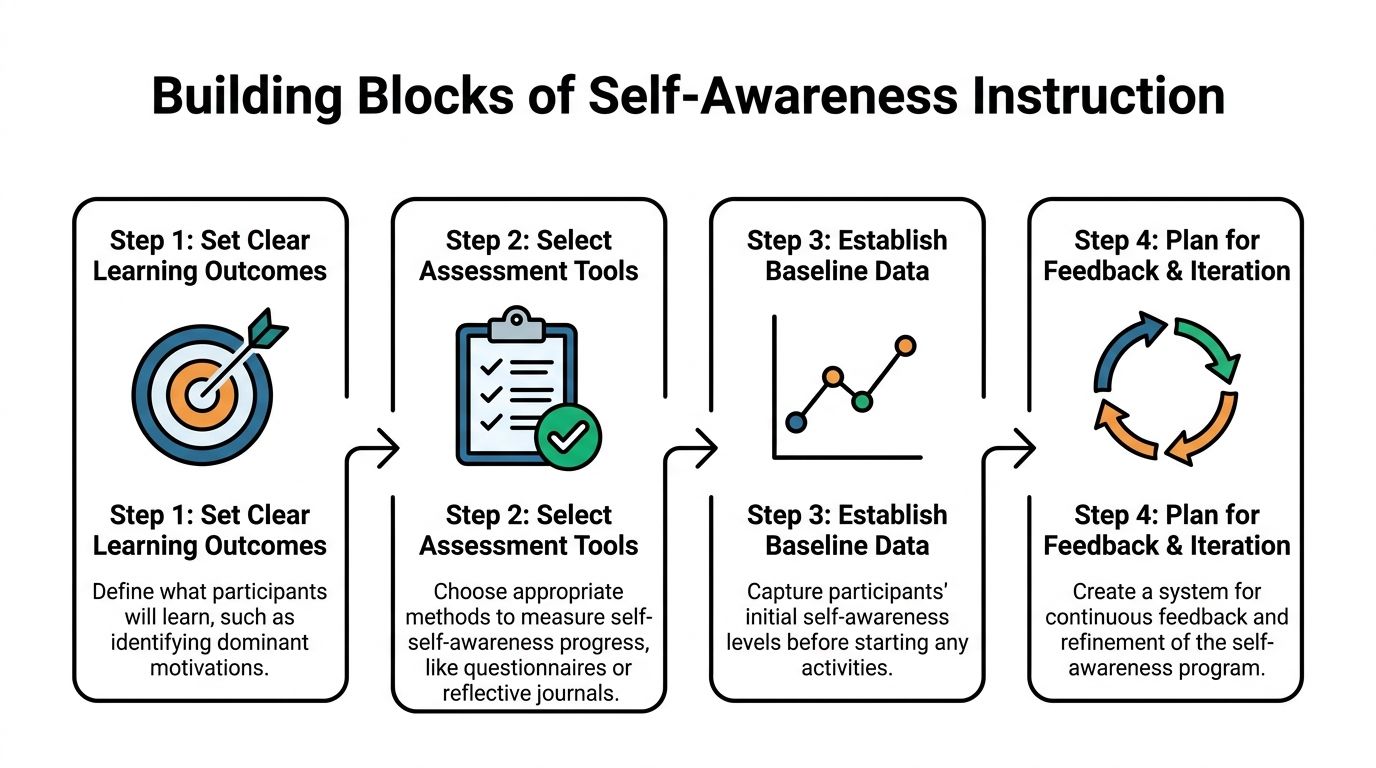
Self-awareness sessions succeed or stall at the planning stage. If your goal is broad, your teaching gets broad too, and learners leave with interesting thoughts but no clear evidence of growth.
A stronger approach is to define outcomes you can observe. In other words, decide what participants should be able to say, notice, compare, or test by the end of the session. That shift changes the whole design. It also makes the Enneagram Universe assessment more useful, because you are no longer handing out personality results as a standalone experience. You are using assessment data at the right moment, for a specific teaching purpose.
Write objectives you can hear in the room
Good self-awareness objectives sound like behaviors, not aspirations.
Try goals like these:
• Identity objective: • participants describe recurring patterns with specific language rather than vague traits
• Emotion objective: • participants name common triggers and the behavior that usually follows
• Feedback objective: • participants compare self-perception with outside input and identify one mismatch
• Application objective: • participants choose one communication habit to test after the session
Those objectives work across classrooms, leadership programs, coaching cohorts, and staff training. They also help you avoid a common facilitation mistake. Many instructors try to cover insight, emotion, feedback, conflict, and action planning in one sitting. The result feels like overstuffing a suitcase. Everything fits badly, and nothing is easy to use.
A simple test helps. If you cannot picture what a learner would say, write, or discuss to show progress, tighten the objective.
Choose methods that match the teaching goal
Assessment selection should follow the objective, not the other way around. A journaling prompt will not do the same job as peer feedback. A personality assessment will not replace a baseline reflection. Each tool gives you a different camera angle.
Use a sequence like this:
Research on integrative feedback methods suggests that combining self-perception, feedback from others, and personality assessment produces stronger self-awareness development than relying on one source alone ( The Myers-Briggs Company quick guide ).
That combination is what many generic guides miss. Instructors need more than a list of tools. They need to know when each tool belongs in the learning arc.
Build a mixed assessment plan
One instrument rarely gives enough signal on its own. Self-awareness is easier to teach when learners can compare several forms of evidence.
A practical mix might include:
• Reflective prompts • for motivations, recurring frustrations, and self-talk
• Rating scales • for stress response, listening habits, conflict behavior, or confidence
• Open-ended peer questions • for blind spots and interpersonal impact
• A personality assessment • for pattern language and interpretation
For example, Enneagram Universe uses a 180-question assessment with responses ranging from “almost never” to “almost always,” then reports Type, Wings, Triads, and Health Levels. That format works well when your objective is to help learners connect inner motivation with observable behavior. It also gives instructors a clean way to differentiate by audience. A student group may need simpler reflection prompts tied to Type patterns, while a leadership cohort can work with subtype nuance, conflict tendencies, and pattern overuse under pressure.
If you want learners to practice before the full session, assign one or two pre-work tasks from these self-awareness activities for structured reflection and discussion .
Collect a baseline before interpretation begins
Facilitators often rush to the interesting discussion. Keep the baseline.
Without a starting point, learners cannot tell whether they are becoming more accurate or more talkative. Baseline data gives you a before-and-after comparison, and it helps participants test whether their first self-description holds up once reflection and feedback enter the picture.
You can gather that baseline with a short form like this:
| Prompt | Response format |
|---|---|
| I can describe what motivates me under stress | 1 to 5 rating |
| I know how others experience me in groups | 1 to 5 rating |
| I can name my usual emotional triggers | 1 to 5 rating |
| I can identify one blind spot I’m working on | yes/no plus comment |
Add one prediction question: “How self-aware do you think you are today?”
That question becomes especially useful later. Learners can compare their confidence rating with their Enneagram Universe results, written reflections, and group feedback. In workshops, that comparison often produces the most honest learning moment of the day.
Choose feedback sources with care
For feedback sources, use people who know the learner well enough to describe patterns, not just impressions. In a formal multi-source process, earlier guidance from Myers-Briggs recommends a broad pool of trusted respondents. In teaching settings, you can scale the number to fit the context, but the principle stays the same. Familiarity matters. Specificity matters more.
Ask for observations about behavior, not identity judgments.
Use prompts like:
• “When do you experience me at my best?”
• “What do I do when I’m stressed that I may not notice?”
• “What’s one strength I may underestimate?”
• “What’s one habit that makes collaboration harder?”
Here is the practical rule I give instructors: feedback questions should sound like a window, not a verdict. Windows help people see. Verdicts make people defend.
That distinction keeps the session teachable.
Deliver Individual Self Awareness Activities
The strongest solo exercises help learners slow down enough to notice patterns before they explain them away. That’s why I usually begin with attention, not analysis.
Mindfulness-based self-awareness training has documented effects on emotional regulation, stress reduction, and workplace performance ( Cornerstone OnDemand ). For teaching, that matters because dysregulated learners can’t reflect clearly. They defend, perform, or rush.

Begin with a short settling practice
Use a guided exercise that lasts just a few minutes. Keep it plain.
Facilitator script:
That last line matters. It gives learners a physical entry point. Many people can’t name an emotion at first, but they can tell you their jaw clenches, chest tightens, or stomach drops.
If someone resists meditation language, rename the exercise. Call it attention training or a pause for observation . Resistance usually drops.
Follow With a Body Scan and Trigger Reflection
After the settling practice, ask learners to write fast for a few minutes.
Use prompts like:
• “When I feel criticized, my body usually…”
• “When I don’t feel in control, I tend to…”
• “The emotion I avoid most often is…”
• “My first move in conflict is usually…”
This works because the learner has just shifted out of autopilot. Their answers are often more honest and less polished.
Quick Type Signals to Watch For in the Room
You won't know everyone's type going in, but a few behavioral tells show up quickly once people start engaging with self-awareness exercises:
• Jumps straight to fixing or correcting the exercise itself • → often a 1 or an 8 — channel that energy into leading a small group instead of letting it derail the room.
• Immediately checks in on how others are doing with the exercise • → often a 2 or a 9 — gently redirect them back to their own reflection first.
• Reframes a hard prompt into something upbeat before really sitting with it • → often a 7 — name that it's okay for the reflection to stay uncomfortable for a minute.
• Goes quiet and needs real space before answering anything • → often a 5 or a 4 — don't call on them cold; let silence sit without filling it for them.
• Asks several clarifying questions before starting • → often a 6 — one clear example usually settles it faster than more explanation.
These are starting hunches, not conclusions — but they help a facilitator adjust in the moment instead of waiting for a formal assessment to catch up.
Use Journaling That Points to Motivation
A weak journal prompt asks, “How are you feeling today?” A stronger one asks what sits underneath the feeling.
Try these in your session:
These prompts pair well with personality-based reflection because they move learners from behavior to motive. That’s the turn many people miss.
For instructors who want more ready-made prompts, this collection of self-awareness activities is useful in workshop planning: 8 Powerful Self-Awareness Activities to Try
Add a digital self-assessment walkthrough
If you’re using a structured personality report, don’t just hand it out and hope learners interpret it well. Walk them through it.
Focus the review on three questions:
• What feels immediately accurate?
• What feels uncomfortable but possibly true?
• What needs outside feedback before I accept or reject it?
That last question is where teaching gets interesting. It stops participants from treating a result as either gospel or nonsense.
Troubleshoot common individual reactions
Some learners get emotional. Some go blank. Some become analytical and detached.
Respond differently to each:
• If a learner gets emotional: • normalize it and bring them back to one concrete observation
• If a learner goes blank: • shift from “What do you feel?” to “What happened right before you shut down?”
• If a learner intellectualizes: • ask for a recent example instead of a theory
A practical sequence for a 45-minute individual block can be simple: brief settling, short body scan, focused journaling, report review, and one written behavior commitment. Keep the pace moving, but don’t rush the silence. That’s often where the answer becomes evident.
Deliver Group Self-Awareness Exercises
Self-awareness deepens when learners hear how others experience similar moments differently. Group work makes those contrasts visible fast.
That doesn’t mean putting people on the spot. It means creating structured interactions that reveal assumptions, habits, and blind spots without turning the room into amateur therapy.

Run a blind spot brainstorming round
This exercise works especially well with teams, graduate cohorts, and coach training groups.
Ask each participant to complete this sentence privately:
“A behavior I think helps me may sometimes land as…”
Then form pairs or trios and let people test their assumptions. One person might say, “I think my quick feedback helps.” Others may respond, “Sometimes it lands as impatience.”
Keep the rule tight: feedback must describe behavior and impact, not personality judgment.
Use this script:
That one line protects psychological safety.
Try intertype or pattern-based pairings
If your group is using a personality framework, pair people with contrasting approaches to stress, control, support, or conflict.
Examples:
• A person who values order with someone who values flexibility
• A direct communicator with a harmony-preserving communicator
• A fast decider with a reflective processor
Give them one shared prompt: “What do you do when you feel pressure, and what do you need from others in that moment?”
That question gets practical quickly. It helps couples, classroom groups, and workplace teams move from irritation to interpretation.
Use empathy mapping circles
Put four prompts on a shared sheet:
• What I want others to understand about me
• What I assume too quickly about other people
• What shuts me down
• What helps me re-engage
Each person speaks briefly while others listen without fixing. This is useful for HR sessions, counseling groups, and educator teams because it teaches self-disclosure and listening at the same time.
If the room feels stiff at first, start with a lighter warm-up. A short bank of icebreaker games for parties can help you adapt low-pressure openers into workshop-friendly connection activities.
Bring in cultural self-awareness
Many self-awareness lessons stay narrowly personal. That leaves out a major blind spot. People interpret themselves through family, region, race, ethnicity, class, and cultural norms, whether they notice it or not.
Research highlighted in global competency work notes that heritage-based reflection exercises can support 40% deeper cultural competence ( Participate Learning ). For instructors, the useful move is adaptation.
Try a heritage mapping exercise with prompts such as:
| Prompt | Example response |
|---|---|
| What messages about emotion did I grow up with? | “Stay calm and keep it private.” |
| What did my family reward? | “Achievement and reliability.” |
| What was considered disrespectful? | “Questioning elders directly.” |
This works in multicultural teams, counselor education, and adult learning groups because it helps participants see that some “personality” habits are also cultural habits.
Differentiate by audience
Use the same structure, but shift the examples.
• For executive teams: • center the exercises on authority, decision-making, and conflict
• For couples counselors: • focus on repair attempts, misunderstanding cycles, and emotional bids
• For students: • use everyday situations like group projects, feedback from teachers, and friendship tension
• For coach training groups: • ask participants to notice when helping becomes rescuing, controlling, or avoiding
The room doesn’t need more activities. It needs the right framing for the people in it.
Evaluate Progress Using Enneagram Universe and Feedback
Self-awareness instruction falls apart if the evaluation only asks, “Did this feel helpful?” Plenty of activities feel meaningful in the moment. The key question is whether participants became more accurate.
Educational research supports a useful model for this. Students who can predict their own competence more accurately tend to be rated by teachers as more socially skilled and academically capable, with fewer problem behaviors ( 7 Mindsets ). That gives instructors a clean assessment principle: compare the self-estimate with actual evidence .
Measure alignment, not just insight
After the workshop, ask participants to revisit their opening self-ratings and compare them with what they learned from reflection, report data, and outside feedback.
Use questions like:
• Where did my self-rating match outside input?
• Where did I overestimate my awareness?
• Where did I underestimate a strength?
• What pattern appeared across more than one source?
One isolated comment may be noise. A repeated pattern across several inputs is a teaching signal.
Compare methods side by side
Here’s a practical way to explain the options to instructors and participants.
| Assessment Tool | Strength | Best For |
|---|---|---|
| Self-report reflection | Fast, personal, easy to repeat | Individual insight and session openings |
| Enneagram report | Gives pattern language for motives, stress, and behavior | Structured interpretation of recurring tendencies |
| Peer feedback | Reveals impact and blind spots | External self-awareness and team dynamics |
| Combined approach | Shows where self-view and outside view align or diverge | Workshops, coaching, leadership development |
The combined approach is usually the most useful because it prevents two common errors. The first is assuming “what I feel” equals “what’s true.” The second is assuming outside feedback always tells the whole story.
Use a post-session interpretation routine
A good debrief is not “Do you agree with your results?” That invites snap judgment.
Use this instead:
That sequence keeps learners from rushing to acceptance or rejection. It also turns the assessment into an experiment rather than a verdict.
If you want learners to complete a structured report before comparison and discussion, you can direct them to the full assessment here: Enneagram Test
Track change with simple evidence
You don’t need a complicated dashboard. You need a repeatable review habit.
Look for changes in:
• Language: • participants speak with more precision about motives and reactions
• Alignment: • self-ratings move closer to peer descriptions over time
• Behavior: • participants report specific communication or decision-making changes
• Reflection quality: • journal entries move from storytelling to pattern recognition
That’s how to teach self-awareness without turning it into a vague wellness exercise. You’re building accuracy, then checking whether it transfers into everyday behavior.
Common Mistakes and How to Avoid Them
The most common mistake is assuming self-awareness grows automatically once people start reflecting. It doesn’t.
Some participants can journal for pages and still avoid the central truth. Others can discuss emotions fluently while staying completely unaware of their impact on the room. Insight alone isn’t enough. Accuracy requires friction.
Mistake one: treating introspection as the whole job
Reflection helps, but reflection without feedback can harden a false self-image.
Fix it by building in an outside perspective. Even one structured peer response can interrupt a polished but inaccurate story.
Mistake two: overloading the session
Instructors often cram in too many models, too many prompts, and too much sharing. Learners leave with a full notebook and no usable shift.
Cut the plan down. One strong reflection, one discussion, and one behavior commitment usually beats a marathon of activities.
Mistake three: forcing vulnerability too early
People won’t share openly if the room feels performative, rushed, or unsafe.
Try this sequence instead:
• Start with observation: • “What do you notice?”
• Move to pattern: • “When does that usually happen?”
• Then invite meaning: • “What might be underneath that?”
That gradual build keeps people from feeling exposed before they feel grounded.
Mistake four: ignoring culture and context
A behavior that looks avoidant in one setting may be respectful restraint in another. A behavior that looks confident may come from a role expectation, not personal security.
Ask context questions:
• “What did your environment teach you about speaking up?”
• “Who rewarded this behavior?”
• “Where is this trait useful, and where does it create friction?”
Those questions reduce snap judgments.
Mistake five: asking weak feedback questions
“Tell me about me” rarely produces anything useful. People either become too nice or too vague.
Ask for examples, moments, and impact. That gets you observations instead of flattery.
Sustaining Growth With Follow-Up Strategies
A good workshop opens the door. Ongoing practice keeps it from swinging shut a week later.
People forget insights fast when they return to normal routines, normal stress, and normal roles. Sustaining growth means attaching reflection to real life instead of waiting for another formal session.
Build small routines instead of big resolutions
Most learners don’t need a grand transformation plan. They need a short, repeatable rhythm.
A workable follow-up system can include:
• Weekly reflection prompt: • one question answered in a few minutes
• Peer check-in: • a brief conversation with one accountability partner
• Behavior experiment: • one interaction habit to test repeatedly
• Monthly review: • a look back at patterns, not just intentions
Keep the prompts narrow. “Be more self-aware” is useless. “Notice what happens in your body before you interrupt someone” is teachable and testable.
Use peer coaching pods
Small follow-up groups work well because they create structure without requiring a full facilitator every time.
Give each pod a simple routine:
This format works for educators, coaches, HR cohorts, and leadership groups because it keeps the conversation grounded in lived moments.
Send prompts that support transfer
Email or message prompts should sound like coaching, not homework.
Examples:
• “What situation brought out your default pattern this week?”
• “Where were you more accurate about yourself than usual?”
• “What feedback did you hear without arguing with it?”
• “What behavior will you repeat next week?”
Short prompts get answered. Long reflection assignments usually get postponed.
Anchor self-awareness to recurring moments
The best follow-up trigger is something that already happens.
Tie reflection to:
• After meetings: • “How do I think I came across, and what evidence do I have?”
• After conflict: • “What was I protecting?”
• After praise: • “What strength did I use?”
• Before difficult conversations: • “What am I likely to do under pressure?”
That’s when how to teach self-awareness becomes practical. You stop treating it like a workshop topic and start treating it like a daily skill.
Normalize revision
Learners often assume that once they identify a pattern, they should stop doing it immediately. That’s not how behavior change works.
Tell them this plainly:
That message matters. It replaces shame with practice.
A strong follow-up plan keeps asking three things: What did you notice? What did others notice? What will you try next? If learners stay with those questions over time, self-awareness stops being a one-day insight and becomes a working habit.
If you want a structured way to support that habit, Enneagram Universe offers an Enneagram assessment with 180 questions, plus reports on Type, Wings, Triads, and Health Levels that can give learners a shared language for reflection, discussion, and follow-up practice.