How to Teach Emotional Intelligence? A Guide for Parents and Teachers
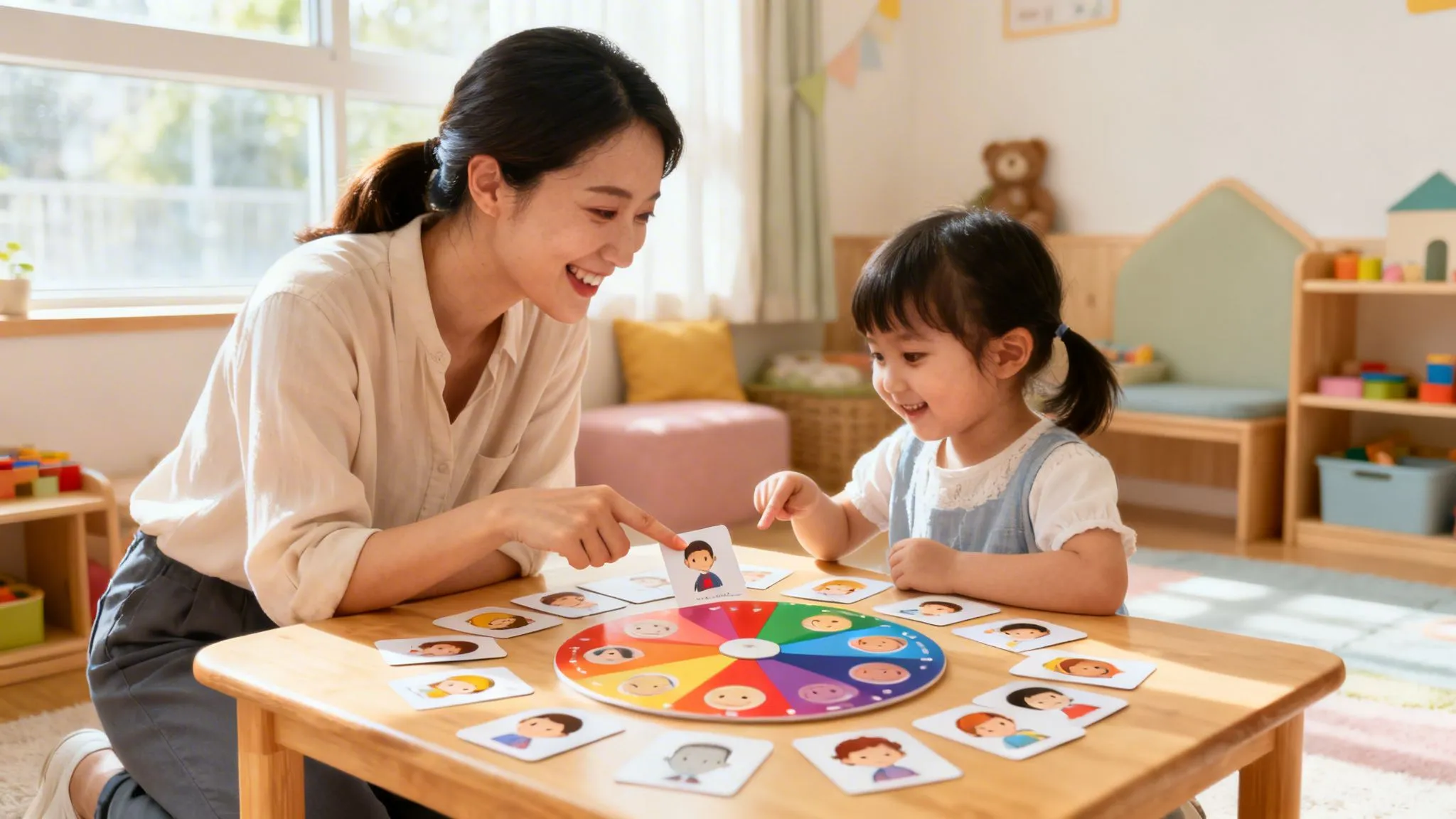
Let's be honest, "emotional intelligence" can sound like a lofty, abstract concept from a psychology textbook. But teaching it is actually one of the most practical things you can do. It’s all about helping people—kids, coworkers, or even yourself—get a handle on their feelings and understand the people around them.
The goal isn't to turn everyone into a therapist. It's to give them a real-world playbook for navigating life, focusing on five key areas: self-awareness, self-regulation, motivation, empathy, and social skills . Think of these as the building blocks for turning emotional static into genuine success.
Your Quick-Start Guide to Teaching Emotional Intelligence
Forget trying to memorize dense theories. The best way to teach emotional intelligence is to live it. Whether you're a parent trying to help a child name that big, scary feeling, a teacher creating a more supportive classroom, or a manager trying to build a cohesive team, your most powerful tool is modeling the behavior you want to see.
It all starts with understanding the fundamentals.
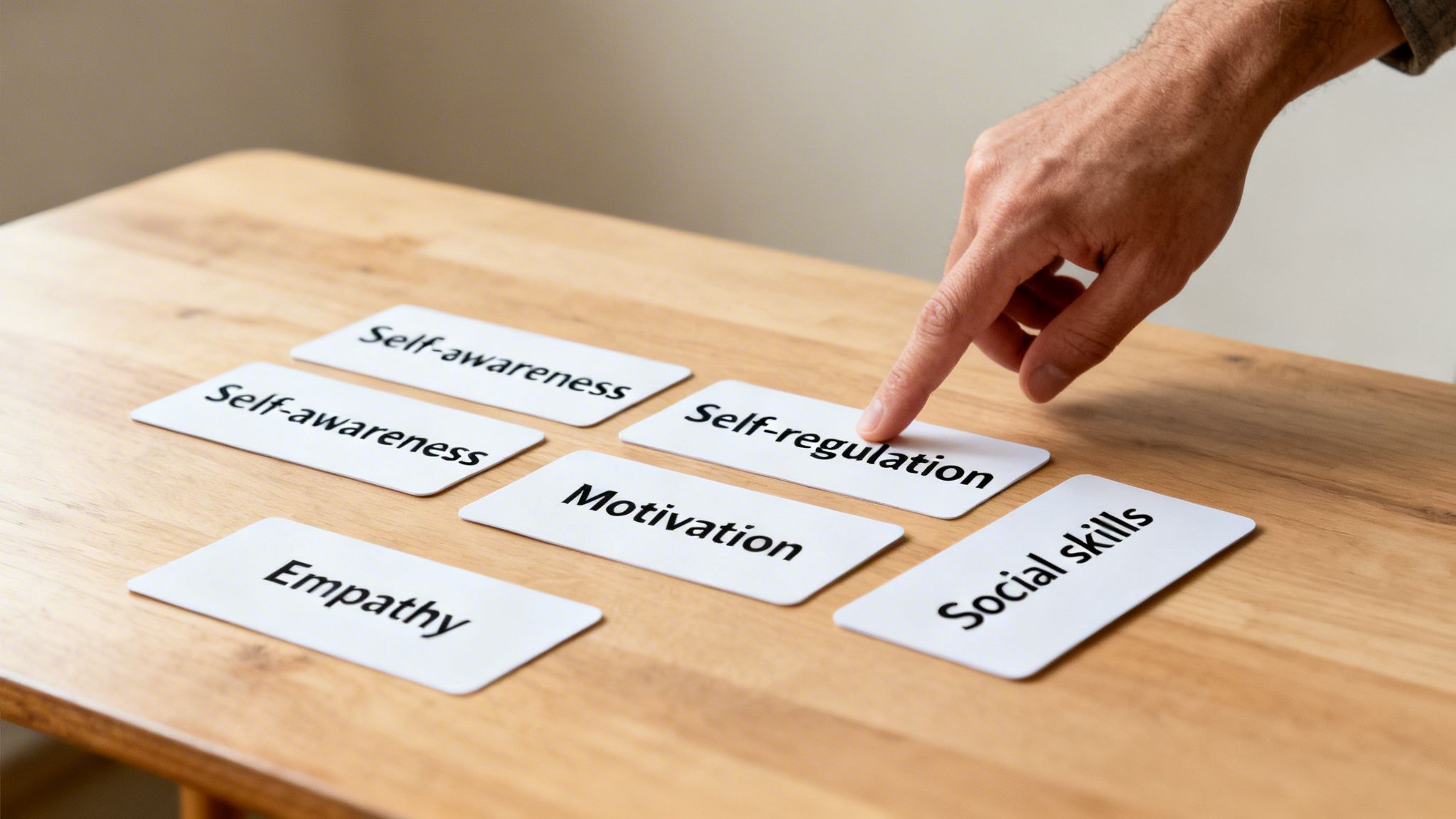
These five pillars are the bedrock of emotional intelligence. They aren't just buzzwords; they're skills you can actually practice and improve. Getting a grip on what they mean is your first step toward creating those "aha!" moments for your learners. For a deeper dive into foundational techniques, check out this a practical guide to teaching emotional intelligence .
The 5 Pillars of Emotional Intelligence
At its core, emotional intelligence is a framework of five interconnected skills, made famous by psychologist Daniel Goleman. Let's break down what they look like in the real world.
To help you see how these pillars work together, here’s a quick snapshot.
The 5 Pillars of Emotional Intelligence at a Glance
| Pillar of EI | What It Means | A Simple Example |
|---|---|---|
| Self-Awareness | Knowing your own emotions, strengths, and limits. The foundation for everything else. | Realizing your stomach is in knots because you're nervous about a presentation, not because you're sick. |
| Self-Regulation | Managing your emotional reactions and impulses. It's the pause between feeling and acting. | Instead of firing off an angry email, you take a walk to cool down and respond later. |
| Motivation | Your inner drive to achieve goals with persistence and optimism, even when it's tough. | Pushing through a difficult project because you believe in the outcome, not just for the paycheck. |
| Empathy | The ability to understand and genuinely share someone else's feelings. | When a colleague says they're overwhelmed, you truly listen and try to see it from their shoes. |
| Social Skills | Using all the other skills to build relationships and communicate effectively. | Navigating a team disagreement by finding common ground and helping everyone feel heard. |
Each pillar builds on the last, creating a powerful toolkit for navigating our complex social world.
Ultimately, these skills aren't just "nice-to-haves." They're fundamental for building stronger relationships, making better decisions, and leading a more fulfilling life. By focusing on these pillars, you give people a clear and effective roadmap for growth that they can use every single day.
Building Your Emotional Intelligence Toolkit
Before you can teach emotional intelligence, you have to pack your bag. This isn't about memorizing theories—it's about gathering real, hands-on tools that spark those lightbulb learning moments. The absolute bedrock of your toolkit? A safe, judgment-free space where people feel they can actually be vulnerable.
Think of it as a safety net. It’s what turns a stiff lecture into a real conversation, where people can share what’s genuinely on their minds. Without that psychological safety, even the best-laid plans will fall completely flat.
Create a Common Language for Feelings
To get everyone on the same page, you need a shared vocabulary. Giving people a simple, structured framework takes the mystery out of emotions and makes them easier to talk about. One of the most powerful I've used is RULER , which breaks emotional literacy down into five very manageable skills.
This method gives you a repeatable roadmap for guiding someone through their feelings, whether you're working with a five-year-old in a classroom or a fifty-year-old executive in a boardroom.
Here’s a quick rundown of what RULER looks like in practice:
• Recognizing: • Spotting emotions in yourself and others. A practical example is noticing a coworker is unusually quiet in a meeting and has their arms crossed, which might signal they are feeling withdrawn or defensive.
• Understanding: • Playing detective to figure out • why • a feeling has shown up. For example, if a child is crying, ask "Did something happen on the playground?" to uncover the cause.
• Labeling: • Putting a specific name to the emotion. Is it just "bad," or is it actually disappointment, frustration, or maybe even envy? A practical example is helping a teenager identify their feeling not as "anger" but as "humiliation" after a poor performance.
• Expressing: • Learning how to share those feelings in a way that’s constructive and socially aware. A great example is teaching someone to say, "I feel frustrated when I'm interrupted," instead of lashing out.
• Regulating: • Finding strategies to manage or shift your emotions to help you reach your goals. For instance, taking three deep breaths before responding to a stressful email.
A framework like this demystifies the whole process. Suddenly, feelings aren't scary or abstract—they're just data points we can work with.
Practical Tools for Daily Practice
Emotional intelligence isn't a one-and-done lesson; it's a muscle you build through consistent practice. The real win is making conversations about feelings a totally normal, everyday thing. You can weave small, simple exercises into routines you already have.
Try introducing a one-word emotional check-in at the start of your team meetings or even at the family dinner table. Just go around and have everyone share a single word that captures how they feel in that moment: "Energized," "Stressed," "Calm," "Distracted." It’s a deceptively simple act that normalizes emotional expression and gives you a quick pulse-check on the room.
This really gets to the heart of it. Meaning and connection are what EI is all about, and these tiny daily practices are what build that connection over time.
Set Up Your Learning Environment
Don't underestimate the power of your physical or virtual space. Creating designated areas or rituals for emotional check-ins can make the skills you're teaching feel much more tangible and sticky.
With younger learners, you can make this incredibly visual and fun.
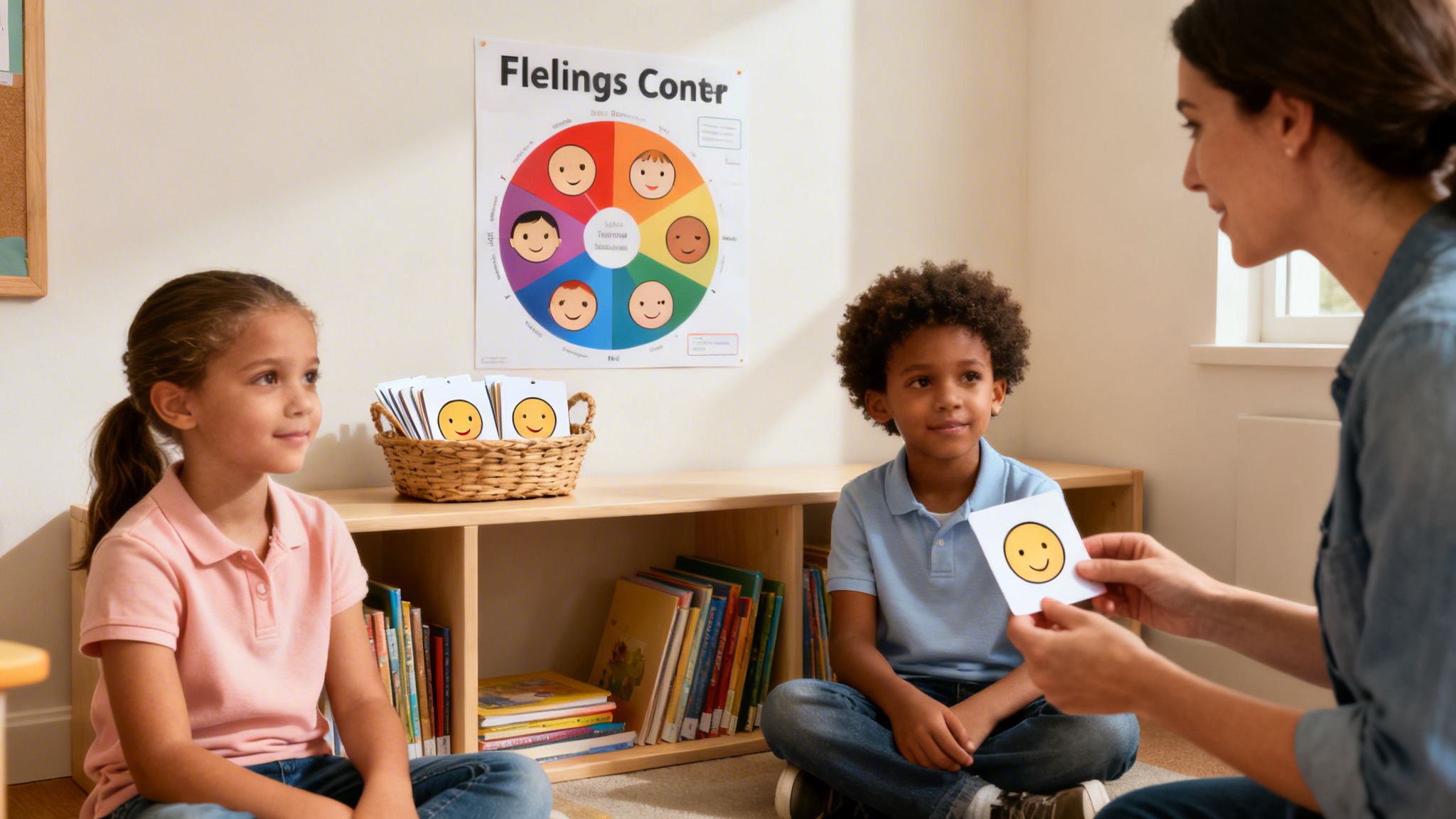
Classroom Idea: The Feelings Corner Set up a cozy nook in your classroom with pillows and soft blankets. Then, stock it with helpful tools:
• Emotion Flashcards: • Find cards with a diverse range of faces showing all sorts of emotions. This is a great way for kids to practice recognizing and labeling feelings.
• Feeling Faces Poster: • A simple chart with different facial expressions can be a fantastic quick-reference tool.
• Calm-Down Kit: • Fill a small box with items like a stress ball, a little notepad for doodling, or a pair of noise-canceling headphones.
This corner becomes a safe haven where a child can go to figure out what they're feeling and find a healthy way to regulate it. For adults, the "environment" might look like a dedicated slot in a weekly meeting or a special channel in your team's Slack for sharing personal wins and challenges.
By weaving together a shared language, daily rituals, and a supportive environment, you create a powerful toolkit for teaching emotional intelligence. And if you’re looking to sharpen your own skills first, our guide on how to increase EQ has some great personal strategies. These tools will help you move from just talking about EI to actively building it in others.
Tailoring the Lesson: EQ for Every Age and Stage
Let’s be real: you can’t teach emotional intelligence with a one-size-fits-all script. The way you connect with a boardroom of executives is worlds away from how you’ll get through to a classroom of first-graders. The secret sauce is making the concepts stick by making them relatable and, frankly, fun.
It’s not just about one single activity, either. The most successful approaches are a blend. A huge systematic review of 67 different studies found that the best training programs mix things up with Social-Emotional Learning (SEL), mindfulness practices, journaling, and even virtual reality simulations.
This tells us what many of us have seen in practice: a varied, dynamic approach is what truly works. By tailoring our lessons, we can build skills that last a lifetime.
For the Little Ones: Building the Emotional Toolkit
When you're working with young kids, the name of the game is building their emotional vocabulary from the ground up. Think less about abstract lectures and more about playful, hands-on discovery. Concepts like "empathy" have to be things they can see, touch, and feel.
Story time is your superpower here. Don't just read the book; turn it into an emotional treasure hunt. Pause and ask them to become feeling-detectives.
• "Look at the bear's scrunched-up face. What feeling do you think is bubbling up inside him right now?"
• "Oh, she looks so sad. What do you think just happened that made her feel that way?"
• "Wow, look at that giant smile! When was the last time you felt • that • happy?"
Another activity that’s always a hit is Emotion Charades . I like to make a "feelings wheel" with simple drawings of characters showing big, clear emotions—joy, sadness, surprise, anger. A kid gives it a spin, lands on an emotion, and then acts it out for everyone else to guess. It’s a blast, and it subtly teaches them to read nonverbal cues and connect expressions to internal feelings.
If you’re looking for more hands-on ideas, you can find some fantastic and engaging emotional intelligence activities for kids that are easy to adapt.
For Teenagers: Navigating the Social Maze
Ah, the teenage years. The social world suddenly becomes ten times more complex, with a minefield of peer pressure, digital drama, and the chaotic search for identity. Teaching EQ to this group means getting real about the challenges they face every single day. Forget basic emotion charts; it’s time for role-playing.
You can set up scenarios that feel like they're ripped straight from their group chats or school hallways. This gives them a safe space to practice navigating tricky conversations.
Role-Playing Scenario: Putting Out a Digital Fire
• The Goal: • Practice calming down a conflict online and sharing your own perspective without making things worse.
• The Setup: • One person is the friend who posted a rude or hurtful comment. The other is the teen who saw it and needs to address it.
• The Coach's Tip: • Steer them toward using "I feel" statements instead of accusatory "You did" language. "I felt really hurt when I saw that comment" lands a lot better than "You were being a total jerk."
• The Debrief: • After they finish, talk it out. What felt right? What was awkward? How could they use this approach the next time a real conflict pops up?
It's all about learning to approach others with curiosity instead of judgment. This skill is universal.
That same empathic impulse—seeking to understand before demanding to be understood—is just as crucial for a teen trying to save a friendship as it is for a manager trying to lead a team.
For Adults in the Workplace: EQ as a Performance Tool
In the professional world, emotional intelligence isn't a "soft skill"—it's a direct driver of performance, teamwork, and leadership. Workshops for adults need to be sharp, practical, and focused on solving the nagging problems that plague offices everywhere: bad communication, sinking morale, and endless, unproductive arguments.
One of the most valuable skills you can teach is how to give and receive feedback . So many people dread feedback because it feels like a personal attack. An effective workshop reframes it as a tool for growth.
Workshop Activity: Feedback That Builds, Not Burns
Instead of a rigid formula, teach a more natural flow that disarms defensiveness.
First, set a collaborative tone. Kick things off by making it clear the goal is mutual success, not placing blame. Something like, "I wanted to share a few thoughts on the project so we can both knock this out of the park."
Next, anchor the feedback in a specific moment using the Situation-Behavior-Impact model. This removes the sting of personal criticism.
• Situation: • "During yesterday's client meeting..."
• Behavior: • "...when you jumped in while the client was speaking..."
• Impact: • "...I noticed they clammed up, and I'm worried we might have missed hearing some of their key concerns."
Finally, pivot to a solution. End with a question that invites collaboration, not a command. "How can we work together to make sure we’re catching everything they have to say next time?"
This approach transforms feedback from a dreaded critique into a productive, forward-looking conversation. To take this even further, you can help people understand their own ingrained patterns by exploring our guide on self-awareness activities .
Unlocking Deeper Insights with the Enneagram
If you're ready to graduate from teaching general emotional skills to crafting a truly personalized growth plan, let's talk about the Enneagram . Think of it as a cheat sheet for the human soul. When you pair emotional intelligence work with someone's core personality type, you get a direct line into their inner world—their secret motivations, their deepest fears, and their most stubborn blind spots.
Suddenly, the conversation shifts. Instead of just saying, "try to be more empathetic," you're asking, "How can a Type 3 Achiever , who is laser-focused on performance, practice genuine empathy?" It transforms generic advice into a specific, actionable strategy that actually gets results.
Your New Secret Weapon for EI
The Enneagram isn't just another personality quiz. It’s a dynamic map that reveals the why behind our emotional habits. It uncovers the unconscious programming that drives our reactions, which is the very heart of self-awareness.
This is a massive advantage when teaching emotional intelligence. Instead of just dealing with the symptom (like an angry outburst), you can get right to the root cause. For instance, a Type 8 Challenger might use anger to maintain control, while a Type 2 Helper might bottle up their anger to avoid rejection. Same emotion, completely different driver.
When you know this, you can design interventions that are surgical in their precision. You’re no longer just putting out fires; you’re helping people rewire their emotional circuitry from the inside out.
Coaching Questions That Cut to the Chase
Once you have a sense of someone's Enneagram type, your coaching questions can become incredibly powerful. You can stop circling the issue and get right to the core of their growth work.
Here are a few ways I’ve seen this play out:
• For the Type 1 (The Perfectionist): • "I've noticed you're incredibly hard on yourself when a mistake happens. What would it feel like, just for a moment, to offer yourself the same grace you so easily give to others?" This nudges them to regulate that famously harsh inner critic.
• For the Type 7 (The Enthusiast): • "It seems like when a tough feeling pops up, you're already looking for the next fun thing. I'm curious—what do you think would happen if you sat with that discomfort for just a few moments, without needing to fix or escape it?" This builds their muscle for self-regulation in the face of negativity.
• For the Type 9 (The Peacemaker): • "You have a true gift for seeing everyone's perspective, but I wonder if your own needs get lost in the process. What's one small thing you want that you haven't mentioned, and what's the fear that's holding you back?" This is a direct exercise in self-awareness and social skills, helping them find their voice without fearing conflict.
This is how emotional intelligence lessons can be adapted across different life stages—from the building blocks for kids to the more complex challenges adults face.
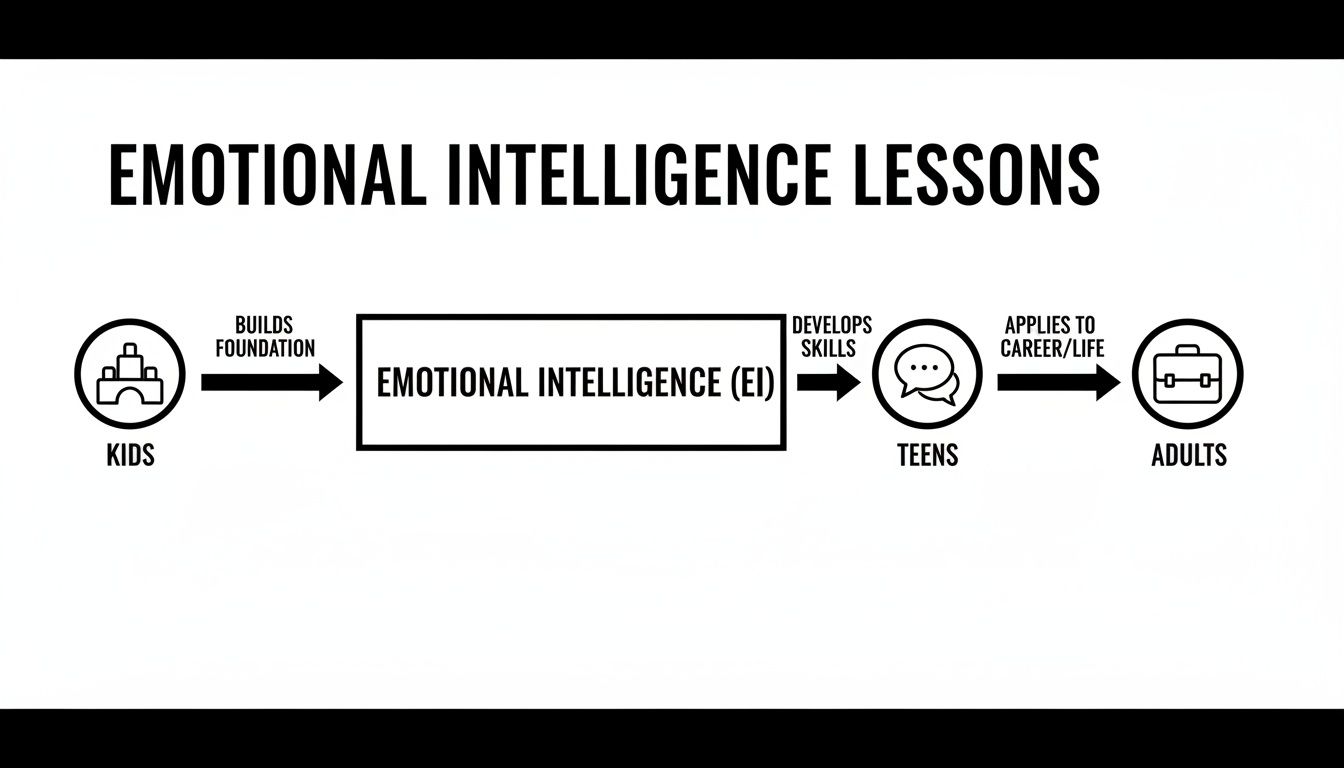
You can see how the approach evolves—what starts with simple emotional identification for a child deepens into nuanced social navigation for a professional. The core skills are the same, but the application has to grow with us.
Putting It All into Practice
Beyond asking potent questions, you can create activities that directly challenge each type's default emotional patterns. This is where the real "aha!" moments happen.
Let's walk through a couple of real-world examples.
Scenario 1: Helping a Type 4 Find Emotional Balance
The Type 4 Individualist often lives by the motto, "I feel, therefore I am." They can get so wrapped up in their emotions that they become overwhelmed by melancholy or envy.
A simple but powerful activity is a "Notice and Name" practice. When a big feeling hits, guide them to pause and say, "I am noticing the sensation of envy in my body," instead of their usual "I am so envious." That tiny shift in language creates just enough space to remind them they are the observer of the emotion, not the emotion itself. It’s a game-changing self-regulation tool.
Scenario 2: Guiding a Type 5 to Connect with Others
The Type 5 Investigator has a tendency to retreat into their mind when things get intense, detaching from their feelings and the people around them.
To help, I'll use a low-stakes social skills exercise. I might ask them to share one cool fact they learned with a colleague. But here's the twist: they also have to ask that person a question about their day and actually listen to the answer. This gently nudges them out of their analytical comfort zone and into the messy, rewarding world of human connection, building both empathy and social skills.
This really gets to the heart of it. By using the Enneagram, you're not just teaching skills; you're helping people connect with their own "human spirit" in a way that feels true to them. You're helping them find meaning, which is the ultimate goal of emotional mastery.
Measuring Growth and Celebrating Real Progress
Alright, so you’ve laid the groundwork. You’ve introduced the core ideas, run through some eye-opening activities, and sparked some pretty important conversations. Now for the million-dollar question: How do you know any of it is actually sticking?
Let’s be clear. Measuring emotional intelligence isn't about slapping a grade on someone's feelings. It’s about learning to spot the real-world, tangible shifts in how people act and react. Forget trying to put a number on "happiness." Instead, we're going to put on our detective hats and look for the behavioral clues that tell us the skills are taking root. These are the small wins that signal a major transformation is quietly unfolding.

From Feelings to Facts: Look for Observable Behaviors
The secret to tracking growth is to stop focusing on internal states and start watching for external actions. You can’t see empathy, but you can definitely see someone putting their phone down and truly listening without jumping in to give advice. You can’t see self-regulation, but you can see a colleague take a deep breath before responding to a critical email instead of firing back a defensive retort.
This is what makes progress concrete. You’re not judging emotions; you're acknowledging skilled responses in real time.
When you focus on these observable actions, you connect the dots between the "human spirit" and actual, measurable results.
Simple Assessment Tools That Actually Work
You don't need a PhD in psychometrics or some convoluted testing software to see what’s happening. In my experience, simple, behavior-focused rubrics or checklists are incredibly powerful, whether you're in a classroom or a boardroom. The goal isn't to assign a grade; it's to create a visual roadmap of the journey.
Think of it as a fitness tracker for emotional skills. You’re just logging the reps.
Example Rubric for Constructive Disagreement
This little tool can be a game-changer for an employee, a manager, or even a teenager learning to navigate conflict.
| Skill Level | Behavior |
|---|---|
| Beginning | Immediately becomes defensive or shuts down when challenged. Uses blaming language ("You always..."). |
| Developing | Listens to the other person but visibly tenses up. May interrupt to defend their position before fully hearing the other side. |
| Mastering | Pauses before responding. Asks clarifying questions ("Can you tell me more about that?"). Uses "I" statements to share their perspective. |
See? This isn't about shaming someone for being "bad" at arguments. It’s about giving them a clear, actionable path forward. When they can see themselves move from "Beginning" to "Developing," that's a massive win you can—and should—celebrate.
The Power of Reflection and Peer Feedback
While watching for behaviors is key, real change happens when people start noticing these things in themselves. Getting people to track their own journey is what builds ownership and deepens self-awareness.
This is where journaling and structured peer feedback become your best friends.
• Self-Assessment Journals: • Prompt learners to get specific. Don't just ask, "How did it go?" Instead, try: "Think of a moment today you felt a strong emotion. What was it, and what did you • do • with it?" This pushes them to connect the feeling to the action.
• Peer Feedback Circles: • Create a safe, structured space for people to share what they see in each other. On a team, you could have everyone share one thing they admire about a colleague's communication. The trick is to keep it positive and behavioral: "I really appreciated how you made sure everyone got a chance to speak in that meeting."
Practices like these build a culture where reflection is just part of the routine. It makes talking about emotional growth normal, turning everyone into a partner in the process. For a deeper dive, check out our guide on how to measure emotional intelligence for more techniques.
Celebrate the Wins, Big and Small
Here’s the most important part: you have to celebrate the progress. When you teach emotional intelligence, you're asking people to do hard, vulnerable work. Acknowledging their effort isn't just nice; it's essential.
Don't wait for perfection. Celebrate the baby steps.
That progress might be a child who, for the very first time, says, "I'm feeling really mad!" instead of throwing their blocks. It might be a management team whose weekly meetings suddenly have 50% fewer unproductive arguments because people are actually listening to understand, not just to reply.
These are the moments that reveal the true power of emotional intelligence. They show how tiny, intentional shifts in behavior snowball into massive, positive change. Every single time you spot one of these wins, call it out. Make it a success story. That positive reinforcement is the fuel that turns a single lesson into a lifelong practice of growth.
Common Questions About Teaching Emotional Intelligence
Let's be honest: even with a solid plan, teaching emotional intelligence can feel a bit like trying to bottle lightning. It’s messy, it’s human, and it’s completely normal to have questions swirling around.
So, let's dive into the common stumbling blocks I see people hit all the time. Think of this as your field guide to navigating the tricky parts with a lot more confidence and a lot less guesswork.
How Can I Teach Emotional Intelligence to Someone Skeptical?
Ah, the skeptic. You’ll meet them everywhere—the boss who thinks this is all “fluffy nonsense” or the teenager whose eyes glaze over the second you say the word “feelings.” This is a big one, and the secret isn't to argue harder. It's to change your language entirely.
For the data-obsessed leader in the corner office, you have to talk in terms of results. Frame emotional intelligence as a direct line to better productivity, lower turnover, and more effective teams. The numbers don't lie: teams led by emotionally intelligent managers consistently run circles around the competition.
For a resistant teen? Ditch the "emotional intelligence" label altogether. Connect the skills to what they actually care about.
• Mental Toughness: • Self-regulation isn't about feelings; it's about staying cool under pressure during the championship game or a final exam.
• Real Friendships: • Empathy is the superpower that helps you know what to say when a friend is having a meltdown.
• Unshakeable Confidence: • Self-awareness is just knowing your own strengths so you can walk into a party and own the room instead of hugging the wall.
Show them the "what's in it for me," and you'll see that skeptical armor start to crack. It always does.
What Are the Biggest Mistakes to Avoid?
I’ve seen a few train wrecks in my time, and they almost always stem from the same mistakes. The biggest pitfall is treating emotional intelligence like a one-and-done training session. It’s not a module to complete; it’s a muscle you build through practice, day in and day out.
The other huge error is making people feel bad about their "negative" emotions. The goal isn't to force a smile or pretend anger and sadness don't exist. The real win is helping people see that all emotions are valuable data . They're signals telling us something important about what’s happening.
That’s really the heart of it. You're a guide helping people find the meaning in their feelings, not a judge telling them which ones are acceptable. And, of course, you have to walk the talk. If you can't manage your own frustration in a meeting, you have zero credibility. Your actions will always shout louder than your lesson plan.
How Long Until I See Real Results?
Everyone wants to know this, and the answer is always the same: it’s a marathon, not a sprint. While you might spot little glimmers of progress pretty quickly, deep, lasting change takes time. And it's never a straight line—there will be setbacks.
Here’s a rough idea of what to expect:
• Weeks 1-4: • The first green shoots appear. A child might start using feeling words ("I'm frustrated!") instead of throwing a toy. A colleague might actually pause and take a breath before firing off a reactive email.
• Months 2-6: • This is where you start to see real behavioral shifts. Arguments at home become less frequent. A team starts collaborating more smoothly. People get better at giving and receiving tough feedback without getting defensive.
• 6 Months and Beyond: • The magic happens. The skills become second nature. People start using these tools instinctively, without even thinking about it. This is where true habits are born.
The key is to celebrate every tiny win. That moment of self-awareness or that small act of empathy? That's the foundation for everything that comes next.
Ready to unlock a deeper understanding of yourself and others? At Enneagram Universe , we provide the tools to explore your core motivations and fears. Take our free, scientifically validated Enneagram test to discover your type and get personalized strategies for growth. Visit us to begin your journey of self-discovery today.