How to Stop Feeling Alone and Unwanted: A Guide for Real Connection

Ever feel like you’re shouting into a void, even when you’re in a crowded room? It’s a gut-wrenching feeling, and if you’re nodding along, know this: you’re so far from being the only one. The first, and maybe most counterintuitive, step to shaking off that feeling of being unwanted isn't to rush out and meet a ton of new people. It’s actually to turn inward.
This isn’t about self-blame. Far from it. It's about getting smart— self -smart—so you can build connections that actually stick and feel good. We have to understand that loneliness isn't just about being by yourself; it's about feeling disconnected from the inside out.
Why You Feel Alone Even When You’re Not
That awful, invisible-in-a-crowd feeling? It’s a paradox of our hyper-connected world. We can scroll through hundreds of "friends" online, sit in a packed coffee shop, or even be at a family dinner, yet feel a cavernous sense of isolation.
Think of loneliness like a smoke alarm. It's a natural, built-in signal that's trying to tell you something important: a core human need for real, meaningful connection isn't being met. The trick is to figure out why the alarm is going off. Often, the culprits are hiding in plain sight in our everyday lives.
The Modern Roots of Feeling Unwanted
Our modern world, for all its wonders, has a knack for breeding loneliness. It’s not your fault; it’s baked into the system. Let’s look at a few common scenarios that might feel eerily familiar:
• The Workplace Grind: • Whether you're in a high-pressure office in New York City or working from your kitchen table in a quiet suburb, work can become a place of transactions, not connections. For instance, you might spend all day on Zoom calls discussing project deadlines but never have a real conversation about how your weekend was, leaving you feeling more like a line on a spreadsheet than a person.
• The Ever-Shrinking Circle: • Life happens. We get older, friends move away, start families, and suddenly, that weekly hangout becomes a "we should really catch up sometime" that never materializes. A practical example is when your best friend from college moves to a different state for a new job. The daily texts turn into weekly calls, then monthly check-ins, and the natural drift can leave you feeling left behind.
• Life’s Big Shake-Ups: • Moving to a new city, switching careers, or going through a breakup can feel like someone just unplugged your entire social support system. Imagine you've just relocated to Denver for work; you're surrounded by new streets and faces, but you have no one to call for a spontaneous Friday night movie. You’re left standing there, holding the cord, feeling completely adrift.
Take my friend Sarah. She landed her dream job and moved to Chicago, buzzing with excitement. A few months in, the reality hit: she was eating dinner alone every single night. Her colleagues were nice enough, but they had their own lives. She was in a city of millions and had never felt so profoundly alone. Sarah's story isn't about being unlikable; it's a perfect example of how a lack of meaningful connection is the real issue.
Let's be clear: The problem isn't a lack of people. It's a lack of belonging . It's that nagging feeling that if you vanished tomorrow, it might take a while for anyone to notice. Nailing this distinction is everything when you're learning how to stop feeling alone and unwanted.
This isn’t just a feeling; it’s a full-blown public health crisis. The data is staggering.
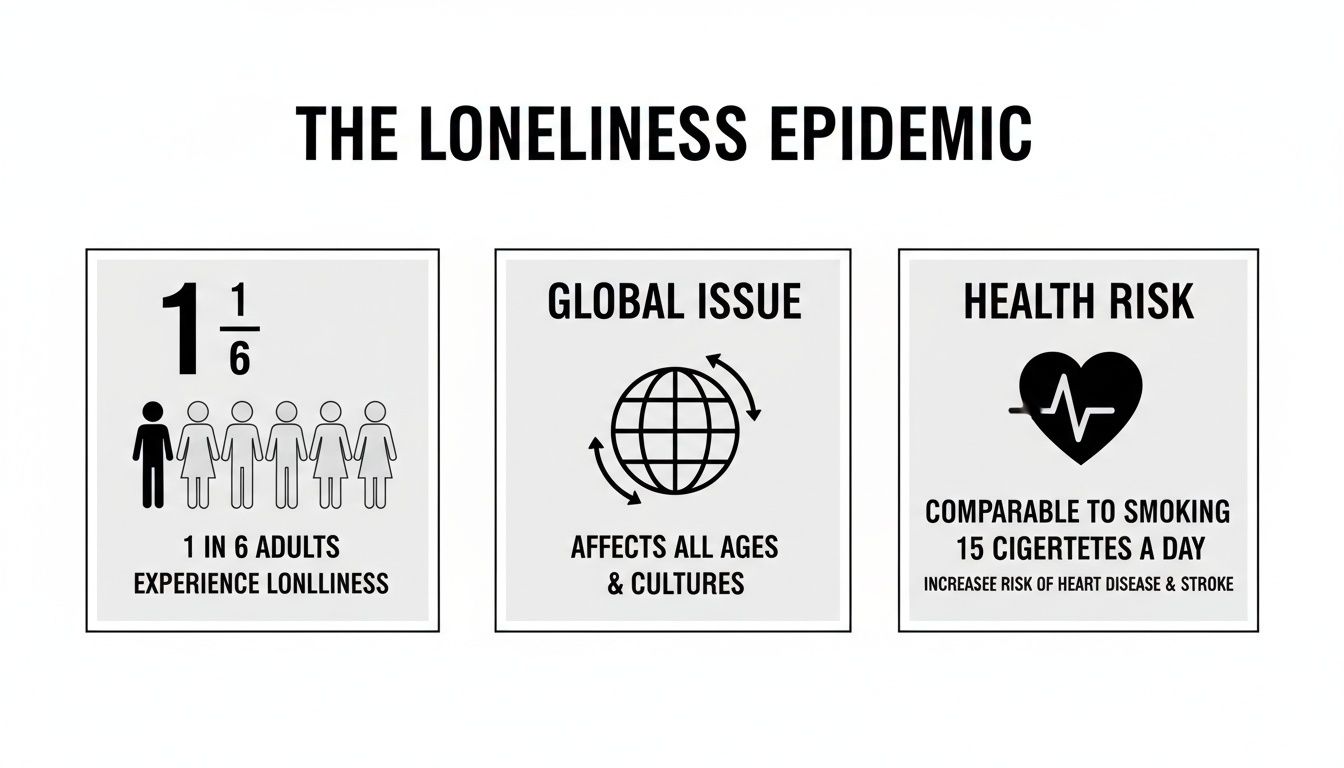
To really drive this home, take a look at the hard numbers. They can be oddly comforting, reminding you that this is a shared human experience, not some personal flaw.
The Loneliness Epidemic at a Glance
| Statistic | What It Means for You |
|---|---|
| 1 in 6 people feel the grip of loneliness worldwide. | You are absolutely not alone in feeling this way. It's a massive, shared experience. |
| 871,000 deaths are linked to loneliness annually. | This isn't just an emotional issue; it's a serious health concern that deserves attention. |
| It poses a mortality risk comparable to smoking 15 cigarettes a day. | Taking steps to connect isn't just "nice"—it's as vital as any other healthy habit. |
These aren't just numbers on a page; they represent real people feeling the same ache. Seeing the scale of the problem reframes it from "what's wrong with me?" to "how can I navigate this common human challenge?"
The journey out of this starts with you. It begins with getting curious about your own triggers and thought patterns. By building a better relationship with yourself, you lay the groundwork for a richer, more connected life with others.
Ready to start looking inward? Our guide on how to become more self-aware is the perfect place to begin.
Discover Your Personal Loneliness Blueprint with the Enneagram
If you want to really figure out how to stop feeling so alone and unwanted, you have to look beyond the usual, one-size-fits-all advice. Why? Because your brand of loneliness is as unique as your fingerprint. What makes you feel invisible is tied directly to your personal history, your secret fears, and your deepest longings.
This is exactly where the Enneagram shines. It's so much more than another personality quiz; it's a dynamic map of your inner world. Think of it as your personal loneliness blueprint. It uncovers the core motivations that drive everything you do and, more importantly, the specific fears that can make you accidentally create the very isolation you’re trying to escape.

When you understand your Enneagram type, you start to see that these isolating habits aren't some personal flaw you need to be ashamed of. They're predictable, almost automatic patterns wired into your personality. And once you can see the pattern, you finally get the power to change it.
Your Unconscious Habits and Loneliness
So, how does this actually work in the real world? Let’s ditch the abstract theories and get into how specific Enneagram types get stuck in cycles of feeling alone and unwanted.
Type 2: The Helper
Are you someone who lives to help others? The first person your friends call in a crisis, the one who never forgets a birthday, the person who can't help but say "yes" to a favor? If this sounds familiar, you might just be a Type 2. Your core motivation is a deep, driving need to be loved and wanted.
On the surface, this is a beautiful thing. The shadow side, though, is that your self-worth gets all tangled up in how much other people need you. You might feel completely drained from giving so much, but if you even think about stopping, a terrifying fear bubbles up: if I'm not useful, will I be unwanted? For a Two, loneliness feels like a punch to the gut—a total lack of appreciation.
• Real-World Example: • Let's talk about Maria, a classic Type 2 from Texas. She blows up her entire Saturday helping a friend, Mark, move into his new apartment. She cancels her own plans, hauls heavy boxes for hours, and even springs for pizza for the whole crew. A few days later, she’s scrolling social media and sees photos from Mark's housewarming party. She wasn't invited. For Maria, this isn't just a social snub; it feels like a fundamental rejection of who she is. The story she tells herself is, "They only want me around when I'm serving a purpose."
Type 4: The Individualist
Are you constantly driven by a need to be unique, authentic, and true to yourself? Do you find a strange comfort in your distinct identity and dread being seen as ordinary or insignificant? Welcome to the rich inner world of the Type 4.
Your powerful drive to be special can fuel incredible creativity and depth. The problem is, it can also lead you to focus so intensely on what makes you different from everyone else that you end up building walls. The very thing that makes you feel special can become the source of feeling separate and hopelessly misunderstood.
For a Type 4, loneliness feels like being a one-of-a-kind masterpiece locked away in a museum basement. You know you're valuable, but no one is there to see or appreciate you for who you truly are.
Type 9: The Peacemaker
Is your main goal in life to keep things peaceful, both inside yourself and with everyone around you? Do you go out of your way to avoid arguments, easily merge with what others want, and just keep things pleasant? You might be a Type 9.
Your knack for creating harmony is a true gift. The hidden pitfall, however, is that you can become so focused on avoiding conflict that you completely erase your own needs, opinions, and desires from the equation. You can become a ghost in your own life, which leads to a deep, profound loneliness that comes from not being truly seen—because you’ve made yourself invisible.
• Real-World Example: • Think about Tom, a Type 9 from California. His friend group is planning a weekend trip. Some want to go hiking, while others want to chill by a lake. Tom secretly wants to go hiking, but to sidestep even the slightest disagreement, he just says, "I'm happy with whatever!" The group, of course, chooses the lake. The whole trip, Tom feels this quiet, nagging sense of disconnection. He’s physically there, but he’s checked out emotionally because his true self never even got a seat at the table. He created his own loneliness by choosing harmony over authenticity.
This feeling of disconnection is more common than you think. Loneliness isn't just for the elderly; a revealing AARP study found that a staggering 40% of U.S. adults aged 45+ now report feeling lonely, a number that's shot up due to the pressures of modern life. This is where a personalized tool like the Enneagram becomes so incredibly helpful.
By spotting these automatic patterns, you can start making conscious choices instead. If you aren’t sure what your type is, a great next step is our step-by-step guide for beginners on how to find your Enneagram type . This kind of self-awareness is the first real, concrete step toward building the genuine connections you're craving.
Ready to Connect Without the Awkwardness?
Alright, you've done the heavy lifting of understanding why you feel lonely. That's huge. But now it’s time to move from just thinking about it to actually doing something about it. This is where we put down the theories and start taking real, practical steps to build your social world back up—minus the cringey, outdated advice.
The goal here isn't to suddenly become a social butterfly overnight. Forget that pressure. It’s all about taking small, manageable risks that build your confidence one conversation at a time. And we'll start with something I call "micro-connections."
Master the Art of Micro-Connections
Micro-connections are your secret weapon. They are tiny, low-stakes, genuine interactions that completely take the pressure off. You're not trying to make a new best friend; you're just reminding your brain that connecting with other humans can actually feel good.
Think about your daily routine. Where do you cross paths with people, even for a moment? The coffee shop, the grocery checkout, walking your dog? These are your new practice grounds.
For example, instead of just ordering your usual coffee with your head down, try making a little eye contact with the barista and asking a simple, open-ended question.
• Instead of: • "I'll have a medium latte."
• Try this: • "That new seasonal drink on the menu sounds interesting. Is it your favorite?"
This tiny shift changes the whole dynamic from a sterile transaction to a human moment. The barista might say, "Oh, it's good, but I actually prefer..." and just like that, you’ve had a pleasant little chat. You walk away with your coffee and a small but mighty boost of social success.
The point of a micro-connection isn't what you say; it's the simple act of reaching out. Each one is a small deposit in your social confidence bank account, proving to yourself that you can do this.
Level Up to Shared-Interest Connections
Once you start getting comfortable with those tiny interactions, you can level up to something a bit more involved: connecting with people over a shared interest. This is where the classic "join a club" advice actually works, but we're going to approach it with a much smarter strategy.
Here’s the deal: pick an activity you genuinely enjoy , not something you think you should do just to meet people. If you hate hiking, a hiking group will just make you miserable.
Try something that actually lights you up:
• A weekly yoga or fitness class
• A local volunteer opportunity (animal shelters are great for this!)
• A book club at your neighborhood library
• A board game night at a local cafe
The real key here is consistency . Show up. Week after week. Seeing the same faces over and over again builds a natural sense of familiarity, which is the soil where friendship begins to grow. A practical example would be joining a Wednesday night pottery class. For the first few weeks, you might just nod at the person at the wheel next to you. By week four, you can comment on their cool mug design. By week six, you're laughing about a shared pottery fail. This consistent, low-pressure contact is how friendships form organically.
Your Go-To, Non-Awkward Conversation Starters
Okay, let's be real—the scariest part is just breaking the ice. So, here are some simple, field-tested conversation starters that don't feel forced. The trick is to make an observation about your shared environment.
• At a yoga class: • "This is my first time at this studio, the vibe is great! Have you tried any other classes here?"
• At a volunteer event: • "Wow, we've packed a lot of boxes today. It feels good, right? What made you decide to volunteer here?"
• At a book club: • "I had such a hard time with that plot twist. What did you think of it?"
These work because they are context-specific and invite the other person to share their opinion, which is the perfect launchpad for a real conversation.
Action Plan for Your Enneagram Type
Since your personality shapes how you experience loneliness, your action plan should be personal, too. Here are some starting points for three Enneagram types that often feel the sting of isolation.
| Enneagram Type | Core Loneliness Fear | First Action Step |
|---|---|---|
| Type 2: The Helper | Being unwanted or unneeded by others. | Practice a micro-connection where you receive help. Ask the grocery clerk for their opinion on the best apples or ask a colleague for a quick tip. The goal is to connect without giving. |
| Type 5: The Investigator | Being overwhelmed or drained by social demands. | Find a low-energy, shared-interest group, like a book club or a chess group. The focus is on the activity, not forced small talk, which takes the pressure off. |
| Type 9: The Peacemaker | Losing yourself or being overlooked in a group. | Identify one person at a recurring event (work, a class) and make it your mission to say a simple "hello" by name each time you see them. This builds a one-on-one connection where you feel seen. |
This isn't about changing who you are; it's about using your natural wiring to your advantage as you take these first few steps.
From Isolation to Community: A Real-Life Example
Let's talk about Matt, a remote worker in the American Midwest. After his company went fully remote, his daily human interaction dwindled to his cat and the Amazon delivery driver. He felt crushingly alone and unwanted, watching his social skills get rusty.
Instead of trying to force a bunch of new friendships, Matt started small. He committed to working from the same local coffee shop every Tuesday morning. At first, he just did his work. Then, he started making micro-connections with the staff. Soon enough, he noticed another guy who was also there every Tuesday.
One day, he used a shared-interest starter: "I see you here every week, too. I'm Matt. Is this your go-to remote office as well?" It turned out the other guy, David, was also a remote worker feeling the same isolation. That simple conversation blossomed into a weekly "co-working" meetup, which then grew to include a few other regulars. Within six months, Matt had a solid group of local friends—all because he started with one small, consistent action.
The global tide of social isolation is rising, making proactive connection more vital than ever. A recent analysis in JAMA Network Open revealed that social isolation surged by 13.4% between 2009 and 2024, with sharp drops in in-person hangouts for men and young people post-COVID. If you're struggling with this, our guide on building the relationship skills you need offers even more support.
Rewire Your Mind from Feeling Unwanted to Unstoppable
That nagging feeling of being unwanted isn't just about what's happening around you; it's often fueled by a powerful, persistent inner critic. This voice is a master storyteller, twisting any situation—a missed invitation, an unreturned text—into "proof" that you're not liked. To really stop feeling alone and unwanted, you have to learn how to talk back to that narrative. It means rolling up your sleeves and doing the internal work to change the thought patterns that keep you feeling stuck.
The great news? Your thoughts aren't facts. You absolutely have the power to challenge them, question them, and ultimately, change them. Let’s get into the practical tools you can use to shift your mindset from feeling unwanted to feeling unstoppable.

Challenge Your Inner Critic with Cognitive Reframing
Think of cognitive reframing as becoming a detective of your own mind. You're actively questioning a negative thought, looking for evidence that contradicts your inner critic's harsh judgments, and then replacing it with a more balanced and empowering one.
Here’s how it works in the real world. The next time you feel yourself spiraling into a negative thought pattern, just pause and challenge it.
For example:
• The Automatic Negative Thought: • • “My friends went out without me. They must be sick of me and don't want me around anymore.” • This thought feels heavy and final, right? It leaves zero room for other possibilities.
• The Challenge: • Ask yourself: Is there • any • other explanation? Have they • really • been avoiding me, or is this a one-off? What evidence do I have that they • do • care about me? (Think about past texts, hangouts, or inside jokes.)
• The Reframe: • • “My friends might just have needed a low-key night, or maybe it was a last-minute plan. It doesn’t mean they don't value our friendship. This is actually a great opportunity for me to have a relaxing evening to myself. I can reach out and suggest we all get together next weekend.”
This isn't about slapping on a fake smile. It’s about acknowledging other, more likely truths. This simple shift takes you from being a victim of your circumstances to being in control of your response. For anyone serious about this journey, learning how to rewire your brain with proven daily practices is a game-changer.
Use Journaling to Uncover the Roots of Loneliness
Journaling creates a safe, private space to explore where these feelings are coming from, without any judgment. Instead of just documenting your day, use pointed prompts to dig deeper into that "unwanted" story you’ve been telling yourself. This is a powerful way to build self-compassion, simply by taking the time to understand your own story.
Try these prompts the next time you feel that familiar ache of loneliness:
• When did I first start feeling this way today? What was the trigger? (e.g., "I felt it when I saw an Instagram story of my coworkers at happy hour without me.")
• What story is my inner critic telling me about this situation? Write it down, word for word. (e.g., "They secretly have a group chat without me and think I'm boring.")
• If my wisest, kindest friend were sitting here, what would they say to me right now?
• What is one small, kind thing I can do for myself in this moment?
This process gets the negative thoughts out of your head and onto paper, making them so much easier to examine and dismantle. It’s a direct conversation with yourself that builds true understanding and kindness.
Ground Yourself When Overwhelm Strikes
Sometimes, the feeling of being unwanted is more than a thought—it's a full-body experience. Your chest might feel tight, your stomach might churn, and a wave of anxiety can make it impossible to think clearly. In those moments, you need a quick tool to bring you back to the present. The 5-4-3-2-1 grounding technique is perfect for this.
It’s incredibly simple. Wherever you are, just stop and silently name:
• 5 • things you can see around you. (My laptop, the blue mug, the plant on the windowsill, a dust bunny, my own hands.)
• 4 • things you can physically feel. (The texture of my jeans, the smooth desk, the cool air from the vent, the tension in my shoulders.)
• 3 • things you can hear. (The hum of the fridge, a car driving by outside, the sound of my own breathing.)
• 2 • things you can smell. (The faint scent of coffee, the soap on my hands.)
• 1 • thing you can taste. (The lingering taste of my lunch.)
This technique yanks your focus away from the overwhelming internal storm and anchors you in your immediate physical environment. It’s a pattern interrupt that breaks the anxiety loop and gives your nervous system a chance to reset.
A Real-World Example Consider Mark, an American man in his late 40s living in Ohio. After a difficult divorce, he was crushed by loneliness. Weekends were the worst; seeing friends' family photos pop up on his feed would send him into a spiral, convinced his new single status made him an unwanted burden.
He started using these tools. When the thought "No one wants the divorced guy at their party" crept in, he reframed it: "My friends are adjusting, and so am I. It's my job to show them I'm still the same friend and suggest things we can do." He began journaling to process his grief and used the 5-4-3-2-1 technique when the silence in his apartment felt deafening. This internal work was the turning point in his healing, proving that the most critical work you'll ever do is often within your own mind.
Turn Casual Chats Into Meaningful Friendships
So, you’ve mastered the art of small talk. You’re exchanging pleasantries with the barista, nodding to your neighbor—you're getting out there. That’s awesome, and it's a bigger deal than you think. But now comes the tricky part: How do you turn that friendly chat into a real, honest-to-goodness friendship?
This is where so many of us freeze up. The fear of being seen as awkward, needy, or just plain weird can be paralyzing.
Let's put that fear on notice. The secret isn't some grand, dramatic gesture. It’s about learning how to slowly and naturally invite people a little closer, in a way that feels completely comfortable for both of you. This is your playbook for turning those "see you around" people into the friends you've been looking for.

From Acquaintance to Friend: The Low-Pressure Invitation
Leaping from "person I see at yoga" to "person I grab coffee with" can feel like you're trying to jump the Grand Canyon. The trick is to make the gap smaller with a low-pressure invitation. The magic formula? Keep it specific, casual, and incredibly easy for them to say "no" to.
This whole approach removes the emotional weight. It frames the invite as a simple "Hey, if you happen to be free..." instead of a heavy-handed "Please be my friend!" request.
Here are a few scripts you can steal:
• To a work colleague: • "I'm escaping my desk for a coffee downstairs around • 2 PM • . Want to join and save me from my spreadsheet coma?"
• To someone from your book club: • "Hey, I'm thinking of hitting up that new taco place after our meeting next week. You interested?"
• To a neighbor you chat with: • "I'm taking my dog to the park Saturday morning. You should totally bring yours along if you're free!"
See the pattern? Each one has a built-in escape hatch. If they can’t make it, it’s not a personal rejection. They might just be busy, or maybe tacos aren't their thing. Learning to see a "no" as simple information, not a judgment on your worth, is a massive step in figuring out how to stop feeling alone and unwanted .
The Art of Sharing Without Oversharing
Real connection is built on vulnerability, but the fear of TMI (Too Much Information) is also very real. Nobody wants to be the person who trauma-dumps their life story onto a brand-new acquaintance over lattes.
The solution is to practice what I call gradual disclosure .
Think of it like dipping your toe in the water. You share one small, low-risk personal detail, and then you pause to see how the other person reacts.
A Real-World Example: Imagine you're chatting with a new acquaintance, Alex, about weekend plans.
• The Overshare: • "I'm not doing anything. Weekends are the worst since my breakup, and I just end up feeling so lonely and miserable." (Whoa, too much, too soon.)
• The Gradual Disclosure: • "I'm actually trying to get back into some old hobbies. I saw a local pottery class I might check out this weekend, just to get out of the house." (This shares a personal goal without being overwhelming.)
This gives Alex an easy opening to respond with encouragement ("That sounds amazing!"), share something similar ("Oh, I've been wanting to do that!"), or just ask more questions. Their reaction is your cue for how much more to share.
Navigating Friendships With The Enneagram
Just as the Enneagram can shine a light on your own loneliness triggers, it’s an incredible map for understanding how to connect with others. You don't need to ask for their number, just pay attention! Knowing what makes a potential friend tick can help you build a much stronger bond and sidestep common misunderstandings.
• Your Enneagram 2 (The Helper) friend: • This person feels loved when they feel needed and appreciated. A simple, "Thank you so much for listening; you always have the best perspective," means the world to them.
• Your Enneagram 5 (The Investigator) friend: • This friend guards their time and energy like a dragon guards its gold. Instead of a spontaneous "Let's hang out now!" try, "I'd love to pick your brain on this book sometime next week when you have the bandwidth." It shows you respect their need for space.
• Your Enneagram 7 (The Enthusiast) friend: • This friend is powered by fun and new experiences. An invite to a weird new escape room or a random street festival is the perfect way to speak their language.
Seriously, you don't need to make them take a test. By just listening and observing, you'll start to get a feel for their core motivations. If you want to get really strategic, you can even borrow ideas from event planning—thinking about how to group people to naturally spark conversations and make new connections can work just as well for a small dinner party as it does for a big conference. The principles are pure gold.
Your Questions on Loneliness Answered
Deciding to face loneliness head-on takes guts. Seriously. It's a journey, not a race, and there will absolutely be some unexpected detours. So, let's talk through a few common questions and snags that pop up, so you feel ready for whatever comes your way.
What If I Try All This and I
Still
Feel Lonely?
First things first, take a deep breath. Progress is never a straight line, and some days are just going to feel heavier than others. This isn't about getting it perfect; the real win is consistency over perfection . When you hit a rough patch, try not to see it as a total failure.
Instead, dial it back to the basics. Did you have a pleasant, two-minute chat with the cashier? That’s a win. Celebrate it! Go back and re-read some of the cognitive reframing exercises. Gently push back on the story your inner critic is spinning about this setback. For example, if you go to a book club meeting and don't talk to anyone new, instead of thinking "I failed," try "I showed up, and that's the hardest part. Next time, I'll aim to ask one person a question."
Remember, getting help isn't a sign that you've failed; it's a sign that you're getting serious about your own happiness. If that feeling of being alone and unwanted just won’t let up and is messing with your daily life, it might be the perfect moment to talk to a professional.
A therapist can give you strategies tailored specifically for you and help you dig into the deeper roots of loneliness, like social anxiety or old wounds. It’s an incredibly brave and powerful act of self-care.
How Can I Tell If I'm Just an Introvert or Actually Lonely?
This is a fantastic and super important question. The real distinction boils down to one simple thing: your energy and your emotions .
Introversion is just about how you recharge your social battery. Introverts get their energy back by spending time alone and can feel totally wiped out by too much socializing. But—and this is a big but—they absolutely still crave and need deep, meaningful connections.
Loneliness, on the other hand, is that painful feeling that your need for connection is going unmet. It’s a feeling of lack, and it can hit anyone, whether they're an introvert, an extrovert, or somewhere in between.
• An introvert • might spend a weekend curled up with a good book and feel perfectly content and recharged.
• A lonely person • could spend that exact same weekend alone and feel a painful, isolating void.
The key is the emotion attached to the solitude. One feels like peaceful contentment, the other feels like aching distress. The Enneagram really helps clarify this; a Type 5, for instance, is a natural introvert who needs solitude, but they'll feel intensely lonely without a few trusted people to share their big ideas with.
I'm So Anxious I Can't Even Imagine Trying to Make Friends. Where Do I Start?
I hear you. When social anxiety is screaming in your ear, the goal of "making friends" can feel as realistic as climbing Mount Everest in your flip-flops. So, let's just toss that goal out the window for now. We need to start smaller. Much smaller.
Your first mission, should you choose to accept it, isn't to make a friend. It's simply to exist comfortably around other people .
Start here:
These are what I call micro-interactions. They slowly and gently teach your nervous system that social situations aren't life-threatening. You’re building a foundation of safety from the ground up, proving to yourself, one tiny success at a time, that you've got this.
Your path to connection starts with understanding yourself. Here at Enneagram Universe , we create tools to help you map your inner world, build self-awareness, and forge the authentic relationships you truly deserve. Take our free, in-depth Enneagram test today and unlock your personal path to belonging.