How to Stop Avoiding Conflict and Build Stronger Relationships

Alright, let's get to the heart of the matter. If you’re reading this, chances are you’ve mastered the art of the tactical retreat. You know, when a conversation starts to get a little… tense. But to stop running from conflict, you first have to understand why you're running and what that sprint to safety is really costing you.
It's a familiar feeling, isn't it? That knot tightening in your stomach when you need to tell your boss their "quick question" is actually a two-hour project you don't have time for. Or the way your pulse quickens when you need to bring up that same issue with your partner for the tenth time. Dodging it feels like a win. It feels like peace.
But that peace is a cheap imitation. Avoiding conflict isn't a strategy for a happy life; it's a slow-burn sabotage that quietly erodes your relationships, your career, and your self-respect.
The Hidden Fears Pulling the Strings
Let's be clear: avoiding conflict isn't a character flaw. It's a deep-seated survival instinct. We're wired to protect ourselves, and your brain has flagged difficult conversations as a genuine threat. The reasons why can usually be traced back to a few core fears.
See if any of these sound familiar:
• Fear of Rejection or Abandonment: • You bite your tongue because you're terrified that speaking your truth will make someone pull away. You worry that if you disagree, set a boundary, or ask for what you need, you’ll be disliked, dismissed, or even left behind. For example, you might agree to host a family holiday you can't afford because you're afraid saying "no" will make your relatives think you don't care about them.
• Fear of Harming Others: • For the natural caretakers out there, the thought of causing someone else discomfort is just unbearable. You'd rather swallow your own frustration than risk ruffling feathers, even when it means your own needs go completely unmet. A practical example is staying silent when a friend consistently shows up late, because you don't want to make them feel bad, even though it makes you feel disrespected.
• Fear of Losing Control: • Let's face it, conflict is messy. It's unpredictable. You can’t script the other person’s reaction, and that sheer uncertainty can feel paralyzing. Keeping quiet feels like you’re at least in control of the • immediate • moment, even as the real problem mushrooms in the background. Think about not bringing up a serious budget issue with your partner because you can't predict if they'll get angry, sad, or defensive.
• Fear of Being the "Bad Guy": • Most of us are taught to be nice, to be agreeable. Voicing a complaint can feel like you’re breaking some sacred social contract, instantly casting you as the "difficult" one or the buzzkill.
Ever let a coworker’s distracting habit derail your focus for weeks on end because you just didn’t want to be that person who complains? That’s the fear of being the "bad guy" running the show.
The High Price of Keeping Quiet
This habit of avoidance isn't a harmless quirk. It has a real, tangible cost, creating a ripple effect that damages the things you care about most. You're trading long-term happiness for a few moments of temporary comfort.
Just look at the workplace. A staggering 85% of employees deal with conflict at their jobs. It’s so pervasive that it leads to a mind-blowing $359 billion in lost productivity every year across major markets in the US and Europe. That's not just a few people having a bad day; it's a colossal economic drain that starts with simple avoidance. When issues are ignored, they fester, with unresolved problems tanking team output by as much as 27% if they're left to linger for just two weeks. If you want to see the full, jaw-dropping picture, check out these conflict resolution statistics.
"Avoiding a difficult conversation is a short-term solution that creates a long-term problem. The issue you sidestep today becomes the crisis you're forced to confront tomorrow."
At home, the stakes are even higher. Dodging the conversation about finances or unequal chores doesn't make the tension vanish. It just turns it into resentment. Intimacy doesn’t die in a big, dramatic explosion; it dies a death by a thousand cuts—a thousand tiny issues that were swept under the rug.
How Your Personality Plays Into the Avoidance Trap
Your natural wiring has a massive influence here. This is where tools like the Enneagram become so powerful—they shine a light on the why behind your actions.
• Enneagram Nines (The Peacemaker): • Your core desire is inner harmony. To keep the peace, you’ll often merge with others' opinions and desires, subconsciously erasing your own to avoid rocking the boat. For instance, you might publicly agree with a political opinion you privately disagree with, just to prevent an argument from starting at a dinner party.
• Enneagram Twos (The Helper): • You're driven by a need to be loved and wanted. This can make you avoid any disagreement that might jeopardize the approval you work so tirelessly to secure. A classic example is taking on extra work for a colleague, even when you're swamped, because you're afraid they won't like you if you say you're too busy.
• Enneagram Sixes (The Loyalist): • Your focus on security means you’re often anxious about disrupting the status quo. Challenging a boss or a partner can feel like you're threatening the very stability you crave. For example, you might not question a new company policy you think is unfair because you fear it could put your job at risk.
Getting brutally honest about your specific "why" is the first and most important step. This isn't about blaming yourself. It's about developing the self-awareness to finally see the pattern for what it is: a self-sabotaging habit you have the power to break. Once you've dissected the fear, you can start building the skills to create the authentic, connected life you truly want.
Rewiring Your Brain to Face Disagreements Head-On
Let's be real: changing a lifelong habit of dodging conflict isn't like flipping a switch. It's more like being a personal trainer for your own brain. For years, you’ve taught it that every disagreement is a five-alarm fire. Now, it's time to show it that facing these "fires" is actually how you build emotional muscle.
The great news is that our brains are remarkably flexible. You can absolutely create new, healthier defaults. This process doesn't start with a massive, soul-baring confrontation. It begins with small, internal shifts that completely change how you see and prepare for those tough talks.
The 5-Minute Reframe
The stories you tell yourself about conflict are running the show. If your internal monologue is "disagreement equals danger," your body is going to react like you're about to wrestle a bear. This quick mental exercise is designed to challenge those old, tired scripts.
When you have a quiet moment, grab a notebook. First, jot down your biggest fear about conflict. Is it, "If I push back, they'll think I'm a jerk"? Or maybe, "Speaking up will just make everything ten times worse."
Now, it's time to play detective and look for the hard evidence. Ask yourself:
• Is this belief • always • true? • Like, • 100% • of the time, with no exceptions? Can you think of even one time a disagreement actually led to a better outcome? For example, remember that time you and your friend argued about where to go for dinner, but it led to a great conversation about your budgets and you found a new favorite, affordable spot?
• What has • avoiding • this conversation actually cost me? • Let's get specific. Think about the sleepless nights, the simmering resentment, or the trust that's slowly eroding.
• What's a more realistic story? • Instead of "conflict is a disaster," how about trying on, "Handled with care, conflict can actually bring us closer."
Just asking these questions interrupts that automatic fear response. It creates a tiny crack in the old programming, giving you just enough room to choose a different path.
Shifting your perspective is the first real step. You start to see conflict not as a threat to your peace, but as an opportunity for real clarity and stronger connections.
This little loop below is what we're trying to break. It’s the cycle so many of us get stuck in.
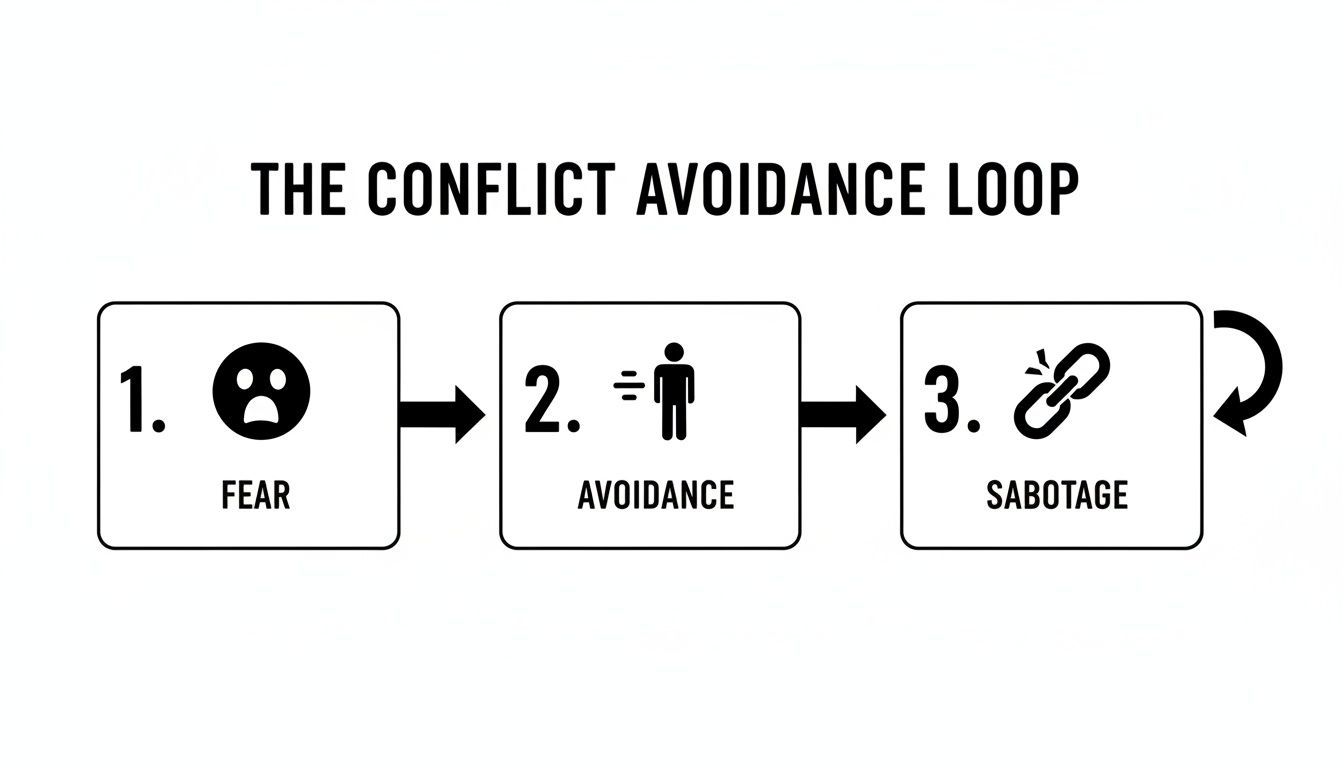
The fear leads to avoidance, which, ironically, ends up sabotaging the very relationships and harmony we were trying so desperately to protect.
Taming Your Physical Triggers
Ever notice how your body seems to know a conflict is brewing before you do? That knot in your stomach, the heat creeping up your neck, the sudden jackhammering in your chest—those aren't just feelings. That's your nervous system hitting the panic button and flooding you with fight-or-flight chemicals.
The trick is to treat these signals as an early-warning system, not a command to retreat. When you feel that familiar tightness, don't run from it. Instead, just notice it. "Ah, there's that feeling again. My body thinks we're in danger, but I've got this."
This is your cue to drop an anchor.
This isn't just fluffy wellness advice; it's a physiological hack. This breathing pattern sends a direct message to your brain: "We're safe. Stand down." It's like a manual override that brings your logical mind back online so you can think clearly.
Starting Small With Actionable Scripts
You wouldn't walk into a gym for the first time and try to bench-press 300 pounds, right? So don't start your conflict-facing journey by confronting your biggest, most emotionally charged issue. The name of the game is building confidence through small, manageable wins.
You need to rack up some proof for your brain that you can, in fact, survive a disagreement. Start with low-stakes stuff where the potential fallout is tiny. This is how you build your "conflict muscle."
The table below is your cheat sheet for getting started. Think of it as a set of training wheels to get you moving.
Your First Steps From Avoidance to Action
| Scenario Level | Example Situation | Your Goal | Starter Script |
|---|---|---|---|
| Easy | The barista messed up your coffee order. | Get the right order without feeling rude. | "Excuse me, I'm so sorry, but I think I ordered the oat milk latte. Would it be possible to remake this?" |
| Medium | A friend borrowed $20 two weeks ago and forgot. | Gently remind them and get your money back. | "Hey, I was just going over my budget and wanted to check in about the $20 from the other week. Is now a good time for that?" |
| Advanced | Your partner keeps leaving their stuff all over the place. | Express your need for a tidier space without blaming. | "I feel a little stressed when the living room is cluttered. Could we find a better spot for our things together?" |
Each time you successfully navigate one of these small moments, you're gathering powerful evidence that contradicts your old, fearful beliefs. You are actively, tangibly rewiring your brain—one calm, courageous conversation at a time.
Mastering the Art of Constructive Conversation
Alright, you’ve done the internal work of reframing conflict from a monster under the bed to a genuine opportunity. That’s huge. But now comes the actual conversation. The face-to-face part.
Knowing how to kick things off is one thing, but learning to steer the ship through the choppy waters of a disagreement is what really changes the game. This is where you swap out those old, rusty tools of blame and silent treatment for a shiny new set built on clarity, empathy, and respect.
Let's turn those potential shouting matches into moments of real connection.

Ditch the Accusations with a Simple Formula
Want to kill a conversation before it even starts? Lead with an accusation. The second someone hears "You always..." or "You never...," their brain slams the door shut and puts up the defensive barricades.
The secret is to flip the script. Instead of pointing a finger at their behavior, talk about your experience. The "I Feel, When You, Because" formula is an absolute game-changer here.
• I Feel... • Name your emotion. Be specific. ("I feel overwhelmed...")
• When You... • Describe the • exact • , observable behavior without judgment. ("...when dirty dishes are left in the sink...")
• Because... • Explain the underlying need that isn't being met. ("...because I need a sense of order in our home to really relax.")
Put it all together: "I feel overwhelmed when dirty dishes are left in the sink because I need a sense of order in our home to really relax."
Feel the difference? It’s a world away from, "You always leave your disgusting dishes everywhere!" One invites a solution; the other starts a war.
Validate Their Feelings (Even if You Disagree)
Active listening isn’t just about staying quiet until it’s your turn to talk. It's about making the other person feel heard . This is the magic ingredient for dialing down the tension, and the key is validation .
Let's be clear: validation does not mean you agree with them. It just means you acknowledge that their emotional reality is real for them . A practical example is when a coworker is upset about a project deadline you think is reasonable. Instead of arguing, you can say, "It sounds like this timeline is causing a lot of stress for you. I can see why you're feeling overwhelmed."
A simple "I can see why you'd feel frustrated by that," or "Wow, it sounds like that was really difficult for you," can work miracles. It lowers defenses and opens the door for actual problem-solving.
When someone feels seen, they become infinitely more willing to hear your side. The dynamic shifts from a battle of who's right to a team of two exploring different perspectives.
A Tale of Two Conversations
Let's put this into practice. Picture Alex and Jamie, a couple who are both fried after a long week. The apartment is a mess, and the air is thick with unspoken resentment.
Version 1: The Blame Game
• Alex: • "I can't believe you just dumped all your stuff on the counter again. Am I your maid?"
• Jamie: • "Oh, here we go. I had a brutal day! Can't you cut me some slack instead of nagging me the second I walk in?"
This is a dead end. It’s a vicious cycle of blame and defensiveness. Nobody wins. Now, let's rewind and try again with our new tools.
Version 2: The Constructive Approach
• Alex: • (Taking a deep breath) "Hey, can we talk for a sec? • I feel • really stressed and a bit resentful • when • the kitchen is a mess at the end of the day, • because I need • us to feel like a team in keeping our home peaceful."
• Jamie: • (Pauses, caught off guard by the non-attack) "I hear you. I know it's messy. I've just been so drained from work that I completely shut down when I get home."
• Alex: • "That makes sense, it sounds like you're totally burned out. I get that. How can we make this work for both of us?"
See the massive difference? The second conversation identifies the real problem (clutter), expresses the core need (teamwork), and validates the other person's reality (burnout). This is how you stop running from conflict and start building a stronger connection. To truly get this right, you have to learn how to fix relationship communication problems at their root.
Don't underestimate the cost of letting these issues fester. One study found that U.S. workers lose an average of $3,216.63 per employee annually because they spend 2.8 hours every single week tangled up in workplace conflicts. The good news? Communication training works. A stunning 76% of trained employees see positive results, with 95% achieving win-win outcomes.
Setting Boundaries with Grace
Finally, a huge part of healthy conflict is knowing how to set and hold your boundaries. This isn't about building walls to keep people out; it's about drawing a line in the sand that protects your peace and well-being.
A graceful boundary sounds like this:
• "I love chatting with you, but I can't take work calls after 7 PM. I really need that time to decompress."
• "I want to figure this out with you, but I won't continue the conversation if you're raising your voice. We can take a break and come back when we're both calm."
Boundaries teach people how you expect to be treated. When you deliver them with kindness but firmness, they don't push people away—they create the safety and respect needed for a real connection to grow.
Enneagram Secrets for Peace-Seekers and People-Pleasers
Ever wonder why the thought of a simple disagreement sends you running for the hills? Your personality is like a hidden blueprint for how you handle conflict. For some of us, that blueprint has "ABORT MISSION!" written in giant, flashing letters.
If you consistently swallow your words just to keep the peace, the Enneagram can be a stunningly accurate mirror. It shows you exactly why you retreat and, more importantly, how to find a better path forward.
While any personality type can dodge a difficult conversation, a few are practically hardwired for it. Let's dig into the core motivations of Enneagram Types Nine, Two, and Six—our beloved peace-seekers, people-pleasers, and loyalists. This isn't just theory; it's a practical roadmap to help you turn your greatest fear into your biggest strength.
The Type Nine Peacemaker
If you're a Nine, your whole world is built around a deep desire for harmony, both inside and out. You're the ultimate mediator, gifted at seeing every single side of an issue. But this superpower has a shadow side: you live in fear that any discord will shatter your inner peace, leaving you feeling fragmented and disconnected.
To avoid that feeling, you unconsciously merge with other people's agendas. You put your own needs and opinions on the back burner until they practically vanish.
Your growth path is all about learning that your voice doesn't have to be a grenade; it can be a bridge. Real peace isn't just the absence of tension—it's the presence of a genuine connection built on honesty.
• Try out "I" statements. • Start small. Instead of your usual, "Whatever everyone else wants is fine," try saying, "I'd actually prefer to see the comedy tonight."
• Lean into the discomfort. • The next time you disagree, just sit with that slightly queasy feeling for a moment. Notice that the world doesn't end. The other person doesn't shatter. And surprisingly, your inner peace is still there.
• Schedule "What do I want?" check-ins. • A few times a day, just pause and ask yourself, "What do I • actually • want right now?" It’s a simple practice that helps you reconnect with the voice you've learned to mute.
From Fear to Fuel: Your fear of fragmentation can transform into a passion for true integration. You'll discover that your presence and opinions are what make relationships whole, not what breaks them apart.
The Type Two Helper
For a Two, being loved and needed is like oxygen. Your entire being is geared toward helping others, anticipating their needs, and earning their affection. The thought of a conflict that could cause someone to withdraw that love is nothing short of terrifying.
So, you avoid setting boundaries or expressing needs that might inconvenience anyone. The problem? It often leads to a deep, simmering resentment when your own unspoken needs inevitably go unmet. If this sounds painfully familiar, our guide on how to stop being a people-pleaser offers a deeper dive.
Your journey is about realizing that authentic love isn't conditional. It doesn't just evaporate the second you have a need of your own.
• Start with a gentle "No." • Begin by declining small, low-stakes requests. "I'm so sorry, but I can't help with that project this weekend." You don't need a ten-page excuse. A simple, kind refusal is more than enough.
• State a need directly. • No more hinting! Instead of sighing loudly and hoping your partner magically intuits your exhaustion, try saying, "I really need some quiet time to myself after work today."
From Fear to Fuel: Your fear of being unloved can become the motivation to build relationships on a foundation of mutual respect, not just one-way service. You teach people that your love is a gift, not an obligation earned by neglecting yourself.
This isn't just a personal quirk; it's a massive issue in the workplace. A sobering stat reveals that 49% of emerging leaders lack effective conflict skills, and a mere 12% are actually proficient. This fuels a vicious cycle where 60% of employees never get basic conflict training, leaving avoidance as their only strategy.
It's no wonder that 36% of workers now face conflict frequently, a noticeable jump from 29% in 2008 . This erodes not just job satisfaction but also the feeling of inclusion at work. Understanding your personality's wiring, as highlighted in recent research on manager conflict skills , is the first powerful step in breaking that cycle.
The Type Six Loyalist
As a Six, you're driven by a deep need for security and support. You are incredibly loyal, responsible, and absolutely brilliant at spotting potential problems from a mile away. But this worst-case-scenario thinking also makes you intensely anxious about disrupting the status quo.
Challenging authority or questioning a loved one can feel like sawing off the very branch you're sitting on. It triggers a deep-seated fear of being left all alone, without support.
Your path forward is learning to trust your own inner authority. It's about recognizing that true security comes from tackling problems head-on, not from pretending they don’t exist.
• Gather your data. • Your mind is already a pro at spotting problems. Before bringing something up, write down the facts of the situation. This grounds your concerns in reality, separating them from free-floating anxiety. For instance, if you're concerned about a new project's timeline, list the specific tasks and realistic time estimates before you approach your manager.
• Lead with curiosity. • Instead of launching in with an accusation, start by asking clarifying questions. "Can you help me understand the thinking behind this new policy?" It feels much less confrontational and immediately invites dialogue instead of defensiveness.
From Fear to Fuel: Your fear of being unsupported can become a powerful drive to create genuinely secure, trustworthy relationships. By bravely voicing your concerns, you don't destroy security—you build it on an unshakeable foundation of honesty.
Building Resilience and Making It a Lasting Habit
Alright, let's talk about the long game. Learning to face conflict isn't a "one and done" kind of deal. It's more like building muscle. You've done the hard work of reframing your thoughts and practicing new ways of talking, but now we need to make sure those changes stick.
This is where the real work begins—turning conscious effort into unconscious competence.
Think about it like learning to drive a car. At first, you're white-knuckling the steering wheel, consciously thinking about every single move. "Okay, check the mirror, signal, brake, turn..." It's exhausting. But after a while, you just drive . That's our goal here: to make healthy conflict responses your new automatic setting.

This final phase is all about creating a personal system that has your back, especially on those days when the urge to ghost a conversation is screaming at you.
Create Your Conflict Resilience Plan
You wouldn't walk out into a blizzard without a coat, so why walk into a tough conversation without a plan? This isn't about memorizing a script. It's about knowing exactly what tools you have in your back pocket before the emotional storm hits.
Think of this as your personal first-aid kit for difficult moments. Here’s what you should pack:
• Your Go-To Support Person: • Pinpoint one trusted friend you can call. This isn't the person who will just hype you up and say you're right; it's the one who will listen and then ask, "Okay, that sounds really hard. What do you think your next move is?"
• Your Calming Ritual: • What’s your foolproof way to get grounded when your heart starts racing? Maybe it's a five-minute walk around the block, a specific breathing exercise, or blasting your favorite pump-up song. Mastering a few simple • relaxation techniques for stress relief • can be an absolute game-changer.
• A Pre-Written Pep Talk: • Seriously, do this. Open the notes app on your phone and write a short, punchy message to your future, stressed-out self. Remind yourself • why • you’re doing this. Tell yourself the discomfort is temporary and that you've totally got this.
Practice Self-Compassion After Setbacks
Let me be perfectly clear: you will mess up. There will be a day when your old avoidance habits creep back in, and you'll duck out of a conversation you know you should have had. You'll feel that familiar pang of regret.
This isn't failure. It's data.
The absolute worst thing you can do is beat yourself up. That just feeds the old narrative that conflict is scary and you're bad at it.
"A setback is just a setup for a comeback. The goal isn't perfection; it's progress. Berating yourself for a mistake only reinforces the old belief that conflict is something to be feared and ashamed of."
Instead of spiraling into self-criticism, get curious. Ask, "What triggered that old response? What was going on for me in that moment?" Every fumble is a lesson that helps you refine your approach for next time. For example, if you avoided telling your friend you couldn't make their party, instead of calling yourself a coward, ask: "Was I too tired to have the conversation? Did I not have a script ready?" If you want to dig deeper into this, some great behavioral change strategies can help you bounce back stronger.
Track Your Wins with a Progress Journal
Your brain has a negativity bias—it's hardwired to remember threats and failures to keep you safe. To fight this, you have to be intentional about logging your wins, no matter how tiny they seem. This is where a Progress Journal becomes your secret weapon.
Once a week, maybe on a Sunday evening, take 10 minutes to write down every success:
• That time you actually spoke up in the team meeting instead of staying silent.
• When you told your friend "no" to a request without launching into a 20-minute apology.
• The awkward-but-necessary chat you had with your partner that ended with a hug.
This isn't about patting yourself on the back. It's about building a mountain of evidence for your brain. You're creating a highlight reel that proves, without a doubt, that you are becoming someone who can handle conflict. You’re turning that nagging inner voice from "I can't" to a much more confident "I did."
Answering Your Burning Questions About Conflict
Diving headfirst into conflict when you’ve spent a lifetime avoiding it is going to bring up some… questions. Big, scary, “what-if” questions. That’s completely normal. Let’s tackle some of the most common fears I hear from people, so you can walk into this with a little more swagger.
"But What if I Just Make Things Worse?"
This is the big one, isn't it? The fear that by trying to fix something, you’ll just shatter it completely. I get it. But this fear usually comes from a fundamental misunderstanding of what "worse" actually means.
That awkward, tense, heart-pounding feeling you get during a difficult conversation? That’s not things getting worse. That’s the feeling of things finally getting real . It's the discomfort before the resolution.
The trick is all in the delivery. When you use the communication tools we've talked about—starting with "I feel," focusing on the shared problem, and aiming for understanding instead of victory—you fundamentally change the game. And if the temperature in the room starts to rise? That’s not a failure. It’s just a signal to press pause. The real failure is saying nothing, which pretty much guarantees the problem will fester and grow.

"How Do I Handle Someone Who Gets Defensive or Just Plain Mean?"
Okay, this is where your new skills get a real test drive. When someone comes at you with aggression or a wall of defensiveness, your primary job is no longer to solve the problem. It’s to manage the energy. You can't control how they react, but you have 100% control over your own response.
Here's your game plan:
• Stay cool. • Seriously. Keep your voice even and your posture open. Don't match their fire with your own.
• Validate the feeling (not the behavior). • A simple, "I can see you're really upset about this," works wonders. It's not you agreeing with them; it’s you showing them you see their emotion. This is a verbal de-escalation ninja move.
• Draw the line. • Firmly but calmly state your boundary. "I really want to figure this out with you, but I won't be yelled at. Let's take • 15 minutes • and come back when we're both calmer."
The second you refuse to play the aggression game, you take back all the power. You're not running from the fight; you're demanding a better, more respectful one.
"Is It Ever Okay to Just… Let It Go?"
Yes! Oh, thank goodness, yes. Part of becoming a pro at handling conflict is developing the wisdom to know which battles aren't worth your energy. Not every little annoyance needs a sit-down summit.
The key is learning how to tell the difference between a one-off irritation and a symptom of a bigger problem.
Ask yourself two quick questions:
If you answer "yes" to either of those, it’s probably time to have a chat. But if your coworker chewed their lunch loudly one time? Let it slide. That’s not avoidance; it's emotional intelligence. Healthy conflict is about being intentional, not just being loud.
Ready to uncover the "why" behind your conflict style? At Enneagram Universe , our free, in-depth test reveals your core motivations, helping you build self-awareness and transform your relationships. Start your journey of discovery today at Enneagram Universe .