How to Reconnect with Partner: Enneagram-Informed Steps to Restore Connection

If you're trying to reconnect with your partner, the first step isn't some grand, dramatic gesture. It’s about ditching the blame game, getting curious, and focusing on small, consistent actions . The real magic happens when you start understanding the why behind your partner’s feelings and actions. This shifts you from guesswork to genuine empathy, letting you build real connection back into your everyday life.
That Awkward Silence When You Feel Like Roommates
It’s a slow fade, isn't it? The inside jokes stop landing, the easy chatter dwindles, and soon your conversations are just a series of logistical updates about who’s picking up milk. Then one evening, you look up from your phone, see them across the room, and it hits you: you're just roommates. You share a roof and a history, but the actual life part feels like it's gone missing.

If that scene feels painfully familiar, trust me, you’re in good company. This kind of emotional drift is one of the most common challenges in long-term relationships. Life just… happens. Stress mounts, routines take over, and the conscious effort it takes to stay close gets shoved to the bottom of an ever-growing to-do list.
The good news? Feeling disconnected isn’t a death sentence for your relationship. It’s just a sign that your old ways of connecting aren't cutting it anymore. It's time for a new game plan.
Why Do We Drift Apart?
So how does that slide from passionate partners to polite housemates actually happen? It’s rarely one big thing. It's a collection of small, subtle shifts that build up over time. Here are a few of the usual suspects I see all the time:
• Unspoken Resentments: • Those little annoyances and hurts you swallowed to "keep the peace"? They don't just disappear. They pile up, brick by brick, until there’s an invisible wall between you. For example, maybe you feel like you’re always the one managing the kids' schedules and have never really said out loud how exhausted and unappreciated it makes you feel. That stuff festers.
• The "Autopilot" Trap: • You get comfortable. You fall into a routine and just assume your partner knows you love them, so you stop doing the little things that show it. A practical example is when the daily "I love you" becomes rote, like saying "goodbye," rather than a moment of genuine connection where you make eye contact.
• Mismatched Stress Signals: • This one is huge. When stress hits, one of you might pull away and go quiet, while the other wants to talk it out and connect more. This creates a painful push-pull dynamic. For instance, after a hard day at work, one partner might retreat to play video games to decompress, which the other partner interprets as a personal rejection, driving you further apart.
A New Map for Connection
Let’s be honest, most of the generic relationship advice out there is pretty useless. "Plan a date night!" they say. Great, but that doesn't fix the fact that you have nothing to talk about once you're there. The problem is that this advice doesn't get to the heart of why you're disconnected.
This is where a tool like the Enneagram can be an absolute game-changer. Think of it as a personalized roadmap to your partner's emotional world. It sheds light on their deepest motivations, their hidden fears, and what truly makes them feel seen and loved.
When you understand your Enneagram type and your partner's, you can finally stop guessing. You start speaking their language. You can find specific relationship communication exercises that are tailored to your dynamic. This guide will show you how to use that knowledge to stop having the same fights on a loop and find your way back to each other—not as roommates, but as partners who get it.
Prepare the Groundwork for a Real Connection
So, the bridge between you and your partner feels a little shaky. Maybe it’s been wobbly for a while. Before you start trying to patch things up with grand gestures or a big "we need to talk" ambush, you have to check the foundation.
This first step isn't about the two of you just yet. It’s about you. It’s about making a crucial internal shift—moving away from the blame game and toward a genuine, collaborative "how do we fix this together?" mindset. Trying to reconnect without doing this first is like trying to navigate a new city without a map. You'll just keep driving in circles, having the same old fights, and feeling more lost than when you started.
Ditch the Blame and Get Curious
When we feel disconnected, it’s ridiculously easy to build a case against our partner. Our brains are expert detectives when it comes to spotting their flaws, and before we know it, we've written a whole story where they’re the villain. But let's be honest: that story is rarely the full truth.
The only way to really lay the groundwork for a new kind of connection is to focus on your side of the street first. There are always actionable steps you can take to improve marriage communication . The point isn’t to heap all the blame on yourself, but to courageously own your part in the dynamic.
Here's a powerful little mental flip: move from judgment to curiosity. Instead of thinking, "Why are they always on their phone?" try asking yourself, "I wonder what they're looking at that's so engaging, and what need is it fulfilling for them?" See the difference? One slams the door shut, and the other props it open with empathy.
Use Your Enneagram Type for an Honest Look in the Mirror
The Enneagram is a brilliant shortcut to seeing your own blind spots in a relationship. It shines a light on the unconscious habits and default settings that might be, without you even realizing it, pushing your partner away.
Take a second to ask yourself a question tailored to your type. No beating yourself up allowed—this is just about clarity.
• Type 1 (The Reformer): • "Is my inner critic so loud that it's making my partner feel constantly judged? For example, do I immediately point out the 'wrong' way they loaded the dishwasher?"
• Type 4 (The Individualist): • "When I feel misunderstood, do I retreat into my emotional world and give the silent treatment, leaving my partner guessing what’s wrong?"
• Type 8 (The Challenger): • "Is my intensity and directness coming across as aggression? For example, when I say 'Just tell me what's wrong,' does it sound like a demand, making it unsafe for my partner to be vulnerable?"
This isn’t about changing who you are; it’s about understanding how you show up. This awareness is the secret sauce that lets you approach your partner differently, finally breaking those old, destructive cycles. Research from Enneagram specialists backs this up, showing self-awareness matters far more than just "compatible" types. For instance, while a survey of 88,000 people found that 51% of Type 2s reported being happiest in relationships, long-term success for any type comes down to knowing yourself and communicating well.
Start the Conversation Without Starting a Fight
Okay, once you’ve done some honest self-reflection, it’s time to gently invite your partner in. The goal here is psychological safety . You want to create a space where both of you can be vulnerable without fear of getting your head bitten off. The way you kick things off is everything.
Whatever you do, please don’t lead with the dreaded "We need to talk." That phrase is a guaranteed recipe for defensiveness. Instead, lead with your own feelings and a shared desire for something better.
Try one of these scripts—they actually work:
• "I’ve really been missing 'us' lately, and I want to find our way back. Are you open to talking about it sometime this week?"
• "I feel like we've been more like roommates than partners recently, and I totally take responsibility for my part in that. I’d love to work with you to feel close again."
• "Something that’s been on my mind is how much I value you and our connection. I feel like we've drifted, and I'm committed to changing that. Can we set aside some time just to connect?"
Notice the pattern? You're using "I" statements, expressing a positive goal (connection!), and asking for permission. This simple approach builds a foundation of respect and makes it safe for real reconnection to finally begin.
Your Enneagram Playbook for Rebuilding Intimacy
So many couples trying to reconnect get stuck spinning their wheels with generic advice like "just plan a date night." Let's be honest: a fancy dinner doesn't magically patch the emotional canyon that’s grown between you. The real secret to finding your way back to each other is understanding what actually makes your partner feel seen, heard, and cherished .
This is where the Enneagram becomes your secret weapon. It’s not about slapping a label on your partner; it’s about getting a cheat sheet to their heart.
Think about it. A spontaneous, thrill-seeking weekend getaway might sound like heaven to an adventurous Type 7, but it could easily send their security-focused Type 6 partner into a total tailspin. Real connection happens when you stop guessing and start speaking their unique emotional language.
Speaking Their Language: Activities for Every Type
Instead of throwing spaghetti at the wall and hoping something sticks, you can use your partner's Enneagram type to choose activities that genuinely fill their cup.
A practical example: A Type 2, whose entire world revolves around feeling wanted and needed, would probably melt if you took the lead and planned an entire evening dedicated to their comfort. This could mean arranging for a babysitter, cooking their favorite meal, and having a movie they love ready to go—no decisions, no work for them, just pure, focused affection.
Now, picture a Type 9, who just wants a little peace and harmony. A high-pressure, competitive game night? That's their personal nightmare. They're far more likely to open up during a low-stress, collaborative experience, like planting a garden together or trying a new recipe side-by-side.
Here's the thing to remember: the point isn't the activity itself. The goal is to create a shared space that lowers defenses and reminds you both why you fell for each other in the first place.
Here are a few quick ideas to get the gears turning:
• For the Type 1 (The Reformer): • Plan a project with a clear, satisfying finish line, like finally building that bookshelf or tackling a messy closet together. Their need for order and purpose gets met, creating a powerful sense of "we did it!"
• For the Type 5 (The Investigator): • A trip to a museum, a lecture on a topic they're obsessed with, or even just a deep-dive documentary night. This taps right into their love of knowledge and gives you fascinating things to talk about afterward.
• For the Type 8 (The Challenger): • Get physical with some playful competition! Think bowling, axe throwing, or a tough hike. It hits their energetic nature and creates a fun dynamic where you can be a powerhouse team.
This simple visual breaks down the core of connection into three essential actions that work for every single type.
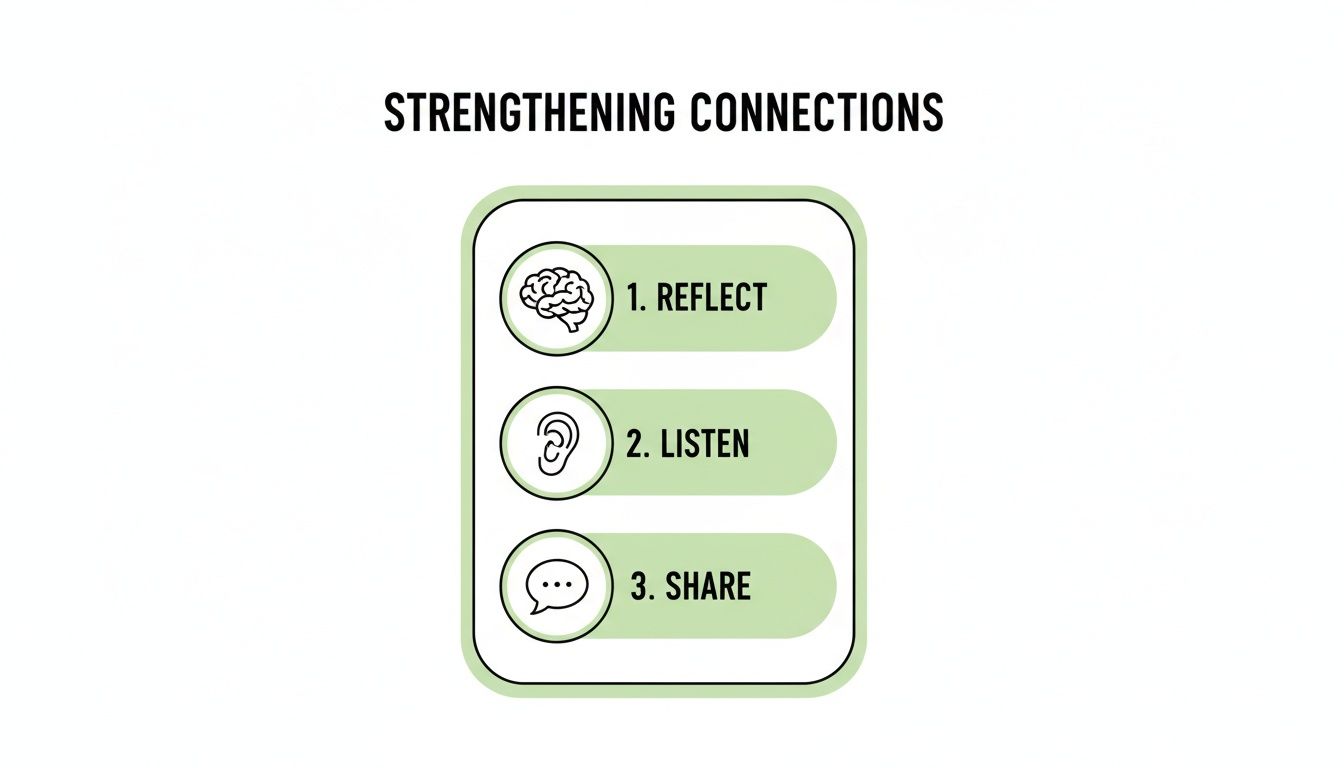
It all boils down to this: you have to look at your own part in the dynamic, listen like you actually want to understand, and be brave enough to share what's really going on inside.
A Deeper Dive: Your Type-by-Type Roadmap
To really make progress, you need a one-two punch of shared experiences and communication that lands. This table is designed to be your go-to guide, matching activity ideas with conversation starters that speak directly to each Enneagram type’s core motivations.
Reconnection Activities Tailored to Each Enneagram Type Use this table to find specific ideas for activities and communication starters that align with your partner's core Enneagram motivations, helping you reconnect in a way that truly resonates with them.
| Enneagram Type | Core Desire | Reconnection Activity Idea | Conversation Starter |
|---|---|---|---|
| 1 The Reformer | To be good, balanced, and have integrity | Volunteer for a cause you both care about, creating a shared sense of purpose. | "What's one small thing we could do to make our home feel more peaceful for you?" |
| 2 The Helper | To be loved and wanted | Plan a surprise evening where every detail is taken care of, focusing entirely on their comfort and enjoyment. | "I want to make sure you feel as loved as you make others feel. What fills your cup?" |
| 3 The Achiever | To be valuable and worthwhile | Set and work toward a shared goal, like training for a 5k or completing a home renovation project. | "When you look at our life together, what makes you feel the most proud of us?" |
| 4 The Individualist | To be unique and find their significance | Take a creative class together (like pottery or painting) or create a shared playlist of songs that are meaningful to your relationship. | "What's a feeling you've had lately that you haven't known how to put into words?" |
| 5 The Investigator | To be capable and competent | Explore a new bookstore or library, then discuss your finds over coffee, giving them space for intellectual connection. | "What's something interesting you've learned recently that you'd be willing to teach me about?" |
| 6 The Loyalist | To have security and support | Plan your next vacation together in detail, or create a "dream board" for your future, reinforcing your shared commitment. | "When you feel worried or anxious, what's the most supportive thing I can do for you?" |
| 7 The Enthusiast | To be satisfied and content | Go on a spontaneous day trip with no set itinerary, or try a new, exotic type of food together. | "If we could do anything fun and new this month, what would be at the top of your list?" |
| 8 The Challenger | To protect themselves and be in control | Engage in a playful debate about a low-stakes topic, or tackle a challenging physical task together as a team. | "I really respect your strength. What's one battle you're fighting right now that I can help you with?" |
| 9 The Peacemaker | To have inner peace and harmony | Spend a lazy afternoon reading side-by-side in a park or cooking a simple, comforting meal together with no pressure. | "What would a perfectly peaceful and connected weekend look like for you?" |
Think of this as your starting point to spark conversations that actually go somewhere meaningful.
When You're Two Different Types: Blending Your Reconnection Styles
Your type-by-type roadmap works well for understanding your own reconnection style — but reconnecting is a two-person job, and your styles won't always match.
A common mismatch: one partner (say, a Type 4) wants to talk through what went wrong before moving forward, while the other (say, a Type 9) wants to skip the postmortem and just get back to feeling okay together. Neither is wrong — one needs to understand before they can reconnect, the other needs peace restored before they can talk about it without shutting down.
The move isn't to pick a winner — it's sequencing. Give the processing-first partner a short, contained window ("let's talk about it for fifteen minutes, then we do something together"), so the peace-first partner isn't stuck in an open-ended conversation, and the processing partner isn't cut off before they feel heard. Most type mismatches around reconnecting are solved less by changing what either of you needs, and more by giving both needs a defined turn.
Navigating Physical Intimacy With Empathy
Okay, let's talk about the final frontier: physical intimacy. When emotional distance creeps in, physical closeness is usually the first casualty, and finding your way back can feel downright terrifying.
This is another moment where knowing your partner's Enneagram type is a game-changer. Stress and vulnerability look completely different from one type to the next. A stressed Type 6, for instance, might need an ocean of reassurance before they can even think about being physically vulnerable. Pushing them for spontaneity is a recipe for disaster.
Meanwhile, a Type 3 under pressure might use physical activity—sex included—as a way to blow off steam and feel accomplished, potentially missing the deep emotional connection their partner is starving for.
Approaching this tender subject requires empathy, not assumptions. For a much deeper look at these dynamics, our complete Enneagram love and relationships guide has more specific insights.
Start small. Really small. For example, make it a point to hold hands while you're walking the dog. Or give a back rub for five minutes with absolutely no strings attached. The goal is to rebuild safety and prove that touch can simply be about connection, not a demand for something more.
Weave Connection into Your Everyday Life
Forget the grand, movie-style gestures. A truly connected relationship isn't built on occasional fireworks; it’s forged in the small, seemingly boring moments that fill up your days. Rebuilding that feeling of being an "us" again is all about intentionally weaving moments of connection into the fabric of your normal routine.
Think of these as tiny anchors in your day. They’re simple, consistent signals to your partner that say, "Even when life is absolutely bonkers, you're my priority."

This steady drip of positive attention is what refills your emotional bank account. It gives you the reserves you need for when things inevitably get tough. A simple ritual acts as a powerful, daily reminder that you're on the same team.
Start Small with Micro-Rituals
The best rituals are the ones you'll actually do. Don't add another monumental task to your to-do list! The goal here is to find tiny pockets of time that already exist in your day and just make them a little more intentional. It's a surprisingly simple way to show you want to reconnect without overwhelming yourselves.
Here are a few practical examples that work wonders for couples:
• The Morning Kick-Off: • Before a single phone is grabbed or email is opened, take just • 10 minutes • over coffee to actually talk. No logistics, no chores. Just ask a simple question like, "What's one thing you're looking forward to today?" or "What's really on your mind this morning?"
• The 'No Screens in the Bedroom' Pact: • This one is a total game-changer. Seriously. Make your bedroom a sanctuary for only two things: sleep and intimacy. This one simple rule forces distractions out and creates a natural space for that old-school pillow talk to sneak back in.
• The Six-Second Kiss: • Relationship experts have found that a kiss lasting at least six seconds releases oxytocin, the "bonding hormone." Make it a non-negotiable ritual to share one of these every time you say hello or goodbye. It’s a tiny investment with a massive emotional payoff.
Remember, it's about consistency over intensity. One heartfelt 10-minute conversation every single morning is infinitely more powerful than a forced, awkward two-hour dinner once a month.
Team Up on a Shared Mission
Another fantastic way to rebuild your bond is to stop living parallel lives and start tackling something together . Having a shared project, no matter how small, instantly shifts your dynamic from "roommates managing a household" to "partners working toward a common goal."
This isn't about adding stress. It’s about creating new inside jokes and reminding yourselves that you can count on each other.
Ideas for a Shared Mission:
• The Low-Stakes Project: • Finally organize that disaster of a garage, plant a small herb garden, or learn to cook a ridiculously complicated new dish together. The shared frustration and eventual high-five create a fun, bonding story.
• The Fun-Focused Goal: • Plan your next vacation. I mean • really • plan it—from scrolling through destinations to building the perfect itinerary. The act of dreaming and scheming together is a ritual of connection all on its own.
• The Health & Wellness Challenge: • Train for a 5k, commit to a 30-minute walk together every evening, or try a new fitness class you'll both be terrible at. Supporting each other's health reinforces your partnership on a really deep level.
For a mission focused on pure relaxation and physical touch, you could even book a luxury couples massage . It carves out dedicated time to reconnect physically without any pressure. These shared experiences are the real-life building blocks of a resilient, deeply connected partnership.
Hitting a Wall? How to Handle Roadblocks and Setbacks
Let's be real: the path back to each other is almost never a straight shot. You'll have amazing days where you feel like you've cracked the code, followed by a day where an old fight rears its ugly head and you feel like you’ve been knocked back to square one.
It’s maddening. But it's also completely normal.
These moments aren't a sign that you're failing. Think of them as real-world pop quizzes—chances to use your new skills when the pressure is on. The trick is to stop seeing them as dead ends and start viewing them as detours that reveal a whole new part of your relationship map.
When It Feels Like You’re Going Nowhere
One of the toughest pills to swallow is the feeling that you're the only one putting in the effort. You're trying the rituals, using the "I feel..." statements, and getting... well, not much back. It's so easy to just throw your hands up and think, "Why am I even bothering?"
Hang on a second. Before you give up, let’s reframe this. More often than not, when a partner seems resistant, it isn’t because they don’t care. It’s usually driven by fear or just plain overwhelm. They might be terrified of another fight, unsure how to do things differently, or just completely drained from work, kids, or life in general. Your incredible effort, while well-intentioned, can accidentally feel like a spotlight on a problem they just don't have the energy to fix right now.
Your Enneagram Troubleshooting Guide
This is where the Enneagram moves from a fun personality tool to a dead-serious troubleshooting manual. Under stress, each type has a very predictable—and often frustrating—way of hitting the brakes on progress. If you can spot the pattern, you can respond with compassion instead of getting hooked into a fight.
Here’s what this can look like in the wild with some practical examples:
• The Perfectionistic Type 1: • When a Type 1 feels the pressure, they can get rigid and start pointing out all the ways you're "doing this wrong." For example, you suggest a spontaneous date, and they immediately list all the reasons it's a bad idea (too late, too expensive, haven't planned for it). It feels personal, but it's not. It's their stress brain trying to grab the wheel and restore order by perfecting the process.
• The Intense Type 4: • A Type 4, worried that this reconnection doesn't feel "real" or "authentic" enough, might just retreat into a moody silence. For instance, you try one of the conversation starters and they respond with a one-word answer and a shrug. The structured exercises can feel forced to them, which makes them pull away to sort through their tangled web of feelings.
• The Private Type 5: • For a Type 5, who needs time and space to process everything, your direct emotional questions can feel like a full-blown interrogation. A practical example: you ask "How did that make you feel?" and they change the subject or give a purely logical answer. Your attempt to connect can feel like an invasion of their inner sanctum, causing them to bolt the door and retreat.
Your partner's most frustrating behavior is usually a coded message about their deepest fear. A One's criticism is a plea for order. A Four's withdrawal is a search for genuine meaning. A Five's silence is a desperate need for security.
Seeing what's underneath the behavior changes everything. Instead of reacting to the prickly exterior, you can speak directly to the vulnerable need hiding inside.
What to Say When Things Get Tense
Knowing the "why" is half the battle, but you still need to know what to do. Here are a few simple scripts you can borrow and make your own for those moments when you're about to lose it.
When your Type 5 partner clams up:
• Instead of: • "Why won't you just talk to me? We have to sort this out now!"
• Try: • "I can see you're thinking. I want to give you the space you need for that. Whenever you're ready, I'm here to listen—no pressure."
When your Type 1 partner starts nitpicking your efforts:
• Instead of: • "Nothing I do is ever good enough for you! I'm trying my best here."
• Try: • "I know it’s really important to you that we get this right. I hear your concerns. Can we figure out a way forward that feels good to both of us?"
These small shifts in how you talk can be the difference between a full-blown argument and a moment of genuine understanding. You're showing them you're on the same team, even when it's hard.
And here’s a little hope for you: this kind of commitment is baked into some personalities. A study of 457 married couples found that Type 1s are the least likely to be single—with 62% in a relationship—and are often in it for the long haul, tying for being with their partner for 8 or more years . Knowing that some types have these deep-seated loyalty patterns can be a huge comfort; it shows their inherent drive to work through the tough stuff. You can find more fascinating details in these Enneagram relationship patterns.
Ultimately, getting through the setbacks is the real final exam. It's where you both prove that you can handle the messy, imperfect, and frustrating parts of your story and still, always, choose to turn back toward each other.
When to Bring in Professional Support
Trying to get your connection back on track by yourselves is a huge, brave act of love. Seriously. But let's be real—sometimes, even with the best intentions and a solid game plan, you end up stuck in the same old emotional cul-de-sac.
Deciding to call in a professional isn't throwing in the towel. It’s a smart, courageous move that says, "This relationship is worth fighting for, and we're bringing in the big guns."
Not every disagreement or quiet spell means you need to rush to a therapist's office. But some patterns are more like blinking red lights on the dashboard, signaling that the disconnection might be rooted in something deeper than just a communication snag.
Recognizing the Red Flags
If you're putting in the work but still hitting a wall, it might be time to tag in an expert. These are the kinds of persistent issues that your best efforts just can't seem to untangle.
• Gridlocked Conflicts: • You're having the exact same fight. Again. And again. The topic might shift from the dishes to the finances, but the feelings of frustration and being unheard are identical. It’s a painful loop with no off-ramp.
• Deep Resentment: • One or both of you are clinging to past hurts like a life raft, and it's poisoning every new interaction. For example, a mistake from five years ago is brought up in every argument about trust. Simple conversations get filtered through a thick lens of bitterness, making connection feel impossible.
• Betrayal or Trauma: • Major wounds from things like infidelity, a profound loss, or other significant traumas are incredibly difficult to heal alone. You often need a skilled, neutral guide to help you both navigate that minefield safely.
Calling for professional help isn't about admitting defeat. Think of it as bringing in a skilled architect to help you rebuild on a stronger foundation. A therapist creates a safe, structured space where you can finally put down your weapons.
How to Suggest Therapy Without Starting a War
Okay, bringing up the "T-word" can feel like you're about to tiptoe through a minefield. The trick is to frame it as a team project for "us," not an indictment of "you."
Find a calm, neutral moment. No ambushing them as they walk in the door or right after another argument.
You could try something like, "I love you, and I am all-in on us. I feel like we're stuck in a rut, and I think having someone neutral to guide us could really help us find our way back to each other. Would you be open to looking into it with me?"
This approach is all about teamwork and a shared goal—getting your connection back. If you want to explore more ways to broach these topics collaboratively, our guide on marriage counseling exercises has some great ideas for building that team spirit.
True strength isn’t about never needing help. It’s about knowing when to ask for it, together.
Got Questions? We've Got Answers
When you're trying to find your way back to your partner, it's natural for a million questions to pop up. It can feel like you're navigating a maze in the dark. Let's shed some light on the most common concerns that come up on this journey.
How Long Does This
Actually
Take?
Look, there's no magic formula or universal timeline. I've seen some couples feel a real shift in just a few weeks of dedicated effort, while for others, especially those rebuilding after a long period of distance or a deep hurt, it might be a journey of several months or more.
The real key? Focus on small, daily progress rather than a deadline. Celebrate the tiny wins—like having a 10-minute conversation without any tension—instead of staring at a finish line that doesn't exist.
What if My Partner Thinks the Enneagram is Woo-Woo Nonsense?
Fair enough. You don't need to get them to buy a book or take a test to make this work. Seriously.
Start with yourself. Understanding your own Enneagram type, your knee-jerk reactions, and your go-to communication habits is a game-changer all on its own. When you change your side of the dynamic, the whole dance changes. You can use what you learn about their likely type to approach them with more compassion and understanding, without ever mentioning the word "Enneagram."
For instance, let's say you suspect your partner is a Type 5. You learn that Fives need private time to process their thoughts and feelings. Instead of pushing for an immediate answer after a tough conversation, you can say, "Why don't you take some time to think about it?" That small shift can make them feel respected and safe, which is way more effective than any label.
Your positive changes will speak for themselves, and who knows? It might just get them curious.
Is It Possible to Come Back from a Total Intimacy Shutdown?
Yes, absolutely. But it’s a marathon, not a sprint, and it demands a gentle touch. The mistake most people make is trying to jump right back into the physical stuff.
First, you have to rebuild the emotional foundation. That means having those safe, non-judgmental conversations and just enjoying each other’s company again—no strings attached.
Then, you can slowly reintroduce physical touch without any pressure or expectation. Think of it as re-learning a language. Practical first steps could be:
• Start by holding hands when you're out for a walk.
• Try cuddling on the couch while you watch a movie.
• Give a simple, brief back rub before they go to sleep.
The entire goal is to make touch feel like connection again, not a demand for something more. If this feels like trying to climb a mountain, a good couples therapist can be an incredible guide, offering a safe space and specific exercises to get you both back on the same page.
Ready to get a clearer picture of what makes you and your partner tick? At Enneagram Universe , we offer a free, scientifically validated assessment that gets to the heart of your core motivations. It’s the first step toward building a stronger, more understanding relationship. Take the free Enneagram test now!