How to Read People Better: Your Guide to Decoding Human Behavior

Learning how to read people better isn't about mind reading. It’s about paying attention. It’s the simple, yet profound, skill of noticing what people aren't saying out loud.
This is where you shift from just hearing words to actively observing the whole picture—the nonverbal cues, the hidden motivations, the true emotional current in a room. You become an empathetic observer, not just a passive listener.
Why This Is the Most Important Skill You’re Not Using
Ever walk out of a meeting with that nagging feeling you missed the real conversation? You heard every word, but the unspoken hesitation, the flicker of excitement, or the quiet disagreement completely flew past you. It’s a frustratingly common experience, but it doesn’t have to be yours.
Look, understanding people isn't some mystical gift for detectives and therapists. It’s a learnable skill, like picking up a new language. The language just happens to be human behavior. And when you consider that some studies suggest over 50% of all communication is nonverbal, you realize how much you’re missing by only listening to the words.
You're missing half the story.
To help you get started, let's break down the foundational skills. These are the four pillars that support your ability to accurately and ethically interpret human behavior.
The Four Pillars of Reading People Effectively
| Pillar | What It Means | Why It's Critical |
|---|---|---|
| Observation | Actively watching body language, facial expressions, and posture without immediate judgment. | This is your raw data. Without sharp observation, you have nothing to interpret. |
| Context | Considering the situation, environment, culture, and relationship dynamics. | A grimace in a tense negotiation means something different than a grimace while tasting new food. |
| Intuition | Paying attention to your gut feelings and hunches, then testing them against the facts. | Your subconscious often picks up on subtle cues your conscious mind misses. |
| Empathy | Genuinely trying to understand the other person’s perspective and emotional state. | This is the ultimate goal. It turns observation into connection, not just analysis. |
Mastering these pillars is the key. They work together, helping you build a holistic and surprisingly accurate picture of what's really going on with someone.
See What's Happening Beneath the Surface
Getting good at this changes everything. It’s not about becoming a human lie detector or manipulating people. It’s about forging stronger, more authentic connections because you finally understand what’s happening on a deeper level.
• At Work: • Imagine knowing a potential client is genuinely sold on your pitch, not just being polite. For example, you see them lean in, nod enthusiastically, and start using "we" instead of "I" when talking about the project. This gives you the confidence to move toward closing the deal. Or spotting a colleague’s barely-there wince when they agree to a deadline—giving you the opening to talk about their workload and head off burnout before it starts.
• In Your Life: • Think about seeing through your friend's cheerful "I'm fine" to the stress they're trying to hide, which allows you to offer real support. That's how you build rock-solid trust and intimacy.

For instance, you're at a party and notice your normally chatty brother-in-law is hanging back, quiet. Instead of just writing him off as being in a mood, you see his shoulders are tight and his smile doesn’t quite reach his eyes. That little observation prompts you to ask, "Hey, you seem a little off. Everything okay?"
That's it. That small, observant question can crack open the door to a real, meaningful conversation.
The real point of reading people is empathy. It’s about shifting your focus from being interesting to being interested . When you truly see and hear someone, they feel valued.
This guide will show you how. We're going to skip the mind-reading myths and get straight to practical, actionable techniques you can use immediately. By learning to decode the silent signals all around you, you'll unlock a more intuitive and connected way of moving through the world.
Mastering the Silent Language of Nonverbal Cues
Ever get that feeling? You're in a conversation, and the words sound fine, but something in your gut tells you there's more to the story. That’s because there is. Communication is a full-body sport, and most of the action happens completely silently. Some experts say that what we don't say can make up more than half of the message we're actually sending.
This isn't about learning a secret code or memorizing a dictionary of gestures. Forget the old cliché that "crossed arms mean someone is defensive"—they could just be cold! True skill lies in becoming a keen observer of the subtle symphony of movements and expressions that everyone puts on display.
The Face: A Window to Their Real Feelings
Our faces are surprisingly honest, but their truest stories are told in a flash. I'm talking about micro-expressions. These are tiny, involuntary facial movements that flicker across someone's face in a split second, revealing a genuine emotion before they have a chance to hide it. For example, you might see a brief flash of disgust (a wrinkled nose) when your roommate says they love your new painting, revealing their true feelings before they can force a smile.
Take the smile, for example. We all know the polite, tight-lipped smile you give a coworker in the hall. That's just a social contract. But a genuine, heartfelt smile—the famous "Duchenne" smile" —is a whole different animal. It's the kind of smile that lights up the whole face, engaging the muscles around the eyes and creating those little "crow's feet" at the corners. Spotting one of these is like catching a glimpse of pure, unfiltered joy.
• Here's how it plays out: • You've just pitched a big idea to your boss. She listens, nods, and says, "This looks promising." But her smile is all mouth, no eyes. That's a social smile. It’s a polite acknowledgment, but its lack of warmth is a huge clue that she has unstated concerns you'll need to dig into.
Posture and Gestures: The Body's Tell-Tale Signs
While the face gives a lot away, the rest of the body has its own story to tell. Posture and gestures are fantastic indicators of confidence, comfort, and engagement, especially because people often forget to "manage" them.
Have you ever noticed someone unconsciously copying your movements? This is a fascinating phenomenon called mirroring . If you lean in and they lean in a moment later, or you cross your legs and they follow suit, it’s a powerful, subconscious sign of rapport. They are literally, nonverbally, telling you, "I'm on the same page as you." For example, on a first date, if you notice your date picks up their water glass right after you do, it's a good sign they feel connected to you.
The real secret is to look for clusters of signals, not just one isolated gesture. A single cue is just a data point, but a pattern of them paints a much more reliable picture of what's really going on inside someone's head.
Reading the Room: Space, Direction, and Feet
The space between people ( proxemics ) and the way their bodies are angled speak volumes. Are they leaning in, closing the gap to show interest? Or are they subtly pulling back, creating distance that signals discomfort or a desire to wrap things up?
And here’s a pro tip: always watch the feet. People are hyper-aware of their facial expressions and hand gestures, but they almost always forget their feet. A person's feet will almost always point in the direction they subconsciously want to go.
• Picture this: • You're in a tense negotiation. The other person is saying all the right things, making great eye contact, and sounding confident. But you notice their feet are angled away from you, aimed squarely at the door. That mismatch—confident words versus "getaway" feet—is a massive clue they might be bluffing or feeling cornered and desperate to leave.
This deeper awareness of space and direction is a game-changer. It’s like adding another layer of perception to your toolkit. Similarly, understanding how our environment sways us, like how color psychology in a room's design can influence mood, gives you an even bigger picture.
When you start tuning into these silent signals, you stop just hearing conversations and start truly understanding them. This is the bedrock of emotional intelligence. If you're ready to build on this, check out our guide on how to increase your EQ for more powerful strategies.
Understanding What Makes People Tick with the Enneagram
While body language tells you what’s happening in the moment, it doesn't always reveal the why . For that, we need to go deeper. If you want to predict how someone might behave long-term, you’ve got to understand their core motivations. This is where a framework like the Enneagram is an absolute game-changer.
The Enneagram isn't about slapping labels on people. Instead, it offers a window into the nine fundamental ways people see the world, each driven by a unique core desire and a powerful core fear. It’s less about putting someone in a box and more about understanding the shape of the box they've built for themselves.
Spotting Enneagram Types in the Wild
Once you get a handle on these core drivers, you'll start seeing patterns you never noticed before. It's like putting on a new pair of glasses—suddenly, everything clicks into place.
Think about that coworker who’s almost painfully organized, triple-checking every detail. Instead of just seeing them as a control freak, you might start to recognize the hallmarks of a Type One, The Reformer . Their obsession with getting things right isn't about annoying you; it's fueled by a deep desire to be good and a fear of being corrupt or defective.
Or what about that friend who’s always the center of attention, jumping from one adventure to the next? That's classic Type Seven, The Enthusiast , behavior. They aren't just flighty; their core desire is to be satisfied and happy, which means they're constantly running from pain and boredom toward the next exciting thing. For instance, the moment a conversation gets serious, they might crack a joke or suggest going to a new bar, avoiding discomfort at all costs.
The point isn't to diagnose everyone you meet. It's about forming a working hypothesis about what makes them tick. This is how you build empathy instead of frustration.
The Power of Empathy Through Understanding
This shift in perspective can completely transform your daily interactions. Let's say a team member consistently avoids conflict, agreeing with every idea pitched in a meeting. You're likely seeing a Type Nine, The Peacemaker , at work. Their biggest fear is loss and separation, so they'll do almost anything to maintain harmony, even if it means silencing their own voice.
This insight is incredibly practical. Imagine you’re trying to close a deal and can’t tell if your counterpart is genuinely sold or just being polite. Knowing that Type Nines are the most common personality—making up 16.2% of people in a huge global survey by TestGorilla —is a massive advantage. That means roughly one in every six people you meet is wired to avoid tension.
Armed with this knowledge, you can spot their subtle hesitation and gently ask, "I'd really love to hear what you truly think about this." It turns an awkward silence into a real conversation.
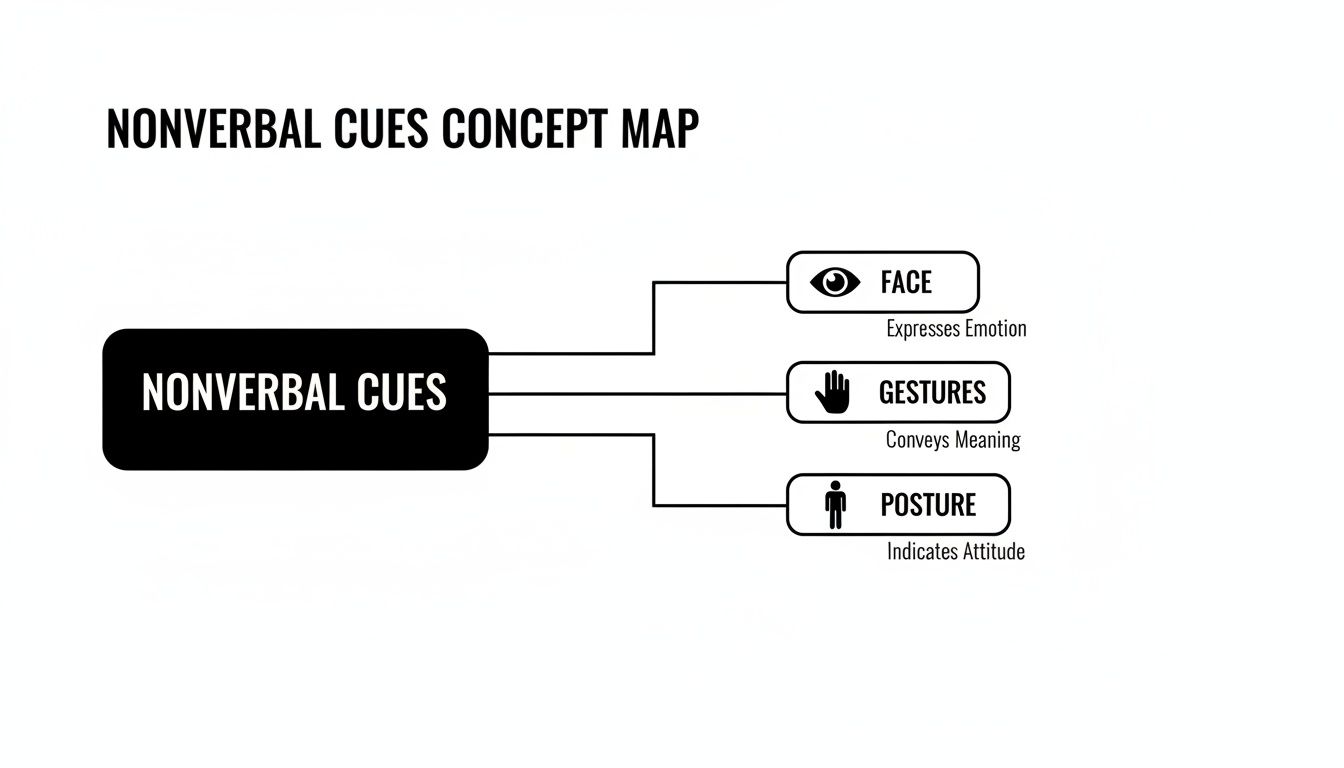
As you can see, reading people starts with observing these simple cues, which then give you clues about their deeper motivations.
From Observation to Connection
Using the Enneagram ethically is all about adapting your approach, not playing armchair psychologist. Here’s how this works in the real world:
• Dealing with a Type Three (The Achiever): • This person needs to feel valuable and successful. When giving feedback, don't focus on what they did wrong. Instead, frame it around winning. Try, "This is good, but here's an idea to make this project even more of a success."
• Communicating with a Type Five (The Investigator): • This individual thrives on being capable and competent. Never ambush them with a last-minute demand for information. Give them time to process—it respects their need to feel prepared and avoids triggering their fear of being helpless. For example, instead of asking for a report on the spot, say "Can you look into this for me and get back to me by end of day? I'd love to get your expert opinion."
• Supporting a Type Six (The Loyalist): • This type is motivated by a need for security and support. If you’re pitching a new idea, come prepared with a risk assessment and a backup plan. Showing you’ve thought through the worst-case scenarios is the fastest way to earn their trust.
When you start to see the world through these different lenses, you can anticipate needs, avoid misunderstandings, and build much stronger connections. If you're ready to dive in, our guide on h ow to find your Enneagram type is the perfect place to start your own journey.
Becoming an Active Listener Who Hears Everything
Let’s be honest: most of us think we're pretty good listeners. But in reality, we're usually just waiting for our turn to talk. We’re busy formulating our brilliant rebuttal or our next killer point while the other person is still speaking. If that sounds familiar, you're missing out on the real secrets to understanding people.
The most revealing clues aren't just in what people say , but in how they say it. Reading people is as much an auditory sport as it is a visual one. You have to learn to hear the music between the words.

Tune In to the Vocal Soundtrack
Think of someone's voice as the soundtrack to their words. Is it tense and high-pitched? Or is it flat and lifeless? The words might be saying one thing, but the melody often tells a truer story.
A sudden jump in vocal pitch can signal anxiety or a burst of excitement. A robotic, monotone delivery often points to boredom or total exhaustion. Even the speed of their speech is a dead giveaway.
Imagine you ask a team member about a critical project. They say, "Oh yeah, everything's totally on track," but their voice is hesitant and drags. The words are a "yes," but the soundtrack is screaming, "I'm in over my head!" That’s your signal to gently probe deeper, not just nod and move on.
Pay attention to their word choice, too. People who lean on fuzzy language—phrases like "sort of," "kind of," or "I guess"—are often hedging their bets. For example, if your partner says they "sort of" like the restaurant you picked, it’s a clear sign they aren't thrilled and you should probably suggest another option.
Master the Art of the Playback
One of the most effective tools I've ever used is something I call the "playback." This isn't just about parroting their words back to them. It's about summarizing what you heard in your own words to prove you were actually listening.
When you do this, something magical happens. You send a powerful signal: "I hear you, and I want to make sure I'm getting this right." It instantly builds trust and makes people feel safe enough to open up even more.
Here’s how it looks in action:
• "Okay, so if I'm hearing you correctly, you're feeling slammed because this deadline is looming, but you're still waiting on the data from Sarah's team?" • This shows you're connecting the dots for them.
• "It sounds like you're fired up about this new direction, but also a bit nervous about getting the VPs on board. Is that fair to say?" • This validates their feelings and names the underlying worry.
This simple technique changes the entire dynamic. It’s no longer a debate; it becomes a collaboration. You’re not just trading talking points—you’re working together to figure out what's really going on.
This is a game-changer when tensions are high. By focusing on the facts and feelings you've observed, you can drain the drama out of a situation and get back to a productive place. If you're looking to build this muscle, we have a ton of great strategies in our guide to relationship communication exercises .
Ask Questions That Unlock, Not Shut Down
The final piece of the puzzle is asking the right kind of questions. Most of our questions are conversation-killers. We ask "yes" or "no" questions that put a full stop on the dialogue.
Open-ended questions, on the other hand, are conversation-starters. They are invitations to share, reflect, and tell a story. They almost always start with words like:
• What...
• How...
• Why...
• Tell me about...
See the difference?
Instead of: "Are you happy with the proposal?" Try: "What are your initial thoughts on this proposal?"
Instead of: "Did the meeting go well?" Try: "How did you feel walking out of that meeting?"
Tuck these powerhouse questions into your back pocket:
• "Can you walk me through how you got to that conclusion?"
• "What's the biggest obstacle you're seeing here?"
• "How does this look from where you're sitting?"
• "Tell me more about that."
By actively listening to the vocal soundtrack, using the playback to confirm what you hear, and asking questions that open doors, you stop being a passive recipient of words. You start truly understanding the people right in front of you.
Putting Your People-Reading Skills into Practice
Alright, so you’ve got the theory down. You know how to spot the nonverbal tells and listen for what's not being said. But that’s like reading a recipe over and over without ever actually cooking the meal. The real magic happens when you get your hands dirty.
This is where we move from a passive understanding to an active, almost intuitive skill. It’s time for a little practice.

And don't worry, you don't need a lab coat or a lineup of volunteers. Your training ground is the world around you, and you can start building these skills in some fun, totally low-stakes ways.
Become a Coffee Shop Detective
Your local café isn't just for caffeine hits; it’s a goldmine for human observation. Find a cozy spot, grab your coffee, and give yourself a secret mission. Don't just people-watch—observe with a purpose.
Your goal: guess the relationships between people based only on their body language and interactions.
• First date? • Look for those slightly awkward, self-aware gestures. You might see a lot of mirroring (she sips her coffee, so does he) and intense eye contact that gets broken with a shy glance away.
• Business meeting? • They’ll probably have a more formal, upright posture. Notice if they use their briefcases or laptops as a subtle barrier on the table between them. Professional distance is a real thing.
• Old friends? • This one’s easy. The body language is relaxed and open. The laughter is genuine—it reaches their eyes—and they sit closer to each other than they would with a mere acquaintance.
Grab a notebook and write down what you see. It doesn’t even matter if you’re right. The entire point is to train your brain to notice these details and start connecting them into patterns.
Try the Silent Movie Challenge
This one is a blast, and you can do it right from your couch. Find a movie or TV show you’ve never seen—a drama with lots of character interaction works best—and watch a 10-minute scene with the volume muted.
Your mission, should you choose to accept it, is to figure out what's happening just from the nonverbals.
• Who’s in charge here? Look for who takes up more physical space, whose posture is the most confident, or who initiates touch.
• What’s the real emotional undercurrent? Keep an eye out for micro-expressions—those fleeting looks of anger, fear, or sadness that flash across someone's face before they can hide them.
• Can you see the relationship dynamics shift? Watch for the moment someone leans back after being engaged, or when the mirroring suddenly stops. That's usually a sign of disagreement or a disconnect.
Once you’re done, rewind and watch the same scene with the sound on. How close were you? You'll be shocked at how much of the story is told before anyone even opens their mouth.
Practice isn’t about being perfect. It’s about calibrating your internal radar. Every observation you make—right or wrong—sharpens your skills and makes you a more insightful person in your own life.
The 30-Day Observation Gauntlet
Feeling brave? Let’s kick it up a notch. For the next 30 days , commit to focusing on one specific people-reading skill each day. This approach is fantastic because it lets you build your awareness layer by layer without feeling overwhelmed.
Here are a few ideas to get you rolling:
| Day | Your Mission for Today |
|---|---|
| Day 3 | Vocal Tone Focus: On every phone call today, tune out the words for a moment and just listen to their tone. Do they sound energized, stressed, or like they're in a hurry? |
| Day 11 | Spot the Mirroring: During your next meeting, notice who is subconsciously copying whom. This is a huge tell for who has rapport with whom in the group. |
| Day 18 | Hand Gesture Audit: Pay attention to what people are doing with their hands. Are they open and expressive (a sign of confidence) or hidden and still (often means they're holding something back)? |
| Day 25 | The Foot Factor: In your next conversation, sneak a peek at where their feet are pointing. If they’re aimed at you, they're engaged. If they’re pointing toward the exit, their mind is already halfway out the door. |
Think of these daily missions as turning you from a passive observer into an active investigator of human behavior. In business settings, these skills are invaluable; you can even see them applied in fields like behavioral assessments in human risk management to prevent major issues.
With a little consistent effort, this kind of observation becomes second nature. And that’s when you'll find a much richer, more meaningful layer in every single conversation you have.
Common Questions About Reading People
So, you're starting to tune into the silent language of human behavior. It’s an incredible skill, almost like developing a sixth sense. But with this new perception comes a few thorny questions that pop up for just about everyone. It's smart to think through the ethics and accuracy of it all. Let's clear the air on some of the biggest concerns so you can use these skills with confidence and a clear conscience.
The whole point is to build stronger connections, not to gain some kind of sneaky advantage.
Is Trying to Read People Manipulative?
This is the big one, isn't it? The answer comes down to one simple thing: your intent . The line separating genuine empathy from ugly manipulation is drawn entirely by why you're doing it. Are you using an insight to exploit someone for your own gain, or are you using it to understand and connect with them on a deeper level?
Let’s get practical.
• Imagine you notice a new colleague, David, is totally silent during brainstorming meetings. When he does smile, it doesn't quite reach his eyes.
• A • manipulative • approach would be to think, "Aha, David's insecure. I'll shut down his next idea in front of the boss to make myself look better."
• An • empathetic • approach would be to catch him later and say, "Hey, I noticed it gets pretty chaotic in there. Just wanted to check in and see if you had any thoughts you didn't get a chance to share."
The first one uses an observation to hoard power. The second uses that same observation to create a space where everyone feels safe enough to contribute. That's the whole ballgame.
How Can I Be Sure My Interpretation Is Accurate?
You can't. Not 100% , anyway, and you shouldn't even try. Real accuracy in reading people doesn't come from a single, magical "tell." It comes from spotting clusters of signals and, just as importantly, understanding the context they're happening in.
Think of your first read as a hypothesis, never a final verdict. It’s the starting point for a conversation, not a judgment you quietly pass on someone.
Your role is that of a curious investigator, not a courtroom judge. You’re gathering clues and asking questions to get closer to the truth—not issuing a sentence based on flimsy evidence.
For instance, you're in a meeting with a client, and she crosses her arms.
• The Isolated Cue: • Crossed arms.
• The Problem: • This could mean anything. She could be cold, comfortable, defensive, or just lost in thought. It's useless on its own.
• The Cluster of Cues: • Now, what if she has crossed arms • plus • a tight jaw, is leaning away from you, and only gives clipped, one-word answers?
• A Much Stronger Hypothesis: • This collection of signals paints a pretty clear picture of defensiveness. It’s your cue to gently probe. You could say, "I get the sense you might have some reservations. Is there anything on your mind?"
Can I Use the Enneagram to Read Strangers?
You bet, but you have to do it with a big dose of caution and respect. You can never definitively "type" a stranger who hasn't done the deep work of self-discovery themselves. What you can do is make an educated guess about their likely behavioral patterns to communicate more effectively.
The key is to think of it as "typing the behavior," not slapping a label on the person.
If you notice a potential business partner is relentlessly focused on success, image, and hitting targets, you might hypothesize they operate with a lot of Type 3 (The Achiever) energy. Knowing this allows you to frame your proposal in a way that resonates with them. You can highlight how your solution will help them achieve their goals and make them look brilliant in the process. You're not pigeonholing them; you're just speaking their language. And that's always a smart move.
Ready to stop guessing and start truly understanding the people in your life—including yourself? At Enneagram Universe , we give you the framework for building that deep self-awareness. Discover your core motivations and unlock your true potential with our free, in-depth Enneagram test. Take the first step on your journey today .