How to Prevent Employee Burnout: A Practical Guide for Managers

Let's be honest: preventing employee burnout is about a whole lot more than just managing stress. It’s about building a workplace where people aren’t drowning in tasks, where leaders actually have their backs, and where everyone feels like they matter. This isn't about fluffy initiatives; it's a real strategy built on fairness , clarity , and genuine support to snuff out exhaustion before it even sparks.
Your No-Nonsense Guide to Beating Burnout
Burnout isn’t some trendy buzzword. It’s a silent profit killer that quietly drains your most talented people, leaving you with a disengaged team and a revolving door of new hires. Too often, the conversation gets stuck on surface-level perks—think free snacks and meditation apps. While those things are nice, they’re like putting a bandage on a broken leg. They don't fix the real problems.
True prevention means rolling up our sleeves and tackling the systemic issues that are grinding people down. It’s about getting serious and focusing on what actually works:
• Manageable Workloads: • Are we setting people up for success or failure? For example, instead of assigning a developer three major coding projects with the same deadline, a manager should work with them to stagger the timelines or reallocate one project.
• Empowering Leadership: • We need to train our managers to be coaches, not controllers. For instance, a supportive leader might say, "I trust your judgment on the best approach for this client report. Let me know what resources you need," instead of dictating every step.
• Genuine Support Systems: • This is all about psychological safety. Can someone on your team raise a red flag or admit they're struggling without fearing a penalty? If not, you don't have a support system. A practical example is having a "no-blame" policy for post-project reviews, where the focus is on improving processes, not pointing fingers.
The Real Cost of Inaction
Ignoring the smoldering embers of burnout isn't just a morale problem—it's a massive financial leak. When your team is running on fumes, productivity nosedives, and your best people start polishing their resumes. The cost to replace just one employee is bad enough, but the ripple effect of widespread burnout can cripple a company's momentum.
Don't just take my word for it. Research consistently points to excessive workloads as a top driver of burnout. A recent analysis estimates that burnout-related disengagement can cost a U.S. employer anywhere from 4,000 to 21,000 per employee annually . For a company with 1,000 employees, you're looking at an average loss of roughly $5.04 million every single year. You can dig deeper into the financial impact of workplace burnout if you're curious.
The bottom line is crystal clear: investing in burnout prevention isn't an expense. It's one of the smartest strategic moves you can make to protect your people and your profits. It's time to stop admiring the problem and start fixing it.
Quick Fixes for Common Burnout Triggers
The good news? You don't need to launch a massive, company-wide overhaul tomorrow to start making a difference. Small, targeted changes can have an immediate and powerful impact. The trick is to identify the most common stressors and apply a quick, practical solution. This builds momentum and, more importantly, shows your team you're serious about their well-being.
Here’s a quick-reference table I've put together that connects some of the most frequent burnout triggers with simple actions any manager can take this week.
Quick Fixes for Common Burnout Triggers
| Burnout Trigger | Immediate Actionable Solution |
|---|---|
| Unmanageable Workload | Conduct a weekly "workload check-in" during 1-on-1s to identify and postpone one non-critical task. |
| Lack of Recognition | Start every team meeting by publicly acknowledging a specific contribution from a team member in the last week. |
| No Control Over Work | Let an employee choose which of their two priority projects they want to focus on for the day, giving them autonomy. |
| Unclear Communication | Create a simple "project one-pager" for every new initiative outlining goals, roles, and deadlines to eliminate ambiguity. |
These aren't silver bullets, but they are tangible first steps. By addressing these small but significant issues, you begin to shift the culture from one that tolerates burnout to one that actively prevents it.
Reading the Smoke Signals of Burnout
Burnout doesn't just show up one Tuesday morning with a resignation letter. It’s a slow, quiet fade. Think of it like a faulty wire smoldering behind a wall; you don’t notice it until the smoke alarm is screaming and your best employee is already halfway out the door. Spotting the signs early is your best defense in learning how to prevent employee burnout before it becomes a full-blown crisis.
This is your field guide to identifying the real behavioral tells that go way beyond someone just looking tired. We’re talking about the subtle shifts in energy and engagement that are easy to miss if you aren't paying attention. It’s about learning the difference between an employee who is simply busy and one who is becoming deeply disengaged.

From Passionate to Passive
One of the first smoke signals is a noticeable drop in enthusiasm. The person who used to volunteer for every new project now hangs back. The one who filled whiteboards with ideas now sits silently during brainstorms. This isn't laziness; it's a symptom of exhaustion.
I once worked with a brilliant project manager named Sarah. Six months ago, she was the first to champion new initiatives and rally the team. Then, slowly, it changed. In meetings, she’d consistently deflect ownership with phrases like, "I don't have the bandwidth," or, "Maybe someone else should lead this." This shift from proactive to passive is a massive red flag.
The Rise of Cynicism and Detachment
When someone is heading for burnout, their whole perspective can darken. A healthy level of skepticism is valuable, but burnout breeds a much deeper, more pervasive cynicism. You’ll hear it in their tone—increased frustration, sharp sarcasm, or a general negativity toward the company, clients, or even their own work.
Think of David, a talented creative designer on my team. He used to be the office optimist, always finding the silver lining in tough feedback. Lately, though, he’s been making cynical jokes about project deadlines and seems emotionally distant from the work he once loved. For instance, after a client presentation, he might say, "Well, that was another hour we'll never get back," which is completely out of character for him. This emotional distancing is a self-preservation tactic against overwhelming stress.
To get better at spotting these changes, check out these insights on the 10 key signs of emotional burnout to recognise . Understanding these signals is the first step toward creating a supportive environment.
Burnout isn't a single event. It's the final stage of a long, slow process of disengagement. The goal isn't to react to the crisis but to intervene during the quiet fade.
Declining Performance and Missed Details
Another classic sign is a drop in professional efficacy. This isn't about major, catastrophic failures. It's often much more subtle.
• Small Errors: • The employee who was once meticulous starts making minor mistakes, like forgetting to update a key spreadsheet or missing a detail in a client email. A practical example is an accountant who suddenly starts making small transposition errors in financial reports.
• Missed Deadlines: • They begin to struggle with timelines they used to manage easily, often working longer hours but producing less. For example, a writer who consistently met deadlines now asks for extensions on routine blog posts.
• Lower Quality: • The final product just isn't as polished. The passion and extra effort that defined their work seem to have vanished. A software developer might submit code that is functional but lacks the usual elegant structure and comments.
These aren't signs of incompetence. They are signals that the person's cognitive and emotional batteries are completely drained. They're trying to keep up, but they're running on empty.
How to Open the Conversation
Once you spot these signals, what you do next is crucial. Your approach has to feel like genuine support, not an accusation. Whatever you do, don't start with, "Your performance is slipping."
Instead, try an open-ended, observation-based approach.
• Start with an Observation: • "Hey, I noticed in the meeting today you seemed quieter than usual. Is everything okay?"
• Express Genuine Concern: • "You've been putting in a lot of hours lately. I want to make sure you're not feeling overloaded."
• Offer Specific Support: • "Let's look at your workload together. Is there anything we can reprioritize or take off your plate to give you some breathing room?"
Learning to read these early smoke signals allows you to step in with support when it matters most, turning a potential crisis into an opportunity to rebuild resilience and trust.
Building a Burnout-Proof Company Culture
Let's get one thing straight: free snacks, a ping-pong table, and "Fun Fridays" are not your culture. They're perks. A truly burnout-proof culture is woven into the very fabric of your company, shaping every decision, meeting, and interaction. It’s all about making big, systemic changes that fiercely protect your team's energy and psychological well-being.
This isn't just about adding a "wellness" line item to the HR budget. It's a fundamental shift in how work gets done. The goal is to build an environment where peak performance and sustainable energy aren't competing priorities—they're two sides of the same coin.
Foster Genuine Psychological Safety
The absolute cornerstone of a resilient culture is psychological safety . It's that shared belief that you won't be punished or humiliated for speaking up with ideas, questions, concerns, or—gasp—mistakes. It’s creating an atmosphere where an employee can actually say, "My plate is too full right now," without fearing it's a career-killer.
Picture a marketing team gearing up for a major product launch. In a psychologically unsafe environment, everyone nods along to an impossible deadline, terrified of looking uncommitted if they push back. What follows is a frantic, stressful sprint to the finish line, leaving a trail of exhausted people in its wake.
Now, imagine that same scenario in a safe culture. Jessica, a team member, feels completely comfortable saying, "Based on our current resources, hitting that date will mean sacrificing quality on these other two projects. Can we talk about adjusting the timeline or shifting some help over here?" That isn't complaining; it's brilliant, strategic problem-solving that stops burnout before it even starts. For a deeper dive, check out our guide on how to improve workplace culture with actionable steps.
Leaders Must Model the Boundaries
Nothing torpedoes a well-intentioned policy faster than a leader who doesn't live by it. A manager who fires off emails at 10 PM is sending a clear, silent message: work never stops, no matter what the employee handbook says. Your leadership team has to be the most visible champion of a healthy work-life balance.
Think about these powerful, culture-defining actions:
• Visible Log-Offs: • When Mark, a director, posts in Slack, "Alright team, I'm logging off for the day to make dinner with my family. See you all tomorrow!" he gives everyone else permission to do the same. It's such a simple act, but it sets a powerful precedent.
• Protected Focus Time: • Some of the smartest companies I've seen have rolled out policies like "Focus Wednesdays," where no internal meetings are allowed. This carves out precious time for deep work and breaks the cycle of constant context-switching that absolutely fries your brain.
• Vacation Normalization: • Leaders shouldn't just take their vacation time; they need to • fully • disconnect. No "just checking in" emails from the beach. This signals to the whole team that rest isn't just allowed—it's expected.
A culture of well-being is not built on what you say, but on what your leaders consistently do. Their actions are the blueprint that everyone else will follow.
Embed Wellbeing into Your Operations
To truly get ahead of employee burnout, you have to move beyond reactive support. It's time to proactively design work to be sustainable from the ground up. This means putting your core operational processes under a microscope and asking, "Does this protect our team's energy, or does it drain it?"
This systemic approach involves training managers and implementing clear policies around workload management. In fact, recent workplace reports show that regular manager-led check-ins and psychosocial risk policies materially reduce burnout symptoms. Organizations that invest in structured manager training and routine workload reviews see substantially lower rates of severe burnout, with some reporting double-digit percentage-point reductions within a single year. You can discover more insights about these workplace wellbeing trends and their impact.
The key is to treat burnout prevention as a core business strategy. When you build a culture that values sustainable performance, you create an incredible competitive advantage: an engaged, energized, and loyal team that is built to last.
Actionable Leadership Tactics to Reduce Stress
Let's be real. Managers are the first and most critical line of defense against burnout, but they're often thrown into the ring with flimsy advice like "be a good listener" or "support your team." That sounds nice, but it’s useless when you're staring down a wall of deadlines and a team running on fumes.
Forget the fluff. This is your practical playbook. I’m going to give you concrete techniques—tangible scripts, frameworks, and strategies—to actively manage your team's energy and focus, not just their tasks. Preventing burnout starts with proactive leadership, not reactive damage control.
Run a Workload Audit, Not Just a Status Update
Your one-on-one meetings are goldmines for spotting burnout risks, but only if you dig in the right places. Stop just asking, "What are you working on?" and start turning your check-ins into regular "workload audits."
The goal is to move beyond a simple to-do list review and get a real feel for your team member's capacity. It’s about collaboratively assessing their plate, not just piling more onto it.
Try asking these questions in your next one-on-one:
• "On a scale of • 1-10 • , how is your workload feeling this week?"
• "What's one thing on your plate right now that feels draining or like a roadblock?"
• "If we could punt one non-urgent task to next week to give you some breathing room, what would it be?"
This simple shift changes the dynamic from inspection to partnership. It makes it safe for people to be honest about their limits. A huge part of leadership is building trust, and these conversations show you truly have your team's back. For more on this, check out our guide on building trust in a team .
From Overwhelmed to In Control: A Real-World Scenario
Let’s make this real. Michael, a manager, notices his top engineer, Chloe, has been online late every night for two weeks straight. Her Slack status is always green, and she’s a top performer, so the work is getting done—but he sees the writing on the wall.
Instead of a generic "You've been working late!" check-in, which can sound like an accusation, Michael tries something else. He schedules a one-on-one and comes prepared with a simple capacity planning template—just a shared doc with columns for "Project," "Priority," and "Estimated Effort."
Together, they map out all of Chloe’s active projects. The visual makes it immediately obvious: she’s juggling three high-priority initiatives that all have critical deadlines in the same two-week sprint. Michael sees it, and more importantly, Chloe feels seen . They identify a series of internal reports that, while important, aren't client-facing. They decide to postpone that task for a week, instantly relieving the pressure.
This is what effective leadership looks like. It's not about finding fault; it's about providing the tools and creating the space to find solutions together. Michael didn't just tell Chloe to work less; he helped her restructure her work so she could .
This infographic boils it down to a simple, three-step process for creating a culture where safety, boundaries, and well-being are the foundation.
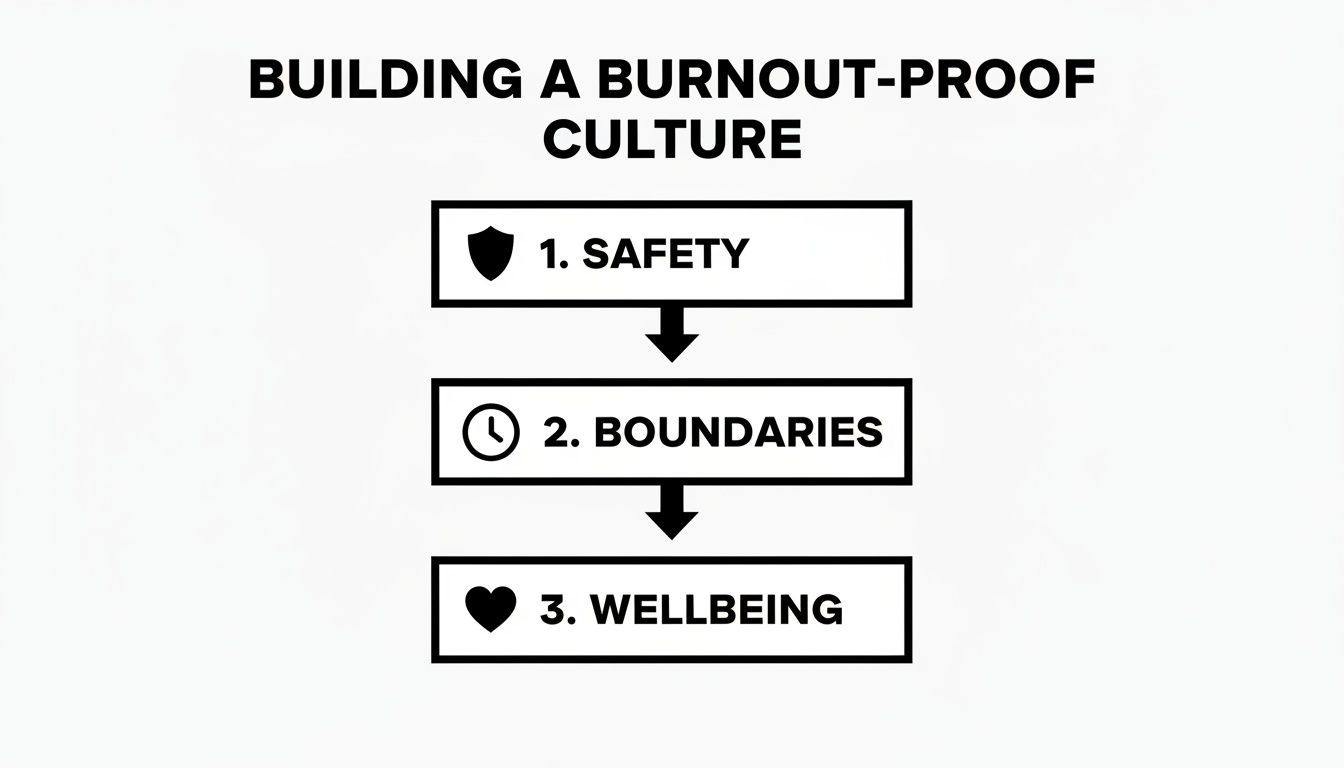
It all starts with psychological safety, moves to enforcing clear work boundaries, and leads to a genuine focus on employee wellbeing.
Implement Energy-Protecting Team Norms
Individual interventions are great, but creating team-wide norms is a game-changer. These are simple, agreed-upon rules of engagement that protect everyone's time and focus by default. It takes the burden off any one person to constantly defend their boundaries.
Here are a few powerful norms you can roll out immediately:
• "No-Meeting" Blocks: • Block out a specific afternoon each week—say, Thursday from • 1 PM • to • 4 PM • —for deep, uninterrupted work. This isn't a suggestion; it becomes a sacred time on everyone’s calendar.
• Clear Communication Channels: • Establish rules like, "If it's on fire, call. If it needs a thoughtful response, email. If it's a quick question, use Slack." This stops the constant, chaotic barrage of notifications.
• "Response Time" Expectations: • Set a clear standard, like, "We aim to respond to non-urgent emails within • 24 hours • ." This frees your team from the pressure of feeling "always on."
By putting these simple systems in place, you remove a massive source of daily friction and anxiety. You’re building a work environment that is predictable, respectful, and designed for sustainable success—not just short-term sprints.
Empowering Your Team with Resilience Tools
While the heavy lifting of creating a healthy work environment falls on the organization, we can’t ignore the individual's role. Giving your people the right tools to navigate pressure is a massive piece of the burnout-prevention puzzle.
This isn't about shifting blame or telling someone to just "be more resilient." Think of it this way: the company is responsible for building a safe, well-maintained racetrack, but the driver still needs the skills to handle the curves at high speed. These tools give employees a sense of control over their own well-being, helping them manage their energy and focus in the moment.
Building Practical Resilience Habits
You’d be amazed at how small, intentional practices can break the cycle of constant stress. We're not talking about complex, time-consuming programs. These are simple, tactical habits that anyone can weave into their day to reclaim their focus and energy.
Here are a few I’ve seen work wonders:
• The '5-Minute Reset': • Get your team to schedule five-minute breathers between back-to-back video calls. This isn't for a quick email check. It’s for standing up, stretching, grabbing a glass of water, or just staring out a window. That tiny buffer is a game-changer for preventing cognitive fatigue.
• Visible 'Focus Time' Blocks: • Teach everyone to block out "focus time" on their shared calendars and, most importantly, to respect those blocks. This creates precious pockets for deep, uninterrupted work, shielding people from the constant ping-and-ding of notifications and meeting requests.
• A "Hard Stop" Ritual: • Encourage employees to create a clear ritual that signals the end of their workday. It could be as simple as closing all work tabs, tidying their desk, or writing down the top priority for tomorrow. This symbolic act tells the brain it's officially time to switch off.
Highlighting Underused Company Resources
Here's a little secret: your company probably already offers powerful resources that hardly anyone uses. Employee Assistance Programs (EAPs) are the classic example. They're often gathering digital dust, yet they provide free, confidential access to counselors, coaches, and other support services.
Bringing these programs out of the shadows is a huge step. I once worked with a marketing pro named Alex who was drowning in campaign deadlines that were bleeding into his home life. His manager finally nudged him to use their EAP, and he connected with a coach. Those sessions gave him practical strategies to build a wall between work stress and personal time, completely changing his relationship with his job.
Investing in recovery and mental health access pays off. Seriously. Recent analyses show that organizations providing protected recovery periods and accessible mental health benefits can see self-reported burnout rates drop by 10–20 percentage points .
These programs aren't just a "nice-to-have"; they're a smart investment. The savings in employee turnover can often pay for the programs themselves within a year or two. When you consider that nearly half of all employees report feeling burned out, making these resources visible and easy to access is a no-brainer.
Building Emotional Intelligence and Boundaries
At its core, resilience is about self-awareness and protecting your own energy. This means developing emotional intelligence (EQ) and learning how to set firm, professional boundaries. High EQ helps people recognize their own stress triggers before they get overwhelming. For example, an employee with high EQ might notice they feel anxious every time they receive a last-minute project request, allowing them to proactively address it with their manager instead of letting the stress build.
A great way to empower your team is by sharing practical guides on setting clear boundaries at work that protect their time and mental space.
When you champion these skills, you’re not just helping employees cope; you're helping them thrive. You can also learn more about how to increase EQ in our detailed guide. An equipped and empowered employee becomes an active partner in creating a workplace that's truly burnout-proof.
Got Questions About Burnout? We've Got You.
When you're trying to tackle something as messy as burnout, it's easy to get lost in the weeds. Let's clear the air and answer the most common questions leaders and managers have, with no-fluff answers you can actually use.
What's The Real Difference Between Stress And Burnout?
This is a big one. Think of them as cousins, not twins.
Stress is a state of being over-engaged. It's that feeling of frantic urgency, hyperactivity, like you're drowning in responsibility but still paddling like mad. With stress, you're putting too much in.
Burnout is the polar opposite: total disengagement. You're tapped out. There’s a sense of emptiness, helplessness, and emotional exhaustion. You have nothing left to give.
Here’s an image that might help: a stressed employee is in a sinking boat, bailing water as fast as they can, absolutely convinced they can save it. A burned-out employee has already dropped the oars. They're just sitting there, waiting for the inevitable. Understanding this distinction is everything because managing short-term stress is a world away from fixing the deep-seated issues that make someone give up completely.
Stress is characterized by over-engagement . Burnout is defined by disengagement . A stressed employee needs relief, but a burned-out employee needs true recovery.
How On Earth Do You Prevent Burnout On A Remote Team?
With a remote or hybrid team, you have to be way more intentional. The natural bumpers of office life are gone, so that "always on" culture can creep in and completely erase the line between work and home.
To fight this, you have to build some explicit guardrails.
• Establish Clear Communication Hours: • You need to set—and, more importantly, • model • —clear expectations for when people are expected to respond. For example, a manager can use the "schedule send" feature in their email client to ensure messages only arrive during business hours.
• Be a Ruthless Calendar Guardian: • Actively encourage your people to block out "focus time" and real lunch breaks. Make "no-meeting Fridays" or protected deep-work blocks a team-wide norm, not a special favor someone has to ask for.
• Create Structure for Spontaneity: • Those casual "how's it going?" chats by the coffee machine don't happen on their own anymore. You have to build them in. For example, you could schedule a 15-minute optional "virtual coffee" on Monday mornings with no work talk allowed.
It's really about designing the structure and connection that used to happen organically. You can't just hope for a good culture in a remote world; you have to build it brick by brick.
How Do I Get Leadership To Actually Invest In This?
Simple: stop talking about feelings and start talking about money.
To get the C-suite on board, you have to frame burnout prevention as a core business strategy, not just a fuzzy HR initiative. They speak the language of finance, so you need to show up with data that hits the bottom line.
Bring the cold, hard numbers on what burnout is really costing the company—think higher turnover, lost productivity, and soaring healthcare expenses. Don't be afraid to use some stats. For instance, burnout-related disengagement can cost a company up to $21,000 per employee every single year. For a company with 1,000 employees, that's a multi-million dollar problem you're offering to solve.
Present your plan as an investment with a killer ROI.
• Slash Turnover Costs: • Calculate what it costs to replace just a few key people and show how your plan plugs that leak. For example: "Replacing just three mid-level managers this year cost us 250.000 in recruitment fees and lost productivity. Our proposed wellness program costs 50.000.”
• Boost Productivity: • Explain how an energized, engaged team doesn't just work more; they produce higher-quality work and hit their goals.
• Win the Talent War: • Frame this as a serious competitive advantage. The best people want to work for companies that won't grind them into dust.
If you're still hitting a wall, propose a small, measurable pilot program with one team. It's a low-risk way to prove the concept, get some powerful success stories, and build the momentum you need for a company-wide rollout.
At Enneagram Universe , we believe self-awareness is the bedrock of a resilient and fulfilling life—at work and beyond. When you understand your core motivations, you can start managing your energy instead of letting it manage you. Discover your Enneagram type with our free, in-depth assessment and unlock personalized strategies for growth at the Enneagram Universe Test .