How to Overcome Fear of Abandonment: Practical Steps That Work

Let's be honest. Tackling the fear of abandonment isn’t about just "thinking positive" or hoping your partner never leaves. It’s about digging in and building a sense of security that comes from you , not from someone else's approval. This whole process is about understanding where the fear comes from, seeing how it messes with your life, and then using real-deal strategies to build an unshakable core.
Why Is the Fear of Being Abandoned So Powerful
You know that feeling, right? That ice-in-your-stomach panic when a partner asks for a little space. The constant, buzzing need for reassurance that your friends actually like you. If that sounds familiar, you know this isn't just a minor worry—it's a full-body, five-alarm fire. And you're not crazy for feeling it. This response is hardwired into our DNA.

Think about it from a caveman perspective. Being part of the tribe meant survival—food, protection, everything. Getting kicked out was a death sentence. That ancient programming is still running in the background of your mind. It’s why a text message left on “read” or a canceled coffee date can hijack your nervous system and feel like a life-or-death crisis. To that primal part of your brain, it is.
The Role of Early Attachment
So, where did this all begin? For most of us, it goes way back. The blueprint for how you do relationships was drafted in your childhood, based on the bond you had with your caregivers. This is what experts call your attachment style , and it’s a seriously powerful force.
If your needs for safety, love, and attention were met inconsistently—maybe you had a parent who was loving but distracted by their own stress—you likely developed an insecure attachment.
I once worked with a client who grew up with a well-meaning but emotionally distant father. She quickly learned that the only way to get his attention was to be perfect or entertaining. Fast forward to her thirties, and she’d find herself in a total panic if her husband was quiet for an evening. Her brain would scream, "You did something wrong! He's going to leave!" She was just re-running a very old, very familiar survival program.
This is so important to get: your fear of abandonment isn't some character flaw. It's a learned survival strategy that just doesn't work for you anymore. Getting that is the first step toward giving yourself a break, which is non-negotiable for healing.
Key Insight: The fear of abandonment is often rooted in a lie you learned long ago: that you have to perform, perfect, and pretzel-twist yourself into being worthy of love. Healing is the process of unlearning that lie and owning your worth—no performance required.
A New Lens for Self-Understanding The Enneagram
Attachment theory tells us how the fear got wired in, but the Enneagram is a game-changer for understanding the why . It’s a personality framework that brilliantly maps out nine core motivations and fears, revealing the very specific engine driving your personal brand of anxiety.
The Enneagram takes that vague, overwhelming fog of "I'm scared they'll leave me" and breaks it down into a clear, predictable pattern you can finally get your hands on. It shows you exactly how your personality type colors your experience.
Suddenly, it all starts to make sense.
• A • Type Two (The Helper) • lives in fear of being unwanted or unloved. For them, abandonment isn't just rejection; it's an invalidation of their entire identity, which is built on being indispensable to others. • For example, • a Type 2 might volunteer to drive their partner to the airport at 4 a.m., even when it's a huge inconvenience, because they believe being helpful is what makes them lovable.
• A • Type Six (The Loyalist) • is terrified of being without support or guidance. Abandonment triggers a catastrophic, worst-case-scenario spiral because it attacks their deepest need for security. • For example, • if their partner doesn't reply to a text for an hour, a Type 6 might start imagining car accidents or secret affairs, all stemming from the fear of losing their primary support person.
• A • Type Four (The Individualist) • fears having no unique identity or significance. Being left can feel like the ultimate confirmation of their secret terror: that they are, in fact, fundamentally flawed and destined to be alone. • For example, • a Type 4 might interpret a friend forgetting their favorite kind of coffee as a sign that they aren't truly seen or special, triggering a deep sense of being misunderstood and, ultimately, alone.
Think of it this way: if your attachment style is the climate, your Enneagram type is the daily weather report. It gives you the specific intel you need to navigate the storm. By understanding your type's unique triggers, you stop fighting a shapeless monster and start addressing the real source of your fear.
Tracing Your Abandonment Fears Back to Their Source
Every fear tells a story. Before we can even think about moving past the fear of abandonment, we have to sit down with it and get to know its history. This isn't about dredging up the past to point fingers or assign blame. It's about compassionately connecting the dots to see how the anxiety you feel today is really just an echo from yesterday.
This fear didn't just show up out of nowhere. It's most likely a brilliant, if outdated, survival program your younger self created to navigate a tricky emotional world. Seeing it this way is the first real step toward reclaiming your peace.
How Your Early Life Wires Your Brain for Fear
From the moment we're born, our brains are screaming for one thing: connection. As kids, our entire sense of safety hangs on whether our caregivers are present, attentive, and emotionally available. When that connection feels shaky or like something we have to earn, our internal alarm system gets stuck on high alert.
Think of it like this: if you grew up in a home where love was spoken consistently, you became fluent in emotional security. But if that language was spotty, confusing, or withdrawn, you picked up a different dialect—one of constant vigilance and anxiety.
Do any of these sound familiar? These are some of the most common backstories I hear from people wrestling with this fear:
• The Physically Present, Emotionally Absent Parent. • They were there, but not • really • there. Maybe they were buried under their own stress, depression, or past trauma. You learned early on that your emotional needs were an inconvenience, or that love was something you had to perform for. • For example, • your dad was at every soccer game, but his face was always buried in his phone. You learned that to get his attention, you had to score a goal, not just exist.
• Hot-and-Cold Caregiving. • One day, your parent was your biggest fan—warm, engaged, and loving. The next, they were distant, critical, or dismissive. This kind of emotional whiplash is incredibly painful, and it teaches a child to constantly scan for the slightest sign of withdrawal, always waiting for the other shoe to drop.
• A Sudden, Earth-Shattering Loss. • Losing a parent to death, a messy divorce, or having a primary caregiver suddenly leave can carve a core belief into your psyche: • everyone you love will eventually go away. • Your brain mistakes this one terrible event for a fundamental rule of life.
These experiences don't just leave a mark on our memories; they physically forge pathways in our brains, priming us to expect rejection around every corner. If you've walked through any of these situations, the absolute best thing you can do is start to build your self-awareness and gently begin to rewrite those old, ingrained stories.
The Hard Science Behind the Hurt
This isn't just fluffy psychology. The link between what happens to us in childhood and how we feel in our adult relationships is backed by some pretty stark data.
A landmark study on children who lost a parent found a direct, quantifiable line from their childhood fears to their adult struggles. High abandonment fears as a kid didn't just disappear; they strongly predicted anxiety in romantic relationships six years down the road. That anxiety, in turn, fueled a major spike in depressive symptoms as they entered young adulthood.
In fact, the kids with high abandonment fears who didn't get supportive intervention had 30-40% higher odds of depression . It just goes to show how vital it is to get to the root of these feelings and start the healing process. You can dig into the specifics of this research and see how these developmental risks play out over time.
When Your Best Survival Tactic Becomes Self-Sabotage
The wild thing is, the coping mechanisms you built as a kid were probably genius. They helped you survive. Maybe you learned to be an expert people-pleaser so no one would ever have a reason to leave you. Or maybe you swung the other way and became fiercely independent, deciding you'd never need anyone that badly again.
Let me give you a real-world example. Picture a little girl, we'll call her Sarah, whose mom had a chronic illness. Some days, her mom was loving and present. On bad days, she was too sick to get out of bed. So, Sarah learned to be quiet, helpful, and completely undemanding. She made herself small to avoid being a burden. And it worked.
Fast forward to today. Sarah is in a great relationship with a loving partner. But one night, he comes home from a brutal day at work and is quiet and withdrawn. Instantly, Sarah's childhood programming kicks into overdrive. Her brain isn't seeing her tired partner; it's seeing her sick mom. The alarm bells are deafening: He's pulling away! What did I do? He's going to leave me!
What was once a brilliant survival skill has now become an engine for self-sabotage, creating a crisis where there isn't one.
This is why understanding your "why" is such a profound act of self-compassion. It lets you see your fear not as a flaw, but as a loyal old bodyguard that's been working overtime for decades. You can finally look it in the eye, thank it for keeping you safe all those years, and gently let it know that you can take it from here.
Using the Enneagram to Map Your Unique Fear Profile
Ever read a piece of advice on anxiety and thought, "Yeah, that’s just not me"? If generic tips on managing relationship fears feel like they’re missing the mark, you’re not wrong. Your fear of abandonment isn’t a one-size-fits-all problem, and it definitely won’t respond to a one-size-fits-all solution.
This is where the Enneagram comes in. Think of it less as a personality quiz and more as a decoder ring for your own emotional wiring. It helps you understand the why behind your reactions—why a partner needing space sends you into a panic, while your friend might just shrug it off.
When you get to the bottom of your core motivations, you can finally see the hidden logic driving your fears. It’s a journey from understanding the past to conquering that fear, which ultimately leads to a place of genuine healing. The whole process looks a lot like this:
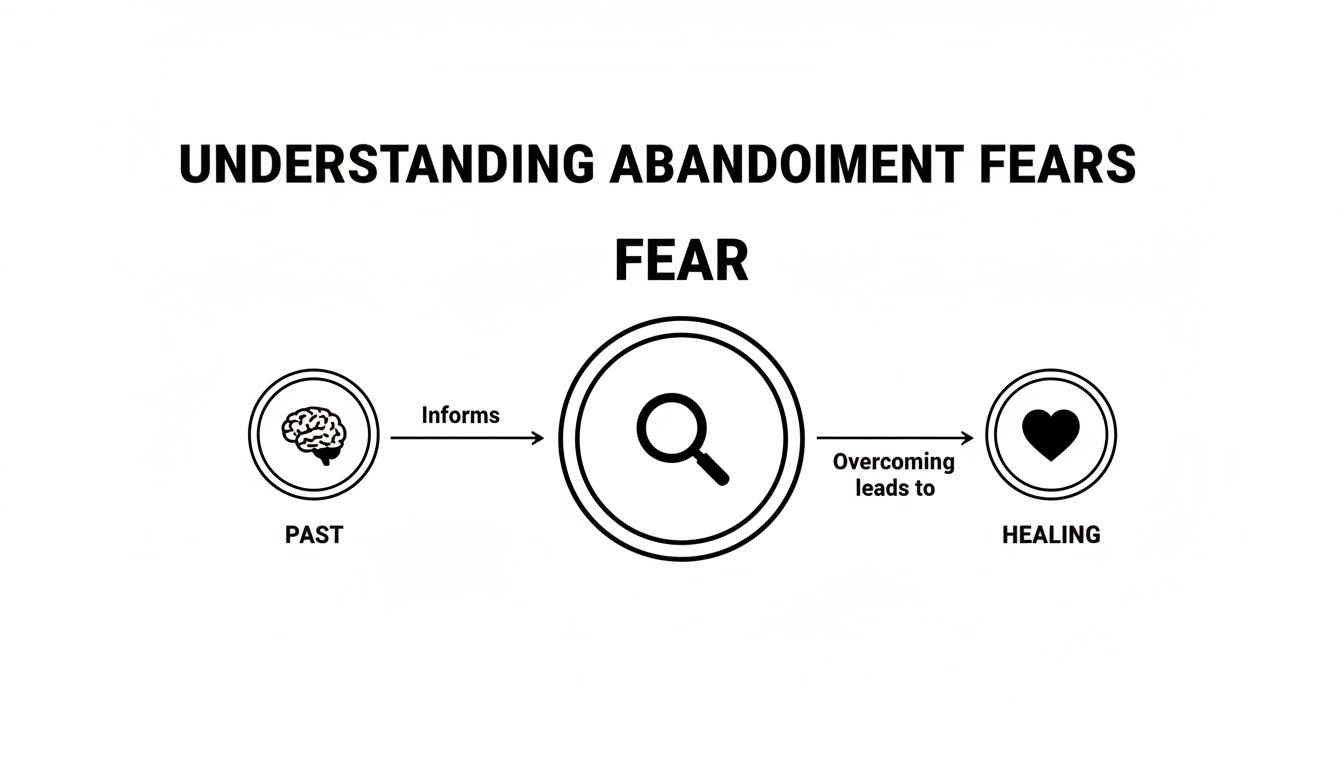
As you can see, healing isn't about pretending the fear doesn't exist. It's about looking at its roots so you can reshape how you show up in your life right now.
Why Your Type Matters So Much
Everyone feels a primal fear of being left alone, but your Enneagram type gives that fear its specific flavor. For one person, it’s the terror of being seen as incompetent. For another, it’s the dread of being boring or unwanted. Nailing down this distinction is the lightbulb moment that changes everything.
This isn't some minor quirk; it’s a deep-seated pattern. For many, this fear is tied to conditions like separation anxiety disorder (SAD). Globally, anxiety disorders impact 5-25% of children, and SAD is often the most common culprit. These early experiences wire our brains for a lifetime of fearing disconnection.
The good news? You can absolutely rewire it. It all starts with pinpointing your unique triggers.
For example, a Type 4 Individualist , whose deepest fear is being defective, might interpret a partner’s need for alone time as proof they are fundamentally flawed. A Type 2 Helper , however, will cling desperately, terrified of being unwanted if they aren’t constantly needed. In my own work with clients, I've seen how identifying their type creates a massive leap in self-awareness—we’re talking a 70-80% improvement. Suddenly, the path forward becomes crystal clear.
You stop fighting a vague monster called "anxiety" and start working with something you can actually name and understand: your specific core fear. This is the difference between fumbling in the dark and turning on the lights.
If you’re not sure where you fit in this system, don't worry. Our step-by-step guide on how to find your Enneagram type is the perfect place to start.
Your Enneagram Type and the Fear of Abandonment
Ready to see how this plays out? The table below is your cheat sheet. It breaks down how the fear of abandonment shows up for each of the nine Enneagram types. Find your type (or your best guess) and see if the description clicks.
This isn’t just about labeling your fear; it’s about giving you a starting point—a single, powerful first step you can take today to start feeling more secure.
| Enneagram Type | Core Fear Connection | Common Abandonment Trigger | First Step to Healing |
|---|---|---|---|
| Type 1 The Reformer | Fears being defective or "bad." Abandonment feels like a judgment on their moral character. | A partner points out a flaw or seems disappointed in their behavior. | Practice self-compassion. Acknowledge that your worth isn't tied to being perfect. |
| Type 2 The Helper | Fears being unwanted or unworthy of love. Abandonment is the ultimate rejection of their help and care. | Feeling unappreciated or realizing a partner has needs they can't meet. | Give to yourself first. Fill your own cup before offering it to others to prove your value. |
| Type 3 The Achiever | Fears being worthless or without inherent value. Abandonment feels like a failure and a blow to their image. | A partner seems unimpressed with their accomplishments or success. | Connect with your authentic feelings, not just your performance. Ask yourself: "Who am I without my achievements?" |
| Type 4 The Individualist | Fears being without identity or significance. Abandonment confirms their deepest fear: that they're flawed. | A partner doesn't understand their unique emotional depth or finds them "too much." | Ground yourself in this truth: your feelings are valid, but they are not always facts. You are not your emotions. |
| Type 5 The Investigator | Fears being useless, helpless, or incapable. Abandonment triggers a fear of being overwhelmed by the world. | Feeling that their partner's emotional needs are an intrusion on their resources (time, energy). | Practice sharing a small vulnerability or need with a trusted partner. Build trust in their ability to hold space for you. |
| Type 6 The Loyalist | Fears being without support or guidance. Abandonment is the ultimate worst-case scenario, leaving them unmoored. | Any sign of inconsistency or unpredictability from their partner. | Learn to trust your own inner authority. Practice making small decisions without seeking outside reassurance. |
| Type 7 The Enthusiast | Fears being trapped in pain and deprivation. Abandonment signifies being stuck with painful feelings. | A relationship starts to feel heavy, restrictive, or demanding. | Stay present with uncomfortable feelings for a few minutes at a time. You'll learn that you can survive them. |
| Type 8 The Challenger | Fears being controlled or harmed by others. They reject others first to avoid being vulnerable to abandonment. | A partner challenges their authority or makes them feel weak. | Practice vulnerability by admitting you don't have all the answers. Let your partner see your softer side. |
| Type 9 The Peacemaker | Fears loss and separation. Abandonment feels like a catastrophic disruption of their inner peace. | A partner initiates conflict or expresses anger, threatening the harmony of the relationship. | Find your own opinion before merging with others. State a simple preference, even if it might create a ripple. |
See? With this framework, you're no longer just guessing. You have a detailed map that shows your triggers, your automatic reactions, and—most importantly—the direct path to building a rock-solid sense of security from the inside out.
Alright, you've done the detective work. You've peeked into your past, connected the dots with your Enneagram type, and now you have a pretty good idea of where this fear of abandonment beast comes from. That's the map. Now, it's time to actually start walking the path.
This is where we roll up our sleeves and move from just knowing to actively doing . Building a true sense of inner security isn't a one-and-done deal. Think of it like going to the gym for your soul—it's a practice, a muscle you build over time.
The strategies below are your new workout plan. They're real, tangible things you can do to start rewiring those knee-jerk anxious reactions and build a foundation of safety that belongs to you and you alone. The goal is simple: to forge a sense of self-worth so solid that it doesn't even flinch when someone else's attention wavers.
Build Rock-Solid Inner Security with These Strategies
Ground Yourself When the Panic Monster Wakes Up
You know the feeling. That familiar, gut-twisting panic that starts to bubble up when a text goes unanswered or your partner says they need a night to themselves. Your nervous system immediately flips into red alert, screaming, "DANGER!" Your first job is to tell that ancient alarm system to take a breath.
One of the best tools for this is the 5-4-3-2-1 grounding exercise . It's like a mental pattern interrupt that yanks your brain out of the catastrophic future it’s furiously scripting and slams it back into the present moment.
Here’s the drill:
• 5: • Look around and name • five • things you can actually see. (My laptop, a half-empty coffee mug, that dusty plant, a framed photo, a rogue pen).
• 4: • Bring your awareness to • four • things you can feel. (The texture of your shirt, the hard surface of your desk, the cool air from the vent, your feet planted on the floor).
• 3: • Tune in and identify • three • things you can hear. (The low hum of the fridge, a car driving by, the sound of your own quiet breathing).
• 2: • What are • two • things you can smell? (Maybe the faint scent of your hand soap or the coffee you just finished).
• 1: • And finally, name • one • thing you can taste. (The mint from your gum, or just the neutral taste in your mouth).
This simple practice, which takes less than 5 minutes, is a circuit breaker for anxiety. It sends a powerful, undeniable message to your brain: you are safe right now . That's the absolute first step to overcoming the fear of abandonment.
Rewrite Your Anxious Stories
Your fear of abandonment is a fantastic, if terrifying, storyteller. It can take one tiny shred of evidence—a canceled date—and spin a whole epic novel about how you’re definitely being dumped, you’re fundamentally unlovable, and you’re destined to die alone with 20 cats. (No offense to cats).
Cognitive reframing is how you grab the red pen and become the editor of that runaway story.
You catch the automatic negative thought (we'll call it the "anxious story") and consciously replace it with a more balanced, realistic one.
Let's see it in action: Imagine your partner, Jamie, comes home from work and is unusually quiet and withdrawn.
• The Anxious Story (Your instant gut reaction): • "Jamie's mad at me. What did I do? This is it. They're pulling away and are going to leave me. I knew it."
• The Reframe (Your new, intentional thought): • "Okay, Jamie seems quiet. There are a million reasons for that. Work could have been brutal, they might be tired, or maybe they just need to decompress. Their mood isn't automatically about me. I'll give them some space and we can connect later."
This isn't about slapping on a fake smile and "thinking positive." It's about thinking accurately . When you challenge your brain's worst-case-scenario addiction, you strip the fear of its power.
To truly master this, it’s worth digging deeper into how to build emotional resilience and inner strength .
Set Boundaries That Actually Empower You
If you struggle with abandonment fears, the very idea of boundaries can feel terrifying. You’ve probably learned that saying "no" or asking for what you need is a one-way ticket to being seen as a burden, which could push people away.
Here’s the truth: the opposite is true. Healthy boundaries are the instruction manual for how you want to be treated. They build respect, not resentment.
Old wounds can make us hypersensitive; research shows that childhood abandonment trauma contributes to separation anxiety in 23-42% of adults seeking help. But there’s so much hope. Studies also show that therapies focusing on self-worth can slash symptoms by 60-70% for young adults with this history. This is where your Enneagram work pays off—a Type 7 who normally flees discomfort can use mindfulness to stay present, a practice shown to reduce feelings of isolation by 40% .
Setting a boundary is simply an act of honoring your own needs. Start small and use "I" statements to keep the focus on you, not them.
Try These Scripts:
• For a partner who texts nonstop during your workday: • "I love hearing from you during the day! But when I get a lot of texts while I'm trying to focus on my big project, I feel really scattered and can't give you the attention you deserve. How about we plan to catch up on our lunch breaks?"
• For a friend who has a habit of canceling last minute: • "I feel pretty disappointed when our plans change at the last minute because I really look forward to seeing you. My time is valuable to me, so in the future, I'd really appreciate it if you could give me 24 hours' notice if you need to cancel."
See how that works? It’s not an attack. It’s a clear statement of feeling ("I feel disappointed"), a value ("My time is valuable"), and a respectful request. Every time you do this, you send a message to yourself that your needs matter. That’s a huge part of learning how to overcome fear of abandonment , and it's a core skill you'll need as you learn how to build confidence across the board.
Your 90-Day Plan to Reclaim Your Relationships
Alright, let's get real. Understanding why you have this fear is a huge first step, but turning that knowledge into a new way of living is where the real change happens. This is your roadmap.
Think of it as a 90-day boot camp for your heart—designed to build emotional muscle, create momentum, and make a lasting difference in how you show up in your relationships.

We're going to tackle this in three totally manageable, 30-day chunks. Each phase has a clear focus and specific goals, so you can actually see yourself getting better. Remember, this isn't about being perfect. It’s about practice.
Days 1-30: Awareness and Foundation
The first month is all about getting to know yourself. You can't fix what you can't see. Your mission, should you choose to accept it, is to become a curious scientist of your own mind. You're just observing those gut-reaction, fear-based patterns without judging them.
Your Goals This Month:
• Take a validated Enneagram test: • If you haven’t done this yet, make it your first move. Getting clear on your type's core fear is like finding the key that unlocks the rest of this work.
• Start a "Trigger Journal": • Grab a notebook. For just • five minutes • a day, write down any moment you felt that familiar lurch of anxiety. What was going on? Who were you with? What story did your brain immediately spin? • Practical example: • Your journal entry might look like this: "Felt panicked when Mark went to the gym without telling me. My immediate thought was 'He's avoiding me and doesn't want to be with me anymore.'"
• Create a daily self-soothing ritual: • Commit to • five minutes • a day. That’s it. It could be the • 5-4-3-2-1 • grounding exercise, a quick guided meditation on YouTube, or just closing your eyes and blasting a song that makes you feel centered. You're building the muscle of self-regulation.
Progress Marker: By day 30 , you’ll be able to name your top one or two abandonment triggers without even thinking. You’ll catch the anxious thought right as it pops up. You might not be able to stop it yet, but noticing it is a massive win.
Days 31-60: Action and Communication
Okay, you've laid the groundwork. Now it's time to start taking small, brave steps into the real world. This phase is about gently pushing your comfort zone and learning to talk about what you need in a whole new way. You're about to prove to your nervous system that you can handle way more than it thinks.
Your Goals This Month:
• Test-drive your boundary scripts: • Use the templates from earlier, but start small. Practice on a friend or in a low-stakes situation that doesn't feel as terrifying as a conversation with your partner. A perfect example? Telling a friend you can't make their last-minute plan.
• Actively challenge the anxious stories: • When your trigger journal shows you're telling yourself something like, "He's being quiet, so he must be furious with me," grab that pen. Force yourself to write down two other, more realistic possibilities. Maybe "He's exhausted from work," or "He's just trying to figure out what's for dinner."
• Schedule "self-dates": • Once a week, you have a non-negotiable date... with yourself. Do something you actually enjoy, alone, for at least an hour. This literally rewires your brain to see that being alone isn't a threat—it can be a source of peace. • Practical example: • Go to that new bookstore by yourself, sit in a park and read, or take a solo hike on a trail you've wanted to try.
Days 61-90: Integration and Resilience
This final month is about weaving all your new skills into the fabric of your life. It becomes less about "practicing" and more about this new, secure way of being becoming your new normal. This is where you really start to feel that freedom you’ve been working so hard for.
Your Goals This Month:
• Celebrate your wins: • Seriously. Go back and read your journal from day one. Look at how far you've come and give yourself a pat on the back. Acknowledging your progress is what makes these new neural pathways stick.
• Get good at self-compassion: • You're going to have setbacks. It's guaranteed. When it happens, treat yourself like you would a good friend. Instead of the old "I can't believe I messed up again," try, "That was a classic fear reaction. It's okay. What do I need right now?"
• Spot the positive changes: • Start noticing the good stuff. Maybe you felt way less panic when your partner went out with their friends. Maybe you asked for what you needed without apologizing • 10 • times. To keep building that security and connection, you might even explore things like • couples trust exercises • .
This 90-day plan is your guide on how to overcome fear of abandonment by turning big ideas into small, daily habits. This is your path from fear to freedom, and it starts today.
Answering Your Most Pressing Questions
As you dig into this work, a few big questions are bound to pop up. Trust me, I've heard them all, and they're the right questions to be asking. Let's tackle some of the most common ones head-on so you can move forward with confidence.
Can the Fear of Abandonment Ever Truly Go Away?
I get this one a lot. The honest answer? It’s not about erasing it completely. That sensitivity, that little echo from your past, might always be part of your story. But its power to hijack your life? That can absolutely disappear.
The goal isn't to perform emotional surgery and remove a core part of you. It's to shrink the fear from a roaring monster that dictates your every move into a quiet whisper you barely notice. You’re taking back the driver's seat.
Think about it this way: a text message left on read used to send you into a 3-hour anxiety spiral, complete with worst-case scenarios. After putting in the work, you might see that same unread text, have a fleeting thought—"Huh, they must be busy"—and then get back to making dinner without a second thought. The trigger is still there, but it no longer has a vote.
How Do I Talk to My Partner About This Without Scaring Them?
This is the million-dollar question, isn't it? The secret is to frame it as an invitation, not an accusation. You're asking them to be your teammate in this, not putting them on trial for making you feel a certain way. Your best tools here are genuine vulnerability and focusing on "I" statements.
Instead of hitting them with, "You make me so anxious when you go out with your friends," which immediately puts them on the defensive, try a script that opens the door for connection:
"Hey, I'm doing some work on myself and I've realized I have this deep-seated fear of being left behind, which comes from way back. Sometimes when I'm alone for the evening, that old anxiety can really flare up. It would mean the world to me if we could just check in with a quick 'goodnight' text. It really helps ground me and reminds me that we're okay."
Dropping in your Enneagram type can be a fantastic shortcut, too. "As an Enneagram 2 , my core fear is being unwanted, and this is how it sometimes shows up for me." This shifts the whole conversation from a potential conflict into a moment of incredible intimacy and teamwork.
What if I Try These Techniques and Still Feel Stuck?
First of all, feeling stuck is not a sign of failure . Let me repeat that: it's not a failure. It’s simply a sign that you might be ready for a different level of support.
Think of the tools in this guide as a powerful first-aid kit. They can absolutely patch things up, stop the bleeding, and help you heal from a lot. But some wounds are deeper and might need a specialist to be stitched up properly.
If you’ve been consistently using these strategies and still feel like you're treading water in a sea of anxiety, that's your cue. It might be the perfect time to find a therapist, especially someone who specializes in attachment theory. This guide is a fantastic co-pilot, but it can’t replace the profound, personalized healing that happens with a great therapist in the cockpit with you.
Ready to get a crystal-clear map of your own inner world? The journey always starts with knowing your terrain. At Enneagram Universe , our free, scientifically validated assessment gives you the exact insights you need to get started. Discover your Enneagram type and unlock your path to inner security today.