How to Improve Self-Regulation and Master Your Mind

Ever feel like you're fighting a losing battle with your own impulses? You know what you should do, but in the heat of the moment, that cookie, that "one more episode," or that procrastination urge just wins. If that sounds familiar, you're in the right place.
Improving your self-regulation isn't about white-knuckling your way through life. It's about learning how to work with your brain, not against it. Think of it as a skill—one you can build with the right training, a little consistency, and some clever environmental design.
A No-Nonsense Guide to Building Real Self-Regulation
Let's get one thing straight: self-control isn't some magical trait you're either born with or you're not. It's a muscle. And just like any muscle, it gets stronger with the right exercises. This guide is your personal training plan.
We're going to skip the vague "just try harder" advice and get into practical, smart systems that make self-regulation feel less like a constant struggle and more like a natural reflex. This isn’t about turning into an unfeeling robot. It's about gaining the freedom to consciously choose your actions instead of letting temporary feelings or a shiny distraction call the shots.
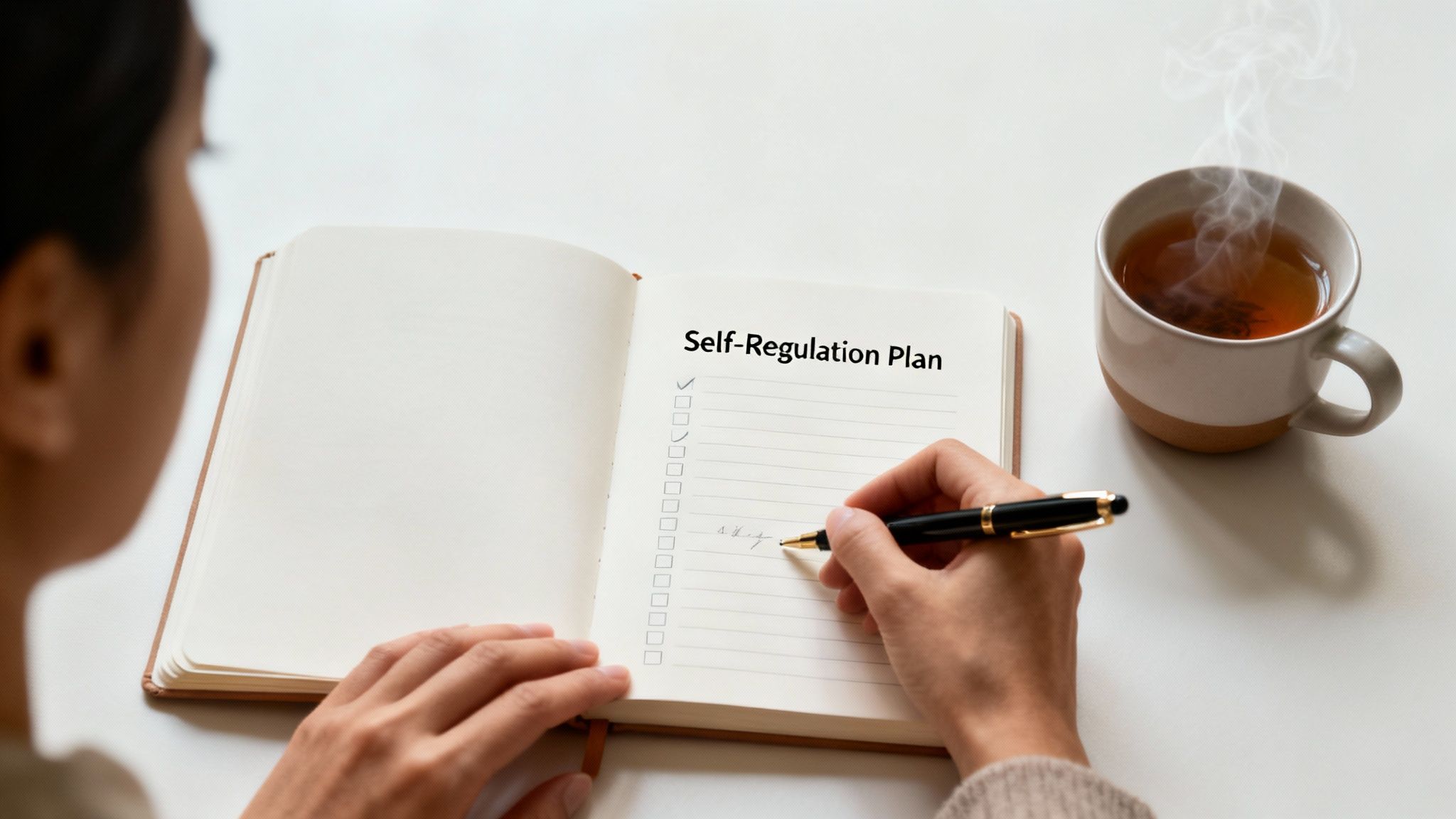
The Four Pillars of Building Self-Regulation
To make this journey manageable, we'll focus on four core pillars. Each one targets a different, crucial aspect of mastering self-regulation. This framework gives us a clear roadmap for what's ahead.
| Pillar | Core Action | Why It Works |
|---|---|---|
| Understand Your Brain | Learn the science behind your impulses and decision fatigue. | Knowledge is power. When you know why you act a certain way, you can outsmart it. |
| Daily Exercises | Implement small, consistent habits to build mental muscle. | Just like going to the gym, repetition strengthens your ability to resist impulses. |
| Design Your Environment | Actively shape your surroundings to support your goals. | This makes good choices the path of least resistance, saving your willpower. |
| Track and Personalize | Monitor your progress and adapt strategies to fit you. | Seeing small wins keeps you motivated and helps you fine-tune your approach. |
This is more than just a personal quest; it’s part of a massive cultural shift. The global self-improvement market was valued at 46.1 billion in 2025 and is expected to rocket to 90.9 billion by 2034. Clearly, people are hungry for tools that help them master their inner worlds.
The real secret sauce? Self-awareness. You can't regulate what you don't recognize. Getting honest about your own patterns, triggers, and motivations is the absolute, non-negotiable first step.
For those who want to go deeper, structured approaches from psychology offer incredible tools. Techniques from Cognitive Behavioral Therapy (CBT), for example, provide a powerful framework for rewiring the thought patterns that sabotage your self-control.
Ultimately, this guide will give you the playbook. But it’s your curiosity and willingness to understand yourself that will truly drive your success. If you're ready to dig in, our guide on “ How to Become More Self-Aware: Tips for Self-Discovery ” is the perfect place to start that journey.
Understanding the Science of Your Willpower
Ever wonder why you can walk right past a box of donuts at 10 AM but find yourself elbow-deep in the same box by 9 PM? That’s not a personal failing. It’s your brain’s biology playing out in real-time. If you want to get a grip on self-regulation, you first need to understand the fascinating tug-of-war happening between your ears.
Think of your brain as having two competing managers. First up is the prefrontal cortex (PFC) , the sophisticated CEO sitting right behind your forehead. This is the part of you that thinks about long-term goals, uses logic, and keeps your impulses in check. It's the voice of reason that reminds you about your health goals when you lock eyes with that donut.
But the PFC isn't running the show alone. It’s got a powerful, and much more primal, rival: the limbic system . This is the ancient, emotional part of your brain that’s all about survival, rewards, and gut feelings. It’s the part that screams, "EAT THE DONUT! It's sugary, delicious, and will make us feel good right now !" That sudden, overwhelming urge? That's your limbic system making a bid for control.
The Battle for Control
Every single day, you're a spectator to this internal showdown. Choosing to grind through a tedious report instead of falling down a YouTube rabbit hole? That’s a classic PFC vs. limbic system throwdown. Your PFC is gunning for the delayed gratification of a job well done, while your limbic system is desperately trying to hit that instant dopamine button.
This mental conflict is completely normal. In fact, these high-level cognitive skills, like planning and reasoning, don't even finish developing until we're well into our twenties. So, strengthening them isn't something you should have mastered by now—it's a lifelong project.
Self-regulation isn’t about brute-forcing your impulses into submission. It’s about understanding the biological battle and giving your inner CEO—the prefrontal cortex—the tools it needs to win more often.
To really dig into this, it's incredibly helpful to understand what is executive function and how it powers your self-regulation. These functions are essentially the playbook your PFC uses to manage your thoughts, actions, and emotions.
Why Your Willpower Fades
Do you ever feel like your self-control has a battery life that’s in the red by dinner time? There's a name for that: ego depletion , or decision fatigue. Your PFC isn’t a magical, infinite resource; it's more like a muscle. And like any muscle, it gets tired when you overuse it.
Just think about all the tiny decisions you make all day long:
• What outfit to wear
• Which email to tackle first
• Whether to say what you're • really • thinking in a meeting
• What to make for lunch
• When to merge into traffic
Each one of these choices, no matter how small, takes a little slice out of your willpower pie. By the end of the day, your PFC is exhausted, which leaves the door wide open for your impulsive limbic system to crash the party. That’s precisely why that 9 PM donut is a thousand times more tempting than the 10 AM one. Your willpower isn't gone; it's just running on fumes.
Work With Your Brain, Not Against It
This is actually great news. Once you understand the science, you can stop blaming yourself for having "weak willpower" and start strategically managing your mental energy. You can work with your biology instead of constantly fighting a battle you're destined to lose.
For instance, you can tackle your most demanding, high-focus tasks in the morning when your PFC is fresh and ready to go. You can also automate small, daily decisions (like what to eat for breakfast) to save that precious mental energy for the choices that actually matter. This simple shift in perspective is the foundation for building a system of self-control that actually works.
Daily Exercises to Strengthen Your Regulation Muscle
Alright, knowing the science behind willpower is one thing. Actually putting it to work is another. It’s time to hit the gym—the mental gym, that is. Self-regulation isn't some innate talent; it’s a skill. And just like any muscle, it gets stronger with consistent reps.
This isn’t about some dramatic, life-altering overhaul you’ll abandon by Thursday. It's about small, repeatable exercises that build your mental fortitude, brick by brick, until self-control becomes your new normal. Forget the vague advice to "just try harder." We're diving into specific, actionable techniques you can start using the moment you finish reading this.
The whole game is about making these things easy to weave into your day. When it comes to building habits, consistency always trumps intensity.
Think of it like this: your brain is in a constant tug-of-war between your logical, forward-thinking prefrontal cortex and your impulsive, "I want it now" limbic system. Every time you have to make a choice, it drains your mental battery.
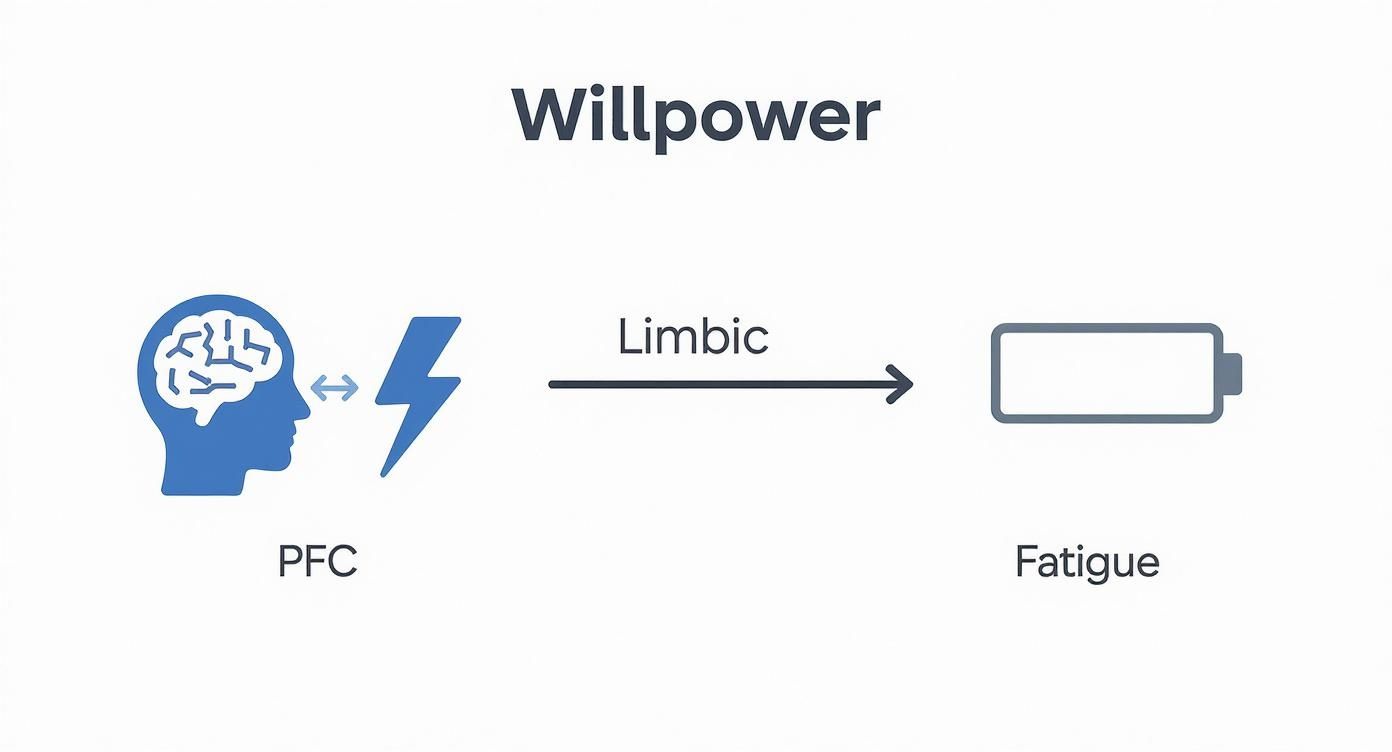
This is why you need a game plan. Relying on sheer willpower is like trying to hold back a flood with a paper towel—it’s just not going to work for long.
Master the Mindful Pause
Meet your new secret weapon: the Mindful Pause . It's your impulse-control emergency brake. This isn't some hour-long meditation session; it’s a 60-second trick to create that crucial sliver of space between a trigger and your knee-jerk reaction.
Feeling that sudden urge to snap at a coworker, dive headfirst into a bag of chips, or doomscroll instead of finishing that report? Hit the pause button.
Here’s the drill:
• Stop. • Whatever you're doing, just freeze.
• Breathe. • Take one long, slow breath. In through your nose, out through your mouth.
• Notice. • Acknowledge the urge without judging it. Just say to yourself, "Ah, there's the urge to procrastinate," or "Okay, I'm feeling angry right now."
• Choose. • Now, with that tiny bit of breathing room, you can consciously decide what to do next.
This simple act yanks you out of autopilot. It interrupts that primal, limbic-driven response and brings your brain's "inner CEO"—the prefrontal cortex—back online to make a call that aligns with your actual goals. The more you practice this, the more automatic it becomes. If you want to explore this further, there are some fantastic self-awareness activities that build on this very principle.
Pre-Plan Your Success with If-Then Scenarios
One of the sneakiest ways to boost your self-regulation is to make fewer decisions in the heat of the moment. That’s where "If-Then Planning" (also known as implementation intentions) comes in. You're basically creating a pre-made script for your brain to follow when temptation strikes.
The formula couldn't be simpler: If X happens, then I will do Y.
You’re outsourcing the hard work to your past self, who had the clarity and energy to make a good choice. This requires way less mental horsepower than trying to wrestle with a craving when you’re already tired and stressed.
Here’s what this looks like in the real world:
• If • I feel the urge to check my phone while I'm trying to work, • then • I will immediately stand up and do five quick stretches.
• If • that 3 PM sugar craving hits, • then • I will drink a full glass of cold water and eat the apple I packed for this exact moment.
• If • my brother says that • one thing • that always gets under my skin, • then • I will take a deep breath and say, "I need a moment to think about that."
See what's happening? You're automating good behavior. You're not relying on discipline; you're just running a program you already wrote.
The Genius of Temptation Bundling
Now for a truly brilliant brain hack: Temptation Bundling . This is where you pair something you love doing with something you should be doing. The catch? You only get to do the fun thing while you're doing the not-so-fun thing.
It’s about linking an instant dopamine hit to a long-term goal. You’re making the chore more appealing by attaching it to a reward.
How to put temptation bundling to work:
• Only listen to your favorite true-crime podcast • while • you're on the treadmill.
• Only watch the latest episode of that trashy reality show you love • while • you're folding laundry.
• Only treat yourself to that fancy latte • on your way back from • the weekly team meeting you dread.
By linking a source of pleasure directly to a challenging task, you create a powerful positive feedback loop. Your brain starts to associate the difficult habit with the immediate reward, making you more likely to repeat it.
This strategy cleverly bridges the gap between your present self (who wants fun now ) and your future self (who benefits from you doing the hard stuff). You’re tricking your brain into wanting to do the things that are good for you.
And the science backs this up. A recent clinical trial showed that combining simple mindfulness techniques with these kinds of exercises led to major improvements in self-regulation, with the biggest changes happening within the first four weeks of daily practice. You can read the full research on how daily practice boosts self-regulation skills on Nature.com . These aren't magic spells, but with daily repetition, they lay the foundation for real, lasting change. A little effort each day truly compounds into remarkable self-mastery over time.
Design Your Environment for Effortless Self-Control
Let's get one thing straight: the most disciplined people you know aren't superheroes. They don’t have some secret reserve of infinite willpower. What they do have is a knack for rigging the game in their favor.
They are master architects of their own lives. They understand a powerful secret: willpower is flaky. It's a finite resource that runs out, especially on a Tuesday afternoon when you’ve had three meetings and a weak cup of coffee. A well-designed environment, on the other hand? It works for you 24/7 . It's time to stop trying to win every battle with brute force and start designing a world where the right choice is also the easiest choice.
This whole concept is called choice architecture . You're intentionally shaping your surroundings to gently nudge your future self toward your goals. Instead of constantly fighting off temptation, you make temptation a massive pain to get to.
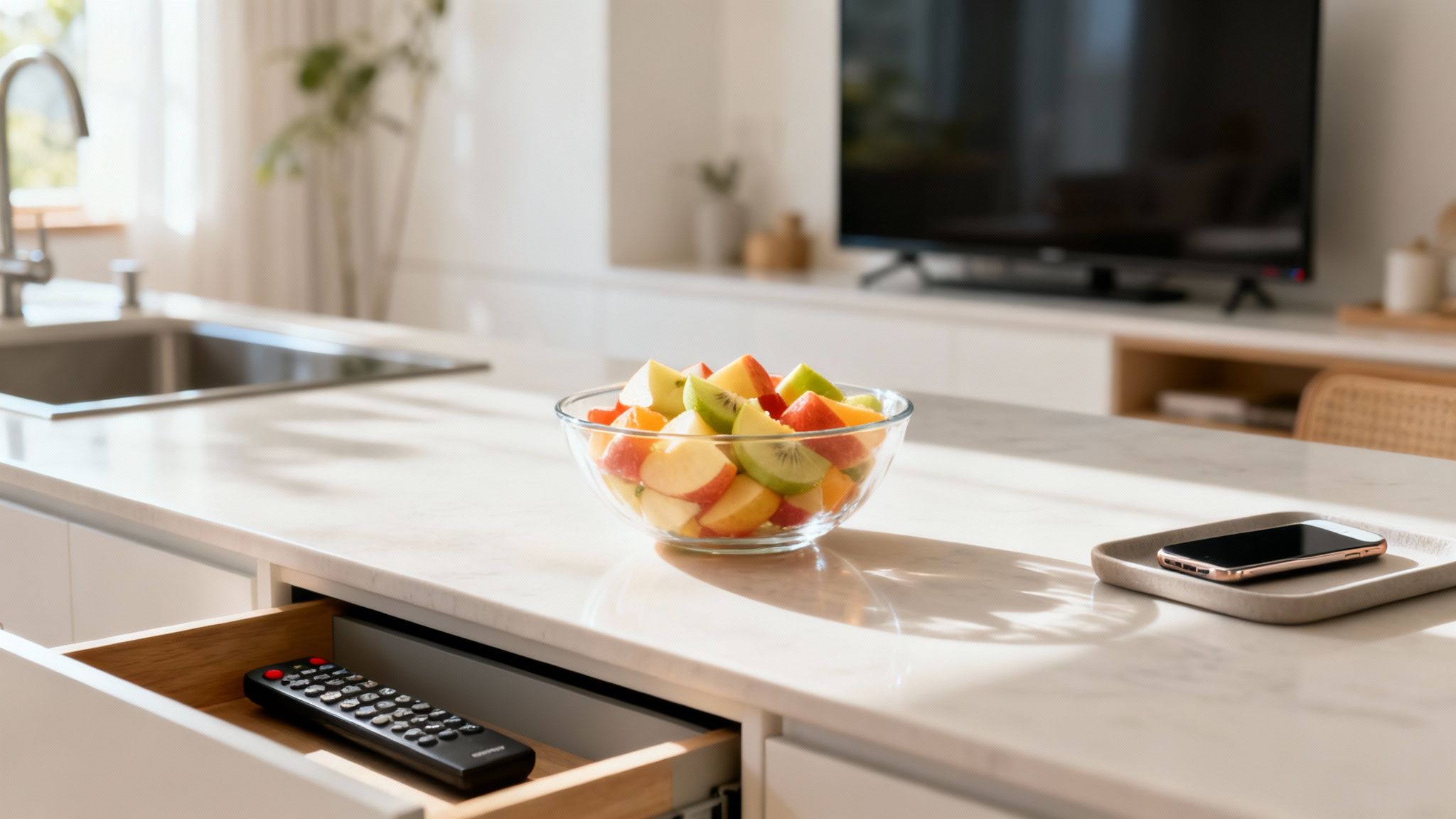
This isn’t about creating a sterile, joyless existence. It’s about being clever. Every little bit of friction you place between yourself and a bad habit is a win for your future. And every obstacle you remove from the path of a good habit makes success that much more likely.
Tweak Your Digital World
In today’s world, your digital space is just as real as your physical one. Your phone and computer can be incredible tools for growth, or they can be black holes of distraction that suck you in for hours. You get to decide which.
Think about something as simple as turning off your phone's non-essential notifications. It’s not just about silencing the buzz. It’s about reclaiming your focus. Every single alert is a tiny papercut to your attention, forcing your brain to switch contexts and draining that precious mental energy.
Here are a few quick digital moves you can make right now :
• Banish Apps from Your Home Screen: • Shove those distracting social media and game apps into a folder on the second or third page of your phone. That extra swipe creates just enough of a pause for your rational brain to jump in and ask, "Do I • really • want to open this right now?"
• Get a Website Blocker: • For those times you need to do deep, focused work, use a browser extension like • Freedom • to block your biggest time-wasting websites. Set it for a • two-hour • block and prepare to be amazed at what you get done.
• Go on an Unsubscribe Spree: • That daily email from a store you bought one thing from three years ago? It's a tiny, daily invitation to browse and spend money you don't need to. Ruthlessly unsubscribe from any marketing emails that don't bring you genuine value.
These small tweaks create a digital environment where focus is the default setting, not a constant struggle.
Engineer Your Physical Space
Your physical surroundings are constantly sending your brain little signals about what to do next. If a leftover slice of cake is the first thing you see when you open the fridge, guess what your brain is going to crave? But if it sees a container of pre-cut carrots and hummus? You’ve just made the healthy choice, the lazy choice. Win-win.
It’s all about making your desired behaviors obvious and your undesired ones practically invisible.
Stop draining your willpower fighting the same old daily battles. Instead, invest a little energy upfront to create an environment where the habits you want happen almost automatically. Your future self is going to thank you for it.
Think of yourself as a movie set designer. What props can you place around to encourage the right actions?
At Home:
• Want to read more? When you make your bed in the morning, leave a book on your pillow.
• Trying to watch less TV? When you're done for the night, unplug it and put the remote in a drawer in another room. The sheer hassle of setting it all back up might be enough to make you reach for that book instead.
• Need to drink more water? Easy. Keep a full, appealing-looking water bottle on your desk or kitchen counter at all times.
At the Office:
• Can't focus? Pop on some noise-canceling headphones. Even if you're not listening to anything, it's the universal symbol for "I'm in the zone, please come back later."
• Losing track of deadlines? Get a physical whiteboard and map out your projects. Making your goals physically visible keeps them right in front of your mind.
None of this is rocket science. These are simple, environmental cues that steer your behavior without needing a single drop of willpower. You’re rigging the game so that you can't help but win. And the research backs this up, showing that skills like organization and planning—which are central to self-regulation—need support systems well into adulthood. By designing your environment, you're literally building your own support system.
How to Track Your Progress and Stay Motivated
Let's be real: you can't improve what you don't measure. Trying to build self-regulation without tracking your progress is like trying to get fit without ever stepping on a scale or timing your runs. You might feel like you're making headway, but you'll have no idea what's actually working.
But forget about complicated spreadsheets or rigid systems that feel like a second job. The goal here is to gather just enough information to see your wins, understand your patterns, and build unstoppable momentum. We're chasing progress, not some impossible standard of perfection.
This isn't just a feel-good idea; it's backed by some serious science. The landmark 40-year Dunedin Study discovered that self-control is surprisingly flexible—about half as stable as IQ. What does that mean? It means you can change it! The study showed that external structures and a clear sense of progress actually helped people improve their self-regulation over time. You can dive deeper into the lifelong impacts of self-control in this fascinating article from American Scientist .
Find a Tracking Method That Clicks
The best tracking method is the one you’ll actually use. Simplicity is your best friend here. If it takes more than a few minutes a day, you’ll ditch it by Wednesday.
Here are a few dead-simple approaches that I’ve seen work wonders for people.
• The "Don't Break the Chain" Calendar: • This is as low-tech as it gets. Grab a wall calendar, pick • one • specific habit you're building (like pausing before reacting when you're frustrated), and draw a big 'X' on every day you nail it. Your only job? Don't break that beautiful chain of Xs. That visual cue becomes a surprisingly powerful motivator.
• A Basic Daily Journal: • This isn't a "Dear Diary" epic. We're talking two or three lines before bed. Just jot down the answers to two questions: "When did I successfully manage an impulse today?" and "When did I struggle?" This simple reflection builds massive self-awareness and helps you pinpoint your triggers.
• Simple Habit-Tracking Apps: • If you're more digitally inclined, an app can provide that satisfying visual feedback. Tools like • Streaks • or • Habitify • can gamify the process with charts and reminders, turning your self-regulation practice into a game you actually want to win. The key is to pick one that’s minimalist and won't bombard you with notifications.
To help you decide, let's break down which method might be the best fit for your personality and lifestyle.
Simple Self-Regulation Tracking Methods
| Method | Best For | Pros | Cons |
|---|---|---|---|
| "Don't Break the Chain" | The visual and tactile person who loves tangible proof of progress. | Extremely simple, low-cost, and creates a powerful visual motivator. | Not portable; can be discouraging if you break a long streak. |
| Basic Daily Journal | The introspective person who wants to understand the "why" behind their actions. | Deepens self-awareness, helps identify triggers, and is very flexible. | Requires more mental effort than just checking a box. |
| Habit-Tracking App | The tech-savvy, data-driven person who loves charts and reminders. | Gamifies progress, provides data visualizations, and sends reminders. | Can lead to notification fatigue; some apps have distracting features. |
Ultimately, the best method is the one that doesn't feel like a chore. Experiment for a week and see what sticks!
Progress, not perfection, is the goal. Each small win, no matter how tiny, creates a dopamine-fueled feedback loop in your brain that says, "Hey, that felt good. Let's do it again."
The Weekly Regulation Review
Daily tracking is where you collect the data, but the real magic happens when you connect the dots.
Set aside just 15 minutes every Sunday for what I call a Weekly Regulation Review . This is your personal debrief where you step back, look for patterns, and decide on your next move.
During this quick check-in, ask yourself three simple questions:
• What was my biggest self-regulation win this week? • Seriously, celebrate it. Did you hold your tongue in a meeting? Did you go for a walk instead of doomscrolling? Acknowledge it.
• What was the most common trigger that threw me off course? • No judgment here. Just identify the pattern. Was it midafternoon stress? A specific person?
• What one small adjustment can I make next week to support myself? • This isn't about overhauling your life. It's about a tiny, actionable tweak.
This quick ritual shifts you from being a passenger to being the CEO of your own growth. You're no longer just reacting; you're learning, adapting, and getting smarter every week. If you want a more structured way to set and track these kinds of goals, our guide on creating a personal development plan template is the perfect place to start.
This is the secret sauce: celebrating the small, consistent wins. That moment you chose water over a third coffee, or took five deep breaths before replying to a frustrating email—those are the victories that rewire your brain for more success. It’s this steady pile-up of small wins that builds the strong, resilient self-regulation muscle you’re after.
Answering Your Burning Self-Regulation Questions
Alright, let's get real for a minute. Even with the best plan in the world, the path to mastering self-regulation is almost never a straight line. Life loves to throw curveballs. You'll have days where you feel like a willpower superhero, and others where you can't even resist a cookie staring at you from across the room.
This is totally normal. In fact, these messy, imperfect moments are where the most important growth happens.
So, let's dive into some of the most common questions and roadblocks that pop up. Think of this as your personal troubleshooting guide for when things inevitably go sideways.
What If I Have a Terrible Day and Completely Fall Off the Wagon?
First things first: take a deep breath. One bad day doesn't wipe out all your hard work. The goal here isn't flawless perfection; it's building resilience. Trust me, falling off track isn't a failure—it's just a new piece of data.
Instead of beating yourself up, switch into detective mode. Get curious. What actually led to the slip-up? Were you completely drained? Stressed about that big project at work? Did you forget to eat lunch? More often than not, what feels like a "willpower failure" is really just your body screaming that a basic need isn't being met.
The most powerful thing you can do after a setback is to show yourself some compassion. Treat it as a chance to learn something new about yourself, not as a final judgment on your character. Acknowledge what happened, figure out the lesson, and get right back on your plan tomorrow.
Remember, these skills take time to build, and they actually keep getting stronger well into adulthood. There's no magical finish line you've failed to cross. It’s all just a continuous process of learning and adjusting your sails.
How on Earth Do I Handle Intense Cravings or Impulses?
When a really powerful craving hits, it can feel like a tidal wave about to drag you out to sea. Trying to fight it head-on with sheer brute force is a recipe for exhaustion and, frankly, it rarely works. You need a smarter, more tactical approach.
This is the perfect moment to whip out that Mindful Pause we talked about earlier. But here's another great technique for your arsenal called "Urge Surfing." Instead of fighting the craving, you just observe it with the detached curiosity of a scientist.
• Notice the physical feelings. • Where is this urge showing up in your body? A tightness in your chest? A knot in your stomach?
• Acknowledge the thoughts • that come with it, but don't let them sweep you away. Let them float by like clouds.
• Remind yourself that this is temporary. • Just like a wave, every craving will rise, hit a peak, and eventually break and fade away.
Your job isn't to stop the wave; it's just to ride it out until it passes. When you do this, you're actively rewiring your brain to understand that an urge is merely a suggestion, not a direct command you have to obey.
Can Stress Completely Derail My Self-Regulation?
In a word: absolutely. Stress is the undisputed arch-nemesis of self-regulation. When you're stressed out, your body floods your system with cortisol, a hormone that yanks your brain into "fight or flight" mode. This literally shuts down the logical, forward-thinking part of your brain (the prefrontal cortex) and gives the car keys to your reactive, impulsive, toddler-like limbic system.
This is pure biology, not a personal flaw. So, how to improve self-regulation when life gets stressful? You need a solid stress-management toolkit.
• Be Proactive: • Weave daily habits into your routine that keep your baseline stress levels low. Think short walks, cranking up your favorite playlist for a few minutes, or just five minutes of absolute quiet.
• Be Reactive: • Have a go-to move for when stress ambushes you. This could be a specific breathing exercise you know works, a quick text to a supportive friend, or simply stepping outside for a gulp of fresh air.
Managing your stress isn't some side quest—it’s a central part of building better self-regulation. By actively keeping your cool, you’re making sure your brain's CEO stays in the corner office, making the smart decisions.
It Feels Like I'm Not Making Any Progress at All.
I hear this one a lot. Progress in self-regulation can be incredibly subtle. It's not always about big, dramatic, life-changing breakthroughs. More often, the real magic happens in the tiny moments you might not even notice.
It’s that flash of irritation you feel, but choose not to snap. It’s the moment you catch yourself mindlessly reaching for your phone out of boredom and decide to do a quick stretch instead. These are the wins. This is what progress looks like.
This is precisely why tracking your progress is a game-changer. When you feel stuck, go back to your journal or calendar. Look at that chain of "X's" you've been building. Reread the notes you made about those small victories. This tangible proof is the best reminder of how far you’ve actually come, even on days when it doesn't feel like it. This whole journey is a marathon of small, consistent steps, not a mad dash to some imaginary finish line.
Ready to discover the core motivations that drive your habits and impulses? At Enneagram Universe , we provide the tools to unlock deep self-awareness. Take our free, scientifically validated Enneagram test to understand your unique personality type and receive a personalized roadmap for your growth journey. Start your path to mastering self-regulation today.