How to Improve Marriage Communication: Simple Steps for Stronger Conversation

If you want to get better at talking with your partner, it really boils down to two things: active listening and clear self-expression . This isn't about just waiting for your turn to speak. It's about a real, conscious effort to get inside your partner’s head and understand where they're coming from before you even think about your reply.
It's a shift from pointing fingers to showing a little vulnerability, and that's where frustrating old habits can finally turn into moments of genuine connection.
Moving From Frustration to Real Understanding
You know that argument? The one you have over and over again—about the dishes, the weekend plans, or that nagging feeling of being totally and completely unheard? Every couple has one. It's not a red flag signaling the end; it's a giant, flashing sign pointing toward a deeper connection just waiting to be found. This guide is the map to get you there.

So many couples get stuck in this rut, thinking, "If only they would change, everything would be fine." But the research is clear: the most successful relationships aren't the ones without fights. They're the ones where both people have the right tools to get through the fights. It’s never really about being right; it's about feeling heard.
Why Your Communication Style Matters
We all lug our own unique communication style into a relationship, a quirky mix shaped by our families and everything we've been through. These little differences are often where misunderstandings start to bubble up.
Maybe one of you needs to talk things out right now , while the other needs to retreat to a quiet corner and process. Neither way is wrong, but when they collide—ouch. That’s where the friction comes from. For example, after a disagreement about finances, one partner might want to sit down immediately and hash out a new budget, while the other might need a 30-minute walk alone to cool down before they can even think clearly.
We’re going to get way more specific than the usual generic advice. We'll dig into real, actionable techniques and even use powerful tools like the Enneagram to shine a light on these invisible patterns. If you're curious, you can learn more about how different Enneagram types behave in relationships to really start grasping what makes each other tick.
"A great deal of research and clinical findings proves that even couples on the brink of break up or divorce can reinvent themselves and create a more fulfilling relationship, together."
From Conflict to Connection
Imagine taking that one, massive fight—your greatest hit—and turning it into your biggest breakthrough. It’s absolutely possible when you learn to speak and listen in a new way.
Sometimes, you just need a change of scenery to break the cycle and get back to basics. If you want to truly escape the daily grind and focus on each other, think about planning a romantic getaway . A little time away can work wonders.
Here's a snapshot of the core skills you'll master in this article. Use this as a quick reference to start making a positive change today.
Your Quick Guide to Better Communication
| Core Skill | What It Looks Like in Action | Why It Transforms Your Relationship |
|---|---|---|
| Active Listening | Putting your phone down, making eye contact, and reflecting back what you hear. For example: "It sounds like you felt really overwhelmed at the party." | It shows you truly value your partner's perspective, which builds trust and safety. |
| "I-Statements" | Starting sentences with "I feel..." instead of "You always..." For example: "I feel hurt when plans change at the last minute." | It takes the blame out of the conversation and focuses on your own experience. |
| Repair Attempts | A simple "I'm sorry, can we start over?" or a moment of humor in a tense discussion. For example: Squeezing their hand and saying, "We're on the same team, right?" | This is the emergency brake for arguments, preventing them from spiraling out of control. |
| Conflict Structure | Setting aside a specific, calm time to discuss a tough topic instead of ambushing each other. For example: "This is important, can we talk about it after the kids are in bed?" | It creates a safe container for difficult conversations, making you both feel more prepared. |
| Regular Check-Ins | A weekly chat about what's going well and what needs a little work. For example: A Sunday morning coffee chat where you share one appreciation and one small challenge from the week. | It's preventative maintenance for your relationship, catching small issues before they become huge. |
In this guide, you’ll find the tools to build that stronger partnership you're looking for. We'll go way beyond theory and give you concrete things you can start doing tonight .
The Art of Actually Hearing Your Partner
Have you ever been in a "conversation" where you suddenly realize you haven't heard a single word your partner said? Why? Because you were too busy crafting the perfect, devastatingly clever comeback in your head.
You're not alone. Most of us think we're listening when we're really just reloading our own arguments. But truly hearing your partner is an active skill—a full-contact sport, not a passive waiting game.
It’s the crucial difference between hearing the sounds coming out of their mouth and actually understanding the meaning and emotion behind them. Getting this right can radically change your entire relationship.
From Defense to Validation
Our default setting when we feel criticized is to throw up a defensive wall. It's just human nature. Your partner says, "You weren't paying attention to me at the party," and your brain immediately screams, "Yes, I was! I was talking to your boss to help you out!"
While that might be totally true, jumping straight to your defense completely misses the point.
Your partner isn't presenting a court case; they're trying to express a feeling of loneliness or disconnection. Learning to listen past the literal words to hear the underlying emotion is where the magic happens.
Imagine this powerful swap:
• Instead of this: • "That's not what happened at all. You're misremembering."
• Try this: • "It sounds like you felt really alone and ignored in that moment. Is that right?"
See the difference? The second response doesn't require you to agree with their version of events. It simply acknowledges their emotional reality, which is a massive act of validation. It tells them, "Your feelings matter to me," which is often all they were looking for in the first place. This simple change is a huge first step in learning how to stop being defensive in your relationship .
The single most important skill in a relationship isn't debating, it's validating. Acknowledging your partner's feelings doesn't mean you agree with their facts; it means you agree that their feelings are real and important.
Your Enneagram Listening Filter
Now, let's add another fascinating layer to this: your Enneagram type. We all listen through a filter shaped by our core motivations and fears. If you don't know what yours is, you're essentially communicating with the lights off.
For example, a Type 5 (The Investigator) listens primarily for data and facts. They want to analyze the problem logically. So when their partner is just trying to vent about a bad day at work, the Type 5's well-meaning desire to "fix it" by offering a three-point plan can come across as cold and dismissive.
On the flip side, a Type 9 (The Peacemaker) listens to maintain harmony. They are experts at hearing whatever will keep the peace, which means they might unconsciously filter out or downplay points of conflict. Their partner is then left feeling like the real issue was never actually addressed.
Here’s a quick look at how a few other types listen:
• Type 1 (The Reformer): • Listens for right and wrong, for what needs to be fixed. For example, they might hear "The kitchen is a mess" as a call to action or a moral failing.
• Type 2 (The Helper): • Listens for how they can meet a need or be of service. They might hear "I'm so tired" as "Please make me dinner."
• Type 8 (The Challenger): • Listens for control, strength, and potential weaknesses. They might hear a simple request as a challenge to their authority.
Knowing these hidden motivations helps you both adapt. A Type 5 can learn to consciously listen for emotion first, and a Type 9 can practice leaning into a little discomfort for the sake of true resolution.
The Staggering Impact of Good Listening
The gap between good and poor listening isn't just a minor detail; it's a massive predictor of relationship success. Modern relationship research has uncovered a truly startling "listening gap."
Data from over 1,300 couple assessments revealed that among couples where partners described each other as good listeners, an impressive 63% reported thriving relationships.
In stark contrast, for couples with poor listeners, only a minuscule 1.4% achieved that same thriving status. That's a 43-fold difference based on this one skill. The takeaway is clear: improving how you listen is one of the highest-impact things you can do for your marriage.
Try This 5-Minute Listening Exercise Tonight
Ready to give it a shot? This simple exercise takes just a few minutes but can create an immediate shift in how you connect.
I'll be honest, this exercise can feel super awkward at first because it forces you to break the habit of normal conversational turn-taking. But it trains your brain to focus entirely on your partner's experience, building the muscle of empathy and making them feel truly, deeply heard.
How to Speak Your Mind Without Starting a War
Let's be honest, expressing your needs in a marriage can feel like you’re trying to disarm a bomb. We've all been there—either bottling things up until we explode or phrasing our frustrations as accusations that immediately put our partner on the defensive.
The secret to breaking this cycle isn't to stop speaking your mind. It’s to completely change how you say it.
The most powerful tool I've seen for this is the "I-statement." It's a simple but profound shift in language that moves the focus from blame to your own personal experience. It’s the difference between pointing a finger and opening your heart.
The Magic of "I-Statements"
Think of an "I-statement" as a way of expressing your feelings, the specific situation that triggered them, and what you need—all without making your partner the villain of the story. It replaces confrontational "You" statements with vulnerable, and frankly, undeniable "I" statements.
Let's take a look at a classic conflict point:
• The Blaming "You" Statement: • "You • never • listen to me when I'm talking about my day. You're always on your phone."
• The Productive "I-Statement": • "I feel lonely and unimportant when I'm sharing about my day and I see you on your phone, because I really need that time to connect with you."
See the difference? The first version is an attack. It pretty much guarantees a defensive reply like, "I'm not always on my phone!" The second version is an honest expression of your emotional reality. It’s not about their bad behavior; it’s about your hurt feelings. This invites empathy, not an argument.
This visual map breaks down the journey from just hearing words to truly connecting. It shows that just because the sound waves hit their ears doesn't mean the message has landed.
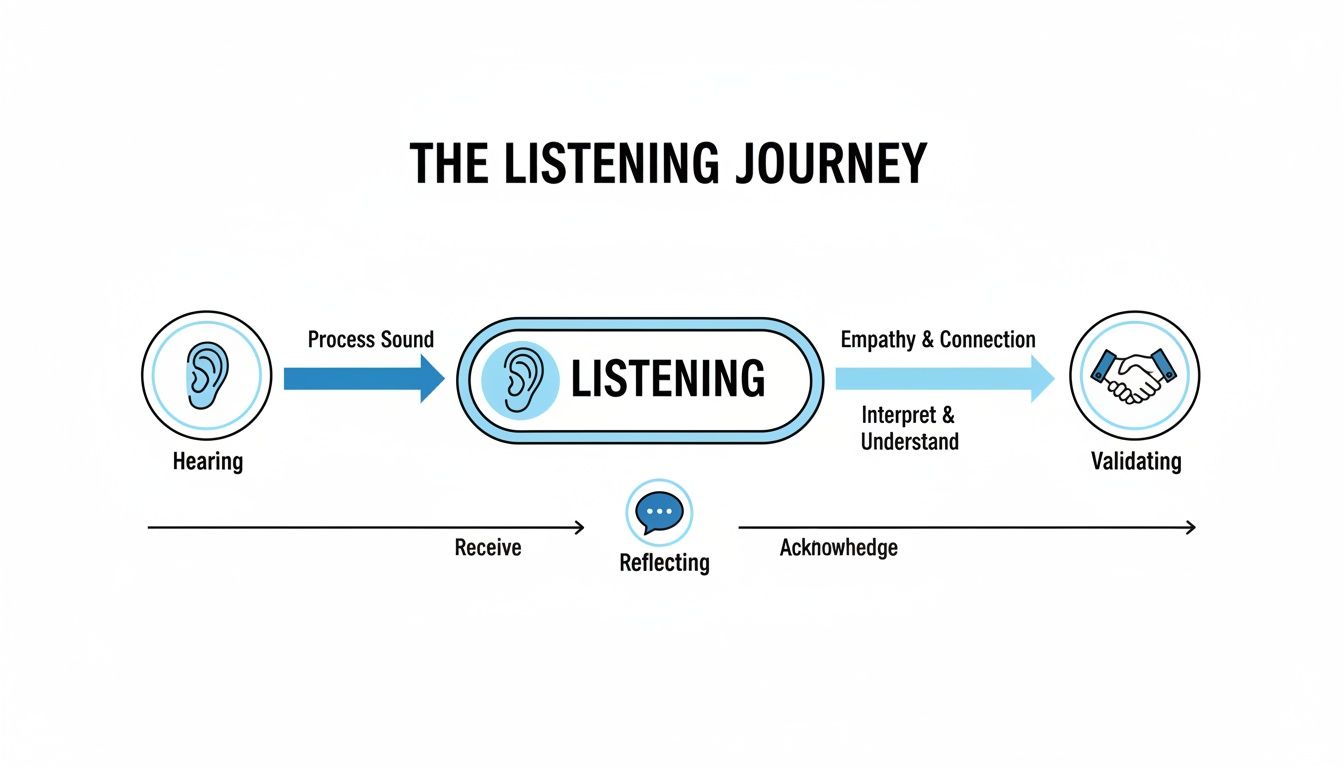
As the infographic highlights, active listening is a whole process. Reflecting on what was said and validating the emotion are just as crucial as the initial act of hearing.
Tweaking Your Approach with the Enneagram
This shift toward "I-statements" becomes even more effective when you factor in your partner's Enneagram type. Different types have different core fears and emotional triggers. What feels like directness to one can feel like a harsh, personal attack to another.
Take a Type 1 (The Perfectionist) , for example. Their inner critic is already working overtime. Direct criticism like, "You messed up the budget again," can trigger intense feelings of shame and cause them to shut down completely.
But an "I-statement" that focuses on a shared goal? That's a whole different ballgame.
Try this instead: "I feel anxious when I see unexpected charges because financial security is really important to me. Could we sit down together and make a plan to track our spending more closely?" This appeals to their desire for order and correctness without poking their fear of being flawed.
Your Words Are Only Half the Story
Have you ever said "I'm fine" through gritted teeth with your arms crossed? Yeah, your partner probably didn't believe you. That's because our non-verbal cues—our tone of voice, posture, and facial expressions—often speak way louder than our actual words.
Your body language can either support your message of connection or completely undermine it. An open posture (uncrossed arms, leaning in slightly, making eye contact) signals you're receptive and engaged. A defensive posture (crossed arms, turning away, avoiding eye contact) sends a clear message: "I'm closed for business." A practical example is turning your whole body towards your partner when they start talking, putting down your phone, and nodding to show you're listening, which reinforces your verbal message of care.
"When you deliver an 'I-statement' with open, receptive body language, you're sending a consistent message: 'I am here to connect and solve this with you, not to fight you.'"
Investing in this skill has a huge payoff. When a staggering 65% of couples say poor communication is their biggest obstacle, the potential for growth is immense. In fact, couples who dive into communication training report a 50% improvement in relationship satisfaction. That's a huge gain, and it shows these skills really do work. You can dig into more of these findings about the power of effective couple communication on southdenvertherapy.com .
Mastering "I-statements" and aligning your body language isn't going to happen overnight. It might feel formal or clunky at first, but with practice, it will become a natural way of communicating that replaces war with warmth and understanding.
Navigating Conflict Without Wrecking Your Connection
Let's get one thing straight: conflict isn't the boogeyman in a happy marriage. Every single couple argues. The real trouble starts when those arguments escalate, go unresolved, and leave a trail of resentment in their wake.
The couples who thrive aren't the ones who never fight; they're the ones who've figured out how to fight for their relationship, not against each other. It’s a total mindset shift. The goal isn’t to “win” the argument. The goal is to understand where your partner is coming from and tackle the problem as a team. This isn't just fluffy, feel-good advice—it's a set of skills you can actually learn, starting right now.
Hitting the Brakes with Repair Attempts
Ever been in an argument that feels like a runaway train? A repair attempt is your emergency brake. It’s any word, touch, or silly face that stops the fight from spiraling into that ugly place where you both say things you can't take back. Think of it as a lifeline that yanks you back to reality, reminding you you're on the same team.
These aren't some grand, dramatic apology. We're talking small, in-the-moment gestures that just turn the temperature down. The power of these little moves is huge. Communication habits formed early in a marriage are incredibly accurate predictors of whether a couple will make it long-term.
In fact, one long-term study of 431 newlywed couples found something astounding. The worst communicators had a divorce rate of 22% . But the best communicators? Their rate was just 9% . Learning a simple skill like a repair attempt is a direct investment in your future. You can read the full research about these communication patterns for yourself.
Here are a few repair attempts you can borrow, from the serious to the seriously goofy:
• "Can we just pause for five minutes? I'm getting overwhelmed."
• "I’m sorry. That came out way harsher than I meant it."
• "You know what? Let's start over."
• "Okay, I can see your point there."
• Sticking your tongue out (seriously, it's hard to stay furious at that).
• "We sound like two angry parrots. Can we try that again in a human voice?"
• A gentle, unexpected touch on their arm.
The trick is to find what works for your unique dynamic. It might feel cheesy at first, but a well-timed repair attempt can stop a destructive fight dead in its tracks.
Key Insight: A repair attempt isn’t about admitting you're wrong. It’s about admitting the conversation is going wrong and you both want to get it back on track.
Unpacking Conflict Styles with the Enneagram
Just as the Enneagram can tell you a lot about how you listen and speak, it also puts a giant spotlight on your go-to moves when a fight breaks out. Seeing these automatic, deeply ingrained patterns is the first step to choosing a better way. It helps you stop reacting to what your partner is doing and start understanding why they're doing it.
Take a Type 6 (The Loyalist) , for example. Their conflict style is often fueled by anxiety. Their brain immediately jumps to the worst-case scenario, so they might become accusatory ("Why didn't you call? I thought you were in a ditch!") or try to control the situation as a way of managing their internal fear. When their partner can see this not as a personal attack but as a desperate plea for reassurance, the entire dynamic can shift.
Or consider the Type 9 (The Peacemaker) , who would rather do just about anything than face conflict head-on. They’ll shut down, withdraw, or agree to things they don't actually believe just to make the tension disappear. To their partner, this can look like they don't care. The reality is the opposite—they care so much that they're terrified the conflict will sever the connection for good. You can dive deeper into this by checking out our guide on how to resolve relationship conflict with the Enneagram .
A Practical Structure for Tough Conversations
You can't just wander into a minefield and hope for the best. Big, emotional conversations need a game plan. Instead of ambushing your partner with a heavy topic when they're exhausted from work, setting a specific time to talk shows respect and radically improves your odds of a good outcome.
Here’s a simple structure that works wonders:
Turning Great Communication Into a Lasting Habit
Here’s a little secret from the trenches: awesome communication isn’t just about putting out fires. It’s about fireproofing your relationship.
Think of it like an "emotional bank account." Every time you connect, listen, or show appreciation, you’re making a deposit. When that account is flush, you have a huge reserve of goodwill to draw from when things inevitably get rocky. This is about shifting from being reactive—only talking when something blows up—to being proactive.
Let's dive into two simple, powerful habits that can completely change the weather in your marriage.

Your Weekly 'State of the Union' Meeting
Okay, I know. A scheduled "meeting" sounds about as romantic as a spreadsheet. But trust me on this. Think of it as a dedicated, sacred time for your partnership—a weekly check-in where you can talk without the pressure of a full-blown conflict. It’s not a chore; it’s a game-changing investment.
The structure is simple and intentionally designed to keep things positive:
• Kick off with Appreciation: • Start by sharing something you genuinely appreciated about your partner that week. ("I was so proud of how you handled that stressful call with the school. You were so calm and clear.")
• Highlight What's Working: • Talk about what’s going • right • in your relationship. This isn't about ignoring problems; it's about reinforcing the good stuff. ("I feel like we’ve been an amazing team with the kids' schedules this week.")
• Gently Raise One Issue: • Each partner gets to bring up • one thing • that could be improved, using those "I-statement" skills we’ve been talking about. ("I felt a little disconnected this week because we haven't had much downtime together.")
• End with Gratitude: • Close things out by expressing gratitude for something in your life or your future together. This ends the whole thing on a high note of shared connection.
This isn’t the time to solve world hunger or rehash that fight from 2017. It’s a 20-minute tune-up that stops small issues from festering into major resentments.
The Game-Changing Power of Daily Appreciation
While the weekly meeting is great for big-picture alignment, nothing fills that emotional bank account faster than daily doses of appreciation. It's the small, consistent acknowledgments that truly make a partner feel seen, valued, and loved.
But here’s the pro tip: get specific. Even better, tailor your appreciation to your partner’s Enneagram type. Different types hear praise differently.
• A • Type 2 (The Helper) • feels most loved when you notice their acts of service. Instead of a generic "thanks," try, "You have no idea how much it helped that you picked up dinner. You totally saved my stressful day."
• A • Type 5 (The Investigator) • often cringes at gushy compliments. They feel truly seen when you value their insights. "I was so impressed with your solution to that tech problem; you think about things in a way I never would."
• A • Type 8 (The Challenger) • appreciates when you acknowledge their strength and protective nature. "I felt so safe and supported when you stood up for me in that conversation."
Understanding these nuances is a shortcut to making your partner feel truly cherished. Of course, beyond specific techniques, it's also about knowing how to keep your relationship strong in a broader sense, nurturing that lasting connection.
Take the 5-Day Appreciation Challenge: For the next five days, make it your mission to voice one specific, genuine appreciation for your partner each day. Seriously, write them down if you have to. Just notice how this tiny act shifts the energy between you.
What If Your Partner Isn't on Board?
It can be incredibly frustrating when you're fired up to try these new habits and your partner… isn’t. You can't force them to play along, but you can single-handedly change the dynamic.
First, just focus on your side of the street. Start modeling the behavior yourself without demanding they do it back. Express your appreciation freely. Use "I-statements." When they start experiencing conversations that feel better and less like an attack, their walls might just start to come down.
Second, frame it as an invitation, not a prescription. Instead of saying, "We need to do these exercises," try something lighter. "I've been thinking about how we can have more fun and feel more connected. I have a couple of silly ideas I'd love to try with you."
Keeping it low-pressure removes the fear that they're about to be lectured. Your gentle, persistent effort can be the very thing that helps you both find a more loving way forward.
Got Questions? We’ve Got Answers.
Alright, so you’ve got the toolkit. But putting these communication skills into practice is where the rubber really meets the road. It’s totally normal for things to feel a bit clunky at first or for new questions to pop up.
Think of it this way: you're not failing, you're learning . This is the messy, beautiful part of growth. Let’s tackle some of the most common hurdles I see couples run into.
"What If My Partner Won't Do This With Me?"
Ah, yes. The classic "I'm all in, but they're not" scenario. It’s frustrating, and honestly, it’s one of the toughest spots to be in. The hard truth is you can't make anyone do anything.
But here’s the good news: you hold more power than you think. You can single-handedly change the entire dynamic of your relationship.
The trick is to stop focusing on them and start focusing on you . Model the behavior you want to see, but without any expectation of getting it right away. Use your "I-statements." Genuinely listen when they talk. Make a conscious effort to validate their feelings, even when you don’t agree.
When you start showing up differently, a practical example is when your partner complains about their boss; instead of offering advice, you just say, "Wow, that sounds incredibly frustrating." This shift from fixing to validating, done consistently, can make conversations feel safer for them. The old, tired conflict-dance gets interrupted. Your partner will start to notice that conversations with you feel safer, less like an attack. You’re not demanding they change; you’re just creating a space that’s way more inviting to connect in. A fun, low-pressure way to start this conversation? Suggest taking an Enneagram test together, just for kicks. It can be a surprisingly gentle doorway to deeper understanding.
The fastest way to inspire change in your partner is to change yourself. When you change your dance steps, they have to learn a new way to move with you.
"How Long Until This Actually Starts Working?"
I get it. You want to see results, and you want them now. While you can definitely feel a shift after just one good conversation—one moment where you avoid a blowout or really hear each other—the deep, lasting change takes time. It’s less like flipping a switch and more like learning guitar.
You wouldn’t pick up a guitar for the first time and expect to shred a solo, right? Building new communication habits takes consistent, patient practice. Trust me, committing to just 15 minutes of intentional practice a day is a thousand times more effective than having one marathon "fix-it" talk every six months.
The goal isn't perfection overnight. It's progress. Celebrate the tiny wins! Did you catch yourself before making a sarcastic comment? Did you successfully use a repair attempt mid-argument? Those little moments are huge. They're the reps that build the emotional muscle for a completely new way of being together.
"Is the Enneagram Just Another Personality Box?"
It's a fair question. We’ve all been inundated with personality quizzes that feel like they just slap a label on you. But that’s not what the Enneagram is about—when used correctly, anyway.
Think of it less as a restrictive box and more as a detailed roadmap to your partner’s inner world.
It’s not a get-out-of-jail-free card for bad behavior ("Oh, he's a Type 8, that's just how he is!"). It's a tool for radical empathy. When you understand that your Type 5 partner (The Investigator) needs time to process things internally, you stop pushing them for an immediate emotional reaction they can’t give you. A practical application of this is saying, "I see this is important. Why don't you take some time to think about it and we can talk again this evening?" This honors their need for space instead of creating a conflict.
Knowing their type helps you communicate smarter, not just harder. You can frame your words in a way that speaks directly to what motivates them, what they fear, and what they secretly need. That’s how you get your message heard and received with an open heart.
Ready to get your hands on the roadmap to your own inner world? Our free, in-depth assessment at Enneagram Universe is the perfect place to start. Understanding what makes you tick is the key to unlocking a more connected, empathetic, and truly fulfilling relationship. Take the free Enneagram test today and see for yourself.