How to Improve Intimacy in Marriage: Practical Steps Couples Can Apply Today

Let’s be honest, improving intimacy in your marriage isn’t about some grand, complicated formula. It's about getting back to basics. It’s about building a real connection through the small stuff—the day-to-day moments that lay the groundwork for everything else. Forget what you see in the movies; true intimacy starts with emotional closeness, not a perfectly staged romantic evening.
The Real Secret to an Intimate Marriage
Think of your relationship like a fire. Those big, flashy date nights are like throwing a log on the flames—they create a nice, big burst. But the real warmth, the thing that keeps it from dying out, comes from the glowing embers. That’s what we’re talking about here: the quiet, consistent, everyday actions that often get lost in the shuffle of life.
This isn't about adding more to your already overflowing plate. It’s about making tiny, intentional shifts that pack a surprisingly big punch. A simple, unexpected hug while one of you is making coffee can do more for your connection than you’d think. For example, if your partner is at the stove, walk up behind them and wrap your arms around them for just a moment. Holding hands while you’re watching a show on the couch? That’s pure gold. These little moments rebuild the safety and affection that remind you both: "Hey, we're in this together."

From Roommates Back to Lovers
It happens to the best of us. Life gets hectic, and suddenly your conversations are all about who’s picking up the kids, what’s for dinner, and whether the bills are paid. You've slipped into the "roommate zone." The way out is to consciously bring back the behaviors that made you partners in the first place.
• Emotional Closeness Is Everything: • This is your foundation. When you feel truly seen and heard by your partner, physical intimacy becomes a natural, safe, and exciting extension of that bond.
• Think Small, Win Big: • You don't need a week in Paris to reconnect. A • five-minute • chat—no phones, no TV, just the two of you—can work wonders. For instance, while you’re both brushing your teeth before bed, make a point to ask a question that isn't about logistics, like, "What was the best part of your day today?"
• Don't Underestimate Touch: • We’re not just talking about sex here. A hand on the back, a quick kiss on the forehead, or just sitting closer together on the sofa releases oxytocin (the “cuddle hormone”), which is a natural stress-reducer and a powerful connector.
Here's the bottom line: Intimacy isn't a code to be cracked. It's the simple, profound feeling of being deeply known and loved by your person, and it’s something you build together, one small moment at a time.
This shift really hinges on your emotional intelligence—your ability to tune into your own feelings and empathize with your partner's. Honing this skill can change the entire game. If you're curious, we have a whole guide on “ How to Increase EQ: Real Strategies That Actually Work ” that can help build that emotional muscle.
Feeling overwhelmed? Don't be. Here’s a quick-start guide with simple actions you can take right now to begin rebuilding that connection.
Quick-Start Guide to Rebuilding Intimacy
| Action | Why It Works | Try This Tonight |
|---|---|---|
| The 6-Second Kiss | A quick peck is a habit. Holding a kiss for at least 6 seconds forces you to be present and releases bonding hormones like oxytocin. | When you or your partner get home, stop what you’re doing and share a deliberate, 6-second kiss. No distractions. |
| Put Phones Away for 20 Mins | Creates a distraction-free zone where you can genuinely focus on each other, signaling that your relationship is the priority. | Pick a 20-minute window after dinner. Put both your phones in another room and just talk or sit together. |
| Share One "High" and One "Low" | Goes beyond the generic "How was your day?" to foster real emotional sharing and understanding of each other's inner worlds. | Over dinner or before bed, each share one good thing (a high) and one challenging thing (a low) from your day. |
These small, consistent efforts are what turn the tide, creating a positive loop where emotional connection naturally leads to more physical closeness.
The Unbreakable Link Between Heart and Body
Emotional and physical intimacy are two sides of the same coin; they feed each other. A strong emotional connection makes you crave physical closeness, and a satisfying physical connection can smooth over life’s rough patches and deepen your emotional bond.
In fact, some research suggests that a healthy sex life can be a powerful tool for navigating marital conflict, promoting forgiveness, and easing tension. One study even found that a significant percentage of marital issues get ironed out in the bedroom.
One of the most powerful ways to keep this cycle going is by celebrating the story you've built together. Reinforce your unique journey with meaningful anniversary gifts that tell your story . By starting with these foundational pieces, you can make your marriage feel deeply connected and excitingly alive again.
From Logistics to Real Conversation
Do your daily conversations sound more like a business merger than a romance? "Did you pay the electric bill?" "Who's picking up the kids from soccer?" "We're out of milk again."
When life gets busy, it’s dangerously easy for your communication to shrink into a series of logistical updates. Before you know it, you feel more like roommates than soulmates. This slow slide from heartfelt connection to purely functional talk is a notorious intimacy killer, but it's one you can absolutely turn around.
The goal isn't to pretend the bills and chores don't exist. It's about intentionally carving out space for the kind of talk that actually builds you up as a couple. It’s about creating a safe harbor where you can both get real and be vulnerable without fearing judgment. This is the true bedrock of emotional intimacy.

The Daily Temperature Reading: A Simple Habit for Deep Connection
One of the most powerful tools I've seen couples use to break the cycle of surface-level chat is a structured check-in. The "Daily Temperature Reading" is a simple, low-pressure exercise designed to gently pry open the door to deeper sharing. It's not about solving problems on the spot; it's about listening and understanding.
Just set aside 10-15 minutes each day. Take turns sharing your thoughts on these five points:
• Appreciation: • Share one thing you appreciated about your partner from the past 24 hours. (e.g., "I really appreciated that you made coffee this morning.")
• New Information: • Offer a little tidbit from your inner world. (e.g., "I was thinking about our first vacation together today.")
• Puzzles: • Mention something you're mulling over or confused by. (e.g., "I'm not sure how to handle this new project at work.")
• Concerns with Recommendations: • This is key. If you have a complaint, you must also offer a potential solution. (e.g., "I've been feeling stressed about the clutter. Maybe we could spend 15 minutes tidying up together after dinner?")
• Hopes and Wishes: • Share a dream for the future, big or small. (e.g., "I hope we can take a weekend trip this fall.")
This simple structure provides a framework that keeps conversations from spiraling into criticism. It transforms a potential argument into a moment of mutual understanding and support, laying the groundwork for real intimacy.
From Accusation to Invitation
The words you choose have the power to either build a wall or a bridge. When you're trying to talk about something sensitive, swapping accusatory "you" statements for vulnerable "I" statements can completely change the vibe of the conversation.
An "I" statement focuses on your feelings and experiences, making it an invitation for your partner to understand you. A "you" statement often sounds like an attack, immediately putting your partner on the defensive.
Let's look at how this plays out in real life:
The Dialogue Shift
| Instead of This (Accusation)... | Try This (Invitation)... |
|---|---|
| "You never listen to me." | "I feel unheard when I'm trying to share something important." |
| "You're always on your phone." | "I feel a little lonely at night, and I'd love it if we could put our phones away and connect." |
| "You don't care about my day." | "I feel disconnected when we don't get a chance to talk. I miss hearing about your day and sharing mine." |
This isn't about sugarcoating the issue. It's about being honest about your emotional state, which invites empathy rather than defensiveness. It’s a core technique in relationship-building, and you can explore more structured approaches with these marriage counseling exercises .
Creating a Culture of Emotional Safety
Ultimately, improving your communication comes down to making your relationship a safe space to be human. This means listening to understand, not just to fire back a response. It means validating your partner's feelings, even if you don't fully agree with their perspective. For example, if your partner is upset about something you see differently, you can say, "I hear how frustrating that must have been for you." This shows you're on their team, even if you don't share their exact view.
Meaningful communication is a powerful engine for marital happiness. While around 60% of married couples report being satisfied with their sex life, a staggering 80% of happy couples explicitly credit their strong emotional connection as a key factor. Clear, empathetic communication is consistently linked to higher intimacy and relationship satisfaction.
When you both feel seen, heard, and valued, the emotional intimacy that blossoms becomes the fuel for every other kind of connection you share.
Sync Your Rhythms to Deepen Your Bond
Does it feel like you and your partner are just two ships passing in the night? One of you is getting up as the other is crawling into bed, and your days are a chaotic mess of separate to-do lists. If you feel like you’re living parallel lives under the same roof, trust me, you’re not alone. This kind of emotional drift is one of the most common ways intimacy quietly evaporates.
But here’s the good news: you don’t need a massive schedule overhaul to fix it. The secret is often in small, synchronized habits—tiny points of connection you deliberately weave into your day. It’s all about creating shared rhythms that pull you back into the same orbit.
The Surprising Power of Going to Bed Together
Let’s start with one of the most powerful changes you can make: go to bed at the same time. This isn’t just about sleep hygiene; it’s about reclaiming a sacred, protected window of time that belongs only to the two of you. When you make this a non-negotiable part of your day, you’re creating a space free from work emails, kids' demands, and the endless doomscroll.
This is your time for pillow talk, for cuddling, for just sharing a quiet moment of stillness before sleep. It’s a chance to reconnect physically and emotionally without any pressure or expectations. This simple act sends a powerful message: no matter how crazy the day gets, we end it together.
Don't just take my word for it. Studies on marital satisfaction consistently show that syncing up daily routines can significantly boost intimacy. According to one UK survey, couples who go to bed at the same time are twice as likely to report feeling deeply connected. It just goes to show how critical shared downtime is for a strong bond. You can find more fascinating stats about how couples connect over at We're Not On A Break .
Weave Micro-Rituals into Your Daily Life
Beyond bedtime, you can create "micro-rituals" that act as little anchors of connection throughout your day. These are small, consistent habits that become your special thing. They don't need to be some grand gesture—their power is in their consistency.
Think about the natural pockets of time in your day and how you can share them.
• The Morning Kick-off: • What if you woke up 15 minutes earlier to share a cup of coffee before the day’s chaos kicks in? No phones, no news—just a quiet start together.
• The Midday Check-in: • For couples with demanding jobs, a quick 10-minute call during lunch can be a total game-changer. It’s not about solving problems; it’s a simple "Hi, I'm thinking of you" that bridges the distance.
• The Digital Sunset: • Try a "no phones after 9 PM" rule. This forces you to turn your attention toward each other instead of your screens, opening the door for real conversation or just quiet companionship.
These rituals are about more than just spending time together. They are about creating a shared culture in your relationship—a set of predictable, comforting touchpoints that reinforce your partnership every single day.

Tailor Your Rhythms to Your Personalities
The best rituals are the ones that feel natural to both of you. A quiet morning coffee might be perfect for one couple, while another might thrive on a high-energy walk after work. Understanding your unique personality styles can help you find routines that actually energize your relationship instead of feeling like another chore.
This is where knowing your Enneagram types can be incredibly helpful. For instance, a Type Seven (The Enthusiast) might love the idea of a spontaneous dance party in the kitchen, while a Type Five (The Investigator) would much prefer a ritual of reading side-by-side on the couch. Recognizing these core motivations allows you to sync up in ways that honor both of your needs. If you're curious, you can learn more about Enneagram type compatibility for couples and find what works for you.
By intentionally weaving these shared moments back into the fabric of your life, you stop living parallel lives and start building a deeply connected partnership, one small ritual at a time.
Rebuilding Desire and Physical Connection
Physical intimacy is so much more than just sex. It's the playful tap as you pass in the hallway, the lingering hug at the door that says, "I'll miss you," and the spontaneous kiss in the kitchen just because. When that casual, affectionate touch disappears, it can feel like a huge chasm has opened up between you.
If you’ve fallen into a pattern where every touch seems like a prelude to sex, it's easy for one or both of you to become hesitant. The secret to rebuilding that physical connection? Take sex completely off the table, at least for a little while. You need to reintroduce touch that is purely about affection, safety, and fun, breaking that exhausting cycle of expectation and pressure.
Starting Outside the Bedroom
Let's be real: genuine desire rarely sparks to life under the covers. It starts much earlier, rooted in feeling safe, seen, and cherished throughout the day. Rebuilding this foundation means piling on the non-sexual touch. This approach helps lower defenses and reminds you both of the simple joy of being close, no strings attached.
Here are a few ways to get started:
• The Spontaneous Touch: • Make a conscious effort to find small moments for contact. A hand on their back as you walk by, a gentle squeeze of their shoulder while they're on a work call, or playing footsie under the table at dinner.
• The Lingering Hug: • Don't just hug— • really • hug. Hold on for a few extra seconds, long enough for you both to take a deep, grounding breath. This small change transforms a routine gesture into a powerful moment of connection.
• The Affectionate Greeting: • The way you greet each other sets the tone for your entire evening. Instead of a distracted "hey" from across the room, stop what you’re doing, make eye contact, and offer a real kiss or a warm embrace when you reunite.
Think of these small acts as deposits in your relationship's emotional bank account. They build a reserve of goodwill and affection that makes deeper intimacy feel like a natural next step, not a demand.
Syncing your daily rhythms—like sharing that morning coffee, a quick midday call, or simply going to bed at the same time—creates the consistent touchpoints needed for this reconnection to stick.
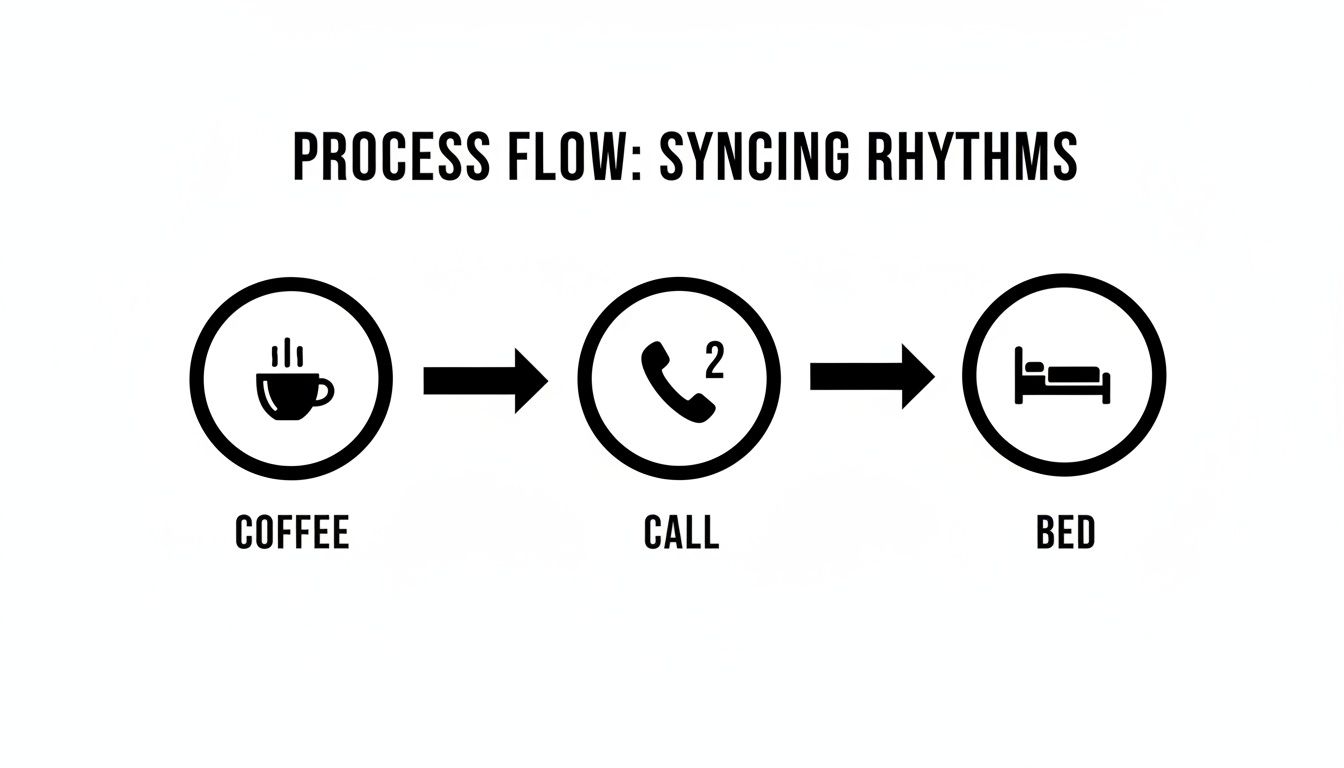
This simple flow shows how physical connection is built through a series of small, intentional acts woven throughout the day, not just saved for when the lights go out.
The Intimacy Ladder: A Step-by-Step Reconnection Plan
For couples who feel particularly distant, even the idea of cuddling can feel like too much, too soon. This is where the "Intimacy Ladder" comes in. It’s a brilliant, low-stakes way to slowly and safely reintroduce physical touch at a pace that feels right for both of you.
The goal of the Intimacy Ladder isn't to race to the top. It's to linger on each step until it feels completely comfortable and natural, creating a solid foundation of safety before moving to the next rung.
Here’s a look at how to build your own ladder, starting with low-pressure actions and gradually moving toward deeper connection.
The Intimacy Ladder: A Step-by-Step Reconnection Plan
| Step Level | Example Activities | Goal of This Step |
|---|---|---|
| Level 1: Low-Pressure Contact | Sitting next to each other on the couch while watching a movie. Holding hands for 5 minutes while out for a walk. A brief but genuine hug. | To re-establish comfort with physical proximity and casual, non-demanding touch. |
| Level 2: Increased Affection | Extended cuddling on the couch (without it leading anywhere). Giving a 10-minute shoulder or foot rub. Back-to-back sitting while reading. | To build a sense of warmth, care, and relaxation through longer periods of affectionate, non-sexual physical contact. |
| Level 3: Sensual Exploration | Taking a shower or bath together. Lying in bed together, clothed, just talking and cuddling. Giving each other a full-body massage. | To explore sensual touch without the pressure of intercourse, focusing purely on mutual pleasure and discovery. |
By moving up the ladder only when you both feel ready, you give trust the space it needs to grow back, stronger than before.
Navigating Mismatched Libidos with Empathy
Few topics create more tension than mismatched sex drives. It's one of the most common hurdles couples face, and it's almost never about one person being "right" and the other "wrong." Desire is a complex beast, influenced by everything from stress and hormones to health and emotional connection.
The conversation needs a total reframe—from blame to curiosity.
Instead of saying, "You never want me," try a gentler approach: "I miss feeling close to you physically. Can we talk about what might help us reconnect?" This opens the door for a real conversation about what each of you actually needs to feel desired and safe. Sometimes, a shared experience like a luxury couples massage can be a fantastic, neutral way to rediscover touch and relaxation together.
When you focus first on rebuilding the fun, safety, and affection in your physical relationship, you create an environment where desire can finally flourish again. It’s about rediscovering the simple joy of touch and remembering that you're not just roommates—you're partners who truly cherish each other.
How to Argue Without Wrecking Your Connection
Let’s be honest, conflict is going to happen. You’re two different people trying to build one life together—of course, you’ll butt heads. The real question isn’t if you'll fight, but how you'll fight.
An argument can either be a wrecking ball that smashes trust or a tool that helps you build a stronger foundation. The difference is everything.
It all boils down to your goal. Are you in it to win, or are you in it to understand? Healthy couples instinctively know that scoring points is a losing game. The real prize is solving the problem together without torching the connection you've worked so hard to build.
The (Unofficial) Rules of Engagement
Think of a healthy disagreement like a boxing match with a referee and padded gloves. The rules aren’t there to stop the fight; they’re there to keep anyone from getting seriously hurt. Setting up a few ground rules for your arguments keeps things from spiraling into a personal attack fest.
Here are a few essential rules to get you started:
• Ditch the Dramatics. • Words like " • always • " and " • never • " are gasoline on a fire. They're almost never true and instantly force your partner into a defensive crouch. Instead of, "You • never • help with the dishes," try something like, "I felt really overwhelmed when I was left to clean the whole kitchen alone tonight."
• Stay in the Right Decade. • Don't dig up old grievances from six months ago. Keep the conversation locked on the issue at hand. Otherwise, you’re not solving one problem; you're starting a massive, unwinnable war about every wrong turn in your relationship history.
• Attack the Problem, Not the Person. • The second you start lobbing insults ("You're just lazy!") or assassinating their character, you've lost. You’re no longer a team trying to fix something; you're just two people trying to wound each other.
• Hit the Pause Button. • Can you feel your heart pounding? Your voice getting tight? That’s your cue to call a timeout. Agree to take • 20 minutes • to cool off and—this is the important part—promise to come back to the conversation once you’ve both had a chance to breathe.
These aren't about being "nice." They're about being effective. They keep you both focused on finding a resolution instead of just venting your spleen.
The Art of the Mid-Fight "Repair"
Even with the best intentions, arguments can get heated. This is where a "repair attempt" comes in. It’s a tiny olive branch—a word, a joke, a touch—offered in the middle of a conflict to hit the brakes on negativity. It’s the pressure-release valve that reminds you both you’re on the same team.
A repair attempt is any signal—verbal or not—that says, "Hey, we're getting off track. Let's not let this spiral." It’s a bid for connection right when you feel most disconnected.
These don’t have to be some grand, sweeping apology. They’re usually small, subtle, and sometimes even a little goofy.
• A bit of self-deprecating humor: "Yikes, I can hear myself getting way too worked up about this."
• A simple moment of validation: "Okay, I can see why you feel that way."
• A physical gesture: Gently touching your partner's arm.
• A straightforward plea: "Can we pause for a second? I don't want to fight with you."
The magic only works if the other person accepts the repair attempt. When one of you waves that little white flag and the other acknowledges it, you shatter the downward spiral. Now you can get back to the actual problem with a much clearer head.
Let's See It in Action
Here’s how this plays out with a classic source of marital strife: money.
The Fight That Goes Nowhere:
• Partner A: • "I can't believe you spent • $300 • on new golf clubs! You • always • do this without even asking me."
• Partner B: • "It's my money! You’re not my mom. And what about that ridiculously expensive purse you bought last month?"
This is a train wreck. We've got blame ("you always"), defensiveness, and a classic case of whataboutism. They'll both walk away angry, misunderstood, and a little further apart.
The Fight That Actually Fixes Something:
• Partner A: • "Hey, I saw the charge for the golf clubs. Seeing a • $300 • purchase we hadn't talked about made me feel really anxious." (Uses an "I" statement, names the feeling, sticks to the facts).
• Partner B: • "Okay, I hear you. I got excited because they were on a huge sale and just wasn't thinking. I should have run it by you first." (Validates, takes responsibility).
• Partner A: • "I really appreciate you saying that. Maybe we could agree on a spending limit for solo purchases so we can avoid this in the future?" (Offers a solution, works as a team).
See the difference? It’s still a tense conversation, but it's a productive one. They tackled the issue, heard each other out, and came up with a plan. They didn't just avoid a fight; they actually strengthened their partnership. That's how you argue without wrecking your connection.
Got Questions? Let's Talk Real-World Intimacy
Alright, so we've talked about the big ideas, but what happens when you try to put them into practice and... it gets awkward? Or frustrating? Or you're just plain exhausted? It’s one thing to read about connecting, and another thing entirely to do it on a Tuesday night after the kids have gone nuclear.
Let's dive into some of the most common roadblocks couples hit and get brutally honest about how to navigate them.
What If My Partner Just Isn't on Board?
Oof. This is a tough one. It can feel incredibly lonely when you're the one pushing the cart uphill, trying to get your relationship moving again. But this isn't a dead end, I promise. It just means you have to be a little more strategic.
The absolute worst thing you can do is come in hot with a list of demands or critiques. That’s a surefire way to make your partner retreat further into their shell. Instead, the key is to be vulnerable, not forceful.
Try framing it from your perspective with a gentle "I" statement. Something like, "Hey, I've been feeling kind of distant from you lately, and I honestly just miss us." See the difference? It's an invitation, not an accusation. It’s about your desire for closeness, not their failure to provide it.
From there, suggest something ridiculously small and low-pressure. Think a 15-minute walk after dinner (phones stay in your pockets!), or even just sitting on the couch and listening to a couple of your favorite old songs together. You're not trying to solve everything at once; you're just trying to crack the door open a tiny bit.
Seriously, How Long Will This Take?
If I had a dollar for every time a couple asked this, I'd have a very nice vacation fund. The truth is, there’s no magic number. Rebuilding intimacy isn't a 30-day challenge; it’s a process that depends entirely on your unique history, the issues you're facing, and how much energy you can both realistically pour into it.
But here’s the most important thing I can tell you: consistency beats intensity every time.
One big, dramatic, romantic gesture a month won't move the needle nearly as much as the tiny, consistent efforts you make every single day. Stop fixating on the finish line and start celebrating the small wins. Did you have one really good, uninterrupted conversation? Awesome. Did you manage to go to bed at the same time every week? High-five yourselves.
Rebuilding intimacy is a lot like getting back in shape. You don't get a six-pack after one trip to the gym. It's the daily reps—the consistent, sometimes boring, effort—that builds real strength and connection over time.
Progress isn't a straight line. You'll have great days and days where it feels like you've taken three steps back. Just keep showing up. That's the whole game.
Can This Work if We Have Totally Different Sex Drives?
Yes. A thousand times, yes. Having mismatched libidos is so incredibly common, it’s practically a feature of long-term relationships, not a bug. It absolutely does not mean your relationship is doomed. In fact, tons of research shows that most couples deal with this at some point.
The fix requires two major shifts: communicating without judgment and blowing up your old definition of what "intimacy" even means. You have to get past the narrow, intercourse-or-bust mindset.
Instead, put your energy into all the other ways you can connect physically.
• Cuddling • on the couch while you binge your favorite show.
• Giving a • foot rub or a shoulder massage • with zero expectation that it will lead to anything else.
• Holding hands • while you’re walking through Target. It counts!
• Taking a bath or shower together • .
This stuff takes the pressure off. It allows the partner with the lower libido to relax and feel cherished, while the partner with the higher libido still gets that crucial dose of physical touch and affection. Everybody wins.

What If We're Just Drowning in 'Busy'?
Welcome to modern life. Between jobs, kids, and the never-ending list of chores, connection doesn't just happen anymore—it has to be scheduled. I know, I know, scheduling intimacy sounds about as sexy as scheduling a dentist appointment. But it's the single most effective tool for protecting your relationship from the chaos of life.
You schedule everything else that's important, right? Work meetings, parent-teacher conferences, oil changes... Your marriage deserves a non-negotiable spot on that calendar.
And remember, we're going for quality over quantity . I'd rather see a couple have 10 minutes of focused, phone-free connection than an hour of sitting in the same room, completely checked out.
Hunt for those little pockets of time and guard them with your life.
• Can you get up • 15 minutes • earlier to have coffee together before the chaos monster (aka the kids) wakes up?
• What about a five-minute back rub trade-off right after you put the kids to bed?
• Could you make a pact to ditch the phones and actually talk for the first • 10 minutes • after walking in the door from work?
Think of these as micro-connections. They're the glue that will hold you together when your calendars are trying to rip you apart.
At Enneagram Universe , we believe that understanding why you and your partner act the way you do is the first step toward real connection. Knowing your Enneagram type can be a game-changer, revealing your core motivations and fears. Ready to unlock deeper insights? Take our free, scientifically validated Enneagram test and start your journey to a more fulfilling relationship.