How to Improve Emotional Intimacy: 5 Simple Steps That Truly Connect

Ready to stop feeling like roommates and start feeling like soulmates again? It all boils down to three things: truly listening to understand, being brave enough to share your real self, and choosing to respond with empathy instead of putting up a wall.
Nailing these communication basics is what builds the kind of safety and trust where you can finally take a deep breath and just be together.
What Emotional Intimacy Actually Feels Like
Forget the clinical definitions. Real emotional intimacy isn't about spilling every single secret you have. It's that gut-level feeling of being completely, utterly seen by someone—and knowing you're safe with them. It's the magic that turns a person you live with into the person you can't live without.
Take Sarah and Tom, a couple from Chicago. They'd slipped into a comfortable but silent routine. Evenings were a quiet dance of Netflix on the TV, smartphones in hand, basically living parallel lives in the same room. It's a trap so many of us fall into, mistaking that easy silence for a deep connection. They were physically together, but emotionally, they were miles apart.
The spark wasn't dead; it was just buried under a mountain of unspoken feelings, tiny resentments, and a hundred missed chances to truly connect. This guide is your map to dig your way out of that quiet drift and back to a vibrant, deeply connected partnership.
Let's be clear: learning how to improve emotional intimacy is a journey, not a magic trick. It's about small, intentional actions stacked on top of each other, building trust and understanding brick by brick. This guide cuts right through the fluff, giving you practical exercises, conversation starters, and real-world tips to rebuild that bond. You're about to learn how to turn those mundane, everyday interactions into moments that actually mean something.
Here's a peek at what's ahead:
• The Art of Deep Communication: • We're going way beyond "how was your day?" You'll master the skills of active listening, sharing vulnerably (without freaking out), and responding in a way that doesn't immediately start a fight.
• Practical Reconnection Exercises: • I’m talking simple, hands-on things you can do • tonight • to feel closer. Think meaningful daily check-ins that take less than 10 minutes and fun, shared goals that get you back on the same team.
• Navigating Conflict Constructively: • Disagreements are inevitable, but they don't have to be destructive. You'll learn how to handle arguments in a way that actually brings you closer, turning friction into an opportunity for real growth.
This simple visual breaks down the core cycle of building that connection. It’s not rocket science, but it does take practice.
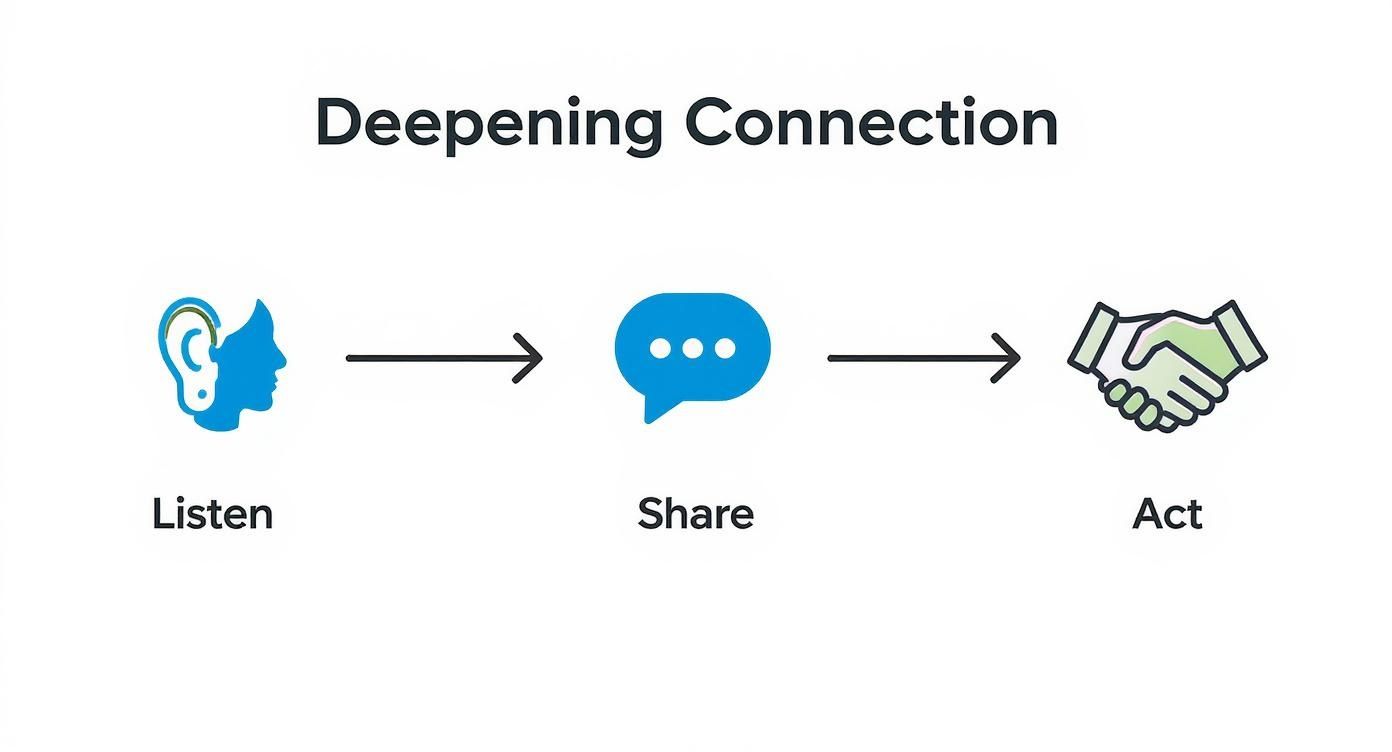
This whole process is a loop. It starts with genuinely hearing your partner, requires the courage to let them see you, and gets locked in when you both act in supportive ways.
To give you a head start, here’s a quick glance at the core strategies we’ll be diving into. Think of it as your cheat sheet for building a stronger connection.
Quick Guide to Deepening Your Connection
| Strategy | Why It Works | Quick Action |
|---|---|---|
| Active Listening | Makes your partner feel heard and valued, which is the foundation of safety. | Put your phone down, make eye contact, and ask, "Tell me more about that." |
| Vulnerable Sharing | Lets your partner into your inner world, which builds trust and deepens the bond. | Share one small fear or hope you haven't mentioned before. For example, "I'm a little nervous about my presentation tomorrow." |
| Empathetic Responses | Validates their feelings instead of dismissing them, preventing defensiveness. | Instead of fixing it, say, "That sounds really tough. I'm here for you." |
| Shared Activities | Creates new positive memories and reinforces your identity as a team. | Plan a low-pressure date or activity for this week—even just a 30-minute walk through a local park. |
These small actions, practiced consistently, are what create the big shifts. They signal to your partner—and to yourself—that this relationship is a priority worth investing in.
Mastering the Art of Deep Communication
Let's be real: great communication is the lifeblood of a thriving relationship, but most of the time, it feels less like an art and more like a chore. It’s so easy to get stuck in the weeds of daily logistics—who's grabbing groceries, what the work schedule looks like. To actually build emotional intimacy, we've got to break out of that rut and turn those routine talks into real moments of connection.
This isn't about becoming a flawless communicator overnight. Forget that. It’s about getting good at three specific skills that are the absolute bedrock of intimate conversation: active listening , courageous vulnerability , and responding without getting defensive . Think of this as your personal coaching session, packed with scripts and real-world examples to make these skills second nature.

Pillar One: The Power of Truly Listening
Most of us are guilty of listening just so we can figure out what we’re going to say next. Active listening flips that script entirely. It’s about making your partner feel like they are the only person in the entire world in that moment. It's a gift of your full, undivided attention.
One of the biggest mistakes I see couples make is jumping straight into "fix-it mode." Your partner shares a problem, and your first instinct is to offer a solution. It comes from a good place, but it often sends a terrible message: "Your feelings are a problem to be solved, not an experience to be shared."
My Two Cents: The point of listening isn't to solve anything. The point is to make your partner feel heard, validated, and understood. Connection always, always comes before solutions.
Let’s watch this play out with a classic scenario. Meet Maya and David, a couple from Austin, Texas.
• The Old Way: • Maya walks in, totally stressed from work. "My boss is piling on another project, and I'm already drowning," she says. David, eyes glued to his phone, mumbles, "You should just tell him you don't have the bandwidth." Maya just sighs. The conversation is over before it even began, and she feels completely alone.
• The New Way: • Maya shares the same frustration. This time, David puts his phone down, turns to face her, and says, "Wow, that sounds incredibly overwhelming. Tell me more about what he said." You can almost see the tension leave Maya's shoulders. She feels seen, supported, and ready to actually talk.
Pillar Two: The Courage of Vulnerability
We have this idea that vulnerability is a weakness, but in a relationship, it's the ultimate superpower. It's cracking open your inner world—your fears, your screw-ups, your secret hopes—without knowing for sure how your partner will handle it. This is where the magic of real intimacy happens.
Of course, just blurting out your deepest fears feels like jumping off a cliff. The trick is to start small and use language that invites your partner closer, instead of putting them on the defensive. This is where "I feel" statements are an absolute game-changer.
Here are a few practical phrases you can steal and make your own:
• "I'm feeling a little insecure about this, but I wanted to share..."
• "Something that's been on my mind lately is..."
• "Can I be honest? I felt a little hurt when..."
• "I have a fear that I haven't told you about, and I'd like to."
Think of these as gentle on-ramps. They signal that you're about to share something tender and that you're trusting them to hold it with care. For example, instead of bottling up anxiety about finances, you could say, "Something that's been on my mind lately is our budget for the next few months. I'm feeling a bit stressed about it." You’re building a bridge, not a wall.
Pillar Three: Responding Without Defense
How you react when your partner takes that leap of faith is just as important as taking it yourself. The second they open up is a make-or-break moment. Your response can either pull them in closer or slam the door in their face. And defensiveness is intimacy’s kryptonite.
When we feel criticized, our lizard brain screams at us to defend, explain, or fire back. But in an intimate conversation, that completely misses the point. Your partner isn't starting a debate; they are asking for empathy.
Let's look at some common defensive traps and how to sidestep them with practical examples.
| Defensive Response (The Intimacy Killer) | Empathetic Response (The Connection Builder) |
|---|---|
| "That's not what I meant at all." | "I can see how my words came across that way. I'm sorry they hurt you." |
| "You're being too sensitive." | "It sounds like that really struck a nerve. Can you help me understand why?" |
| "Well, you did the same thing last week!" | "Let's focus on what's bothering you right now. We can talk about my feelings later." |
This is all about validating their reality, even if you don’t agree with their interpretation. It says, loud and clear: "Your feelings make sense, and they matter to me."
Nailing these skills does more than just deepen your emotional bond; it has a massive ripple effect. In fact, emotional intimacy is a primary driver of sexual satisfaction. Research shows that for both men and women, feeling emotionally connected is the most significant predictor of a fulfilling sex life—with emotional intimacy and communication explaining a whopping 49% of the variance in sexual satisfaction.
For anyone navigating specific communication hurdles, like those that can come with neurodivergence, finding the right tools is everything. For instance, there are specialized strategies for ADHD communication problems and solutions that can make a world of difference. And sometimes, just understanding your own wiring can give you a huge leg up—check out our guide on how to improve your relationship communication with your personality type in mind: 8 Tips for Improving Relationship Communication Effectively .
Practical Exercises to Rebuild Your Connection
Alright, we’ve covered the why and the how of deep communication. Now it’s time to roll up our sleeves and actually do something. Let's be honest, improving emotional intimacy isn't a spectator sport. It's built through small, consistent actions that whisper to your partner, "You're my priority."
This section is your toolkit. Think of these as hands-on, low-pressure exercises you can slide into even the most chaotic schedules. The goal is to make reconnection feel less like a clinical assignment and more like a shared adventure.
The Daily Temperature Reading
I love this one. It’s like a quick, daily emotional check-in with your partner. It’s a beautifully structured way to share the little highs and lows that so often get swallowed up by the relentless pace of work, kids, and chores. This simple habit, taking just 10-15 minutes a day, can totally shift the emotional landscape of your relationship.
Here's a practical example of how it works. Find a time when you can actually be present—phones away, TV off, full attention on each other. Then, each partner takes a turn sharing:
• Appreciations: • Share one • specific • thing you appreciate about them from that day. "I really appreciated you making me coffee this morning" hits differently than a generic "thanks for being you."
• New Information: • Share something new, big or small. Maybe, "I found out today my old college friend is moving back to town." It keeps your partner in your inner circle.
• Puzzles: • Mention something you're mulling over. "I'm not sure how we're going to juggle the schedule next week with the car in the shop." It invites them in as a teammate.
• Complaints with a Request: • This is the game-changer. Share a complaint, but—and this is key—frame it with a positive, actionable request. For example: "I felt a little lonely when we were both scrolling on our phones after dinner. Could we try to have • 20 minutes • of screen-free time together tomorrow?"
• Wishes, Hopes, and Dreams: • Share a desire for the future, near or far. "I was just daydreaming about taking a weekend trip to the coast this fall."
This little ritual works wonders because it carves out a predictable, safe space for both the good and the tricky stuff. It builds a daily habit of turning toward each other, keeping you in sync.
Go Beyond the Surface with Deeper Conversation Prompts
Are you trapped in the "How was your day?" "Fine" loop? I feel you. The only way to break that soul-crushing cycle is by asking better questions. The right question can be like a key, unlocking a part of your partner’s inner world you haven’t seen in a while and reigniting that spark of curiosity.
Keep a running list of these on your phone or on sticky notes on the fridge. The next time you're driving, making dinner, or just hanging out, pull one out. You'll be amazed at where the conversation goes.
A Few Starters to Get You Going:
• What's a small thing that brought you joy this week?
• If you could give your younger self one piece of advice, what would it be?
• What's a dream you've never told me about?
• When was a time you felt incredibly proud of yourself?
• What is one way I can be a better partner to you this week?
For a practical example, imagine you're cooking dinner together. Instead of comfortable silence, you ask, "What's a small thing that brought you joy this week?" Your partner might pause, then share a funny story about a coworker you've never heard before, opening up a whole new avenue of conversation. It might feel a little new or even awkward at first, but this is a powerful muscle to build. For more structured guidance, you can explore a variety of relationship communication exercises .
Create a Shared Relationship Vision Board
Okay, this one is pure fun. It's a creative, tangible way to get back on the same team and start dreaming about your future together again. A relationship vision board is simply a collage—physical or digital—of images, quotes, and ideas that represent the life you want to build together . It’s all about aligning your goals and getting genuinely excited about your shared journey.
Grab some magazines, a corkboard, or fire up a Pinterest board. Spend an afternoon talking about your shared dreams across different parts of your life:
• Travel & Adventure: • Where do you want to go? Maybe you'll add a picture of the Grand Canyon or a cozy cabin in Vermont.
• Home & Lifestyle: • What does your ideal home life • feel • like? You might cut out a picture of a garden or a game night with friends.
• Personal Growth: • What skills do you want to learn, either on your own or as a couple?
• Connection & Intimacy: • What does your ideal emotional and physical closeness look like?
The very act of creating something together strengthens your bond. It shifts your focus from rehashing old problems to building a hopeful, exciting future. And speaking of future plans, you can take this energy and channel it into one of these inspiring couples retreat ideas .
These tangible actions almost always have a ripple effect, often spilling over into physical affection. It's not just a hunch; research spanning 37 countries shows that love and affectionate touch are significantly and positively related. This isn't just a cultural quirk—it seems to be a fundamental part of human connection. The more emotionally close we feel, the more we want to express that physically.
Navigating Conflict Without Losing Connection
Let's bust a huge myth right now: the idea that a great relationship is a conflict-free one. That’s not just wrong, it’s damaging. Disagreements aren't just normal; they're a guarantee. The real measure of a strong connection isn't whether you fight, but how you handle the friction when it sparks.
If you handle it poorly, conflict becomes a slow poison, chipping away at trust and affection. But when you learn to navigate it with a little skill and grace, every argument becomes a backdoor opportunity to get closer.
It’s all about a simple but profound shift in mindset: moving from a "me versus you" battle to an "us versus the issue" collaboration. Once you make that mental flip, everything changes.

Ditch the Blame Game with 'I' Statements
When things get heated, our instincts take over. It's so easy to let a "You always..." or "You never..." fly out of your mouth. But think about what that does. That language is a verbal grenade; it immediately puts your partner on the defensive and slams the door on any chance of a real conversation.
The fix is deceptively simple: start with "I" instead.
An "I" statement isn't a magic trick, but it's close. It keeps the focus on your feelings and your experience, not on a laundry list of your partner's supposed failures. It's an invitation to understand, not an accusation to be fought.
• Instead of: • "You never help around the house." (Feels like an attack.)
• Try this: • "I feel overwhelmed and unsupported when the chores pile up." (Shares your experience.)
• Instead of: • "You're always on your phone when I'm talking." (Feels like a judgment.)
• Try this: • "I feel disconnected and unimportant when I'm trying to share something and you're distracted." (Explains the impact on you.)
This small tweak in your vocabulary can completely change the energy of a tough talk. It allows your partner to actually hear you without their defenses going to red alert.
Master the Art of the Repair Attempt
Listen, even the most emotionally intelligent couples mess up during an argument. We all say dumb things. We all get defensive. The secret weapon isn’t avoiding mistakes; it’s knowing how to fix them in real-time. This is the repair attempt .
A repair attempt is any action or phrase—sincere, silly, or serious—that tries to de-escalate the tension and pull the conversation back from the brink. It’s the lifeline you throw out in the middle of a storm. It can be a moment of vulnerability, a gentle joke, or a simple apology.
Key Takeaway: A repair attempt is your way of saying, "Hey, we're going off the rails. Let's remember we're on the same team." It's one of the single most important skills for a lasting, happy relationship.
Here are a few practical examples you can borrow:
• "Oof, I didn't say that right. Can I have a do-over?"
• "I can see I’ve hurt your feelings. I'm so sorry."
• "You seem really angry right now. Can you tell me what's going on for you?"
• "This is getting too hot. Can we take five minutes and come back?"
The trick is not just to offer these olive branches but also to accept them when your partner does. For instance, if your partner says, "Can we take five minutes?" respecting that and returning to the conversation later shows you prioritize the relationship over winning the argument. A successful repair can stop a downward spiral dead in its tracks and turn a potential fight into a moment of genuine connection.
How Conflict Management Builds (or Breaks) Intimacy
The way a couple navigates disagreements isn't just about hurt feelings in the moment; it directly predicts their long-term happiness. Research has shown that the ability to manage emotions during a conflict is a massive predictor of a healthy relationship. Destructive habits like shutting down, stonewalling, or lashing out—a pattern known as emotional cutoff—have been proven to tank relationship satisfaction and even lower sexual desire over time. You can dive deeper into the science behind how emotional control influences couple outcomes .
To make this crystal clear, let's watch a common argument play out in two very different ways.
The Chore Conflict: A Tale of Two Conversations
| The Intimacy-Destroying Way | The Connection-Building Way |
|---|---|
| Partner A: (Sighs dramatically) "Of course the dishwasher is still full. I guess I have to do everything around here." | Partner A: "Hey, can we talk for a minute? I'm feeling really stressed looking at the kitchen." |
| Partner B: "I was going to do it! You don't have to nag me the second you walk in the door." | Partner B: "Sure, what's up? You do look a little stressed." |
| Partner A: "Nagging? If I didn't 'nag,' this place would be a complete disaster. You never pull your weight." | Partner A: "I feel so overwhelmed when I get home and see a lot of chores waiting. It makes it hard for me to unwind. Could we make a plan for the dishwasher?" |
| Partner B: (Stonewalling) "Whatever. I'm not doing this right now." (Leaves the room) | Partner B: "You're right, I totally forgot. I'm sorry. How about I get it done tonight, and we can figure out a better system this weekend so this doesn't happen again?" |
See the difference? The first conversation is a fast-track to resentment and disconnection. The second, full of "I" statements and a collaborative spirit, turns a point of friction into a moment of teamwork. This is how you build a partnership that can truly withstand anything.
Let's Get Specific: Tailored Tips for Your Situation
Look, there’s no one-size-fits-all instruction manual for human connection. The path to deeper emotional intimacy is going to look different depending on where you're starting from. Are you and your partner tackling this as a team? Are you trying to initiate change on your own? Or are you a pro helping others navigate this tricky terrain?
Let’s break down some real-world strategies for each scenario.

For Couples: When You’re In It Together
If you’re both on board, congratulations—you’ve already got a huge head start. The secret sauce here isn't a single grand gesture, but the small, deliberate acts of connection you weave into the rhythm of your daily life.
I know it sounds totally unsexy, but schedule your connection time. Seriously. Put "Us Time" on the calendar, or it will get swallowed by work, kids, and Netflix. This doesn't have to be a fancy date night; it can be 20 minutes of phone-free conversation after dinner or a dedicated walk on Saturday mornings where you just talk. For example, you could set a recurring calendar event for "Tech-Free Tuesdays" from 8:00 to 8:30 PM.
Want to take it a step further? Get curious about how your fundamental personalities mesh (or clash). Understanding why your partner ticks the way they do—their core fears, motivations, and desires—can be a game-changer for building empathy. A fantastic tool for this is exploring your Enneagram type compatibility ; it provides a surprisingly insightful map for navigating each other’s inner worlds.
For Individuals: When You’re Flying Solo (For Now)
So, what happens if your partner isn't exactly jumping for joy at the idea of "intimacy-building exercises"? It's a tough position to be in, but don't lose hope. You have way more influence than you think. While you can't force someone else to change, you can absolutely shift the entire dynamic by changing your own approach.
Start with what you can control: yourself. Model the very behavior you hope to receive. Share something vulnerable about your day. When they talk, put your phone down and listen— really listen—without jumping in to fix things.
My Two Cents: Your mission, should you choose to accept it, is to make connections feel safe and rewarding for your partner. When you create an atmosphere of genuine appreciation and non-judgment, you lower their defenses and make it a whole lot more appealing for them to open up.
Phrase your needs as an invitation, not an accusation. Instead of a frustrated, "You never talk to me anymore," try a much softer approach: "Hey, I've been feeling a little disconnected lately, and I really miss feeling close to you. I'd love to hear what's been on your mind." See the difference? One puts them on the defensive; the other opens a door.
For Coaches And Therapists: Guiding the Guides
As a professional, your job is to be the sherpa, guiding clients from the abstract idea of emotional intimacy to the tangible feeling of it. You provide the structure, the tools, and the insights that turn theory into reality.
One of the most powerful frameworks in my own toolkit is Attachment Theory. Helping clients identify their attachment style—be it secure, anxious, avoidant, or disorganized—is often a massive "aha!" moment. It gives them a non-blaming language for their relational habits and helps them understand the deep-seated fears that get in the way of true connection.
Here are a few actionable strategies I rely on:
• Assign "Safe Sharing" Homework: • Start small. Give couples low-stakes conversation prompts to build their "vulnerability muscle" before tackling the heavy stuff. For instance, ask them to each share one high point and one low point from their day for a week.
• Role-Play the "Do-Over": • Fights will happen. What matters is the repair. Actively practice what it feels like to de-escalate in real-time. Role-playing a simple, "Oof, that came out wrong. Can we try that again?" in the safety of your office is incredibly powerful.
• Bring in the Body: • Guide clients to notice the physical sensations that pop up during tough conversations—a tight chest, a clenched jaw. This somatic awareness helps them get ahead of their emotional reactions, allowing them to respond thoughtfully instead of from a place of pure fight-or-flight.
By equipping your clients with these skills, you’re not just helping them put out today's fire; you’re giving them the tools to build a more resilient and deeply connected partnership for years to come.
Frequently Asked Questions (Because You're Not Alone in This)
Even when you've got a solid plan and the best of intentions, the path to deeper emotional connection can feel a bit... well, bumpy. It's totally normal to hit a few snags or wonder if you're actually getting anywhere. Let's dig into some of the most common questions that come up when you're doing this incredible work.
My Partner Isn't on Board. What Now?
This one's a classic, and it's tough. It can feel like you're trying to clap with one hand. But here's the thing: you're not completely stuck. The secret is to stop focusing on what you can't change (their readiness) and pour that energy into what you can (your own approach).
You have to lead by example.
Start modeling the kind of connection you're longing for. Instead of an accusation like, "You never talk to me," try framing it from your perspective. Something like, "I've been feeling a little distant lately, and I'd love to find a way for us to feel closer," lands a lot softer.
The goal is to make vulnerability feel safe and inviting, not like a chore or a demand. When they do offer a little something, pounce on it—with kindness! Listen like what they're saying is the most interesting thing you've ever heard. Show them, through your actions, that opening up leads to warmth, not criticism. If you're consistently met with a wall, it’s fair to say, "This is really important for me and my happiness in our relationship," and gently suggest talking it through with a pro.
Seriously, How Long Does This Take?
Ah, the million-dollar question. There’s no magic number, but you can feel small, meaningful shifts faster than you might think. With some real, consistent effort, you could notice conversations feeling less like a minefield and more like a collaboration within just a few weeks. Those little wins are the fuel that keeps you going.
But let's be real: creating deep, unshakable intimacy is more of a slow-burn. It often takes several months of practice.
The most important thing to remember is that consistency beats intensity . A heartfelt, 10-minute chat every single day is infinitely more powerful than one marathon 4-hour conversation once a month.
Try to fall in love with the process of getting to know each other again, rather than staring at a finish line that doesn't exist. Celebrate the small stuff! Every time you navigate a disagreement without casualties or share something that makes you feel a little naked (emotionally speaking), you’re laying another brick in a much stronger foundation.
Can We Actually Get Closer if We Have Totally Different Communication Styles?
Not only can you, but you must . Learning to bridge your different styles is one of the ultimate intimacy-building exercises. The point isn't to become communication clones; it's to become expert translators for each other.
Maybe one of you is a classic "external processor" who needs to talk it all out, right now, while the other is an "internal processor" who needs to retreat to their mental man-cave to make sense of things. A couple that nails this learns to honor both instincts.
In the real world, this looks like a simple compromise:
• The • "talker" • learns to hit the pause button, saying something like, "I can tell you need a minute. Let's pick this up after dinner."
• The • "processor" • agrees to come back to the conversation, so it doesn't feel like avoidance. "You're right, I do. Let me get my head straight for an hour, but I promise we'll sit down and sort this out tonight."
It's all about co-creating a playbook that works for your specific team. When you value how your partner is wired, you're sending a powerful message of respect and building a relationship that has room for both of you to be yourselves.
At Enneagram Universe , we believe self-awareness is the bedrock of any healthy, intimate relationship. When you understand your core drives and fears—and your partner's—you unlock a whole new capacity for empathy and connection. Start your journey by discovering your personality framework with our free, in-depth Enneagram test. Take the free Enneagram test at Enneagram Universe .