How to Improve Emotional Intelligence in the Workplace?

Monday starts with an email nobody can quite decode.
“Need this fixed.” No greeting. No context. Sent to six people. One person reads urgency. Another reads blame. A third decides to stay quiet because they’re tired of getting snapped at in meetings. By noon, the project is stuck, Slack is weirdly silent, and two capable adults are rewriting the same deck out of mutual resentment.
That mess usually gets blamed on communication. Sometimes on the workload. Sometimes on “strong personalities.” Most of the time, it’s an emotional intelligence problem. Not a soft problem. Not a fluffy problem. A performance problem.
People with sharp technical skills can still turn a workplace into a low-grade stress festival if they can’t read a room, regulate themselves, handle feedback, or say hard things without detonating morale. If you’ve ever watched a brilliant employee create chaos because they confuse bluntness with honesty, you’ve seen this up close.
Learning how to improve emotional intelligence in the workplace isn’t about becoming nicer in some vague corporate-poster way. It’s about reducing friction, making better decisions under pressure, and keeping teams functional when deadlines, egos, and ambiguity collide.
The Hidden Skill That Runs Your Workplace
A product manager gives tight feedback in a meeting. The designer hears contempt. The engineer withdraws because conflict makes him disappear into silence. The manager leaves thinking, “Good, we were efficient.”
They were not efficient. They were emotionally expensive.
That’s the hidden tax of low EQ at work. Nobody logs it on a spreadsheet, but everyone pays it. You pay in delayed decisions, passive-aggressive emails, weird meeting energy, and talented people mentally checking out.
Why smart people still struggle at work
Technical intelligence matters. It helps people solve problems, learn systems, and get hired in the first place.
But once the job involves humans, pressure, and competing priorities, emotional intelligence starts doing the heavy lifting . According to Jobera’s roundup of emotional intelligence statistics , EQ accounts for 58% of job performance across all types of jobs , while IQ contributes only about 1 to 4% of performance variance .
That should change how most companies think about “high performance.”
The star employee isn’t just the one with the fastest brain. It’s the one who can stay grounded during conflict, hear criticism without spiraling, and keep relationships intact while pushing for results.
What emotional intelligence looks like in real life
You can usually spot low EQ faster than high EQ.
Low EQ sounds like this:
• Defensive feedback response: • “Well, that’s not what I meant, so I don’t see the issue.”
• Mind-reading: • “She didn’t reply for two hours. She’s obviously upset.”
• Emotional leakage: • “I’m not angry,” said through clenched teeth and a slammed laptop.
• Conflict avoidance: • “Let’s circle back,” which often means “I hope this problem dies.””
High EQ is less dramatic. That’s the point.
They ask clarifying questions before reacting. They notice their own triggers before those triggers hijack a meeting. They can be direct without being careless.
That’s the difference between a workplace that feels adult and one that feels like group therapy run by people who hate feelings.
The EI and Enneagram Connection for Self-Awareness
Many individuals try to improve emotional intelligence by jumping straight to behavior.
They work on tone. They practice active listening. They remind themselves not to interrupt. Useful, yes. Sufficient, no.
If you don’t understand the motive underneath your behavior, you’ll keep treating symptoms while the underlying pattern keeps running the show.
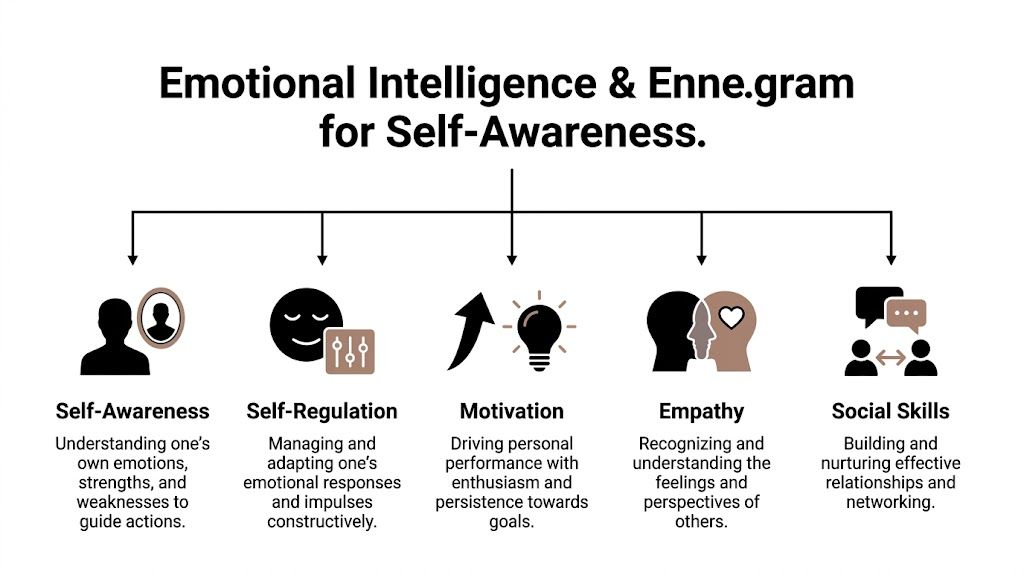
The five parts of emotional intelligence
Most workplace EQ problems land in one of five buckets.
| Component | What it looks like at work | What low skill looks like |
|---|---|---|
| Self-awareness | Knowing what you feel and how you affect others | “I’m just being honest” after steamrolling a team |
| Self-regulation | Managing reactions under pressure | Sending the spicy email instead of saving it to drafts |
| Motivation | Staying grounded in purpose, not just praise | Performing only when someone is watching |
| Empathy | Reading other people accurately | Treating every silence as agreement |
| Social skills | Navigating conflict and relationships well | Confusing urgency with permission to be rude |
Self-awareness sits first for a reason. If you can’t identify your emotional pattern, the rest gets shaky fast. A lot of people know what they do. Fewer know why they keep doing it .
Why the Enneagram helps where generic advice stalls
At this point, personality typing becomes useful, not cute.
The Enneagram doesn’t just describe behavior. It points to core motivations, fears, and habitual defenses. That matters because two people can show the same behavior for completely different reasons.
A Type 1 and a Type 7 can both interrupt in meetings. The Type 1 may be trying to correct what feels wrong or sloppy. The Type 7 may be trying to outrun discomfort and keep the energy high. Same behavior. Different engine. Different fix.
That’s why generic workplace advice often falls flat. “Be more self-aware” is not a method. It’s a wish.
A more specific approach offers genuine benefits. Genos North America’s article on improving emotional intelligence in the workplace notes that integrating personality frameworks like the Enneagram with EI training can boost training efficacy by 28% in team performance , while only 15% of firms use such integrated tools .
That gap is where a lot of wasted development money lives. If you want a practical overview of how type patterns show up on the job, this look at the Enneagram at work is a solid companion.
A few type-based aha moments
Here’s where people usually sit up straighter.
• Type 1 Reformer: • Often struggles less with effort and more with tension. Their growth edge isn’t “care more.” They already care. It’s noticing when standards become irritation and when irritation becomes control.
• Type 3 Achiever: • Usually looks polished and competent. Their self-awareness gap often hides in image management. They may confuse being effective with being emotionally available.
• Type 5 Investigator: • Often regulates by withdrawing. That can look calm from the outside while teammates experience it as cold, unhelpful, or impossible to read.
• Type 8 Challenger: • Brings courage and decisiveness. Their EQ work usually isn’t about becoming softer. It’s learning that intensity lands differently on different nervous systems.
• Type 9 Peacemaker: • Keeps peace beautifully until peacekeeping becomes self-erasure. Then feelings leak out sideways, usually late and inconveniently.
That’s the key connection. Emotional intelligence helps you manage emotions well. The Enneagram helps you understand why your default emotional strategy exists in the first place.
Assess Your Workplace EQ with a Reality Check
Self-ratings on emotional intelligence are often generous. Very generous. Almost everyone thinks they’re self-aware until they hear how they land in meetings, under stress, or in feedback conversations. Then the room gets quiet. A real EQ baseline needs more than “I’ve been reflecting lately.”

Start with four weeks of trigger journaling
One of the most reliable ways to build self-awareness is annoyingly simple. Track your emotional reactions daily.
Not “Why am I like this?” That question often sends people into a dramatic TED Talk with themselves.
Use what questions instead.
• What happened right before I got irritated?
• What story did I tell myself about that moment?
• What did I do next?
• What did that reaction cost me?
That method matters. Masterplan’s guidance on emotional intelligence training describes a proven approach of journaling what triggers emotional reactions daily for four weeks , then comparing self-assessments with anonymous 360° feedback . That process yields an average 25 to 40% improvement in EI scores .
The detail that matters most is specificity. Not “Meetings are stressful.”Try “I tense up when someone challenges my idea in front of senior leaders.” That’s usable.
Add 360 feedback before your ego starts editing
After journaling, ask for anonymous input from people above, beside, and below you.
Keep the prompts tight. Don’t ask for vague personality commentary. Ask things people can observe.
Use prompts like:
If the feedback stings, good. Not because pain is noble, but because bland feedback rarely changes behavior.
The trick is not to argue with it. Your intent matters morally. Your impact matters operationally.
If you want a broader framework for benchmarking your starting point, this guide to how to measure emotional intelligence can help you organize what you’re seeing.
Connect behavior to motive
Many assessments stop too soon at this stage. Say a Type 3 Achiever gets repeated feedback that they’re intimidating. Their first reaction is often confusion. “I’m being efficient. I’m helping us move.” That may be true. But efficiency can carry a sharp edge when it outruns attunement.
The useful question isn’t “Am I a bad teammate?” It’s “What am I protecting?”
For a Type 3, the answer is often tied to competence, image, or fear of failure. Once they see that, the behavior changes more cleanly. They stop trying to merely look warmer and start noticing when urgency turns other people into obstacles.
That’s a proper reality check. Not shame. Not performance theater. Just clearer data about the emotional patterns you bring to work every day.
Daily Drills for a Higher EQ
Emotional intelligence improves the same way mobility, language, or strength improves. Repetition beats insight. One dramatic workshop won’t do it. Neither will one very sincere note in your journal. You need drills that fit into normal workdays, especially the messy ones.

Three drills that work during actual work
The productive pause
When emotion spikes, don’t trust your first draft. Pause before replying to the email, the Slack, or the verbal jab in a meeting. Take one breath. Relax your jaw. Ask, “What response serves the outcome, not just my mood?”
This sounds small because it is small. That’s why people skip it. It’s also the difference between leadership and emotional littering.
Example:A manager gets a last-minute deck that isn’t usable. Low EQ says, “This isn’t even close.”Higher EQ says, “We’re off target. Let’s fix the assumptions first so you’re not reworking the wrong thing.”
Same standard. Better delivery. Less cleanup.
The five-minute perspective shift
Pick one tense interaction from the day. Set a timer for five minutes. Write the scene from the other person’s point of view. Not your rebuttal to their point of view. Their point of view.
Ask:
• What might they be worried about?
• What pressure could they be under that I can’t see?
• What did my tone or timing probably signal to them?
This drill builds empathy without requiring you to agree with nonsense. A very important distinction.
The last-two-minutes listening rule
In your next one-on-one or meeting, spend the final two minutes summarizing what you heard before you offer your opinion.
Use a script like:
That one sentence prevents a shocking amount of workplace drama.
Don’t just train alone
People improve faster when practice is social, not private.
This Lumenalta article on improving emotional intelligence in the workplace notes that structured mentorship programs focused on EI skills like empathy and self-regulation, paired with team-building activities, can boost employee engagement by 30% and increase team productivity by 20% through enhanced trust .
That lines up with what works on the ground. Solo reflection helps people notice patterns. Mentorship and team practice help them interrupt those patterns when another human is involved.
A simple version looks like this:
• Weekly mentor check-in: • Review one emotionally charged moment from the week.
• Shared language: • Name the pattern without moralizing it.
• One practice target: • Pick one response to test next week.
• Team simulation: • Use role-play for conflict, feedback, and boundary-setting.
Here’s a short explainer worth watching before you try to teach this internally:
If you want more practical exercises beyond the ones here, this guide on how to increase EQ offers additional ideas.
Tailored EQ drills for your Enneagram Type
| Enneagram Type | Common EI Challenge | Recommended Daily Drill |
|---|---|---|
| Type 1 | Irritation masked as “high standards” | Before giving correction, state one thing that’s working |
| Type 2 | Helping instead of stating needs | Ask for one concrete need directly each day |
| Type 3 | Prioritizing efficiency over emotional signal | In each meeting, ask one question that has no performance agenda |
| Type 4 | Over-identifying with feelings | Name the feeling, then name the task that still needs doing |
| Type 5 | Withdrawing when emotion rises | Share one internal reaction out loud before ending a discussion |
| Type 6 | Scanning for risk until trust collapses | Ask, “What evidence supports the positive read?” |
| Type 7 | Escaping discomfort with speed or jokes | Stay with one unpleasant conversation for two extra minutes |
| Type 8 | Intensity landing as intimidation | Lower volume and ask how your message is landing |
| Type 9 | Avoiding tension until resentment builds | Voice one disagreement in real time, even if it’s small |
What doesn’t work
A few things sound emotionally intelligent but usually aren’t.
• Forced positivity: • Teams don’t need fake calm. They need honest steadiness.
• Endless self-expression: • Naming every feeling without owning behavior is just better-dressed chaos.
• One-off workshops: • Insight fades fast when managers don’t reinforce the practice.
• Using the Enneagram as a weapon: • “You’re such a Type 8” is not development. It’s astrology with office supplies.
The useful standard is simple. If a drill makes your relationships clearer, your reactions less impulsive, and your conversations less costly, keep it.
Lead with Emotional Intelligence for Team Success
Managers set the emotional weather.
Not perfectly. Not alone. But more than they usually admit.
A leader can have a polished strategy deck, a clean operating cadence, and solid technical judgment. If the team feels unsafe to speak, challenge assumptions, or recover from mistakes, performance will flatten anyway.

Your job is bigger than output
A lot of managers still think their role is to drive delivery and fix underperformance.
That’s part of the job. The larger job is managing the conditions under which people can tell the truth, think clearly, and collaborate without bracing for emotional collateral damage.
Leadership EQ has a direct retention effect. According to Boterview’s emotional intelligence statistics roundup , employees with emotionally intelligent managers are 4 times less likely to leave their jobs , and 83% of employees with high-EQ managers report high job satisfaction .
People don’t stay just because a manager is nice. They stay because the environment feels workable.
What high-EQ leadership sounds like
The fastest way to improve team culture is to change the leader’s language during high-stakes moments. Here are scripts that help.
When giving tough feedback
Low EQ: “You need to be more strategic.”
Better: “I want to talk about impact, not your worth. In that meeting, you answered the question quickly, but you didn’t address the concern behind it. Next time, pause and speak to the risk first.”
That works because it’s specific, behavioral, and not weirdly personal.
When a conflict is brewing
Don’t wait until two people are collecting evidence against each other.
Try: “I think we have a process disagreement that’s turning personal. Let’s separate what decision needs to be made from what each of you is assuming about the other.”
That sentence often lowers the temperature enough to get adults acting like adults again.
When someone shuts down
Some employees get louder under stress. Others disappear.
Try: “I don’t need you to have the polished answer right now. I do want your honest read. What feels hard to say?”
That’s especially useful with conflict-avoidant team members who need a cleaner invitation into candor.
Different leaders have different growth edges
The Enneagram helps leaders understand how their strengths can become liabilities.
• Type 2 leaders • often create warmth and loyalty, but they can avoid direct accountability if they fear being disliked.
• Type 8 leaders • can move a team through uncertainty fast, but if they don’t calibrate intensity, people may comply without contributing.
• Type 6 leaders • often anticipate risk well, but if anxiety leads the room, caution can start sounding like distrust.
The strongest leaders don’t erase type. They mature it.
A simple meeting reset for managers
If your team is tense, distracted, or brittle, use this structure for the next few meetings:
That doesn’t make meetings magical. It makes them usable.
And usable beats inspirational speeches every time.
Troubleshooting Common Emotional Intelligence Roadblocks
The first roadblock is usually cynicism. “This feels manipulative.”“I don’t want to perform empathy.”“I’m not trying to become one of those overly processed people who talks like a leadership podcast.” Fair objection. Bad conclusion.
Roadblock one is mistaking EQ for image management
Emotional intelligence is not pretending to feel things you don’t feel.
It’s noticing what’s true, managing what’s unhelpful, and expressing what needs to be said in a way people can hear. That’s not manipulation. That’s skill.
If you’re worried you sound fake, simplify. Use plain language. Skip the therapy vocabulary if it’s not natural to you.
Roadblock two is wanting instant transformation
People often quit because they expected a personality transplant by next Tuesday.
EQ growth is slower than insight and faster than burnout. That’s the honest trade-off. You’ll usually notice progress in recovery time first. You still get triggered, but you recover faster and do less damage.
Track small signs:
• Shorter defensiveness: • You stop arguing with every piece of feedback.
• Cleaner conflict: • Fewer post-meeting autopsies in your head.
• Better timing: • You delay tough conversations less often.
• More accurate empathy: • You ask instead of assuming.
Roadblock three is being the only emotionally competent adult in the room
Many people ask some version of this: “What if my boss has the emotional range of a stapler?”
Then your goal shifts. You’re not trying to fix them. You’re trying to protect your clarity.
Use three moves:
• Name facts, not motives: • “The deadline changed twice this week,” not “You’re chaotic.”
• Limit emotional volunteering: • Don’t overexplain feelings to people who weaponize vulnerability.
• Create recovery rituals: • Step away, debrief with a trusted peer, and decide what needs a response versus what just needs a boundary.
Type matters here too. A Type 9 may need help saying the hard thing sooner. A Type 8 may need help saying it with less force. A Type 6 may need help not catastrophizing every ambiguous interaction.
Progress isn’t becoming unbothered. It’s becoming harder to throw off course.
Your EI Journey Is a Marathon, Not a Sprint
Workplace emotional intelligence isn’t a personality makeover. It’s a practice.
You get better by noticing your patterns, testing better responses, and repeating them often enough that they become less forced. That starts with self-awareness. Not the flattering kind. The useful kind. The kind that lets you catch your tone before it wrecks a meeting and spot your blind spots before your coworkers start avoiding you.
The Enneagram earns its place here because it gives shape to your default strategy. It helps you see why you over-control, over-help, overthink, overperform, or vanish when things get tense. Once that pattern is visible, change gets much less mysterious.
Then the work becomes refreshingly ordinary. Better pauses. Better questions. Better repair. Better leadership under pressure.
If you want to support that effort beyond communication habits alone, it helps to pair EQ practice with broader routines that reduce stress and make regulation easier. These real workplace wellness tips for lasting impact are useful for creating that kind of environment.
Don’t wait for a perfect moment to start. The next hard conversation is your practice field. The next irritating email is your practice field. The next meeting where someone says, “No offense,” and then absolutely means offense, that’s your practice field too.
If you want a sharper read on your core motivations, blind spots, and workplace patterns, take the assessment at Enneagram Universe . It’s a practical first step for anyone who’s tired of repeating the same interpersonal mess at work and would prefer to become the colleague people trust, not the one they brace for.