How to Improve Conflict Resolution Skills with the Enneagram

To improve your conflict resolution skills, you need to make one crucial shift: stop trying to win the argument and start trying to understand the perspective .
It’s about learning to really listen, keep your own emotions in check, and say what you need without pointing fingers. Get a handle on these, and you can turn messy disagreements into moments of real connection and growth.
Why Better Conflict Skills Are Your Secret Superpower
Do you ever feel like disagreements are a high-stakes chess match where you're always one move away from checkmate? Whether it’s a tense family dinner or a strained team meeting, that constant friction is just plain exhausting. If you feel that way, you're not alone. Most of us were never taught how to disagree well, so we either run from conflict or charge into battle.
But what if conflict wasn't a battle at all? What if it was actually an opportunity to build something stronger?
Learning to handle conflict isn't about mastering debate club tactics. It's more like developing emotional x-ray vision—the ability to see past the surface-level anger or frustration to understand what’s really going on with the other person, and with yourself.

From Friction to Forward Motion
Let's imagine a classic workplace scenario. A project deadline is breathing down your neck, and you and a colleague, Michael, are completely at odds over the final steps. The old way might involve a flurry of passive-aggressive emails, some complaining to other team members, and a final product that feels like a watered-down compromise nobody is happy with.
Now, imagine a new way. You see this disagreement as a signal. It’s a chance to take two strong, valid perspectives and fuse them into something truly fantastic. Suddenly, the clash becomes a collaboration. That is the power of great conflict resolution. It transforms moments of friction into catalysts for genuine progress.
"Handled well, conflict can be a catalyst for better workplace culture. Proactive conflict resolution reveals blind spots, surfaces buried frustrations, and challenges stagnant ways of thinking."
This kind of shift doesn’t just happen. It takes a specific set of skills that help you stay grounded, curious, and open, even when your lizard brain is screaming "fight or flight!"
Your Personality Is the Key
So, where do you even start? The most powerful and effective starting point is looking in the mirror and understanding your own wiring. Under stress, we all have default settings. Some of us dig in our heels and get critical. Others pull back and go silent. And some of us just want to smooth everything over to make the tension disappear.
This is where a tool like the Enneagram can be a game-changer. It’s not just a personality quiz; it’s a detailed map of your core motivations, fears, and the subconscious patterns that drive your behavior. By figuring out your Enneagram type, you gain incredible insight into your personal conflict style.
• You'll start to spot your emotional triggers • before • they hijack the conversation.
• You'll finally understand the hidden needs that fuel your knee-jerk reactions.
• You’ll develop a real sense of empathy for why others react so differently.
This guide is designed to give you practical, actionable steps to build this essential skill set. We're skipping the dry theory and jumping straight into relatable stories and clear frameworks you can put to use today. By blending proven resolution techniques with the deep self-awareness the Enneagram provides, you’ll learn to navigate disagreements with confidence, turning potential battles into powerful moments of connection.
The Hidden Costs of Workplace Conflict
Let's be honest, unresolved tension at work is more than just awkward elevator rides. It’s a silent killer of productivity, morale, and ultimately, your company's bottom line. When disagreements are left to simmer, they create a toxic undercurrent that makes genuine collaboration feel downright impossible.
This isn't just a "people problem"—it's a massive business liability. The numbers are staggering. U.S. businesses lose an estimated $359 billion every single year to workplace conflict. Think about that. On a smaller scale, employees waste an average of 2.8 hours per week dealing with drama, and managers? They're burning 20-40% of their time playing referee instead of leading their teams forward.

The Domino Effect of Unchecked Tension
Friction at work never stays between two people. It starts small, then spirals, poisoning entire teams. It’s a classic domino effect.
• Productivity Nosedives: • People start obsessing over office politics, replaying arguments in their heads, or taking the long way around the office just to avoid someone.
• Innovation Grinds to a Halt: • Who’s going to share a bold, risky idea when they’re afraid of getting shot down? Psychological safety vanishes, and with it, creativity.
• Your Best People Walk: • Top talent won't tolerate a toxic environment. They’ll just leave, taking their skills and knowledge with them.
The dynamics of failed communication and escalating tension are universal. On a much grander scale, you can see these same principles at play by understanding the immense stakes of unresolved conflict. While your office dispute probably won't trigger a global crisis, the core issues are surprisingly similar.
A Real-World Turnaround
I once worked with a marketing manager, Sarah, at a fast-growing tech startup in Austin. Her team was stacked with brilliant people who just couldn't get along. The designers and copywriters were in a constant state of cold war, lobbing passive-aggressive Slack messages back and forth. Deadlines were a joke, and morale was in the gutter.
Instead of banging her head against the wall, Sarah tried something different. She decided to help the team understand why they clashed. This is where personality frameworks like the Enneagram can be a game-changer for workplace dynamics (you can learn more about that here: Enneagram at Work: Unlock Your Team's Hidden Potential ).
Sarah realized her lead designer, a Chicago native, was a Type 8, "The Challenger," who thrived on direct debate to get to the best idea. Her lead writer, who grew up in the Midwest, was a Type 9, "The Peacemaker," who saw any direct confrontation as a personal attack and would immediately shut down.
It was a classic mismatch.
Armed with this knowledge, Sarah ran a workshop. There was no finger-pointing. Instead, she gave them a new toolkit for how to disagree productively . They learned how to frame feedback, listen to actually understand—not just to reload for their next argument—and see that a different viewpoint wasn't a threat.
The change was almost immediate. The team started having real conversations. Projects that had been stuck in a swamp of resentment suddenly had life again. By tackling the problem head-on, Sarah didn't just rescue a few projects; she built a stronger, more resilient team. That's the real ROI of mastering conflict resolution.
The Four Pillars That Will Change How You Handle Conflict
Enough with the abstract theories. If you really want to get better at navigating disagreements, you need a solid, practical toolkit—a few reliable moves you can pull out when things get tense.
Think of these four pillars not as rigid rules, but as the foundational supports that keep a difficult conversation from completely falling apart. Getting a handle on them will fundamentally shift your approach from head-to-head confrontation to side-by-side collaboration. Suddenly, resolution won't just feel possible; it'll feel natural.
Pillar 1: Listen Like You Mean It (Active Listening)
Let’s be honest. Most of us don't really listen; we just wait for our turn to talk. Active listening is the complete opposite. It’s a full-body sport that involves hearing not just the words someone is saying, but the emotion and unmet needs simmering just beneath the surface.
The goal here is simple: make the other person feel genuinely heard. That alone is often half the battle.
When you're truly listening, you aren't just being quiet—you're getting curious. You ask questions to clarify. You repeat back what you heard to make sure you got it right. You notice their tone and body language.
Here’s how it looks in real life: Imagine your partner says, "You never help with the finances!" The knee-jerk, defensive reply is, "That's not true! I just paid the car insurance!"
But an active listening response sounds completely different: "It sounds like you're feeling really overwhelmed and alone in managing our budget. Is that right?" See the difference? This simple switch validates their feeling instead of attacking their statement, and it instantly pours water on the fire.
Pillar 2: Tame Your Inner Lizard (Emotional Regulation)
Conflict triggers our primal fight-or-flight response, flooding our system with adrenaline and cortisol. When this lizard brain takes over, our rational, thinking mind takes a backseat. Emotional regulation is the skill of noticing that surge and choosing not to let it drive your actions.
This isn't about bottling up your feelings. It's about acknowledging them—"Wow, I'm feeling really angry right now"—without letting them hijack your mouth. That tiny pause is where you reclaim your power. One of the best ways to build this muscle is by strengthening your overall emotional intelligence. We've got a great guide on how to increase your emotional intelligence that can help.
The space between stimulus and response is our power. In conflict, pausing for even three seconds before you speak can be the difference between resolution and regret.
A super simple technique? Take one slow, deep breath before you say anything. For example, if your manager gives you unexpected critical feedback in a team meeting, resist the urge to immediately defend yourself. Instead, inhale slowly through your nose for four counts and exhale for six. This small act can calm your nervous system just enough to let your thinking brain come back online, allowing you to respond thoughtfully instead of just reacting.
Pillar 3: Drop the "You-Bomb" (Using I-Statements)
Blame is the gasoline you pour on a conflict fire. "You-statements" like "You always..." or "You never..." put people on the defensive in a split second. The conversation is no longer about the actual issue; it’s about them defending their character.
"I-statements," on the other hand, are a game-changer. They're a powerful way to express your side of things without assigning blame. You take ownership of your feelings and your experience, which makes it infinitely easier for the other person to listen without shutting down.
The formula is dead simple:
• "I feel..." • (your emotion)
• "...when..." • (the specific, factual behavior)
• "...because..." • (the impact it has on you)
Let's try a workplace scenario: Your teammate, Mark, has missed a deadline, which is now delaying your part of the project.
• A "You-Bomb" sounds like this: • "You're so unreliable! You've completely messed up my schedule."
• An "I-Statement" is way more effective: • "I feel frustrated when deadlines are missed, because it means I have to rush my own work and the quality suffers."
The first is an attack. The second is a statement of fact about your experience. Mark can't argue with how you feel—he can only address the behavior and its impact.
Pillar 4: Find the "Us vs. The Problem" (Common Ground)
Even in the most polarized, heated disagreements, there is almost always a shared goal or a tiny patch of common ground. Your job is to become a detective and find it. This single move reframes the entire conflict from "me versus you" to "us versus the problem."
This is all about asking unifying questions. What are we both trying to achieve here? What outcome would we both be happy with? What’s the one thing we can agree on right now?
This skill is absolutely critical, yet so many workplaces just don't teach it. A recent survey revealed that while a massive 98% of people believe conflict resolution training is important, a mere 27% of managers are rated as 'very skilled' at it. In fact, 60% of employees have never received any formal training on the topic, but when they do, 95% report positive results. The gap between knowing this is important and actually having the skills is huge. You can explore more data on the state of workplace conflict to see just how vital this is.
When you intentionally look for that shared objective, you create a foundation of goodwill. Even if you totally disagree on the "how," just agreeing on the "what" or "why" can turn adversaries back into partners.
To tie it all together, here's a quick cheat sheet for these four game-changing skills.
The Four Pillars of Conflict Resolution at a Glance
| Pillar | What It Is | Why It Works | Your Mantra |
|---|---|---|---|
| Active Listening | Hearing the emotion and need behind the words, not just the words themselves. | Makes the other person feel validated and understood, de-escalating tension immediately. | "Help me understand." |
| Emotional Regulation | Noticing your emotional triggers and pausing before you react. | Keeps your rational brain in charge and prevents you from saying things you'll regret. | "Breathe before I speak." |
| I-Statements | Expressing your feelings and needs without blaming the other person. | Prevents defensiveness and keeps the focus on solving the problem, not attacking character. | "I feel... when... because..." |
| Finding Common Ground | Actively searching for a shared goal, value, or desire, no matter how small. | Reframes the dynamic from "me vs. you" to "us vs. the problem." | "What are we both trying to do?" |
Think of these pillars as your new toolkit. The more you use them, the more natural they'll become, and the more confident you'll feel walking into any tough conversation.
How Your Enneagram Type Shapes Your Conflict Style
If learning the core principles of conflict resolution is the "how," then understanding your Enneagram type is the "why." This is where the magic happens. Think of your Enneagram type as a subconscious blueprint that reveals your go-to moves in a fight—your deepest fears, core motivations, and knee-jerk reactions when the pressure is on.
Ever wonder why some people completely shut down while others get louder? Or why one person obsesses over being right while another just wants everyone to get along? The Enneagram gives us some startlingly accurate answers. It's the key to shifting from unconscious reaction to conscious choice.
Knowing your type helps you catch yourself before you tumble into those old, unproductive patterns. It’s the difference between being a puppet pulled by emotional strings and being the one holding them.
The Nine Conflict Personalities
Every Enneagram type has a unique way of walking into a disagreement, complete with hidden strengths and glaringly predictable blind spots. Pinpointing your own pattern is the first real step toward getting better at this stuff.
Here’s a quick tour of how each type tends to show up when things get tense:
• Type 1 (The Reformer): • Fears being wrong or corrupt. They can become rigid and critical, arguing from a place of high principle and methodically pointing out every flaw in your logic.
• Type 2 (The Helper): • Fears being unwanted or unloved. To keep the peace, they might over-accommodate to an absurd degree, only to become passive-aggressive when they feel their sacrifices go unnoticed.
• Type 3 (The Achiever): • Fears being worthless or seen as a failure. Conflict is just an obstacle to success, so they’ll try to smooth it over, avoid it, or just "win" fast to keep their successful image intact.
• Type 4 (The Individualist): • Fears having no unique identity. In a conflict, they can withdraw and become temperamental, fixating on how it all makes • them • feel and often dialing up the emotional drama.
• Type 5 (The Investigator): • Fears being incompetent or overwhelmed. Their gut reaction is to detach emotionally and retreat into their minds to analyze the problem, which can come across as cold and dismissive.
• Type 6 (The Loyalist): • Fears being without support or guidance. They can swing between being anxiously compliant to authority and rebelliously confrontational, constantly testing your loyalty.
• Type 7 (The Enthusiast): • Fears being trapped in pain. They are masters of using humor, charm, or a quick change of subject to sidestep negativity, avoiding the real issue to keep things light.
• Type 8 (The Challenger): • Fears being controlled or harmed by others. They meet conflict head-on with assertive—and sometimes intimidating—energy, aiming to control the situation and protect themselves.
• Type 9 (The Peacemaker): • Fears loss and separation. To maintain harmony, they will do almost anything to avoid a direct confrontation, often merging with others' opinions and numbing out their own needs.
If you're still figuring out your own inner wiring, you can learn more about the nine Enneagram types to see which one clicks for you.
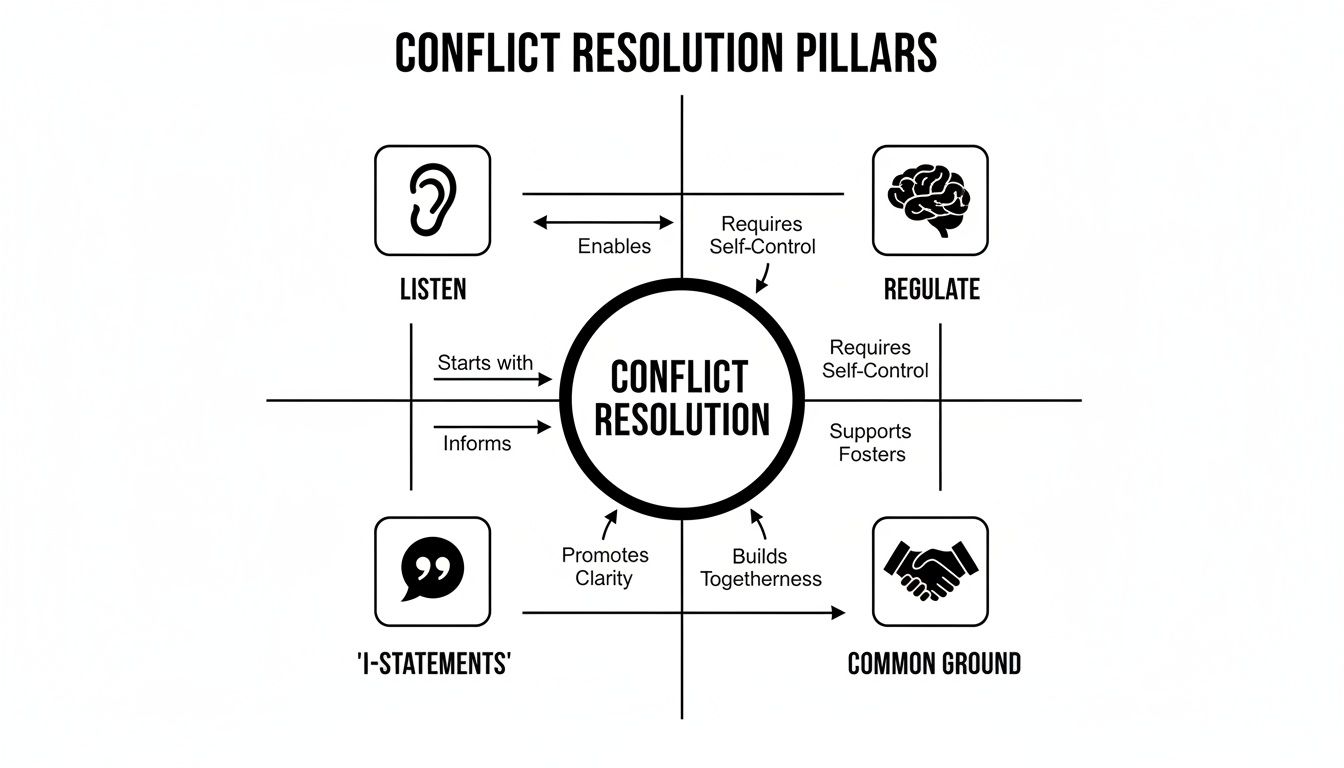
This map is a great reminder that no matter your type, these foundational skills are your ticket to better outcomes.
From Autopilot To Action
Okay, so recognizing your pattern is the first piece of the puzzle. The next is consciously choosing a better response.
Let's look at a classic workplace clash. Imagine David, a Type 1 Reformer, and Maria, a Type 7 Enthusiast, are butting heads over a big project launch at their office in Denver.
David (Type 1) is all about a perfect, meticulous, step-by-step plan. He sees Maria's freewheeling brainstorm of creative ideas as chaotic and reckless. His conflict trap is rigidity —he's convinced his way is the only "right" way.
Maria (Type 7) wants to explore every exciting possibility and keep all options on the table. She sees David's detailed plan as a creative straitjacket. Her conflict trap is avoidance —she wants to skip the tense, boring details and fast-forward to the fun part.
The result? A complete standstill. David gets more critical, and Maria gets more evasive.
Self-awareness isn't about beating yourself up. It's about recognizing your default settings so you can manually override them when they're not getting you where you want to go.
Instead of getting stuck, they can take a different path. David's growth action is to practice flexibility and accept that there’s more than one way to get a great result. Maria's growth action is to stay present and resist the urge to deflect, engaging with the necessary details even when they feel tedious.
To make this super practical, here’s a breakdown of the default trap for each Enneagram type and the specific action you can take to grow.
Enneagram Conflict Tendencies and Growth Actions
This table identifies the common conflict trap for each Enneagram type and suggests a specific, actionable growth step to take.
| Enneagram Type | Common Conflict Trap | Your Growth Action |
|---|---|---|
| Type 1 Reformer | Righteous Rigidity Believing your way is the only correct way. | Embrace Flexibility Acknowledge the validity of other perspectives. |
| Type 2 Helper | Resentful Giving Over-accommodating, then feeling unappreciated. | State Your Needs Directly Clearly and kindly express what you need. |
| Type 3 Achiever | Image Management Avoiding conflict to appear successful and unfazed. | Pursue Authentic Dialogue Engage with the real issue, not just the optics. |
| Type 4 Individualist | Emotional Escalation Over-identifying with your feelings and making it personal. | Seek Objective Facts Separate your emotional reaction from the events. |
| Type 5 Investigator | Detached Observation Withdrawing emotionally to analyze from a distance. | Engage with Empathy Share your thoughts and connect with the other's feelings. |
| Type 6 Loyalist | Anxious Projection Assuming the worst-case scenario and reacting to fear. | Stay in the Present Focus on the current problem, not future what-ifs. |
| Type 7 Enthusiast | Positive Reframing Using humor or optimism to avoid difficult feelings. | Lean into Discomfort Stay with the difficult conversation until it's resolved. |
| Type 8 Challenger | Domination and Control Using intensity to overpower the other person. | Practice Vulnerability Acknowledge your impact and listen without defending. |
| Type 9 Peacemaker | Conflict Avoidance Agreeing externally while feeling resentful internally. | Assert Your Position State your own opinion, even if it might cause tension. |
By understanding what drives you in a conflict, you can turn your biggest challenge into your greatest area of growth. The Enneagram gives you a personalized roadmap to get off autopilot and start creating better outcomes, one conversation at a time.
Time to Put This Stuff to Work
Alright, let's get real. Reading about how to handle conflict is one thing, but actually doing it when your heart is pounding, and you feel misunderstood? That’s a whole different ballgame.
Think of this as your personal practice field. We're moving past the theory and into the nitty-gritty of real-life disagreements. The goal here isn't to follow a script perfectly, but to build the muscle memory so you can stay grounded when things get tense.

Workplace Scenario: Your Boss Gives You Bizarre Feedback
Picture this: your boss critiques your latest project, and the feedback feels like it came from another planet. It's just... wrong.
Your gut might scream at you to get defensive (a go-to for Enneagram Type 8s) or maybe to just nod along while silently plotting your revenge (hello, Type 9s). Let’s try a more productive path.
First, take a breath. Seriously. Before a single word escapes your lips, just breathe. Acknowledge that internal voice yelling, "I feel defensive right now!" but don't hand it the microphone. That tiny pause is everything.
Next, get curious, not furious. Instead of launching a counter-attack, try to genuinely understand where they're coming from. It shows respect and, more importantly, opens the door to an actual conversation.
• Try this: • "Thanks for the feedback. I want to make sure I'm on the right track. Are you saying the main issue is with the project timeline, or is it more about the concept itself?"
Then, share your perspective with an 'I-statement'. Once you've heard them out, it's your turn. Frame your point of view around the project's goals, not their bad judgment.
• A powerful phrase: • "I feel concerned that changing direction now might put our launch date at risk. My thinking with the original approach was to make sure we hit that deadline."
See what happened? You just transformed a potential showdown into a brainstorming session about how to ensure the project succeeds. That's a goal you both share.
Personal Scenario: The Never-Ending Chores Fight
You and your partner are trapped in the same old argument about who does what around the house. It's the conflict that's never really about the dirty dishes—it's about feeling unappreciated, invisible, or disrespected. This is where knowing your Enneagram types can be a secret weapon.
Let's imagine you're a Type 1, driven by the "right" way to do things, and your partner is a Type 7, who feels suffocated by rigid routines.
Start by finding common ground. Kick things off by zooming out from the problem to what you both actually want.
• Open with this: • "Look, I know neither of us wants to fight about this. Can we agree that we both want our home to feel like a relaxing place, not a stressful one?"
Own your Enneagram quirks. Bringing your self-awareness into the open is a game-changer. It can create a moment of empathy and connection right when you need it most.
• Try being vulnerable: • "I know my Type 1 brain can get really locked into how things • should • be done, and I bet that feels controlling sometimes. I'm really trying to work on that."
Use "we," not "you." Shift your language from blame to teamwork. Use words like "we" and "us" to remind yourselves you’re on the same side.
• Ask a collaborative question: • "How can we come up with a system that actually works for both of us? One that helps me feel like there's order, but gives you the freedom and flexibility you need?"
This approach respects both of your core needs instead of turning it into a battle where one person has to lose. Once you've got a handle on the concepts, the real magic happens when you figure out how to use what you learn for real-world success in moments just like these.
And make no mistake, this isn't just fluffy stuff—it's a massive advantage. The global market for conflict resolution is expected to hit $12.68 billion by 2029 . That’s a huge number reflecting a major cultural shift. With a staggering 85% of employees dealing with workplace conflict every year and nearly 88% of professionals saying they're willing to compromise, building these skills isn't just nice, it's necessary.
Got Questions? Let's Troubleshoot Common Conflict Hurdles
Alright, so you're ready to put these new skills into practice. Awesome! But let's be real—the moment you try something new, especially in a tense situation, things can get awkward. That’s completely normal.
To help you get past those "uh-oh, what now?" moments, I've rounded up some of the most common questions and sticking points that pop up when people start this journey.
What if the Other Person Just Isn’t Playing Ball?
Ah, yes. The big one. You've brought your best self to the conversation, you're using "I-statements," you're listening like a champ... and they're giving you nothing but a brick wall. It’s maddening.
Here’s the tough-love truth: you can't make anyone do anything. You can only control your own actions and reactions. When someone simply refuses to engage constructively, your goal has to pivot from resolution to management .
You’ve already done your part. You calmly stated your side and showed you were ready to find a solution. If they won't meet you there, the game changes. Now, it's about protecting your own peace and setting firm boundaries.
For example, imagine a coworker in a U.S. office is completely stonewalling you on a project. You could follow up with a clear, neutral email documenting your conversation and, if it continues, bring a manager into the loop. At home, it might sound like, "I'm not going to have this conversation while we're yelling. I'm going for a walk, and we can try again when we’re both calm." Notice the shift? The focus is on what you will do, not what you're trying to force them to do.
How Can I Get Better at This Without an Actual Fight?
I love this question because it’s so proactive! You wouldn't try to bench press 300 pounds on your first day at the gym, right? You’d start with lighter weights to nail your form. The same logic applies here. You don’t want your first road test of these skills to be during a full-blown, emotionally-charged meltdown.
Start small. Look for low-stakes opportunities to practice.
• Practice Active Listening Everywhere: • The next time a friend is just telling you about their day, really tune in. Don't just wait for your turn to talk. Try paraphrasing back what you hear: "Wow, so it sounds like you felt totally unappreciated by your boss today."
• Rephrase Simple Requests with "I-Statements": • Instead of the usual, "Can you please not leave your shoes there?" try this: "Hey, I feel a little stressed when I see shoes in the hallway because I'm worried someone might trip." See how that lands differently?
• Run Mental Drills: • Think about a minor disagreement you had recently. Play it back in your head, but this time, consciously script a better response for yourself using the principles we've discussed. This kind of mental role-play is surprisingly powerful for building muscle memory.
The whole point is to make these skills a natural part of your communication style, not some emergency glass you only break during a five-alarm fire.
Seriously, How Does My Enneagram Type Help with This?
Think of the Enneagram as the ultimate cheat sheet for your own brain's weird, subconscious wiring. It doesn't just show you what you do in a fight; it pulls back the curtain to show you why you do it. It reveals the deep-seated fears and motivations that are secretly running the show.
For instance, a Type 6 (The Loyalist) often escalates conflict by spinning up worst-case scenarios. Their core fear is being without support, so they react to a catastrophe that hasn't even happened yet. Meanwhile, a Type 3 (The Achiever) might just ghost the conversation entirely. Their core fear is being seen as a failure, and an open disagreement feels like a crack in their polished image.
When you know this about yourself, you can catch that knee-jerk reaction before it hijacks your behavior. You can have that split-second moment of clarity and think, "Ah, there's my Type 6 brain assuming the absolute worst again." That tiny pause is everything. It gives you the freedom to choose a response that actually helps, instead of just reacting out of old fears. It's how you switch from being on autopilot to being in the driver's seat.
At Enneagram Universe , we believe that knowing yourself on a deeper level is the key to building stronger relationships and a more rewarding life. Ready to figure out your own conflict style? Take our free, in-depth Enneagram test and get the personalized insights you need to grow. Find it at Enneagram Universe .