How to Improve Active Listening Skills for Better Conversations

Improving your active listening skills all boils down to one powerful shift: moving from just hearing words to truly understanding the person saying them. This isn't just about paying attention; it's about actively showing you're engaged, both with what you say and what you do. Get this right, and you'll see fewer misunderstandings and build much deeper connections.
The Real Reason You're Not Being Heard
Let's be honest—most of us think we're pretty good listeners. We nod along, patiently wait for our turn to talk, and figure we've captured the essence of what's being said. But what if that confidence is totally off the mark? The hard truth is there’s often a huge gap between how well we think we listen and how well we actually do.
This isn't about being intentionally rude. It’s just how our brains are wired. We're constantly processing, jumping ahead to formulate our own thoughts, and getting ready to drop our own story or solution into the conversation. This constant mental multitasking is the biggest enemy of true understanding.

The Great Listening Delusion
The data on this is pretty eye-opening. One survey found that a staggering 85.54% of employees believe they’re effective listeners. But here’s the kicker: other research shows that the average person only remembers about 50% of a conversation immediately after it ends. Wait 48 hours, and that number plummets to a dismal 25% .
This "listening delusion" is exactly why so many of our interactions feel shallow or, worse, lead to conflict. It's the reason a partner feels ignored, a coworker misses a crucial instruction, or a friend feels completely unsupported. For example, when your partner says, "The trash is getting full," they might mean, "I feel overwhelmed and could use some help." If you just hear the words, you might reply, "Okay, I'll get it later." But if you listen actively, you might say, "It sounds like you're stressed. What can I do to help right now?" More often than not, arguments aren't about the topic at hand—they're about a lack of true understanding. By focusing on deep listening, you can learn how to stop arguing and foster genuine connection .
Why Active Listening Is A Superpower
Active listening isn't some fluffy soft skill—it’s a foundational tool for just about everything in life. When you listen actively, you’re not just a passive sponge for sound waves. You’re making a conscious effort to hear not just the words but the complete message being communicated.
This means you are actively working to:
• Understand their perspective • without immediately judging it or trying to shoehorn it into your own experience. For example, instead of thinking, "That's a silly reason to be upset," you think, "I can see why that situation would be frustrating for them."
• Acknowledge their emotions • , validating how they feel, even if you see the "facts" differently. A practical example is saying, "It sounds like that meeting was really discouraging," even if you thought the meeting went well.
• Hold back your solutions • until you are absolutely certain you've grasped the entire picture. For instance, if a friend is complaining about their job, your first instinct might be to say, "You should quit!" An active listener waits, listens for the root cause of the unhappiness, and only offers advice if asked.
Think about it: when conversations get stuck, it's usually because one person is talking while the other is just reloading for their next rebuttal. This creates a defensive loop where nobody feels heard. Recognizing and breaking this cycle is the first step, and learning about defensive communication patterns is a game-changer for building stronger connections.
To really see the difference, let’s look at how these behaviors stack up side-by-side.
Active Listening At a Glance Before and After
| Behavior | Passive Hearing (The Default) | Active Listening (The Goal) |
|---|---|---|
| Focus | On what you’ll say next | Solely on the speaker |
| Goal | To respond, win, or fix | To understand completely |
| Questions | Asks questions to drive your own point | Asks clarifying questions for deeper meaning |
| Body Language | Distracted, looking away, fidgeting | Engaged, eye contact, open posture |
| Feedback | Offers unsolicited advice or judgment | Paraphrases and reflects to confirm understanding |
| Interruptions | Jumps in with own stories or opinions | Allows the speaker to finish their thoughts |
This table shows the shift from a self-centered approach to a speaker-centered one. That’s the entire game.
Key Takeaway: The goal of active listening isn’t to agree or to fix the problem—it’s to make the other person feel genuinely seen and understood. This simple shift from winning a debate to sharing an experience changes everything.
By making small, intentional changes to your listening habits, you can create huge wins in both your personal and professional life. It’s all about building a bridge of understanding, one conversation at a time.
Get to Know Your Own Listening Style
Before you can truly level up your listening skills, you have to get brutally honest about where you're starting from. This isn't a one-size-fits-all kind of deal. Your personality, your core motivations, and even your deepest fears are all running the show in the background, filtering every word you hear.
Think of it this way: if your listening is a car that always pulls to the right, you can’t fix it by just yanking the wheel left. You’ve got to pop the hood and see what's causing the misalignment. For this, the Enneagram is an incredible road map.
The Enneagram doesn't just stick you in a box. It’s a tool that shines a light on the subconscious "why" behind how you communicate. It helps you pinpoint your listening blind spots so you can finally treat the cause, not just the symptoms. If you're new to the system, taking a few minutes to discover your Enneagram type can be a total game-changer.
How Each Enneagram Type
Really
Listens
Let's break down how each of the nine types typically shows up in a conversation. See if you can spot yourself in these sketches.
• Type 1 (The Reformer): • You listen with a proofreader's ear, constantly scanning for mistakes, inaccuracies, or ways to make things better. • For example, • if a colleague presents an idea, you might immediately point out a flaw in their logic instead of hearing the excitement behind their concept. You're focused on getting it right, which means you might totally miss the emotional core of the message while you're busy fact-checking the details.
• Type 2 (The Helper): • Your ears are tuned to the frequency of need. You’re always listening for what people want and how you can jump in to help. • For example, • when a friend vents about being busy, you might instantly offer to run errands for them, missing their underlying need just to feel heard and validated. The big pitfall? You might be listening to feel needed or appreciated, rather than hearing the person's own, independent point of view.
• Type 3 (The Achiever): • You listen for the bottom line. You're scanning for opportunities, outcomes, and how this conversation can lead to a win. • For example, • during a team brainstorm, you might cut someone off to say, "Okay, so the action item here is..." because you're more focused on the result than the collaborative process. This is great for efficiency, but you might steamroll right past someone's feelings to get to the "so what?" of it all.
The Filters We All Wear
Our listening habits aren't just about logic; they're wired directly into our emotional core.
• Type 4 (The Individualist): • You listen for what's • not • being said—the depth, meaning, and emotional truth under the surface. But this can backfire. • For example, • if your partner says, "I'm fine," you might spend the rest of the conversation trying to decode their "true" feelings of sadness, potentially overlooking that they are, in fact, just tired. You might project your own intense feelings onto the speaker or just completely tune out if a conversation feels too shallow.
• Type 5 (The Investigator): • You listen for pure information. You’re a sponge for data, detaching from the emotion to stay objective and fully understand a subject. • For example, • if a family member shares a health concern, you might start researching symptoms and treatments online instead of asking how they are feeling emotionally. This makes you a brilliant problem-solver, but it can make the speaker feel like you're more interested in their problem than in • them • .
• Type 6 (The Loyalist): • You listen for what could go wrong. Your mind is a master of "what if" scenarios, scanning for hidden dangers, subtext, and potential threats. • For example, • if your manager announces a new, exciting project, your first thought might be about all the potential risks, and you might ask, "But have we considered how this could fail?" While this makes you an amazing troubleshooter, it can also mean you hear skepticism and doubt where none was ever intended.
The goal isn't to stop being your type, but to become a more aware version of it. Acknowledging your default listening filter is the first step toward consciously choosing a different one when the situation calls for it.
Hearing Through Harmony and Big Ideas
Finally, a few types listen through a lens of grand possibilities or keeping the peace, each with its own quirks.
• Type 7 (The Enthusiast) • : • You listen for fun, for exciting ideas, and for connections to other cool topics. Your brain is a pinball machine of positivity! • For example, • if a friend is telling you about their trip to Italy, you might interrupt to talk about a great pizza place you know, completely derailing their story. The challenge is staying with the speaker—especially if they're being negative or getting bogged down in details—without zinging off to the next shiny idea.
• Type 8 (The Challenger) • : • You listen for the main point, the power dynamic, and the decision. You want to cut through the bull and take action. • For example, • in a long meeting, you might say, "Let's cut to the chase. What's the decision here?" This has a gift for getting to the truth, but your directness can intimidate people or make them feel like their feelings are just inconvenient fluff.
• Type 9 (The Peacemaker) • : • You listen to create harmony and see every single side of an issue. You’re a natural mediator, always looking for common ground. • For example, • if two friends are arguing, you might say, "You're both making good points," to avoid taking a side, which can sometimes frustrate the person who feels they have been wronged. The risk here is that you might listen • so • hard to keep the peace that you avoid difficult truths, sometimes even merging with the other person's opinion just to sidestep a conflict.
Knowing your default setting is incredibly empowering.
The next time you're in a conversation, you can catch yourself in the act. If you're a Seven, you can tell yourself, "Okay, stay here. Don't jump ahead." If you're a One, you can make a mental note: "Listen for the feeling, not the flaw." This self-awareness is the bedrock on which all other active listening skills are built.
When Two Different Types Try to Listen to Each Other
Most listening breakdowns aren't about anyone listening badly — they're about two different listening styles colliding without either person realizing it. A few common mismatches:
• Type 8 talking, Type 9 listening: • the 8's directness can feel like being steamrolled to a 9, who then goes quiet — which the 8 reads as agreement, not withdrawal.
• Type 5 talking, Type 2 listening: • the 5's need to process privately before responding can read to a 2 as coldness or disinterest, when it's actually care taking a slower route.
• Type 7 talking, Type 4 listening: • the 7's instinct to reframe pain positively can feel dismissive to a 4, who needs the feeling acknowledged before any silver lining.
None of these are failures of empathy — they're just different defaults meeting each other without a translation layer. The fix is almost always the same: name the mismatch out loud ("I need a minute to think before I respond" or "I just need you to hear this, not fix it yet"), instead of assuming the other person should already know your style.
Your Body Speaks Louder Than Words: Mastering Non-Verbal Listening
If you think listening is just something you do with your ears, you’re missing about 50% of the conversation. Seriously. Before you even think about paraphrasing or asking a smart question, your body is already broadcasting your level of interest. Active listening is a full-body sport, and your non-verbal cues can make or break the connection.
Most people get told to "make eye contact," but that advice is way too simplistic. Nobody wants to be stared down like they're under interrogation. What you're aiming for is a natural, relaxed gaze that says, "I'm here with you," not a creepy, unblinking stare that makes them want to run for the hills.

Open Up Your Posture (No, Really)
One of the quickest ways to show you're engaged is to adopt an open posture. Think about it physically. Crossed arms, hunched shoulders, body angled away—these are classic "closed off" signals. They create a literal barrier and silently shout, "I'm not really buying what you're selling," or worse, "I'm bored."
To instantly look more receptive, consciously work on your stance:
• Uncross your arms and legs. • It’s a simple move, but it immediately makes you appear more approachable and less defensive.
• Face the person head-on. • Point your torso and feet right at them. This tells them they have your undivided attention.
• Lean in just a bit. • This is a classic for a reason. Leaning forward shows you’re genuinely interested and don't want to miss a thing.
Picture this: your coworker swings by your desk with a problem. If you stay glued to your monitor with your arms folded, they'll probably rush through their story and feel like they’re bothering you. But if you turn your chair to face them and lean in? You’ve just created a safe space where they feel comfortable opening up.
The Subtle Art of Mirroring (Without Being a Mime)
Mirroring is when you subtly and unconsciously copy another person's body language. It's a powerhouse for building rapport because it tells the speaker, "Hey, we're on the same wavelength." But there’s a fine line between mirroring and just being weird.
The secret is to mirror the vibe , not to meticulously copy every single move they make.
For example, if the speaker is leaning back, looking thoughtful and relaxed, you can adopt a similar calm posture. If they're animated, gesturing wildly to make a point, you can dial up your own non-verbal feedback, maybe nodding more emphatically. You're just matching their energy, creating a natural harmony in the conversation.
The Real Deal: Mirroring isn't about mimicry; it's about synchrony. It's a non-verbal dance that, when done right, makes the speaker feel deeply understood—often without them even knowing why.
Put Your Face to Work: Nods and Expressions
Your face is your most powerful listening tool. A blank, stone-cold expression can come across as disinterest or disapproval, and it'll shut a speaker down in a heartbeat.
A well-timed nod is your best friend here. I'm not talking about a constant, frantic bobblehead motion that screams, "Hurry up!" Use it strategically to emphasize their key points. A slow, deliberate nod says, "I get it," or "That makes sense." It's a silent affirmation.
Your facial expressions should also match the emotional temperature of the conversation. If a friend is telling you about their amazing vacation, light up! A big smile shows you're sharing in their joy. If they're venting about a frustrating day, a look of concern and empathy is what's needed. These small physical cues prove you’re not just hearing the words; you're feeling the story right along with them. Honing these non-verbal skills is a cornerstone of any truly effective communication skills training .
By putting these physical techniques into play, you’re building a foundation of trust and safety that makes the other person feel truly heard before you’ve even said a word.
Powerful Verbal Techniques That Actually Work
Alright, you’ve nailed the non-verbals. You’re leaning in, making eye contact, and looking every bit the engaged listener. Now for the main event—what you actually say . This is where you move from passively hearing to actively understanding.
Moving beyond silent nodding is where the real magic happens. It’s how you prove you’re not just catching the words but truly grasping the meaning, the nuance, and the emotion behind them.
We're going to break down three absolute game-changers for verbal active listening: paraphrasing, reflecting, and clarifying. These aren't complicated mind games; they're simple, powerful tools that build an instant connection when you get them right.
The Power of Paraphrasing
Paraphrasing isn't just repeating what someone said like a parrot. Not even close. It’s about catching their message, running it through your own mental processor, and then serving it back to them in your own words. It's a simple gut-check: "Did I get that right?"
This one move is probably the fastest way to make someone feel deeply heard.
Think about this: on average, we spend about 55% of our communication time listening, yet we only remember about a quarter of what we hear. That's a massive gap. A tiny improvement in a skill like paraphrasing can save you from hours of miscommunication and build a much stronger connection. This becomes even more critical when you're working with diverse teams where subtle meanings can easily get lost in translation. If you're a stats nerd like me, you can find more fascinating listening statistics here.
Let's see this in action.
Scenario: Your direct report, a hard-working Enneagram Type Three who lives for achievement, seems completely defeated after a project meeting.
• They say: • "I just don't get it. I put in 60 hours this week to get the presentation ready, and in the meeting, Sarah completely took it in a different direction. It feels like all that work was for nothing."
• Weak Response (Don't do this): • "Yeah, that sucks."
• Powerful Paraphrase (Try this instead): • "So if I'm hearing you right, you poured a huge amount of effort into this, and you’re feeling completely deflated because the project's focus shifted unexpectedly, making your work feel wasted. Is that about right?"
See the chasm between those two responses? The first one is a verbal shrug. The second one shows you heard it all: the facts (60 hours), the problem (Sarah changed direction), and the feeling (the work was pointless). For a results-driven Type Three, having their effort validated is everything.
Reflecting the Feeling Behind the Words
While paraphrasing nails the what , reflecting gets to the how . This is all about tuning into the emotional frequency of the conversation. You identify the feeling the speaker is broadcasting—even if they haven't put a name to it—and gently hold it up for them to see.
It's an incredibly effective way to build emotional intimacy and trust, fast.
This technique is a lifesaver when you're talking to people who might not wear their hearts on their sleeves, like an analytical Enneagram Type Five or a peace-loving Type Nine. By naming the emotion for them, you create a safe space and give them permission to actually feel it.
Pro Tip: Reflecting isn’t about telling someone how they feel. It's about making a thoughtful guess that shows you're paying attention on a deeper level. Kick it off with gentle phrases like, "It sounds like..." or "I can imagine you might be feeling..."
Scenario: You’re talking to your partner, an Enneagram Type Six who is a master of worrying about worst-case scenarios.
• They say: • "With these layoffs happening at my company, I just keep thinking about what we'd do if I lost my job. I know it probably won't happen, but my boss was in a weird mood today, and I can't shake this bad feeling."
• Weak Response (Don't do this): • "Don't worry, you'll be fine."
• Powerful Reflection (Try this instead): • "It sounds like all the uncertainty at work is making you feel really anxious and insecure right now."
The first response is a complete dismissal of their feelings. The second one validates them by naming the anxiety and insecurity, showing you get the emotional weight of the situation. This lets them explore the feeling rather than having to defend it.
Asking Clarifying Questions to Go Deeper
The last piece of our verbal toolkit is clarifying. This is where you put on your curiosity hat and ask open-ended questions to fill in gaps, understand the details, and gently challenge any fuzzy assumptions.
The goal here isn't to interrogate them; it's to show you’re genuinely interested in getting the complete picture. And the key to a great clarifying question is that it can't be answered with a simple "yes" or "no."
Here are a few of my go-to phrases:
• "Can you tell me more about..."
• "What was that like for you when...?"
• "When you say _____, what does that mean to you?"
Scenario: Your friend, a creative and deeply feeling Enneagram Type Four, is venting about a fight with their sibling.
• They say: • "My brother just doesn't get me. We had this huge fight, and he said I was being 'too dramatic' again. It’s like he doesn’t even know who I am."
• Weak Response (Don't do this): • "Why do you always let him get to you?"
• Powerful Clarification (Try this instead): • "That sounds really painful. When he used the words 'too dramatic,' what part of that hurt the most?"
The first question is loaded with judgment. The second one is a gentle, curious probe. It validates their hurt and invites them to go deeper, helping both of you understand what's really at the core of the issue.
Your Verbal Active Listening Toolkit
To make this even easier, here's a quick-reference table with some sentence starters you can pull from your back pocket. Think of these as conversation keys that can unlock a deeper level of understanding.
| Technique | Purpose | Example Phrases to Use |
|---|---|---|
| Paraphrasing | To confirm you understand the facts and show you're processing their message. | "So, what I'm hearing is..." "It sounds like you're saying..." "In other words, you felt that..." "Let me see if I've got this right..." |
| Reflecting | To acknowledge the underlying emotion and build an emotional connection. | "That sounds incredibly frustrating." "I can imagine you must be feeling..." "It seems like you're really excited about this." |
| Clarifying | To get more detail, fill in gaps, and show you're curious to learn more. | "Can you tell me more about what happened when...?" "What did you mean when you said...?" "Help me understand the next steps." |
Don't feel like you have to memorize this table. Just start by picking one phrase from each category and trying it out this week. You'll be amazed at how differently people respond when they feel truly and completely heard.
Turning These Skills Into Habits
Knowing all the tricks to active listening without actually using them is like having a gym membership and only going to take selfies. It looks impressive, but you’re not building any muscle. The real magic happens when you move these techniques from theory into automatic, everyday practice.
This is where the rubber meets the road. It’s not about some overnight transformation into a communication guru. Instead, it’s about making a game out of it—running small, daily experiments that slowly, but surely, rewire how you show up in conversations.
Start with a Simple Audit: The Interruption Log
Before you can fix a leaky faucet, you have to know it’s dripping. The same goes for our conversational habits. For just one day, keep a ridiculously simple "interruption log." Use a note on your phone or a pocket-sized notebook and just make a tally mark every time you catch yourself cutting someone off.
No judgment, no shame. Just observe. You might be stunned to find you jump in on your partner 10 times during dinner or constantly finish your colleague's sentences in meetings. This awareness isn't meant to make you feel bad; it's the launchpad for real change.
To put this into action, it helps to see how the core verbal skills work together in a natural flow, turning listening from a rigid checklist into a smooth, conversational dance.
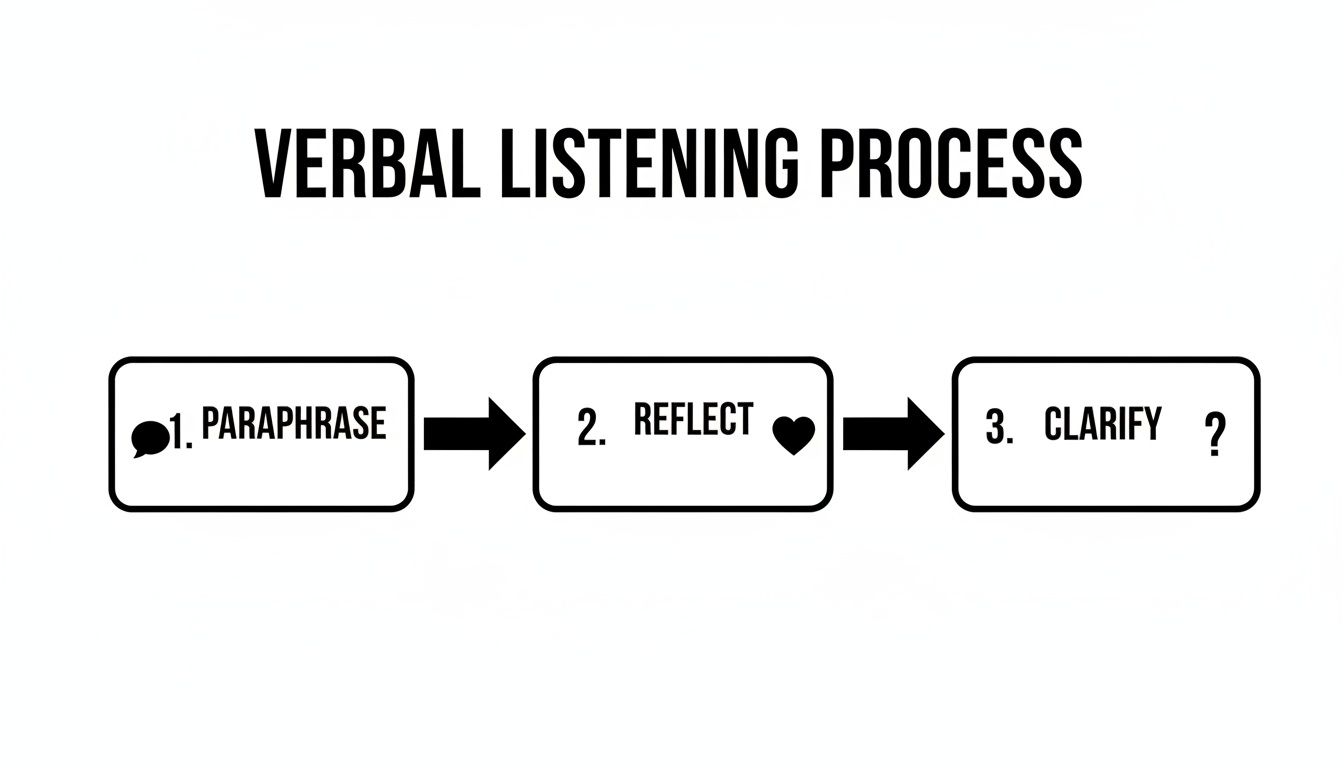
This simple flow— paraphrase the facts, reflect the feeling, and clarify the fuzzy parts—is the engine of great listening. It guarantees you’re getting the whole picture, both head and heart, before you ever think about responding.
Role-Playing Tough Conversations
Okay, this one might feel a little awkward, but it's a game-changer. Grab a willing friend or partner and practice a scenario that usually makes you defensive. The goal is to create a safe space to completely botch a conversation with zero real-world consequences.
Example Scenario: "The Messy Roommate"
• Person A (The Speaker): • You’re frustrated. The shared living space is a disaster, and you feel like you’re the only one who ever cleans. Your job is to express that frustration without pointing fingers. For example, "When I come home and see dishes in the sink, I feel really stressed out because it feels like I have more to do."
• Person B (The Listener): • Your only mission is to listen. No defending yourself, no offering solutions, no turning it around. You must paraphrase what you hear ("So you're saying the mess makes you feel anxious"), reflect their feelings ("It sounds like you're feeling overwhelmed"), and ask open-ended questions to understand more ("What would a clean space feel like for you?").
Do this for five minutes, then swap. Trust me, it’s a workout for your empathy muscles. You’re building the mental wiring to stay curious even when you feel attacked. This kind of practice is invaluable—research even shows how a manager's active listening can make employees feel more secure. You can explore more insights on this from Penn State about how active listening reduces job insecurity .
The point of these exercises isn't to win the fake argument. It's to train your brain to default to understanding instead of reacting , which is the very heart of how to improve active listening skills.
Your 30-Day Active Listening Challenge
Want to make this stuff stick for good? Try a 30-day challenge . The secret isn't a massive overhaul; it's focusing on one tiny, almost laughably easy "micro-goal" each day. This creates momentum without the overwhelm.
Here’s what your first week could look like:
• Day 1: • The • Interruption Log • . Seriously, just notice. That's it.
• Day 2: • The • No-Advice Zone • . For one entire conversation, your goal is to listen without offering a single solution unless they explicitly ask, "What do you think I should do?"
• Day 3: • • Paraphrase Power • . In a work meeting, successfully paraphrase one person's point. ("So, if I'm hearing you right, the top priority is...")
• Day 4: • • Reflect a Feeling • . With a friend or loved one, try to name an emotion you hear them express. ("Wow, that sounds incredibly frustrating.")
• Day 5: • • Ask One Great Question • . Ask a powerful, open-ended question that starts with "What..." or "How..."
• Day 6: • • Body Language Check • . In one conversation, consciously uncross your arms and lean in slightly.
• Day 7: • • Review and Reflect • . What was the hardest part of the week? The easiest? What surprised you?
By breaking it down into these daily missions, you’re not just learning a skill. You’re actively forging new neural pathways, making genuine, curious listening your new, effortless default.
Why Becoming a Better Listener Changes Everything
Let’s be honest: most of us think we're pretty good listeners. But there's a world of difference between just hearing words and truly listening to what someone is trying to tell you.
Getting good at active listening isn't just about having better chats. It's about fundamentally upgrading your relationships, your influence, and even how well you understand yourself. It’s the secret sauce for everything from calming a tense argument with your partner to finally earning that skeptical colleague’s trust.
At its heart, listening is an act of pure respect. When you give someone your full, undivided attention, you’re sending a powerful message: "You matter. Your perspective is valuable." That simple act is the bedrock of real trust.
The Ripple Effect on Trust and Teamwork
This isn’t just feel-good fluff; it has a real, measurable impact, especially at work. Think about it: research shows that a staggering 74% of employees are more engaged when they feel their leaders actually hear them out.
Great listening is also the cornerstone of building team cohesion and psychological safety , which is non-negotiable for any team that wants to do great work. You can even dig into more data on how active listening boosts workplace culture on psu.edu .
Listening isn't a passive chore. It's one of the most proactive tools you have for creating positive change in your life and in the lives of those around you.
When you make that small but crucial shift from trying to be interesting to being genuinely interested , you open the door to much deeper connections. This journey isn't just about learning a new skill; it's an investment in a more respected, connected, and influential version of yourself.
Got Questions About Active Listening? Let's Get Real.
Even when you know what to do, actually putting active listening into practice can feel clunky and unnatural at first. That's totally normal. Let's dig into some of the most common sticking points I hear from people trying to level up their listening game.
What’s the Single Biggest Mistake People Make?
Hands down, the biggest blunder is listening just to find your turn to talk.
Most of us are guilty of this. While someone else is speaking, our brain is already racing ahead, formulating a reply, scripting some genius advice, or prepping a killer counter-argument. When we do this, we're not truly listening; we're just reloading. We completely miss the subtle details, the emotional currents, and the real heart of what's being said.
The goal isn't to reply. It's to understand .
Here's a simple fix that works wonders: Make a deal with yourself to quickly paraphrase what you just heard before you even think about sharing your own perspective. For example, before you jump in with your idea in a meeting, say, "So, to make sure I'm on the same page, your main concern is the budget. Is that right?" This forces you to process their point first.
How Can I Actually Do This in a Zoom Meeting?
Great question. Virtual meetings are a whole different beast, and they require you to be even more intentional. You lose a ton of in-person body language cues, so your verbal and visual signals have to pull double duty.
• Become a digital monk. • Seriously. Close every single distracting tab and put your phone on silent, face down, and out of reach.
• Camera on is non-negotiable. • It’s the virtual equivalent of showing up. It signals you're present and invested.
• Use your words. • Since they can't see you nodding as easily, use frequent verbal signposts like, "Hang on, let me make sure I've got that right..." or "That's interesting, tell me more about that part."
• Fake your eye contact. • Don't just look at your own face. Pin the speaker's video and look at it on your screen. It helps you focus and makes them feel seen.
I'm an Introvert and This Sounds Exhausting. Help!
I hear you, and this is a fantastic point. But here's the good news: active listening isn't about becoming the most chatty, high-energy person in the room. In fact, many introverts are absolute naturals at this.
The secret is quality over quantity.
Don't feel pressured to be "on" for every single interaction. Instead, choose just one or two conversations each day where you commit to being fully present. For example, you might decide to actively listen during your one-on-one with your manager, but conserve your energy during a large group lunch. Your primary job isn't to perform; it's to understand. Let the other person do most of the talking, while you focus on those quiet non-verbal cues and short, powerful reflective statements. This way, you can build incredibly deep connections without completely wiping out your social battery.
At Enneagram Universe , we know your personality is the key to unlocking better communication. Ready to see how your Enneagram type shapes the way you listen? Take our free, in-depth assessment and start your journey at Enneagram Universe .