How to Identify Your Strengths and Unlock Your True Potential

So, you've heard it a million times: "play to your strengths." It's great advice, but it’s completely useless if you have no earthly idea what your strengths actually are. Let's cut through the fluff and create a real, practical plan for you to figure out what you're genuinely brilliant at.
This isn't just a navel-gazing exercise; it’s a game-changer for your career, relationships, and overall happiness.
Quick tip: The fastest way to get a clue is to look for patterns. What activities make you feel alive and energized? What skills did you pick up weirdly fast? What kind of problems do your friends and coworkers always bring to you? That’s where the magic is.
When you know and use your core talents, everything clicks. People who use their strengths at work are more engaged, more productive, and frankly, just happier. Don't just take my word for it—teams that focus on strengths see a whopping 12.5% greater productivity .
What's So Hard About Seeing Our Own Strengths?
If it’s so obvious, why can’t we see it? Well, we’re often way too close to the picture. We get bogged down by a few common mental roadblocks.
• The Impostor Monster: • Ever feel like a fraud, just waiting to be found out? That’s impostor syndrome, and it whispers that your wins are just luck, making it impossible to own your actual skills. For example, a talented graphic designer might dismiss praise for a brilliant logo, thinking, "I just got lucky with that idea."
• The Weakness Fixation: • From red marks on our school papers to performance reviews focused on "areas for improvement," we're trained to fix what's broken. We pour energy into our weaknesses while our true gifts gather dust. Think of a manager who spends hours trying to master complex financial modeling when her real talent lies in motivating her team.
• Talent Blindness: • This one is sneaky. Sometimes a strength is so natural, so baked into who you are, that you assume everyone can do it. You think, "Doesn't everyone find it easy to untangle a messy spreadsheet?" or "Can't anyone walk into a room of strangers and make a friend?" Nope. That’s a gift.
To get past these hurdles, you have to get to know yourself on a deeper level. It’s all about fostering self-awareness , which is the bedrock of figuring out what makes you tick.
The real journey isn’t about becoming someone new. It's about un-becoming everything that isn't really you so you can be who you were meant to be in the first place.
Think about a project manager who says her only strength is being "organized." After some real digging, she might realize her true superpower is actually creating calm out of complete chaos for her team. That's a far more potent and specific talent.
This guide will help you find those hidden gems. Let’s get started.
Become a Detective in Your Own life Story
Your past is a goldmine of clues about your natural talents, but most of us never learn how to pan for that gold. Finding your strengths isn’t about waiting for some grand, mystical revelation to strike you like lightning. It's about putting on your detective hat and getting your hands dirty.
You've got to gather evidence, look for patterns, and connect the dots in your own life story.
The best place to start is by zeroing in on moments of peak performance and genuine joy. Think back to those times when you felt completely in your element, where work didn't feel like work . You were so absorbed, so energized, you might have even lost track of time. That feeling? That's a massive clue.
Uncovering Clues with Self-Reflection
To kick off your investigation, grab a journal and really chew on these questions. Don't just noodle on them in your head—the act of writing forces a level of clarity you can't get otherwise and helps you spot the themes that keep popping up.
• When did you feel most alive? • Pinpoint a project or task where you were totally engaged. What were you • actually doing • ? Were you organizing a chaotic system, persuading a skeptical client, or dreaming up a creative fix for a stubborn problem? For example, recall the time you stayed late to map out a new workflow for your team, not because you had to, but because you genuinely enjoyed making things more efficient.
• What comes easy to you? • What do you seem to pick up way faster than other people? Maybe you can untangle a tense argument between friends without breaking a sweat, or you just • get • how new software works right out of the box. Think about how your coworker struggled for a week with the new CRM, but you had it figured out in an afternoon. We often dismiss these as "no big deal" because we assume they're easy for everyone. They aren't.
• What do people ask for your help with? • Think about it. What problems do your friends, family, or colleagues consistently bring to your doorstep? Are you the go-to person for proofreading an important email, planning the perfect party, or talking someone off a ledge during a crisis? If everyone in your department asks you to look over their presentations before the big meeting, that's a clue. Their trust is a spotlight on a reliable strength.
This simple journey is what takes you from just guessing about your abilities to taking confident action based on what you know to be true.
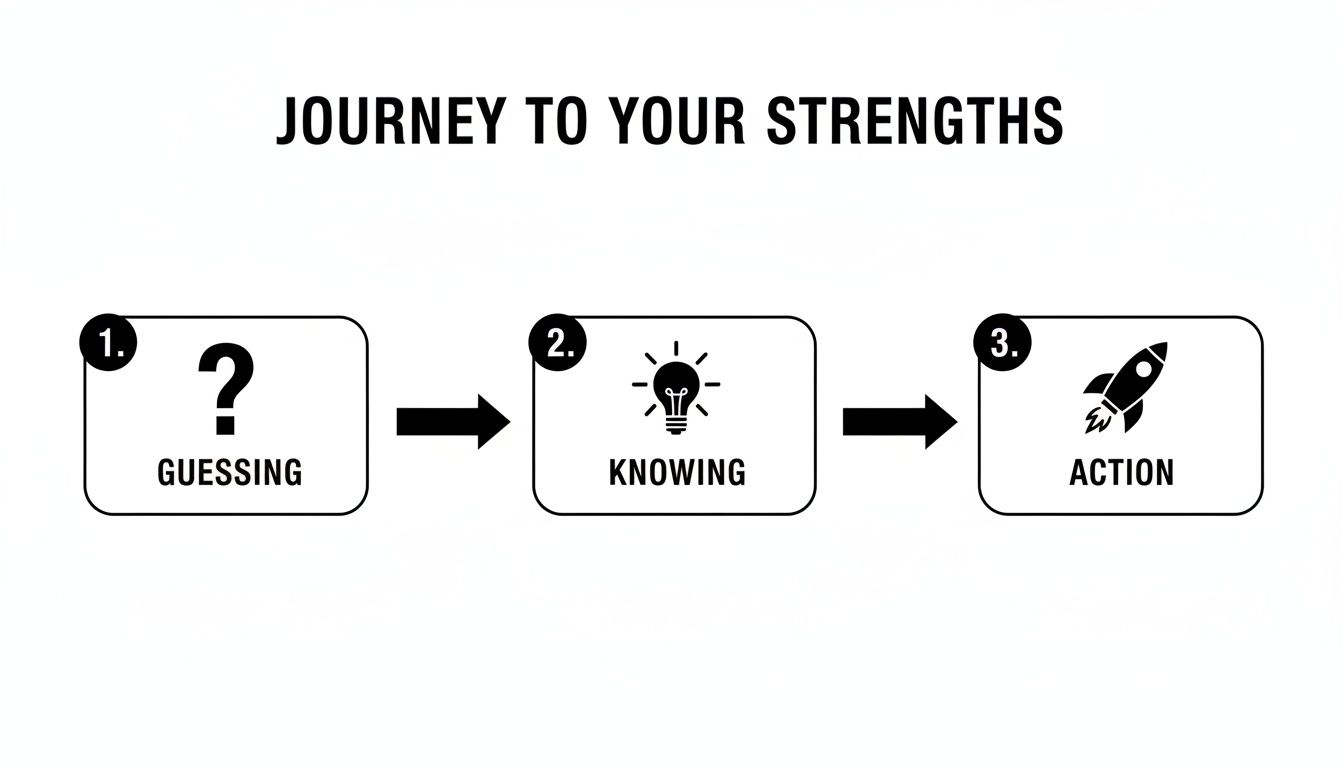
Making that leap from the fog of "Guessing" to the clarity of "Knowing" is what gives you the power to take meaningful "Action."
Conduct a Personal Energy Audit
Here’s another fantastic technique: track your energy. For a week, just pay attention to how different tasks make you feel. This "energy audit" is brutally honest—it shows you what fuels you versus what completely drains your tank.
Create a simple log in a notebook or a note on your phone. Jot down which activities leave you feeling like you could take on the world and which ones make you want to crawl under your desk.
A Quick Look at an Energy Audit:
• Energizing Tasks: • Brainstorming new campaign ideas with the team; mentoring a junior designer; organizing the project chaos in • Asana • .
• Draining Tasks: • Filling out mind-numbing expense reports; answering the same customer service emails over and over; sitting in another meeting with no clear agenda.
See the pattern? The person in this example clearly thrives on creativity, collaboration, and bringing order to chaos. The repetitive, administrative stuff drains them. This isn't a weakness; it's a giant, flashing signpost pointing directly toward their core strengths.
By analyzing these moments of flow and energy, you're doing more than just making a list of things you're good at. You are building an evidence-based case for how to identify your strengths in a way that feels real and actionable. These clues are the bedrock for everything that comes next.
Let’s Get an Outside Opinion
Self-reflection is a great start, but let's be honest: you can't read the label from inside the jar. Our self-perception is notoriously foggy, often clouded by a healthy dose of impostor syndrome or just plain old blind spots. To get the full, high-definition picture of what you're truly good at, you need to see yourself through other people's eyes.
It’s time to call in some detectives.

This part can feel a little squirmy, I get it. But it doesn't have to be a big, awkward deal. The secret is asking the right kinds of questions. If you just ask, "What am I good at?" you'll likely get a sweet but useless compliment like, "You're just... so great!" We need specifics, not platitudes.
How to Get Feedback That’s Actually Useful
Your mission here is to collect stories, not just praise. Think of a few people you trust—mentors, colleagues, even close friends—who have seen you at your best and won't just blow smoke.
Here’s a simple, low-anxiety script you can totally steal:
"Hey [Name], I'm doing a little personal development work to get a better handle on my strengths. I'd love your perspective for a second. Can you think of a time when you saw me at my best, or when I handled a situation really effectively? "
This question is pure gold. Why? Because it prompts them to recall a specific memory and describe what you did . Their answers will unearth strengths you’d never spot on your own.
A former manager might bring up that time you defused a tense client situation by staying calm and finding common ground, revealing a hidden talent for diplomacy. A friend might laugh about how you masterfully organized that chaotic group vacation, booking flights and coordinating schedules for ten people, highlighting your logistical wizardry. These little stories are the clues you're looking for.
Dig for Treasure in Your Performance Reviews
Another fantastic source of intel is probably collecting digital dust in a folder somewhere: your old performance reviews. Seriously, go look. Ignore the boring numerical ratings and hunt for the written comments from your managers and peers.
You're looking for patterns.
• Did your boss consistently mention your knack for "making complicated ideas easy for clients to understand"? That’s a powerful communication strength.
• Did a teammate once write that you "always seem to know what the project needs before anyone else asks"? Hello, foresight and empathy!
• Maybe multiple people noted you "bring a contagious energy to meetings." That's not just fluff; the ability to boost morale is a huge and often undervalued asset.
Gather these golden nuggets of feedback and the stories from your trusted circle into one place. Create a document and call it your "Strengths Dossier" or something equally official-sounding. This isn't about ego; it's about evidence. It's your secret weapon for the next time that little voice of self-doubt starts whispering nonsense.
Frameworks like the Enneagram can provide a fantastic lens for making sense of all this feedback. In fact, it's become a go-to for personal discovery, with nearly 88% of users saying that understanding their type has significantly improved their relationships at work and at home. It helps connect the dots between what people see in you and why you operate that way. To get started, you can explore our guide on how to take a free Enneagram test and see what it reveals.
Using Personality Frameworks to Connect the Dots
Okay, so you’ve done the hard work. You’ve sifted through performance reviews, bugged your friends for feedback, and maybe even have a journal full of reflections. You’re holding a bunch of puzzle pieces, but the final picture? It's still a bit blurry.
This is exactly where personality frameworks, especially the Enneagram, come in to save the day. They’re not about shoving you into a box; they’re about giving you the blueprint to the box you’re already in.
Think of it this way: The Enneagram helps you understand the why behind your what. It goes beyond surface-level behaviors to uncover your core motivations—the deep-seated desires and fears that quietly run the show.
This shift in perspective is everything. Instead of just saying, "I'm good at organizing projects," you start to understand, "My Type One drive for order and 'rightness' makes me a natural at turning chaos into a clean, actionable plan." See the difference? Your talents stop feeling like random quirks and start feeling like authentic expressions of who you are.
Your Enneagram Type as a Strengths Decoder
Once you have a solid idea of your Enneagram type, a whole new level of clarity opens up. Each of the nine types operates from a unique motivational engine, which gives rise to a very specific set of gifts.
For example, a Type 8 is driven by a powerful need to protect themselves and control their own destiny. It’s no surprise, then, that they often excel at decisive leadership, championing their team, and cutting through the noise to get things done. Meanwhile, a Type 5 is motivated by a desire to be competent and capable, so they naturally become masters of deep-dive analysis, objective observation, and untangling complex systems.
The goal isn’t to slap a label on yourself—it’s to find the language that finally fits. Knowing your type helps you articulate your value in a way that feels true, quieting that nagging voice of imposter syndrome that whispers, "Oh, anyone can do that."
It's also fascinating to look at the bigger picture. Data from a platform with over 1,400,000 assessment results gives us a peek into how different Enneagram types show up across the globe. Understanding these patterns, like those found in global Enneagram statistics , helps coaches and leaders appreciate the incredible diversity of strengths available on any given team.
Strengths Across the Enneagram Types
So, how does this actually look in the real world? Let’s get practical.
The table below gives you a snapshot of the core strengths tied to each Enneagram type, along with a concrete example of how that strength might shine in a professional setting. If you’re still trying to pin down your type, our step-by-step guide for beginners on how to find your Enneagram type is a great place to start.
| Enneagram Type | Core Strength | Example in Action |
|---|---|---|
| Type 1 The Reformer | Principled Improvement | The person who catches the critical error in the report before it goes to the client, constantly refining processes to meet the highest standards. |
| Type 2 The Helper | Supportive Connection | The account manager who remembers a client’s birthday and masterfully anticipates their needs, building unshakable loyalty. |
| Type 3 The Achiever | Ambitious Execution | The project lead who smashes every deadline and knows exactly how to rally the team to cross the finish line with energy to spare. |
| Type 4 The Individualist | Creative Authenticity | The marketing creative who infuses a brand campaign with a unique voice and emotional depth that truly connects with the audience. |
| Type 5 The Investigator | Expert Analysis | The analyst who becomes the company’s go-to expert on a complex new software, providing calm, well-reasoned insights when everyone else is panicking. |
| Type 6 The Loyalist | Pragmatic Foresight | The operations manager who thinks of every possible worst-case scenario and creates a bulletproof contingency plan, saving the team from disaster. |
| Type 7 The Enthusiast | Optimistic Vision | The team member who keeps morale high during a tough project and generates a dozen brilliant, out-of-the-box ideas in a single brainstorming session. |
| Type 8 The Challenger | Decisive Leadership | The leader who takes charge in a crisis, advocates fiercely for their team’s resources, and makes the tough calls with unwavering confidence. |
| Type 9 The Peacemaker | Collaborative Harmony | The mediator who can calmly listen to all sides of a heated debate and guide the group toward a consensus that everyone can feel good about. |
Ultimately, a framework like the Enneagram helps you weave all your self-discovery into a story that makes sense.
It helps you see that your knack for planning the perfect party ( Type 7 ), your obsession with getting the details just right ( Type 1 ), or your uncanny ability to de-escalate an angry customer ( Type 9 ) aren't just random personality traits. They are powerful, valuable strengths—and they’re wired directly into your core.
Putting Your Strengths into Action Every Day
Alright, you've done the hard work of digging deep and figuring out what you're truly great at. That's a huge step. But knowing your strengths is like having a sports car in the garage—it's cool, but it's not actually getting you anywhere until you take it out for a spin.
The real magic happens when you move from self-awareness to deliberate action. This is where you start weaving your unique talents into the fabric of your everyday life, making your work not just more effective, but a whole lot more fun.
This all starts with a little game I like to call "strength-spotting." It's simple: as you go through your day, actively look for opportunities to flex those superpower muscles. Instead of just tackling your to-do list, scan it for chances to shine.

You don’t have to quit your job or make some dramatic pivot. In fact, the most powerful changes often happen right where you are.
• Maybe you're an accountant who discovers a hidden talent for teaching. You could volunteer to onboard the new junior hires, turning a routine task into a chance to mentor.
• Or perhaps you're a marketing manager who realizes you have a real knack for data analysis. You could take the lead on digging into campaign reports, finding insights no one else sees.
When you intentionally reshape your current responsibilities around your talents, you start to craft a job that truly fits you . It’s a small shift that can have a massive impact on your energy and satisfaction at work.
Crafting Your Strength Development Plan
To make this stick, you need a plan. Don’t worry, this isn’t some stuffy corporate document. Think of a Strength Development Plan as your personal roadmap for growth—a simple tool to set clear goals, get the right support, and actually see your progress.
This kind of structured approach is catching on in the business world for good reason. A 2018 study revealed that a whopping 75% of Fortune 500 companies use personality assessments to help manage their talent. When used correctly, frameworks like the Enneagram are brilliant for matching people to roles where they’ll not only succeed but thrive.
Here’s a dead-simple template to get the ball rolling:
| Plan Component | What to Do |
|---|---|
| Identified Strength | Name the talent you want to grow. (e.g., "Bringing collaborative harmony to tense meetings"). |
| Application Goal | Set a tiny, specific, and measurable goal. (e.g., "Volunteer to facilitate one team meeting this month"). |
| Needed Support | Figure out who or what can help. (e.g., "Ask my manager for the opportunity" or "Read an article on facilitation"). |
| Progress Tracker | Define what success looks like. (e.g., "The meeting ended with clear action items and way less confusion"). |
If you want to go a little deeper, we've got you covered. Check out our guide on creating a personal development plan template . You can make your own.
Articulating Your Value with Confidence
Once you're consistently using your strengths, the final piece of the puzzle is learning how to talk about them. This is absolutely critical for performance reviews, networking events, and, of course, job interviews. You need to be able to tell compelling stories that show people what you bring to the table.
A fantastic way to structure these stories is to learn how to use the STAR method in interviews . This simple technique helps you walk someone through a S ituation, the T ask you faced, the A ction you took (hello, strength!), and the awesome R esult you delivered.
When you turn self-knowledge into daily practice and confident communication, you've completed the journey. You're no longer just someone who knows their strengths—you're someone who uses them to build a more successful and deeply fulfilling career.
Got Questions? Let's Talk It Out.
You're on the path to figuring out what makes you tick, but it's totally normal to hit a few bumps or have questions bubble up. Let's tackle some of the most common ones that come up when you start digging into your personal strengths.
"Help! My Strengths Don't Fit My Job At All."
First off, take a breath. This isn't a disaster; it's a discovery. What you've just found is a major clue about your future career path. But you don't have to quit your job tomorrow.
Think of it as "job crafting." Look for small, sneaky ways to inject your real talents into your current role.
Let's say you're a data-entry wizard who just discovered a flair for creative strategy. You could:
• Volunteer to join a brainstorming session for a new project.
• Propose a more creative—and efficient—way to organize the data you're working on.
• Offer to help design the slides for the next team presentation.
These small moves help you build experience and make your day-to-day more satisfying. If the gap between your strengths and your job feels more like a canyon, that’s okay too. This newfound awareness is your compass, pointing you toward a career where you can really shine.
"Will My Strengths Change As I Get Older?"
You bet. While your core motivations—the kind of deep-seated stuff the Enneagram points to—tend to stay pretty stable, the strengths you build on top of them absolutely evolve.
Think of your core personality as the foundation of a house. That foundation is set, but you can always add a new wing, renovate the kitchen, or build a killer deck.
For instance, many of us aren't born loving public speaking. In fact, for many American professionals, it's a huge source of anxiety. But with practice and experience, it can absolutely become a powerful, well-honed strength. Personal growth is all about polishing the strengths you have and uncovering new ones you never knew were there.
The Enneagram is unique because it uncovers your core motivation—the 'why' you do what you do. It gets to the heart of your deepest fears and desires, providing a richer context for your strengths.
Most personality tests are pretty good at telling you what you do. The Enneagram goes a layer deeper. It explains that a Type 2 's helpfulness stems from a core need to be loved and needed, which is a far more powerful insight than just slapping on a "helpful" label. When you understand your core drivers, you can grow in a way that feels authentic, not forced.
Ready to stop guessing what you're good at and actually know ? It all starts with a clear, accurate look in the mirror.
Take the free, scientifically validated personality test from Enneagram Universe today to uncover your core motivations. It’s time to start your journey of self-discovery.