How to Identify Limiting Beliefs and Reshape Your Reality?

Ever feel like you’re trying to drive with the emergency brake on? You’re hitting the gas, you know where you want to go, but something invisible is holding you back.
That, right there, is the classic feeling of a limiting belief at work. These aren't just fleeting negative thoughts. They are the deep, ingrained rules you’ve accidentally written for yourself about who you are, what you deserve, and what’s possible. They feel like unshakeable truths, and they run your life on autopilot more than you’d ever guess.
Spotting these invisible barriers is the first real step toward taking back the wheel. It starts with learning to recognize their sneaky disguises in your everyday thoughts and actions.
The Sneaky Disguises of Limiting Beliefs
Limiting beliefs rarely walk up and introduce themselves. They’re masters of camouflage, showing up as perfectly reasonable excuses, persistent habits, or nagging feelings.
Think about a talented colleague who keeps turning down promotions. On the surface, she says, "I just need a bit more experience before I'm ready for that." It sounds logical. But dig a little deeper, and you might find the real driver: a core belief that says, "I'm a fraud, and if I take that job, everyone will finally figure it out."
Her choice isn't based on her actual skills—it's dictated entirely by that hidden script.

So, what does this look like in the wild? Here are a few of the most common costumes these beliefs wear:
• Chronic Procrastination: • The excuse is "I'll do it tomorrow," but the belief is often "I'm going to fail, so why even start?" For example, a man named David wants to start his own landscaping business but spends months just "researching" because he secretly believes his business plan isn't good enough.
• Crippling Perfectionism: • You're not just aiming for high standards. You're operating from a belief that says, "Anything less than flawless is proof that I'm not good enough." A student named Maria might rewrite the first page of her term paper ten times, convinced that a single awkward sentence means she's a terrible writer.
• Self-Sabotage: • You might pick a fight with your partner right when things are going great because a deep-seated belief whispers, "I'm not worthy of love, and this will end eventually anyway." A person might finally meet a wonderful partner but find themselves nitpicking small flaws or creating drama, pushing them away to prove the belief true.
Sometimes, just seeing these patterns laid out can trigger a lightbulb moment. This little table connects some common thoughts to the beliefs they might be hiding.
Quick Guide to Uncovering Your Limiting Beliefs
Use this table to connect common feelings or excuses to the potential underlying belief and see how it might appear in your actions.
| Common Thought or Feeling | Potential Underlying Limiting Belief | Behavioral Sign |
|---|---|---|
| "I'm not ready for that yet." | "I am an imposter and don't have what it takes." | Passing on opportunities, downplaying your skills. |
| "I'll just do it later." | "My best effort won't be good enough, so it's safer not to try." | Missing deadlines, avoiding important tasks. |
| "It has to be perfect." | "My worth is tied to my performance; mistakes are unacceptable." | Agonizing over small details, never feeling "done." |
| "Why bother? It won't work out." | "I am destined to fail, and nothing I do can change that." | Giving up easily, having a pessimistic outlook. |
Seeing your own patterns in a chart like this can feel a bit exposing, but it’s also incredibly empowering. You can't change what you can't see.
This first phase is all about observation without judgment. Think of yourself as a detective gathering clues. You’re simply noticing the patterns in your language and behavior. It's a fundamental practice of how to become more self-aware , which is the bedrock of any real personal growth.
By spotting these patterns, you’re finally shining a light on what’s been holding you back. And from here, you can start to rewrite the script.
Becoming a Detective for Your Inner Dialogue
Your mind is like a 24/7 radio station, constantly broadcasting commentary. But have you ever actually tuned in to check what's on the air? It's all too easy to let our thoughts run on autopilot, assuming everything they say is gospel truth. In reality, most of what we hear is just a playlist of well-worn mental habits. This is where the fun begins—it’s time to put on your detective hat and start investigating your own inner dialogue.

The brain is wired for efficiency, which is why it absolutely loves creating shortcuts and loops. Every time you repeat a negative idea—like "I always mess things up"—you’re carving a tiny groove in your mind. Do it enough, and that groove deepens into a canyon, making the thought feel less like an opinion and more like a fundamental law of your personal universe.
This isn't just a metaphor. Research from the National Science Foundation suggests the average person has around 50,000 thoughts per day . Here's the kicker: a staggering 95% of them are the same thoughts we had yesterday. These repetitive thought patterns are the bedrock of our self-imposed limits, which makes learning to listen in absolutely essential.
Starting Your Thought Audit
So, how do you become a thought detective? You start by conducting a simple "thought audit." This isn't about judging yourself or trying to fix anything just yet. Think of it as a mindfulness exercise with a mission: to simply monitor your mental chatter and spot the recurring themes.
Grab a notebook or open a notes app on your phone. For the next day or two, just listen. What are the go-to phrases that pop into your head when you're stressed, facing a tough decision, or even just daydreaming about your goals? For example, every time you think about applying for a new job, does the phrase "I'm not qualified enough" immediately appear? Write it down. The idea is to catch these thoughts in the wild before your brain automatically rubber-stamps them as truth.
Sometimes, these thoughts are tangled up with intense emotional patterns. Understanding concepts like Rejection Sensitive Dysphoria (RSD), for example, can illuminate why certain beliefs feel so painfully real. These intense reactions often turn up the volume on our inner critic, making a thought audit even more revealing.
Common Phrases to Listen For
As you begin your audit, you’ll start to notice certain types of thoughts show up again and again. These are your prime suspects. You're looking for language that's absolute, overly critical, or just plain dismissive of what you're capable of.
Here are a few classic examples to keep an ear out for:
• "I'm just not a numbers person." (Often said by someone who avoids looking at their budget.)
• "It's way too late for me to start a new career." (Heard from a 40-year-old accountant who dreams of being a chef.)
• "I could never be that confident." (Thought by someone watching a colleague give a presentation.)
• "Successful people don't look like me." (A common barrier for people from underrepresented backgrounds.)
• "I am terrible with money." (The automatic thought after buying a coffee.)
Take, for instance, a talented graphic designer I once knew who was convinced, "I'm not a real artist because I need client briefs to be creative." By catching that thought every time it popped up, he was able to start asking questions. Is that really true? Or is it just a convenient story he's been telling himself for years? This simple act of noticing is the first step. It shifts your entire perspective from being a prisoner of your thoughts to being a curious observer of them.
Practical Exercises to Expose Hidden Beliefs
Alright, you've been doing the quiet work of listening to that inner chatter. Now it’s time to switch from passive observation to active interrogation. This is where we roll up our sleeves and drag those sneaky, subconscious beliefs out into the open using two of my favorite, battle-tested techniques: the Thought Record and Evidence Testing .
These aren't just abstract concepts; they are concrete, structured tools you can start using tonight . They’re designed to help you slice through the vague fog of feelings and examine your beliefs with the sharp clarity of a scientist.
Let’s get into the first one.
Using a Thought Record to Untangle Your Mind
A Thought Record is a game-changing tool from the world of cognitive-behavioral therapy (CBT). Think of it as a slow-motion replay for your mind. It forces you to stop, take a breath, and break down what actually happens when you get triggered, separating the event from the story you tell yourself about it.
It’s a simple but profound way to challenge those gut-punch emotional reactions and question the narratives that run on autopilot. Here’s a classic layout—it gives you a perfect template to start with.
This visual breaks it down beautifully: the situation, the automatic thought, the resulting emotion, and then—most importantly—a space for a more balanced, alternative thought. Filling this out creates a crucial pause between a trigger and your usual reaction. That tiny gap is where all the magic happens.
Let's walk through what this looks like in the real world.
Example: A Thought Record in Action
Imagine an entrepreneur, Mark, who just launched a new product. He’s been working on it for months, and after the first week, the sales numbers are, to put it mildly, disappointing.
• The Situation: • "My new product launch only made a handful of sales in its first week." (This is just a fact. No drama yet.)
• Automatic Negative Thought (ANT): • "This is a complete disaster. I knew I didn't have what it takes. I'm a total failure, and everyone who invested in me is about to find out."
• Emotions & Intensity: • Shame ( • 9/10 • ), Anxiety ( • 8/10 • ), Defeat ( • 9/10 • ). (Notice how the • thought • creates the emotion, not the situation itself.)
• Balanced, Alternative Thought: • "Okay, the launch was way slower than I hoped, but calling it a 'total failure' is a huge leap. Early sales data is just feedback, not a final verdict on my worth. This is information. I can use it to tweak my marketing, or better yet, I can call the first few customers and find out what could be better."
See that shift? Mark didn't have to pretend the low sales were great news. He just untangled the objective fact (slow sales) from the crushing emotional story ("I'm a failure"). This simple act creates breathing room and moves him from a shame spiral into a problem-solving mindset.
Putting Your Beliefs on Trial with Evidence Testing
If a Thought Record is like replaying the tape, Evidence Testing is like putting your belief on the witness stand in a courtroom. You play the part of both the prosecution and the defense, and you’re only allowed to present cold, hard facts.
Let’s put Mark’s big, scary belief on trial: "I'm a total failure."
Evidence FOR the Belief (The Prosecution’s Case):
• "The initial sales for this current launch were very low."
• "A project I worked on two years ago also missed its financial targets."
(The prosecution's case is often surprisingly short when you stick to the facts!)
Evidence AGAINST the Belief (The Defense’s Case):
• "I successfully built and launched two other profitable products before this one."
• "I managed to secure investor funding based on my business plan and my track record."
• "My mentors, who are successful in their own right, have consistently praised my resilience and vision."
• "Failure is a normal part of the entrepreneurial process. Some of the most successful founders I admire had major flops before they hit it big."
When you lay it all out like this, the verdict is usually crystal clear. The evidence against the belief is far more compelling and substantial. The sweeping statement "I'm a total failure" simply can't hold up under factual scrutiny. It gets exposed for what it is: a feeling, not a fact.
If you want to go even deeper with this kind of self-inquiry, using a few targeted personal growth journal prompts can be a fantastic way to explore where these beliefs first took root.
Using the Enneagram as a Shortcut to Your Subconscious
What if you had a roadmap that led directly to your most stubborn limiting beliefs? That's the power of the Enneagram. It's less of a personality test and more of a dynamic map of the mind, showing how your type's core fear often creates a very specific, very sneaky belief that runs the show from behind the scenes.
This isn't just a random connection; it's a predictable pattern. If you're just dipping your toes into this world, our guide on how to find your Enneagram type is the perfect place to start. Once you have a sense of your type, you can start decoding the stories you’ve been telling yourself for years.
Your Type's Default Story
Every Enneagram type is wired with a core fear, and from that fear, a powerful limiting belief is often born. This belief becomes the quiet architect of your choices, shaping everything from your career path to who you let into your life.
Let's see how this plays out in real life:
• Type Two (The Helper): • Their biggest fear is being unwanted. This often blossoms into the belief, • "To be worthy of love, I must be completely indispensable." • For example, a mother and community volunteer, let's call her Brenda, constantly says "yes" to every bake sale, carpool, and favor, convinced that if she ever says "no," her friendships and family role will simply dissolve.
• Type Six (The Loyalist): • Haunted by a fear of being without support, Sixes can get stuck in the loop of, • "I can't trust myself, so I need to find certainty outside of me." • This looks like a project manager named Kevin who, before making any decision, needs to consult three senior colleagues, his spouse, and a trusted mentor, paralyzed by the fear of making the "wrong" choice alone.
• Type Nine (The Peacemaker): • Because they dread conflict and disconnection, Nines can start to believe that • "My own presence doesn't really matter, so my job is to blend in and keep the peace." • For instance, when a group of friends is deciding where to eat, a Nine will say "I'm fine with anything!" even if they're craving pizza and hate sushi, just to avoid any potential disagreement.
If these sound familiar, it's because they tap into a near-universal feeling of "not-enoughness." It’s a huge part of the human experience—in fact, some studies show that as many as 85% of people grapple with low self-esteem. It's a powerful reminder of why understanding the crucial role of your relationship with yourself is the bedrock of personal growth.
This is the feedback loop that keeps these beliefs alive. A situation triggers the old thought, and our brain immediately goes on a mission to find "proof" that it's true.
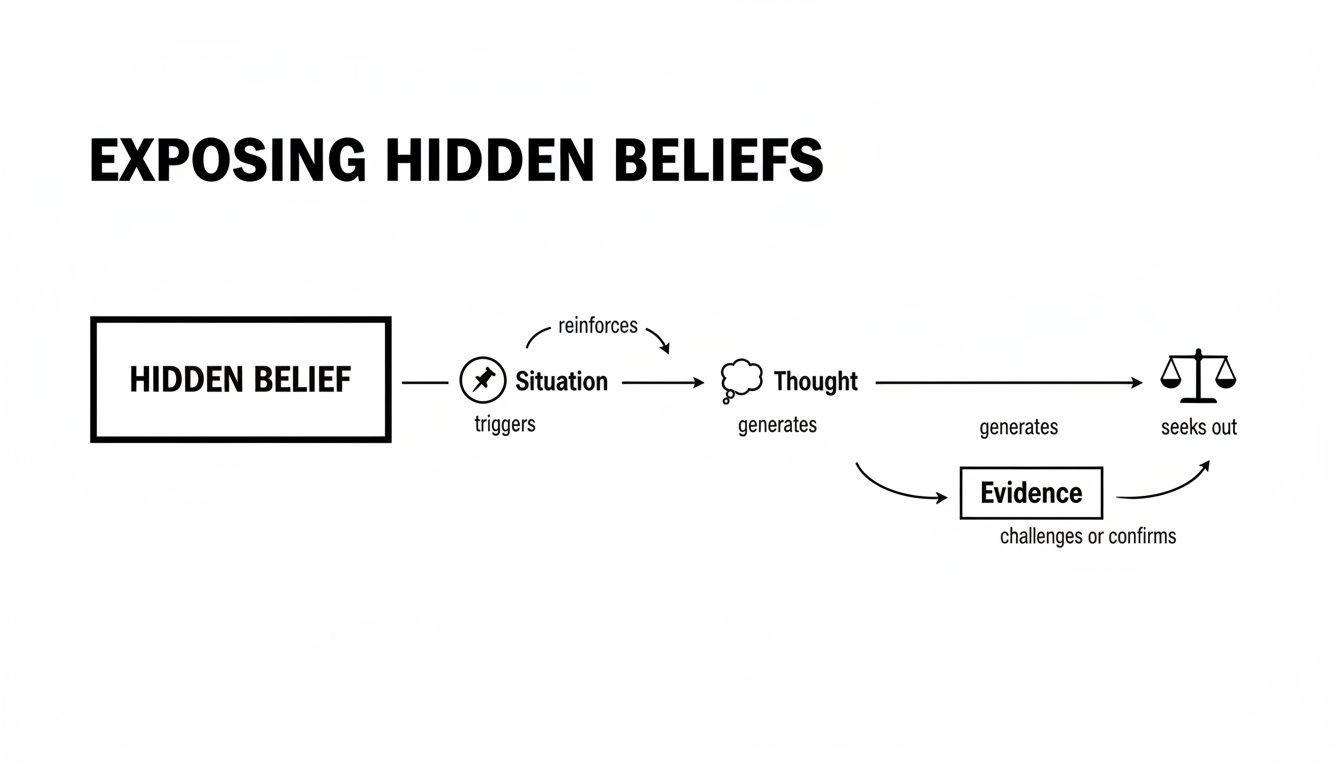
What this shows is that our beliefs aren't just passive thoughts. They're active filters. They literally change what we see, making us lock onto anything that confirms what we already suspect about ourselves.
Prompts to Get You Started
Ready to start digging? Grab a journal and spend a few minutes with the question that matches your Enneagram type. No need to write a novel—just see what comes up.
Think of your Enneagram type not as a box to put you in, but as the key to get you out of one. It shines a spotlight directly on the invisible rules you've been living by, giving you a powerful head start on identifying the exact limiting beliefs that are yours and yours alone.
Alright, let's talk about what happens when this whole "find your limiting beliefs" thing gets messy. Because it will. This work isn't a neat, straight line—it’s a winding, sometimes frustrating, path. It's completely normal to hit a wall, feel like you're going backwards, or just get overwhelmed.
This is your game plan for when the going gets tough and you feel totally stuck.
The second you start poking at a belief you've held for years, your brain might sound all the alarms. This is actually a good thing! That resistance means you’re getting close to something really important. Instead of pushing back, let’s get curious about what that resistance is trying to protect.
What if I Can't Find Any Limiting Beliefs?
So you've been doing the exercises, you're journaling, you're trying to dig deep and... crickets. It can feel like you're doing something wrong, but I promise, you're not. This usually just means your limiting beliefs are so deeply embedded they don't feel like beliefs at all—they feel like undisputed facts.
When you hit this point, change your strategy. Stop hunting for a big, dramatic "belief" and start looking for the friction points in your daily life.
• Where do you consistently feel that flash of frustration or a slow burn of resentment? For example, do you feel a pang of annoyance every time a certain coworker is praised?
• What dreams have you quietly shelved, telling yourself they were "unrealistic"? Did you want to be a musician but decided you "didn't have the talent" without ever really trying?
• When someone gives you a compliment, what's your immediate impulse? Do you brush it off? If someone says, "Great job on the presentation!" do you immediately reply, "Oh, it was nothing, I messed up slide 10"?
These little moments of tension are the breadcrumbs. For instance, you notice you feel that knot of resentment every time your boss asks you to take on yet another project. Following that trail might lead you straight to a hidden belief like, "I have to be helpful to be valued, so I can't ever say no." See how that works?
When a Belief Feels Too True to Challenge
Sometimes, you’ll uncover a belief, and it feels so undeniably true that challenging it seems delusional. You might identify, "I'm just terrible with money," and your brain immediately fires back, "BUT IT'S TRUE! Look at your credit card statement!"
This is where self-compassion is your absolute best friend.
Instead of fighting that belief head-on, just soften the language. What if you shifted from "I'm bad with money" to "I haven't quite mastered the skills for managing money yet"? A practical example: instead of seeing a high credit card bill as proof of being "bad," you see it as a data point indicating you need to learn a specific skill, like creating a budget in a spreadsheet. That tiny change is huge. It moves you from a fixed, permanent identity ("I am bad") to a temporary state of learning ("I haven't learned yet"), which immediately gives you room to breathe and grow.
Handling the Emotional Fallout
Pulling one of these beliefs out into the light can unleash a tidal wave of emotions—shame, anger, grief, you name it. This is a totally normal part of the process. It means you’re touching on a story that has shaped you in a profound way. The trick is to not get swept away by the current.
When an old wound gets poked, your job isn't to fix it on the spot. It's just to sit with it for a moment. Acknowledge the feeling without judgment: "Wow, a lot of shame is coming up for me right now. That makes sense, given how long I've believed this." Simply naming the emotion can strip it of so much of its power.
Feeling stuck is a universal experience, whether you're working on your inner world or a creative project. The same principles that apply here can be used for overcoming writer's block . It’s all about being gentle with yourself, staying curious, and taking one tiny, manageable step forward.
From "Aha!" to Action: Making Your New Beliefs Stick
So, you’ve done it. You’ve peered into the messy, noisy attic of your mind, found those dusty old limiting beliefs, and dragged them out into the light. Give yourself a serious pat on the back—that’s the hardest part for most people.
But now what? An "aha!" moment feels great, but it won't pay the bills or get you that promotion. Awareness is just the starting line. The real, life-changing work happens when you take that awareness and turn it into deliberate, consistent action. This is how we make the new reality stick.
And let's be clear: this isn't about slapping some "good vibes only" sticker over a deep-seated fear. That's like painting over rust—it looks good for a week, and then it all flakes off. We're not just covering up the old belief; we're building a brand new, sturdier foundation, one brick at a time.
First, Write Your New Story
Before you can build, you need a blueprint. What, exactly, do you want to believe instead?
Here’s where most people trip up. If your old belief is, "I'm terrible with public speaking," your first instinct might be to declare, "I'm an amazing, world-class speaker!" It’s a nice thought, but your brain will immediately call shenanigans. It feels fake, and your mind will reject it outright.
The trick is to be gentle and, above all, believable . Try something like, "I am capable of learning and improving my public speaking skills." See the difference? It feels true, and it puts the power back in your hands.
This new belief is your new North Star. Write it down. Put it on a sticky note on your mirror. Make it your phone’s wallpaper. Your mission is to make this new thought more familiar and comfortable than the old, worn-out one.
• Own it: • Start with "I am..." to put yourself in the driver's seat.
• Live it now: • Frame it in the present tense, as if it’s already happening.
• Focus on the doing: • Center it on a process you can actually control.
Now, Go on an Evidence Hunt
Your brain is a confirmation machine. For years, it’s been diligently collecting "proof" that your limiting belief is true. Our new job is to give it a new assignment: become a detective for your new belief.
You are now officially on the hunt for any shred of evidence that proves your new, empowering belief is the real story.
Let's imagine a young professional, Sarah, who has always believed, "I'm not a leader." It's held her back for years. She reframes it to, "I am developing my leadership skills every day." Then, she starts an "evidence log" in a simple notebook:
• Monday: • A junior colleague was stuck and asked for my help. I actually knew the answer and explained it clearly. • That felt like leadership.
• Wednesday: • I had an idea in the team meeting and, instead of staying quiet, I actually said it out loud. The team is going to try it! • That felt like influence.
• Friday: • I managed to get the entire team to agree on a time and place for a happy hour. It was like herding cats, but I did it. • That's organizational skill.
This isn't about ego. It's about data collection. You are building a rock-solid case file to present to the biggest skeptic of all: your own brain.
And this isn't just fluffy self-help, either. The results are real. A study in the Journal of Applied Psychology found that employees who actively worked on these beliefs saw a 23% increase in job performance . You can dive deeper into the science of how overcoming limiting beliefs directly impacts your life and see for yourself.
By consciously gathering this new proof, you're not just wishing for change. You're engineering it, one small win at a time.
Ready to uncover the specific map your personality uses to create these beliefs? Enneagram Universe offers a free, in-depth personality assessment to help you pinpoint your core motivations and fears. Start your journey of self-discovery and turn awareness into action today. Take our free Enneagram test .