How to Identify High-Potential Employees: A Practical Guide for HR & Managers

So, you want to spot the future leaders hiding in plain sight within your company? It's a common goal, but one that trips up a lot of managers. The first, and most important, step is to stop thinking in clichés. Forget the "rockstars" and "A-players." To find genuine high-potential employees, you need a clear, tailored blueprint for what "potential" actually means for your business.
This isn't about just rewarding your top performers. It's about identifying the people who have the right combination of drive, smarts, and dedication to tackle the next challenge, and the one after that.
What a High-Potential Employee
Actually
Looks Like
Before you can launch a search party for your next-gen leaders, you need a map. That map is your "High-Potential Profile," and it’s built on three core pillars that separate the good from the truly great.
Think of these as the essential ingredients for long-term success.
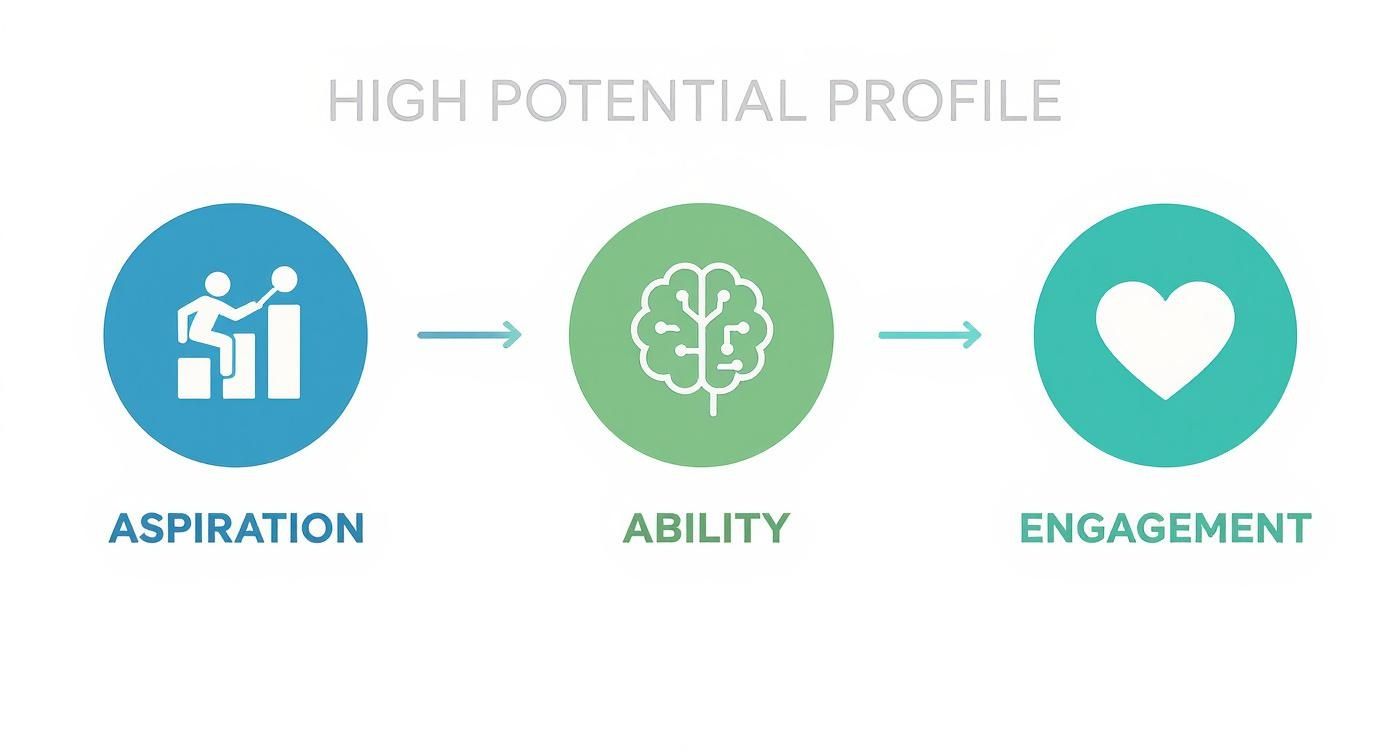
When you see these three qualities working together, you're looking at someone with serious growth potential.
The Three Pillars of Potential
Let's get real about what these pillars look like on the ground:
• Aspiration: • This is that fire in the belly. It’s the person who’s always raising their hand for the tough assignments, asking "what's next?" and showing a genuine hunger to grow. They don't just want a title; they want to make a bigger impact. • Example: • An analyst, Maria, doesn't just complete her reports; she proactively schedules meetings with department heads to understand how her data can better inform their strategy, signaling her desire to influence business outcomes, not just describe them.
• Ability: • This is more than just being good at their current job. It's about raw talent—the horsepower to grasp complex ideas quickly, think strategically, and solve problems that don't have a playbook. They're the ones who connect dots others don't even see. If you're curious about digging deeper into this, we have a great guide on • how to find your strengths • .
• Engagement: • True engagement is a deep, personal connection to the company's mission. These folks act like owners. They're your biggest cheerleaders, they live the company values, and their commitment is contagious. • Example: • When the company launches a new sustainability initiative, a junior developer, Kevin, voluntarily organizes a "green code" workshop for his peers, showing his personal commitment to company values beyond his job description.
High Performer vs. High Potential: A Quick Comparison
It's easy to confuse someone who is crushing their current role with someone who has the potential to lead. They are not the same thing. This table breaks down the crucial differences.
| Characteristic | High Performer | High Potential Employee |
|---|---|---|
| Focus | Excels within their defined role and responsibilities. | Looks beyond their current role for broader business impact. |
| Contribution | Delivers outstanding results and meets goals consistently. | Elevates the performance of those around them. |
| Ambition | Values recognition and mastery in their current function. | Shows a clear desire for leadership and greater challenges. |
| Learning | Becomes an expert in their current skill set. | Learns new skills rapidly and applies them across different areas. |
| Thinking | Is a reliable problem-solver for known issues. | Anticipates future problems and thinks strategically. |
Recognizing this distinction is the key. While you absolutely want to keep your high performers happy, your high-potential employees are the ones you need to invest in for future growth.
Define What Potential Means for
Your
Company
The secret sauce is customizing this framework. The weight you give each pillar should reflect your unique culture and industry.
A scrappy tech startup in Austin, for instance, might prize Ability above all else. They need people who can pivot on a dime and learn new technologies overnight. Their profile for a future leader would be skewed towards learning agility and creative problem-solving.
On the other hand, a legacy manufacturing firm in Detroit might put more emphasis on Engagement and long-term commitment. Their ideal leader is someone deeply invested in process, safety, and mentoring the next generation on the factory floor.
A high-potential employee isn't just great at their job. They're the ones who show the unmistakable DNA to be great at the next job, and the one after that.
Take the time to define what these pillars mean for you. By creating this tailored blueprint first, you'll have a much clearer, more reliable way to spot the people who will truly drive your business into the future.
Why a Formal Identification Program Is a Game Changer
A quick "great job" in the hallway is nice. A shout-out in a team meeting feels good. But when it comes to keeping your absolute best people, that kind of informal praise is like a sugar rush—it feels great for a moment, then it’s gone. If you want to build fierce loyalty and lock in your future leaders, you need a structured, transparent process for identifying your high-potential employees.
This isn't just about making people feel good; it's about shifting their entire perspective. It’s the difference between feeling appreciated and feeling valued . A formal program tells an employee, loud and clear, that the company sees a real, tangible future for them. It turns a job into a career.

From Casual Compliment to Concrete Commitment
Let’s play this out. Imagine a project manager—we’ll call her Sarah. She just pulled off an incredibly difficult product launch, and her director catches her in the breakroom. "Fantastic work on that launch, Sarah," he says. "You really knocked it out of the park." Sarah feels awesome for the rest of the day.
Now, let's rewind and try a different approach. A month after the launch, Sarah's director schedules a formal one-on-one. He tells her that based on her performance, strategic thinking, and the way she led the team through that project, she’s been identified for the company's leadership development program. He then walks her through a clear plan with mentorship opportunities and challenging new assignments designed just for her.
The first scenario is a nice memory. The second is a career-defining moment that cements her commitment to the company. That’s the power of putting a formal system in place.
A formal high-potential program isn't just a label; it's an investment signal. It tells your best people, "We see your future, and we're willing to help you build it here."
The numbers don't lie. Research shows that only 14% of formally identified high-potential employees are actively looking for another job. That number explodes to 33% for people who were only informally told they had potential. That's a turnover risk that's over 135% higher. You can dig into the specifics in the full research on high-potential talent from the Center for Creative Leadership.
Building a Program That Inspires Trust
For this to work, it can't just be some secret list kept in a manager's desk drawer. A truly effective program is built on fairness and clarity. When done right, it motivates everyone—not just the people who get selected.
Here are the non-negotiables:
• Clear, Public Criteria: • Everyone in the company should know what you're looking for in a future leader. This kills the idea that it's a popularity contest and makes it clear that it's based on merit. • Example: • A company posts its leadership competency model on the internal intranet, defining behaviors like "Strategic Impact" and "Team Empowerment" so everyone knows the goalposts.
• Fair and Consistent Assessment: • Use the same yardstick for everyone. A standardized evaluation process minimizes bias and crushes any perception of favoritism.
• Transparent Communication: • Be open about the program's purpose and what it means to be part of it. This goes for those selected • and • for the rest of the organization.
By ditching the guesswork and building a real system, you create a powerful engine for keeping your stars and developing the leaders you'll need tomorrow.
Behavioral Interviews: The Stories Behind the Resume
A resume tells you what someone has done. A great interview tells you how they did it. If you really want to spot high-potential talent, you have to dig past the polished bullet points and get to the real stories. That's where behavioral interviews come in—they're your best shot at seeing how a person actually thinks and acts on the job.
Forget asking tired, hypothetical questions like, "How would you handle a difficult teammate?" You'll just get a rehearsed, textbook answer. Instead, you want to see their problem-solving skills, grit, and strategic mind in action by asking for real-world proof.
This isn't just a hunch; it's become the gold standard for a reason. A staggering 82% of top companies across the globe now rely on behavioral interviews to pinpoint their future leaders. These scenario-based questions are designed to uncover the very traits that signal high performance and leadership ability. You can dive into the research behind these powerful talent identification findings to see just how effective this is.
Your Secret Weapon: The STAR Method
The engine behind any killer behavioral interview is the STAR method . It's a simple, brilliant framework that forces candidates to give you concrete details, not just fluffy, vague claims. Think of it as your guide to getting the whole story.
Here’s the breakdown:
• Situation: • "Set the scene for me. What was going on?"
• Task: • "What was your specific mission? What were you responsible for?"
• Action: • "Walk me through the exact steps • you • took."
• Result: • "So, what happened? What was the outcome, and what did you take away from it?"
As the interviewer, your job is to be a friendly guide, steering them through each point of the star. If their story is fuzzy, gently probe for more specifics until you have a crystal-clear picture of what they did and why.
Asking Questions That Actually Reveal Something
The difference between a generic question and a sharp behavioral one is the difference between a canned response and a revealing story. One gives you nothing; the other gives you pure evidence of potential.
Let's see it in action.
| Instead of This... | Ask This... | What It Uncovers |
|---|---|---|
| "Are you a leader?" | "Tell me about a time your team hit a major roadblock right before a deadline. What was your role, and what did you do?" | Resilience, initiative, and problem-solving when the heat is on. |
| "Are you a strategic thinker?" | "Walk me through a project where the original plan was falling apart. How did you spot the problem and pivot?" | Adaptability, critical thinking, and a knack for seeing the bigger picture. |
| "How do you handle conflict?" | "Describe a time you had a serious disagreement with a colleague on an important project. How did you handle that conversation?" | Emotional intelligence and communication skills. For a deeper look, check out our guide on how to measure emotional intelligence. |
When you frame questions around actual past experiences, you’re no longer guessing. You're collecting hard evidence of the behaviors you need. This shifts your hiring process from a game of chance to a data-driven strategy, letting you confidently pick the people who truly have what it takes to excel.
Using Data to Find Your Hidden Gems
Gut feelings are great, but let's be honest—data tells the real story. Your intuition might nudge you toward a promising candidate, but backing that feeling up with hard evidence is what separates a lucky guess from a brilliant strategic decision. If you really want to pinpoint your future leaders, you need to dig deeper than surface-level performance.
This isn't about just one set of numbers. It’s about weaving together performance metrics, 360-degree feedback, and targeted assessments to get a complete, unbiased picture of someone's potential. Think of it as creating a full-color portrait that reveals not just what an employee accomplishes, but how they get it done.

Looking Beyond the Obvious Metrics
Top-line numbers are flashy, but they don’t tell you everything. It’s easy to get fixated on sales quotas or project completion rates, but those metrics often miss the signs of true potential. What you're really looking for are the trends that scream agility and a growth mindset.
Try focusing on metrics that reveal deeper capabilities:
• Speed to Competency: • How fast does someone actually master a new skill or piece of software? A lightning-fast learning curve is one of the most reliable indicators of high potential. • Example: • A new hire becomes the team's go-to expert on a new analytics platform within three weeks of its rollout.
• Cross-Functional Impact: • Look at their projects. Do they consistently create a ripple effect that benefits other departments? That’s a sign of a big-picture thinker who gets how all the puzzle pieces of the business fit together.
• Initiative Rate: • Are they the one always raising their hand for unassigned tasks? Do they pitch new ideas without being asked? This isn't just being a "go-getter"; it's a clear demonstration of proactive ownership.
These data points tell a much richer story. They show you who isn't just checking boxes, but is actively hunting for ways to add more value. And remember, as you dig into the data, you have to be intentional about fairness. Applying 10 strategies to reduce bias in your hiring process ensures your assessments are as objective as possible.
The Power of 360-Degree Feedback
Sometimes, the most telling insights come from the people in the trenches with your potential superstar. That's where 360-degree feedback comes in. By gathering anonymous input from peers, direct reports, and managers, you get a well-rounded view of an employee's influence and people skills.
A stellar performer can look like a future leader on paper, but 360-degree feedback reveals the soft skills—like collaboration and influence—that are essential for navigating senior roles.
This is where you find the stuff that quarterly performance reviews almost always miss.
Real-World Example: A Sales Director's Blind Spot
Let’s talk about Mark, a sales director whose team consistently smashes their targets. On paper, he’s a shoo-in for a C-suite role. His metrics are flawless, and his drive is off the charts.
But his 360-degree feedback told a different story. His team absolutely loved him, no question there. However, feedback from his peers in Marketing and Product painted a picture of someone who struggled with cross-departmental collaboration. He had a habit of pushing his own agenda hard, often without thinking about the downstream impact on other teams. This created friction and gummed up the works on more than one occasion.
That one piece of data was pure gold. It didn’t disqualify Mark from a promotion. Instead, it flagged a critical development area he needed to work on to succeed at the next level. Without that holistic data, the company might have promoted him into a role where his collaborative weakness would have become a massive liability. Instead, they had the insight to give him targeted coaching, turning a potential derailer into a future strength.
Building a Growth Path for Future Leaders
Pinpointing your future leaders is a huge win, but it’s really only half the battle. Now comes the fun part: turning that raw potential into polished, effective leadership.
Simply identifying high-potential employees without a clear plan to nurture them is like finding a prize-winning seed and just leaving it in the packet. To really secure your company’s future, you have to get your hands dirty and actively cultivate that talent.
This is where we move beyond generic training modules and start creating personalized, high-impact growth paths. The goal is to challenge and support your rising stars in ways that accelerate their development, making them feel seen, valued, and absolutely essential to the company's journey. When you get this right, you don't just prepare them for bigger roles—you build fierce loyalty.
Crafting a Personalized Development Roadmap
Forget one-size-fits-all development plans. Every single high-potential employee has a unique fingerprint of strengths and areas where they need to grow. A powerful growth path is tailored, focusing on experiences that will stretch them in precisely the ways they need it.
A great way to structure this is by creating a framework that feels personal yet actionable. For those looking for a fantastic starting point, exploring a personal development plan template can give you the structure you need without reinventing the wheel.
From my experience, the most effective plans are always built on three core strategies:
• High-Impact Stretch Assignments: • These aren't just extra tasks. They are carefully chosen projects that push an employee just beyond their comfort zone, where the real learning happens.
• Targeted Mentorship: • Pairing your high-potential talent with seasoned senior leaders provides invaluable guidance, a different perspective, and a safe space to ask the tough questions.
• Executive Coaching: • Sometimes, you need an outside perspective. A great coach can help a future leader work through specific challenges like developing executive presence or mastering strategic communication.
Putting the Plan into Action
Let’s get practical. Imagine you’ve identified a brilliant marketing manager in your Chicago office. She's a sharp strategic thinker and fantastic at motivating her team, but she has almost no experience with new market entry. A generic leadership course just won't cut it here.
A high-impact development plan designed specifically for her might look something like this:
The Stretch Assignment: Assign her to lead a cross-functional task force responsible for launching a key product in a completely new international market. This immediately forces her to navigate unfamiliar cultural dynamics, collaborate with logistics and legal teams she rarely interacts with, and build a go-to-market strategy from scratch.
The Mentorship: Pair her with the VP of International Sales, who has decades of experience launching products all over the globe. Their bi-weekly meetings aren’t about checking boxes; they're for strategic sparring, sharing war stories, and getting real-world advice.
Identifying potential is a promise. Development is how you keep it. An employee who sees a clear, challenging path forward is an employee who stays.
Once high-potential employees are identified, formalizing their development with effective succession planning strategies becomes the critical next step.
Got Questions? We've Got Answers

Even with the best game plan, identifying high-potential employees is one of those things that brings up a lot of questions. It's an art and a science, mixing cold, hard data with gut feelings and human insight.
Let’s dig into some of the most common questions I hear from managers and HR leaders. Getting these right can help you sidestep common pitfalls and build a program that actually works.
How Do We Spot Potential in Remote or Hybrid Employees?
This is the big one these days. When you can't rely on "face time," you have to get smarter about what you're looking for. The focus shifts from physical presence to digital impact.
The signs are still there, they just look a little different. Your remote high-potentials are the ones who take complete ownership of their work, no hand-holding required. They're the proactive communicators on Slack and Teams, keeping projects moving and everyone informed without being asked.
Here's where to look:
• Digital Footprints: • Who’s consistently adding brilliant comments in shared docs or asking the smart questions in virtual meetings that get everyone thinking? That’s a clue.
• Virtual Leadership: • Notice who naturally steps up to lead a remote project group, or who volunteers to virtually mentor the new hire who seems a little lost. • For example, • an engineer in another time zone offers to create a "quick start" guide for a complex project on the shared wiki, saving everyone hours of confusion.
• Intentional Check-ins: • Use your one-on-ones as a specific time to talk about career goals. Ask them point-blank what they want to achieve and see if they have ideas for taking on more responsibility from a distance.
What’s the Biggest Mistake Companies Make With HiPos?
I've seen this happen more times than I can count: the "identify and abandon" trap. A company spends a ton of time and energy creating a list of their rising stars, everyone high-fives in a conference room, and then... crickets.
Nothing happens.
This is a surefire way to kill morale. Telling someone they have high potential without providing any follow-through—no new challenges, no development, no investment—feels like a hollow promise. It’s the fastest way to convince your best people to start looking elsewhere.
A high-potential program isn't a spreadsheet you fill out once a year. It's a living, breathing commitment to your future leaders. It demands real investment, genuine challenges, and constant communication.
Should We Actually Tell an Employee They're on the "High-Potential" List?
Yes. 100% yes.
Keeping these things secret only creates a culture of whispers, rumors, and paranoia. On the flip side, transparency is one of your most powerful retention tools. When you sit down with an employee and tell them the company sees a big future for them, it's a massive validation of their effort. It builds incredible loyalty.
The trick is in the delivery. Don't frame it as a golden ticket to the executive team tomorrow. Instead, position it as an invitation—an investment in their growth. Be clear about what it means: higher expectations, yes, but also access to unique development opportunities and tougher, more rewarding assignments. You manage their expectations while lighting a fire under them to keep climbing.
Ready to unlock what truly motivates your team? Enneagram Universe provides a scientifically validated assessment to pinpoint the unique drivers and growth paths for each person. Discover their Enneagram Type and start building a more engaged, self-aware, and powerhouse workforce.