How to Handle Criticism at Work with Confidence and Grace

Let's be real—getting criticized at work can feel less like constructive feedback and more like a personal gut punch. That hot flash, the pit in your stomach... It's a universal feeling. The secret isn't to pretend it doesn't sting. It's to have a game plan: Pause , Process , and Plan . This simple framework can turn that "oh crap" moment into a genuine opportunity for growth.
Why Criticism Feels Like a Personal Attack

You know the feeling. Your manager pulls you aside, and suddenly your heart is pounding, and a defensive monologue is already scrolling through your brain. Don't beat yourself up for it—that's your brain doing exactly what it's designed to do.
Our minds are wired for survival and social belonging. When criticism comes our way, especially in a professional setting where our reputation and income are at stake, our ancient threat-detection system lights up. It doesn’t know the difference between a tiger in the bushes and a critique of your quarterly report. It just screams, "Danger!"
This primal response unleashes a cocktail of emotions—shame, anger, anxiety—that makes it almost impossible to actually hear what’s being said. Your brain doesn't register the feedback as data about a task; it interprets it as a verdict on your overall competence and value.
The Negative Feedback Loop
This defensive reaction gets amplified by a bleak workplace reality. One landmark study found that a whopping 80% of employees believe feedback is something that only happens when they’ve messed up. When feedback is only associated with negativity, it's no wonder we dread it.
This perception is part of a larger accountability crisis. A staggering 82% of people admit to either avoiding giving tough feedback or fumbling it when they try. You can dive deeper into this mess in the full workplace accountability report .
The trick to handling criticism isn’t about growing thicker skin. It’s about retraining your brain to see feedback not as an attack, but as a tool. Think of it as valuable intel that shines a light on your blind spots and can put your career on the fast track.
To start making this shift, you need a way to short-circuit your emotional gut reaction. The goal is to move from a place of feeling hurt to a position of curiosity and control. That’s where this little toolkit comes in handy.
Your Instant Reframe Toolkit for Negative Feedback
Think of this table as your emergency guide for transforming those immediate, defensive thoughts into something genuinely productive.
| Your Knee-Jerk Reaction | A Growth-Oriented Reframe | What You Gain |
|---|---|---|
| "They're wrong. I need to defend myself immediately." | "What part of this, even if it's just 1%, could be true? Let me listen fully first." | The ability to find the valuable nugget in any feedback, even if poorly delivered. |
| "I can't believe I messed up. I'm such a failure." | "This feedback doesn't define my entire worth. It's a single data point about one specific action." | Emotional resilience and the separation of your performance from your identity. |
| "My manager is out to get me. This is personal." | "This feedback is about improving the work and the team's goals, not about me as a person." | Objectivity and the power to de-escalate a tense situation in your own mind. |
Keep these reframes in your back pocket. Just having them ready can help you stay grounded and turn a potentially painful conversation into a powerful learning moment.
Your In-the-Moment Survival Guide
It happens in a flash. The criticism lands, and suddenly the first sixty seconds feel like an hour. Your heart thumps, your face flushes, and a tidal wave of defensive rebuttals crashes into your brain. This is the exact moment where most people falter, but it's where you can learn to stand out.
Winning this moment isn’t about having the perfect comeback ready. It’s about having a game plan. Think of it as a tactical response that lets you regain your footing, stay professional, and flip an awkward situation into a genuinely productive one.
First, Tame Your Body Language
Before a single word leaves your mouth, your body is already screaming a response. Crossed arms, a tense jaw, eyes darting anywhere but at the speaker—it's a universal sign that you've thrown up a wall. This kind of non-verbal language can pour gasoline on the fire before you've even had a chance to speak.
Instead, consciously shift into a more open posture. Uncross your arms. Let them rest on the table or at your sides. Lean in just a little to show you're actually listening. Make eye contact—not an aggressive stare-down, but a steady gaze that says, "I'm here, I'm listening, and I'm not running for the hills."
It’s such a simple physical tweak, but the psychological impact is huge for both of you. It signals that you’re mature enough to handle a tough conversation, which instantly brings the temperature down in the room.
The Two-Word Disarmer: "Thank You"
While your inner monologue is probably shouting a very different two-word phrase, the most powerful thing you can say out loud is simply, "Thank you."
Try it. "Thank you for bringing this to my attention," or "I appreciate you sharing that with me." This isn't you admitting guilt or agreeing with them. It’s you acknowledging their courage for speaking up and reinforcing your own professionalism. It also buys you a few precious seconds to just breathe.
This simple act of gratitude instantly shifts the dynamic from a confrontation to a collaboration. Suddenly, you're not opponents in a fight; you're just two people trying to solve a problem.
This is a game-changer, especially if your knee-jerk reaction is to get defensive. If that sounds familiar, learning how to stop being defensive is a skill that will serve you for your entire career. It’s about managing those emotional triggers so your brain can stay in the driver's seat.
Your Go-To Scripts for a Graceful Pause
Here’s a secret: you don't have to solve anything right then and there. Your only job in that moment is to listen, acknowledge, and create some space to think. Having a few phrases in your back pocket makes this infinitely easier.
Here are some lifesavers you can pull out to buy yourself time:
• When the feedback is heavy: • "That’s a really helpful perspective. To do it justice, I'd like to take a day to digest this. Can we connect tomorrow afternoon to talk more?"
• When you're confused: • "I want to make sure I'm fully understanding. Would you mind if I took some notes while we talk so I can ask a few questions?"
• To wrap up the initial chat: • "Thank you again for this. I'm going to spend some time thinking through your points and will circle back with a plan."
These little scripts are your escape hatch. They show you’re taking the feedback seriously while giving yourself the room you need to get past that initial emotional sting. You get to respond with a clear head, not with gut-reaction defensiveness. And that, my friend, is the ultimate professional power move.
How Your Enneagram Type Shapes Your Reaction to Criticism
If you really want to get good at handling criticism, the secret weapon isn't a thick skin—it's radical self-awareness. You have to know your own psychological wiring. And for that, the Enneagram is an incredible cheat sheet for understanding how you react when you feel judged, misunderstood, or just plain wrong.
At its core, your Enneagram type is driven by a core motivation and a core fear. When criticism comes your way, it often pokes that core fear with a sharp stick, triggering an automatic, and usually unhelpful, gut reaction. Knowing your type's specific trigger helps you see that reaction coming and choose a better path.
Not sure what your type is? No problem. Take a few minutes to check out this step-by-step guide on how to find your Enneagram type to really unlock these insights.
This simple breakdown shows the first three things anyone should do when feedback lands, regardless of their Enneagram type.
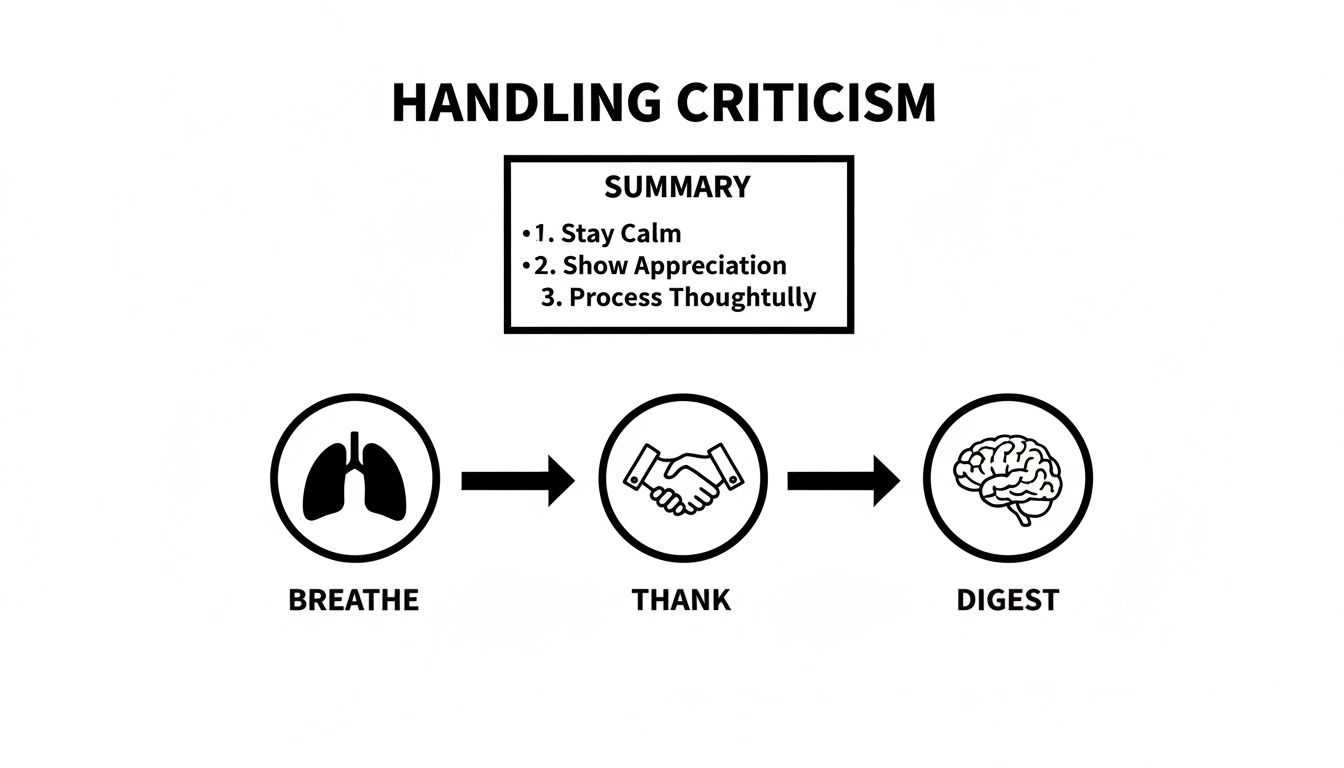
Before you dive into a full self-analysis, just remember the basics: Breathe, Thank, and Digest. That's always your best starting point.
Now, let's get into the nitty-gritty for each type.
The Gut Triad: Types 8, 9, and 1
Folks in this triad (also called the Body Center) react instinctively, from a gut level. Their world revolves around control, justice, and their personal autonomy. So, when criticism hits, it feels like a direct challenge to their sense of rightness.
• Type 8 (The Challenger): • Your deepest fear is being controlled. Criticism doesn't sound like feedback; it sounds like a power play. That’s why your first instinct is to push back—hard. The red flag is immediate confrontation, seeing helpful advice as an attack on your authority.
• Type 9 (The Peacemaker): • You’re terrified of loss and separation, which makes you avoid conflict like the plague. Criticism feels like a crack in the harmony. You might nod and agree on the surface, but inside, you're either shutting down or quietly fuming. The red flag is going passive-aggressive or just mentally checking out.
• Type 1 (The Reformer): • Your core fear is being defective or corrupt, and you live with a loud inner critic. When someone else offers criticism, it feels like they’re just confirming your own worst fears. The red flag is getting defensive and righteous, launching into a detailed explanation of why you did what you did.
The Heart Triad: Types 2, 3, and 4
These types are all about feelings and image. They process the world through their emotional connections and how others see them. Criticism cuts deep, often feeling like a direct hit to their value and identity.
• Type 2 (The Helper): • You’re afraid of being unwanted or unloved. You hear criticism as, "You failed me," which your brain translates to, "You are not worthy of my love." The red flag reaction is to over-explain all your good intentions or even become a little manipulative to win back their approval.
• Type 3 (The Achiever): • Your deepest fear is being worthless without your achievements. Criticism feels like a direct threat to the successful image you've carefully built. The red flag is either trying to spin the failure into a success or immediately deciding the person giving the feedback is incompetent.
• Type 4 (The Individualist): • You’re terrified of having no unique identity. Criticism often feels like a profound misunderstanding of who you are at your core, making you feel tragically flawed. The red flag is withdrawing into a moody silence or dismissing the feedback because the other person just "doesn't get you."
Let's be real: poorly handled criticism is a huge source of workplace drama. A staggering 85% of employees deal with conflict at work. For a Type 9 Peacemaker who swallows their frustration, this can lead straight to burnout—a condition 1 in 3 employees now report. Understanding how you’re wired for conflict isn't just a "nice-to-have," it's essential for your well-being.
The Head Triad: Types 5, 6, and 7
These types navigate the world with their minds, constantly seeking safety and security through thinking, planning, and analysis. Criticism often triggers deep anxieties about their competence and future.
• Type 5 (The Investigator): • Your core fear is being incapable or helpless. When you’re criticized, it can feel like someone is calling your knowledge into question, which makes you want to retreat into your head and analyze everything to death. The red flag is becoming detached, hoarding information, and disappearing from the conversation.
• Type 6 (The Loyalist): • You fear being without support or guidance. Criticism can kick your worst-case-scenario thinking into high gear, making you doubt your job security and your place on the team. The red flag is either becoming visibly anxious and suspicious or, on the flip side, overly compliant and deferential.
• Type 7 (The Enthusiast): • Your greatest fear is being trapped in pain or deprived of good experiences. Your instinct is to run from negative feelings. The red flag is immediately rationalizing the feedback away, using your charm to deflect, or quickly changing the subject to something more fun.
Turning Vague Feedback into a Concrete Action Plan

Alright, you made it through the meeting. You’ve taken a few deep breaths, listened without jumping to your own defense, and bought yourself some space to think. So... now what?
This is where the real work—and the real growth—begins. It happens when you’re alone with your thoughts, trying to make sense of that jumble of feedback. A lot of people stumble here, either letting the criticism eat away at them or just shrugging it off completely.
The secret to handling criticism like a seasoned pro is to shift from feeling to doing . Stop replaying the conversation on a loop and start building a plan.
Let’s get you there with a simple but ridiculously effective framework: Clarify, Categorize, and Commit . Think of it as turning a messy pile of comments into a clean, actionable project plan for your own career.
Clarify The Ambiguity
Let’s be honest: vague feedback is useless feedback. Comments like “you need more executive presence” or “just be more proactive” sound important, but they give you absolutely nothing to grab onto. Your first mission is to turn those fuzzy platitudes into concrete, observable behaviors.
This means you’ve got to ask some smart, non-defensive questions later on. You’re not a defendant on the stand; you’re a detective trying to uncover the facts.
Here are a few questions to get you started:
• "Could you walk me through a specific time when you noticed that?"
• "That's helpful. To make sure I understand, what would have been a better outcome in that situation?"
• "When you mention being 'more proactive,' can you give me an example of what that would look like on a project like the one we're on now?"
Asking these questions does two things: it shows you’re taking the feedback seriously, and it pulls the conversation out of the land of vague opinions and into the world of tangible actions. To really dig into this, check out this complete guide to understanding and acting on employee feedback .
Categorize The Input
Here’s a hard truth: not all feedback is created equal. Once you’ve gotten some clarity, it’s time to sort it all out. This is how you separate the genuine gold from the, well, junk mail.
You wouldn't treat a final-notice utility bill with the same casual glance as a flyer for a new pizza place, right? Treat criticism the same way.
Don’t treat every piece of feedback as a command. Your job is to evaluate its merit, categorize its importance, and decide what to act on. This is where you regain control of the narrative.
Try sorting the feedback into these buckets:
• Immediately Actionable: • This is the low-hanging fruit. Clear, valid points you can start working on right away. For example, your manager says, "Please include a summary slide at the beginning of your presentations." Done.
• Needs More Info: • This feedback might have legs, but you need more context before you can run with it. Something like, "Your reports are sometimes confusing," goes right back into the "Clarify" pile for a follow-up conversation.
• A Difference in Opinion: • Sometimes, feedback isn’t about you being "wrong." It's just a clash of working styles or perspectives. For instance, a coworker suggests you use a different project management tool, but your current system works perfectly for your workflow. You can respectfully acknowledge it without overhauling your entire process.
Commit To An Action Plan
Okay, time to build your roadmap. For everything you’ve filed under "Immediately Actionable," you need to create a simple, measurable plan. Writing it down is what turns a good intention into a real commitment—this is probably the most crucial part of handling criticism well.
This doesn't have to be some epic, multi-page document. It just needs to be clear.
Using a simple table is a great way to track each point and keep yourself honest. Plus, it’s a killer tool to bring to a follow-up meeting with your manager to show them you’re not just listening, you’re acting .
Your Personal Growth Action Plan Template
Organize feedback into actionable steps to track your progress and demonstrate commitment.
| Core Feedback Received | Specific Action Step | Timeline & Check-in Date | How I'll Measure Success |
|---|---|---|---|
| "Your weekly reports lack a clear top-line summary." | Add a 3-bullet-point executive summary to the top of every Monday report. | Starting next week. Check in with my manager in one month. | Manager confirms reports are easier to digest quickly. |
| "You sometimes seem disengaged in team meetings." | Actively contribute at least one idea or question in every team meeting. | Start this Wednesday. Track my contributions weekly. | I feel more involved, and my ideas are being discussed. |
| "The client felt the project deadline was unclear." | Create a shared project timeline doc for all new clients and review it during kickoff. | Implement for the next client project starting October 1st. | Positive client feedback on project transparency. |
By filling this out, you’re not just hoping you’ll improve; you’re creating a structured path to make it happen. Now that's taking charge.
Mastering the Follow-Up to Showcase Your Growth
Getting hit with criticism can feel like the end of the conversation. But honestly, what you do next is the real power move. So many people drop the ball here, but closing the feedback loop is what separates the pros who just take feedback from those who genuinely grow from it. This is your chance to grab the wheel, show some initiative, and rewrite your professional story.
The goal isn't to go back fishing for compliments or to ask a needy, "Am I doing better now?" Nobody wants that. Instead, think of the follow-up as a strategic, confident check-in. It’s a quick meeting where you prove you listened, you took action, and you're getting results. That simple act flips the script, turning you from a passive recipient into the active driver of your own development.
When and How to Circle Back
Timing is everything. Don't march back into their office the next day—that just looks desperate. But don't wait a month either, or they'll assume you completely forgot. The sweet spot is usually one to two weeks. It's just enough time to have genuinely implemented a few changes and maybe even seen some early wins.
Your request for a follow-up should be breezy and professional. You're not asking for another heavy, soul-searching feedback session. You’re just booking a quick sync to share an update.
Here’s a simple email you can adapt:
Subject: Quick Follow-Up on [Project/Topic]
Hi [Manager's Name],
Thanks again for the feedback you shared on [mention the specific topic] last week. I’ve been putting your suggestions into practice and wanted to briefly share the progress I've made.
Would you have 15 minutes to connect sometime next week?
Thanks, [Your Name]
This approach is proactive, shows respect for their time, and frames the entire conversation around progress, not problems.
Show, Don’t Just Tell
Once you’re in that follow-up meeting, your mission is to showcase concrete actions. Vague statements like "I've been working on it" are useless. You need to lead with specific examples that prove you put the feedback into practice.
A simple formula that always works is: "Based on your feedback about X, I started doing Y, and I'm already seeing Z results."
• If the feedback was about your presentation style: • "Based on our last chat about my presentations, I've started adding an executive summary slide at the beginning. In the team meeting on Tuesday, I noticed people were able to jump into the discussion much faster."
• If the feedback was about client communication: • "You mentioned I could be clearer in my client emails. I created a few templates based on your advice, and on the Apex project, the client approved the first draft of the timeline with zero revisions."
This approach proves you’re not just a good listener but also a skilled problem-solver who takes ownership. If you want to get really serious about this, using a personal development plan template can be a fantastic way to keep your growth organized and visible.
Adapting to a Changing Workforce
How you handle criticism at work also means understanding who you're talking to. The workforce is shifting, and communication styles are changing right along with it. By 2032, Gen Z will make up over 32% of the workforce, and their digital-first upbringing has shaped how they interact. With 80% of employees already viewing feedback as punitive and 37% of Gen Z having quit over toxic cultures, adapting your approach isn't just nice—it's critical. You can dig deeper into navigating these generational shifts on ctomasters.com .
The key is to shift from reactive feedback to proactive growth conversations. By initiating the follow-up, you create a positive, forward-looking dialogue that all generations can appreciate.
Instead of waiting around for your annual review like it's a doctor's appointment you're dreading, start asking for feedback on your own terms. This flips the script entirely. You're no longer waiting for criticism to land on you; you're actively seeking data to fuel your own growth.
Try asking for input on a specific skill you're developing:
• "Hey, I'm really trying to get better at running efficient meetings. After our next project sync, could you give me one piece of feedback on how it went?"
This shows humility, a real desire to improve, and a level of professional maturity that will get you noticed for all the right reasons.
Gotcha Questions: Your Guide to Handling Criticism in the Wild
Alright, you've got the framework down, you know your Enneagram triggers, and you’re ready to follow up like a pro. But let's be real—workplace feedback rarely comes in a neat, tidy package. Life is messy, and so is criticism.
This is your field guide for the gray areas. Think of it as your playbook for those moments that make you go, "Okay, but what if…?"
What If the Criticism Is Just Plain Wrong?
This one stings. Your first instinct is to jump up and shout, "OBJECTION!" while listing every single reason the other person is mistaken. Don't do it. Seriously, resist that urge. Fighting fire with fire in the heat of the moment almost never works and can make you look defensive and unprofessional.
First, fall back on the core principles: listen and buy yourself some time. A simple, "Thanks for bringing that to my attention. I'd like to think that over and get back to you," is pure gold. It gives you a moment to let the initial emotional storm pass so you can respond with logic, not rage.
When you do follow up, bring the receipts. Present your side calmly, with evidence, not emotion. You’re not there to accuse; you're there to clarify.
For example: "Thanks again for your feedback on the project timeline. I wanted to touch base so we're on the same page. I pulled my log, and it looks like we hit our initial deadlines, but then we had a hold-up waiting on the vendor. For future projects like this, maybe we could build in a buffer for external dependencies?"
See? It’s non-confrontational, fact-based, and makes you look like a proactive problem-solver.
How Do I Handle Feedback from a Coworker Who Isn't My Boss?
When a peer drops some feedback in your lap, the power dynamic is different, but the need for grace is just as high. Your first move should always be to keep the team dynamic positive. Acknowledge their comment with a simple, "Appreciate you sharing that," or "That's an interesting way to look at it."
Later, take a moment to evaluate it privately. Is there any truth to it? If so, great—you just got a free tip to help you improve. If it’s unhelpful or just their personal preference, you have the professional freedom to smile, nod, and let it go.
Now, if a coworker is consistently dropping unsolicited "advice" that feels more like they're trying to undermine you, it might be time for a direct but polite chat about boundaries. If it keeps happening and starts affecting your work, that's when it's time to bring your manager into the loop.
My Boss Delivers All Feedback Like a Wrecking Ball. Help!
Ugh, this is tough. Working for a harsh boss can be incredibly draining. The trick is to become a master at separating the message from the terrible delivery . Your goal is to pan for the gold—the actual substance of the feedback—without getting covered in all the mud.
Try to steer the conversation into a more objective zone by asking clarifying questions. This can sometimes force them out of attack mode and into problem-solving mode.
You can also subtly "train" your boss by proactively asking for feedback in a way you control.
Try this script: "I'm really focused on improving my presentation skills. After the team update next week, would you be willing to share one or two specific things I could do better?"
This approach frames the whole interaction constructively and puts you back in the driver's seat. If you're dealing with a really challenging professional situation like this, you might explore hiring a career coach for personalized guidance.
Is This Constructive Criticism or a Straight-Up Personal Attack?
Knowing the difference is absolutely critical for your mental health at work. The line can feel blurry, but there are some tell-tale signs.
• Constructive criticism • is specific. It focuses on your work or a particular behavior and is meant to help you grow. It usually comes with examples or suggestions. ("When you presented the quarterly numbers, it would have been more impactful to start with the key takeaway first.")
• A personal attack • is vague and aims at your character. It feels like a judgment, not a piece of advice. ("You're just lazy," or "You never think things through.") It offers no path forward.
If you feel like you're on the receiving end of personal attacks, start documenting every instance—dates, times, direct quotes. If a pattern emerges, you might be dealing with a toxic environment or even workplace bullying. At that point, it’s wise to take your documented concerns to HR or a senior leader you trust.
At Enneagram Universe , we believe deep self-awareness is the key to navigating any professional challenge with confidence. Understanding what makes you tick is the first step in turning criticism from a stumbling block into a stepping stone. Find out your Enneagram type with our free, in-depth test today at Enneagram Universe .