How to Discover Your Core Values and Build a Life With Purpose

Let's be real for a moment. Have you ever felt like you're just going through the motions? You're checking all the "right" boxes—the sensible job, the stable life—but something feels... off. It's like you're following a recipe that looks delicious on paper but leaves you feeling unsatisfied.
That nagging feeling of misalignment is a classic sign of being disconnected from your core values. Think of them as your personal operating system, the internal compass that should be guiding your every move. When you ignore it, you end up adrift.
Why Knowing Your Values Is Your Ultimate Life Hack
If you sat down right now, could you confidently name your top three values? If you hesitated, you're in the vast majority. A report from the Human Clarity Institute revealed a pretty shocking statistic: a staggering 69% of people couldn't name their top three values without a list to choose from.
Only 31% had that clarity on hand. That's a huge deal, because other studies show that people living in alignment with their values report 40% higher daily energy and motivation . That's not just a small boost; it's the difference between dragging yourself through the day and living with genuine purpose.
What Are Core Values, Really?
So, what are we even talking about here? Core values are the fundamental beliefs that quietly dictate your actions, shape your attitudes, and ultimately define what makes you feel fulfilled. They're your non-negotiables—the principles you stand by even when it's hard and no one is watching.
To get to the heart of what they are, it’s just as important to understand what they aren't . Getting this clear from the start saves a lot of confusion.
Before we dive deeper, let's get our terms straight. It's easy to mix up values with goals, morals, or even just wishful thinking. This quick-reference table should help clear things up.
The Core Values Discovery Starter Kit
| Concept | What It Is (Your North Star) | What It Is Not (Common Mix-Ups) | Practical Example |
|---|---|---|---|
| Values | The why behind your actions. The guiding principles you live by (e.g., integrity, connection, growth). | Fleeting goals or achievements (like "run a marathon"). | A person who values Freedom might choose a freelance career over a stable corporate job. |
| Goals | The tangible outcomes you want to achieve. They have a finish line (e.g., get a promotion, save $10k). | The underlying reason you're pursuing the outcome. | Saving $10,000 is a goal. The value driving it could be Security or Freedom. |
| Morals | A code of conduct, often shaped by external sources like society, culture, or religion. | Your personally chosen, authentic principles. | A moral belief might be "It is wrong to steal," which is a societal rule. A personal value might be Integrity, which is an internal choice. |
| Aspirations | The qualities you wish you had or want to develop in the future (e.g., "I want to be more spontaneous"). | The principles that actually guide your choices right now. | Aspiring to be more spontaneous is a desire. Valuing Adventure is what makes you actually book the last-minute trip. |
Understanding these distinctions is the first step. True values are already inside you, waiting to be uncovered, not invented.
The Power of a Personal Compass
When you're out of sync with your values, life feels like one big, exhausting decision after another. Should you take that job offer? Move across the country? Stay in that relationship? Without an internal compass, you’re just guessing, often relying on what other people think you should do. That’s a fast track to burnout and regret.
"Values are the principles that give our lives meaning and allow us to persevere through adversity."
Discovering your values is the ultimate life hack because it cuts through the noise. It gives you a powerful filter to run every opportunity through, helping you set meaningful boundaries and build a life that actually feels like yours .
In fact, getting clear on your values is the essential first step before you can even figure out how to set good goals that you'll actually stick with. It’s this foundational work in self-awareness that reignites your motivation and gives you a powerful sense of direction in everything you do. To go even deeper on this, check out our complete guide on how to become more self-aware .
Four Unconventional Exercises to Find Your True North
Let's be honest, those generic lists of 100 values you find online are... fine. They’re a starting point. But they rarely get to the heart of what actually makes you tick. To really nail down your core values, you have to do a bit of detective work—to move past the words you think you should value and uncover the ones already running your personal operating system.
These four exercises are your self-discovery toolkit. They're designed to be a little unconventional and a lot more revealing than a simple checklist.
This whole journey is about moving from a state of misalignment, where things just feel "off," to a place of genuine clarity. This is what that process looks like.
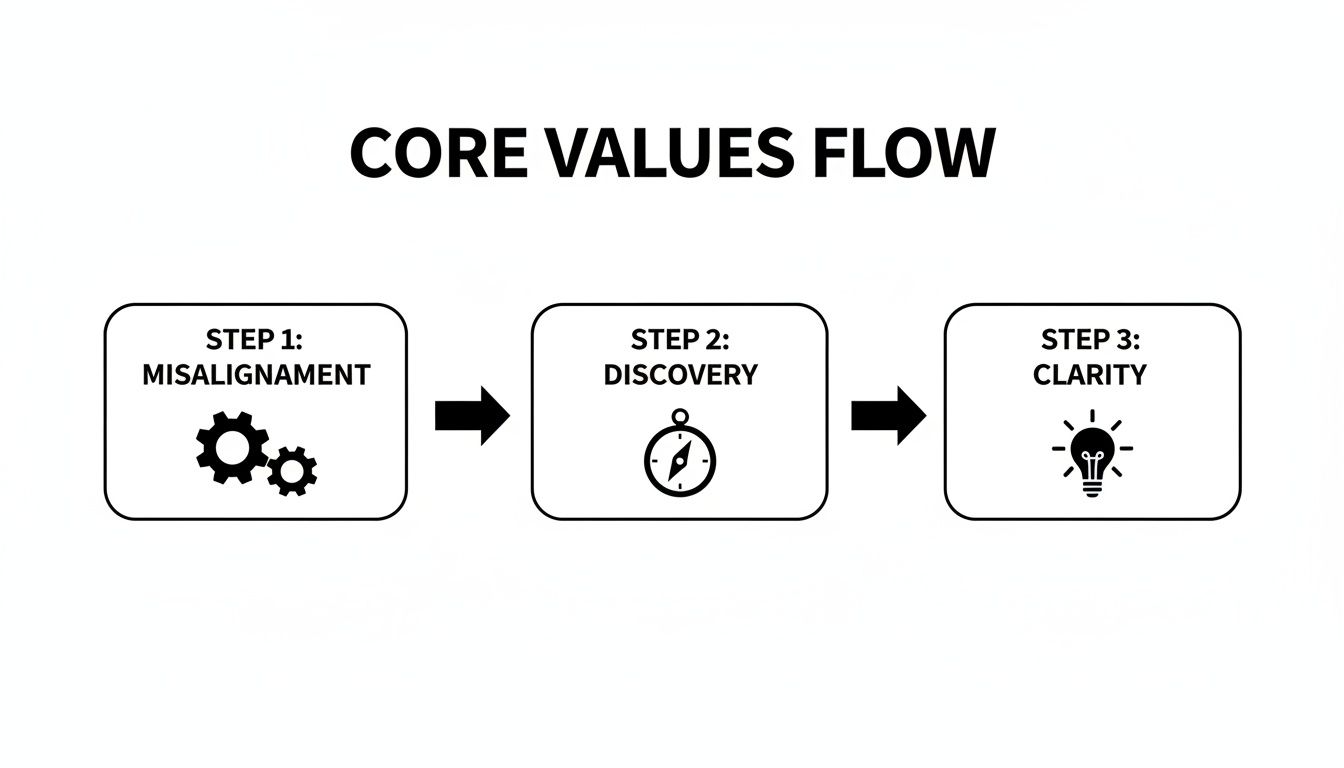
Think of these exercises as the bridge that gets you from the spinning gears of confusion to the lightbulb of purpose.
The Peak Moments Method
I want you to travel back in your mind. Pinpoint two or three moments when you felt on top of the world—energized, proud, and completely in your element. Forget monumental achievements; we’re looking for those moments where you thought, "Heck yeah, this is it."
Maybe it was the feeling after you nailed a huge presentation, crossed the finish line of your first 5K, or pulled off a killer surprise party for a friend. The event itself doesn't matter as much as the feeling it sparked.
Once you have those moments, put them under the microscope:
• What were you doing?
• Who was with you?
• What strengths were you flexing?
• What, specifically, made that experience feel so damn good?
Let's see it in action: Imagine Alex, a software developer. A peak moment for Alex was leading a tiny team to launch a passion project app against a wild deadline. Digging in, Alex realized it wasn't just about shipping the product. The magic was in the collaboration (the seamless teamwork), the creativity (solving tough problems with clever hacks), and the impact (knowing real people would use their creation).
Boom. Collaboration, creativity, impact. Those are some serious clues to Alex's core values.
The Irritation Investigation
Okay, let's flip the script. This one can be surprisingly powerful. Instead of focusing on what brings you joy, think about what drives you absolutely bonkers. What are your biggest pet peeves? What makes you want to throw your hands up in frustration?
Often, that feeling of irritation is a blaring alarm signaling that one of your core values is being trampled on. That coworker who always misses deadlines? They might be stomping all over your value of accountability . That friend who constantly flakes on plans last minute? They could be violating your deep-seated need for reliability .
Frustration is a compass. It points directly to the values you hold most dear—the ones that are being ignored or violated in a given situation.
Practical Example: Let's say you get incredibly annoyed when you see someone littering in a public park. The irritation might point to a core value of Respect (for shared spaces) or Stewardship (caring for the environment). Jot down three things that consistently get under your skin. For each one, name the value that's being compromised. It’s one of the quickest ways to figure out what you stand for by first identifying what you can’t stand.
The Role Model Breakdown
Now, think of someone you genuinely admire. This could be anyone—a public figure, a mentor, a historical leader, even your grandma. For this example, let’s pick someone well-known, like Serena Williams.
The key here is to get specific. Don't just say, "I admire her success." That's too vague. What exactly about her resonates with you?
• Is it her • resilience • to battle back from injuries and setbacks?
• Is it her raw • competitiveness • and relentless drive for • excellence • ?
• Maybe it's her • advocacy • work, using her massive platform for change?
• Or is it her dedication to • family • , balancing a legendary career with motherhood?
The qualities you admire in others are often a mirror reflecting the values you want to see in yourself. Pick three people you look up to and list the specific traits you respect. I guarantee you’ll start seeing a pattern that points straight toward your own values. This is just one of many self-awareness activities that can unlock some surprising truths.
The Life Chapter Audit
Your life story is a goldmine of data about what makes you, well, you . This last exercise is all about mapping your personal history to find the recurring themes.
Grab a piece of paper and divide your life into distinct chapters. You can base them on anything: where you lived ("The Ohio High School Years"), relationships ("The College Crew Era"), or career stages ("My First Startup Gig"). Give each chapter a name that captures its essence.
For each chapter, ask yourself:
Here's a quick example: Let's take Maria, a teacher. Her chapters might look something like "Finding My Voice in College," "Adventures Teaching Abroad," and "Building a Community Back Home."
As she looks back, a clear pattern emerges. In every single chapter, she was fueled by a deep desire for learning , a powerful need for connection , and an unshakeable passion for personal growth . The scenery changed, but her inner drivers stayed the same. They were her true north all along.
By the time you finish these four exercises, you'll have a rich, personalized list of potential core values that go way beyond a generic checklist. You'll have something that truly reflects who you are and what makes you come alive.
From a Long List to Your Core Five
Alright, so you've done the hard work. You've excavated your past, poked at your frustrations, and celebrated your peak moments. Now you're probably staring at a sprawling list of words— 'freedom,' 'creativity,' 'loyalty,' 'impact'—all jumbled together on a page or in a doc. That’s not a mess; that's gold. It's the raw material for building your personal compass.
But let's be honest, a compass with 30 different directions is basically useless. The real magic happens when we distill this glorious brainstorm into a powerful, concise set of principles. It's time to go from a big collection of nice ideas to your top five non-negotiables .
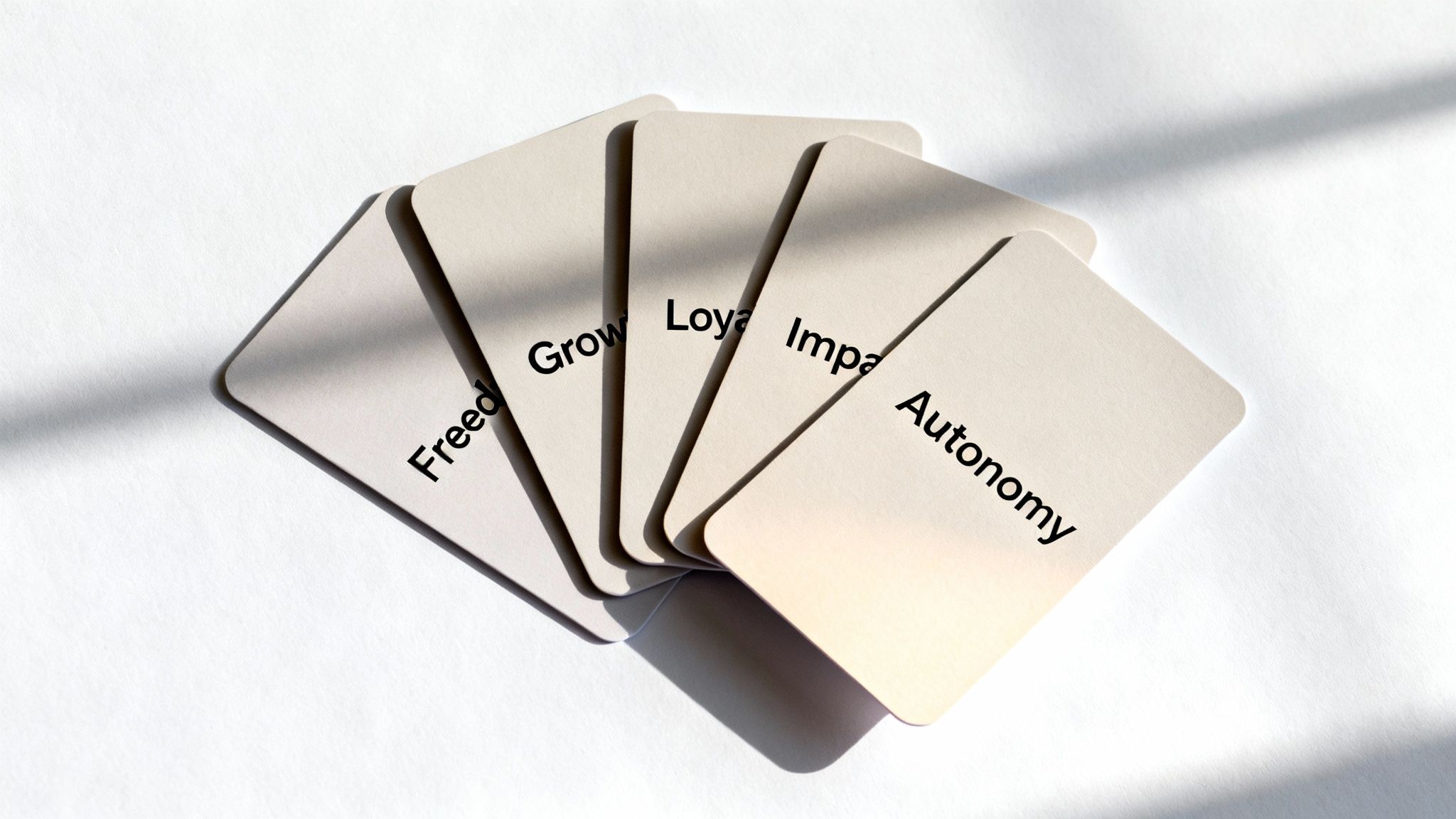
This is where the fog starts to clear. It’s how you turn a bunch of aspirational words into a practical tool for making decisions you won't regret later.
Group and Cluster Similar Ideas
First things first, let's play a little game of word association. Look at your list and start grouping words that feel like they're part of the same family. We often use a dozen different words to talk about a single, fundamental driver.
For instance, maybe you wrote down:
• Adventure
• Novelty
• Exploration
• Learning
• Curiosity
See the pattern? While each has its own subtle flavor, they all point to a central theme of Growth or Discovery . Your job is to find the one word that best captures the heart of that cluster for you .
This isn't about finding the "correct" dictionary definition. It’s about picking the word that lands with a thud in your gut—the one that feels most true to your own life.
Here's another classic example. Someone might have 'dependability,' 'loyalty,' 'accountability,' and 'trustworthiness' on their list. Dig a little deeper, and the core value holding them all together might just be Reliability . Grouping these synonyms helps you avoid redundancy and gets you much closer to what’s really moving you.
This sorting process helps you spot the big themes running through your life. It's also pretty cool to see how some of these drivers are baked into our human DNA. In a massive dataset from 500,000 surveys , Valuegraphics found that family is the #1 most influential value worldwide. It's followed by relationships (#2) , financial security (#3) , belonging (#4) , and community (#5) . While your values are uniquely yours, they often connect to these universal human needs. If you're curious, you can discover more insights about these global values on Visual Capitalist .
If you find yourself stuck with words that seem similar but distinct, a quick table can help.
Values Clustering Common Themes and Synonyms
This table is a simple tool to help you group related ideas. When you see several similar words on your list, use this to find the single, powerful term that best represents the whole group.
| If You Wrote Down... | Consider This Core Value | What It Might Mean |
|---|---|---|
| Accomplishment, Success, Winning | Achievement | A drive to reach goals and make a tangible impact. |
| Daring, Excitement, Spontaneity | Adventure | A need for new, thrilling, and unpredictable experiences. |
| Fairness, Equity, Morality | Justice | A deep-seated belief in doing what is right and fair for all. |
| Autonomy, Independence, Self-Reliance | Freedom | The ability to make your own choices and live life on your terms. |
| Learning, Curiosity, Self-Improvement | Growth | A constant desire to expand your knowledge, skills, and perspective. |
| Kindness, Empathy, Service | Compassion | A motivation to help others and alleviate suffering. |
| Dependability, Trustworthiness, Loyalty | Reliability | Being someone others can consistently count on. |
| Calm, Harmony, Stillness | Peace | A need for inner and outer tranquility and a lack of conflict. |
Clustering isn't about erasing nuance; it's about finding the foundational pillar that all the other words are built on.
Use the Forced Choice Technique
Okay, you've clustered and condensed. Your list is probably down to a lean 10 or 15 contenders. Now for the fun part: the ultimate cage match. The Forced Choice technique is a powerful exercise that pits your top values against each other in tough, real-world scenarios. It forces you to get off the fence and reveals what you truly can't live without.
Here’s how you do it. Pick two values from your list and cook up a hypothetical dilemma where you can only honor one. Be brutally honest.
Scenario 1: Security vs. Autonomy Would you take a stable, high-paying job ( Security ) if it meant you had to follow a rigid script all day with zero creative input ( Autonomy )? There's no right answer, only your answer.
Scenario 2: Community vs. Ambition Would you say "no" to a massive career promotion ( Ambition ) if taking it meant moving thousands of miles away from your tight-knit circle of friends and family ( Community )?
Scenario 3: Well-being vs. Achievement Would you willingly sacrifice your physical and mental health ( Well-being ) for six months to lead a high-stakes project that could make or break your career ( Achievement )?
Keep running these head-to-head matchups with your top values. The ones that consistently come out on top? Those are your true non-negotiables. They're the pillars of your entire personal operating system.
Define Your Final Five
By now, a clear top five should be emerging from the fog. But hold on, we’re not quite done. A word like "Freedom" is slippery—it can mean a dozen different things to a dozen people. For one person, it’s financial independence. For another, it’s a creative expression. For a third, it’s the ability to pack up and live anywhere.
This is the final, crucial step: write a personal, one-sentence definition for each of your five core values. Turn each word into a short, actionable principle that explains what it means to you, in your life .
Check out the difference:
• Instead of: • Integrity
• Try: • "Doing the right thing even when no one's watching, and being honest with myself and others, especially when it's hard."
• Instead of: • Growth
• Try: • "Actively seeking out knowledge, skills, and experiences that stretch my perspective and get me out of my comfort zone."
• Instead of: • Connection
• Try: • "Building and nurturing deep, authentic relationships where I can show up as my true self and help others do the same."
This simple act of defining your values is what makes them real. They stop being abstract concepts and become a personalized guide for living—the bedrock for your decisions, the filter for your opportunities, and the ultimate measure of a life well-lived.
Putting Your Core Values to the Test
Alright, you've done the deep work. You have a list of words that feel like you —maybe 'Growth,' 'Integrity,' or 'Connection' made the final cut. But right now, that's all they are: a list of words.
Defining your core values is like drawing a map. It’s an exciting first step, but the real adventure begins when you take that map out into the messy, unpredictable real world. It's time to stop just thinking about who you want to be and start stress-testing those principles.
This is where your values go from being abstract ideas to a gut-level GPS for your life.

Conduct a Real-Life Values Audit
The quickest way to see if your values are for real is to perform a 'values audit' on your life as it is right now . This isn't about judging yourself; think of it as pure data collection.
Take a hard look at the two resources you can never get back: your time and your money.
Where are they actually going? Does your weekly calendar reflect that shiny new value of 'Well-being,' or is it a chaotic mess of draining obligations? Does your bank statement tell a story of 'Generosity' and 'Growth,' or... something else entirely?
This reality check can be a massive eye-opener. A fascinating MIT Sloan study revealed a huge gap between what companies say they value and their actual culture. While a whopping 65% of companies listed 'integrity' as a core value, researchers found zero correlation between that claim and what employees actually experienced. You can read the full research about this 'walk the talk' gap for more on this.
That gap exists in our personal lives, too. This audit is your way of closing it.
Run Small-Scale Experiments
You don’t need a life-altering crisis to see if your values hold up. The best way to test them is with small, low-stakes experiments. Think of it as A/B testing your principles.
• The One-Day Decision Challenge: • For just one day, make a single, small decision based purely on one of your top values.
• The Calendar Test: • Pull up your calendar for next week. Does looking at it make you feel energized or exhausted? Now, find just one thing you can add, remove, or shift to better align with a core value.
By intentionally making micro-choices aligned with your values, you're not just testing them—you're strengthening them. Each small, aligned action builds the muscle memory of an authentic life.
These little experiments give you immediate feedback. Did that decision feel right? Did it bring a sense of relief, pride, or fulfillment? If the answer is yes, you're on the right track.
Align Your Values With a Growth Plan
Testing your values isn't a one-and-done deal; it's an ongoing process. Once you’ve confirmed that your core five truly resonate, the next move is to weave them into your long-term vision. This is how your values become the bedrock for real, meaningful personal growth.
You do this by turning each value into an actionable goal, creating a clear roadmap for becoming the person you truly want to be.
For example, if 'Creativity' is a core value, your goal might be to block out one evening a week for a creative hobby. If 'Community' is key, your goal could be to finally volunteer for that local cause you care about.
Putting this into a structured framework makes all the difference. To see how this works in practice, you can check out our guide on creating a personal development plan template that uses your values as its engine. This is the crucial step that transforms this whole self-discovery journey from a reflective exercise into a concrete plan for a life led on purpose.
Navigating the Bumps in the Road to Your Values
The journey to find your core values isn't always a straight shot down a freshly paved highway. Honestly, it’s more like a rambling country road—beautiful, but with its fair share of potholes and surprise detours. Sooner or later, you’re going to hit a snag that makes you want to throw the map out the window. Don't sweat it. This is a totally normal, and frankly, essential part of the process.
Think of this as your personal roadside assistance for getting unstuck. We'll navigate the most common hurdles so your values can become the reliable GPS you need them to be, not just another source of confusion.
Help! My Values Are Fighting Each Other!
What happens when your soul craves both Adventure and Stability ? It’s a classic. Or maybe you feel a constant tug-of-war between ambitious Achievement and a deep need for restful Well-being . This is hands-down the most common roadblock, and it can feel like you’re being pulled apart at the seams.
This internal conflict doesn’t mean your values are broken; it just means you're a wonderfully complex human. The trick isn’t to force a choice between them, but to get them to play nicely together.
• Ditch the 'Or,' Embrace the 'And': • Stop framing it as, "Should I choose adventure • or • stability?" That’s a recipe for misery. Instead, ask, "How can I design a life that makes space for • both • adventure • and • stability?" This simple reframe is a game-changer. It unlocks a whole world of creative possibilities you couldn't see before.
• A Real-World Example: • I once worked with Sarah, a graphic designer who was torn between 'Freedom' and 'Financial Security'. Her rigid 9-to-5 corporate job was great for security but suffocated her freedom. Quitting to freelance full-time felt way too risky. Her solution? She found the "and." She landed a long-term, remote contract with a stable client. This gave her the predictable income she needed while allowing her the freedom to travel and set her own schedule.
I Think My Values Are…Changing?
Take a look at the values you held five years ago. Do they look a little different from today’s list? Good. That’s not inconsistency—that’s growth. The person you were in college, with a focus on 'Fun' and 'Social Connection,' probably had different priorities than the person you are now. And that's exactly as it should be.
Life has a way of reshuffling our priorities. Big life events are often the catalyst:
• Starting a family can suddenly push values like • Community • and • Responsibility • right to the top of the list.
• Getting through a major health scare might bring • Resilience • or • Gratitude • into sharp focus.
• A career change could shift your drive from • Achievement • toward a deeper sense of • Purpose • .
Your core values aren't carved in stone. Think of them as living, breathing principles that evolve right alongside you. Making a habit of re-evaluating them—maybe once a year over a cup of coffee—is a powerful act of self-awareness. It’s like recalibrating your compass to make sure it’s always pointing toward your current true north.
My Values Don't Fit My Life Right Now
This one is tough. What do you do when your personal value of 'Integrity' runs headfirst into a company culture that rewards a "win at all costs" mentality? Or when your deep-seated value of 'Growth' is met with a shrug from a partner who prefers the comfort of routine? This gap between your inner compass and your outer world is a major source of burnout and stress.
First things first, get brutally honest about what you can and cannot control. You can’t magically change someone else’s values. But you always have control over how you respond.
• Try Talking It Out: • Sometimes, a clear and respectful conversation can work wonders. Instead of stewing, you could tell your manager, "I've realized that to do my best work, I really need more autonomy on my projects." You're not complaining; you're expressing your value of 'Freedom' in a professional, actionable way.
• Find Fulfillment Elsewhere: • If your day job isn't scratching your 'Creativity' itch, can a side hustle or a weekend hobby fill that void? If your family members are homebodies, can you plan that backpacking trip with like-minded friends? You don't have to get everything from one source.
• Draw Your Line in the Sand: • Sometimes, the gap is just too wide to bridge. Recognizing when a job, a relationship, or a situation is in direct violation of one of your non-negotiables is a critical skill. Sure, making a change is scary. But living a life that’s fundamentally out of alignment with who you are? In the long run, that’s much, much harder.
Still Have Questions? Let's Untangle a Few Common Knots
Even the most dedicated explorers get a little turned around sometimes. As you dig into your own values, a few "what ifs" and "how tos" are bound to pop up. Think of this as your troubleshooting guide for the journey. Let's tackle the questions that come up most often so you can get back on the path with clarity.
How Often Should I Check In On My Values?
Your core values aren't set in stone. Think of them less like a permanent tattoo and more like your favorite, most trusted jacket—it’s a core part of your style, but you might need a different one as the seasons of your life change.
While your deepest principles probably won't do a 180 every few months, making a point to formally check in with them once a year is a fantastic habit. It’s also wise to pull them out for review after any big life shake-up.
You might want to do a values audit when you:
• Switch careers or leave a long-held job
• Start or end a significant relationship
• Welcome a new child into your life
• Pack up and move to a new city or even a new country
This regular check-in ensures your values are a living, breathing guide for who you are today , not just a dusty souvenir from the person you were five years ago.
Aren't Values and Goals the Same Thing?
This is probably the single most common point of confusion, but the difference is simple and incredibly powerful once you see it.
Basically, your values are your "why," and your goals are your "what."
• Values • are the direction your compass is always pointing. Think: • Adventure, Connection, Security • . They are the principles you live out, not finish.
• Goals • are the specific destinations you punch into your GPS. Think: • "Climb Mount Kilimanjaro," "Host a monthly game night," "Save a $10,000 emergency fund." • They have a finish line.
The easiest way to remember it is this: A goal is something you achieve ; a value is something you live . You can tick a goal off your to-do list, but you can never really "complete" the value of kindness or integrity.
If you're just starting this whole self-discovery thing, a common question is Where to Start with it all. The best advice is always to figure out your "why"—your values—first. That's what gives your goals the fuel they need to actually matter.
What If My Life Is Totally Out of Sync With My Values?
First, take a deep breath. Realizing there's a Grand Canyon-sized gap between the values you claim and the life you're living isn't a sign of failure. It's a breakthrough. Seriously. This awareness is the most critical first step toward building a life that actually feels like yours .
The trick is to meet this discovery with curiosity, not a ten-ton pile of self-judgment.
Let's make this real: Suppose you've pinpointed Well-being as a core value, but one look at your calendar reveals a chaotic hellscape of back-to-back meetings and commitments that leave you completely fried.
Instead of beating yourself up, get surgical.
Closing the gap isn't about a dramatic, overnight life renovation. It's about making a series of small, deliberate course corrections that, over time, steer your ship back toward your true north.
Ready to add another powerful layer to your self-understanding? The Enneagram is an incredible tool that uncovers the deep-seated motivations that drive your personality—and it complements your values work perfectly. Enneagram Universe has a fantastic, in-depth test that's completely free. Take the free Enneagram test today !