How to Discover Your Core Values and Find Clear Direction in Life

Discovering your core values isn't some mystical quest; it's a practical process of digging into your own life. It means looking at your best moments, figuring out why you admire certain people, and getting brutally honest about what lights you up. Think of it as building your own internal compass—a reliable guide for every single choice you make, big or small. This clarity changes everything.
Why You Feel Lost Without a Personal Compass
Ever have that feeling you’re just… going through the motions? Maybe you've landed a job that looks amazing on LinkedIn but leaves you feeling hollow and drained. If you're nodding your head, you're in good company. That nagging sense of being adrift usually points back to one simple, powerful disconnect: you aren't clear on your core values.
This is what I call the "awareness gap"—the chasm between the life you’re currently living and the one that would actually make you feel alive. It's so easy to get swept up in what everyone else thinks you should be doing. Family, society, and that endless Instagram scroll all have loud opinions on what success looks like. But without your own internal GPS, you inevitably end up following someone else’s map.
It plays out in real life all the time:
• Sarah, a brilliant coder in San Francisco, • landed a dream job at a big-name tech firm. The pay was great, the perks were better. But six months in, she was miserable, burning the midnight oil on a product she couldn't care less about. Her core value of • impact • was completely sidelined, even as her bank account swelled.
• David, a genuinely kind guy from Chicago, • kept finding himself in relationships that fizzled out in the exact same way—with him feeling like a ghost. He hadn't yet realized that • deep connection • was a non-negotiable for him, so he kept picking partners who prioritized shallow fun over real intimacy.
The Hidden Gap in Self-Awareness
These stories are painfully common because most of us have never been taught to stop and define our own principles. Seriously, if you had to list your top three values right now, could you do it? If you're drawing a blank, you're not alone.
Recent research has uncovered a shocking 'hidden gap' in self-awareness. A study found that a staggering 69% of people cannot confidently name their top three values without some serious hand-holding. You can dive deeper into these numbers in the Human Clarity Institute's report about values discovery . This isn't just an interesting statistic; it shows that the majority of us are navigating major life decisions without a compass.
Your core values are the fundamental beliefs that quietly steer your behavior and choices. When your actions line up with them, life feels purposeful and right. When they don’t, you get that friction, that nagging dissatisfaction, that feeling of being totally lost.
To get started, let's lay out the tools we'll be using. This isn't about just thinking hard; it's about using specific, proven exercises to get real answers.
Your Values Discovery Toolkit
Here’s a quick overview of the concepts and exercises we’ll use to help you uncover your core values and start living a more aligned life.
| Concept | Why It Matters | What You Will Do |
|---|---|---|
| Peak Moments | Your happiest memories are goldmines of information about what you truly value. | Reflect on times you felt most alive and identify the underlying themes. For example, was it winning a team sport (value: collaboration) or finishing a solo marathon (value: perseverance)? |
| Role Model Analysis | The people you admire often reflect the qualities you wish to cultivate in yourself. | Analyze the traits of your heroes to see which values they represent. Do you admire a CEO for their innovation or a local activist for their dedication to justice? |
| Life-Mapping | Looking back at your life's major turning points reveals consistent patterns in your choices. | Chart your life's highs and lows to uncover your decision-making drivers. Did you choose a college for its prestige or its close-knit community? |
| Personality Insights | Tools like the Enneagram can provide a language and framework for your innate motivations. | Connect your personality type's core drivers to your list of potential values. An Enneagram 7 might value freedom, while a Type 2 values connection. |
These exercises work together to give you a 360-degree view of what truly makes you tick. It's time to close that awareness gap for good.
This journey is a simple, three-part process: from acknowledging that "lost" feeling to gaining the clarity you need to find your way.
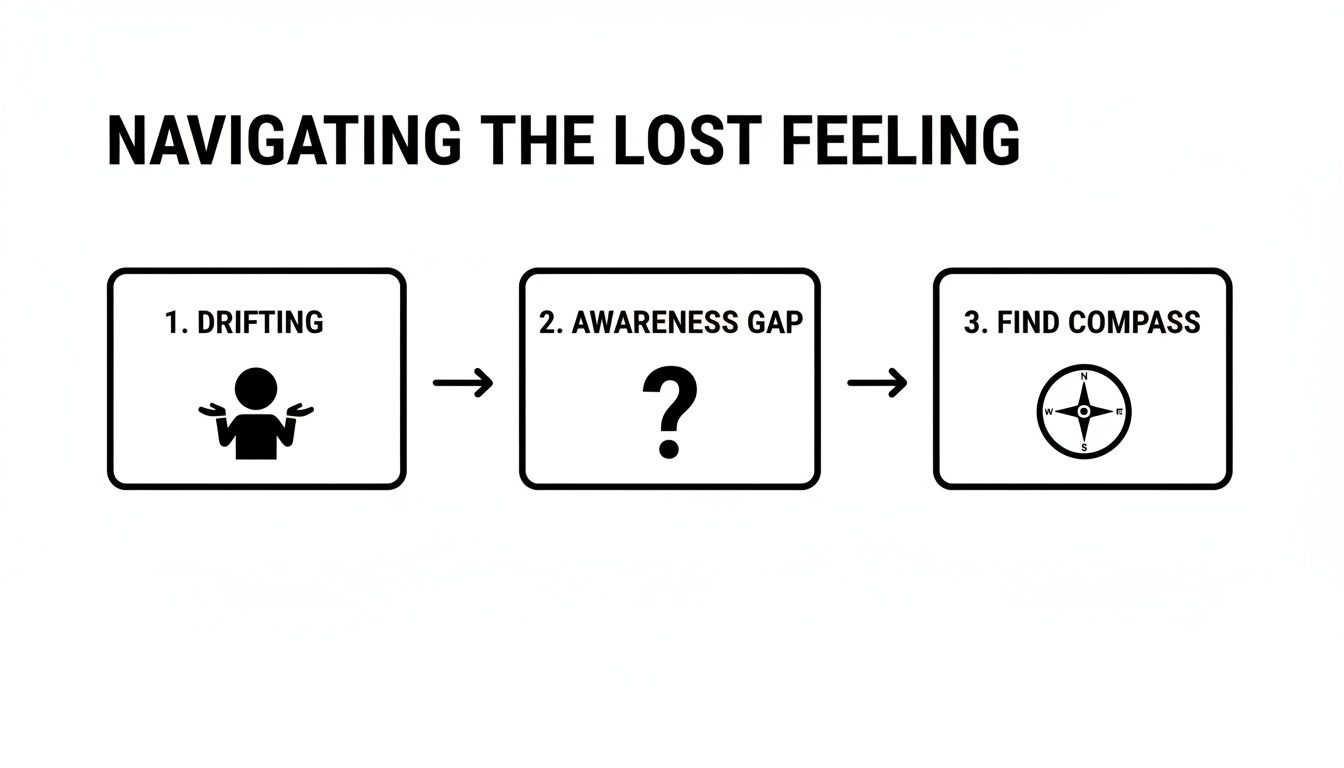
The first step is simply recognizing that feeling adrift is a symptom of an undefined compass. Getting clear on what matters most isn't just a nice idea—it's the key to building a life that feels like your own.
So, let's start building.
Let's Go Window Shopping for Your Values
Before you can carve your core values in stone, you’ve got to know what’s out there. Think of this as the fun part—the window shopping phase. You’re not making any commitments yet; you're just wandering through the mall of human principles and seeing what catches your eye.
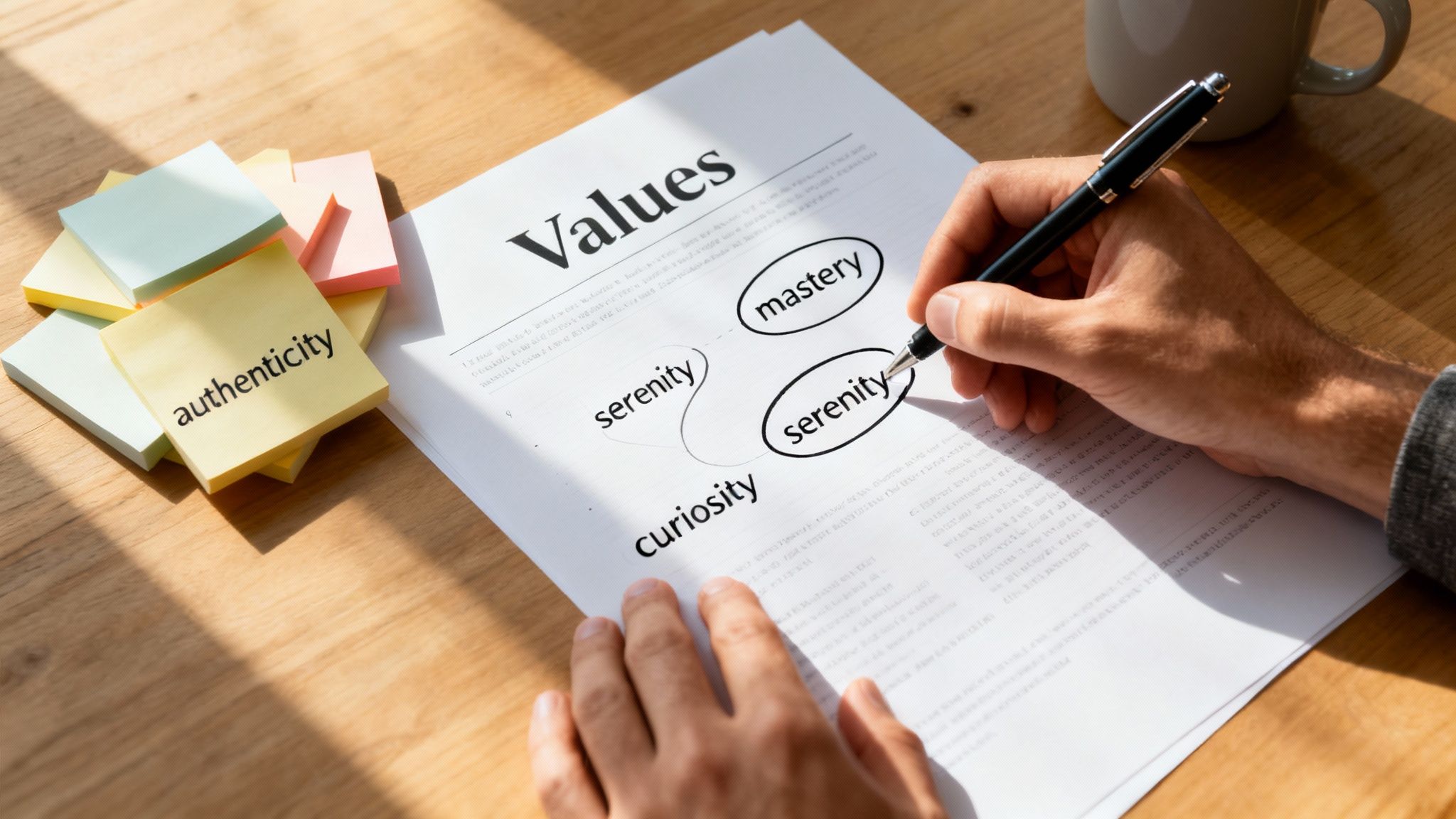
Most of us can name the big ones, like "honesty" or "success." And those are great! But the world of values is so much bigger and more interesting than that. Have you ever thought about mastery as a driving force? What about serenity , curiosity , or authenticity ? These words hit differently, don't they? They can spark a little flicker of recognition deep down.

Right now, your only job is to be an explorer. Stay open, stay curious, and just notice what resonates. No pressure.
Finding Your Way Around the Map
To keep this from feeling like you're staring at a dictionary, it helps to group potential values into a few common themes. This is a great way to spot patterns in what you’re drawn to. Do your eyes keep landing on words about stability and security? Or do you find yourself highlighting all the words related to adventure and change?
Here are a few categories to get you started, with practical examples of how they might show up:
• Growth-Oriented Values: • These are the engines of progress. Think • curiosity • , • learning • , • resilience • , • adaptability • , and • courage • . This might look like someone who is always taking online courses or who moves to a new city without knowing anyone.
• Relationship-Centered Values: • All about how you connect with other humans. This includes • community • , • empathy • , • kindness • , • loyalty • , and • intimacy • . A practical example is making time for a weekly dinner with family, no matter how busy you are.
• Stability-Focused Values: • These are your anchors. Consider • dependability • , • financial security • , • peace • , and • responsibility • . Someone who values this might prioritize building a six-month emergency fund over taking a lavish vacation.
• Impact-Driven Values: • These speak to the mark you want to leave. This might look like • leadership • , • advocacy • , • influence • , or • altruism • . This could be as simple as mentoring a junior colleague at work or volunteering for a cause you believe in.
Looking at values through these lenses can be a fantastic shortcut to figuring out your internal wiring. It’s a huge piece of the puzzle when you’re figuring out “ How to Become More Self-Aware: Tips for Self-Discovery ” and trying to build a life that actually feels like you .
A Quick Detour: Meet Alex
Let's imagine a guy named Alex, a project manager from Chicago. If you asked Alex about his values, he’d have told you they were achievement and hard work . His whole career was built on those two pillars.
So, when he sat down with a giant list of potential values, he figured he’d just circle all the words related to ambition and success. But then, something weird happened.
The word tranquility seemed to jump off the page. He immediately thought of his quiet Sunday mornings—the best part of his week—sipping coffee with a good book. It was the total opposite of his chaotic work life. Then his eyes landed on creativity , and he felt a sudden pang for the camera he hadn't touched in years.
Alex’s experience is totally normal. The values we think we have are often the ones society claps for. The values that are truly ours are the ones that whisper to us when no one else is around.
This was a lightbulb moment for Alex. He realized he’d been living according to a script that was missing a few key pages. Discovering these unexpected values didn't cancel out his ambition; it just added much-needed color and depth to the picture of who he really was.
You're Not Alone in This
While your final set of values will be deeply personal, it turns out we humans have a lot in common. A massive study, drawing from over 500,000 surveys in 152 languages , looked for universal human values. While corporations love to talk about integrity , what do real people actually prioritize?
Globally, family comes in at #1, with relationships at #2 and financial security at #3. But culture plays a huge role. For example, patience is the 5th most important value in Africa but ranks just 26th globally. It’s a fascinating look at how our environment shapes our inner compass.
The point isn't to make you choose what everyone else does. It's to show you that you're part of a massive, global conversation about what makes a life well-lived. Your unique blend of these principles is what makes your internal compass entirely your own.
Four Unconventional Exercises to Reveal Your Truth
Alright, enough theory. This is where we get our hands dirty and start digging for gold.
Forget those bland "what's important to you?" questions that just make your brain go fuzzy. We're going to use four powerful, slightly offbeat exercises to sneak up on your core values from different—and often surprising—angles.
Think of these as different trails leading up the same mountain. Each one offers a totally unique view of your inner landscape.
To make this real, we'll follow a few people through the process. No two paths are the same, so let's jump in.
The Peak and Valley Method
Your life's highest highs and lowest lows aren't random. They're giant, flashing neon signs pointing directly to what you value most. During your peak moments, a core value was being lived out loud. In your valleys, a core value was being crushed.
Let's meet Jessica, a marketing manager from Denver.
• Her Peak Moment: • Launching a community garden project in her neighborhood. She remembers feeling totally alive, connected, and deeply proud, even though it was unpaid work on her weekends. • The values being honored here? • • Community, Impact, and Creativity.
• Her Valley Moment: • The promotion she got last year. Sure, the money was better, but it came with endless meetings obsessed with maximizing profit, often at the team's expense. She felt drained, cynical, and isolated. • The values being violated? • • Connection, Integrity, and Purpose.
Your Turn: Grab a notebook and map out at least two peaks and two valleys from your own life. For each one, ask: What made this moment so incredible? or What made this experience so soul-crushing? The real answers are hiding just beneath the emotions.
The Role Model Autopsy
The people you admire are mirrors. The qualities that you see shining in them are often the very values you want to see in yourself. This exercise is all about dissecting exactly what it is about your heroes that hits you right in the gut.
Pick three people you genuinely respect. They can be anyone—a historical figure like Maya Angelou, a brilliant entrepreneur, a family member, or even a fictional character.
Let's see this in action with Marcus, a young software engineer from Atlanta.
By performing this "autopsy," Marcus isn't just listing nice traits. He’s uncovering a blueprint for the person he truly wants to become.
The Furious Button Test
Anger gets a bad rap, but it’s an incredibly useful tool for this kind of work. Think of your frustration as a fire alarm, blaring to let you know a deeply held value is under attack. What consistently pushes your "furious" button?
What makes you genuinely, undeniably angry?
• Watching someone take credit for another person's work? You likely value • Fairness • and • Justice • .
• Dealing with convoluted bureaucracy or ridiculously inefficient systems? You probably value • Simplicity • and • Effectiveness • .
• Seeing someone being bullied or intentionally excluded? Your core values might include • Kindness • and • Inclusion • .
Jessica, our friend from Denver, gets absolutely incensed by "greenwashing"—companies that pretend to be eco-friendly just for the PR points. That anger is a compass needle pointing straight to her deep-seated values of Authenticity and Responsibility . It’s not just a fleeting emotion; it's a signpost.
Which Values Exercise Is Right for You
Not sure where to begin? This little table can help you pick the exercise that best fits your style.
| Exercise Method | Best For... | Time Commitment |
|---|---|---|
| Peak and Valley | Reflective, story-driven people who learn from past experiences. | 30-45 minutes |
| Role Model Autopsy | Outward-focused individuals who are inspired by others' actions. | 20-30 minutes |
| Furious Button Test | Emotionally-aware people who can easily tap into their gut reactions. | 15-20 minutes |
| Personality Framework | Analytical thinkers who enjoy systems and finding patterns in behavior. | 45-60 minutes |
There's no wrong choice here. The best approach is the one you'll actually do, so pick one that feels interesting and give it a shot. You can always try another one later!
Personality Framework Clues
While not a direct list of values, personality frameworks like the Enneagram are basically cheat sheets for understanding your core motivations. They reveal the "why" behind what you do, which is the very engine of your values.
The Enneagram, for example, outlines nine fundamental ways of seeing the world, each with its own core desire and core fear.
• An • Enneagram Type One (The Reformer) • is motivated by a desire to be good and right, which often translates to values like • Integrity • , • Excellence • , and • Justice • .
• A • Type Seven (The Enthusiast) • is driven by a need to be satisfied and happy, leading to values like • Freedom • , • Adventure • , and • Joy • .
• A • Type Nine (The Peacemaker) • seeks inner stability and peace of mind, naturally aligning with values like • Harmony • , • Comfort • , and • Connection • .
Knowing your type can hand you a pre-sorted list of potential values to explore. It’s a brilliant shortcut. If you want to go deeper, you can find a ton of self-awareness activities based on your Enneagram type that will shed even more light on your internal wiring.
Interestingly, while your values feel deeply personal, some global patterns do emerge. One analysis of half a million surveys identified 56 core values shaping behavior worldwide. While Family (#1) , Relationships (#2) , and Financial Security (#3) top the charts globally, it's your personal hierarchy that truly defines you.
Here's the kicker: The Human Clarity Institute reports that only 31% of people can confidently name their top three values . That disconnect can erode daily motivation by up to 30% .
These four exercises are designed to get you out of your head and into the real experiences of your life. By using your memories, heroes, frustrations, and even your personality, you can start to triangulate what truly matters most.
How to Whittle That Big List Down to Your Core Five
Okay, you’ve done the hard work of digging deep. Your notebook probably looks like a beautiful, chaotic mind map of your soul, brimming with words that made you go, "Yes, that's me!" Words like Community , Growth , Adventure , Peace , and Mastery are all jumping off the page.
First off, celebrate that! It's a massive step. But let’s be honest, staring at a list of 20 , 30 , or even 50 potential values can feel just as paralyzing as having none. The point isn't to create a laundry list of admirable traits; it's to forge a powerful, practical set of principles—your core five—that will become your non-negotiables.
This is the distillation process. We're about to take that big bucket of raw potential and boil it down to its most potent, concentrated form.
First, Separate the Means from the Ends
Right out of the gate, let's make a critical distinction that will save you a world of confusion. You need to untangle your means values from your ends values . This is a total game-changer.
A means value is something you want because it gets you something else. An end value is something else —it's the final destination.
Money is the classic example. For most of us, financial security isn't the ultimate goal. It’s a vehicle—a means—to achieve something far more fundamental. Are you chasing money for the freedom it brings? What stability does it provide your family? The generosity it allows?
The Big Question: Look at a value on your list and ask, "What does this give me?" If your answer is another value on your list, you’ve probably found a means value. Keep digging until you hit bedrock—the principle that's the 'end of the road.'
Let’s follow a real-world example. Sarah, a graphic designer from Austin, had "Success" written in giant letters on her list. But when she asked what success would actually give her, the answer was crystal clear: the ability to pick her own projects and work on her own terms. Suddenly, she realized her core value wasn't "Success" at all; it was Autonomy .
Next, Group and Theme Your Values
Now it’s time to play matchmaker with your words. Look closely at your list. You'll probably notice that many of your values are close cousins, just different ways of describing a single, powerful theme. Start clustering them together to see the bigger picture.
Sarah's list was full of these little families of words:
• Exploration, Adventure, Novelty
• Friendship, Family, Connection, Belonging
• Learning, Improvement, Challenge
She grabbed a few highlighters and started grouping. It became obvious that "Exploration," "Adventure," and "Novelty" were all pointing to the same core need for new experiences. She bundled them all under the umbrella of Growth .
Likewise, "Friendship," "Family," and "Belonging" all fed into a central theme of Connection . Just by doing this, she slashed her list from over 20 words down to about eight core concepts. Much more manageable.
Then, Make the Hard Choices
This is where the rubber meets the road. It’s the toughest—and most clarifying—part of the whole process. Your core values aren't just things you like; they're what you prioritize when you can't have it all. This is about building a true hierarchy.
The best way to do this is with the "This or That" test. Pit two of your remaining values against each other in a realistic, but tough, hypothetical scenario.
For Sarah, this led to a few internal battles:
• Stability vs. Growth: • "If a dream job offered mind-blowing creative growth but was less stable than my current role, which would I choose?" Her gut immediately screamed • Growth • . Stability was nice, but not at the expense of stagnation.
• Autonomy vs. Connection: • "If I had to choose between leading a project exactly my way or collaborating deeply with a team I love, which is more essential to me?" This one was trickier. But she realized that while she thrives on collaboration, her need for creative control— • Autonomy • —was more fundamental to who she is as a designer.
This isn’t about throwing good values in the trash. It’s about figuring out which ones sit at the absolute center of your personal universe.
Finally, The Desert Island Test
This is the final filter—a simple but incredibly powerful thought experiment.
Imagine you're stranded on a desert island for the rest of your days. You can only pack five principles to live by. These five words will guide every single decision you make in your new reality, with no outside influence. Which ones make the cut?
This exercise forces you to think beyond your current job, your social circle, or your to-do list. It gets to the very essence of who you are when everything else is stripped away.
After all her grouping and agonizing "This or That" choices, Sarah applied this final test. The values that survived were the ones she simply couldn't imagine her life without, no matter the context.
Her sprawling list had been distilled into a clear, powerful personal compass:
This short list wasn't just a collection of nice words anymore. It was hers . It was real. And it was ready to guide her through any decision, big or small.
Putting Your Values to the Test in the Real World
Figuring out your core values is a massive "aha!" moment. It’s like someone finally handed you the instruction manual for your own operating system. But let's be real—a list of inspiring words tucked away in a journal doesn't actually change anything.
The real magic happens when you drag those values off the page and into the messy, beautiful chaos of your daily life. This is where we move from theory to practice.
This isn't about blowing up your life overnight. It’s about the small, consistent choices that prove your values are more than just nice ideas. They're your new navigation system. So, let’s talk about how to "test-drive" your values and make sure they feel as good in practice as they look on paper.
Start with a Weekly Values Audit
One of the easiest—and most powerful—ways to get started is with a quick weekly audit. Think of it as a five-minute check-in, maybe over coffee on a Sunday morning, to see where your actions and values actually lined up... and where they went their separate ways.
It’s simple. Just ask yourself a couple of questions:
• Where did I really live my value of [Connection] this week? • (Maybe it was that hour-long phone call with your sister instead of the usual quick text.)
• Where did my value of [Creativity] get totally ignored? • (Oof. Was it all those nights you spent doom-scrolling instead of picking up that guitar you swear you love?)
This isn’t about beating yourself up. Not at all. It's about gathering honest data. When you see the patterns, you can make tiny, intentional shifts in the week ahead. This simple habit keeps your values front and center, turning them from dusty artifacts into an active guide.

Use Your Values as a Decision-Making Filter
Okay, this is where your values become a superpower. They are the ultimate filter for life’s tough calls. When you’re standing at a crossroads, you can run each option through your values to see which one feels right, not just which one looks right.
It shifts you from a tangled "What should I do?!" panic to a much calmer, "What's the most me thing to do?"
Let's see this in action. Meet David, an engineer whose top values are autonomy and financial security . He gets two job offers in one day.
Without his values, David might just chase the bigger paycheck. But when he runs the offers through his filter, the choice is a no-brainer. Job A hits financial security but completely bombs on autonomy . Job B, however, is a huge win for autonomy while still checking the box for "financially stable." He can confidently turn down the "better" offer, knowing it would have made him miserable.
Your core values give you an internal compass for your choices. They’re what give you the guts to say no to things that look good on the outside but feel all wrong on the inside.
Learn to Talk About Your Values
Finally, living your values means you eventually have to talk about them. You don't need to stand on a soapbox, but learning to articulate what matters to you is a game-changer for your relationships and your career. It helps you set boundaries and build deeper connections.
For example:
• In your relationships: • Instead of stewing because your partner isn’t spending enough quality time with you, you can say, "Hey, • connection • is a huge value for me. Could we make sure we have one night a week that’s just for us, no phones?"
• At work: • If a new project feels sketchy and conflicts with your value of • integrity • , you can explain • why • it's a problem for you. Suddenly, you're not just being difficult; you're taking a principled stand. For instance, you could say, "I'm concerned this marketing approach isn't fully transparent with our customers, which doesn't align with my value of integrity."
Voicing your values reinforces your commitment to them and, as a bonus, helps the people around you finally understand what makes you tick.
Over time, this rhythm of auditing, filtering, and communicating is what makes your values real. They stop being abstract concepts and become the very fabric of your life. This kind of intentional action is the bedrock of a solid personal development plan. If you're ready to get more structured, our guide on building a personal development plan template can help you put all of this into motion.
Got Questions? Let's Untangle Some Common Knots
Even with the best map, the path to self-discovery can have a few tricky spots. It's totally normal to hit a snag or have questions pop up while you're figuring out what truly makes you tick. Let's walk through some of the most common hurdles I see people encounter, so you can keep moving forward with clarity.
"But What If My Values Change Later On?"
Good! They probably will, and that’s a sign of growth. Your values aren't set in stone; think of them more like a living document that evolves as you do. Big life changes—like a new career, marriage, or even a cross-country move—naturally shuffle our priorities.
For instance, "Adventure" might be the undisputed champion of your 20s. But fast forward a couple of decades, and you might find that "Stability" or "Community" has taken the top spot. A practical example is someone who loves backpacking through Asia in their youth (Adventure) but later finds deep fulfillment in coaching their child's soccer team (Community). The point isn't to chain yourself to a list for life. It's about understanding what's driving your bus right now . A good rule of thumb is to check in with these exercises every few years to make sure your internal compass is still pointing in the right direction.
"Help! I Have Way More Than Five Values. How Do I Choose?"
This is easily the most frequent question I get, and honestly, it’s a good problem to have. It just means you’re passionate about a lot of things! The trick here is learning to tell the difference between what's "important" and what's truly "core." Your core values are the absolute, non-negotiable pillars of who you are.
Here's a little game I call "Forced Choice." Pit two values from your long list against each other in a hypothetical dilemma. If you could only honor one, which one wins? Say, "Creativity" vs. "Financial Security." What does your gut scream? That gut reaction is pure gold.
Another great tactic is to look for themes. Do "Friendship," "Family," and "Community" keep showing up? They might all be different flavors of a single, powerful core value like "Connection." The goal is to distill everything down to the essential handful that acts as the foundation for all the others.
"Uh Oh. My Values Clash With My Job (or Relationship)."
Discovering this is a huge moment, and it’s often the very thing that kicks off this whole journey. The first step? Don't hit the panic button. A values conflict isn’t a sign to burn everything down; it’s a signal that something needs a closer look.
Start with small, deliberate actions. If your core value is "Autonomy" but you're stuck in a micromanaged role, could you volunteer to lead one small project to carve out some space? If "Connection" is a core value, but you and your partner feel like ships in the night, can you put a weekly, non-negotiable date on the calendar? For other questions about different learning tools, the frequently asked questions on educational resources are a great place to check.
This new clarity gives you the words to explain why something feels off. Instead of just saying "I hate this," you can say, "This process conflicts with my core value of integrity." If you try to close the gap and the conflict is still there, you now have a solid, values-based reason to consider making a bigger change.
Ready to uncover the core motivations that drive your decisions? At Enneagram Universe , we provide the tools to accelerate your journey of self-discovery. Take our free, scientifically validated Enneagram test today to gain profound insights into your personality and find the clarity you've been searching for. Start your transformation at Enneagram Universe .