How to Develop Intrinsic Motivation and Reclaim Your Drive

If you want to build motivation that actually lasts, you have to look inward. The secret isn't about chasing the next bonus, promotion, or gold star. It's about feeding three core psychological needs: Autonomy , Competence , and Relatedness .
Focusing on these internal drivers is what turns a tedious task into an engaging challenge. It’s the foundational shift that builds a fire within you that no external reward can ever match.
The Real Source of Your Inner Drive
Let’s be honest. The old carrot-and-stick approach to motivation is broken. If fear of failure or the promise of a bigger paycheck were the long-term answer, you probably wouldn't be reading this. The high from an external reward is fleeting, leaving you right back where you started, searching for another temporary fix. That’s extrinsic motivation in a nutshell—a powerful but ultimately hollow source of fuel.
The real, sustainable engine that drives passion and persistence comes from within. It's the force that keeps a musician in Austin practicing for hours, not for the applause, but for the sheer joy of nailing a difficult guitar riff. It's what gets a weekend gardener in suburban Ohio up at dawn, fueled by the satisfaction of nurturing something beautiful.
This is intrinsic motivation. It's not some mystical gift you're born with; it’s a system you can intentionally build.

Unlocking Your Psychological Nutrients
So, how do you build it? Decades of research have given us a powerful roadmap called Self-Determination Theory (SDT) . Think of it as the nutritional guide for your psyche. SDT shows us that for motivation to flourish, we need to regularly consume three essential psychological "nutrients."
• Autonomy: • This is your deep-seated need to be the captain of your own ship. It’s about feeling like you have a say in your actions and that your choices reflect your genuine values, not just someone else's agenda. For example, a marketing manager in Boston choosing her team's strategy for a new campaign instead of just executing a plan from upper management.
• Competence: • This is the drive to feel effective and skillful. It’s that satisfying feeling you get from mastering a new skill, overcoming a tough challenge, and seeing the tangible impact of your efforts. Think of a junior chef in a New York kitchen finally perfecting a complex sauce after weeks of practice.
• Relatedness: • This is our fundamental need to connect with other people. It’s about feeling a sense of belonging, knowing you're part of a team or community where you’re understood and valued. This could be a remote software team in a weekly virtual hangout where they share personal wins, not just project updates.
When a task satisfies one (or more) of these needs, it stops feeling like a chore and starts feeling meaningful. To escape the burnout cycle, you have to figure out how your daily activities stack up against these pillars. Sometimes, that means swapping your to-do list for something more aligned with what energizes you, like your energy calendar .
A quick look at these three pillars shows just how intuitive they are.
The Three Pillars of Intrinsic Motivation at a Glance
| Pillar | What It Means for You | A Real-World Example |
|---|---|---|
| Autonomy | Feeling like you're in the driver's seat of your own life and making your own choices. | A developer in Seattle choosing which programming language to use for a new feature. |
| Competence | The satisfaction of learning, growing, and feeling capable of tackling challenges. | A writer in Chicago finally mastering a complex topic and explaining it clearly. |
| Relatedness | The sense of belonging and connection you feel with colleagues, friends, or a community. | A sales team in Atlanta celebrating a project milestone together, sharing in the success. |
Once you start seeing your daily life through this lens, you can't unsee it.
Why Your Personality Is the Key
Knowing the theory is one thing, but making it work for you is another. The real magic happens when you filter this framework through your own unique personality—and that’s where a tool like the Enneagram can be incredibly insightful.
Your Enneagram type points to your core motivations and fears, which directly impacts which of the three needs—Autonomy, Competence, or Relatedness—will be your primary fuel source.
Think about a software developer from Portland who is an Enneagram Type 5 (The Investigator). Her core desire is to be capable and competent. She feels completely drained by her corporate job, where projects are handed down from on high and every step is micromanaged.
But on the weekends, she’s building her own app from scratch. Suddenly, everything changes. She has total autonomy over the features, the design, and the deadline. She’s building her competence by tackling a new coding challenge that pushes her to her limits. The project is hers , and the feeling of mastery is all the reward she needs. This is what building intrinsic motivation looks like in the real world: aligning what you do with who you are.
Get That "I Can Do This" Feeling by Building Real Competence
You know that feeling? The one where you finally crack a tough problem or nail a new skill you've been practicing for weeks? That electric jolt of satisfaction isn't just a fleeting high. That's competence , and it's one of the most powerful fuels for your internal motivation engine. It’s the voice in your head that says, “Hell yeah, I can do this,” and it leaves you hungry for the next challenge.
But here’s the thing: this sense of competence doesn’t just show up. You have to build it, on purpose. It’s all about intentionally pushing yourself into that sweet spot just outside your comfort zone—what psychologists call the 'growth edge'. This is where the magic happens, where you actually learn, and where that deep-seated motivation catches fire.

Map Your Way to Mastery
First things first, ditch the vague goal of just "getting better." If you want to build competence, you need a plan—what I like to call a personal mastery map. This isn't some crazy scheme to achieve perfection overnight. Think of it more as a visual guide that breaks down a huge, overwhelming goal into small, skill-building steps you can actually celebrate along the way.
For example, a marketing coordinator in Dallas wants to become a video editing pro. Her map might start with "Learn basic cuts and transitions in Adobe Premiere." The next step could be "Master audio mixing for voiceovers." Then, "Learn color grading basics." Each little win builds on the last, creating a steady drip-feed of proof that she's getting better.
This approach is a game-changer, especially when you factor in your personality. Take an Enneagram Type 7, The Enthusiast. They're brilliant at starting new things but can get distracted and lose steam. For them, mapping out a single project and seeing it through to the end builds an incredible sense of competence. The satisfaction of actually finishing is a much deeper fuel than the temporary buzz of starting five new things they'll never complete.
On the other hand, an Enneagram Type 1, The Reformer, finds genuine joy in methodically perfecting a craft. Their mastery map might be filled with super-detailed, incremental steps. This allows them to savor the process of improvement and feel that profound sense of "rightness" as they progress. Understanding your own patterns is huge here; our guide on how to become more self-aware is a great place to start digging into that.
Swap Performance Goals for Learning Goals
The way you frame your goals can completely change the game. Most of us are taught to set performance goals , which are all about the final outcome.
• "I need to land that promotion."
• "I have to close five deals this month."
• "I will get an A on this test."
See the problem? These goals put all the pressure on a single, make-or-break result. If you don't hit the target, it feels like a catastrophic failure, which absolutely crushes your sense of competence.
A much smarter, more motivating approach is to set learning goals . These shift your focus from the final score to the process of getting better and acquiring new skills.
Instead of aiming to be the best, aim to become your best. This tiny shift in perspective reframes every challenge as a chance to grow, making the process itself the real prize.
Let's see how this plays out in the real world:
| Performance Goal (Outcome-Focused) | Learning Goal (Process-Focused) |
|---|---|
| "Win the big pitch competition." | "Master my public speaking skills and learn how to deliver a truly compelling story." |
| "Sell 100 units of the new product." | "Deeply understand our top three customer pain points and how our product is the perfect solution." |
| "Run a 5k in under 25 minutes." | "Improve my running form and build enough stamina to finish a 5k without stopping to walk." |
With learning goals, you can "win" even if you don't hit the external metric. You still gained the skill. You still built your competence. And you're way more prepared for the next time. This creates a resilient motivational feedback loop that keeps you in the game.
Get Just 1% Better Every Day
The thought of mastering a massive new skill can be totally paralyzing. That's where the "1% Better" technique, made famous by the book Atomic Habits , comes in to save the day. The idea is brilliant in its simplicity: just focus on making a tiny, almost ridiculously small improvement each day.
Forget trying to write a whole novel; just write one really good paragraph. Don't try to become fluent in a new language overnight; just learn three new words. A practical example for an American sales rep could be improving their cold call script by one sentence each day or spending five extra minutes researching one prospect before a call.
This works because it makes the act of starting feel effortless and gives you an immediate taste of progress. That daily micro-dose of competence is incredibly powerful. It's concrete proof that you're moving forward, and that's how you build unstoppable momentum.
This isn't just some feel-good fluff, either—it's backed by solid research. When you feel effective, your belief in your own creative abilities (your creative self-efficacy ) skyrockets. One study even found that intrinsic motivation was a major predictor of this self-belief, which directly fueled people's innovative performance. On a global scale, when people are in roles that let them use their strengths and build competence, motivation can leap by as much as 36% .
Take Control and Cultivate Autonomy
When was the last time you were completely lost in what you were doing? My guess is you felt like you were in the driver's seat. That's the power of autonomy . It’s not about causing chaos or tossing the rulebook out the window. It's about feeling like you’re the captain of your own ship, with a real sense of choice in your actions.
This feeling is a core psychological need. We have to feel like our actions are ours , driven by our own values, not just items on someone else's to-do list. When you have a say in what you do or how you do it, the entire dynamic shifts. The work becomes an extension of you, a creative challenge you actually want to solve.

Job Crafting Your Way to Freedom
You don't have to overhaul your entire career to get more autonomy. A fantastic strategy I've seen work time and again is job crafting . Think of it as proactively tweaking your role to better fit your skills, passions, and ideal work style. It's about looking at the different parts of your job and rearranging them to build something more meaningful.
I remember working with a graphic designer in San Francisco who was completely fried. The top-down creative process was sucking the life out of her. Instead of rage-quitting, she got smart. She drafted a proposal suggesting a new workflow where she'd have full ownership of the initial concept phase for certain projects. This would let her play with new styles before the whole team jumped in.
Her manager agreed to a trial run. And guess what? She produced some of the most groundbreaking work of her career and felt a fire she hadn't felt in years. She carved out her own little pocket of freedom, and her intrinsic motivation exploded.
Scripts for Negotiating More Ownership
Asking for more autonomy can feel… well, terrifying. But it’s a skill, not a personality trait. The key is to frame it as a win-win, showing how giving you more control benefits the whole team.
Feel free to adapt these scripts:
• To lead a project: • "I'm really fired up about the upcoming [Project Name]. I've got some ideas on how we could approach it to [mention a positive outcome, like boost efficiency or nail the client's vision]. Would you be open to me taking the lead and keeping you in the loop with progress reports?"
• To get more flexibility: • "I've been thinking about how I can bring my A-game even more. I have a hunch that if I had more flexibility in [describe the area, e.g., how I structure my day], I could deliver even stronger results on [mention a key responsibility]. Could we test this out for a couple of weeks and see how it goes?"
This isn’t just about feel-good vibes; it’s backed by science. Self-Determination Theory names autonomy as a non-negotiable need for motivation to flourish. And the numbers don't lie: when managers shape roles around employee strengths, motivation can jump by 36% . For a deeper dive, check out these insights on employee motivation from Gensler.com .
Autonomy Through the Enneagram Lens
How you experience and pursue autonomy is deeply tied to your personality. Your Enneagram type can be a fantastic roadmap for figuring out what works for you.
Take the Enneagram Type 9 (The Peacemaker) . Nines often sideline their own needs to keep everyone else happy, which can absolutely crush their sense of autonomy. For them, building that inner drive starts with small acts of self-assertion—like picking the restaurant for lunch or being the first to share an idea in a meeting. Each choice builds their "autonomy muscle."
For a Type 9, true autonomy isn't about creating conflict. It's the quiet confidence that comes from finally honoring their own voice. That's what lights their inner fire.
On the flip side, you have the Enneagram Type 8 (The Challenger) , who naturally craves control and thrives on being in charge. For an Eight, autonomy isn't a nice-to-have; it's like oxygen. Stick them in a micromanaged role, and their motivation will suffocate. Their work is to channel that assertive drive in a way that empowers the whole team, not just steamrolls them.
In the end, cultivating autonomy is about realizing you have more control than you think. It's finding the courage to make choices that align with your inner compass. Practices like intuitive eating coaching for lasting change even reinforce this principle by teaching you to listen to your body’s signals—the ultimate form of personal autonomy. When you take these small, intentional steps, you start writing your own script. Your life becomes something you choose , not just something that happens to you.
Find Your People and Foster Relatedness
Let's be honest, humans are wired for connection. This isn’t some fluffy, feel-good platitude; it’s a biological imperative. Feeling like you belong isn't just a nice little bonus—it's the third critical pillar of sustained motivation. When you feel seen, supported, and part of something bigger than yourself, your inner drive gets a serious and consistent jolt of energy.
We’re not talking about schmoozing or collecting business cards at some stuffy networking event. This is about finding your tribe. Your people. The ones who just get it , who cheer you on when you win, and who offer a hand when you inevitably stumble. This sense of relatedness turns a lonely, uphill grind into a shared mission, making every challenge feel a little smaller and every success a hell of a lot sweeter.
Go Beyond Networking to Build Your Tribe
In a world obsessed with climbing ladders, it’s all too easy to just collect contacts instead of building real, solid connections. But a true tribe offers something far more valuable than a LinkedIn connection: psychological safety. It's that rare space where you can be your authentic self, admit you're struggling, and get honest feedback without fearing you'll be judged for it.
Think of it this way: networking is often about what you can get. Building a tribe is about what you can give and receive.
• Mastermind Groups: • Forget glorified brainstorming sessions. A real mastermind is a tight-knit crew of peers deeply committed to each other's growth. For example, a group of female entrepreneurs in Austin might meet monthly to troubleshoot business challenges, share wins, and hold each other accountable to their goals.
• Meaningful Mentorship: • Seek out someone who isn’t just successful, but who lives and breathes the values you admire. A great mentor does more than just dole out advice; they act as a mirror, helping you see your own potential more clearly. A junior software engineer in Silicon Valley could find a senior developer who guides them through career choices and technical hurdles.
• Supportive Peers: • These are your comrades in the trenches. They’re the people who understand the nitty-gritty of what you're facing because they’re right there in it, too. Celebrating their wins should feel just as good as celebrating your own. This could be two teachers at a high school in Chicago who share lesson plans and support each other through tough classroom days.
The energy you get from a supportive community is a renewable resource. It refills your tank when you're running on empty and amplifies your motivation when you're already flying high.
Relatedness in Action: A Tale of Two Enneagram Types
Of course, how you build these connections often comes down to your core personality. The Enneagram offers a fantastic lens for seeing how different people chase that feeling of relatedness.
Take an Enneagram Type 4 (The Individualist) . For them, connection isn't about fitting in; it’s about being deeply appreciated for their unique gifts. They absolutely light up when they find a group that doesn't just tolerate their individuality but celebrates it. Imagine a Type 4 graphic designer from Brooklyn who feels profoundly motivated after joining a niche art collective where her off-the-wall style is hailed as visionary, not just weird.
On the other hand, an Enneagram Type 6 (The Loyalist) draws immense strength from a trusted, collaborative team. Their motivation skyrockets when they feel part of a reliable and supportive unit pushing toward a common goal. For a Six, that feeling of "we're all in this together" is the ultimate rocket fuel. Knowing their team has their back gives them the security to take risks and bring their A-game.
The Power of Peer Support
This isn't just wishful thinking; the data is crystal clear. Research shows a powerful link between intrinsic motivation and positive contributions at work, like building strong networks. Why? Because feeling a sense of relatedness actually helps lower stress. Better yet, companies that actively encourage peer-to-peer recognition see significantly better financial results—up to 35.7% better—than those that only rely on praise from the top down. As research from BI WORLDWIDE shows, when people feel connected, they start mentoring each other, sharing knowledge freely, and building an incredible sense of camaraderie.
A great real-world example is a fully remote tech team I know of, based out of Austin. On paper, they were just a bunch of individuals staring at screens in their respective homes. But their manager was smart. He intentionally built relatedness through non-work activities—things like virtual "coffee breaks," online gaming sessions, and a dedicated Slack channel just for sharing personal wins and funny memes.
Suddenly, a difficult project wasn't a series of isolated tasks anymore. It became a shared mission. When one developer hit a nasty roadblock, three others immediately jumped on a call to help—not because it was in their job description, but because they genuinely wanted their teammate to succeed. They turned a scattered group of employees into a powerful, connected tribe, and their motivation became practically unstoppable. To go even deeper, check out our guide on building your relationship skills .
Your Personal Motivation Code by Enneagram Type
We’ve covered the big three ingredients of intrinsic motivation: autonomy, competence, and relatedness. Now, let’s get personal. The Enneagram is a fantastic tool for pinpointing which of these pillars is your main power source, giving you a custom-fit key to unlock that inner drive.
Think of it as cracking your own motivation code. Once you understand what truly makes you tick—your core desires and fears—you can stop swimming against the current. You can start building a life that feels genuinely energizing from the inside out.
Let’s dive into the motivation hacks for each of the nine types.
The Gut Triad: Types 8, 9, and 1
This crew operates from instinct. They’re all about having a sense of control over their world and their impact on it. Autonomy is a huge deal for them, but the way they go after it couldn't be more different.
• Type 8, The Challenger: • Your primary driver is • autonomy • , pure and simple. You need to be the master of your own destiny. The second you feel micromanaged or powerless, your motivation vanishes into thin air.
• Type 9, The Peacemaker: • You're fueled by a delicate dance between • autonomy and relatedness • . You yearn for inner peace and harmony, but you often achieve it by putting your own needs on the back burner. For you, true motivation sparks when you feel your voice actually matters within a group that has your back.
• Type 1, The Reformer: • For you, the secret sauce is • competence • . You're wired with a deep desire to be good, to do things the • right • way, and to leave everything better than you found it. The quiet satisfaction of mastering a skill with precision is your ultimate reward.
The Heart Triad: Types 2, 3, and 4
These types navigate the world through their feelings and their sense of self-worth. They’re looking for value and connection, but it's a tricky balance. The right kind of connection, though? That's pure rocket fuel.
• Type 2, The Helper: • Your wellspring of motivation is • relatedness • . You come alive when you're deeply connected to others and feel genuinely appreciated for the support you give. Your energy comes from seeing the real, positive impact you have on people you care about.
• Type 3, The Achiever: • You run on • competence • , but with a twist. You crave success, sure, but the real journey to intrinsic motivation for you is shifting from chasing external applause to building your own internal scorecard for excellence.
• Type 4, The Individualist: • You thrive on a unique blend of • autonomy and relatedness • . You absolutely need the freedom to express your unique vision, but you also crave deep connections with the few people who truly see and appreciate your authenticity.
Fostering the kind of relatedness that fuels motivation isn't a passive activity. It often means intentionally curating your circle through mastermind groups, mentorship, or peer support systems.
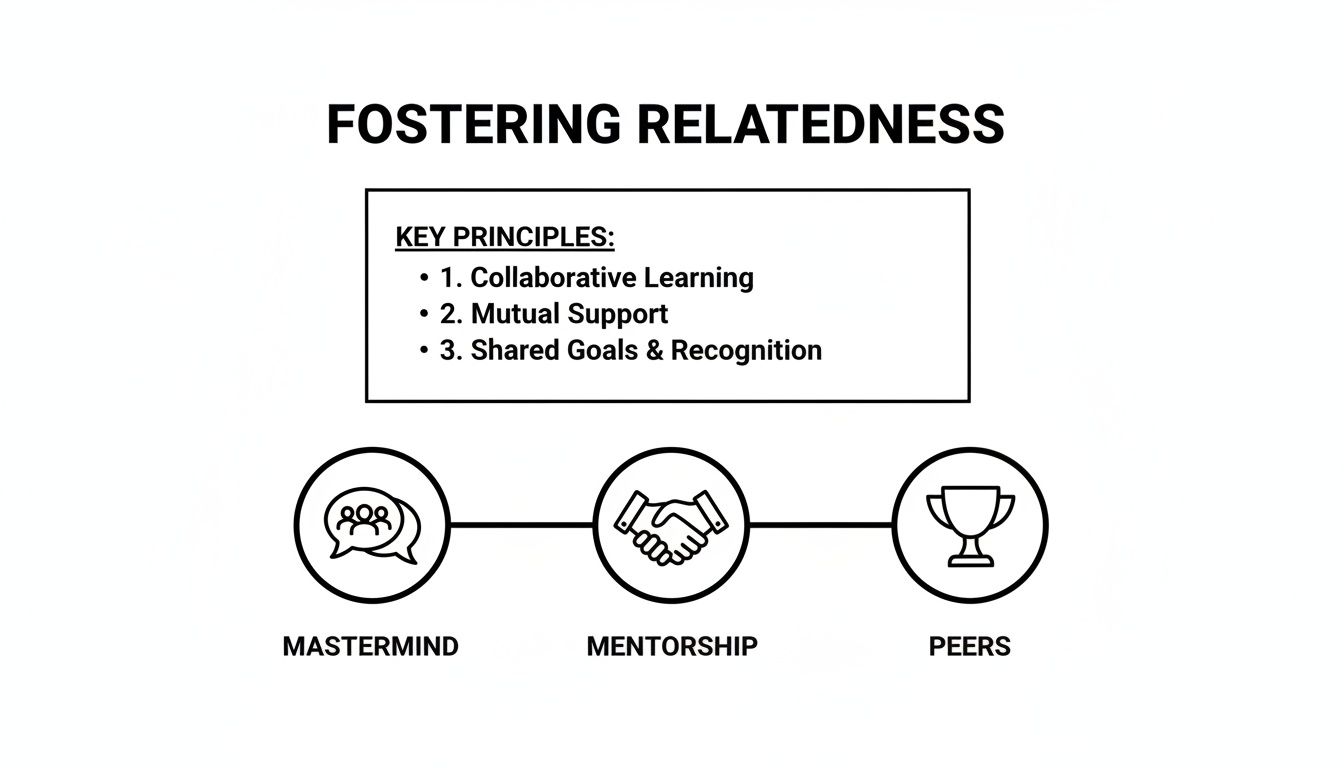
This just goes to show that true connection isn’t something you wait for; it’s an ecosystem you actively build and contribute to.
The Head Triad: Types 5, 6, and 7
Driven by a need for security, mental stimulation, and a handle on their anxiety, these types are all about feeling prepared and free. Their motivation is often tied to managing fear and finding certainty in an uncertain world. To go deeper, you can learn more about the Enneagram core motivations that define each type's perspective.
• Type 5, The Investigator: • Your code is a potent mix of • autonomy and competence • . Give you the space and resources to master a subject on your own terms, without people breathing down your neck, and you become unstoppable.
• Type 6, The Loyalist: • You are powered by • relatedness and competence • . You absolutely need to feel secure and supported by a trusted team or a reliable system. Your motivation skyrockets when you know you're a prepared, essential part of a group you can count on.
• Type 7, The Enthusiast: • Your number one driver is • autonomy • . You are pulled forward by freedom, new experiences, and the exciting possibility of what's just around the corner. Rigid routines and limitations are your kryptonite.
Intrinsic Motivation Levers for Each Enneagram Type
Finding your primary driver is like getting a shortcut to your own motivation. While we're all complex, knowing your starting point can make a world of difference. This table is a quick-reference guide to help you identify your main lever.
| Enneagram Type | Your Primary Motivator | A Quick Tip to Get Started |
|---|---|---|
| Type 1 | Competence | Master one small, meaningful skill this month. Focus on the process, not just the outcome. |
| Type 2 | Relatedness | Schedule a meaningful, no-agenda coffee with a colleague or friend you want to support. |
| Type 3 | Competence | Define what "success" means to you, without any external input. Pick one internal metric to track. |
| Type 4 | Autonomy | Carve out 30 minutes a day for a creative project that is 100% for you and no one else. |
| Type 5 | Autonomy | Block off "deep work" time in your calendar and fiercely protect it from interruptions. |
| Type 6 | Relatedness | Identify one person on your team you trust and ask them to be your "reality check" buddy on a current project. |
| Type 7 | Autonomy | Introduce one new, exciting element into your weekly routine to break up the monotony. |
| Type 8 | Autonomy | Find one area, however small, at work or home where you can take complete ownership and make the final call. |
| Type 9 | Relatedness | In your next team meeting, make a point to voice one opinion or idea, even if it feels uncomfortable. |
Use this as your starting point. Experiment with these tips and pay attention to what makes you feel alive and engaged. Your motivation isn't a mystery; it's just waiting for the right key.
Your Burning Questions Answered
Alright, we've covered the theory, the strategies, and even some Enneagram-specific tricks. But let's be honest—when you're in the trenches trying to build real, lasting motivation, questions always pop up. It's never a perfectly straight line from A to B.
So, let's tackle some of the most common questions I hear from people just like you.
Okay, Remind Me—What’s the Difference Between Intrinsic and Extrinsic Motivation?
Glad you asked! It’s one of the most fundamental pieces of this puzzle.
Think of it this way: intrinsic motivation is the fire from within. It’s that software developer in Seattle who gets so lost in a personal coding project that she completely loses track of time. She's not doing it for a paycheck or a promotion; she's doing it for the sheer joy and challenge of it. The work is the reward.
Extrinsic motivation is all about the external stuff—the carrots and sticks. It's that same developer powering through a soul-crushingly boring task because there's a fat bonus waiting at the end. Both get you to the finish line, but only one is a sustainable fuel source for the long haul.
Can I Be Motivated by Both at the Same Time?
You bet. In fact, we almost always are. The real world is a messy mix of internal drives and external pressures. The trick isn't to pick one, but to understand how they play together.
Sometimes, an external reward can actually pour water on your internal fire. Psychologists call it the "overjustification effect."
Imagine you love baking for your friends in your Phoenix neighborhood just because it makes you happy ( intrinsic ). But then, a local café offers to pay you for every cake. Suddenly, it can start to feel like a chore, a job. The pure joy starts to evaporate. Your goal shouldn't be to get rid of all external motivators, but to make sure they don't hijack the internal ones that truly keep you going.
A healthy balance is everything. Think of extrinsic goals as signposts on a map, but let your intrinsic drive be the engine that actually powers the car. The best systems blend the two without letting one snuff out the other.
Seriously, How Long Does This Take to Build?
Ah, the million-dollar question. I wish I could give you a neat, tidy answer, but building intrinsic motivation isn't like flipping a switch. It's more like cultivating a garden. It takes patience, consistent watering, and the right conditions.
You'll need to consistently feed your core psychological needs for autonomy, competence, and relatedness.
You might start to feel a real shift in just a few weeks, especially if you're actively "job crafting" or setting new learning goals. But for those deeper, more automatic changes to kick in? We're likely talking a few months. The key is to stop looking for an overnight miracle and focus on small, consistent wins.
For example, a project manager in Austin could start by simply taking full ownership of one small part of the weekly team meeting. It seems tiny, but that single act of autonomy, repeated week after week, builds a surprisingly powerful foundation for a more internally driven mindset.
Ready to decode your own motivational DNA? At Enneagram Universe , we provide the tools to understand what truly makes you tick. Take our free, scientifically validated Enneagram test t o discover your type and get personalized strategies for unlocking your deepest potential. It's time to find your unique path to a more passionate and fulfilling life.