How to Decrease Staff Turnover: Data-Backed Methods to Retain Top Talent

If you want to slam the brakes on employee turnover, you need to zero in on three things: better managers, a culture people actually enjoy, and a real chance for them to grow. A constant parade of new faces isn't just an HR problem; it’s a silent killer of profits, morale, and momentum. The first step to fixing a leaky bucket is to find the holes.
The True Cost of a Revolving Door Workplace
Let's cut to the chase: high turnover is one of the most expensive, yet underestimated, problems your business is facing. It’s so easy to write it off as the cost of a recruiter's invoice or a few job postings. That’s like looking at the tip of an iceberg and thinking you’ve seen the whole thing.
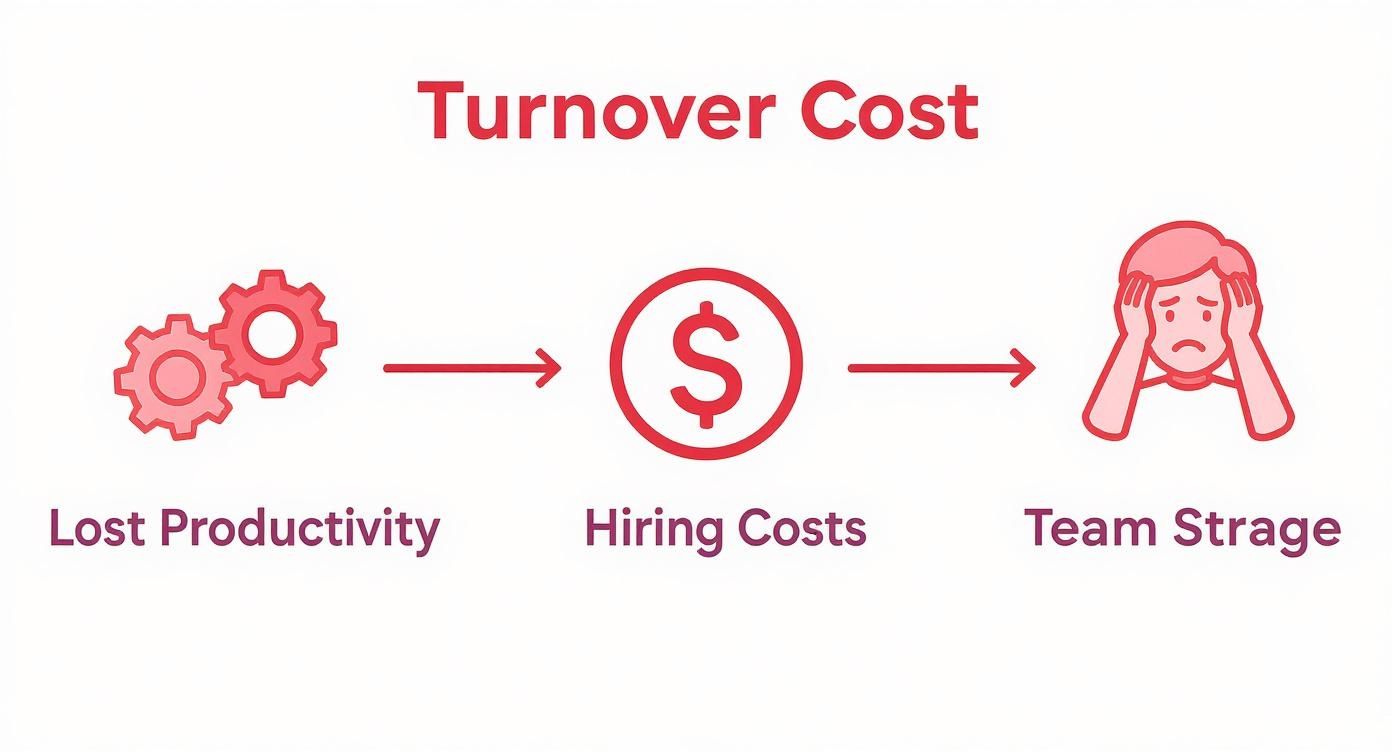
The real damage is happening under the surface, quietly bleeding your company dry of money, productivity, and team spirit. Every single time a good employee walks out, they take a chunk of your company’s brain with them—all those unwritten rules, client quirks, and project backstories just vanish. That loss sends ripples through the whole team.
It's So Much More Than Replacement Fees
The financial drain from turnover is a slow, steady bleed that goes way beyond the obvious. Your remaining team members have to pick up the slack, which is a fast track to burnout and disengagement. And guess what burned-out employees do? They start polishing their résumés. Meanwhile, productivity nosedives while the new person tries to figure out which way is up, a process that can easily take months.
Think about all the hidden ways this is costing you:
• Productivity Black Holes: • The work isn't getting done by the person who left, and the new hire is still learning the ropes. You're looking at a productivity gap that can last for months on end.
• Team Whiplash: • How can a team build trust or feel secure when their deskmates keep changing? Constant churn kills cohesion and makes everyone a little more anxious about their own job.
• The Hiring Hamster Wheel: • Your managers and HR folks are stuck spending their days sifting through résumés, conducting interviews, and running orientations instead of, you know, growing the business.
Managers, in particular, get squeezed the hardest. They're stuck trying to hit their targets while simultaneously training a never-ending stream of new people. It's exhausting.
This is the reality for so many leaders—stuck trying to make the numbers work while their team is in a state of constant flux.
The Staggering Financial Reality
The numbers don't lie, and they paint a pretty grim picture. While the average voluntary turnover rate in the U.S. has dipped a bit recently, the financial fallout is still massive. U.S. companies are losing a mind-boggling $2.9 trillion a year because people are choosing to leave their jobs.
Even more shocking? The cost to replace just one employee can be anywhere from 30% to a whopping 400% of their annual salary, depending on how specialized their role is. You can dig into more of these workforce turnover trends to see the full scope of the impact.
And don't think this is just a problem for the big corporations. For a small business, losing one key player can throw entire projects into chaos and put crucial client relationships at risk.
Before we move on, let's break down exactly where these costs are coming from. Most are hidden in plain sight.
Hidden Costs of Employee Turnover Beyond the Obvious
| Cost Category | Description | Example Financial Impact |
|---|---|---|
| Recruitment & Hiring | The direct costs of finding and hiring a replacement. | Advertising fees (500), recruiter commissions (20% of salary), background checks (100), and time spent by HR/managers on interviews (40+ hours). |
| Onboarding & Training | The investment required to get a new employee up to speed. | Formal training programs ($1,500), manager's time spent coaching (50+ hours), IT setup costs, and initial productivity ramp-up time. |
| Lost Productivity | The gap between the departing employee's output and the new hire's initial output. | It can take 1-2 years for a new hire to reach the productivity level of an experienced predecessor. The team's output also drops by an average of 10-20% during the vacancy. |
| Team & Morale Impact | The "soft" costs associated with team disruption and decreased engagement. | Increased stress on remaining staff, potential for "turnover contagion" (others leaving), and a drop in overall team morale and collaborative spirit. |
| Loss of Knowledge | The institutional and client-specific knowledge that walks out the door. | Loss of key client relationships, undocumented internal processes, and project history, leading to errors and rework. |
Seeing it all laid out like this really drives the point home, doesn't it? These aren't small numbers.
Key Takeaway: If you're only looking at turnover as a line item for recruitment, you're missing the plot. It’s a systemic problem that's quietly wrecking your culture, productivity, and bottom line.
Ultimately, understanding the true cost isn’t about creating panic. It's about building an undeniable business case for investing in your people. Once you truly grasp the financial and cultural toll, the strategies in this guide—from smarter onboarding to better management—stop looking like expenses and start looking like the high-return investments they really are. The goal is to build a place that people are genuinely excited to be a part of.
Find the Real Reasons Your Employees Are Leaving
Throwing money at a turnover problem without knowing the root cause is like trying to fix a leaky pipe by painting the wall. You might be gearing up for a huge salary bump across the board, only to find out your team is actually dying for a clear career path. To get a real grip on why people are leaving, you have to put on your detective hat first.
Let's be honest, that generic, once-a-year employee survey isn't cutting it. Everyone just clicks through it to get it off their to-do list. To get the real story, you need to dig deeper and create real channels for honest feedback. It's time to stop guessing and start solving the right problems.
Go Beyond the Exit Interview with Stay Interviews
Exit interviews have their place, but they're fundamentally reactive. You're collecting data after the game is already lost. The real magic? Stay interviews .
These are simple, informal one-on-one chats with your current top performers. The goal is to figure out what keeps them showing up every day and, more importantly, what might tempt them to look elsewhere. It’s a game-changer for building trust and turning managers into partners in retention, not just spectators.
Think of these conversations as your early warning system, letting you catch small frustrations before they snowball. Keep them casual and forward-looking. Try asking questions like:
• "What do you look forward to when you come to work each day?"
• "If you had a magic wand, what's one thing you'd change about your role?"
• "What would make your job feel more meaningful or engaging?"
Tailoring Your Stay Interview Questions by
Enneagram Type
Generic stay-interview questions ("what would make you leave?") often get generic answers. Asking in a way that matches how someone actually processes their own experience tends to get you the real answer instead:
• Types 1, 6 (security/standards-driven): • "What, if anything, feels unstable or unclear about where things are headed here?"
• Types 2, 9 (relationship-driven): • "Do you feel like your contributions are actually seen here, not just appreciated in passing?"
• Types 3, 8 (achievement/autonomy-driven): • "Where do you feel like you have real ownership, versus just executing someone else's plan?"
• Types 4, 5 (autonomy/depth-driven): • "Is there anything about how you work here that feels forced into a mold that doesn't fit you?"
• Type 7 (variety-driven): • "What's started to feel repetitive or predictable in your role?"
None of these replace a real conversation — but they get past the polite non-answer a generic question usually produces.
Dive Deep into Your Departure Data
While stay interviews are proactive, don't toss your exit data just yet. That stuff is a goldmine. Stop filing away those notes and start treating them like case files. Are you seeing patterns?
Maybe multiple people from the same department keep mentioning the same manager. Or perhaps a lack of flexibility is a recurring theme. Sift through the noise to find the signal. For brutally honest feedback, consider using a third-party service to conduct exit interviews. People are often far more candid with a neutral party than with their soon-to-be-former boss.
A Real-World Example: I worked with a fast-growing tech startup that was bleeding engineers. The leadership team was convinced it was about salary and was about to roll out a massive, company-wide pay raise. Ouch.
Before they did, they ran a few stay interviews. The discovery was stunning. The real issue wasn't pay at all—it was a complete lack of career progression. Their best engineers felt stuck with nowhere to grow. The fix? They built and communicated a clear engineering career ladder. It was a far cheaper and infinitely more effective solution that directly solved the actual problem.
Use Pulse Surveys and eNPS for a Real-Time Vibe Check
Annual surveys are ancient history. By the time you get the results, the problems have already morphed into something else. Instead, use quick, frequent pulse surveys to get a snapshot of how the team is feeling right now .
Another killer metric is the employee Net Promoter Score (eNPS) . It’s based on one simple but powerful question: "On a scale of 0-10 , how likely are you to recommend our company as a great place to work?" Tracking this number over time gives you an ongoing, at-a-glance view of team morale.
When you start blending these quantitative metrics with qualitative insights from something like personality assessments, you get a much richer, more three-dimensional picture of what's happening. You can even use these tools for more intentional team building through personality assessments .
By combining these diagnostic tools, you shift from just reacting to turnover to proactively managing retention. You can finally pinpoint the exact sources of friction—whether it’s leadership, culture, or compensation—and build targeted strategies that actually move the needle.
You can’t fix a turnover problem in the exit interview. That’s an autopsy, not a cure. The real fight to keep your best people starts way earlier—the moment you even think about posting a job opening. It’s all about shifting from panicked damage control to a proactive strategy of hiring people who truly fit and making them feel like they’ve found their place from day one.
If your hiring process is just a glorified skills checklist, you're missing the forest for the trees. You can teach someone new software, sure. But you can't teach them to genuinely care about your mission or to click with your team's weird inside jokes. That’s why your interview process needs to be all about cultural alignment .
Hire for Who They Are, Not Just What They Can Do
Let's ditch the tired old question, "Where do you see yourself in five years?" It’s a performance, not a window into their soul. To get real answers, you need to dig into past behavior. That's where behavioral questions become your most powerful tool.
Stop asking hypotheticals and start asking for stories:
• "Walk me through a time you had to work with a seriously difficult colleague. How did you handle it, and what happened?"
• "Tell me about a project you jumped on that wasn't technically your job. What made you do it?"
• "Describe a project that totally bombed. What was your role, and what did you take away from the experience?"
These questions peel back the polished interview persona. You get a glimpse of how they actually handle stress, navigate conflict, and solve problems—the stuff that really matters day-to-day. You’re not just hiring a résumé; you’re bringing on a new teammate.
And let’s be honest, in a competitive market, great benefits are table stakes. Things like offering small business health insurance aren't just perks; they're a clear signal that you invest in your people's well-being right from the start.
Onboarding: More Than Just Paperwork
Most onboarding is a soul-crushing slog through compliance videos and stacks of forms. What a colossal missed opportunity. A killer onboarding experience doesn't just teach someone their job; it pulls them into your company's world and starts building loyalty before they’ve even logged into their email.

Think of it as a 90-day journey , not a two-day data dump. This simple shift turns the new-hire anxiety phase into a guided tour of learning, connecting, and contributing.
Pro Tip: Your onboarding is the first real taste a new employee gets of your company culture. Make it a good one. A structured, engaging process can dramatically cut down on that "less-than-a-year" turnover and set people up for the long haul.
A solid 90-day plan needs clear milestones. Week one? Total cultural immersion. They should be meeting the team, learning the "why" behind what you do, and picking up on the unwritten rules. Month one is all about mastering the core parts of their role, with lots of check-ins and small wins to build momentum. By day 90, they should be a fully functioning part of the team, ready for their first real performance chat.
Make Friends, Not Just Colleagues
One of the biggest culprits behind early exits is simple loneliness. People feel isolated and disconnected. The good news is you can fix this by being ridiculously intentional about building social bonds from the very beginning.
Here are a few tactics that work wonders:
• The Welcome Swag Box: • Send a box with some cool company gear, a handwritten note from their new manager, and their first-week schedule • before • they even start. It’s a small touch that screams, "We can't wait for you to get here!"
• The Buddy System: • Pair them with a work buddy who isn't their boss. This is their go-to person for all the "silly" questions they’re too nervous to ask their manager, like how to work the espresso machine or which Slack channels are for memes.
• Forced Fun (The Good Kind): • Don’t just hope they’ll make friends at the water cooler. Schedule a team lunch their first week. Set up 15-minute coffee chats with people from totally different departments. These structured interactions break the ice and start weaving them into the company's social fabric.
When you focus on winning the retention battle from day one, you’re doing so much more than just filling a seat. You’re investing in a person who is far more likely to stick around, do amazing work, and become one of your company’s biggest cheerleaders.
Build a Culture People Don't Want to Leave
Let's get one thing straight: you can't buy your way out of a bad culture. Pouring money into bigger salaries while your workplace is a toxic mess is like slapping a designer bandage on a festering wound. It might look better for a second, but it’s not fooling anyone.
The real secret weapon in the war on turnover? Building a place where people feel seen, safe, and genuinely connected to something bigger than themselves. Forget the ping-pong tables and free kombucha on tap. Those are just decorations. The real foundation is trust and respect—creating an environment where people want to show up and do great work. That’s how you stop being a revolving door and start becoming a talent magnet.
Foster Radical Transparency and Trust
Your team is smart. They can smell corporate spin from a mile away. The fastest way to earn their trust is to treat them like the adults they are and be radically transparent, especially when the news is bad. This isn't just an HR initiative; it's a leadership mandate.
Try holding quarterly "ask me anything" town halls where nothing is off the table. Leaders need to share the real story—the wins, the losses, and the messy stuff in between. When an employee asks about a layoff rumor or a failing project, a vague, jargon-filled answer kills morale instantly. A direct, honest response, even if it’s tough to deliver, builds more loyalty than a thousand motivational posters ever could.
This kind of joy isn't staged. It's the natural result of a culture built on psychological safety, where wins are celebrated together because everyone feels like they truly contributed. It grows in an environment of shared purpose, not one of fear.
Building this atmosphere takes time and commitment, but it’s the most critical investment you'll make. For a deeper dive, check out our practical guide on how to improve workplace culture .
Make Employee Recognition Actually Mean Something
The dusty "Employee of the Month" plaque is officially dead. Or at least, it should be. Meaningful recognition isn't a one-size-fits-all program; it’s about making individuals feel seen and valued for their unique contributions. It's the difference between feeling like a cog in the machine and feeling like a vital part of the mission.
Key Insight: The most powerful recognition is timely, specific, and personal. A quick, genuine "thank you" for a specific action often lands with more impact than a formal, delayed award.
Instead of just top-down awards, inject recognition into the daily flow of work with peer-to-peer platforms. Tools like Bonusly or Nectar empower teammates to give each other small, public shout-outs tied to company values. Suddenly, gratitude starts flowing in every direction, not just trickling down from the top.
Here are a few ways to level up your recognition game:
• Personalize the Reward: • Ditch the generic gift cards. If you know an engineer is a huge coffee nerd, get them a gift card to their favorite local roaster. If a marketer is saving for a big trip, an extra day of PTO might be the most valuable thing you can offer. It shows you're paying attention.
• Celebrate the "How," Not Just the "What": • Don't just praise someone for hitting a sales number. Praise them for the ridiculously collaborative way they worked with the product team to get it done. You'll reinforce the very behaviors you want to see more of.
• Amplify Praise Publicly: • When you give someone props in a one-on-one, take an extra 30 seconds to share it in the team-wide Slack channel or at the start of your next huddle. Public praise multiplies the good feelings and inspires everyone else.
When you nail these cultural cornerstones, you create a workplace that people are genuinely proud of. It’s an environment where trust is the default and appreciation is a daily habit. That’s a company people don’t just work for—they believe in it.
Turn Your Managers into Retention Magnets
Let's be honest about an old, uncomfortable truth: people don't leave companies, they leave managers. It's a cliché because it's true. You can pour money into fancy offices and craft a mission statement that would make a poet weep, but if an employee's daily experience is a boss who breathes down their neck, avoids conflict like the plague, or offers zero real support, they’re already polishing their resume.
Your managers are the front line in the war for talent. They are the single most powerful lever you have to stop the revolving door.
Transforming your managers from glorified taskmasters into genuine coaches is a direct investment in keeping your best people. It's about giving them the tools to build trust, go to bat for their teams, and create these little pockets of awesome within the company where people feel they can actually thrive. This isn't fluffy "soft skills" stuff; it's the hard, practical work of leadership that prevents your top talent from taking that recruiter's call.
From Boss to Coach: A Practical Roadmap
The first move is a mindset shift. A manager's job isn't just about hitting deadlines and checking boxes. Their real job is to get the best out of their people, period. This means your training needs to focus on human connection and coaching, not just project management software.
The numbers don't lie. A massive Gallup study found that a staggering 50% of employees who quit cite their direct manager as the reason. This isn't a small problem; it's the problem. It shows that trust in leadership is the bedrock of retention.
So, where do you start? Don't boil the ocean. Focus your training on a few high-impact areas that get quick wins:
• Giving Feedback That Doesn't Suck: • Teach managers how to deliver feedback that's specific, helpful, and forward-looking, instead of a soul-crushing critique that just makes people defensive.
• One-on-Ones That Actually Matter: • Get them to stop treating these as status updates. This is the employee's time to talk about career goals, roadblocks, and what’s driving them crazy. It’s a listening session, not a reporting session.
• Spotting Burnout Before It's an Inferno: • Train managers to recognize the early warning signs—a dip in engagement, a rise in cynicism, a pattern of missed deadlines. They need to be the smoke detectors.
These can't be one-and-done workshops. This stuff needs to become a habit, baked into your culture and backed by senior leadership.
Mastering the Conversations Everyone Hates
Let's talk about the big one: tough conversations. This is where most managers stumble. Whether it's addressing poor performance or mediating a team squabble, they often do one of two things: avoid it entirely (and let the problem fester) or handle it so badly they leave a trail of demoralized employees in their wake.
The trick is to give them simple, repeatable frameworks. Scripts, even. Take a performance issue. Instead of leading with an accusation, a manager can open with a supportive, collaborative tone.
Something like this works wonders: "Hey, Alex. I wanted to check in on the Q3 report. I noticed a few of the data points were missing, which isn't like you at all. Is everything okay? Let's walk through it together and figure it out."
See the difference? That’s an invitation to a conversation, not a courtroom summons. It positions the manager as a coach who is there to solve a problem with the employee, not just point out their flaws. Arming your leaders with practical approaches like this takes the fear out of difficult talks and turns them into moments for growth. Diving into specific coaching skills for leaders can give them a whole toolkit for these exact scenarios.
This is a simple table to get you started on a real, actionable training plan.
Manager Training Action Plan for Retention
| Skill Area | Training Activity Example | How It Reduces Turnover |
|---|---|---|
| Coaching & Feedback | Role-playing with real-world scenarios for delivering both positive reinforcement and constructive criticism. | Employees feel valued and see a clear path for growth, making them less likely to look elsewhere for development. |
| Psychological Safety | Workshops on active listening and asking open-ended questions. Managers practice creating a "no dumb questions" environment. | When people feel safe to speak up, make mistakes, and be authentic, they are more engaged and committed to the team. |
| Career Pathing | Training on how to conduct meaningful career development conversations and connect daily tasks to long-term goals. | Staff can see a future at the company, which directly counters the "dead-end job" feeling that drives people away. |
| Conflict Resolution | A session on de-escalation techniques and mediating disagreements between team members fairly and effectively. | A manager who can resolve conflict prevents a toxic environment from taking root, which is a major reason people quit. |
This isn't just about ticking boxes; it's about building a foundation of leadership that people want to work for.

When you invest in turning your managers into retention magnets, you're doing more than just plugging a leak in the boat. You're building a stronger, more resilient, and more engaged organization from the inside out. You're creating a place where people feel seen, supported, and genuinely excited to stick around—and that’s the most powerful retention strategy there is.
Let's Talk About Those Lingering Turnover Questions
Alright, even with a solid game plan, some tricky questions always seem to surface when you're in the trenches trying to figure out how to decrease staff turnover . Let's cut through the noise and tackle the most common ones I hear from fellow leaders.
Help! Turnover Is High Everywhere. Where Do I Even Start?
When it feels like every department is a revolving door, the urge is to launch a massive, company-wide fix. Don't. You can't boil the ocean.
Instead, get granular. Pick the single department, team, or specific role that’s bleeding the most talent. Put all your energy there first. Isolate the problem. This laser focus lets you dig deep with stay interviews and exit data that actually tell a story.
You might just find the "company-wide" problem is actually one manager’s toxic leadership style. Or maybe one specific job description is a recipe for burnout. Solving your biggest, most painful problem first not only stops the bleeding but often creates a positive ripple effect. It gives you a win to build on.
I once worked with a retail company whose new store associates were quitting within 90 days at an insane rate. Instead of a sweeping corporate initiative, we just focused on fixing their retail onboarding. We added a buddy system and more frequent manager check-ins. That one change cut their early turnover dramatically and gave us a blueprint for other departments.
Seriously, How Long Until I See Results?
This isn’t an overnight fix. But you don't have to wait a year to know if you're on the right track. You’ll see progress in stages if you know what to look for.
• In 1-3 Months: • Keep an eye on your leading indicators. Are pulse survey scores for engagement ticking up? Are you hearing better things in your one-on-ones? This is the early smoke that tells you a fire is starting to catch. It means people feel the change.
• By 6 Months: • You should see a real, measurable dip in your quarterly turnover numbers, especially in the team you targeted. The bleeding is slowing down.
• After 12+ Months: • This is the big one. After a full year of consistent effort, you’ll see that annual turnover rate finally make a significant, sustainable drop.
My Two Cents: Don't get fixated on that big annual number at the beginning. Celebrate the small wins in morale and engagement along the way. They're the proof that your hard work is actually paying off and building momentum for the long haul.
We're a Small Company. Can We Really Afford to Focus on This?
Let me flip that around: a small business can't afford not to. You might not have a six-figure HR budget, but honestly, the most powerful retention tools are often cheap or free. For a small team, losing just one key person can be absolutely devastating—way more than for a Fortune 500 company.
Your superpower is your size. You can make changes and see the impact almost immediately, without getting bogged down in corporate red tape.
Here are a few high-impact, low-cost ideas:
• Give Genuine Recognition: • A specific, public "thank you" costs nothing and means everything.
• Offer Real Flexibility: • The ability to work from home or adjust hours can be more valuable than a small raise.
• Have Real Career Conversations: • Just sitting down with your people and talking about their goals is one of the most powerful things you can do.
If you’re looking for more ideas, this guide on proven strategies to reduce staff turnover is packed with practical tips that work for businesses of any size.
Is It Always About the Money?
Nope. But you can't ignore it, either.
Think of compensation as the foundation of a house. If it’s cracked—meaning you're paying way below the market rate—it doesn’t matter how amazing the rest of the house is. Everything is at risk of crumbling. Uncompetitive pay is like putting a giant "Poach Me" sign on your best employees' backs.
Your goal is to get pay to a point where it's solid, fair, and no longer the main reason people leave. Once you’ve neutralized money as a problem, all the other things—great managers, a killer culture, real growth opportunities—can truly shine and become the reasons people stay for good.
At Enneagram Universe , we believe that truly understanding your people is the secret to building a place they never want to leave. Our scientifically validated assessment helps you see what truly motivates your team members, empowering you to build stronger, more engaged, and more resilient teams. Find out how personality insights can be your secret weapon in the fight against turnover at Enneagram Universe .