How to Deal with Know-It-Alls in Work and Everyday Life

You’re in a meeting, and someone has already corrected the wording on slide two, interrupted the person from finance, and explained your own idea back to you as if they invented it. Or you’re at dinner with a relative who can’t let one comment pass without a lecture. You leave the interaction feeling irritated, oddly smaller, and tempted to either argue or disappear.
That reaction makes sense.
A know-it-all can drain the energy out of a room because the issue usually isn’t intelligence. It’s dominance. They don’t just offer information. They take over space, certainty, and airtime. If you’ve been searching for how to deal with know-it-alls , the first relief is simple. You do not need to outsmart them to handle them well. You need a strategy.
You Are Not Crazy, They Are Just a Know-It-All
There’s a big difference between an informed person and a person who needs to be the authority in every conversation.
The informed person can share, pause, listen, and even say, “I’m not sure.” The know-it-all usually can’t. They treat every exchange like a courtroom closing statement. If they aren’t correcting, advising, or topping your story, they look restless.

In workplaces, this isn’t rare. Approximately 68% of employees encounter at least one know-it-all colleague annually , according to the American Management Association . That matters because people often assume they’re being too sensitive when they feel worn down by this behavior. They’re not. Repeated interruption, unsolicited correction, and conversational one-upmanship create real friction.
The real goal is not winning
Individuals often make one of two mistakes. They either fight the know-it-all head-on and get pulled into a pointless logic contest, or they say nothing and simmer. Neither option brings peace. One creates escalation. The other creates resentment.
That shift changes everything. The best response is usually calm, specific, and boundaried. Not theatrical. Not passive.
Why the Enneagram helps
Here, personality work earns its keep. A know-it-all isn’t always driven by the same motive. One person corrects because they’re terrified of being wrong. Another performs expertise because they need admiration. Another dominates because yielding feels unsafe. The behavior can look similar on the surface, but the engine underneath is different.
The Enneagram gives language for that engine. It helps you stop taking every interruption personally and start responding to the actual pattern in front of you. That doesn’t excuse rude behavior. It makes you more effective with it.
If you’ve been exhausted by someone who always has the answer, the problem may be exactly what you think it is. Not your tone. Not your confidence. Not your imagination.
The Official Know-It-All Spotter's Guide
You can spot a know-it-all faster when you stop asking, “Are they smart?” and start asking, “How do they handle not being in charge of the conversation?” That question reveals a lot.
What a know-it-all actually does
Look for a pattern, not a single annoying moment.
• They interrupt to establish rank. • They don’t just jump in from enthusiasm. They cut in to redirect attention toward themselves.
• They give advice you didn’t ask for. • You mention a problem, and they answer as if they’ve been appointed chief consultant.
• They struggle to say “I don’t know.” • Uncertainty makes them visibly uncomfortable.
• They explain familiar things at length. • Even when everyone in the room already understands the point.
• They need the last word. • Conversations don’t feel complete to them unless they finish on top.
• They confuse disagreement with disrespect. • If you offer another view, they act as if you challenged their worth.
A real expert sounds different. Experts usually ask clarifying questions. They calibrate their language to the room. They don’t need to advertise competence every five minutes.
What may be driving the behavior
Generic advice often misses the most useful layer. Different personality types can express know-it-all behavior for different reasons , and understanding whether someone is driven by Type 1 perfectionism, Type 3 achievement-obsession, or Type 8 control needs allows a more individualized response, as noted in this personality-focused overview .
That lens matters in practice.
A Type 1 flavored know-it-all may sound rigid because they’re attached to correctness. A Type 3 flavored one may sound polished and forceful because they’re attached to image and success. A Type 8 flavored one may sound blunt because they equate strength with certainty.
A quick reality check
Ask yourself these questions:
If the answer to that third question is “diminished” over and over, you’re not dealing with a harmless quirk. You’re dealing with a relational pattern.
Naming the pattern matters because you stop using the wrong tools. Pleasing them doesn’t fix it. Matching their intensity usually worsens it. Clear communication works better than verbal fencing.
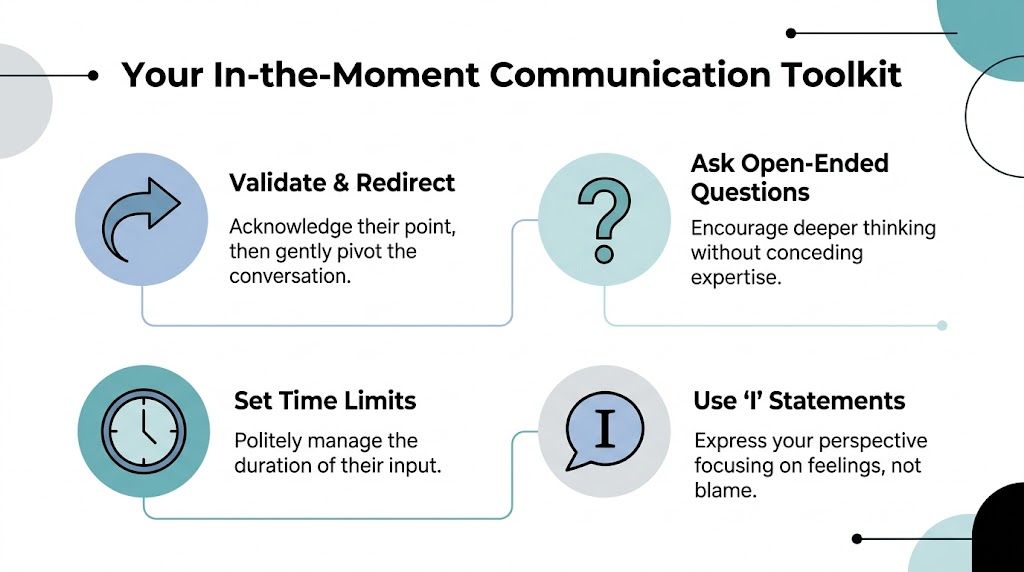
Your In-the-Moment Communication Toolkit
When a know-it-all starts revving up, your best move is rarely a brilliant comeback. It’s a calm move that keeps you in charge of your own lane.
That means less debating, more steering.
Start neutral, not accusatory
If you begin with “You always do this,” most know-it-alls will hear a threat, not a request. A more neutral opening works better. Using a neutral start like “I’ve noticed a recurring interaction pattern” instead of an accusation boosts agreement rates to 65% in difficult conversations , according to Crucial Learning benchmarks .
That sentence works because it names a pattern without turning the first line into a trial. Try these.
Use scripts that redirect instead of wrestling
These are the phrases I reach for most often because they lower the heat without surrendering your point.
Validate and redirect
This works when someone is flooding the conversation with input.
You’re not agreeing. You’re managing airtime.
Decline unsolicited advice cleanly
This is useful with coworkers, family members, and that one friend who thinks every comment requires a TED Talk.
Short beats elaborate. The longer your explanation, the more material they have to argue with.
Ask open questions that slow them down
A know-it-all often speaks in certainty. Questions can move them from performance into thought.
• Ask for specifics. • “What do you see as the main issue here?”
• Ask for limits. • “Where do you think that approach might not work?”
• Ask for collaboration. • “What would a shared solution look like to you?”
This is one of the fastest ways to stop a monologue from steamrolling the room.
Use tone like a lever
A sharp tone may feel satisfying for ten seconds. It usually creates a second problem.
If you want help refining directness, this piece on how to say what you mean without sounding sharp is useful because it highlights the difference between clear language and cutting language. That distinction matters with people who are already primed for defensiveness.
A simple formula helps:
• Low emotion
• Specific observation
• Clear request
For example:
That lands better than “You never listen.”
Know when to end the exchange
Some people don’t want dialogue. They want victory.
When you notice that, stop trying to educate them in real time. End the loop.
If defensiveness is part of your own stress response in these moments, this guide on “ How to Stop Being Defensive: Transform Your Conversations ” can help you catch your side of the cycle before it escalates.
What doesn’t work
A few habits almost always backfire.
• Public humiliation. • It may feel deserved. It usually hardens them.
• Sarcastic jabs. • Funny to bystanders, costly in relationships.
• Over-explaining. • The more you justify, the more they cross-examine.
• Competing on certainty. • That turns you into a second know-it-all.
Your power is not in overpowering them. It’s in staying grounded while they try to pull the interaction onto their turf.
The Enneagram Angle: How to Tailor Your Approach?
The Enneagram doesn’t label people as “the know-it-all type.” It gives you a map of motivations that can produce know-it-all behavior when someone is stressed, defensive, or overidentified with their coping style.
That’s why this framework is so useful. The same behavior can come from very different fears.
Four common patterns behind the behavior
A Type 1 flavored know-it-all often isn’t trying to impress you. They’re trying to prevent error. They may correct details, tighten language, point out what’s missing, or insist on the proper way to do things. Their inner world often runs on standards. When they’re less grounded, that standard leaks outward as chronic correction.
What works with them is precision and respect. Say, “You care a lot about getting this right. I do too. I need room to finish my thought before we refine it.” Don’t mock their standards. Don’t bait them with sloppiness just to prove a point. That usually intensifies the behavior.
A Type 3 flavored know-it-all often manages image through performance. They may present themselves as the person with the answer, the strategy, the shortcut, the win. If they sense they might look uninformed, they may overstate certainty or dominate the room. The behavior can look smooth and high-functioning, which makes it harder to challenge.
What works is appealing to outcomes and impact. Try, “Your input is valuable. When others can’t get a full sentence in, the team loses ideas.” That frames the issue in terms they can respect. Not shame. Results.
Type 5 doesn’t always look like the classic loud know-it-all. Sometimes this version is quieter, but still rigid. They may hoard information, speak with cool certainty, dismiss emotional input, or act as though knowledge outranks everyone else’s lived experience. Their know-it-all pattern can come from safety through mastery.
What works is clarity and scope. Say, “You know this topic thoroughly. I’m also weighing practical factors beyond the data.” This acknowledges competence without handing them total authority.
A Type 8 flavored know-it-all often comes in strong. Direct, forceful, certain, impatient with hesitation. They may not care whether they sound polished. They care whether they sound powerful. If vulnerability feels dangerous, certainty becomes armor.
What works is firmness without collapse. Say, “I’m open to direct conversation. I’m not open to being talked over.” With Type 8 energy, tentative wording can invite more pressure. Calm backbone matters.
Responding to Know-It-Alls by Enneagram Type
| Enneagram Type | Core Motivation | Recommended Strategy |
|---|---|---|
| Type 1 | To be good, correct, and responsible | Acknowledge their standards, then ask for less correction and more dialogue |
| Type 3 | To be valuable, capable, and impressive | Emphasize how collaboration improves results and credibility |
| Type 5 | To feel competent and self-sufficient | Respect their expertise while defining limits and practical context |
| Type 8 | To stay strong, autonomous, and in control | Be direct, brief, and steady. Don’t submit and don’t provoke |
How your type affects your response
This is the part many people skip. Your reaction also has a type pattern. A Type 9 may go quiet and resentful. A Type 6 may start over-explaining. A Type 2 may accommodate too long. A Type 8 may counter-dominate. A Type 1 may become just as corrective in return.
If you don’t know your own style, your response can become automatic instead of intentional. This is why understanding your own structure matters as much as understanding theirs. If you want a clean place to start, this beginner's guide to “ How to Find Your Enneagram Type: A Step-by-Step Guide for Beginners ” can help you identify the lens you’re bringing into conflict.
Tailored examples in real life
A few practical contrasts make this easier.
• With a Type 1 style know-it-all at work • , don’t say, “You’re being controlling.” Say, “Let me finish the draft first, then I want your edits.”
• With a Type 3 style manager • , don’t lead with hurt feelings alone. Say, “When you answer every question first, the team stops contributing.”
• With a Type 5 style partner or colleague • , don’t fight for emotional validation through debate. Say, “I’m not asking who’s right. I’m telling you how this landed.”
• With a Type 8 style family member • , don’t ramble. Say, “I’m willing to talk. I’m not willing to be bulldozed.”
The Enneagram won’t turn a difficult person into an easy one. It will help you stop using a butter knife where a wrench is needed.
Building Your Fortress of Healthy Boundaries
A script can save a conversation. A boundary can save your sanity.
That’s the difference. If you only handle know-it-alls in the moment, you stay in reaction mode. If you set terms for the relationship, you stop rebuilding the house after every storm.

Have the conversation about the pattern
At some point, the issue isn’t the latest interruption. It’s the repeated dynamic. That’s when you stop discussing content and start discussing process.
Try language like this:
Or this:
This kind of statement is harder to wiggle out of because it’s about your participation, not their self-image.
Pick your battles with intention
Not every correction deserves a response.
Some people are mildly annoying and manageable. Some are chronically disrespectful. Those are different categories, and your energy shouldn’t treat them the same way.
Use this filter:
• Address it now • if the behavior affects your work, your dignity, or the emotional tone of an important relationship.
• Let it pass • if it’s minor, one-off, or not worth the recovery cost.
• Reduce access • if every interaction leaves you depleted.
Boundary work includes selective engagement. You’re allowed to stop attending every verbal wrestling match.
Protect your inner life, not just your calendar
A know-it-all can hook your self-worth if you’re already prone to self-doubt. That’s why external boundaries matter, but internal ones matter too.
You may need routines that help your body come down after draining interactions. Some people use walks, journaling, breath work, or simple self-care rituals to reset before the next conversation. The method matters less than the message. Their need to dominate does not get to live in your body all day.
A practical reset can look boring. Good. Boring is sustainable.
A short practice for that reset is below.
When distance is the healthiest answer
Some people won’t change because the behavior works for them. It gets them control, attention, or emotional advantage.
If you’ve tried direct language, repeated the boundary, and the pattern stays contemptuous, distance may be the healthiest next move. That might mean fewer calls, shorter meetings, less disclosure, or firmer structure around when and how you engage.
That isn’t punishment. It’s stewardship. The most compassionate thing you can do is stop offering unlimited access to someone who keeps misusing it.
Reclaiming Your Peace of Mind in a Loud World
Know-it-alls can make you feel like every conversation is a test. It isn’t.
You don’t need to become colder, louder, or more impressive to deal with them well. You need to recognize the pattern, respond with clean language, understand the motivation underneath it, and hold a boundary that protects your peace.
That’s the whole game.
When you know who you’re dealing with, your response gets smarter. When you know yourself, your response gets steadier. That second part is easy to miss. Many people spend years learning how to handle difficult personalities while never noticing how their own habits keep them trapped. Over-accommodating, over-explaining, appeasing, snapping, freezing. Those patterns matter.
If people-pleasing keeps you stuck with know-it-alls longer than necessary, this article on How to Stop Being a People Pleaser and Reclaim Your Life is worth your time.
You may not be able to stop someone from acting superior. You can stop volunteering for the role of audience, sparring partner, or emotional sponge.
And once you do that, difficult people start taking up less room in your head.
If you want to gain a deeper understanding of your own conflict style, triggers, and communication patterns, take the assessment at Enneagram Universe . It’s a practical next step for figuring out why certain people hook you so fast, and how to respond with more clarity, confidence, and self-respect.