How to Create Psychological Safety: Practical Ways to Build Trust and Drive Innovation

Let's be honest, "psychological safety" has become one of those corporate buzzwords that gets thrown around so much it can lose its meaning. But strip away the jargon, and you're left with a simple, powerful idea: creating an environment where people feel safe enough to be human.
It’s about intentionally building a space where your team can stick their necks out, ask the "stupid" question, or admit they messed up, all without fearing they'll be shamed or punished. At its heart, it's about fostering trust and respect so thick you can feel it.
What Psychological Safety Actually Means for Your Team
When we talk about psychological safety, we're really talking about the shared gut feeling that it's okay to take risks around your colleagues. It’s the invisible magic that separates a truly high-flying, innovative team from a group of individuals just clocking in and out.
To really get it, you have to look past the surface definition and explore the true meaning of psychological safety at work . Getting this right is a game-changer for your bottom line, your ability to innovate, and your power to keep your best people from walking out the door.
The Real-World Impact on Performance
Picture this: you're in a high-stakes project meeting in a Boston tech firm. Sarah, your lead engineer, spots a potential landmine in the new software release plan. But she stays silent. Why? Because last month, she saw her manager publicly shut down a junior dev for a similar concern, sarcastically calling it "a solution in search of a problem."
So, Sarah does the mental math. Risk looking "negative" and getting shot down, or risk the project hitting a wall later? She chooses to protect herself.
That right there is the chilling effect of low psychological safety. The fear of looking stupid, being difficult, or getting punished kills the very behaviors that drive success.

When that fear is gone, the dynamic flips entirely:
• Practical Example: • During a brainstorming session, a new hire in customer service asks, "Why do we even use this system? It seems really clunky." This "dumb question" ends up exposing a workflow inefficiency that saves the team five hours a week.
• They throw out half-baked, wild ideas that morph into game-changing innovations.
• They admit mistakes early and often, turning a small "oops" into a quick fix instead of a colossal failure.
• They challenge the way things have always been done, saving the team from stagnating.
Psychological safety isn't about everyone being nice or tiptoeing around tough subjects. It's about creating a culture of rigorous candor where challenging ideas is expected, and respecting people is non-negotiable. It's the most powerful performance lever you have.
More Than Just a "Nice-to-Have" Perk
In today's talent market, this isn't some fluffy, optional perk anymore. The American Psychological Association's 2023 Work in America Survey dropped a bombshell: a massive 92% of U.S. workers said emotional and psychological well-being is a huge factor when they're picking an employer.
And yet, a jarring 22% still report experiencing workplace harassment. That’s a huge gap between what people need and what they're actually getting.
This isn’t just about making people feel good; it’s about creating the conditions for them to do their best work . It’s about unlocking the full brainpower and creativity you hired them for. For those of us who use self-awareness frameworks like the Enneagram, this is gold. Understanding psychological safety gives you a direct line into your team’s core fears and motivations, letting you shape your leadership to make them feel genuinely secure.
To make this tangible, I’ve broken the whole concept down into four core pillars. Think of this as your cheat sheet for building a team that's not just productive, but unstoppable.
The Four Pillars of Psychological Safety at a Glance
This table breaks down the core components you need to get right.
| Pillar | What It Looks Like in Practice | Why It Matters for Your Team |
|---|---|---|
| Inclusion Safety | Team members feel they belong, period. Their unique background and skills are actually welcomed, not just tolerated. Example: During a meeting, the manager intentionally asks the remote team member from a different time zone for their opinion first, ensuring their voice is heard. | This fosters a deep sense of belonging that encourages everyone to show up as their authentic selves, unlocking a goldmine of diverse perspectives. |
| Learner Safety | People feel safe to ask questions, play with new ideas, and say, "I have no idea what that means." Mistakes are treated as data. Example: A developer admits they've never used a particular coding language before, and a senior dev immediately says, "Great, let's pair-program for an hour so you can learn." | It hits the accelerator on growth by killing the fear of looking incompetent. This is the bedrock of a true learning culture. |
| Contributor Safety | Team members feel they can share their ideas and use their skills to make a real impact without someone making them feel small for trying. Example: In a brainstorming session, everyone's idea is written on the whiteboard, regardless of how "out there" it seems, giving each contribution equal initial weight. | This empowers people to step up and own their work, which skyrockets engagement, sharpens problem-solving, and fuels real innovation. |
| Challenger Safety | Everyone, regardless of title, feels safe to poke holes in the status quo, call out problems, or question a decision when something feels off. Example: A junior marketing coordinator questions the budget allocation for a campaign, and the director responds, "That's a fair challenge. Walk me through your thinking." | This is your team's ultimate defense against groupthink and bad decisions. It ensures the tough stuff gets surfaced before it blows up. |
Mastering these four pillars isn't just a leadership task; it's a team-wide commitment to creating a culture where everyone can thrive.
A Leader’s Playbook for Building Trust
Let’s get one thing straight: you don’t get to demand trust. It’s not a line item in your job description. You have to earn it, one intentional, often small action at a time. Creating psychological safety isn't about some grand, sweeping initiative. It’s built in the trenches—in the quiet, consistent, and sometimes courageous moments of daily interaction.
This is your playbook. Forget the corporate fluff. This is about the specific, practical moves you can start making today to build a rock-solid foundation of trust with your team. We’re going to focus on three of the most powerful plays a leader can run.

Model Genuine Vulnerability
Nothing, and I mean nothing , builds trust faster than a leader who is willing to be human. When you admit you messed up, confess you don’t have all the answers, or share a moment of uncertainty, you send a powerful signal across the entire team. You’re telling them that perfection isn’t the price of admission here.
This isn’t about emotional dumping or complaining. It’s a strategic vulnerability.
Imagine this scenario: During a project review, the team lead, Mark, realizes the initial strategy he championed has a massive flaw.
• The Low-Safety Move: • He deflects. He mumbles something about market changes or other vague, external forces. You can feel the tension spike.
• The High-Safety Move: • He stops the meeting cold. "Okay, team, I need to own something. I pushed us down this path, and I was flat-out wrong. I completely missed this dependency, and that's on me. Let's regroup and figure out the right way forward, together."
That simple admission completely transforms the room’s energy from fear to collaboration. Game changer.
Actively Invite Engagement
Think about your last few meetings. Chances are, a couple of voices dominated while others stayed silent. A great leader’s job is to disrupt that dynamic. Psychological safety blossoms when you intentionally make space for everyone to contribute, especially the folks who are less likely to jump in on their own.
This means you have to go way beyond the lazy, "Any questions?" at the end. You need to actively seek out different perspectives.
A leader who nails psychological safety acts like a great host at a dinner party—they make sure everyone feels seen, heard, and gets a real chance to speak.
Tired of hearing crickets? Try a few of these phrases in your next meeting:
• "Sarah, you've been quiet, but I know you have a ton of experience in this area. What are your thoughts?"
• "I've shared my opinion, but I'm only one person here. I'd love to hear a totally different perspective. What am I missing?"
• "Let’s do a quick round-robin. In one sentence, what’s one thing that excites you and one thing that worries you about this plan?"
Respond Productively to Challenges
How you react when someone pushes back, disagrees with you, or delivers bad news is the ultimate test of psychological safety. If your response is defensive or dismissive, you’ve just trained your entire team to never bring you a problem again.
Instead, learn to treat dissent as a gift. It's an opportunity to see a blind spot or to stress-test an idea before it goes off the rails.
Here’s a real-world example: A junior analyst, David, points out a significant risk in a senior leader’s shiny new marketing plan.
• The Low-Safety Move: • The leader gets defensive. "We've already considered that. We need to move forward." The message is clear: Shut up and get in line.
• The High-Safety Move: • The leader pauses, looks directly at David, and says, "Thank you for raising that. That's a brave and important point. Tell me more about what you're seeing."
That single act of appreciation echoes across the whole team. It proves that speaking up with a tough message is valued, not punished.
Leadership Styles and Building Trust
Your natural personality plays a huge role in how you build trust, and a lens like the Enneagram can reveal your blind spots. For instance, an assertive Enneagram 8 leader might need to consciously slow down and create deliberate pauses for feedback, as their powerful energy can inadvertently steamroll others.
On the flip side, a more reserved Enneagram 5 might need to push past their observational comfort zone and make a point to actively invite engagement. Understanding these tendencies is key. For a deeper dive, check out our guide on building trust in a team .
The impact of getting this right is massive. A 2023-2024 analysis by Boston Consulting Group revealed that in high-safety environments, only 3% of employees plan to quit, compared to a whopping 12% in low-safety settings. For women and BIPOC employees, the retention boost is 4x higher . This is a direct line from leadership behavior to team stability.
Ultimately, you can learn a lot from effective strategies for building trust with clients , because so many of the same principles apply internally. It all boils down to consistent, credible, and empathetic actions that prove to your team you have their back.
Team Habits That Forge Unbreakable Bonds
While a leader can definitely set the tone for psychological safety, the real magic happens when the team itself picks up the melody. Safety isn't a top-down mandate; it's a living, breathing thing woven into the fabric of daily peer-to-peer interactions. It's the inside jokes, the shared frustrations, and the unspoken agreement that "we've got each other's backs."
When a team moves from just relying on their manager to creating their own safety net, that's when you see performance really take off. This is where the work gets real, shifting from individual leadership actions to collective, unbreakable team habits.
Celebrate Smart Risks, Not Just Safe Wins
One of the most powerful habits a team can build is celebrating intelligent risks, especially the ones that don't pan out. Let's be honest, in most workplaces, we only pop the champagne for successful outcomes. This accidentally teaches people to only pursue safe, predictable bets and to hide their failures.
It’s time to create a ritual around celebrating the attempt .
Here’s how that looks in the real world: A marketing team in Chicago tries a bold, experimental ad campaign. It completely flops, missing its target metrics by a mile. Instead of quietly burying the results, the team lead adds it to the weekly meeting agenda under a new heading: "Our Most Spectacular Failure of the Week."
She then praises the team member who pitched it, saying, "This was a brilliant swing for the fences. The data told us it was a long shot, but the potential payoff was huge. What did we learn from this that we can apply to our next big idea?" Suddenly, failure isn't a career-limiting move—it's just a valuable data point.
Master the Blameless Post-Mortem
When something goes wrong—a deadline is missed, a client is unhappy, a system crashes—our natural instinct is to find out who is to blame. High-trust teams actively fight this urge. They replace the finger-pointing with a structured, blameless look at the process.
The goal isn't to find a scapegoat; it's to understand the systemic breakdown, so it never happens again.
A practical example of a blameless post-mortem:
• What we expected to happen: • We planned to launch the new feature by Friday.
• What actually happened: • The launch got delayed until Monday.
• What were the contributing factors? • This is where you focus on the • process • , not the people. (For example, "The final QA check was scheduled too late," not "Jen didn't finish QA on time.") Other process-focused factors could be, "The client feedback arrived 12 hours later than anticipated," or "The staging server had an unexpected outage."
• What will we do differently next time? • This is all about creating actionable steps for the future, like "We will build a two-day buffer into our QA schedule for all future launches."
This approach builds a culture where people feel safe to report problems early, knowing the focus will be on fixing the system, not pinning blame.
Enneagram Insights for Team Dynamics
Understanding personality can be a fantastic shortcut to empathy. The Enneagram, with its focus on our deepest motivations, offers a brilliant framework for seeing how different team members experience safety. The three centers of intelligence—Gut, Heart, and Head—all process the world in remarkably different ways.
Psychological safety isn't a one-size-fits-all experience. What makes a pragmatic Gut Type feel secure might feel stifling to an emotion-driven Heart Type. Tailoring your approach shows you respect everyone's unique wiring.
Think of this table as a cheat sheet for turning potential friction into a source of real strength and understanding on your team.
Enneagram Triads and Psychological Safety
A comparative look at how the Gut, Heart, and Head Triads uniquely experience and contribute to team safety, with tips for mutual understanding.
| Enneagram Triad | Core Fear in a Team Setting | How to Help Them Feel Safe |
|---|---|---|
| Gut Triad (8, 9, 1) | Fear of being controlled or seen as "bad" | Give them autonomy. Respect their need for justice and fairness. Be direct and clear in your communication. |
| Heart Triad (2, 3, 4) | Fear of being worthless or unloved | Acknowledge their contributions publicly. Show appreciation for their efforts. Connect with them on a human level. |
| Head Triad (5, 6, 7) | Fear of being helpless or in pain | Provide clarity and information. Give them time to process and prepare. Reassure them with data and contingency plans. |
Building a team where everyone feels truly valued requires effort, no doubt about it. But the payoff is immense. To get started, you can explore some structured team trust exercises designed specifically to open up communication and build that crucial peer-to-peer rapport.
These are the kinds of habits that forge bonds that are not only unbreakable but also a powerful engine for innovation and resilience.
Getting More Specific: What Safety Looks Like for Each Type
The triads above are a good starting map — here's the more precise version, one type at a time.
| Enneagram Type | Feels Safe When... | Feels Unsafe When... |
|---|---|---|
| Type 1 | Standards are clear and consistently applied | Rules feel arbitrary or unfairly enforced |
| Type 2 | Their contributions are acknowledged, not assumed | They feel used without being seen |
| Type 3 | Failure doesn't threaten their standing | Image or competence feels publicly at risk |
| Type 4 | Their perspective is genuinely welcomed, not just tolerated | They feel like the odd one out, dismissed as "too much" |
| Type 5 | They aren't put on the spot without warning | They're expected to perform or opine in real time, unprepared |
| Type 6 | Leadership is consistent and trustworthy | Direction keeps shifting with no explanation |
| Type 7 | There's room for new ideas without instant shutdown | Every idea gets picked apart before it's fully out |
| Type 8 | Directness is met with directness, not passive resistance | People agree to their face and undermine them elsewhere |
| Type 9 | They're asked for their opinion explicitly | Their silence gets mistaken for agreement |
How to Measure Safety Without Making It Awkward
So, you want to move from feeling like your team is safe to knowing it. But how do you do that without walking on eggshells? Nobody wants to be the boss who pulls out a clipboard and announces, "Time for our mandatory trust assessment!"
That’s a surefire way to kill the very vibe you're trying to create.
The good news? Measuring psychological safety doesn't have to be a cringey, formal affair. It’s all about gathering intel in a human way, using simple, low-effort tools that give you powerful insights without making your team feel like they're under a microscope.
Go Beyond the Annual Survey
Let's be honest: the once-a-year engagement survey is where good feedback goes to die. To get a real pulse on your team, you need more frequent, lightweight check-ins. Think of these as quick temperature checks, not exhaustive psychological evaluations.
One of the easiest and most effective tools in the box is the "fist to five" vote. At the end of a risky project discussion, just say, "Okay, on a scale of fist (zero confidence) to five fingers (total confidence), how confident are we that we can hit this deadline?" In an instant, you get a visual read on the room's alignment and comfort level. No spreadsheets required.
Make Anonymity Your Ally
Sometimes, the most honest feedback comes when names are out of the picture. Using anonymous feedback platforms or even simple tools like private-mode virtual whiteboards can create a space for candor that might not exist otherwise.
This is a game-changer when you need to broach sensitive topics. Try posing a question like, "What is one thing that's holding us back from doing our best work?" and let the team submit answers anonymously. This isn't about hiding; it's about removing the fear of personal repercussions so you can get straight to the heart of an issue.
The goal of measuring isn't to judge or score individuals. It's to see the system more clearly. Anonymous feedback allows the team to critique the process and the environment without anyone feeling personally targeted or exposed.
This simple process flow helps visualize how you can use the data you gather to keep building and sustaining team safety.
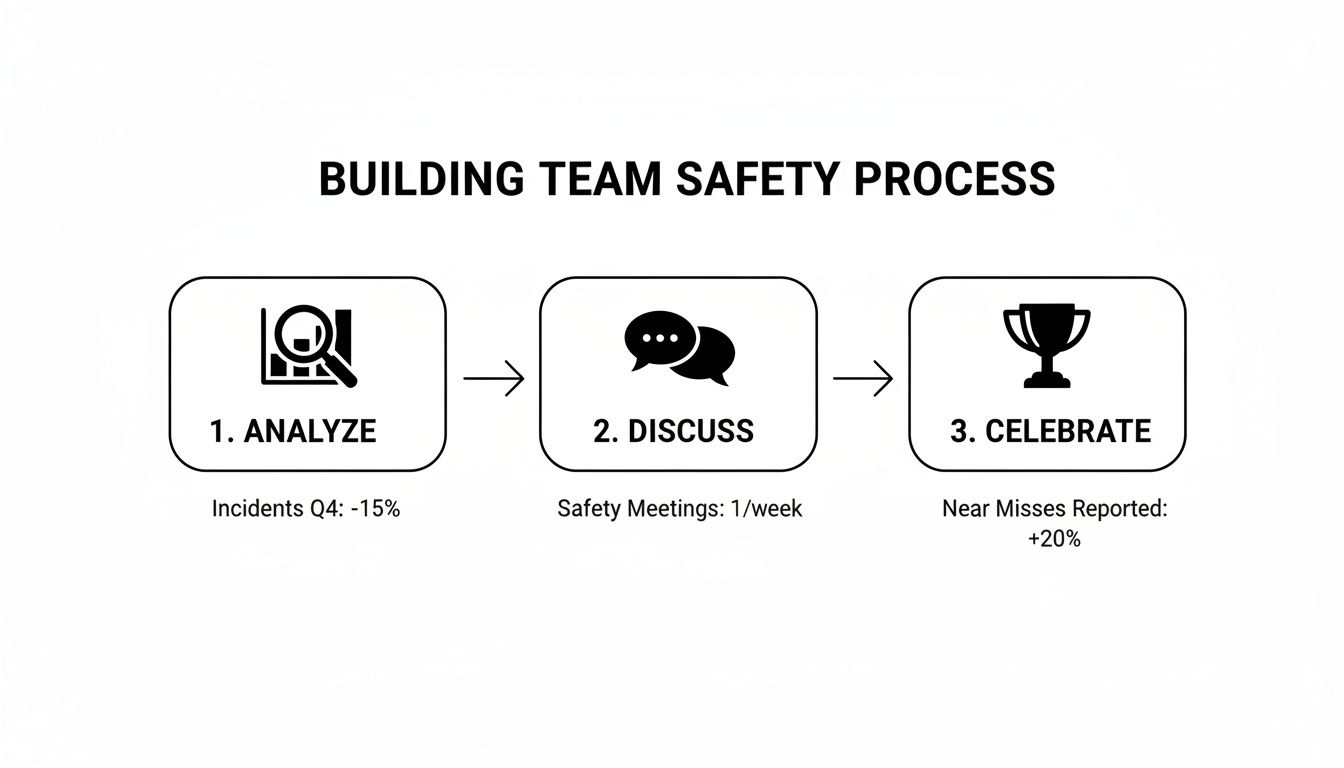
This shows a continuous loop: analyze the feedback, discuss the findings openly as a team, and celebrate the progress you make together. It’s a cycle, not a one-time event.
Run a Dedicated Safety Check-In
For a slightly more structured approach, you can run a dedicated "safety check-in." Frame it as a collaborative exercise to improve how you all work together. Just use a simple set of statements and ask team members to anonymously rate their agreement on a scale of 1 (strongly disagree) to 5 (strongly agree).
Here are a few powerful prompts to get you started:
• "If I make a mistake on this team, it is not held against me."
• "It is safe for me to take a risk on this team."
• "Team members are able to bring up problems and tough issues."
Once you have the anonymous scores, present the aggregated results back to the team. The key here is to approach the conversation with genuine curiosity, not judgment. You could say, "It looks like we scored lowest on 'bringing up tough issues.' What does that feel like for you all? What’s one thing we could try next week to make that easier?"
Interpreting Feedback with Nuance
Remember, not all feedback looks the same—especially when you factor in different personalities. A naturally cautious and loyal Enneagram 6 might hesitate to give critical feedback because they fear disrupting team harmony or jeopardizing their security. On the other hand, a direct and principled Enneagram 1 might offer blunt feedback that is intended to be helpful but can feel harsh if not delivered with care.
Understanding these underlying motivations is crucial for interpreting feedback accurately. For leaders looking to go deeper, exploring how to run a team building personality assessment can provide invaluable context for these conversations.
This nuanced view helps you avoid misinterpreting a Type 6's silence as agreement or a Type 1's critique as a personal attack. When you understand the "why" behind the "what," you can turn raw data into meaningful conversations that truly strengthen your team's foundation of trust.
Common Pitfalls and How to Get Back on Track
Building psychological safety is a marathon, not a sprint. Every team, no matter how great, is going to hit a few potholes. Knowing what these common traps look like is half the battle—it lets you get back on course before a minor misstep snowballs into a major cultural problem.
Think of this as your field guide for spotting and fixing the sneakiest saboteurs of team trust. Even with the best intentions, it's surprisingly easy to slide into behaviors that feel supportive but actually do the opposite.
The Trap of Toxic Positivity
This one is particularly nasty because it wears a friendly mask. Toxic positivity is that unspoken pressure for everyone to be relentlessly upbeat, all the time. It’s where valid concerns, tough feedback, or even just someone having a bad day get steamrolled by a cheerful platitude.
Picture this: In a project kickoff, Maria, a sharp engineer, points out a serious flaw in the proposed timeline. Her manager beams and says, "I love your commitment to quality, Maria! Let's stay positive and focus on solutions, not problems." Just like that, the conversation moves on, and Maria's crucial warning is swept under the rug.
The damage is immense. The team gets the message, loud and clear: raising real issues is "negative." This forces problems underground where they fester, only to explode later as full-blown crises.
The Fix: Go out of your way to reward dissent. When someone raises a tough point, thank them for their courage. Try saying, "That’s a brave and important point. Thank you for flagging that for us. Let's pause and dig into this, because you might be saving us a huge headache down the road."
Confusing Safety with a Comfort Zone
Let’s be clear: psychological safety is not about avoiding conflict. It’s the exact opposite. It's the bedrock that makes healthy, productive debate possible. A team that’s just coasting in a "comfort zone" dodges all friction, which is a fast track to groupthink and stagnation.
The stakes are higher than you think. A 2023 National Safety Council SAFER Trend Survey found a chilling link between psychological and physical safety. In-person workers feeling psychologically unsafe were a staggering 80% more likely to suffer injuries that required medical care or time off work. This happens when a team that avoids conflict also avoids reporting hazards. You can explore more of these critical workplace safety findings on niagarainstitute.com.
The Pitfall of Quick Agreement
If you're a leader and everyone in the room agrees with you instantly, that shouldn't feel good—it should be a massive red flag. A chorus of quick "yeses" is often a sign that people are afraid to challenge you. They’ve learned it’s just safer to nod along than to offer a different opinion.
When everyone thinks alike, then somebody isn't thinking. A room full of immediate "yeses" is often the sound of psychological safety dying.
The Fix: Make dissent a formal part of the process. Appoint a rotating "devil's advocate" for big decisions. You can use a script like this: "For this next discussion, Jake, I'd like you to take on the role of devil's advocate. Your only job is to poke holes in this plan and argue against it, no matter how solid you think it is. We need to hear all the reasons this might fail."
This simple move gives one person explicit permission to challenge the group. It normalizes disagreement and ensures you're seeing the full picture, teaching your team that productive conflict is not just welcome, but essential.
Your Burning Questions About Psychological Safety, Answered
Alright, so you’ve got the framework. But as soon as you start trying this stuff in the real world, the questions start popping up. The "what-ifs" and "but-hows" are completely normal. Let's tackle the most common ones I hear from leaders who are rolling up their sleeves and getting to work.
This is where the theory meets reality. Let's get into it.
Is Psychological Safety Just Coddling People and Being "Nice"?
Not a chance. In fact, this is probably the biggest and most damaging myth out there.
Psychological safety isn't about avoiding tough conversations; it's about making them productive . It's the bedrock that allows a team to have healthy, vigorous debate without anyone feeling like they’re being personally attacked. It's the difference between a team that stays silent to keep the peace and one that challenges ideas to find the truth.
Think of it like this: "nice" teams often suffer from artificial harmony. Everyone smiles and nods, but the best ideas get left on the table because no one wants to rock the boat. A psychologically safe team, on the other hand, embraces intellectual friction. They know it's not personal; it's about pushing for the best possible outcome.
Here’s how that plays out:
A team is reviewing a new marketing campaign.
• The "Nice" Team: • Everyone says, “Looks great!” even though half of them have serious doubts. The presenter’s feelings are spared, but the campaign is destined to underperform.
• The Safe Team: • A junior designer speaks up. "I really appreciate the work that went into this, but I'm worried the tagline is going to fall flat with our Gen Z audience. Can we brainstorm a few alternatives?" This sparks a lively, constructive debate that ultimately makes the campaign • 10x • stronger.
So, How Long Does This Actually Take to Build?
There's no neat and tidy answer here, because it all depends on where you're starting from. If your team already has a decent foundation of trust, you could see a real shift in just a few weeks of consistent, conscious effort.
But if you’re trying to detoxify a culture of fear or blame? That’s a different story. Rebuilding broken trust is a long game. It could take many months of relentless consistency to prove that the new way of operating is here to stay.
I always think of psychological safety as a trust bank account. You make small, consistent deposits every day. But a single, big withdrawal—like a manager publicly shaming someone for a mistake—can wipe out your entire balance in seconds.
Can You Really Do This With a Remote Team?
Absolutely, but you have to be way more deliberate about it. When everyone's a face in a box, you lose all those little spontaneous moments of connection—the hallway chats, the quick questions over a coffee. You can't just let culture happen by accident.
You have to intentionally engineer those moments of connection and feedback.
• Video On for the Tough Stuff: • Get on a video call for any sensitive conversation. You need to see the non-verbals.
• Check-Ins That Aren't Just About Work: • Start meetings by asking, "How's everyone • really • doing?" and actually wait for the answer.
• Set Clear Communication Ground Rules: • Don't leave people guessing. Create a simple guide: "For urgent things, use Slack. For deep questions, schedule a call. We expect a response within • 4 • hours." This cuts down on the anxiety that comes from ambiguity.
In a remote world, you have to actively pull feedback out of people. The quiet ones won't just wander over to your desk; you have to create the space for them to speak up.
What If the Rest of the Company Culture is a Dumpster Fire?
This is a tough one, and it's a reality for a lot of us. You can't change the whole organization overnight. But you can create a pocket of psychological safety on your own team.
Focus on your circle of influence. Be the leader who models vulnerability. When someone on your team pushes back, thank them for their candor. Shield your team from as much of the external negativity as you can.
By creating a "safe harbor," you can make a massive difference in your team's day-to-day experience, their creativity, and their results. And who knows? The success of your little island of sanity might just become the best case study for showing the higher-ups that learning how to create psychological safety isn't just a feel-good exercise—it's good for business.
At Enneagram Universe , we know that real leadership starts with self-awareness. You can't build trust with others until you understand what drives you. The Enneagram is a powerful tool for unlocking those core motivations. Discover your Enneagram type with our free, in-depth assessment and get the insights you need to lead with empathy and confidence.