How to Build Cohesive Teams: Step-by-Step Framework for Stronger Teamwork

Forget the trust falls and awkward icebreakers. If you want to know how to build a truly cohesive team, it's not about forced fun—it’s about creating an environment where people genuinely want to work together.
The secret sauce isn't a secret at all. It boils down to three core pillars: fostering psychological safety , establishing clear communication , and uniting everyone around a shared mission .
The Blueprint For A Genuinely Cohesive Team
Building a tight-knit team is less about flashy initiatives and more about getting the fundamentals right. In today's work environment, where collaboration is king, this isn't just a nice-to-have; it's a must.
Seriously, the modern workplace has completely shifted. Employees now spend around 50% more time on collaborative work than they did just five years ago. For many, teamwork eats up a staggering 80% of their day . As companies ditch old-school hierarchies for flatter, more agile structures, this trend is only picking up speed.
This simple blueprint shows how these pieces fit together. It's a progression—you can't get to a unified mission without nailing communication, and you can't get honest communication without a foundation of safety.
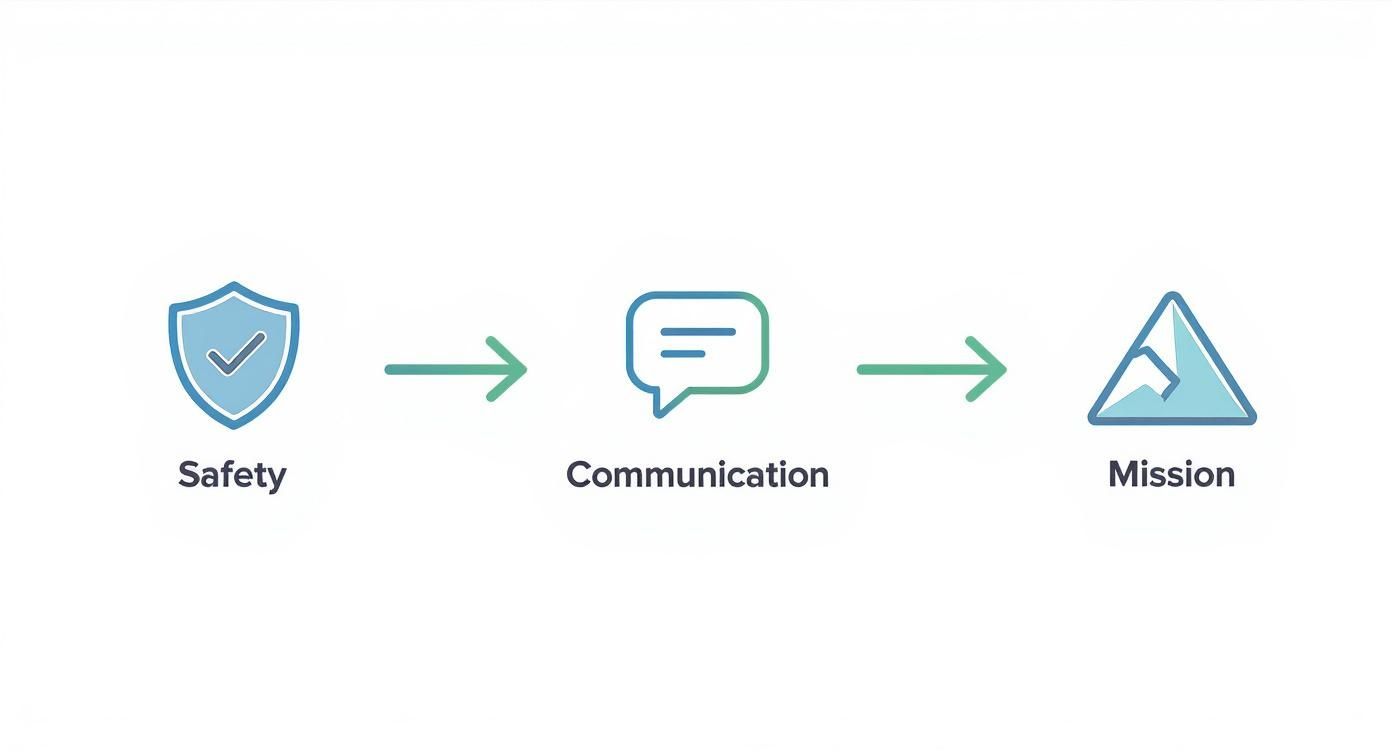
Think of it this way: without that base of psychological safety, everything else just crumbles. It’s the bedrock.
To really grasp how these pillars function, let's break them down. The table below gives you a quick snapshot of what each one looks like when you're actually doing it right.
The Three Pillars of Team Cohesion
| Pillar | What It Looks Like in Practice | Why It's a Game Changer |
|---|---|---|
| Psychological Safety | Team members openly admit mistakes, ask "silly" questions, and challenge the status quo without fear of being shamed or punished. For example, a junior developer in Boston feels comfortable saying, "I'm not sure I understand this spec, can someone walk me through it again?" in a group meeting. | It unlocks creativity and problem-solving. When people aren't walking on eggshells, they bring their whole brain to work. |
| Clear Communication | There are agreed-upon rules of engagement for everything—from Slack response times to how to give tough feedback. Meetings have a clear purpose and action items. A practical example is a team in Miami having a written rule that any project update over 200 words must be an email, not a chat message. | It kills ambiguity and frustration. People know where they stand and what's expected, which cuts down on rework and passive-aggression. |
| Shared Mission | Everyone, from the intern to the CEO, can articulate why their work matters and how it connects to the company's larger purpose. A salesperson in Dallas, for instance, understands that hitting their quota isn't just about revenue; it's about getting their company's life-saving software into more hospitals. | It's the ultimate motivator. A compelling mission turns a job into a cause and gives people a reason to push through the tough stuff together. |
This isn't just theory—it's the difference between a team that thrives and one that just survives.
Why You Can’t Afford To Skip This
Trying to build a team without these fundamentals is a recipe for disengagement and burnout. I once worked with a tech startup in Austin full of brilliant, passionate people who were in a state of total chaos. Deadlines were a moving target, the blame game was a daily sport, and morale was in the gutter.
Leadership threw everything at the problem: catered lunches, happy hours, even an expensive off-site retreat. Nothing stuck.
The problem wasn't a lack of perks; it was the complete absence of a solid foundation. Their turnaround only began when they stopped trying to buy morale and started focusing on what actually mattered:
• First, they built psychological safety. • This started with leaders modeling vulnerability. For example, the CTO openly admitted in a company-wide meeting, "My initial projections for this feature were way too optimistic, and that's on me. Let's reset."
• Next, they created clear communication protocols. • The whole team got together and drafted a "Communication Charter." It was a simple doc that spelled out when to use email vs. Slack, expected response times, and how to deliver feedback that was constructive, not crushing.
• Finally, they defined their shared mission. • The leaders went beyond just talking about revenue. They articulated an inspiring purpose for their product and made sure every single task, no matter how small, was clearly connected back to that mission.
By focusing on these core elements, the startup transformed its culture from one of fear and confusion to one of trust and collaboration. It’s a powerful reminder that genuine cohesion is built, not bought.
Digging into what makes people tick can also seriously fast-track this process. You can learn more about how different personalities show up by exploring the Enneagram at work , a fantastic framework for understanding team dynamics. And for a broader look at what separates the good from the great, check out how others approach building high-performance teams .
The change at that startup wasn't overnight, but it was real and it was lasting. Why? Because it addressed the root causes of their dysfunction instead of just slapping a bandage on the symptoms.
How to Take Your Team’s Temperature on Cohesion
You can't fix what you don't understand. Before you start planning trust falls or drafting a new communication charter, you’ve got to get a real, honest read on your team’s current level of cohesion. Forget those stale corporate surveys everyone just clicks through. To get to the truth, you have to get human.
Building a truly cohesive team means looking under the hood to see what’s really making the engine hum—or what’s causing it to sputter and stall.

Ditch the Surveys and Run a Team Energy Audit
Instead of asking a leading question like, "How cohesive are we?"—which usually gets you polite, vague answers—frame the whole thing around energy . Where is the team's energy flowing, and where is it getting stuck? This approach feels less personal and gets right to the heart of what’s driving motivation and creating friction.
You can do this in a simple "Team Energy" workshop. This isn't some full-day offsite ordeal; a focused 60-minute meeting is all you need. The entire goal is to create a safe space for people to say what they’re really thinking.
Cohesion isn't some abstract HR buzzword; it's the tangible feeling of shared momentum. When you diagnose the team's energy, you're taking a direct pulse of its underlying health.
Here’s a ridiculously simple script to get you started:
The Team Energy Workshop Facilitator Script
This simple exercise shifts the conversation from blame to action. It’s how you find the hairline fractures in the team’s foundation before they become major cracks.
The Power of the Cohesion Check-In
While group sessions are fantastic for spotting patterns, some of the most powerful insights come from quiet, one-on-one conversations. Think of these "cohesion check-ins" as completely separate from performance reviews. Their only job is to gauge an individual's sense of belonging and psychological safety.
Book these as 30-minute informal chats. Coffee is highly encouraged. The secret is asking open-ended questions that can't be answered with a simple yes or no.
• "When was the last time you felt genuinely fired up by something our team did?"
• "Is there anything that makes you hesitate before sharing a half-baked or 'wild' idea?"
• "If you had a magic wand, what's the one thing you'd change about how we work together?"
These questions aren't about solving a problem on the spot; they're about creating an opening for honesty. When people feel like they’re actually being heard, you start building the trust that high-performing teams are made of. Getting a handle on your team's different personality types can be a massive shortcut here. Learning more about using personality assessments for team building can give you a much deeper framework for these crucial conversations.
A Quick Story from the Trenches
I once worked with an American marketing agency in Chicago that thought it had a "creativity problem." Their campaigns felt flat, and brainstorms were dead on arrival. The manager was convinced she needed to hire a new batch of "creative" thinkers.
Instead of blowing up the team, she ran an energy audit and did a round of cohesion check-ins. The real issue surfaced almost immediately. It wasn't a lack of creativity; it was a deep-seated fear of criticism . Team members admitted that one senior person shot down ideas so harshly that everyone else had just… stopped trying.
The energy drain wasn't "bad ideas"—it was "the feeling of being judged."
Armed with a real diagnosis, the manager didn't fire anyone. She facilitated a workshop on constructive feedback and personally coached the senior member on how to disagree without shutting people down. The so-called creativity problem? It vanished almost overnight, all because they finally addressed the real issue: psychological safety.
Designing Exercises That Actually Build Cohesion
Alright, you’ve taken the team’s temperature and figured out where the real friction is. Now comes the fun part: moving from diagnosis to action. This isn’t about tossing random trust falls at the wall and hoping something sticks. It’s about being a surgeon—making precise, targeted interventions that solve the problems you’ve uncovered.
Forget the generic, one-size-fits-all team-building fluff. The most powerful activities are custom-built to address the specific gaps you found. If your diagnosis revealed a fog of confusion, you need an exercise for clarity. If it revealed a team of strangers, you need an exercise for genuine connection.
This is where you stop just talking about building a cohesive team and start creating the conditions for it to happen. Let’s get into a few field-tested exercises that are helping teams cut through the noise and build real momentum.
Untangle the Mess with Role and Responsibility Mapping
One of the fastest ways to drain a team's energy is ambiguity. When nobody is quite sure who owns what, you get duplicated work, critical tasks falling through the cracks, and a whole lot of passive-aggressive finger-pointing. The Role and Responsibility Mapping session is a brutally effective way to fix this.
Get everyone in a room with a whiteboard (or a virtual one like Miro for remote teams). The process is simple but incredibly powerful:
• List Key Functions: • Start by brainstorming all the major ongoing tasks and responsibilities of the team. Think "managing the client newsletter," "updating the project Trello board," or "running the weekly sync."
• Assign the Owner: • For each function, one person's name goes next to it. They are the • sole owner • . They can get help, they can delegate, but the buck ultimately stops with them.
• Define the Lanes: • Team members then "claim" their turf on the board, visually mapping out their core duties. This immediately shines a spotlight on weird overlaps and dangerous gaps.
I saw a project management team in Chicago do this and have a massive "aha!" moment. They discovered three different people thought they were in charge of final client approvals, which was causing endless delays and confusion. In less than an hour, they untangled a problem that had been silently killing their productivity for months.
The goal isn't to put people in rigid boxes. It's to create a shared, visual understanding of the team's operational blueprint so everyone can move faster and with more confidence.
This kind of clarity is a cornerstone of any high-performing team. To keep that momentum going, you can explore other powerful team trust exercises that reinforce this newfound respect and understanding.
Create Your Team's Rulebook with a Communication Charter
Every high-performing team runs on a set of shared rules, whether they're written down or not. A Communication Charter workshop simply makes those rules explicit, co-created, and owned by everyone. It’s the team's chance to finally agree on how they'll actually work together.
This isn’t about micromanaging. It's about answering the nagging questions that create daily frustration:
• When is it okay to use "@channel" in Slack? (And when is it absolutely not?)
• What's our real expected response time for emails?
• How do we give feedback that's helpful, not hurtful?
During the workshop, a facilitator guides the team to agree on a handful of simple, powerful commitments. I worked with a fully remote software team based in Austin, for example, that landed on three core rules: " Assume positive intent in all messages ," " No meetings before 10 AM ," and " Celebrate failures as learning opportunities ."
These simple agreements completely changed their dynamic, dialing down anxiety and cranking up psychological safety. When a team builds its own rulebook, everyone is way more invested in following it.
Don't Underestimate the Power of Just Hanging Out
While structured exercises are crucial, never forget that pure social interaction is a massive catalyst for cohesion. It’s where colleagues stop being just roles ("the developer," "the marketer") and start becoming actual people.
The research on this is pretty clear. According to findings highlighted in Harvard Business Review, over 50% of positive changes in team communication patterns can be traced directly back to social interaction. When people connect as humans, they work better as a team.
This doesn't have to be some big, expensive off-site event. It can be as simple as:
• A virtual "water cooler" channel in Slack dedicated to non-work chat (memes, pet photos, weekend plans). A practical example is a "Weekend-Wins" channel where people post photos from their hikes or family barbecues.
• Team lunches where the only rule is you're not allowed to talk about work.
• Starting weekly meetings with a quick, fun icebreaker that has nothing to do with the agenda. For instance, asking everyone, "What's the best thing you ate last week?"
To get some great ideas, check out these fun team building activities that are proven to enhance teamwork and morale. Remember, these interventions—both structured and social—are the real building blocks of a connected and effective team.
Welcome to the Disagreement Zone
Let's get one thing straight: the best teams argue. They really do. Conflict isn't a sign your team is about to implode; it's a sign that people care enough to fight for what they believe is the right answer. The real magic isn't in avoiding disagreement—it's in learning how to harness it.
When teams get too comfortable and polite, ideas start to go stale. Resentment bubbles up just under the surface. The biggest shift you can make is flipping the script from "conflict is a problem" to "productive conflict is a superpower." It’s about creating a space where people can debate with passion, challenge ideas, and still go for lunch together afterward.

This section is all about giving you the practical tools to make disagreement less of a dreaded encounter and more of a creative spark.
A Script for When Things Get Spicy: The DEAR Framework
When the pressure is on, it's so easy for a simple disagreement to turn into a full-blown argument. The DEAR framework is a lifesaver here. It’s a simple, memorable structure that keeps tough conversations from going off the rails by focusing on the issue, not the emotion.
It breaks down like this:
• D - Describe: • Just the facts. Lay out the specific situation or behavior without any judgment or drama.
• E - Express: • Use "I" statements to share how it affected you. This is about owning your feelings, not pointing fingers.
• A - Assert: • Be crystal clear about what you need to change. What specific action are you asking for?
• R - Reinforce: • Connect the dots. Explain the positive outcome that will happen for everyone if your request is met.
This little formula can single-handedly turn a potentially explosive confrontation into a problem-solving session where you're both on the same side.
DEAR in the Wild: A Developer Standoff
Let's imagine two software developers at an American tech company, Maya and Ben. Maya's getting increasingly frustrated because she feels Ben is cutting corners, leaving her to clean up buggy code. The tension is thick enough to cut with a knife.
Instead of just snapping, Maya pulls out the DEAR framework:
Describe: "Ben, when you pushed that last feature update on Friday, there were a few major syntax errors that completely broke the build. I ended up having to spend my Saturday morning fixing them."
Express: "Honestly, I felt really frustrated and deflated. It felt like my weekend didn't matter."
Assert: "From now on, I need you to commit to running the full testing suite on your code before you merge it, even when we're on a tight deadline."
Reinforce: "If we do that, we'll catch these things way earlier, keep the project moving smoothly, and we'll all have a much more predictable and less stressful time."
See what she did there? No accusations like "You're sloppy" or "You never think about the team." She stuck to a specific event, explained her feelings, made a clear request, and highlighted the win-win. This is how you invite someone to solve a problem with you instead of putting them on the defensive.
Don't Wait for the Fire: Run a Conflict Pre-mortem
Why wait for a five-alarm fire to figure out where the exits are? A 'Conflict Pre-mortem' is your team's fire drill. It’s a proactive session where you game out future disagreements before they happen.
It’s a surprisingly easy and powerful exercise to facilitate. At the kickoff of a new project, gather the team and walk them through these questions:
This little exercise is brilliant for two reasons. First, it makes conflict feel normal and expected. Second, it lets the team build their own playbook for handling it. They’re no longer just reacting to drama; they’re the architects of their own resolution process.
Keeping the Magic Alive: How to Measure and Sustain Team Momentum
You’ve run the workshops, mapped out everyone's roles, and maybe even navigated a few "spirited debates" that actually ended up being productive. Awesome. But here's the real question: Is any of it sticking? If you want to build a team that's truly cohesive for the long haul, you need a way to see what's happening beneath the surface.
This isn’t about chasing vanity metrics or fluffy KPIs that look great on a slide deck but tell you absolutely nothing. It's about building a real, sustainable feedback loop that keeps the team healthy, strong, and pointed in the right direction. Let's get into the nitty-gritty indicators that prove your team's cohesion is more than just a vibe.

Go Beyond the Obvious with Real Cohesion Metrics
Forget about tracking lines of code written or tickets closed. Those are outputs. Cohesion is all about the how —the way the work gets done. To get a genuine pulse, you have to track the metrics that reflect the quality of your team's interactions.
Here are a few powerful, and often overlooked, metrics that actually tell a story:
• Commitment-to-Completion Ratio: • This one's beautifully simple but incredibly revealing. Just track how many of the team's commitments (from sprints, project plans, etc.) are actually hit on time. A practical example is a software team in Seattle tracking their sprint goals and consistently hitting 95% completion.
• Time to Resolution (for internal squabbles): • How long does it take for team members to sort out their own disagreements without a manager swooping in? A shrinking timeframe is a gold-standard indicator of growing psychological safety and rock-solid communication skills.
• The "Help" Ratio (Offered vs. Requested): • Take a look at your team's Slack channels or project management tools. Is it just a wall of people asking for help, or do you see a healthy stream of teammates proactively jumping in to offer assistance? A balanced ratio screams "we're-in-this-together."
These numbers give you a tangible way to see if all your hard work is paying off. And the data backs it up. When teams click, the results are undeniable. In fact, research shows that 73% of employees who regularly collaborate report improved performance. You can dig into more data on how happy, connected teams drive productivity in this detailed overview of workplace collaboration statistics .
Listen to the Unspoken Cues with Qualitative Measures
Numbers only tell part of the story. The real texture of your team's health lives in the qualitative stuff—the feelings, perceptions, and quiet conversations that don't fit neatly into a spreadsheet.
Tuning into these signals is how you spot a problem before it blows up your performance metrics.
The Psychological Safety Pulse Survey
Ditch the annual 50-question corporate snoozefest. A pulse survey is short, frequent, and laser-focused. Once a month, send out a quick, anonymous three-question poll.
The trends over time are what you're watching for. A sudden dip in the safety score is your canary in the coal mine—it’s an early warning to start asking more questions.
Quick Case Study: An American Support Team’s Turnaround
I once worked with a customer support team in Denver that was bleeding talent. Their turnover rate was through the roof, but their classic performance metrics, like call volume, looked perfectly fine. The manager was completely stumped.
They decided to roll out a simple weekly "energy pulse" survey. The results were a gut punch. Words like "drained," "frayed," and "overwhelmed" popped up again and again. When they cross-referenced this qualitative feedback with workload data, a painful pattern emerged: the top-performing agents were being "rewarded" with the most complex and emotionally draining cases, leading straight to burnout.
Armed with this insight, they didn't just reshuffle the work. They created a new "complexity score" for support tickets and built a system to ensure no single agent was shouldering all the heavy lifting. They also instituted a mandatory "disconnect" hour each day for everyone.
Within six months, their voluntary turnover plummeted by 40% . They didn't just save a fortune on recruitment; they saved their team's spirit by finally measuring what actually mattered. That's what sustaining momentum is all about—listening, measuring, and acting with real intention.
Your Questions on Team Cohesion Answered
Even the best-laid plans meet reality. When you're in the thick of it, trying to build a truly cohesive team, you’re bound to face a few curveballs that leave you scratching your head.
Think of this section as your quick-reference field guide for those "what now?" moments. Here are a few of the most common challenges I've seen leaders face, along with some straight talk on how to navigate them.
How Can I Build Cohesion in a Fully Remote Team?
Let's be honest: building a tight-knit team when no one is in the same room is tough. You can't rely on hallway chats or grabbing lunch to build those natural connections. It takes a much more deliberate, intentional effort. You basically have to manufacture the "water cooler."
The trick is to create opportunities for people to be, well, people—not just job titles on a Zoom call.
Think about low-pressure, structured social time. Maybe it's an optional 15-minute "coffee and no-work-talk" call on Monday mornings. A practical example could be a marketing team spread across the US starting their week with a call where they share one non-work-related picture from their weekend.
You also have to over-communicate. So much is lost when you can't read body language or hear someone's tone. Default to video calls for anything even remotely sensitive and be painfully clear in your written messages.
Here's a solid rule of thumb for remote work: assume positive intent . A short, blunt Slack message can easily be misinterpreted without the context of a smile. Make it a habit to assume the best of your colleagues. It’s also crucial to celebrate wins publicly, so everyone feels seen and valued, no matter where their desk is.
What Is the First Step If I Inherit a Fractured Team?
You just walked into a new role and discovered the team is a complete mess. The tension is thick, trust is zero, and everyone’s just trying to survive. Your first instinct will be to jump in and start "fixing" everything.
Don't. Resist that urge with every fiber of your being. Your first job isn't to act; it's to listen.
Forget about planning team-building workshops or offsites right away. That’s like putting a bandage on a wound you haven't even looked at. Your absolute top priority is to schedule confidential, one-on-one meetings with every single person on the team.
The sole purpose of these initial chats is to understand their world. You need to hear their side of the story—the team's history, its highs, its lows, and its most painful sticking points, all from their perspective.
Ask open-ended questions that get them talking:
• "Tell me about a time when this team was really humming. What did that feel like?"
• "If you had a magic wand, what’s the one thing you'd change about how we work together?"
• "What's the biggest roadblock that gets in your way?"
Doing this accomplishes two critical things. First, you start building trust immediately by showing you actually care about their experience. Second, you gather the raw, unfiltered intel you need to diagnose the real problem, not just the symptoms.
Can a Team Ever Be Too Cohesive?
Absolutely. It’s a sneaky trap that can do some serious damage. When a team gets too close, it can slip into the dangerous territory of groupthink . This is what happens when the desire for harmony completely tramples critical thinking and honest debate.
The warning signs are often subtle. You might notice that nobody ever disagrees in meetings. People start censoring their own ideas to avoid "rocking the boat." A weird pressure emerges to just go along with the group, even if the idea on the table is a stinker.
To head this off, you have to actively—and publicly—celebrate constructive debate. Make it crystal clear that challenging ideas isn't just okay; it's expected. You can even formalize it. For big decisions, try appointing a rotating "devil's advocate" whose only job is to poke holes in the plan and find its weaknesses. A practical example would be a product team in Portland formally assigning this role to a different person for each major feature launch meeting.
Healthy cohesion thrives on different perspectives and productive friction. Unhealthy cohesion demands conformity. The best teams aren't the ones who never argue; they're the ones who are close enough to handle the heat of a real debate and come out stronger for it.
The ultimate shortcut to genuine cohesion is understanding what truly makes each person on your team tick. At Enneagram Universe , we give you the roadmap to that deeper level of insight. Discover your team's unique dynamics with our scientifically validated assessment and start building a team that’s not just getting things done, but is truly in it together.