How to Break Bad Habits: Proven Strategies to Change Today

Ever tried to stop biting your nails, quit the doomscscroll at midnight, or finally ditch the sugary snacks, only to find yourself right back where you started a week later? It’s frustrating, and it's easy to chalk it up to a lack of willpower or just being "undisciplined."
But here’s a little secret I've learned from years of studying behavior change: your bad habits aren’t a moral failure. They aren't a reflection of your character at all.
They’re a feature of your brain's brilliant, if sometimes misguided, design. Your brain is a world-class efficiency expert, and habits are its ultimate shortcut. Putting common behaviors on autopilot saves a ton of mental energy for more important stuff.
So, How Does This Autopilot Work?
This whole system runs on a simple but incredibly powerful cycle called the habit loop . It's the neurological blueprint behind every single habit you have, good or bad. Once you understand how it works, you can stop blaming yourself and start getting strategic about dismantling the habits you want to change.
Every habit breaks down into three core pieces:
• The Cue: • This is the trigger, the thing that tells your brain to flip the switch to autopilot and run a specific program. A cue could be a time of day, a place, an emotion, a sound, or even the people you're with.
• The Routine: • This is the habit itself—the physical, mental, or emotional action you perform. It's the act of reaching for the cookie, opening Instagram, or lighting up a cigarette.
• The Reward: • This is the prize at the end. It's the little hit of satisfaction that tells your brain, "Hey, that was good! Let's remember this loop for next time." The reward is what makes the whole cycle stick.
This loop is running in the background of your life constantly, reinforcing behaviors without you even noticing.
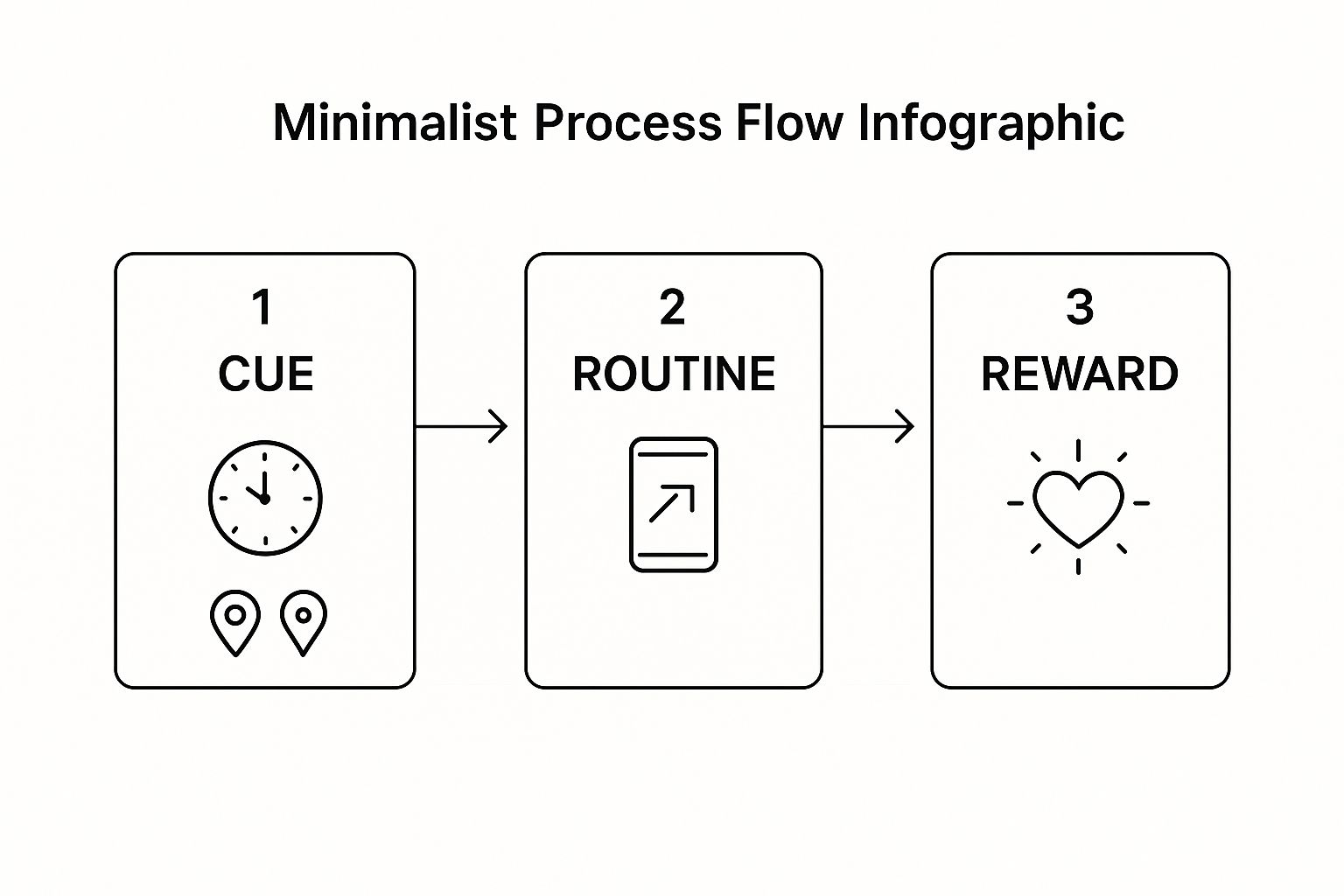
This visual gives you a great snapshot of how the cue, routine, and reward are all linked together.
As you can see, a simple trigger like the clock hitting 3 PM can kick off a routine, which then delivers that sweet reward your brain was craving. Boom. The habit gets a little stronger.
To make this even clearer, let's map out that classic afternoon slump habit.
Decoding Your Habit Loop
Here's a simple breakdown of the three parts of any habit to help you identify your own patterns.
| Component | What It Is | Real-World Example (The 3 PM Cookie Habit) |
|---|---|---|
| Cue | The trigger that kicks off the automatic behavior. | The clock hits 3:00 PM at work. You feel a dip in energy and a wave of boredom. |
| Routine | The action or behavior you perform. | You walk to the office kitchen, grab a cookie, and chat with a coworker. |
| Reward | The satisfaction you get from the routine. | A sugar rush, a momentary distraction from work, and a bit of social connection. |
Seeing it laid out like this makes it obvious, right? The key isn't to fight the cue (you can't stop 3 PM from happening) but to play with the routine to get a similar, or even better, reward.
From Self-Blame to Smart Strategy
When you start seeing your habits as a neutral, automated loop instead of a personal failing, everything changes. You can stop wrestling with your willpower—a fight you'll rarely win—and start acting like a detective. You get to observe the process, find the weak spots, and figure out exactly where to intervene.
The secret to permanent change is to stop focusing on how big your problems are and start focusing on how small your habits can be. Your outcomes are a lagging measure of your habits.
This guide is here to give you the tools to do just that. We're going to move past the generic "just stop it" advice and give you a clear, step-by-step way to identify your cues, break your routines, and find healthier rewards your brain will actually want.
So, let's ditch the guilt. It’s time to become a strategist and learn how to outsmart your own brain.
Become a Detective of Your Own Behavior
Okay, let's get real. To actually break a bad habit, you have to stop sleepwalking through it and start paying attention. It’s time to put on your detective hat, grab a metaphorical magnifying glass, and get down to some good old-fashioned clue-gathering.

This isn't about judging yourself. It's about collecting data—cold, hard facts about what makes you tick.
Every single habit, no matter how random or mindless it seems, gets set in motion by a specific cue. The problem is, we usually have no idea what it is. We blame it on something vague like "stress," but that’s rarely the whole story. The real trigger is almost always something much more specific.
Your investigation starts here. When you can pinpoint the exact moments that launch you into that unwanted routine, you suddenly have the power to step in and change the script.
The Five Usual Suspects: Your Trigger Types
Most of the time, our habit triggers fall into one of five main categories. Think of them as the primary suspects in the case of your runaway habit. If you watch yourself for a week or so, you'll start to see which ones are your personal repeat offenders.
• Location: • Where are you when the urge hits? Is it slumped on the kitchen couch after dinner? Or stuck at your desk in the middle of the afternoon? The environment is a huge player.
• Time: • What does the clock say? The • 3 PM • energy crash is a classic villain, but so is that • 10 PM • urge for "just one more episode" that keeps you up all night.
• Emotional State: • Check in with your feelings. Are you bored? Anxious? Lonely? Heck, sometimes we even do our worst habits when we're happy and celebrating.
• Other People: • Who are you with? Certain friends might be your cue for social smoking, while being totally alone might trigger mindless scrolling.
• The Action Before the Action: • What did you • just • finish doing? Think about it—the urge to grab your phone almost always strikes the second you close your laptop or finish a task.
These categories give you a framework to work with. For example, you might realize your nail-biting isn't just about general "anxiety." It’s that it only happens when you're alone in your car (Location + Other People) listening to a stressful news report (Preceding Action). Now that's a clue you can work with.
This kind of deep dive is a masterclass in self-awareness. You can learn more about how to get better at this by checking out our guide on How to Become More Self Aware: Tips for Self-Discovery.
Your Habit-Breaking Style, By Enneagram Type
The "five usual suspects" above are universal triggers — but why a given trigger sends you into autopilot often traces back to your core motivation.
| Enneagram Type | What Tends to Trigger the Habit Loop | A Tailored Way In |
|---|---|---|
| Type 1 - The Reformer | Frustration at things (including themselves) not being "right." | Replace self-criticism with one factual observation — criticism fuels the loop it's trying to stop. |
| Type 2 - The Helper | Feeling unneeded or overlooked. | Find a version of the reward that doesn't depend on someone else noticing. |
| Type 3 - The Achiever | A stalled sense of progress or falling behind an image of success. | Track effort, not just outcomes — the habit loop often chases visible wins specifically. |
| Type 4 - The Individualist | Low mood or feeling misunderstood. | Build a reward that regulates the feeling directly, rather than one that just distracts from it. |
| Type 5 - The Investigator | Feeling depleted or over-demanded by others. | Protect recovery time proactively, before the habit becomes the only way to reclaim space. |
| Type 6 - The Loyalist | Anxiety or uncertainty about what's coming next. | Replace the habit with a concrete, repeatable action that restores a sense of control. |
| Type 7 - The Enthusiast | Boredom or discomfort sitting still with a feeling. | Build in a "next thing to look forward to" that isn't the habit itself. |
| Type 8 - The Challenger | Feeling powerless or controlled. | Choose a replacement that still delivers a sense of agency, not just a healthier version of numbing out. |
| Type 9 - The Peacemaker | Conflict avoidance or wanting to check out. | Notice the habit as a signal you've gone quiet about something you actually need — address that first. |
Your First Assignment: The Trigger Tracking Log
Ready to get your hands dirty? For the next week, keep a super simple log. Every time you catch yourself in the act of your bad habit, pull out your phone and jot down the answers to the "five Ws" based on the suspects above.
Here's what it might look like for a late-night snacking habit:
Example Log: The Cookie Monster Case
• Where were you? • • On the living room couch, of course.
• What time was it? • • 10:15 PM, like clockwork.
• How were you feeling? • • Bored. A little restless after the TV went off.
• Who else was around? • • Just me.
• What did you just do? • • Finished binge-watching a show.
Do this for a few days, and a pattern will practically jump off the page. If you really want to get a handle on your eating patterns, learning how to keep a food diary effectively is a game-changer.
Don’t underestimate how powerful this awareness is. Health habits are notoriously hard to crack. Globally, only about 62% of people say they sleep well. In some countries, unhealthy habits are just part of the culture— 35.5% of the population in Bulgaria smokes, and Latvia leads the world in alcohol consumption. These stats show just how tough it is to change when our habits are tied to cues we never even notice.
Throw a Wrench in the Works and Rewrite Your Script
If you've ever seen this image from the fantastic book "The Power of Habit," you know it lays out the loop that runs our lives on autopilot. It's a beautifully simple system. And guess what? That simplicity is its weakness. The secret to breaking free is to get in there and mess it all up.
So you’ve pinpointed your trigger. Awesome. Now comes the really fun part: a little bit of strategic sabotage.
Forget trying to white-knuckle your way through this with willpower alone—that’s a losing battle. The real goal isn't to resist the old routine. It’s to make it so clunky, inconvenient, or just plain weird that your brain looks at it and says, "Nah, I'm good." This is where you get to be a little sneaky.
You're basically rewriting the script your brain has been following for years. The cue happens, the curtain goes up, but instead of walking on stage and delivering the same tired lines, you're going to improvise something totally new.
Redesign Your Environment to Do the Hard Work for You
Honestly, the laziest way to break a bad habit is often the most effective: just make it harder to do. We are all creatures of convenience. Even the slightest bit of extra effort can be enough to slam the brakes on an automatic routine. This is the art of what I call "environment design."
You're not just hiding the cookie jar; you're adding friction . Think of friction as anything that creates a pause or a hurdle between the cue and your old routine.
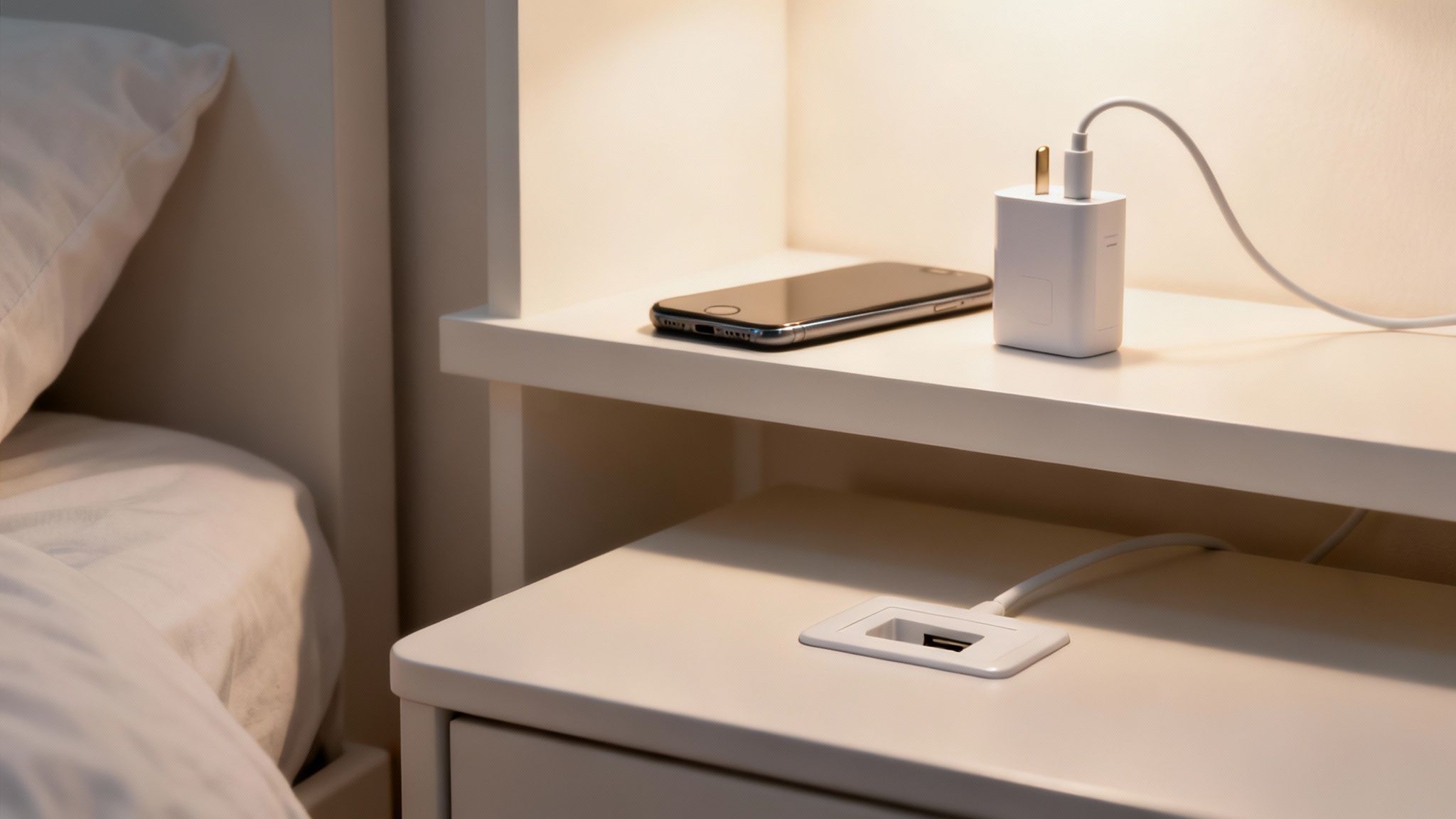
Let's say your kryptonite is mindlessly scrolling on your phone in bed. Don't just tell yourself you won't do it. That's a rookie mistake. Instead, move your phone charger across the house—maybe to the kitchen. That simple change forces a conscious choice. Do I really want to get out of my cozy bed and walk all the way over there? Or... could I just go to sleep? Nine times out of ten, the bed wins.
Here are a few more ways to add some helpful friction:
• Got a late-night snacking problem? • Shove the cookies on the highest shelf, way behind that giant bag of quinoa you swear you’ll use one day.
• Procrastinating with video games? • Make a rule to unplug the console and put the controller in a different room after every single session.
• Impulse online shopper? • Delete your saved credit card info from all your browsers. Having to physically get up and find your wallet is a surprisingly powerful deterrent.
The real secret to self-control isn't having more of it—it's designing your life so you need less of it. Your environment will always beat your willpower in a fair fight.
Master the Art of the "Habit Stack"
Here's another brilliant tactic: hijack a habit you already have to build one you want. This is called "habit stacking," and it feels like a cheat code for your brain. Instead of building a new routine from scratch, you simply tack it onto something you already do without a second thought.
The formula couldn't be simpler: After I do [my current habit], I will do [my new habit].
Just think about your morning. You've got dozens of established little routines that can serve as the perfect launchpad.
• Instead of grabbing your phone to check social media while the coffee brews, try this script: • After my morning coffee starts brewing, I will do ten push-ups.
• Instead of crashing onto the couch the second you get home from work, try this one: • After I take my shoes off, I will immediately change into my workout clothes.
This works so well because your existing habit acts as a built-in trigger for the new one. You're borrowing the automatic momentum your brain has already created. It's one of the most powerful “ 8 Powerful Behavioral Change Strategies ” out there because it helps you install healthier routines almost effortlessly. Before you know it, the new action feels just as automatic as the old one.
Find a Better Reward Your Brain Actually Craves
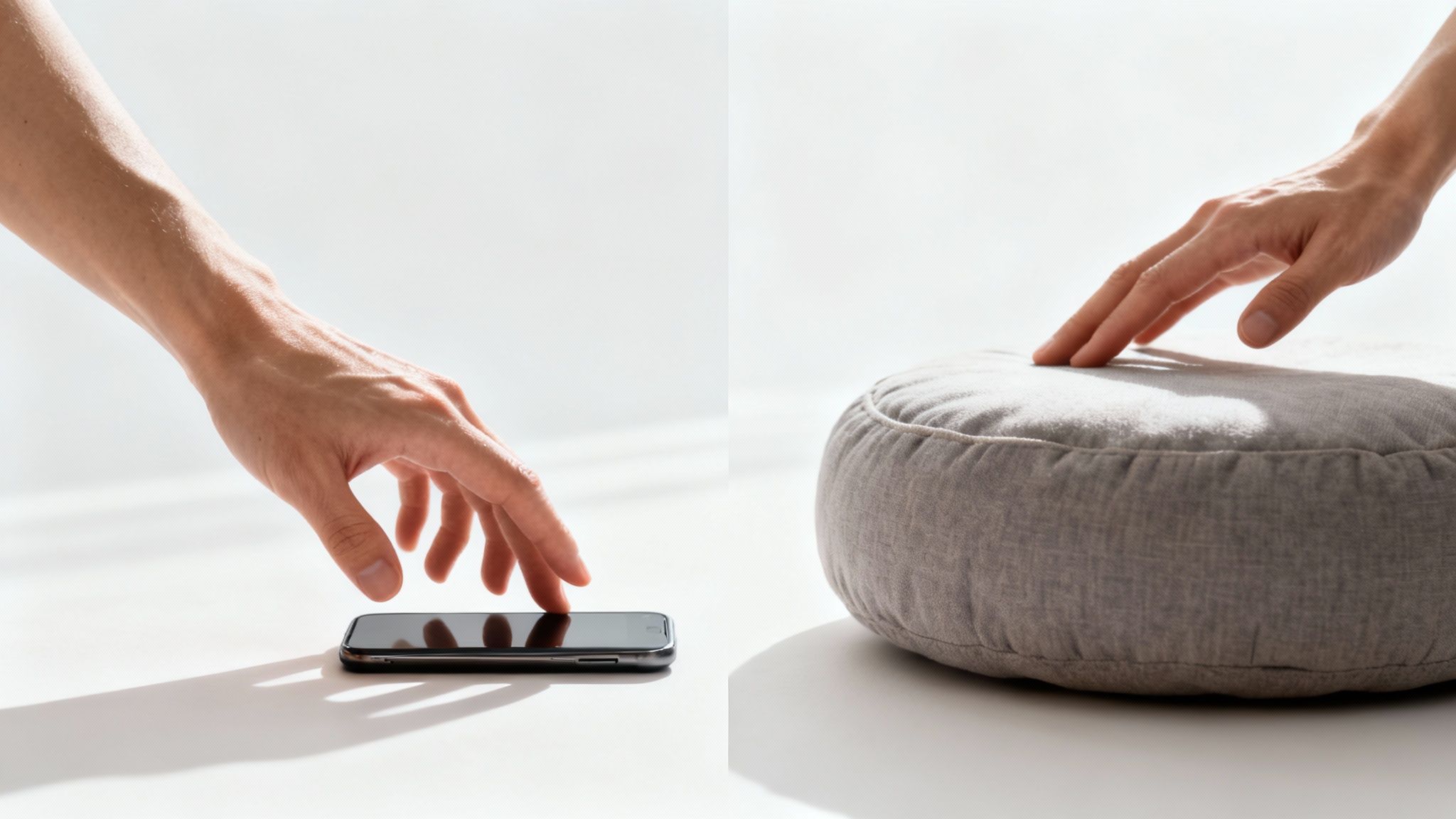
Let’s be honest. Every single bad habit, no matter how much you hate it, is secretly working for you. It sticks around because it delivers some kind of payoff—a tiny hit of comfort, a distraction from boredom, or a brief escape from stress. This reward is the super glue holding the whole habit loop together.
So, how do we dissolve that glue? You don’t fight the craving; you feed it something better . The real trick is to figure out what your brain is really after and then give it a healthier, more satisfying alternative.
This means putting on your detective hat. Ask yourself: what feeling am I actually chasing with this routine? That mindless doomscrolling—is it truly about connection, or is it a desperate attempt to cure a sudden wave of boredom? Does that sugary 4 PM snack genuinely give you energy, or is it just a moment of comfort in a stressful afternoon?
The goal isn't to deprive yourself of a reward. It's to upgrade it. You're not eliminating the payoff; you're just finding a smarter way to get it.
Once you nail down the underlying need, you can start experimenting with new, healthier rewards that scratch that same itch.
Building Your New Reward Menu
Think of yourself as a scientist in a lab, testing different hypotheses to see what clicks for your unique brain. The key is to try several options until you find something that truly satisfies the craving your old habit was trying (and failing) to fix.
Let's walk through a classic scenario:
• The Cue: • Feeling totally overwhelmed by a big project at work.
• The Old Routine: • Procrastinating by watching "just one" YouTube video (we all know how that ends).
• The Real Craving: • A mental break and a small feeling of accomplishment.
• New Reward Experiments:
This process is absolutely critical for breaking modern habits, too. Take smartphone addiction—it's a beast. The average American spends over five hours a day glued to their device. Why? The rewards are powerful: constant connection, endless novelty, and social validation. In fact, a whopping 70% of people feel anxious when their phone battery dips below 20%, which just shows how deeply our brains crave that digital reward. You can find more eye-opening stats on this over at SlickText.com .
When it comes to food, managing cravings is everything. You could explore proven strategies like these snack bites that help manage cravings .
The point is to replace the old, unhelpful routine with something that delivers a similar—or even better—payoff. When you do that, the switch feels less like a sacrifice and more like a brilliant life hack.
So, You Slipped Up. Now What?
Let's be real for a second: you're going to mess up. It’s inevitable. There will be a day when you inhale that donut, ditch the gym for the couch, or find yourself an hour deep in a doomscrolling session you swore you'd avoid.
The most telling moment in this whole habit-breaking journey isn't your string of successes. It’s what you do in the moments right after you slip.
Too many of us get caught in the "all-or-nothing" death spiral. One bad day, one moment of weakness, and we decide the whole thing is a wash. We throw our hands up, quit, and slide right back into the very behavior we were trying to escape. That mindset? That’s the real bad habit, not the occasional cookie.
Building resilience isn’t about flawless execution. It's about how quickly you can dust yourself off and get back on the horse. Progress isn't a straight line—it’s a messy, chaotic, and ultimately rewarding scribble.
Forget Perfect. Just Don't Miss Twice.
If you’re looking for a secret weapon against that all-or-nothing trap, here it is: the "never miss twice" rule. It’s brilliant in its simplicity and shockingly effective.
Here’s the deal: missing once is an accident. It happens. Life gets in the way. But missing twice? That's the start of a brand new, unwanted habit.
So you skipped your morning workout? Fine. But you absolutely, positively cannot miss tomorrow's. You caved and had fast food for lunch? No big deal, as long as dinner is something healthy. This single rule gives you the grace to be human while keeping your commitment from completely derailing.
The goal is consistency, not perfection. A single slip is just a data point. A second slip is a trend you have to shut down immediately.
It’s a powerful little mental trick that stops a minor misstep from turning into a total relapse.
Become a Detective of Your Own Failures
When you do stumble, don't just shrug it off and try to forget it happened. Get curious. Take five minutes and do a quick, blame-free "post-mortem" on what just went down.
Ask yourself a few simple questions:
• What was the real trigger? • Pinpoint the exact time, place, feeling, or person that sent you off course.
• What was my state of mind? • Was I exhausted? Stressed out of my mind? Maybe I was just feeling a little too cocky.
• How can I outsmart this next time? • What tiny, almost unnoticeable tweak can I make to my environment or my plan to avoid this trap in the future?
This isn't an invitation to beat yourself up. It's an intelligence-gathering mission. Every mistake is a lesson that makes your strategy stronger. Honing this kind of self-awareness is a skill in itself; you can learn more about this in our guide on how to increase EQ .
This need for resilience isn't just a personal battle. Think about it on a global scale. Pew Research Center found that about 70% of adults see online misinformation as a major threat. Yet, the collective habit of sharing it without thinking is incredibly tough to break. This just goes to show that even when we know a habit is bad for us, deep-seated biases make setbacks a constant reality. It proves just how crucial resilience is for making any meaningful change stick.
Got Questions About Kicking Bad Habits? We've Got Answers.
Alright, so you're on the path to making some real changes. Fantastic! But let's be honest, this road can get a little rocky. Questions and doubts are bound to pop up. Think of this as your personal troubleshooting guide for when you hit a snag.
We've rounded up the most common questions people have when they're trying to ditch an old habit. No fluff, just straight-up answers to keep you moving forward.
How Long Does It
Really
Take to Break a Habit?
You've probably heard that magic number: 21 days . It sounds great, but it’s mostly a myth. The truth is, there's no one-size-fits-all timeline. It really depends on the habit, how long it's been your go-to, and how consistently you stick to your new plan.
One study found the average is closer to 66 days , but even that had a massive range—anywhere from 18 to a whopping 254 days . So, what's the real takeaway here? Forget the calendar.
Stop watching the clock and start focusing on consistency. The goal isn't to hit a deadline; it's to make daily progress. The old habit will fade when the new one feels more natural, and that happens on its own schedule, not yours.
Why Do I Keep Falling Back Into Old Habits, Even When I'm Super Motivated?
Ah, the motivation trap. Motivation is like a rocket launch—it’s powerful and exciting, but it burns out fast. It’s a terrible fuel source for a long journey. Relying on sheer willpower is like trying to hold your breath indefinitely. Eventually, you have to come up for air.
This is exactly why building a smart system is non-negotiable. Your environment and routines will carry you when motivation inevitably dips.
• Design Your Space: • Make the bad stuff hard to do and the good stuff ridiculously easy.
• Stack Your Habits: • Piggyback a new, tiny action onto something you already do without thinking.
• Know Your Triggers: • Pinpoint what sets off the craving so you can have a plan ready to go.
Lasting change isn't about having superhuman willpower. It's about designing a life where the best choice is also the easiest one.
If I Only Do One Thing, What's the Most Important First Step?
Easy. Get curious, not critical.
Before you try to change a single thing, your first job is to become a detective of your own behavior. Just observe. Spend a few days watching the habit unfold without judging yourself for it. Notice what time it happens, where you are, who you're with, and how you feel right before and right after.
This self-awareness is the bedrock for everything else. You can't dismantle a machine until you understand how all the parts work together.
We've covered some common questions here, but let's dive into a few more that might be on your mind.
FAQ on How to Break Bad Habits
Here are quick answers to some of the most frequently asked questions about changing your habits for good.
| Question | Answer |
|---|---|
| Is it better to stop a habit cold turkey or gradually? | It depends on the habit and you. For some, like quitting smoking, cold turkey is often recommended. For others, like cutting back on sugar, a gradual approach can be more sustainable and prevent a "rebound" effect. |
| What if I mess up and do the bad habit again? | Welcome to being human! A slip-up doesn't erase your progress. The key is the "never miss twice" rule. Forgive yourself, learn from the trigger that caused it, and get right back on track with your next opportunity. |
| How can I stay consistent when life gets crazy? | Shrink the new habit. On busy or stressful days, don't skip it entirely—just do a "two-minute version." Want to exercise for 30 minutes? Just put on your workout clothes. The goal is to maintain the streak, even if the action is tiny. |
| Can you really get rid of a bad habit forever? | The neural pathway for a bad habit never truly disappears, but it can become so weak and dormant that it's no longer your default. The goal is to build a new, stronger pathway that becomes your automatic response. |
Hopefully, these answers clear up a few things and give you the confidence to keep going. Remember, it's a process of learning and adjusting, not a test you pass or fail.
Ready to understand the script your personality follows every day? The first step to breaking bad habits is deep self-awareness. At Enneagram Universe , our free, in-depth Enneagram test can reveal the core motivations driving your behaviors, giving you the insights needed to create lasting change. Discover your type and start your journey today.