How Introverts Make Friends Without Faking It

Let's be honest: making friends as an introvert can sometimes feel like you showed up to a marathon ready to play chess. The game just seems… different. And that’s because it is . It’s not about being broken or shy; it’s about having a different social operating system.
When you understand that, everything changes. Making friends stops being about forcing yourself into loud, crowded spaces and starts being about playing to your natural strengths.
Why Making Friends Feels So Different for Introverts
Ever get home from a party and feel like you need a three-day nap to recover? You’re not alone. The whole experience of socializing is just wired differently for us.
For an extrovert, a bustling social scene is like plugging into a charger. All that interaction fires up the dopamine reward pathways in their brain, leaving them energized. For introverts? It’s more like running a dozen apps at once—it drains the battery, fast. This isn’t a personality flaw; it’s just brain chemistry.

This simple energy difference is why the typical advice—"just put yourself out there!"—often falls flat. An extrovert might hit a networking event in downtown Chicago and come away with ten new contacts, feeling fantastic. You might try the same thing and come away needing to stare at a wall in a dark room for an hour.
Your Hidden Friendship Superpowers
So, what’s the answer? Stop trying to be an extrovert. It’s exhausting and, frankly, it’s not you. Instead, it’s time to recognize the incredible advantages you already have. These aren’t weaknesses; they’re your friendship-building secret weapons.
• You're an Elite Listener: • Most people are just waiting for their turn to talk. You, on the other hand, actually hear what’s being said. For example, when a new colleague mentions they're struggling to find a good dog park, you remember it. This makes people feel incredibly seen and understood, which is friendship gold.
• You’re a Master Observer: • You catch the little things—the slight change in tone, the topic someone's eyes light up for. This lets you ask the kind of thoughtful questions that cut right through the small talk. For example, you might notice someone's Star Wars keychain and ask, "Are you more of an original trilogy or a sequel fan?"
• You Crave Real Connection: • You’re not here for endless chatter about the weather. You’re built for the meaningful conversations that form the bedrock of any real, lasting friendship. You'd rather spend an hour talking about one person's passion for urban gardening than making small talk with ten people.
The goal isn’t to be the life of the party. It’s about finding your kind of party, even if it’s just a party of two, where you can show up as yourself and not feel like you need to perform.
At its core, the difference in social styles comes down to a few key distinctions.
Introvert vs. Extrovert Friendship Approaches
This table breaks down the fundamental differences in how introverts and extroverts often build and nurture their social circles.
| Characteristic | Introvert Approach | Extrovert Approach |
|---|---|---|
| Social Energy | Expends energy in social settings; recharges alone. | Gains energy from social settings; recharges with people. |
| Ideal Context | Prefers quiet, one-on-one, or small group settings. | Thrives in large groups, parties, and bustling events. |
| Pace of Building | Tends to build connections slowly and deliberately. | Often forms connections quickly and spontaneously. |
| Friendship Goal | Seeks a few deep, meaningful bonds (quality). | Enjoys a wide circle of friends and acquaintances (quantity). |
| Conversation | Prefers in-depth discussions on specific topics. | Comfortable with small talk and covering many topics lightly. |
Recognizing these patterns isn't about boxing yourself in—it's about giving yourself permission to succeed on your own terms.
The Power of Quality Over Quantity
This brings us to a game-changing mindset shift: redefining what "successful" socializing even means. Forget the Hollywood ideal of a massive friend group and a calendar packed with parties.
For most introverts, true social fulfillment comes from having a small, trusted circle. These are the people you can really open up to, the ones who get your need for quiet and share your love for deep dives into fascinating topics.
The data backs this up. A 2023 YouGov Friendship Study found that introverts are far more likely to have a smaller inner circle. A whopping 61% of introverts reported having just one to three close friends, compared to only 46% of extroverts . This isn't a failure—it's a deliberate strategy. You can see more details by reviewing the full YouGov friendship study .
Think of your social energy as a valuable, limited resource. You’re simply choosing to invest it wisely in connections that offer genuine depth and understanding.
Finding Your Element: A Real-World Example
Let me tell you about Sarah, a classic Enneagram Type 5 ("The Investigator"). Like many Fives, she’s driven by a need for knowledge and a deep-seated fear of being overwhelmed. For years, she bought into the idea that she had to go to loud bars in Austin and chaotic networking events to meet people. Every time, she’d come home feeling totally drained and defeated.
She felt like a social failure. Then she had a revelation: what if she stopped going where the people were and started going where her interests were?
So, she joined a small weekly book club that met at a cozy, quiet café in her neighborhood—a perfect low-stakes environment. The book itself became the social lubricant, eliminating the need for awkward small talk. The entire focus was on ideas and analysis, which was right in her wheelhouse.
She could listen, observe, and drop in with a thoughtful comment when she was ready. She wasn't performing; she was participating. Within a month, she’d clicked with two other members over a shared love of historical fiction. She didn't change who she was. She just changed the room she was in.
Prepare for Success by Managing Your Social Energy
Alright, before we even get into the where and how of meeting new people, let's talk about your most precious resource: your social energy. For us introverts, this isn't some fluffy self-care concept; it's the whole ballgame. Showing up to socialize on an empty tank is a recipe for a miserable time. You wouldn't try to run a marathon after an all-nighter, right? Same logic.
I like to think of my social energy as a phone battery. Big, loud parties drain it at lightning speed. A quiet coffee with one other person? That’s more like a slow, steady drain. The recharge happens when you're blissfully alone, doing something you actually enjoy. The real secret to a sustainable social life is working with this battery, not against it.

This means you have to get a little strategic. Don't say "yes" to a Friday night out when you know you'll be a walking zombie after a brutal work week. Instead, glance at your calendar. A Saturday morning coffee after a quiet night in? Now that’s a power move. For example, if you know a friend's birthday party is Saturday night, intentionally keep Friday evening completely free to "pre-charge" your social battery.
Set Achievable Goals for Social Outings
Let’s be real, one of the biggest ways we shoot ourselves in the foot is by setting completely bonkers expectations. The goal is not to walk into a room and instantly become the life of the party. If that’s your mission, you’re just signing up for a one-way trip to Overwhelmville.
So, let's redefine what a "win" looks like. Forget the pressure to meet everyone. Your new mission, should you choose to accept it, is simple: aim for one meaningful conversation. That's it. One. This tiny mental shift can take an event from terrifying to totally manageable.
Instead of the old, anxiety-inducing script ("I have to make three new friends!"), try one of these on for size:
• "My only job tonight is to learn one interesting thing about a new person."
• "I'm going to have one solid chat, even if it's just for • 10 minutes • ."
• "I'll just focus on listening and ask one good question."
Suddenly, it’s not a performance anymore. It’s an observation mission. This approach lets you lean into your natural strengths—quality over quantity. If you hit that small goal, you can bail feeling like a champion, not like you just wrestled a bear.
Master the Art of Polite Boundaries
Boundaries are the introvert's superpower. They aren’t about being a jerk or walling yourself off—they’re about giving you control. The best part? The most effective ones are set before you even put your shoes on.
Knowing your exit plan before you arrive is one of the most powerful things an introvert can do. It removes the anxiety of feeling trapped and lets you relax and be present, knowing you can leave whenever you decide.
Here are a few of my favorite, road-tested tactics for setting boundaries that stick:
• The Pre-Planned Escape: • Decide on your departure time • before • you leave the house. Tell yourself, "I'm staying for one hour, tops." Having that finish line in sight is incredibly liberating and stops you from feeling stuck.
• The Graceful Getaway Line: • Have a polite, pre-rehearsed line in your back pocket. When your social battery hits 10%, you can say, "It was so great chatting with you! I've actually got an early start tomorrow, so I should get going." It's simple, honest, and it works every time.
• Arrive Fashionably Late: • Who says you have to be there for the awkward opening act? Showing up • 30-45 minutes • after an event starts lets you skip the small-talk-purgatory and slide into conversations that are already warmed up.
If setting these kinds of limits feels a bit shaky, you're not alone. It takes practice. For a deeper dive, you might find it helpful to learn more about how to build confidence in our dedicated guide.
Mark’s Story: A Real-World Example
Take my friend Mark from Denver, a classic American Enneagram Type 9 . As "The Peacemaker," his core desire is to keep things peaceful and avoid conflict. This made social events a nightmare for him; he’d subconsciously try to manage the vibe of the whole room, leaving him completely wiped out for days.
He was tired of the post-party hangovers (the social kind, of course). So, he tried a new plan for his company's holiday party. His goal: have one real conversation and be out the door by 8:30 p.m. He got there at 7:30 , found a colleague from another department, and they got into a great chat about hiking trails near Boulder. At 8:25 , he used his getaway line and headed home to his book. He felt amazing. He'd made a connection and protected his energy—a total win.
Find Your People in Low-Pressure Environments
The mere thought of a networking event or a loud, crowded party can make an introvert want to build a blanket fort and hang a "Do Not Disturb" sign on the door. If that sounds familiar, I get it. The secret to making friends as an introvert isn't about suddenly becoming a social butterfly; it's about being strategic.
It all comes down to finding the right where —a place that works with your energy, not against it. Forget settings where the whole point is unstructured mingling. That’s a recipe for a drained social battery before you’ve even said hello.
Instead, let's flip the script. Look for places where the activity is the star of the show, and conversation is just a happy little bonus. Suddenly, you're not performing; you're just participating. The shared interest does all the hard work for you, creating natural, low-stakes ways to connect.
Swap Open-Ended Socializing for Structured Activities
Picture this: you're at a pottery class in Portland. Your hands are covered in clay, and you're laser-focused on not creating a lopsided monstrosity. Joking with the American man next to you about his wobbly creation feels completely natural because you’re already in it together.
That’s the magic. The pressure to whip up brilliant small talk just evaporates.
This is exactly why activity-based gatherings are an introvert's playground. The built-in focus gives you a perfect buffer, letting you ease into social moments at your own speed.
Here are a few goldmines for low-pressure friend-finding:
• Creative Workshops: • Think of anything that keeps your hands busy. Funky options like • Kintsugi workshops • are fantastic because you're connecting through a shared, fascinating craft, not just chitchat.
• Hobby and Interest Groups: • Hiking clubs, photography walks, or board game cafes are perfect. For example, joining a Saturday morning bird-watching group in a local park. Your shared passion is the conversation starter, so you never have to scramble for something to say.
• Volunteer Gigs: • Working side-by-side at an animal shelter or a community garden instantly connects you with people who care about the same things you do. A shared mission is a powerful glue for friendship.
• Learning Environments: • Book clubs, language classes, or coding bootcamps are great. You’re all there to learn, which naturally leads to questions, discussions, and collaboration.
This isn't just a feeling, by the way. Our preference for smaller, more meaningful connections is well-documented. A 16Personalities survey found that 28% of introverts keep their core friend group to just one or two people, while only 12% of extroverts do the same. We’re wired to build deep, selective ties, and that starts in environments where we feel comfortable. You can discover more insights about introvert social lives to see how this plays out.
Your Treasure Map for Finding These Groups
"Okay, a structured activity sounds great," you might be thinking. "But where do I actually find these magical, low-pressure gatherings?"
Good news. They’re probably closer than you realize, and you don’t need a complicated expedition to find them.
Start your search here:
The goal is to go where the activity is the main event and conversation is the bonus. This shifts the dynamic from a performance to a shared experience.
Bridge the Gap from Online to Offline
Here’s a modern introvert hack: you don’t even have to leave the house to get started. Online communities are an amazing first step, allowing you to connect with people over shared interests without any of the immediate pressure of a face-to-face meeting.
You can build genuine rapport from the comfort of your own space. Join a Discord server for a video game you love or a subreddit for your favorite author. These can be incredible places to find real connection.
Once you’ve chatted a bit and feel a good vibe with a few people, you can suggest taking the friendship offline. It doesn’t have to be a big deal. For example, if you're in a Discord for fans of a specific director, a simple message like, "Hey, a few of us from the server in the LA area are grabbing coffee this weekend to geek out about the new movie. You should come!" is a perfect, low-stakes invitation. This approach lets you vet for compatibility online before you invest your precious social energy in person. It’s a game-changer.
Mastering the Art of Introvert-Friendly Conversation
Alright, you’ve scouted the perfect low-pressure spot, and you’ve managed your energy like a pro. Now what? The actual talking part. For most of us introverts, this can feel like being pushed on stage for an improv show we never auditioned for.
Let's get one thing straight: you don't need to transform into a stand-up comedian or a silver-tongued charmer. Forget performance. The real goal is connection, and that’s a game we’re built to win. It's all about being a curious, engaged human being, which comes naturally to us. We'll explore a few simple moves you can pull out of your back pocket anytime.
This simple flow chart gives you a bird's-eye view of how to turn a shared interest into a real-life hang.
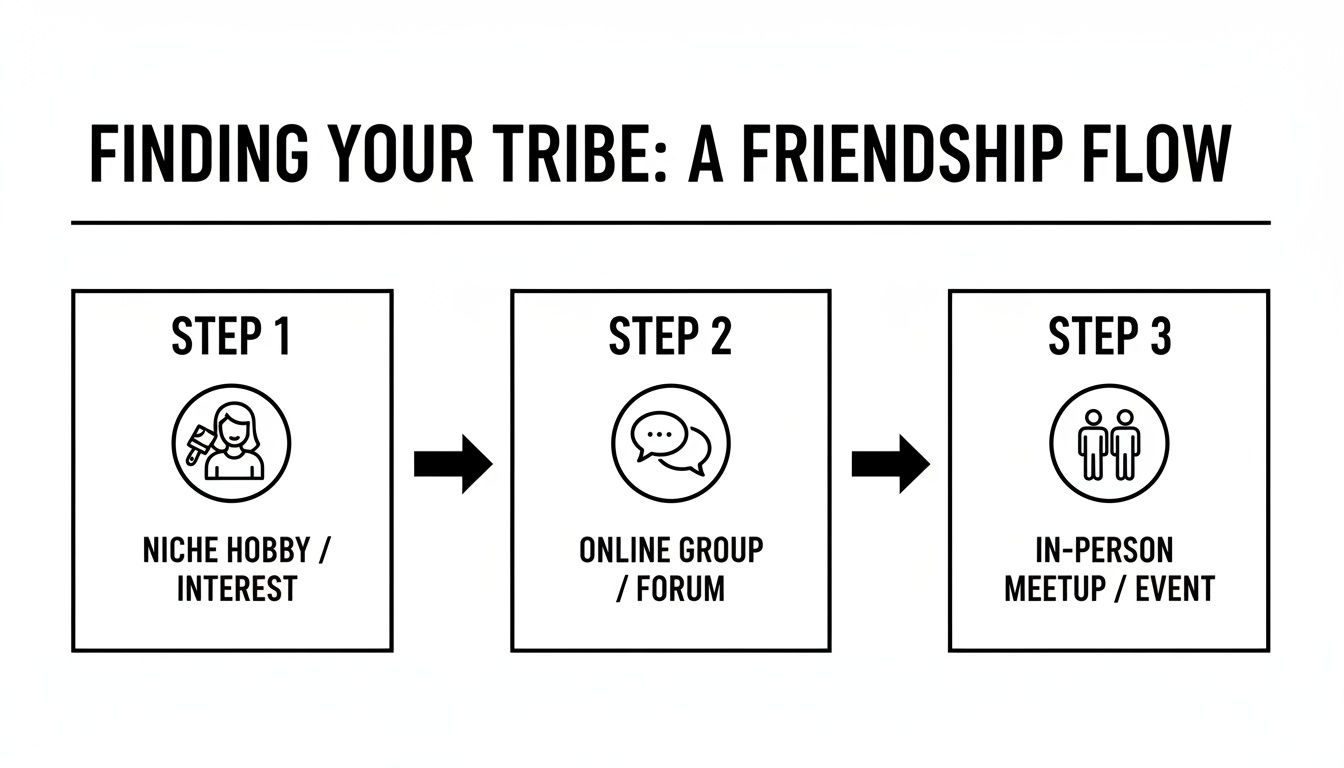
The beauty of this is starting online, where you can build some rapport before you commit your precious social energy to meeting in person.
The Gentle Opener
The first word is always the hardest. A simple "Hi" can feel like a conversational dead end waiting to happen. Instead, put those quiet observation skills to work. A gentle, observational opener is your secret weapon—it feels authentic and gives you both something concrete to talk about from the get-go.
It instantly shifts the spotlight from you to something you both share in that moment. Low risk, high reward.
Here’s what it looks like in the wild:
• At a book club: • "That was a really sharp point you made about the protagonist’s motivation. I hadn't seen it that way at all."
• At a concert: • "I can't believe they actually played that deep cut! What did you think of the new arrangement?"
• At a coffee shop: • "That book looks amazing. Is it as good as the cover makes it seem?"
• At a volunteer event: • "Wow, you’ve got a real knack for this. Have you done this kind of work before?"
See the difference? These aren't just greetings; they are invitations. They show you're paying attention, which is one of the most compelling qualities in a new friend.
The Smooth Pivot
Okay, you've broken the ice. Success! But now you're stuck in the dreaded small-talk vortex, endlessly circling the weather and weekend plans. To build a real friendship, you have to gently guide the conversation somewhere more interesting. This is where the "smooth pivot" comes in.
It's a simple technique that uses a transitional phrase to link what they just said to a deeper topic. You're basically saying, "I hear you, and that makes me think of this..."
Tuck these phrases into your conversational toolkit:
• "That’s so interesting, it actually reminds me of..."
• "Speaking of [their topic], have you ever thought about...?"
• "You know, that makes me wonder..."
The pivot is your escape hatch from conversational dead ends. It lets you steer the chat toward topics you both find genuinely interesting, which is the fertile ground where real bonds start to grow.
Let's say someone mentions they're exhausted from a long week at their job. Instead of just nodding, you could pivot: "I totally get that. It makes me wonder—if you didn't have to worry about the practical side of things, what would your absolute dream job be?" Boom. You've just leaped from a boring complaint to a fascinating chat about passions and dreams.
The Connection Deepener
Once you've pivoted into more meaningful territory, it’s time to go a little deeper. The trick here is asking open-ended questions that can't be answered with a simple "yes" or "no." This is a great place to use the F.O.R.D. method (Family, Occupation, Recreation, Dreams) as a mental guidepost, not a rigid checklist.
So, instead of a closed question like, "Do you like your job?" try an open-ended one like, "What's the most interesting challenge you're working on right now?"
Here’s how to use the F.O.R.D. concepts to spark great conversation:
• Recreation: • "You mentioned you're into hiking. What's the most incredible trail you've ever explored?"
• Dreams: • "If you could drop everything and travel anywhere for a whole month, where would you go and why?"
This is also where your introvert superpower— active listening —gets to shine. People feel an instant connection with those who make them feel truly heard. By listening intently and asking thoughtful follow-ups, you create a powerful bond. If you want to really hone your ability to connect, check out some resources that help you unlock deeper communication by expanding your expressive toolkit.
Ultimately, getting comfortable with these conversational moves is a fantastic way to boost your social and emotional intelligence. For anyone looking to level up in this area, you might want to r ead our guide on how to increase your EQ . It's a skill that pays off everywhere in life, especially when you're on the hunt for your people.
Alright, you did it. You survived the small talk, actually had a great conversation with someone new, and walked away feeling that little flicker of a real connection. High five!
But now what? This is the moment that sends a cold sweat down the back of so many introverts: the follow-up. That simple act of turning a nice chat into an actual, budding friendship feels surprisingly fraught with peril.
Let’s just get one thing straight: you can officially stop trying to workshop the world’s wittiest, most impressive follow-up text. The goal here isn’t to blow their mind; it’s just to be warm and remind them of the cool person they just met. A simple message that ties back to your conversation is more than enough to keep that spark alive.
The Gentle Art of the Follow-Up
Think of your follow-up not as starting something new, but as simply hitting "un-pause" on the conversation you already had. This mindset completely changes the game, taking the pressure off and making the whole thing feel natural and easy for both of you.
Your message just needs to tick a few boxes:
• Be specific. • Mention something you actually talked about. It proves you were listening and not just waiting for your turn to speak.
• Give them an easy “in.” • Share a link, ask a quick question—something that invites a reply without demanding one.
• Keep it low-pressure. • Frame it so they don’t feel obligated to craft a novel in response. Easy in, easy out.
This is where our introvert powers really shine. We’re naturals at this kind of focused, thoughtful connection. While it might seem like extroverts are the ones always making the first move, the real story is a bit different. Research has found that a surprising 22% of introverts are the ones initiating contact 80-100% of the time in their friend groups.
Sure, an extrovert might collect more "friend" nominations in a big crowd, but an introvert's targeted approach often builds deeper, more loyal friendships. It’s a quiet strength, and you can see more on how our social patterns are an advantage .
Ditch "Sometime" for a Real Plan
So, you sent the text, and they replied. Success! Now, how do you bridge the gap from texting to actually seeing them again? The single biggest friendship-killer is the dreaded, "We should totally hang out sometime!" It sounds nice, but it’s a social dead end. It puts all the work on the other person to figure out what, where, and when.
A better way? Be the one to offer a specific, activity-based plan that’s incredibly easy to say “yes” to.
Vague plans create social anxiety. A specific, low-pressure invitation is an act of kindness that makes it easy for someone to join you.
Let’s play this out.
The Scene: You met an American woman at a coffee shop in Seattle, and you geeked out together over a shared love for old sci-fi movies.
• The Follow-Up Text: • "Hey, it was so great chatting with you today! I was thinking about our sci-fi talk and found that list of weird 70s films I mentioned. Here you go!"
• The Invitation (a few days later): • "Hey, I'm planning to hit up that quiet little bookshop we talked about on Saturday morning to browse. No pressure, but want to join for a bit?"
See how perfect that is? It’s directly linked to your conversation, the activity is low-key, the time and place are clear, and it gives them an easy out if they're busy. No awkwardness.
For a much deeper dive into honing these skills, our guide on building relationship skills has some fantastic strategies that work wonders no matter your personality type.
Your Friend-Making FAQ
Alright, so you've got the game plan. But let's be real—making friends isn't like following a recipe. Sometimes you’re left with a weird, wobbly mess and no idea what went wrong.
This is your troubleshooting guide for when things get... well, awkward. We'll tackle the most common head-scratchers with answers that actually work in the real world. Think of me as your buddy in your corner, cheering you on. You've got this.
How Can I Keep My Friends Without Completely Burning Out?
That creeping dread of a social calendar so full it drains your life force? Oh, it's real. The secret to keeping friendships from becoming a chore is to stop being a passive guest in your own social life and start being the host—even if you're hosting a "party" for two.
You get to call the shots.
Instead of automatically saying yes to a loud group dinner, be the one to suggest something that actually sounds fun to you . For example, try saying, "That sounds fun, but I'm craving something a bit more low-key this week. Would you be up for checking out that new art exhibit instead?" A quiet walk through a park, a cozy movie night, or even just chilling at a coffee shop together. These low-key, one-on-one hangs are where the magic happens for us, allowing for real connection without the sensory assault.
A good friend won't just understand your need for quiet; they’ll be glad you’re finding ways to hang out that don’t leave you looking like a zombie. It's all about being proactive, not just reacting to invites.
Friendships should fill your tank, not drain it. A simple text can work wonders: "Hey! My social battery is on empty this week, but I'd love to see you. How about we grab coffee next Tuesday morning?" It's honest, it's clear, and it shows you still want to connect.
What’s the Best Way to Deal With Rejection or Ghosting?
Oof. This one hurts. Whether it’s a text left on "read" forever or a budding friendship that just evaporates, it’s so easy to spiral and think, "What did I do wrong?" First things first: take a breath. Ghosting says a whole lot more about the other person's communication skills (or lack thereof) than it does about you.
Seriously. People get busy, overwhelmed, or are fighting their own secret battles. It almost never feels this way, but it’s rarely as personal as your brain wants you to believe.
Here’s a game plan for when you feel that sting:
• Send one gentle nudge. • After a week or so, a single, no-pressure message is totally fine. Something like, "Hey, was just thinking of you! Hope you're doing well," leaves the ball in their court without being demanding.
• Focus on what you can actually control. • You can't make them reply, but you • can • pour your energy back into the friendships that feel good and the hobbies that make you happy. For example, instead of re-reading their unanswered text, message a different friend to schedule that coffee you talked about.
• Reframe it as intel. • This isn't a failure; it's just information. This person might not be in a place to have the kind of friendship you're looking for. And that's okay! It frees you up to find someone who is.
It’s completely normal to feel bummed out, but don't let the fear of it happening again stop you from putting yourself out there. Every time you try, you're being brave. The outcome doesn't change that.
How Do I Tell My Extroverted Friends I Need Alone Time?
Ah, the classic introvert-extrovert dilemma. To your American friend who recharges by mainlining social interaction, your need for a quiet weekend can feel like a personal rejection. The trick is to talk about it openly and kindly before it becomes a problem.
The key is to frame it as being about your energy management, not about them .
Here’s a script you can steal and make your own: "I have the best time hanging out with you! Just so you know, I'm a classic introvert, which means I have to go into my little cave to recharge sometimes. It’s never, ever personal—it’s just how my brain is wired. Getting that quiet time is what gives me the energy for our next adventure!"
Most people who genuinely care about you will get it. Once they understand that your alone time is what fuels the fun times you have together, it clicks.
Is It Weird to Only Have One or Two Close Friends?
Let me be perfectly clear: 100% NO. It is absolutely okay. We live in a world that acts like your value is determined by the size of your brunch crew. That's a standard built for and by extroverts. Let's toss it out.
For an introvert, friendship success isn't about the headcount; it's about the depth.
Having one or two people you can be your full, weird, quiet self with is the ultimate prize. These are the people who get it, who support you, and with whom you can share a comfortable silence. That's not just a social win; it's a life win.
Research backs this up—introverts consistently thrive with smaller, more intimate circles. This isn't a weakness; it's your superpower. You're wired for quality over quantity . A couple of deep, authentic bonds are worth more than a hundred surface-level acquaintances. So please, celebrate your small-but-mighty tribe. It’s a sign that you’re doing it right.
Understanding your own wiring is the most powerful tool you have. If you’re ready to get a clearer picture of what makes you tick, Enneagram Universe offers a scientifically validated assessment that can light the way. Take our free Enneagram test and start building more fulfilling relationships from a place of true self-knowledge.