How Do You Find Your True Self?: A Practical, Authentic Living Guide

Let's get real for a second. "Finding your true self" sounds like something out of a self-help book from the '90s, doesn't it? But forget the dramatic, movie-style revelation.
Here's the no-nonsense truth: It’s about aligning who you are on the inside with what you do on the outside. It means your daily choices—what you say "yes" to, how you spend your time, who you spend it with—actually line up with your core values and desires, not someone else's expectations.
It’s about finally ditching the masks we all wear. You know the ones: the ‘perfect employee,’ the ‘always-available friend,’ the ‘cool-as-a-cucumber parent.’ It’s about getting comfortable, really comfortable, in your own skin.
What It Really Means to Find Your True Self
Ever feel like you're just... going through the motions? You hit all your marks—work, errands, happy hours—but there's this quiet, nagging whisper in the back of your mind asking, "Is this really it?"
That little voice, that quiet dissatisfaction? That's your first clue. It’s a major sign you’ve drifted away from your true self. The journey back isn't about inventing a brand-new person. It's about excavating the one who got buried under a mountain of social conditioning, endless responsibilities, and everyone else's opinions.
Take Sarah, a sharp project manager in her late 30s living in Chicago. On paper, she’s crushing it: great job downtown, nice apartment, a calendar packed with social events. But behind the scenes? She feels perpetually drained and hollow. She spends her weekends saying "yes" to parties she'd rather skip and her workdays swallowing unreasonable requests, all because the thought of letting someone down feels unbearable. Her inner world is completely out of sync with her outer life.
Recognizing the Disconnect
Sarah's story probably sounds familiar. This disconnect shows up in subtle ways we often brush off as "just stress" or "the grind of adulting." But these are breadcrumbs leading you back to yourself.
The first step is simply to notice. No judgment, just pure observation. It’s about finally validating that feeling of being a little lost and seeing it for what it is: a compass trying to point you back home.
Think of this table as a quick gut-check. Use it to see where you stand on your journey and pinpoint which areas might need a little more attention.
Signs You're Disconnected vs Living Authentically
| Disconnected Self (Running on Autopilot) | Authentic Self (Living with Intention) |
|---|---|
| Your "yes" is automatic, driven by fear of disappointment. For example, agreeing to host Thanksgiving again even though you're exhausted. | You pause before committing, checking in with your own needs first. You might say, "Let me check my calendar and get back to you." |
| You feel a constant, low-grade hum of anxiety or dread. Waking up on Monday morning feels like a heavy weight. | You experience moments of genuine calm and presence. You might find yourself truly enjoying your morning coffee without thinking about your to-do list. |
| Hobbies and passions feel more like chores than joys. That guitar you bought now just collects dust. | You actively make time for things that light you up, like joining a weekly hiking group or a book club. |
| Making decisions feels like torture, even small ones like what to have for dinner. | You trust your intuition and make choices with confidence. You confidently pick a new restaurant for date night. |
| You feel unseen or misunderstood by those around you. You leave family gatherings feeling lonely. | Your relationships feel reciprocal and based on mutual respect. You can have a disagreement with a friend and still feel secure in the friendship. |
| Your energy is consistently low, no matter how much you rest. You're tired even after a full night's sleep. | You feel energized by your life, not just depleted by it. You end a busy day feeling satisfied, not just wiped out. |
Seeing more of yourself on the left side of that table isn't a bad thing—it's the starting line. It means you’re ready for a change.
The journey to find your true self really kicks off when the pain of staying the same finally outweighs the fear of what comes next. It’s that pivotal moment you decide that feeling aligned is more important than just fitting in.
This guide is your roadmap. We're going to give you practical, evidence-informed tools to move from that place of disconnect to a life that feels genuinely yours. We’ll break down the barriers holding you back and show you how to start rediscovering the real you, starting today.
Why You Feel So Lost (and How to Finally Break Free)
Do you ever get that nagging feeling you’re swimming against an invisible current? Like you’re paddling hard in one direction, but life keeps dragging you somewhere else entirely? That’s not just in your head. From the moment we’re born, we're handed invisible scripts for how to think, act, and feel, making the whole "finding your true self" thing feel like a monumental task.
These forces aren't just fuzzy, abstract concepts; they are real, concrete barriers that pile up over the years. They’re the reason you might feel disconnected from your own life, like an actor playing a role you never even auditioned for. The first step toward breaking free is simply to see these barriers for what they are—not personal flaws, but universal parts of the human experience.

The Unseen Rules of Social Conditioning
Social conditioning is basically the rulebook society hands us without ever asking if we want to play the game. It’s all the subtle (and not-so-subtle) messages from family, school, and the media that mold our beliefs and behaviors, usually before we’re old enough to question them.
Let’s take David, from a Midwestern family. He was raised with the classic "big boys don't cry" mantra. Growing up, he got praised for being tough and stoic but was quietly shamed anytime he showed sensitivity. Now, he's a successful architect in Denver, but he feels a deep, gnawing emptiness and can't seem to connect with his wife or kids on a meaningful level.
His conditioning taught him to bury his naturally empathetic and tender side. Now he feels like a stranger in his own life. David isn’t broken; he’s just running on an old program, a script that clashes with his authentic self.
Your Psychological Armor: Defense Mechanisms
When our true self feels threatened, our psyche gets incredibly clever and builds a suit of armor to protect it. We call these defense mechanisms . They're brilliant for getting us through tough times, but they can also end up walling us off from our own hearts.
Think of Maria, a marketing exec in the cut-throat tech industry of Silicon Valley. Growing up, she learned that her parents' love felt conditional—tied directly to her achievements. To cope with that terrifying fear of rejection, she built her armor out of perfectionism and a relentless drive to overachieve. Sure, it earns her promotions and praise, but it's fueled by a constant hum of anxiety, not genuine passion.
Her success isn't an expression of who she is; it's a shield. She’s so busy proving she’s worthy that she’s forgotten to ask what she actually wants. This relentless need for outside approval is exhausting. If it sounds familiar, you might get a lot out of learning how to stop being a people pleaser and start living on your own terms.
Here's the thing: these barriers—the conditioning, the defenses, the roles—are not your fault. They are survival strategies you picked up along the way. Recognizing them isn't about blame. It's about reclaiming your power to choose a different way forward.
Getting Trapped by the Roles You Play
Beyond conditioning and defenses, we get stuck in the specific roles we play every day. We can get so used to wearing these "costumes" that we forget who we are underneath when the show is over.
These roles can be anything, and they often sound a little something like this:
• The Responsible One: • The person who always plans the family holiday and makes sure the bills are paid, even when they’re running on fumes. For example, Kevin always organizes the family reunion trip to the lake house, even though he'd rather have a quiet weekend at home.
• The Funny One: • The friend who uses jokes to deflect from their own pain, never letting anyone see past the punchline. For instance, Ashley cracks jokes about her recent layoff to avoid talking about how scared she really is.
• The Helper: • The colleague who says "yes" to every extra project, sacrificing their own well-being just to feel needed. Like when Jessica stays late to help a coworker finish a report, missing her own son's soccer game.
These parts aren't bad in themselves. The problem starts when we mistake the role for our entire identity. The journey back to yourself is about peeking behind the curtain of these performances and getting to know the person who exists when no one else is watching. Once you see the patterns, you can start to gently take them apart, piece by piece.
Your Hands-On Toolkit for Self-Discovery
Theory is great, but real change happens when you get your hands dirty. Think of this section as your personal workshop for figuring out who you really are. We're moving past the fluffy advice and getting into specific, practical exercises that actually create a shift.
Let's turn the abstract question of "how do you find your true self?" into a concrete, and maybe even fun, project. Each tool here is designed to help you peel back the layers of "shoulds" and outside expectations so you can finally hear your own voice.
Ready to dig in?
The Power of Provocative Journaling
Forget writing down what you had for lunch. If you want to find your authentic self, you have to start asking better questions—the kind that sneak past your brain's polite, pre-programmed answers and get right to the good stuff.
Grab a notebook and give yourself just ten minutes with one of these prompts. The only rule is no judging. Just let the words flow.
• Describe a time you felt completely, absolutely alive. • Where were you? Who was with you? What were you doing? Get into the sensory details—the sounds, the smells, how your body felt. • Example: "I felt most alive during that road trip through Arizona, windows down, music blasting. The vastness of the desert made my problems feel small."
• What would your 8-year-old self be most proud of you for today? • On the flip side, what might they be a little bummed about? This is a great way to reconnect with your original passions before the world told you who to be. • Example: "My 8-year-old self would be thrilled I have a dog, but bummed I stopped drawing cartoons."
• If you had one day with zero obligations and a reasonable (but unlimited) budget, how would you spend it from morning to night? • This little fantasy reveals what you • truly • crave when all the pressures are gone. • Example: "I'd start with a long, quiet hike, then have a leisurely brunch with my best friend, and spend the afternoon wandering through a museum."
• When do you feel most resentful or bitter? • These tough emotions are usually giant, flashing signs pointing to a boundary that's been crossed or a core need that isn't being met. • Example: "I feel resentful when I have to clean up a mess I didn't make, because it feels like my time isn't being respected."
If you really want to map out the pivotal moments that shaped you, exploring resources on Crafting Your True Story can be an incredible exercise for understanding your own personal narrative.
Pinpoint Your Core Values
Think of your core values as your personal constitution. They're the guiding principles that make you, well, you . When your life aligns with them, you feel vibrant and on purpose. When it doesn't, you feel drained, stuck, and totally out of whack.
This quick exercise will help you nail down your top five non-negotiables.
Once you have your top five, do a quick life audit. Rate each value from 1-10 on how much it's showing up in your career, relationships, and daily life. For example, if 'Adventure' is a core value but you haven't taken a real trip in years, you might rate it a 2/10. This isn't about beating yourself up; it's just about gathering data. For a deeper dive, you can learn more about how to become more self-aware in our detailed guide.
Master the Art of the Graceful "No"
Setting boundaries is one of the most direct ways to honor your true self. It's you, telling the world that your time, energy, and well-being are valuable. But for so many of us, especially people-pleasers, saying "no" can feel absolutely terrifying.
The trick is having a simple, respectful script ready to go. It takes the panic out of the moment and lets you respond with confidence.
The Script: "Thank you so much for thinking of me for [the request]. I can’t commit to that right now, but I really appreciate you asking. I hope it goes well!"
Practical example: Your coworker asks you to help with their project on a Friday afternoon. Instead of sighing and saying "sure," you can say, "Thanks for asking, John. I can’t commit to that right now as I need to wrap up my own work, but I appreciate you thinking of me. I hope you get it sorted!"
That's it. Simple, right?
Notice what’s missing:
• A rambling, apologetic excuse.
• A white lie about being "too busy."
• An offer to do the emotional labor of finding a replacement.
It’s clear, it’s kind, and it’s firm. Practice saying it out loud to your dog or into the mirror. It’ll feel clunky at first, but with a little repetition, it becomes a seriously empowering tool in your self-discovery kit.
Using the Enneagram as Your Personal GPS
Journaling and clarifying your values are fantastic starting points. Think of them as your compass—they point you in the right general direction. But if you want the turn-by-turn directions for your inner world? That's where the Enneagram comes in.
The Enneagram is your personal GPS. It doesn't just show you "North." It gives you a detailed, dynamic map of your own psychology.
What I love about it is that it goes beyond what you do and gets straight to the often unconscious why . It digs into your core motivations, your hidden fears, and your deepest desires, giving you a language for your experience that can feel almost unnervingly accurate.
This isn't about slapping a label on yourself and calling it a day. Far from it. This is about understanding your unique wiring so you can finally see the path forward and connect with who you really are.
Decoding Your Inner Blueprint
First things first: you’ll want to take a solid assessment. A flimsy 10-question quiz you find on social media just won't cut it. To get a truly useful result, you need a test that really probes your behavioral patterns and subconscious drivers. The aim is to find your dominant Type, but the real gold is in the nuance that comes with it.
For a great walkthrough on this, check out our guide on how to find your Enneagram type . It breaks the whole thing down for beginners.
Once your results are in, you'll see a few key pieces of information. Let's make sense of them with a real-world example.
Let's say we have Michael, a sales manager from Austin, who discovers he's an Enneagram Type 2 , 'The Helper.' For him, this is an "aha!" moment. He suddenly realizes his constant drive to help his team isn't just about being a good boss. It's tied to a deep-seated fear of being unwanted. He helps because he needs to feel needed.
But the GPS gets even more specific.
• Your Wing: • This is a neighboring type on the Enneagram circle that adds a distinct "flavor" to your core personality. Michael learns he’s a • 2w3 (a Two with a Three Wing) • . That ambitious, image-conscious streak from Type 3 suddenly explains why he gravitates toward helping on high-profile projects that make him look good. It's not just helping; it's helping that gets noticed.
• Your Triad: • The Enneagram is split into three centers of intelligence—Head (Thinking), Heart (Feeling), and Body (Instinct). As a Type 2, Michael is in the • Heart Triad • , which means his world is filtered through emotions and his need for connection and validation.
• Your Health Levels: • This is what makes the Enneagram so dynamic. It’s a scale showing how you express your type's traits when you're thriving versus when you're stressed out. When Michael is healthy, his help is genuine and unconditional. When he’s under pressure, it can twist into something manipulative or resentful.
This layered understanding is what sets the Enneagram apart. It’s not a box; it’s a dynamic roadmap that honors your complexity and potential for growth.
Putting Your Enneagram Map to Work
Getting to know your Enneagram profile is like being handed the user manual for your own brain. You start to anticipate your own reactions, understand your triggers, and navigate challenges with a whole new level of self-awareness.
It becomes a core part of your self-discovery toolkit, working alongside practices like journaling and mindfulness to give you a complete picture.
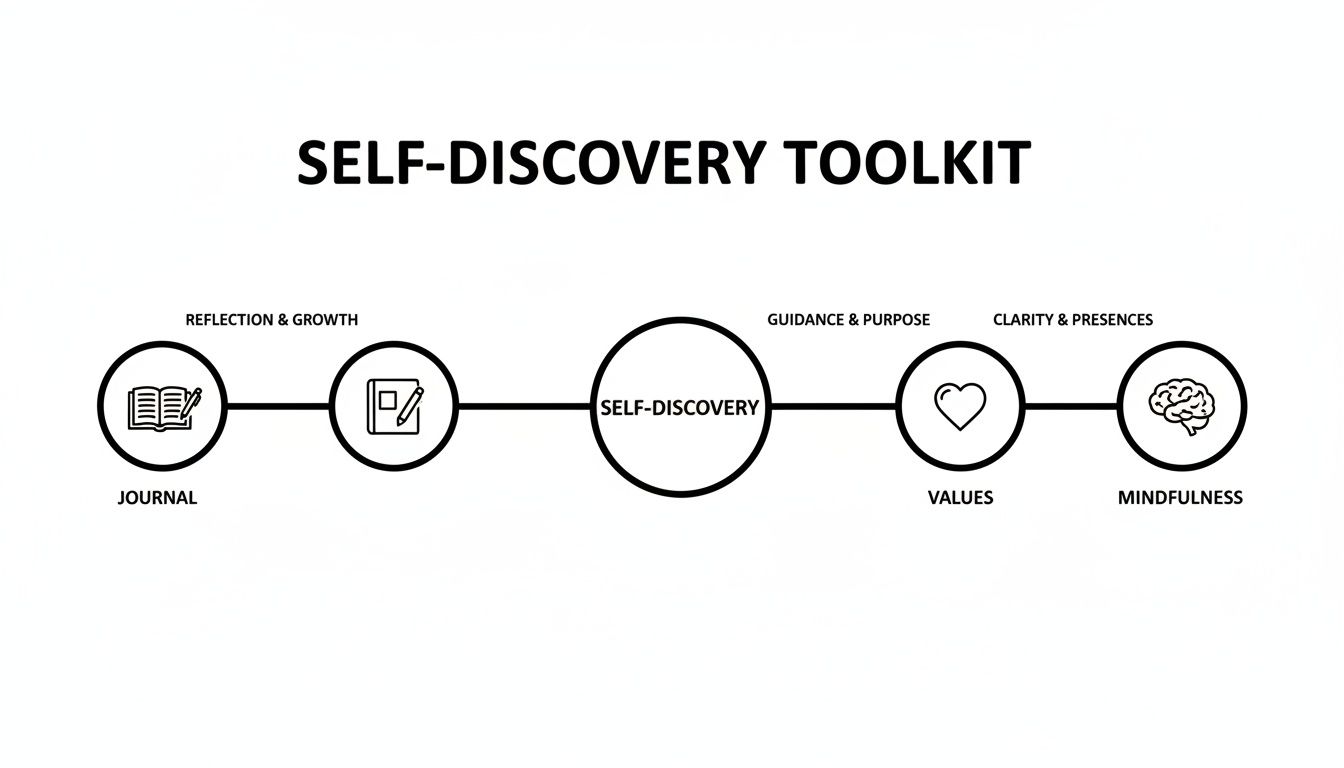
You can see how these tools fit together, with the Enneagram providing that deep, personalized framework that ties everything else to your unique personality structure.
And this framework is surprisingly universal. A worldwide analysis of nearly 190,000 Enneagram tests found that Type 9, 'The Peacemaker,' is the most common at 16.2% —suggesting a widespread, fundamental human desire for harmony. On the flip side, the rarest is Type 5, 'The Investigator,' at just 4.8% , which might suggest that highly analytical people can find it tougher to connect with their inner emotional world—but can gain so much from a structured tool like this one.
Using the Enneagram isn't about changing who you are. It’s about becoming more of who you already are, with less of the baggage and automatic programming that gets in the way.
By understanding his Helper-Achiever blend, Michael can start making conscious choices. He can ask himself, "Am I offering help from a place of genuine generosity, or am I trying to earn my worth?" That simple question, informed by his personal Enneagram GPS, is a massive step toward living a more authentic life.
Alright, let's move all this self-discovery from your journal pages into your actual, lived-in life.
Knowing yourself is one thing; living as yourself is the entire game. All the Enneagram insights and late-night journaling sessions are just interesting data points until you put them into practice. This is where the rubber meets the road—where those "aha!" moments turn into real, lasting change.
The mission here isn't a massive, dramatic life overhaul. It's about building small, sustainable habits that slowly close the gap between who you are on the inside and how you show up in the world.

Start Your Day With an Alignment Check-In
How do you start your morning? If you’re like most of us, you probably grab your phone and let the world's chaos rush in. Let’s try something different. Before the emails and notifications take over, take just two minutes for a Daily Alignment Check-in . It's a ridiculously simple way to start your day with intention.
Just ask yourself one question: "Based on what I know is true for me, what’s one small thing I can do today to honor that?"
Let's see what this looks like in the real world:
• Your core value is 'creativity': • Your intention might be, "I'm going to sketch for 15 minutes on my lunch break instead of doom-scrolling."
• Your core value is 'connection': • It could sound like, "I'm going to send a real text—not just a reaction—to that friend I miss."
• Your core value is 'peace': • You might decide, "When work gets overwhelming, I will physically get up and walk outside for five minutes. No excuses."
This isn't about adding another massive task to your to-do list. It’s about making one tiny, conscious choice that nudges you back toward yourself.
Navigate Your Relationships Authentically
Showing up as your true self in relationships can feel terrifyingly vulnerable, I get it. But it's also the only way to build connections that actually feel good and don't drain you dry. This usually boils down to communicating what you need and—gasp—setting boundaries.
Picture this: It's Friday night. You're exhausted from a long week and just want to curl up on the couch. Your partner, however, is amped to go out. The old you might say "yes" just to keep the peace, only to feel bitter and resentful by 10 p.m.
An authentic response, using a simple script, might sound like this: "I love spending time with you, but I am absolutely wiped from this week. What I really need tonight is to just decompress at home. How about we plan something really fun for tomorrow?"
See what happened there? You're not making demands or picking a fight. You are simply:
This approach doesn't just get you what you need; it builds respect and teaches people how to treat the real you.
Authenticity isn't a license to be a jerk. It's not about "brutal honesty" that leaves a trail of wounded people. It's about being honestly kind—first to yourself, and then to others.
Align Your Career With Who You Are
Your job takes up a massive slice of your life. If it's fundamentally at odds with your core personality, no amount of positive thinking is going to save you from burnout. This is where knowing your Enneagram type can be an absolute game-changer.
Let's take an Enneagram Type 7, 'The Enthusiast.' Their whole world revolves around seeking satisfaction and joy, and they are terrified of being trapped or deprived. They're wired for optimism, adventure, and new ideas.
Now, imagine sticking that Type 7 in a highly-regulated accounting job where every day is the same. It's a recipe for misery. The burnout they'll inevitably feel isn't a character flaw; it's a profound personality mismatch. Understanding this allows them to stop blaming themselves and start looking for work that actually fits—roles in event planning, travel, or entrepreneurship that offer the freedom and novelty they crave.
Interestingly, these insights are becoming more common in the workplace. A Truity survey found that Type 8, 'The Challenger,' makes up 15% of the population, with Type 9, 'The Peacemaker,' close behind at 13% . This means our offices are filled with assertive, can-do leaders and mediating, harmony-seeking colleagues. In fact, some studies suggest that simply understanding these dynamics can slash workplace friction by up to 40% .
Common Questions About Finding Yourself
As you head down this road of self-discovery, it’s only natural for a million questions to bubble up. The whole journey is thrilling, but let's be real—it can also feel a little messy and confusing at times. Let's tackle some of the most common questions head-on to give you the clarity and confidence to keep going.
How Long Does This Whole Thing Take?
Okay, first things first: finding yourself isn't a weekend project you can just check off your to-do list. There's no finish line. It's more like learning a new language or mastering an instrument—it’s a lifelong practice of tuning in and making choices that actually feel like you .
Some people have huge "aha!" moments within weeks, especially when using a powerful tool like the Enneagram. For others, it’s a much slower, more gradual unfolding. The goal isn’t speed; it’s consistency.
My advice? Focus on making just one small, authentic choice today. That’s it. Before you automatically say "yes" to something, pause and ask yourself, "Does this decision really feel right for me?" The more you practice asking that simple question, the more you'll feel like yourself, day by day.
What if I Don't Like What I Find About Myself?
This is probably the biggest fear holding people back, and it's completely understandable. The thought of uncovering a part of yourself you’ve been trying to ignore can be terrifying.
But here’s the secret: true self-discovery isn't about judging what you find. It’s about understanding yourself with radical compassion.
The whole point is to look at the entire picture—your strengths, your shadows, and all the messy bits in between.
For example, realizing you have a major tendency toward envy doesn't make you a bad person. It’s a giant, flashing arrow pointing directly at something you deeply desire but feel you can't have. Instead of shaming yourself, get curious: "What is this envy telling me I truly want for my life?" The Enneagram is brilliant for this, revealing how your biggest challenges are often just the flip side of your greatest strengths. It gives you a clear path forward.
Can Your True Self Change Over Time?
Absolutely, and it’s supposed to! While your core personality structure and motivations (like your Enneagram type) tend to stay pretty consistent, how you express them is meant to evolve. Your priorities will shift, your interests will change, and your self-awareness will deepen.
Think of your true self as the bedrock of a landscape. The bedrock itself is stable and solid, but the trees, rivers, and seasons on the surface are constantly changing, growing, and adapting.
The authentic you at 25 is going to look different from the authentic you at 50 , and that's not just okay—it's the entire point of living and growing. This journey isn't about finding some static, perfect version of yourself and freezing it in time. It's about staying connected to that inner bedrock as you continue to evolve.
As you explore different avenues for self-discovery, you'll come across all sorts of tools and practices. To learn more about some of these, you might want to dive into a practical guide on what are healing stones and how they can play a role in mindfulness.
Ultimately, the more you grow, the more you'll realize that "finding yourself" is less about a grand, dramatic discovery and more about a quiet, steady return home.
Ready to get crystal clear on your personal roadmap? Enneagram Universe offers a free, scientifically validated Enneagram assessment to reveal your core motivations and fears. Stop guessing and start understanding. Find your type today at Enneagram Universe .