How Do You Change Your Attitude and Improve Your Daily Habits

Let's be real for a moment. Changing your attitude isn't some mystical quest. It’s a skill. It's about getting under the hood of your own mind, figuring out what makes you tick, and then consciously deciding to steer in a new direction. It’s a series of small, deliberate choices that add up to a massive shift in how you experience the world.
Your Attitude Is Your Most Powerful Tool
Think of your attitude as the lens through which you see everything. It colors your successes, magnifies your failures, and dictates how you connect with others. It's the silent narrator of your life story. So, before we jump into the "how," let's get crystal clear on the "why." A different perspective doesn't just change your mood; it can fundamentally change your life.
This isn’t about slapping on a fake smile and pretending everything is sunshine and rainbows. That's not helpful. This is about building mental muscle—a resilient, adaptable mindset that lets you handle life's curveballs without getting knocked out of the game. It's a craft you can hone.
The Real-World Impact Of Your Outlook
I once worked with a software developer in Chicago who was absolutely devastated. A huge project she’d poured her heart into completely missed its launch targets. Her first reaction? "My career is over." It was a spiral of defeat and self-blame.
But then, something shifted. After a few days of processing, she decided to reframe the entire situation. Instead of a catastrophic failure, she started seeing it as a brutal but invaluable lesson in managing team dynamics and setting realistic deadlines. She walked into her boss's office, not with excuses, but with a full analysis of what went wrong and what she learned. That proactive, accountable attitude didn't just save her job—it got her promoted to lead the revamped project.
Her story is a perfect example of how your attitude isn't just an internal feeling; it directly impacts your career, relationships, and even your physical health.
This is what that ripple effect looks like in action. A single change in attitude can create a wave of positive changes across your entire life.
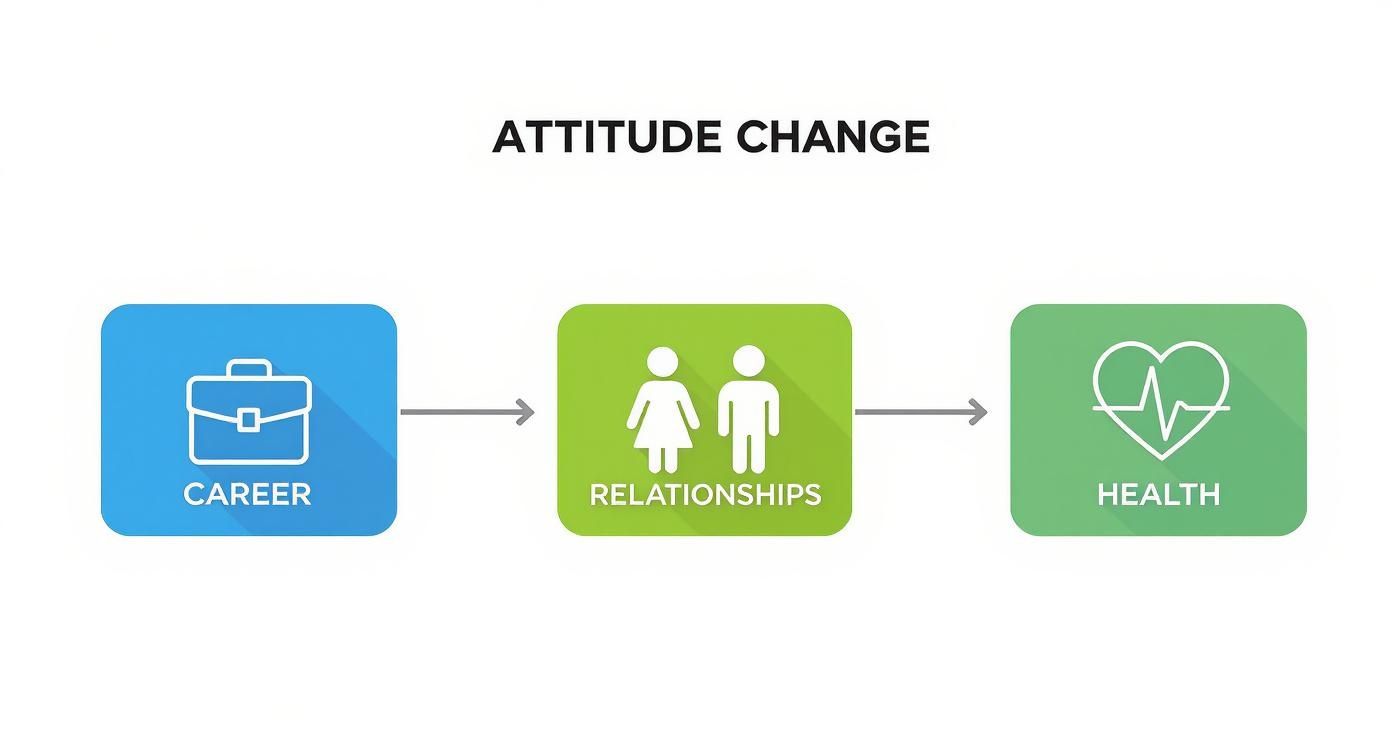
The real magic here is seeing how interconnected these areas are. When you feel more confident and positive at work, it naturally spills over into your personal life, reducing stress and making you a better partner and friend.
Why You Can Actually Change Your Attitude
The idea that you can consciously rewire your outlook isn't just motivational fluff; it's grounded in solid psychology. Cognitive and behavioral strategies are proven to work. In fact, research shows that practices like mindfulness can lead to a 10-15% increase in positive attitude shifts. It all comes down to mastering your emotional regulation.
The biggest discovery of my generation is that a human being can alter his life by altering his attitudes. – William James
This whole process kicks off with a simple commitment to understanding yourself better. You can't change the software if you don't know what's running in the background. If you're ready to dig in, learning how to become more self-aware is the essential first step. For a wider perspective on self-improvement, this guide on how to become a better man offers some fantastic foundational insights for shifting your entire life's trajectory.
To get you started, here’s a quick glance at the core strategies we'll be breaking down.
Your Attitude Change Starter Kit
This table provides a quick overview of the key strategies for kickstarting your attitude transformation, which we'll explore in detail throughout this guide.
| Strategy | What It Is | Why It Works |
|---|---|---|
| Mindset Reframing | Consciously challenging and changing negative thought patterns. | It breaks the cycle of automatic negative thinking, creating new neural pathways for positivity. |
| Habit Formation | Building small, consistent positive actions into your daily routine. | Tiny, repeatable habits create momentum and make positive behavior second nature. |
| Self-Awareness | Understanding your emotional triggers and default reactions. | You can't change what you don't recognize. Awareness is the first step to control. |
| Practical Exercises | Engaging in specific activities like gratitude journaling or mindfulness. | These activities are like going to the gym for your brain—they actively strengthen your positive mindset. |
Think of these as the foundational pillars of your new outlook. Master them, and you’ll have all the tools you need to build a more resilient and positive life.
Master Your Inner Dialogue with Cognitive Reframing
You know that voice inside your head? It’s the director, narrator, and harshest critic for the movie of your life. Every single day, it’s scripting your reality. Figuring out how do you change your attitude really begins with grabbing the microphone away from that inner naysayer.
You wouldn't let a relentlessly negative person follow you around all day, whispering insults, right? So why give that voice in your head a free pass?

This is where a powerful technique called cognitive reframing comes in. It’s the psychological kung fu of identifying, challenging, and flipping unhelpful thoughts on their head. It's less about slapping on a fake "positive" sticker and more about getting real and constructive with yourself.
We're not talking about ignoring problems here. This is about breaking the habit of those automatic negative thoughts (ANTs) that swarm your brain and send you spiraling.
The Catch, Challenge, Change Method
To get practical, let's use a simple but killer framework you can start using immediately. Think of it as a three-step mental workout to stop negativity in its tracks and build a healthier inner narrative.
• Catch It: • The first job is just to notice. You have to become aware of when you’re trash-talking yourself. It’s like catching a ball—you can't do anything until you see it coming.
• Challenge It: • Once you've caught that negative thought, put it on trial. Is this thought • 100% true • ? Is there another way to look at this? What's the evidence • against • this thought? Be a ruthless lawyer for your own well-being.
• Change It: • Now, rewrite the script. Swap that distorted, overly dramatic thought for one that's more balanced, realistic, and genuinely helpful.
Let’s run this through a real-world scenario. Imagine you’re a marketing pro in Denver who just gave a huge client presentation. It wasn't perfect, and your inner critic immediately grabs the mic.
Practical Example of Reframing
• Catch the Thought: • The first thought that blurts out is, • "I totally bombed that presentation. I'm a fraud, and we're definitely going to lose the contract."
• Challenge the Thought: • Hold on. Did you • really • bomb the entire thing? Probably not. The Q&A was a bit shaky, sure, but the data slides were solid. The client even nodded along when you walked them through the market analysis.
• Change the Thought: • The new, reframed thought sounds more like this: • "My opening was a little weak, and I fumbled a couple of questions. But the core strategy is strong, and my data was compelling. Next time, I'll rehearse the intro more and prep for those tricky questions."
See the massive difference? The first thought is a dead end that breeds anxiety. The second is a roadmap for getting better. You just transformed a moment of perceived failure into a productive, actionable lesson.
"The funny thing about attitudes is that we can often see other people’s attitudes more easily than our own... Sometimes, we need to take an introspective look at ourselves to understand better how others may perceive us."
This simple act of reframing is like a bicep curl for your brain. The more you do it, the stronger that mental muscle gets. You're training your mind to default to a problem-solving mode instead of a self-defeating one, which is the secret sauce to fundamentally shifting how you face life's challenges.
Build Positive Habits That Actually Stick
Let’s be real: a better attitude isn't something you just wake up and decide to have. It’s the slow-burn result of the small, consistent things you do every single day. If you want to genuinely shift your outlook for good, you have to build new behaviors that actively reinforce the person you’re aiming to be.
Thinking about forging new habits from thin air can feel like a massive chore. That’s why one of the smartest, most effective strategies I’ve seen is habit stacking . The concept is genius in its simplicity: you just piggyback a new habit you want to do onto an existing one you already do without thinking.
For instance, you probably make coffee every morning. That’s a solid, ingrained habit. To build a gratitude practice, you could "stack" it by deciding: "The second I hit the 'start' button on my coffee maker, I'm going to jot down three things I'm grateful for." Suddenly, the coffee maker becomes the trigger for your new positive routine.
Create Your Own Positive Habit Menu
You don't need to blow up your entire life to see a real difference. The secret is to pick small, almost ridiculously easy actions that you can actually commit to daily. Consistency will always beat intensity.
Here are a few evidence-based ideas to get your gears turning:
• The 2-Minute Journal: • Right before bed, write down one good thing that happened today and—this is the important part— • why • it happened. For example, instead of just "Had a good talk with a coworker," you could write, "Had a great talk with Sarah because I made a point to ask about her weekend project." This trains your brain to hunt for the good stuff instead of marinating in the bad.
• Mindful Moments: • Stuck waiting for a file to download or your lunch to heat up? Just focus on your breath for • 60 • seconds. It’s a tiny act that can slam the brakes on a stress cycle and pull you back into the present moment.
• Curate Your Feed: • Take five minutes and go on an unfollow spree. Ditch any social media accounts that leave you feeling cynical, jealous, or just plain blah. Then, follow accounts that share amazing art, witty humor, or genuinely uplifting stories. What you consume shapes you, and that includes your digital diet.
The secret to lasting change isn't a giant leap; it's a thousand tiny steps taken with intention. By embedding small, positive actions into your daily rhythm, you're not just hoping for a better attitude—you're actively building it, one moment at a time.
These little practices might not feel like much at first, but their power is in the compound effect. Think of them as small, daily deposits into your mental well-being account. Over time, they literally rewire your brain to default to a more balanced and positive perspective. This whole approach is backed by proven behavioral change strategies that champion gradual, sustainable tweaks over those dramatic, flame-out efforts.
Make Your New Habits Stick
Okay, so creating the habit is half the battle. The other, arguably tougher, half is making it last. The mission is to move that new behavior from the "ugh, I need so much willpower for this" category over to the "I just do it automatically" category.
One of the best tricks for this is making your progress visible. Get a simple calendar and put a big, satisfying 'X' on every day you complete your new habit. You’ll be surprised how much the simple desire not to "break the chain" can keep you going. For a more in-depth look at this, you can learn more about setting up and tracking positive habits .
Ultimately, you’re taking an abstract goal—"a better attitude"—and turning it into a series of concrete, daily actions. That five-minute meditation isn't just about feeling calm for five minutes; it's about setting a peaceful, focused tone that creates ripples through the rest of your day.
Shape Your Environment and Social Circle
Ever notice how a single person's bad mood can suck the energy out of an entire room? It's not your imagination. Your attitude doesn't just spring from nowhere; it's constantly being shaped by the people, places, and information you surround yourself with every single day.
Trying to cultivate a positive mindset while your inner circle is a non-stop complaint-fest is like trying to stay dry in a downpour without an umbrella. It’s an uphill battle, and you’re guaranteed to get soaked.
The truth is, moods are contagious. Psychologists even have a name for it: emotional contagion . This means becoming the master of your attitude requires you to become the deliberate curator of your environment.

Now, this isn't about ruthlessly cutting off friends who are having a tough time. Life happens. It’s about recognizing the patterns and taking back control of what you consume—socially, digitally, and even physically.
Audit Your Social Diet
Think of your social circle as your primary source of emotional nutrition. Are you getting a healthy diet of encouragement and optimism, or are you mainlining junk food in the form of gossip and negativity?
A quick "social audit" can be incredibly revealing.
• Who’s on Your A-List? • Grab a notebook and jot down the five people you spend the most time with.
• What’s the Vibe? • Next to each name, be honest. How do you • really • feel after you hang out with them? Energized, inspired, and lighter? Or drained, anxious, and pessimistic?
• Make Some Adjustments: • This doesn't have to be dramatic. It might just mean setting some gentle boundaries with that one friend who’s always complaining, while making a more conscious effort to schedule coffee with the ones who lift you up. For instance, if your friend always calls to complain about work, you might say, "Hey, I've only got 10 minutes before I have to run, but what's up?" to keep the conversation focused.
Navigating these dynamics gracefully requires a good dose of emotional intelligence. If you feel like this is an area you could work on, our guide on how to increase your emotional intelligence is a fantastic place to start.
The company you keep is the company you become. If you want a can-do, problem-solving mindset, you need to surround yourself with people who already have one.
I once worked with an entrepreneur in Austin who realized all her happy hours with friends had devolved into complaining about the tough market. She made one intentional change: she joined a mastermind group filled with fiercely optimistic founders. The shift was immediate. Not only did her own morale skyrocket, but her business saw real, tangible growth because she was suddenly swimming in a culture of possibility and action.
Curate Your Information and Physical Space
The same principle holds true for what I call your "information diet." If the first thing you do in the morning is doomscroll through a feed packed with outrage and bad news, you're basically setting a pessimistic tone for your entire day.
Start unfollowing the accounts that thrive on negativity. Seek out content that teaches you something, makes you laugh, or inspires you.
Don’t forget your physical space, either. A cluttered, chaotic desk almost always contributes to a cluttered, chaotic mind. Tidy up. You'll be amazed at the difference it makes.
This power of the environment isn’t just a personal thing; it works on a massive scale. Historical data shows that major social events and media narratives can dramatically alter the collective attitude of a nation. For instance, American confidence in public institutions has been shown to swing by 10-20 percentage points in just a few years based on the prevailing social climate. You can see more about these global attitude shifts and their causes in this fascinating report.
By consciously shaping your personal world, you’re simply taking that powerful playbook and applying it to your own life.
Time to Walk the Walk and Cement Your New Attitude
Thinking differently is a fantastic start, but it's only half the battle. If you truly want to lock in a new attitude, you’ve got to get your body on board. Taking action is what builds the bridge between your new mindset and your daily reality. It makes the change real .
Think of it like learning to drive a car. You can read the manual cover to cover and watch a dozen videos, but you’re not a driver until you get behind the wheel, hit the gas, and start navigating traffic. Your actions are the evidence your brain needs to finally say, "Yep, this is who we are now."

Connect What You Think with What You Do
So, what's the secret sauce? Start with small, almost laughably easy actions that line up with the attitude you're aiming for. These little "proof points" create a powerful feedback loop, rewiring your brain and reinforcing your new identity. It’s a bit of a psychological hack: behavior often shapes attitude just as much as attitude shapes behavior.
Let's look at how this plays out in the real world:
• Your Goal: Become More Proactive. • You're a project manager in Seattle, and your team's shared drive is a disaster zone. Instead of waiting for someone to complain, you volunteer to organize it. It’s a simple, low-risk task, but the • action • itself is a powerful statement: "I’m a person who takes initiative."
• Your Goal: Cultivate More Gratitude. • You're a college student in Ohio who wants to feel more thankful. Don't just think it—do it. Make it a Friday ritual to send one specific thank-you email to a professor, a friend, or a family member. This small habit turns a fleeting feeling into a concrete, repeatable behavior.
• Your Goal: Build Genuine Confidence. • You're a young professional in Atlanta, and a networking event is giving you anxiety. Instead of just repeating affirmations in the mirror, you prepare one genuinely interesting industry tidbit to share. Taking the action to prepare gives you a tangible reason to feel more self-assured.
Your brain trusts your actions more than your thoughts. Every time you take a small step that aligns with your desired attitude, you're casting a vote for that new identity, making it stronger and more automatic.
This isn’t about "faking it till you make it." It’s about acting your way into who you want to become.
Watch Your Small Actions Create Big Waves
This connection between action and attitude isn't just some personal development theory; you can see it in massive societal shifts. Take public opinion on climate change. A 2025 survey revealed that 64% of Americans view global warming as a significant issue.
But here’s the really interesting part: 55% now reject the idea that their individual actions are meaningless. That proactive mindset translates directly into behavior. About 29% of Americans now intentionally buy from companies that are taking real steps to help the environment. If you want to dive deeper, you can explore the findings on international opinion yourself.
This is a perfect example of how it works. A change in mindset ("I can make a difference") sparks real-world actions (conscious consumerism), which then reinforces and strengthens the original attitude. You can harness this exact same cycle in your own life. Start small, be consistent, and watch your new attitude become your new normal.
Got Questions? Let's Talk.
It's totally normal to have questions. In fact, it's a great sign—it means you're really digging in and thinking about how to make this stick. Let's get into some of the common things that come up when you decide to overhaul your outlook.
So, How Long Does This
Actually
Take?
I wish I could give you a magic number, but let's be real. Shifting a deep-rooted attitude is a lot more like getting in shape than flipping a light switch. It all depends on where you're starting from and how consistent you are. Think months, not days. The cool science behind this is neuroplasticity —a fancy term for your brain’s ability to literally rewire itself based on what you think and do repeatedly.
You’ll probably start to feel small, encouraging glimmers of change within a few weeks of solid effort. But for a new way of thinking to feel truly second nature? Research points to an average of 66 days . The secret sauce isn't one big, heroic effort; it’s the small, daily practice that compounds over time.
What if I’m Trying, but I Still Feel Stuck in a Rut?
First of all, welcome to the club. Hitting a plateau is part of the process. This is a skill you're building, not an instant fix. So, instead of beating yourself up, get curious about it. Play detective and try to pinpoint the specific trigger.
• Is there a particular person who just seems to suck the energy right out of you?
• Does it always hit you in a certain situation, like that dreaded Monday morning meeting?
• Is it one of those sneaky, recurring negative thoughts you haven’t put on trial yet?
Sometimes, you just need to go all-in on one specific technique for a while to break through. But if you’re dealing with a persistent low mood that's seriously getting in the way of your life, it might be something deeper. Reaching out to a therapist can be a game-changer, giving you professional support that’s built just for you.
The funny thing about attitudes is that we can often see other people’s attitudes more easily than our own... Sometimes, we need to take an introspective look at ourselves to better understand how others may perceive us.
Remember, asking for help isn’t a sign of failure. It's a sign of strength and self-awareness. It’s you, deciding to add an expert to your team.
Can I Really Change My Attitude if My Life Genuinely Sucks Right Now?
Absolutely. In fact, this is precisely when changing your attitude becomes a superpower. This isn't about slapping on a fake smile and pretending your problems don't exist. It's about changing how you interact with those problems. It's the difference between being a passenger tossed around in a storm and being the captain steering the ship.
Let's use a tough, real-world example: you're in a financial mess.
• A passive, negative attitude • just marinates in the anxiety: "I'm broke, this is hopeless, I'll never get out of this." This mindset paralyzes you.
• An active, resilient attitude • asks, "Okay, this is hard. What's one tiny thing I have control over • right now • ?" This leads to making a budget, looking up side hustles, or researching financial aid.
The circumstances don't just disappear. But your new attitude gives you the agency and resilience to navigate the situation instead of being drowned by it. You stop waiting for the storm to pass and start learning how to sail in the rain.
Ready to get to the core of what drives your attitude? At Enneagram Universe , we offer a free, scientifically validated personality assessment that helps you understand yourself on a much deeper level. Discover your Enneagram type and get personalized, actionable strategies to lean into your strengths, tackle your unique challenges, and build the life you truly want. Take that first step toward profound self-discovery today.