How Do I Change My Attitude? Practical Steps to Shift Your Mindset

Feeling stuck in a rut and asking yourself, "How do I change my attitude?" You've come to the right place. The good news is, the answer is way more doable than you might think. Changing your attitude isn't about some magical personality transplant; it’s a skill you can learn, like riding a bike. It all comes down to catching those unhelpful stories you have on repeat in your head and consciously deciding to write a better script.
Your Quick Start Guide to a Better Attitude
Forget the fluffy advice to "just think positive." We're going to get our hands dirty with a real, practical framework for rewiring how you react to things. Think of it as hitting the gym for your brain. This isn't about pretending problems don't exist—it's about grabbing the steering wheel of your own perspective so you can navigate those bumps in the road like a pro.
This whole approach is rooted in solid psychology. Decades of research into cognitive behavioral techniques have shown that when people actively spot, question, and rewrite their thought patterns, real change happens. In fact, a huge review of over 375 studies found these methods led to significant attitude shifts in approximately 60-70% of people . Why? Because it treats your mindset as something you can train and improve, not something you're just stuck with.
The Three-Step Attitude Overhaul
To make this feel less like a fuzzy concept and more like an action plan, we’ll use a simple but crazy-effective three-step process: Acknowledge, Challenge, and Replace . This little system is your ticket from knee-jerk negative reactions to thoughtful, constructive responses. It’s a solid foundation you can build on and is a key part of creating any good personal development plan template .
The infographic below breaks down this repeatable process for getting a handle on your inner dialogue.
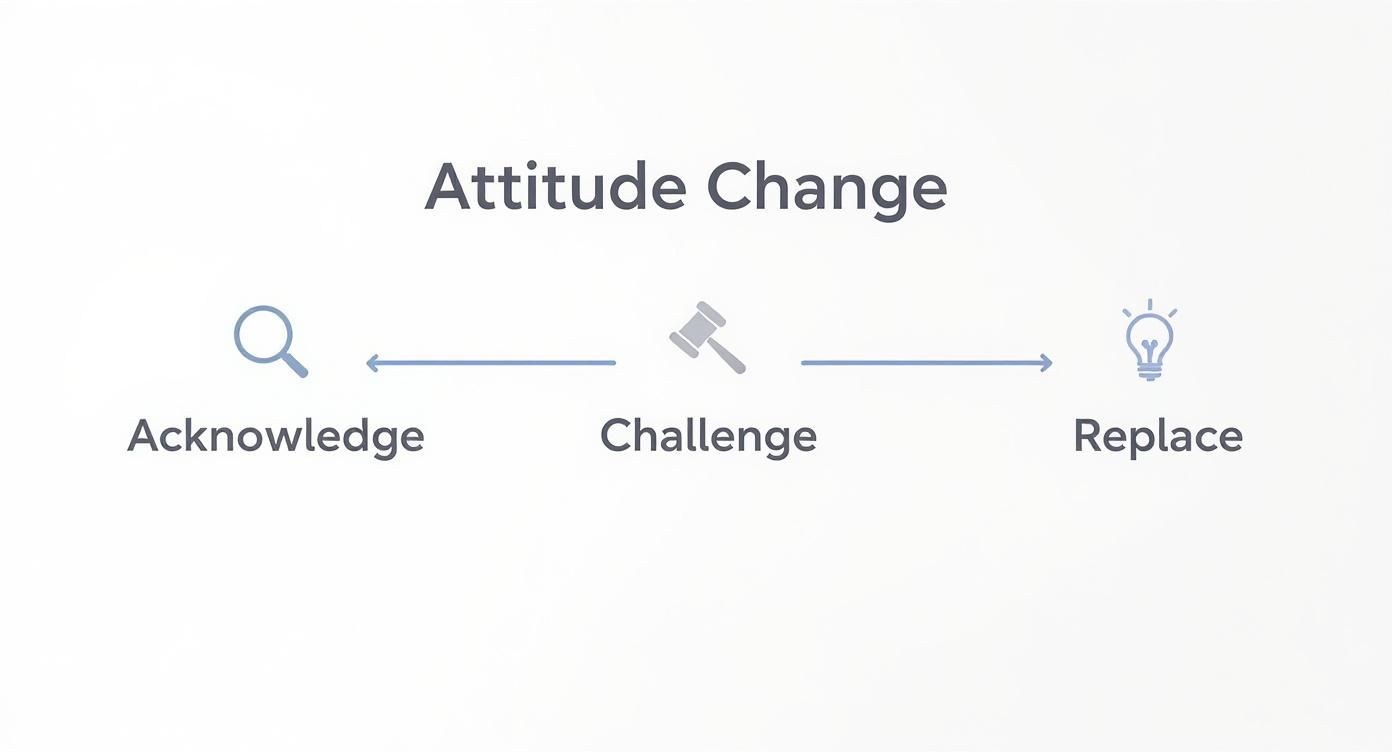
See how one step flows right into the next? This is how you turn an abstract goal into something you can actually do when life gets messy.
Attitude Shift: Quick Wins From Negative to Constructive
To help you put this into practice right now , I’ve put together a little cheat sheet. It breaks down some of the most common negative thought spirals and gives you a practical, constructive alternative. Think of it as a translator for your brain’s grumpy moments.
| Common Negative Attitude | The Hidden Belief | A Constructive Replacement |
|---|---|---|
| "I'll never be good enough for this promotion." | "My skills are fixed, and I'm not talented." | "I might not have all the skills yet, but I can learn them. What's one thing I can do today to get closer?" |
| "This traffic is ruining my entire day." | "External events have total control over my mood." | "This is frustrating, but it's temporary. I'll use this time to listen to a podcast and reset my mindset." |
| "She didn't text back; she must be mad at me." | "I am responsible for other people's emotions." | "She could be busy. I'll focus on my own tasks and trust she'll respond when she can." |
| "I always mess things up." | "My past mistakes define my future outcomes." | "I made a mistake, and that's okay. What did I learn from this that I can apply next time?" |
Play Detective with Your Own Mind
Before you can fix a leaky faucet, you have to find the drip, right? It’s the exact same principle with your attitude. If you're serious about figuring out how to change your attitude, you first have to put on your detective hat and investigate what's really going on in your head. No judgment, no criticism—just pure observation.
This is all about spotting those sneaky little thoughts that pop up out of nowhere. You know the ones I'm talking about—the Automatic Negative Thoughts (ANTs). The goal isn't to squash them on sight. Not yet. For now, you're just a scientist, observing them in their natural habitat.
Think of it as gathering intel. You're just collecting the raw data on your own thought patterns. Sometimes, using a formal personality assessment can be a great shortcut, giving you a map of your natural tendencies and potential blind spots. It's a fantastic starting point for this kind of self-exploration.

Start a Thought Log (It’s Easier Than It Sounds)
One of the most powerful tools in your detective kit is a simple Thought Log. Seriously, don't make it complicated. A little notebook you can carry around, or even the notes app on your phone, works perfectly.
The mission is simple: when you feel that familiar spike of frustration, anxiety, or negativity, just jot down what's happening and what thought just crossed your mind.
Let's walk through an example. Picture Alex, who’s leading a high-stakes project at work when things go sideways.
• The Situation: • The design team completely missed their deadline, which now holds up Alex's part of the project.
• The Automatic Thought: • "This is a total disaster. We're going to fail, everyone will blame • me • , and I clearly can't count on anyone."
• The Feeling: • A lovely cocktail of overwhelm, anger, and anxiety.
The second Alex writes that down, something magical happens. A tiny bit of space is created between Alex and the thought. Instead of being consumed by it, Alex can now look at it. This is the crucial first step to taking back the wheel. It's a foundational skill, and if you want to go deeper, check out our guide on “ How to Become More Self-Aware: Tips for Self-Discovery ”.
Uncover the Real Story with the “Five Whys”
Okay, so you've caught a thought. Now what? It's time to dig a little deeper with a brilliant technique called the "Five Whys." It’s as simple as it sounds: you just keep asking "why?" like a persistent toddler until you hit the root of the issue.
Let's go back to Alex’s thought: "We're going to fail, and everyone will blame me."
Boom. There it is. See how a simple project delay spiraled into a deep-seated fear about personal worth? By playing detective, Alex found the real culprit. The problem isn't just a missed deadline; it's a core belief that his value as a person is on the line.
This is the kind of intel you need. Once you start mapping out these mental habits, you gain the power to make real, lasting changes to your attitude.
Put That Inner Critic on the Witness Stand
Alright, so you’ve done the hard work of spotting those pesky automatic negative thoughts (ANTs) that love to set up camp in your head. High five. Now for the really satisfying part: challenging them. Your inner critic might have a booming voice, but it's usually built on a foundation of pure fiction. Time to play prosecutor.
This isn’t about slapping a smiley-face sticker on a real problem. Forget toxic positivity. We're talking about becoming a mental fact-checker, separating the drama queen narrative from what’s actually happening. The whole point is to build a story that’s not just more positive, but more true . This is where real, lasting attitude shifts happen.

Think of it like this: you’re swapping out the unedited, knee-jerk first draft of your thoughts for a more considered, edited version. You get to step in and ask, "Okay, is that thought really accurate? And more importantly, is it doing me any good?"
Time for a Cross-Examination
Let's get down to brass tacks. Here are a couple of my favorite, battle-tested techniques to dismantle a negative thought before it takes over your day.
• Play "Find the Evidence": • Treat your negative thought like a bold claim made in court. If your brain screams, "I completely bombed that presentation," you have to demand proof. Where's the hard evidence? Did someone actually say it was terrible? Or did you just stumble on one word? Now, find the counter-evidence. What about the parts that went well? The positive nod you got from a colleague? Hunt for the facts that poke holes in that initial, dramatic conclusion.
• What's the • Other • Story?: • Our brains love to jump to the most personal, worst-case scenario. Your job is to force it to consider other options. A friend cancels coffee, and your mind instantly declares, "She's mad at me." Stop. What are • three other possibilities • ? Maybe her kid is sick, she has a brutal deadline, or she’s just completely wiped out. This simple habit stops you from making everything about you.
Try the Best Friend Test
If you only take one tool from this section, make it this one. It's shockingly effective and incredibly simple. The next time you catch yourself spiraling into self-criticism, just ask yourself one question:
What would I say to my best friend if they were saying this about themselves right now?
Chances are, you wouldn't say, "Yep, you're right, you're a total failure." No way. You'd offer compassion. You’d give them a dose of reality, remind them of all the times they’ve succeeded, and tell them to be less hard on themselves.
So why, oh why, do we refuse to give ourselves that same courtesy?
Start treating yourself with the same kindness you’d offer a friend. It feels weird at first, but it’s a game-changer. This one shift can transform your inner voice from your worst enemy into your most reliable ally, fundamentally rewiring your attitude from the inside out.
Build New Habits for a Lasting Attitude Shift

Challenging your thoughts is a huge first step, but how do you make that new, constructive outlook stick? How do you make it your default setting? It all comes down to building tiny, consistent habits. An attitude shift isn't some lightning-strike moment; it’s the quiet result of small, intentional actions you repeat until they become as natural as breathing.
We've all been there—making a huge, dramatic resolution only to watch it fizzle out in a week. That's because big changes require a ton of willpower. The real secret sauce is consistency. If you want a lasting shift, you have to look past temporary motivation and get serious about Building Healthy Habits That Actually Stick . It’s about creating smart systems that support your new mindset without making you feel exhausted.
Engineer Your Wins
Don't just sit around waiting for positive things to happen to you. Get in there and create them yourself! Think of these little rituals as physical anchors for a better attitude, pulling positivity into the tangible reality of your day.
Here are a few ideas I've seen work wonders:
• The Gratitude Jar: • This one is a classic for a reason. Every evening, jot down one good thing—no matter how small—on a slip of paper and pop it in a jar. A perfectly brewed coffee, a funny text from a friend, finishing a task you were dreading. When a bad day hits, you’ll have a physical collection of good memories to fish out. It’s surprisingly powerful.
• Your Digital 'Win Folder': • Screenshot that glowing email from your boss, that sweet text message, or that public praise from a colleague. Keep them all in a dedicated folder on your phone or computer. It's your personal, on-demand morale booster.
• Master 'If-Then' Planning: • Figure out what usually triggers your bad mood. Is it the morning commute? A specific type of meeting? Then, make a pre-emptive plan: "If my commute is a nightmare, then I will turn on my favorite comedy podcast." This gives your brain a ready-made, constructive path to follow instead of defaulting to frustration. You can dive deeper into these kinds of • behavioral change strategies • to find what clicks for you.
Curate a Supportive Environment
The space you live in—both physically and digitally—has a sneaky, massive impact on your mindset. To really change your attitude for good, you need an environment that props you up, not one that’s constantly trying to drag you down. This means taking an honest look at the media you consume, the information you absorb, and even the people you hang out with.
Your environment is the invisible hand that shapes your behavior. You can't maintain a positive mindset in a negative environment.
Think of yourself as the curator of your own mental museum. What are you putting on display? Start with a social media audit. Unfollow the accounts that consistently leave you feeling anxious, jealous, or just plain blah. Fill that space with content that inspires you, teaches you something cool, or genuinely makes you laugh out loud. The same goes for your social life. Make a conscious effort to spend more time with the people who lift you up and less with the "energy vampires" who drain your battery.
The science backs this up. Neuroscience shows that this kind of repeated, intentional effort really does rewire your brain. Research suggests it takes an average of 66 days to form a new habit. And get this—people who consciously practice these small shifts can see their positive attitude traits increase by 20-35% in just a couple of months. That’s a serious return on investment for such small changes.
How Your Environment Shapes Your Attitude
Ever wonder where your attitude actually comes from? It doesn't just pop into existence out of thin air. It’s constantly being shaped, nudged, and sometimes shoved around by the world you live in.
Think of yourself as a plant. You could be a prize-winning orchid seed, but if you’re planted in rocky soil and shoved in a dark closet, you’re not going to grow. It’s the same with your attitude. Your environment—the people you hang out with, the news you scroll through, the very room you're sitting in—is your soil.

This isn't just some feel-good metaphor; there’s real science behind it. It's a phenomenon called social contagion , which is a fancy way of saying that moods and attitudes are surprisingly infectious. Spend all your time with cynics and chronic complainers, and see how long your sunny disposition lasts. It's nearly impossible to stay optimistic when you're swimming in a sea of negativity.
Time for an Environmental Audit
The first, most powerful step you can take is to get brutally honest about what—and who—you're letting into your life. It's time to become the bouncer for your own brain, deciding what gets a VIP pass and what gets told, "Sorry, you're not on the list."
Let's start with the people. Grab a piece of paper and sort the key players in your life into two columns:
• Radiators: • You know who they are. They're the ones who radiate warmth, energy, and encouragement. Being around them just makes you feel better.
• Drains: • Ah, the classic "energy vampires." These are the folks who leave you feeling exhausted with their constant drama, negativity, and criticism.
Now, you don't have to ghost every "drain" in your life (especially if one of them is your boss or your mother-in-law). The goal is to consciously limit your exposure to the drains while actively seeking out more time with your radiators. This one shift can make a massive difference.
Your personal world—the information you consume and the people you associate with—is a direct reflection of your mental priorities. To change your attitude, you must first change your inputs.
This audit doesn't stop with people, either. It’s time to look at your digital diet.
What’s on your podcast playlist? Who are you following on social media? If your feed is a constant firehose of outrage, disaster, and bad news, you're literally feeding your brain junk food.
Even huge societal shifts can rattle our personal outlook. A 2025 global report from the Edelman Trust Barometer found that over 60% of adults felt that major world events pushed them to completely reevaluate their own attitudes. This is a perfect example of how much our external world can mess with our internal one. You can dig into more of their insights on global trends to see just how deep this connection goes.
Got Questions About Shifting Your Attitude? We've Got Answers.
Jumping into this whole attitude-adjustment thing is awesome, but let's be real—questions are going to pop up. You might be wondering if you're doing it right, or what happens when things go sideways. This is where we bust some myths and tackle the big "what ifs" head-on.
Think of this as your straight-talk guide. No fluff, just real answers to keep you on track.
The Million-Dollar Question: How Long Does This Actually Take?
Ah, the big one. Everyone wants to know when they'll "arrive." While there's no magic number that works for everyone, science gives us a decent clue. Most studies suggest it takes about 66 days of consistent effort for a new mindset to feel less like a chore and more like... well, you .
But please, don't get hung up on that number. The truth is, you’ll start seeing small wins much sooner. Maybe you catch yourself before snapping, or you find a silver lining on a cloudy day. These little shifts are huge! Lasting change is a marathon, not a sprint, so pop the confetti for every small victory along the way.
Look, the point isn't to reach some imaginary finish line where you're suddenly "cured." It's about building the mental and emotional muscle to handle whatever life throws at you with a bit more grace and a lot less frustration.
What If I Have a Bad Day and My Old Attitude Creeps Back In?
First of all, welcome to the human race! Having a bad day where your old, grumpy self makes a cameo isn't a failure. It's proof that you're alive. Progress is never a perfect, straight line—it’s more like a messy scribble that, over time, trends upward.
When a slip-up happens, the most important part is how you react. Instead of throwing in the towel, get curious.
• Play detective: • What set this off? Was I hungry, tired, or just plain stressed out?
• Acknowledge it, don't judge it: • "Whoa, that was the old me. Okay, noted."
• Gently course-correct: • Take a deep breath, remember the new habits you're building, and get back to it.
One off day doesn't wipe out weeks of hard work. In fact, these are the moments that build true resilience. It's a prime opportunity to practice some self-compassion, which is the secret sauce for a genuinely positive attitude.
Is It Possible to Change My Attitude When I'm Surrounded by Negative People?
Yes, absolutely. But it's kind of like swimming against the current—it takes a bit more grit and a solid game plan. You can’t always ditch your environment, especially when it comes to work or family. What you can do is control how you show up in it. You are the bouncer at the door of your own mind.
Picture yourself building a mental raincoat. The negativity might be pouring down, but it doesn't have to soak you.
It's not your job to fix the naysayers. Your job is to fiercely protect your own peace and stay focused on the incredible changes you're making for yourself.
At Enneagram Universe , we know that self-awareness is the launching pad for real change. When you understand what truly drives you, you unlock the secret to a better attitude and a life that feels more authentic. Ready to start? Find Your Enneagram Type Now