Holland's Personality Types: A Guide to Career Fit

You’re good at some jobs you don’t want. That’s the trap.
Maybe you’ve been praised for being reliable, so people push you toward operations work. Maybe you’re analytical, so everyone assumes you belong in data or research. Maybe you can lead a room, but every leadership role leaves you tired in a way a title can’t fix. That gap between what you can do and what fits you is exactly where Holland's personality types become useful.
John L. Holland first published his Theory of Career Choice in 1959 , introducing the RIASEC model and the idea that people tend to do better when their personal style matches their work environment, a fit he called congruence ( EBSCO overview of Holland’s theory ). The model is practical because it starts with interests you can observe. What tasks pull you in? What settings drain you?. What kind of work feels natural instead of forced?
The Enneagram adds another layer. Holland helps answer, “What kind of work environment fits me?” The Enneagram asks, “Why do I keep chasing certain roles, avoiding others, or overidentifying with success, service, certainty, or originality?” Put together, they can give you a more honest map.
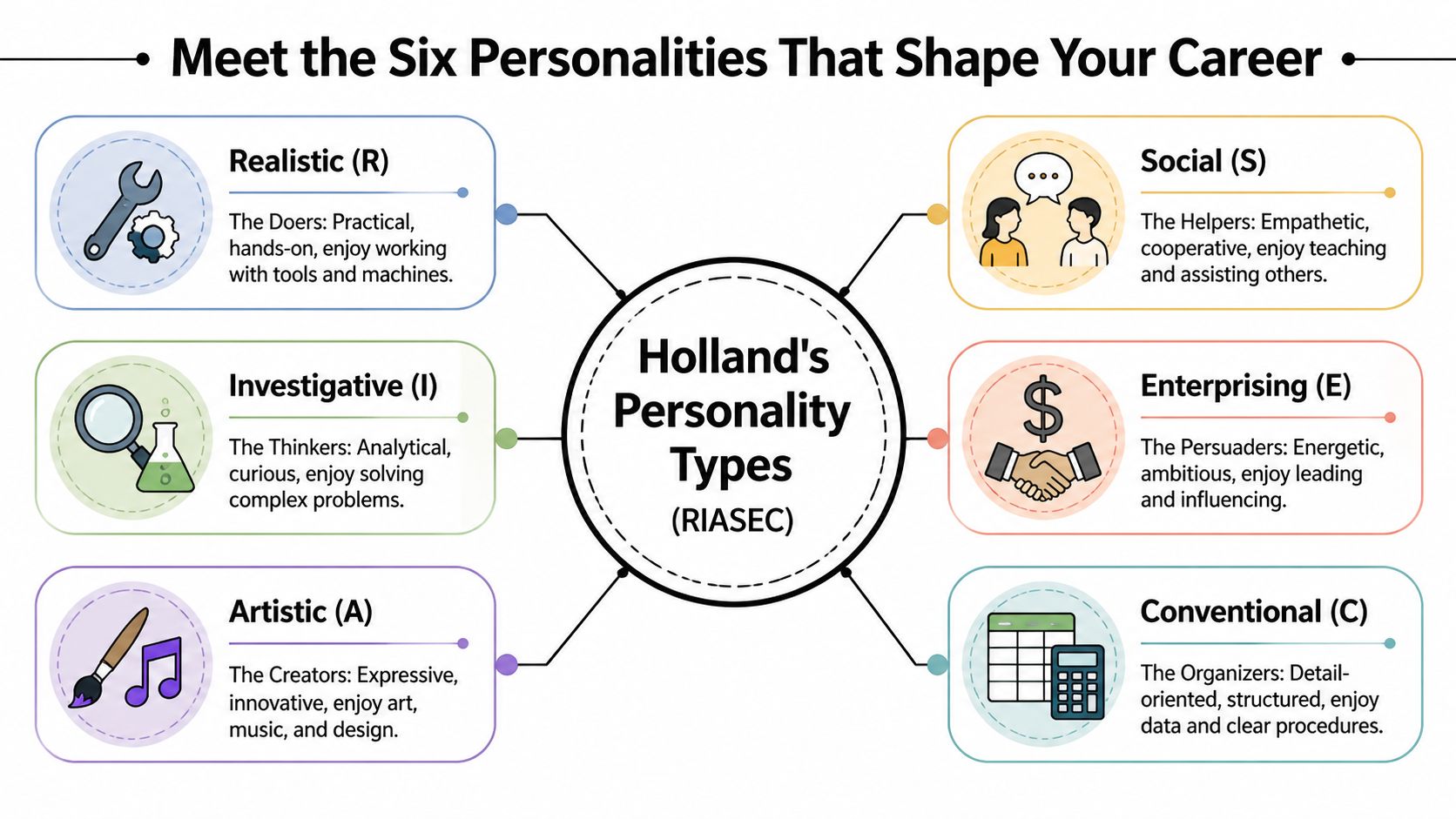
Meet the Six Personalities That Shape Your Career
Holland’s model groups work-related interests into six broad patterns. They’re often described with the acronym RIASEC . Think of them less like six boxes and more like six channels your energy naturally tunes into.
Realistic, Investigative, and Artistic
Realistic people are the builders, fixers, operators, and hands-on problem-solvers. If a Realistic person walks into a messy garage, workshop, garden, or job site, they often don’t feel overwhelmed. They start noticing what can be repaired, assembled, moved, or improved. Holland described these people as drawn to practical activity and concrete tasks, with examples like construction work in the foundational overview of the theory.
A simple picture helps. The Realistic type is like a master builder who trusts tools more than talk. A person with strong Realistic energy might enjoy HVAC work, carpentry, equipment repair, outdoor fieldwork, or technical jobs where the result is visible by the end of the day.
Investigative people are the thinkers. They like patterns, explanations, evidence, and complex questions. Give them a puzzle, a research problem, an unexplained symptom, a coding issue, or a scientific mystery, and they light up. They usually prefer figuring something out over persuading someone to agree.
Investigative energy feels like the person in the room asking, “What’s really going on here?” You might see it in a lab technician, software developer, researcher, analyst, or diagnostician. They don’t just want an answer. They want the right answer.
Artistic people are the creators. They value originality, expression, and room to experiment. Structure isn’t automatically the enemy, but too much of it can make them feel like they’re wearing someone else’s clothes. They often want to shape ideas into something personal and alive.
Think of the Artistic type as a studio full of open tabs. Images, words, sound, mood, design, symbolism, movement. An Artistic person might thrive in writing, graphic design, music, visual arts, branding, photography, or any role that rewards imagination.
Social, Enterprising, and Conventional
Social people are the helpers, teachers, and encouragers. They tend to feel useful when another person grows, heals, learns, or feels supported. They’re often tuned into relationships and group dynamics. Holland’s theory has long associated this pattern with helping professions such as teaching and nursing.
A Social person can feel like a community gardener. They notice potential in people and want to create conditions where it can grow. Counseling, coaching, education, nursing, advising, and community work often fit this pattern.
Enterprising people are the persuaders. They enjoy initiating, influencing, selling, leading, energizing, and moving people toward action. They’re often comfortable with visibility and decision-making. If there’s a goal, a pitch, a campaign, or a team to rally, they usually don’t wait for someone else to step up.
This type is like a campaign captain. They like momentum. You’ll often see Enterprising energy in leadership, entrepreneurship, business development, fundraising, sales, politics, or management.
Conventional people are the organizers. They notice order, sequence, systems, details, and procedures. In chaotic environments, they often become the person who creates the spreadsheet, labels the folders, standardizes the process, and catches the mistakes everyone else missed.
The Conventional type is the architect of consistency. They often fit roles in administration, finance support, operations coordination, records management, scheduling, compliance support, and structured data work.
The RIASEC Types at a Glance
| Type | Nickname | Loves To... | Keywords | Example Careers |
|---|---|---|---|---|
| Realistic | The Doers | build, repair, operate, work with tools | practical, hands-on, concrete | construction, skilled trades, field technician |
| Investigative | The Thinkers | analyze, research, diagnose, solve problems | curious, analytical, scientific | researcher, lab technician, analyst |
| Artistic | The Creators | design, write, perform, invent | expressive, imaginative, original | writer, designer, musician |
| Social | The Helpers | teach, support, guide, care for others | empathetic, cooperative, encouraging | teacher, counselor, nurse |
| Enterprising | The Persuaders | lead, pitch, influence, initiate | ambitious, persuasive, energetic | manager, entrepreneur, sales professional |
| Conventional | The Organizers | organize, track, document, systematize | orderly, reliable, detail-focused | administrator, bookkeeper, operations assistant |
People often get stuck because they read one description and think, “That’s partly me, but not fully.” That’s normal. Holland’s framework was never meant to flatten you into a single label.
If you want a broader personality snapshot alongside career interests, a separate tool like the Enneagram personality test can help you compare what you like doing with what motivates you underneath.
How to Find Your Unique Holland Code
Few individuals are of pure type. They’re a blend.
Holland’s RIASEC model usually identifies 1 to 3 dominant personality types , which then form a three-letter code such as RIA or SEC . Holland was clear that no one is purely one type, and the model works better as a combination than as a rigid label ( Career Key on Holland personality types ).

What an Assessment is Really Measuring
A Holland-style assessment usually asks about activities, preferences, and interests. Not “What job title do you want?” but “Which kinds of tasks draw you in?”
You might react to choices like these:
• Analyzing evidence or solving a technical problem. • This often points toward Investigative interests.
• Leading a group toward a goal. • This often reflects Enterprising energy.
• Helping someone learn or recover. • This often signals Social interests.
• Organizing records or following a clear procedure. • This often leans towards Conventional.
• Building, repairing, planting, or operating equipment. • This often suggests Realistic preferences.
• Designing, writing, composing, or creating something original. • This often indicates Artistic interests.
One answer doesn’t define you. The pattern does.
How The Three-Letter Code Works
Say your strongest reactions show up around teaching, writing, and research. Your code might come out SAI . That would suggest you’re drawn to helping people, expressing ideas, and exploring concepts.
Another person might get REC . That combination could fit someone who likes practical action, a bit of initiative, and clear structure.
The order matters because it tells you what tends to come first. If two people both have Social and Artistic traits, SAI and ASI can still feel different in daily work. One may lead with service and use creativity in support of others. The other may lead with self-expression and only later ask how that work serves people.
What a Differentiated Profile Means
Some people get a very clear pattern. Their top interests stand out sharply from the others. In Holland language, that’s called differentiation . A differentiated profile is easier to interpret because your strongest preferences are more distinct.
Other people score more evenly across several types. That doesn’t mean the assessment failed. It often means one of three things:
If your results feel muddy, don’t panic. Compare your code with moments in your real life. Which assignments did you lose track of time doing? Which tasks made you capable but dull inside? That contrast usually sharpens the picture fast.
For readers who want another reflection tool, this guide on how to find your strengths pairs well with Holland codes because it helps translate interests into usable decisions.
Putting Your Holland Code To Work In Your Career
Knowing your code is helpful. Using it is where things change.
Congruence means the fit between your personality pattern and your work environment. In Holland’s model, that fit predicts career satisfaction, and meta-analytic evidence has found a meaningful relationship between congruence and satisfaction. For employers, using RIASEC assessments for better fit has been associated with 15 to 25% reductions in turnover for congruent hires ( Study.com summary of congruence and turnover benchmarks ).

When Fit is Off
Consider an RI person. They like solving technical problems and working with tangible systems. They take a sales job because it pays well and sounds ambitious. They perform decently. They learn the pitch. They hit targets some months.
But the workday asks for constant persuasion, networking, emotional reading, and relationship maintenance. By Friday, they’re exhausted in a very specific way. Not because they’re lazy. Because the environment keeps asking them to use a mode that isn’t natural for long stretches.
Now compare that with the same person in a lab, engineering support role, diagnostic setting, or technical field position. The exact same intelligence shows up differently. They feel steadier, more absorbed, and less split between who they are and what the job rewards.
That’s congruence in everyday language.
How to Use Your Code as a Compass
Your Holland code can guide more than job titles. It can shape projects, work settings, and side interests.
• Use it for job search filters. • Don’t just ask, “Can I do this job?” Ask, “What does this job ask me to do all day?” A title can hide a bad fit.
• Use it inside your current role. • A Social person in a technical organization may thrive by training new hires, mentoring clients, or facilitating meetings. An Artistic person in a conventional office might come alive through brand work, presentations, or storytelling.
• Use it when considering a career shift. • If you’re reevaluating your direction midlife, practical planning matters as much as self-knowledge. This guide on • how to change careers • is useful because it focuses on the actual steps people face when moving from one fit to another.
What Team Fit Looks Like
Managers can use Holland’s thinking without turning people into stereotypes.
A team with strong Enterprising and Social energy may excel at client relationships, recruiting, teaching, and motivation. A team with Investigative and Conventional strengths may shine in analysis, quality control, documentation, and process design. Add Artistic energy, and the group may generate fresher ideas and better communication materials. Add Realistic energy, and the team may become more grounded in execution.
This short video gives a useful visual explanation of how the types show up in work settings:
A Simple Decision Test
Try this before accepting a role, project, or promotion:
| Question | What to listen for |
|---|---|
| What tasks fill most of the week? | Your top interests should appear often, not occasionally. |
| What kind of people and pace define the environment? | Social and Enterprising types may want interaction. Investigative and Conventional types may want focus and structure. |
| What gets rewarded here? | Promotion criteria reveal the real culture. |
| What drains people in this role? | That answer often exposes hidden mismatch. |
A good career move doesn’t always look flashy. Sometimes it feels like less friction and more honest energy.
Practical Exercises for Deeper Self-Discovery
A code is useful, but reflection turns it into insight. These exercises work well with a notebook, a coaching client, a classroom, or a quiet Saturday morning.
Design your perfect workday
Write out an ideal workday from start to finish. Keep it concrete.
Start with simple prompts:
Then underline the verbs you used most.
If your page keeps filling with words like teach, support, guide, and encourage , Social energy is likely strong. If your language keeps landing on repair, install, test, or build , Realistic energy may be central.
Run the Interest Detective exercise
Look backward instead of forward.
Make three columns in your notebook:
| Experience | What you liked | Likely Holland themes |
|---|---|---|
| School project | presenting, researching, designing, organizing, helping | write in the letters you notice |
| Part-time job | customer contact, troubleshooting, systems, detail work | note recurring patterns |
| Hobby or volunteer role | creating, leading, fixing, coaching, planning | check which themes repeat |
Don’t judge whether the experience was “important.” A high school theater production, tutoring session, church event, coding hobby, landscaping in the summer, or family business task can all reveal the same pattern.
Compare Energy, Not Just Competence
Take two activities you both do well. One should energize you. The other should drain you.
Then answer:
• What kind of effort did the energizing task require?
• What kind of effort did the draining task require?
• Which Holland themes show up in each?
Many people build careers around praise instead of fit. You may be excellent at spreadsheets and still dislike Conventional-heavy work. You may be strong in leadership and still prefer Investigative or Artistic environments. Your most important clue is often not “What am I good at?” but “What kind of good work leaves me with more life afterward?”
Write a One-Paragraph Work Identity Statement
Keep it plain. No corporate language. Try this sentence starter:
“I do my best work when I’m able to ______, in an environment that values ______, with enough room to ______.”
Then read it back and circle any Holland themes you hear in your own words. This exercise does something a test can’t. It lets your inner voice speak before job titles start talking over it.
Connecting Holland Types with Enneagram Insights
Holland tells you what kind of work activities and environments tend to fit. The Enneagram helps explain the deeper motive underneath those preferences.
That distinction matters. Two people can share the same Holland code and still bring very different emotional patterns to work. One Social person helps because they love direct human connection. Another helps because being needed feels safe. One Enterprising person leads for visible success. Another leads to avoiding vulnerability or loss of control.
A recent 2025 study reported that combining RIASEC with the Enneagram improved team performance prediction by 28% , and the same source noted a 35% spike in searches for “Holland Code Enneagram” among personal development audiences in 2025 ( FAU career page reference ). Interest in the overlap is growing because each system covers something the other leaves out.

The What and The Why?
A very simple way to look at it is:
| Holland type shows | Enneagram shows |
|---|---|
| the activities you’re drawn to | the motives, fears, and emotional habits behind your behavior |
| likely work environments | likely inner drivers |
| vocational fit | personal growth path |
A few examples make this easier to see.
Enterprising + Enneagram Type 3 can look like a natural achiever. This person may love leadership, visibility, momentum, and measurable success. They often thrive in roles where influence and ambition are useful. But they may also overidentify with performance and struggle to slow down.
Enterprising + Enneagram Type 8 can look different. The same outward confidence may be driven less by image and more by strength, autonomy, and protecting territory or people. Both combinations may lead well, but the internal weather is different.
Artistic + Enneagram Type 4 often makes intuitive sense. There may be a strong need for authenticity, emotional meaning, and personal expression. Yet Artistic energy doesn’t belong only to Type 4s. A Type 7 may bring playful creativity. A Type 1 may bring disciplined craftsmanship. A Type 9 may bring aesthetic harmony.
Where Coaches and Teams Get More Leverage
When you use only Holland, you might say, “This person likes people-facing work.” That’s helpful.
When you add the Enneagram, you can ask better questions:
• Are they helping from generosity or from difficulty setting boundaries?
• Are they leading from grounded confidence or from fear of failure?
• Are they organizing because they love systems or because uncertainty feels threatening?
• Are they creating from freedom or from a longing to be seen as unique?
That’s the bridge from career fit to personal growth. A Holland code can guide your next role. The Enneagram can explain why you keep repeating the same pattern inside each role. For people who want to identify that deeper pattern, this guide on how to find your Enneagram type is a useful next step.
One Caution About Overlap
Don’t force one-to-one matches. A Social person isn’t automatically a Type 2. An Investigative person isn’t automatically a Type 5. A Conventional person isn’t automatically a Type 1 or 6.
The better question is not “Which Enneagram type belongs to this Holland type?” It’s “How does my motivation shape the way I express my interests?” That question keeps the model honest and much more useful.
A Strategic Guide for Educators and HR Leaders
Used well, Holland's personality types can improve guidance, placement, and development. Used poorly, they become another sorting tool that narrows people too early.
That’s why educators and HR leaders should treat RIASEC as a conversation framework, not a verdict.
What Educators Can Do With It?
In schools, students often hear advice that sounds helpful but is too broad to guide real choices. “Follow your passion.” “Keep your options open.” “You can do anything.” None of that helps a student who needs language for the kind of environment where they’ll likely grow.
A better approach is to connect course choices, projects, and internships to recurring patterns of interest.
• Show students the task level. • Don’t only discuss majors. Talk about daily activities. A biology major can involve fieldwork, patient interaction, data analysis, or lab routine. Those feel different.
• Use reflection after experiences. • After a project or internship, ask what parts felt absorbing, draining, social, structured, creative, or practical.
• Pair fit with possibility. • Students need room to experiment, not early foreclosure. If you also want a useful perspective on how adults can help young people discover their natural strengths, that resource adds a broader strengths-development lens.
What HR Leaders Can Do With It?
In organizations, RIASEC can sharpen hiring and internal mobility decisions. It can also improve coaching conversations when an employee is performing but disengaged.
Use it for questions like these:
| Situation | Better question |
|---|---|
| Hiring | What kind of environment does this role actually reward day to day? |
| Promotion | Will success require a different Holland pattern than the employee’s current strengths? |
| Burnout | Is this exhaustion a workload issue, a motivation issue, or a fit issue? |
| Team design | Which work styles are missing from this group? |
A technically strong employee may fail in a promotion not because they lack ability, but because the role shifts from Investigative or Realistic work toward heavy Enterprising demands. Another employee may flourish once moved from repetitive structure into mentoring, client education, or creative problem-solving.
Use It Carefully in Diverse Settings
Many articles often remain too shallow. A 2023 meta-analysis found that RIASEC predicted career satisfaction with r=0.25 to 0.35 in Western samples, but the relationship weakened to r<0.20 in some non-Western cultures ( North Dakota CTE Holland overview, citing the meta-analysis ). That doesn’t make the model useless. It means context matters.
Culture influences how people answer interest questions, how careers are valued, and how much freedom someone has to pursue fit. Immigration status, family expectations, financial pressure, and collectivist norms can all shape what “choice” means.
So use RIASEC responsibly:
• Don’t treat scores as destiny. • They describe preferences, not permanent limits.
• Don’t ignore access and culture. • A person’s path may reflect constraints, not lack of fit.
• Don’t separate fit from growth. • People can stretch into adjacent environments, especially when supported.
• Don’t use one model alone for high-stakes decisions. • Pair it with interviews, observation, work samples, and broader personality insight.
The goal isn’t to sort people into lanes. It’s to create better alignment between human beings and the roles they inhabit.
Build a Career That Feels Like You
A key gift of Holland's personality types is clarity. Not the fake clarity of “this is your one true job,” but the grounded kind. The kind that helps you notice why one role drains you, another steadies you, and a third makes you feel more like yourself.
You’ve seen the six RIASEC patterns. You’ve seen how a three-letter code creates a more accurate picture than a single label. You’ve seen how congruence turns career choice from guesswork into fit. And you’ve seen why the Enneagram adds something essential by naming the deeper motives that shape how you work, lead, help, create, or organize.
That matters because authenticity is practical. It changes how you choose projects, how you interview? How do you recover from burnout? How do you understand conflict on a team? How do you stop building a life around borrowed definitions of success?
Use Holland to notice your natural direction. Use the Enneagram to notice the inner patterns that can distort it or deepen it. Together, they can help you build a career that doesn’t just look good from the outside but feels honest from the inside.
If you want to explore the deeper motivation behind your work style, Enneagram Universe offers an Enneagram assessment focused on core fears, desires, and patterns, which can pair well with Holland-based career reflection.