Escaping "Good Girl Syndrome" to Reclaim Your Authentic Self

Ever feel like you’re starring in a play you never even auditioned for? That’s the heart of what we call "good girl syndrome." It’s this quiet, relentless pressure to be the agreeable one, the perfect one, the one who keeps everyone happy—usually at your own expense. It’s an unspoken script that somehow makes you feel responsible for everyone else’s feelings but your own.
The Hidden Exhaustion of Being the Good Girl
Picture an actress who never gets to take off her costume. Even after the final curtain call, the heavy corset stays on, the elaborate dress remains, and the perfect smile is plastered on her face. This is exactly what living with good girl syndrome feels like. That role—the pleasant, helpful, and flawless one—stops being a performance and becomes a suffocating identity you can't seem to shake.
The constant striving to meet everyone else’s expectations is just plain draining. It’s a silent, creeping burnout that settles in while you’re busy saying “yes” to yet another favor, swallowing your real opinion to avoid a fight, or over-planning every little thing to make sure no one is disappointed. For example, you might spend hours researching the "perfect" group dinner spot that will cater to everyone's dietary needs and preferences, only to realize you never once considered what you were in the mood for. You become the reliable one, the go-to person for everything. Everyone celebrates you for it, but inside, you just feel unseen and hollowed out.

More Than Just Being Nice
Let's get one thing straight: this isn't about being a kind and decent person. Genuine kindness comes from a place of strength. The "good girl" persona, on the other hand, is fueled by a deep-rooted fear of letting people down. These patterns often start way back in childhood, when we’re praised for being quiet and compliant, and we learn that our value is directly tied to how well we take care of others.
Think of this guide as your official permission slip to finally step off that stage. We’re going to walk through this together.
• The "Why" Behind the Behavior: • We'll dig into the psychological and cultural roots that feed this relentless need for approval.
• The True Cost: • We'll pull back the curtain on how this people-pleasing habit is really affecting your mental health, your relationships, and even your career.
• A Path to Freedom: • I’ll give you a practical toolkit full of real, actionable steps to start setting boundaries, find your voice, and get back in touch with the real you.
A core realization is that you are not responsible for managing other people’s emotions. Your only job is to manage your own.
We’re also going to introduce a powerful tool for self-discovery: the Enneagram. Think of it as a decoder ring for your personality. It helps reveal the secret motivations and fears that keep that "good girl" costume zipped up tight. By understanding your Enneagram type, you get a personalized roadmap to finally break free.
If that feeling of hidden exhaustion and constant overwhelm hits a little too close to home, know that finding a counsellor can be one of the most powerful first steps you take. This whole journey is about trading exhaustion for energy and obligation for authenticity. It's time to find out who you are when you stop auditioning for everyone else.
Where Does 'Good Girl Syndrome' Actually Come From?
If you're reading this and nodding along, there’s something you need to hear right off the bat: this isn't your fault. You didn't just decide one day to become a people-pleaser. Good girl syndrome is a learned behavior, a complex tapestry woven from your family dynamics, the cultural air you breathed, and a lifetime of subtle (and not-so-subtle) messages.
It’s a bit like tending a garden you didn’t plant yourself. As a kid, seeds of compliance, quietness, and agreeableness were dropped into the soil. Every time you were praised for being "such a good helper" or "so easy," it was like a sprinkle of water. Over time, those seeds sprouted and grew deep roots, creating a powerful belief system: your worth is directly tied to keeping everyone else happy.
The Slow Drip of Conditioning
This conditioning often kicks into high gear in school. Think back to the classroom. Little girls are consistently rewarded for being still, quiet, and helpful. While those aren't bad things, the constant reinforcement teaches a more insidious lesson: your value lies in not making waves and making life easier for others.
This becomes the subconscious programming that runs your life. That fear of someone being disappointed in you? It’s the invisible fence that keeps you from speaking your mind in a meeting or makes you feel racked with guilt for taking a sick day. It’s the gatekeeper of your decisions.
A perfect example is the woman who kills it on a project at work but credits it to "luck" or "a great team." It's not that she isn't proud; it's that she's been taught that being boastful or "too ambitious" is a one-way ticket to being disliked. She’s learned that playing small is playing it safe.
The Family Roles We Didn't Audition For
Family dynamics are the primary stage where the "good girl" learns her lines. Many of us were unconsciously cast in roles to keep the family unit running smoothly. See if any of these sound familiar:
• The Peacemaker: • Your job was to de-escalate conflicts. You learned to swallow your own feelings to prevent others from getting upset. A practical example is when your parents argued, you'd quickly change the subject or crack a joke to dissolve the tension, learning that your role was to manage the emotional climate.
• The High Achiever: • Love and praise felt conditional. You had to earn it with good grades, trophies, and perfect behavior. You might have felt that your parents' love swelled when you brought home a straight-A report card but receded when you struggled in a class.
• The Little Helper: • You were the "responsible one," often taking on adult chores and worries, putting your parents' or siblings' needs way ahead of your own. This could look like packing your younger sibling's lunch every day without being asked, because you absorbed the stress of your overworked parents.
These roles become a script we feel obligated to follow for life. When we try to go off-script—by saying no, setting a boundary, or chasing a dream that isn't on the approved list—it can feel like a profound betrayal of who we are.
At its heart, good girl syndrome is an extreme sensitivity to feedback. It’s a constant, anxious dance of seeking approval and desperately avoiding disapproval. People-pleasing isn't just a habit; it's a survival strategy.
This pattern gets a major boost from parenting styles or social structures that don't exactly cheer on independent thought. When you’re not encouraged to figure out who you are, it’s tough to build solid self-esteem and self-respect. You can dive deeper into these psychological origins and their impact on self-worth with experts who have picked the syndrome apart.
Ultimately, digging into these roots isn't about pointing fingers. It's about finding freedom. The moment you see where these behaviors came from, you realize they are not an innate part of you. You are not your conditioning. You're the one holding the gardening shears now, and you get to decide what you want to grow.
The Heavy Price of Being the "Good Girl"
Playing the part of the perfect, agreeable woman isn't just tiring—it's a high-stakes game you can't win. Sure, being the "good girl" might get you a pat on the back and keep things smooth for a while, but the long-term cost is astronomical. This constant habit of pushing your own needs aside slowly erodes your well-being, with fallout that touches every corner of your life, from your health and happiness to your career and closest relationships.
This isn't just about feeling a bit frazzled. It's a slow-motion personal crisis. When you consistently place everyone else’s needs, comfort, and happiness before your own, you’re basically screaming at your own subconscious: my needs don't matter. It might feel quiet at first, but that self-neglect eventually boils over into real, tangible physical and emotional pain.
Your Health and Happiness on the Back Burner
Swallowing your true feelings and saying "yes" when every fiber of your being is screaming "no" creates a state of chronic, simmering stress. Your body always keeps the score, even when you’re telling yourself to just push through. This low-grade, constant anxiety isn't just "in your head"—it has very real, very physical consequences.
Imagine you're driving a car with the handbrake just slightly pulled up. You're still moving, but everything feels harder, and you're slowly burning out the engine without even realizing it. For so many women, this internal friction shows up as:
• Chronic Anxiety: • That constant, nagging feeling of unease because you’re always scanning the room, trying to read people and avoid their disapproval.
• Insomnia: • Your brain just won't switch off at night, replaying conversations or spiraling about all the things you have to do for everyone else.
• Digestive Issues: • It's no secret that stress absolutely wrecks your gut.
• Weakened Immune System: • All those stress hormones running rampant make you an easy target for every bug going around.
The link here is terrifyingly common. Good girl syndrome is practically an epidemic, with some studies showing that around 75% of high-achieving women experience its symptoms. Even more shocking, researchers have found that 1 in 4 American women have been diagnosed with an autoimmune illness, and they're seeing a strong connection between the two. The chronic stress from suppressing your own needs might actually be a trigger for your body to start attacking itself. You can read more about the link between people-pleasing and health in recent studies.
A Career Built on Quicksand
At work, the "good girl" traits can look like a superpower at first. You're reliable, you're the first to volunteer for extra tasks, and you never, ever rock the boat. But you're building your career on a foundation of sand.
Instead of constructing a professional life on your actual talents and ambitions, you’re building it on being accommodating. This is the fast track to getting overlooked for that big promotion, being completely taken for granted, and getting stuck with all the "office housework" that does nothing to move you forward. A practical example is always being the one to take notes in a meeting or plan the office party, tasks that are helpful but rarely lead to a raise. Because you avoid conflict at all costs, you're far less likely to negotiate for the salary you've earned or to voice a brilliant, disruptive idea that might get some pushback.
When your main goal is to be liked, you give up the chance to be respected. And trust me, they are not the same thing.
How "Goodness" Can Poison Your Relationships
Here's the cruel irony: the people-pleasing you do to hold your relationships together is often the very thing that tears them apart. A partnership where one person is constantly silencing their own needs isn't a partnership at all—it's a performance. And just below the surface of that performance, resentment is brewing.
Take Sarah, a graphic designer from Austin. She prided herself on being the "perfect" partner and the go-to employee. She planned every single vacation, remembered everyone's birthday, and never turned down a last-minute project. But inside? A quiet rage was building. It would leak out in little passive-aggressive jabs at her partner or a constant, simmering frustration with her job.
Eventually, the stress landed her in the hospital with a severe autoimmune flare-up. That was her wake-up call. Lying in that sterile hospital bed, she had a lightning-bolt realization: her relentless quest to be "good" had cost her both her health and any shot at a genuine connection. Her journey back wasn't just about medicine; it was about the terrifying, liberating process of learning to say "no," to state her needs out loud, and to finally accept that she couldn't be everything to everyone.
Sarah's story is a stark reminder that breaking these habits isn't just about self-improvement—it's an act of self-preservation. You can start untangling these dynamics with our guide on how to stop being a people pleaser .
Using the Enneagram to Find Your True Motivation
If you’ve ever tried to break a habit, you know that simply telling yourself to “stop” is a fool’s errand. To really change a pattern like people-pleasing, you have to get to the root of what’s driving it. That’s where the Enneagram shines. Think of it less as a personality test and more as a roadmap to your inner world, showing you the hidden fears that keep the good girl syndrome on autopilot.
Why do generic tips like "just say no" fall so flat? Because they don't account for your specific reasons for saying yes. The Enneagram reveals that not all people-pleasing is created equal. For one person, it’s a desperate attempt to avoid being seen as flawed. For another, it’s a strategy to ward off the terrifying possibility of being abandoned.
This framework takes you from a vague sense of “I’m a people-pleaser” to a crystal-clear understanding of your unique flavor of it. Suddenly, you're not just fighting a nameless, shapeless monster; you're facing a specific fear with a name and a playbook.
The infographic below paints a stark picture of just how high the stakes are. The constant pressure to please isn't just a mental game—it has real, cascading consequences for your entire life.
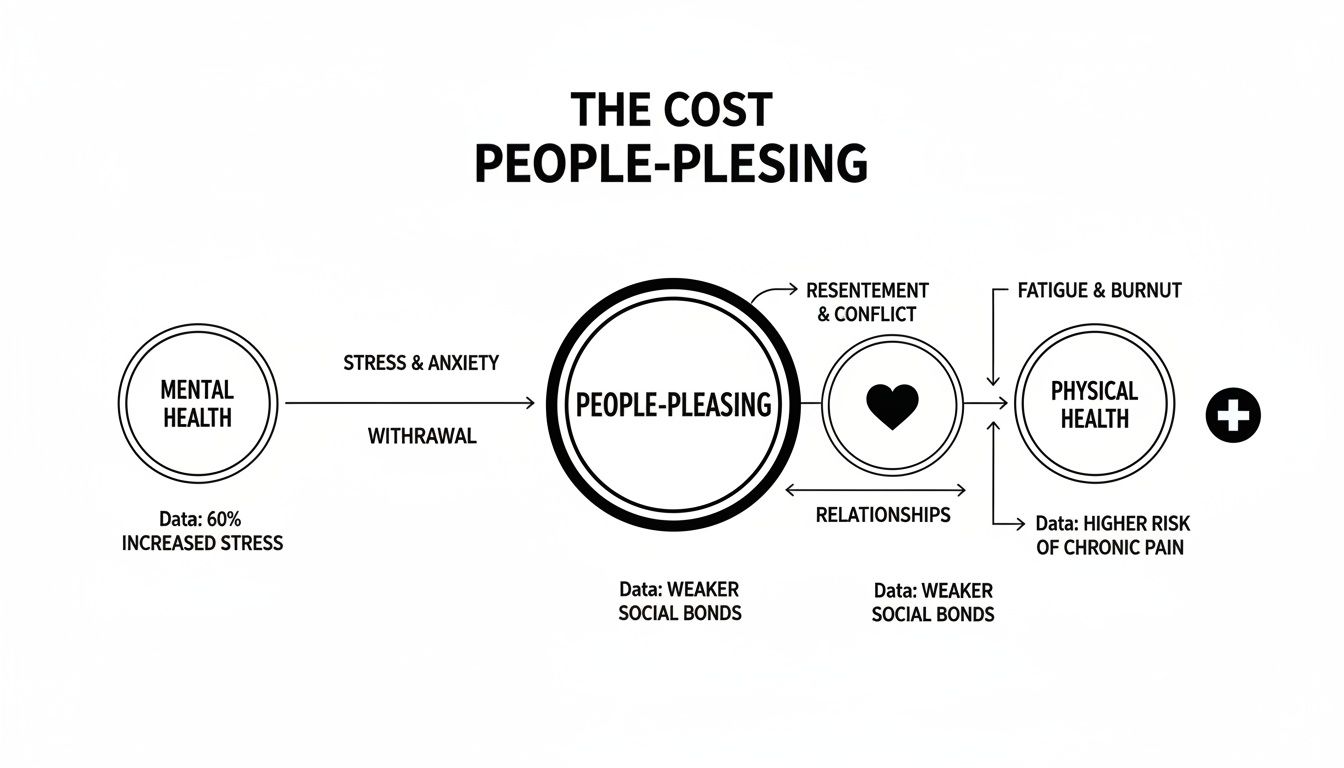
As you can see, what starts as a strain on your mental health quickly poisons your relationships and, eventually, shows up as very real physical problems. It’s a domino effect, and it all starts with that unchecked impulse to please.
So, how does this play out for different people? While many Enneagram types can fall into the "good girl" trap, it's particularly common for Types One, Two, and Nine.
Enneagram Type One: The Perfectionist
The driving force for an Enneagram One is the need to be good, moral, and right. Their absolute worst-case scenario? Being seen as corrupt, defective, or flawed. This makes them prime candidates for good girl syndrome , because they often confuse "being good" with "being perfect" in every single role they fill.
Take Jessica, a lawyer in Chicago. She doesn't just stay late to do a good job; she stays late to do a flawless one. She’s the person who volunteers to run the neighborhood watch, not because she has a spare moment, but because she believes it's the "right" thing to do. Her inner critic is a ruthless tyrant, constantly whispering how she could have done more or been better. For Jessica, saying "no" feels less like setting a boundary and more like a personal moral failure.
Enneagram Type Two: The Helper
For Enneagram Twos, everything comes down to a core desire to feel loved and wanted. Their deepest fear is being seen as unworthy of love or being unwanted for who they truly are. This fear powers their people-pleasing engine, pushing them to earn their spot in everyone's life through relentless helpfulness.
Think of Maria, a kindergarten teacher from Miami. She’s that friend who will drop absolutely everything to help you move, even when she's running on fumes. She remembers how everyone takes their coffee and anticipates her partner’s needs before they’re even spoken. This isn't just simple kindness; it's a survival strategy. The thought of not being needed is terrifying, so Maria works tirelessly to make herself indispensable.
The Enneagram reveals a crucial truth: you’re not just people-pleasing, you’re trying to silence a specific, deep-seated fear. Knowing your type tells you exactly which fear you need to face.
Enneagram Type Nine: The Peacemaker
Enneagram Nines are motivated by a powerful need for inner peace and outer harmony. Their core fear is conflict, loss, and separation. To keep their world from splintering, they become masters of agreeableness, often silencing their own inner voice to maintain a calm exterior.
Let's look at Emily, a project manager in Denver. At work, she's the go-to mediator, famous for her easygoing nature and her talent for smoothing over friction. Her friends adore her because she always "goes with the flow," but they don't realize she hasn't actually chosen the restaurant for dinner in over a year. Emily avoids voicing her own opinions because even a minor disagreement feels like a threatening wave rocking her calm boat. Her version of good girl syndrome is a shield against conflict, but it’s a shield that has cut her off from her own desires.
Recognizing which of these deep-seated fears is running your show is the first real step toward freedom. It lets you ditch the one-size-fits-all advice and start using targeted strategies that actually work for your psychological wiring.
Enneagram Types and the Good Girl Trap
While anyone can be a people-pleaser, the reason behind the behavior is what truly matters. This table breaks down how the "good girl" impulse shows up differently across these three common Enneagram types.
| Enneagram Type | Core Fear | How 'Good Girl Syndrome' Shows Up |
|---|---|---|
| Type 1 | Fear of being flawed, bad, or corrupt | Striving for perfection in every role; equating saying "no" with moral failure; over-committing to be seen as responsible and "good." |
| Type 2 | Fear of being unwanted or unworthy of love | Over-extending to make themselves indispensable; anticipating others' needs to earn affection; feeling guilty when not actively helping. |
| Type 9 | Fear of conflict, loss, and fragmentation | Agreeing to things they don't want to avoid friction; merging with others' opinions; downplaying their own needs to keep the peace. |
Seeing it laid out like this makes it clear: the behavior might look similar on the surface, but the internal motivation is entirely different. That’s the key the Enneagram hands you.
If any of these descriptions resonated a little too deeply, your next step is to figure out your type. Our guide on how to find your Enneagram type is the perfect place to begin your journey.
Your Toolkit for Setting Boundaries and Finding Your Voice
Alright, so we've unpacked what good girl syndrome is and where it comes from. Now for the fun part: kicking it to the curb. This is where we get our hands dirty and move from just understanding the problem to actively fixing it.
Think of this section as your personal boot camp for reclaiming your voice. We're going to give you practical, no-nonsense strategies you can use right now to set boundaries, get back in touch with the real you, and start speaking your mind.
Learning to honor your own needs can feel like learning a new language. It might feel awkward and clunky at first, but stick with it. Before you know it, you'll be fluent.
Mastering the Gentle No
For anyone deep in the trenches of good girl syndrome , the word "no" can feel like a dirty word. It feels sharp, selfish, and like a one-way ticket to letting someone down.
That’s where the "Gentle No" comes in. It’s your secret weapon for setting boundaries without feeling like you’re dropping a bomb. It’s firm but kind, clear but compassionate.
The magic formula is surprisingly simple: Empathy + The No + An Optional Alternative.
Let's see how this plays out in the real world.
• Your coworker needs "urgent help" with their project at 4:55 PM:
• Your family just assumes you're hosting the big holiday dinner... again:
Practice these scripts. Seriously, say them out loud in your car. It builds the muscle memory you need so the words come out smoothly when it counts. A boundary isn't a rejection—it’s an act of self-respect. Of course, learning how to build confidence i s a huge piece of this puzzle; it helps each "no" feel less like a confrontation and more like a simple statement of fact.
Journaling to Reconnect With Your True Self
When you've spent a lifetime tuning into everyone else's wants and needs, your own inner voice can get pretty quiet. It’s like it’s been put on mute. Journaling is one of the best ways to find the volume knob and crank it back up.
This isn’t about writing prize-winning prose. Think of it as a "brain dump"—a private, judgment-free zone where you can be messy, confused, and brutally honest.
Here are a few prompts to get you started digging for your feelings, not someone else's:
• If I had an entire Saturday with zero obligations, what would I • actually • do?
• What’s one thing I said "yes" to this week that I really wanted to say "no" to? What was I so afraid would happen?
• Finish this sentence 10 different ways: "I feel resentful when..." Don't hold back.
• What's a secret dream I’ve never told anyone because I thought they'd think it was ridiculous?
Your journal is your private rehearsal space. It’s where you can test-drive an unpopular opinion, admit to a "selfish" desire, or get angry without having to manage anyone else’s reaction.
The Imperfection Mission: A Fun Challenge
Perfectionism is the fuel that keeps the good girl syndrome engine running. Your inner critic is the drill sergeant screaming that one tiny mistake will result in total disaster and rejection.
So, let's sabotage the sergeant. The "Imperfection Mission" is a playful challenge designed to prove that little voice wrong.
Your mission, should you choose to accept it: Do one thing imperfectly on purpose this week. The only goal is to survive the cringey feeling and show your brain that the world, in fact, does not end.
Need some low-stakes ideas?
• Send an email to a trusted coworker with a typo in it. (I know, the horror!)
• Wear two socks that are • almost • the same color, but not quite.
• Try a new, complicated recipe and serve it for dinner, even if it's a bit of a flop.
• Speak up in a meeting with an idea before you're • 100% • sure it's the most brilliant thing ever said.
Every time you complete one of these tiny missions, you're collecting proof that your worth has nothing to do with being flawless. You’re slowly and surely building a new core belief: I am valuable, even when I'm not perfect. It’s a way to dismantle the fear and make this whole journey feel a little less terrifying and a lot more fun.
Living an Authentic Life Beyond Approval
Picture this: living a life guided by your own internal compass, instead of frantically trying to follow a map someone else drew for you. That’s exactly what the journey out of good girl syndrome is. It’s a courageous, sometimes messy, but incredibly rewarding adventure back to who you really are.
This whole process is about unlearning a lifetime of chasing validation and finally learning to validate yourself.
Every "no" you finally say, every boundary you draw in the sand—these are huge victories. You're slowly chipping away at the old, ingrained belief that your worth is somehow tied to how useful you are to other people. The real power move? Embracing your entire self, including the "messy" emotions, the unpopular opinions, and the non-negotiable needs you've been stuffing down for years.
Your Full Cup
One of the biggest 'aha' moments comes when you realize that real, genuine kindness comes from a full cup, not from a place of anxious obligation. Let's be honest, when you give and give because you're scared or running on empty, resentment is always lurking in the shadows.
But when you start taking care of your own needs first? Your generosity stops being a chore and becomes a joyful, authentic way to show you care.
True kindness isn't about self-sacrifice; it's about self-respect. It's giving because you want to, not because you're afraid of what will happen if you don't.
This isn't just about feeling better; it's about building a life that feels right from the inside out. For some, this journey is so profound they feel called to share it. Learning how to write a self-help book can be an incredible way to turn your personal growth into a lighthouse for others on a similar path.
The most important step in all of this, though, is figuring out your own unique wiring. Cookie-cutter advice just doesn't work because your people-pleasing has a specific flavor, a specific root cause. This is where tools like the Enneagram come in. Discovering your type gives you the "why" behind your actions and hands you a personalized roadmap to freedom.
Don't spend another day living life like you're performing for an audience. It's time to take that definitive next step. Find out your Enneagram type and start building a life that is unapologetically, wonderfully, and authentically yours .
Got Questions About "Good Girl Syndrome"? Let's Dig In.
Once you start pulling at the threads of good girl syndrome , a whole bunch of questions tend to tumble out. It’s a bit like finally turning on the lights in a room you've lived in your entire life but never really seen . Let's clear up some of the most common things people wonder about as they start this journey.
Can Guys Have "Good Girl Syndrome" Too?
You bet. While the name is obviously gendered, a similar pattern absolutely shows up in men, though it might be called "nice guy" or "good boy" syndrome. The social script looks a little different—perhaps it's intense pressure to always be the stoic provider, the successful workhorse, or the guy who never shows "weak" emotions like sadness or fear. A practical example is a man who overworks himself to the point of exhaustion because he believes his value is solely determined by his ability to provide financially for his family, never admitting he's overwhelmed.
But the engine driving it all is exactly the same: a desperate, relentless hunt for approval by sticking to a rigid set of rules someone else wrote.
Is This the Same as Just Being a Good Person?
Nope. Not even in the same ballpark. Being a genuinely kind, thoughtful, and compassionate human is an incredible strength. The real difference is why you're doing what you're doing.
Is your kindness coming from a place of real empathy, or is it coming from a deep-seated terror of someone not liking you? For instance, holding the door for someone because you want to be helpful is authentic kindness. Holding the door, then worrying for the next ten minutes that you didn't smile warmly enough, is a sign of people-pleasing.
Authentic kindness comes from a place of inner strength and genuine care for others. "Good girl" behavior, on the other hand, is a performance fueled by fear—fear of being rejected, rocking the boat, or being left behind. The goal here isn't to stop being kind; it's to keep your compassionate heart but lose the compulsive need for everyone's stamp of approval.
If I Stop People-Pleasing, Won't I Turn into a Selfish Jerk?
This is the number one fear I hear from recovering people-pleasers, and I get it. But the truth is, the exact opposite is what actually happens. Learning to honor your own needs, listen to your gut, and set boundaries isn't selfish—it's an act of self-respect .
Think about it this way: when you’re not running on fumes, simmering with quiet resentment, and totally exhausted from trying to be everything to everyone, you can finally show up for others with genuine energy and joy. It lets you build healthier, more honest relationships built on mutual respect, not one-sided, guilt-ridden obligation.
So, How Long Does It Take to Break Free From This?
Look, these habits are baked in deep, so unlearning them is definitely a marathon, not a sprint. How quickly you move forward really depends on a few things: your commitment to paying attention to your own patterns, consistently practicing new skills (like saying "no" without a 20-minute apology), and sometimes getting a helping hand from a therapist or coach.
The most important thing is to be kind to yourself along the way. Celebrate the small wins. Every single time you say a gentle "no" or choose to honor one of your own needs, you're literally rewriting decades of old programming. It's a huge journey, but it's probably one of the most rewarding ones you'll ever take.
The most powerful first step you can take is to truly understand what's motivating you underneath it all. Here at Enneagram Universe , our free, in-depth assessment is built to give you that exact clarity. It acts like a personalized roadmap, helping you break free from those old, tired patterns and finally step into the person you were always meant to be.