Going No Contact With Narcissist: A Guide to Reclaiming Your Life

Let's be honest, the thought of cutting all ties with a narcissist is terrifying. It can feel like you’re about to do something drastic, maybe even a little cruel. But what if we looked at it differently?
Going no contact isn't an attack; it's a profound act of self-preservation. This is you, finally putting on your own oxygen mask.
This strategy works because it cuts off their "narcissistic supply"—the attention, drama, and emotional reactions they feed on to feel important. For example, if they post a dramatic social media status expecting you to rush to their defense, your silence robs them of that satisfaction. Without your energy to fuel them, their power over you simply vanishes.
Why Going No Contact Is Your Only Way Out
A relationship with a narcissist isn't a normal relationship with ups and downs. It's a chaotic, disorienting cycle of being put on a pedestal one minute and thrown in the dirt the next. This constant whiplash creates a powerful trauma bond , a toxic attachment that feels like an addiction.
You’re not crazy for feeling like you can't leave. That bond is designed to keep you stuck.
You Can’t Just “Cut Back”
I've seen countless people try to set "healthy boundaries" or just limit their interactions. It never works. For a narcissist, a boundary isn't a request for respect; it's a challenge to be conquered. They will push, poke, and manipulate until they break through, every single time.
Think of it like an allergy. You can't just have "a little bit" of the thing you're allergic to. You have to remove it completely to heal. For instance, imagine telling a narcissistic parent you'll only speak to them once a week. They will likely start calling multiple times a day, manufacturing "emergencies" just to test and break that boundary.
• Partial contact is a trap. • It keeps you tangled in their games and leaves the door open for more manipulation.
• Total separation is your reset button. • It’s the only way to break the trauma bond and get off the emotional roller coaster for good.
You've spent enough time trying to fix something you never broke. Going no contact is the moment you finally drop the broken pieces, turn around, and walk away. It's about choosing yourself over their chaos.
Getting Real About the Aftermath
Making this decision will be one of the hardest things you ever do, and the fallout is very real. Narcissistic abuse rewires your brain, and breaking free can feel a lot like detoxing from a drug. You’ll likely face a storm of grief, confusion, and even intense longing for the "good times."
This is why severing contact is so crucial. Any continued communication just drags out the pain and makes it impossible for the fog to clear. To truly reclaim your life, you have to understand why this is a non-negotiable step.
Take my friend, Sarah, for example. Her narcissistic mother would publicly criticize her career, then send loving texts an hour later saying how proud she was. Sarah was in a constant state of emotional whiplash. The day she finally blocked her mom's number and social media accounts, she felt immediate terror... followed by a wave of quiet. For the first time, she had the mental space to hear her own thoughts and start rebuilding the confidence her mother had chipped away for years. It was brutal, but it was the beginning of her freedom.
Severing contact is the only way to stop the abuse and start the healing. Here’s a quick look at why it’s not just a good idea—it’s a necessity.
| Reason | Impact on You |
|---|---|
| Starves Their Ego | It cuts off their "narcissistic supply" (your attention and reactions), leaving them powerless over you. |
| Breaks the Trauma Bond | It's the only way to truly detach from the addictive cycle of idealization and devaluation. |
| Creates Clarity | Without their constant manipulation and gaslighting, you can finally see the situation for what it really was. |
| Allows for Healing | It gives you the physical and emotional space required to process the trauma and rebuild your sense of self. |
Ultimately, going no contact is the definitive statement that you are no longer willing to participate in your own destruction. It's the first and most critical step toward getting yourself back.
Your Pre-Launch Safety Checklist
So, you’ve decided you’re done. That’s a huge first step. But going no contact with a narcissist isn’t as simple as just blocking their number and walking away. It’s more like planning a secret-ops mission where your safety and sanity are on the line. Think of this as your pre-flight check—a careful, methodical process to secure your life before you hit the eject button.
This isn’t about being paranoid; it’s about being smart. You need to anticipate their moves and protect yourself proactively. Start by thinking like your own private investigator. Your first job is to quietly round up every critical piece of your identity.
• Your Papers, Please: • This means your birth certificate, passport, social security card, and any other ID. If you have kids, get theirs, too. Don't leave originals behind.
• The Money Trail: • Gather up bank statements, tax returns, and any deeds or titles to property you share. For example, discreetly take photos of these documents with your phone and upload them to a secure, password-protected cloud drive.
• Sentimental Stuff: • If there are photos or heirlooms you can’t live without, get them out now. One client, Mark, left behind his grandfather's watch. His ex later used it as bait, promising to return it if he would just "talk things over," pulling him back into the cycle. Don't fall into that trap.
Securing Your Digital Life
In this day and age, our digital lives are just as real as our physical ones—and for a narcissist, they're a wide-open back door for harassment and control. It's time to bolt that door shut.
Go on a password-changing rampage. I mean everything —email, social media, banking, even your Netflix account. It sounds like overkill, but it's not. I once worked with a woman who discovered her ex was tracking her new city by looking at the shipping addresses on their "shared" Amazon Prime account. Sever every last digital tie.
Before you make your final move, it's absolutely crucial to protect personal information online . Go through your social media privacy settings with a fine-tooth comb and scrub any geotags from old photos.
You are creating a digital dead end. The goal is for them to search for you and find… nothing. No updates, no new photos, no breadcrumbs leading them back to your new, peaceful life.
Financial and Physical Independence
Money is a classic tool of control in these relationships. Taking back your financial autonomy isn't just empowering; it's a non-negotiable part of your escape plan.
Your first stop should be a completely new bank —one you’ve never used before—to open a private account that only you can access. Next, get a P.O. Box. Start redirecting your mail there so they can't intercept sensitive information or figure out where you've gone. A practical example: go to your local post office and rent a small box, then go online to USPS.com to file a change of address for all your mail.
This is also when you need to brace for impact. When a narcissist loses control, they often react with vengeance. Get ready for a potential smear campaign, where they bad-mouth you to anyone who will listen, or for the "hoovering" to begin. That's when they suddenly reappear, full of apologies and promises, trying to suck you back in.
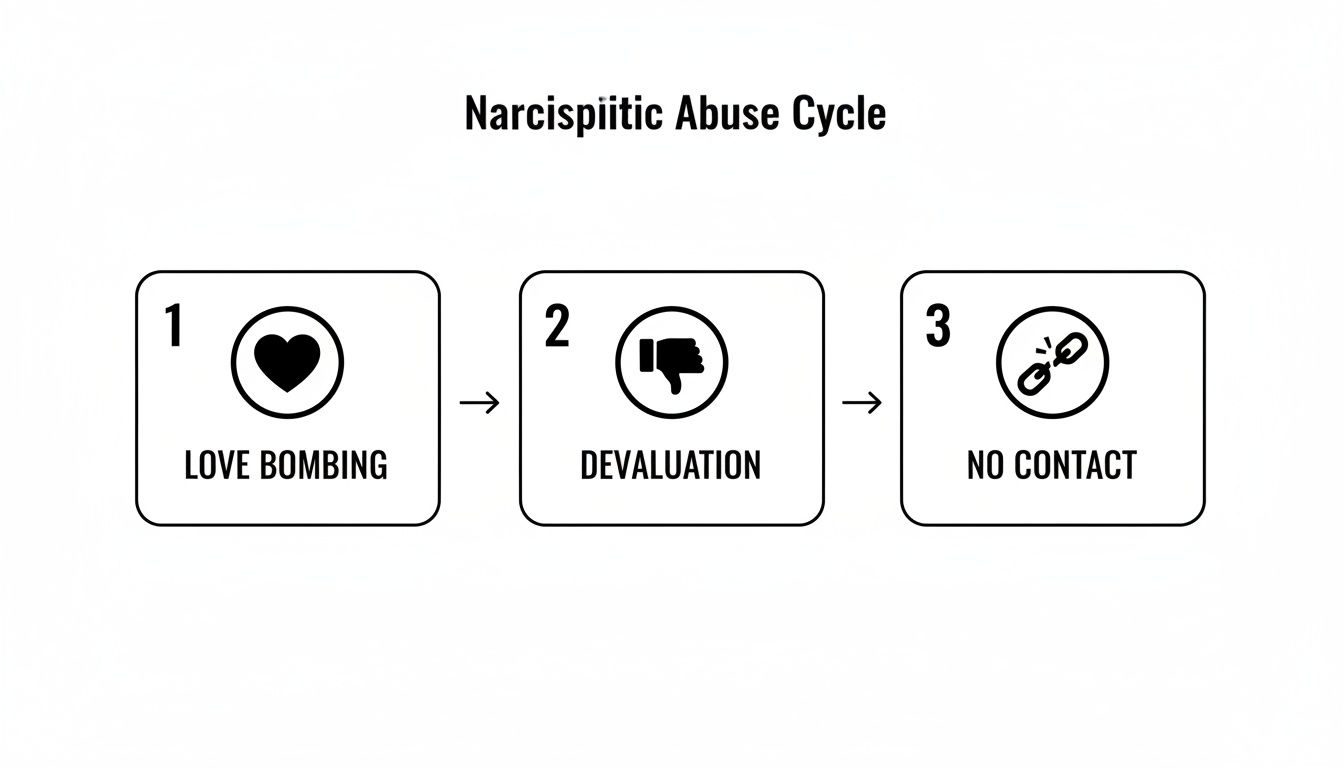
Understanding this cycle is your secret weapon. When they start love bombing you again after you leave, you'll recognize it not as genuine remorse but as a desperate power play.
Building Your Support System Quietly
You can't do this alone, but you have to be incredibly careful about who you bring into your inner circle right now. Telling the wrong person—like a mutual friend who acts as their "flying monkey"—could blow your entire plan before you even get started.
Pick one or two people you trust without a doubt. This could be a loyal best friend, a family member who has seen the narcissist's true colors, or a therapist who gets it.
Here’s how to assemble your small-but-mighty support team:
This whole pre-launch phase is about quietly dismantling the life you built with them, piece by piece. Every password you change, every document you secure, is another brick in the foundation of your new, free life.
The Great Escape: Sending the Final Message and Going Dark
Alright, deep breath. You've done the tough prep work, and you've got your people in your corner. Now for the moment that feels both terrifying and liberating: actually cutting the cord.
For most people, the cleanest break is the quietest one. Just… vanish. No final monologue, no dramatic exit. This approach is powerful because it starves the narcissist of the one thing they crave most: a reaction. It denies them the drama, the fight, and the "closure" they can twist into another manipulation.
But sometimes, a final, clear statement is what you need for your own peace of mind. Or, in situations where things are tangled, leaving without a word could create more problems. If you do send a message, remember this: it's a notification, not a negotiation.

Sending the Final Word (If You Must)
If you're sending one last message, it needs to be an emotional dead end. It’s a full stop, not a comma begging for a reply. Your biggest challenge here is to avoid the trap of JADE—that is, the urge to Justify, Argue, Defend, or Explain your decision. They don't deserve an explanation, and giving one just opens the door for them to argue.
Here are a few real-world examples. Keep it short, blunt, and boring.
• For an ex-partner: • A simple text will do. "I'm ending contact between us. This is my final message. I'm asking you to please respect my decision."
• For a family member: • You can acknowledge the relationship without getting sentimental. "For my own health and well-being, I need to take space from this relationship. I won't be responding to messages moving forward."
• For a toxic friend: • Be direct and final. "I need to end this friendship. I wish you well, but I will not be in contact anymore."
The moment you hit "send," your job is done. Don't look back. Don't wait for the inevitable angry or pleading response. Your very next move is to start building your digital fortress.
Building Your Digital Fortress
Think of this part as battening down the hatches before a hurricane. Your mission is to systematically eliminate every single digital pathway they could use to get to you. Be swift, be thorough, and leave no stone unturned, because a narcissist will try every locked door just to see if one is loose.
The point of this lockdown isn't just to block them; it's to create an impenetrable bubble of peace so you can finally start to heal. Every notification you silence is a potential emotional landmine you've just disarmed.
Start with the most obvious lines of attack and work your way down the list. Be methodical.
The First Wave of Defense
• Phone Number: • This is your #1 priority. Go into your contacts and • block their number • . This is the first and most critical line of defense.
• All Social Media: • Go through Facebook, Instagram, Twitter, LinkedIn—everywhere. Don't just unfriend or unfollow. Use the • block • function. This is key because it prevents them from seeing you or contacting you from a different profile they might create.
• Email Addresses: • Open your email settings. Create a filter that automatically and immediately • deletes • any message from their known email addresses. For example, in Gmail, you can create a filter for their email address and select the "Delete it" option. Don't just send it to spam; you want it gone before you can even be tempted to look.
Securing the Perimeter
A truly determined narcissist doesn't give up after the first few doors are slammed shut. They get creative. They'll look for the cracks you forgot existed.
I once worked with a client who went no contact with a narcissistic business partner. He’d blocked the phone and email, but a few days later, he was horrified to get a notification from Venmo . The ex-partner had sent him $0.01 with a long, manipulative message attached. He’d completely forgotten that payment apps were a communication channel.
Don't let that be you.
The Secondary Lockdown Checklist
• Payment Apps: • Immediately go into • Venmo • , • PayPal • , Cash App, and Zelle and block them. This is a surprisingly common backdoor for harassment.
• "Flying Monkeys": • This is a tough but necessary step. You may need to temporarily block or mute mutual friends and family who you suspect could be manipulated into acting as the narcissist's messengers (we call them "flying monkeys").
• Shared Accounts: • Do you share a • Spotify • or Netflix account? Are you connected on Xbox Live or the PlayStation Network? Change every single password and kick their profiles off the account.
Once you’ve gone through this checklist, just stop and breathe. You've just taken a massive, monumental step toward reclaiming your life. The silence might feel deafening at first, but listen closer. That's the sound of peace. It's the sound of your new beginning.
The Silence Gets Loud: What Happens After You Go No Contact
You did it. You slammed the door, blocked the numbers, and created a fortress of silence. But just as you start to exhale, a different kind of storm brews. The moment you go silent is often the exact moment they get loud.
This is the chaotic, confusing, and utterly predictable aftermath of going no contact with a narcissist. It’s a trial by fire, but it’s also the final confirmation that you made the right call.
Starved of the attention they crave, the narcissist will pull out all the stops to reel you back in. The good news? Their playbook is surprisingly small. Once you know the moves, you can see them coming a mile away.
Brace for Love Bombs and Their Messengers
First, expect the hoovering . Just like the vacuum cleaner it’s named for, this is their desperate attempt to suck you right back into the vortex of their drama. This could be a practical example like flowers showing up at your work with a note saying "I can't live without you," a sudden "I miss you" text, or a manufactured crisis where they suddenly need your help. It’s a calculated strike at your heartstrings.
When hoovering fails, they often unleash the "flying monkeys." These are the well-meaning (and sometimes not-so-well-meaning) friends, family members, or even colleagues they recruit to do their dirty work. They’ll pass along messages, try to gather intel on you, or lay on a heavy guilt trip.
• Here’s what that looks like: • Your mutual friend texts, "Hey, I just talked to Alex, and they're a total wreck. They seem so lost without you. Don't you think you should just talk it out?"
This is a classic flying monkey mission. They may not even realize they’re being manipulated. Your job is to stay calm and shut it down.
A powerful, boundary-setting reply is: "I appreciate you checking in, but my relationship with Alex is in the past, and I’m not going to discuss it. I hope you can respect that."
This script is your shield. It ends the conversation without creating more drama and makes it crystal clear that your decision is not up for debate. You owe no one an explanation.
Surviving Your Own Internal Storm
As wild as the external attacks can get, the battle inside your own head is often the real main event. Withdrawing from a trauma bond is a physical and emotional ordeal, and you can expect to be flooded with a chaotic mix of feelings.
• Crippling Guilt: • You might feel like a monster for "abandoning" them. For instance, you might replay a memory where they seemed vulnerable and convince yourself you are a terrible person for leaving them alone. That feeling is no accident; they conditioned you to feel that way.
• Deep Grief: • You'll mourn the good times, the person you fell in love with (or thought you did), and the future you imagined. That loss is real.
• Intense Longing: • The trauma bond can create a chemical-like craving for them, even when you know they are toxic. It’s a cruel trick of the mind.
These feelings are not a sign you made a mistake. They are the poison leaving your system.
Thankfully, there's a growing awareness about the subtle hell of narcissistic abuse. You're not just imagining it. Therapists now recognize that the invisible wounds—the gaslighting that makes you question your own sanity—are just as damaging as any physical blow. If you're struggling, resources like GoodTherapy.org offer valuable insights into recovering and rebuilding your self-esteem.
You are not going crazy; you are getting free. This is the perfect time to focus on rebuilding your inner strength. A huge part of healing is learning to trust your own gut again, and one way to do that is by boosting your emotional intelligence. Our guide on how to increase your EQ can give you the tools to become more resilient against future manipulation.
It’s messy, but you’re taking back your life. And that’s a beautiful thing.
When Full No Contact Isn't an Option
Let's be real. For a lot of us, the dream of completely going no contact with a narcissist is just that—a dream. What if you share kids? Or work in the same small office? Or you’re both responsible for an aging parent? Sometimes, you simply can't hit the eject button and vanish.
When that's your reality, the game has to change. You can’t go for total silence, so you aim for strategic disengagement instead. You learn how to become emotionally invisible, a ghost in their machine.
This is where you deploy the Gray Rock Method . Think of it as your new superpower. The entire mission is to make yourself as dull and uninteresting as a lump of concrete. A narcissist feeds on drama, chaos, and big, juicy emotional reactions. When you stop serving that up—when you refuse to get angry, play the victim, or jump to defend yourself—you suddenly become a very unsatisfying meal. They get bored. And a bored narcissist will always go looking for a new source of supply.
The Gray Rock Method in Real Life
Putting this into practice feels weird at first. It goes against every instinct, especially if you’re used to JADE-ing (Justifying, Arguing, Defending, or Explaining). But this isn't about winning an argument; it's about hoarding your precious emotional energy for yourself.
Let's say your narcissistic colleague, Brian, lobs a passive-aggressive email into your inbox at 4:59 PM on a Friday. It’s full of little digs about your contribution to the big project. The old you would have stewed all weekend, crafting a five-paragraph masterpiece defending your honor and your work ethic.
The new, Gray Rock you? You see the email, close your laptop, and enjoy your weekend. On Monday morning, you fire back a simple, "Noted. I'll review the project file." That's it. You've given him nothing to grab onto. No emotion. No drama. No fight. You've just become a boring gray rock.
The Gray Rock Method is your secret weapon for emotional self-defense. It's not about being rude or passive; it's about being strategically uninteresting. You're giving them nothing to hook into, forcing them to move on.
Co-Parenting with Low Contact
Co-parenting with a narcissist is, without a doubt, one of the toughest gigs out there. No Contact is impossible, and your kids' well-being is everything. Your communication has to become surgically precise and strictly business.
A co-parenting app like OurFamilyWizard or AppClose is an absolute non-negotiable here. These platforms create a formal, unchangeable record of every single conversation. This isn't just helpful; it can be a lifesaver if things ever end up in court.
Here's how you manage it:
• Communicate ONLY Through the App: • No more texts, late-night phone calls, or DMs. Everything happens on the official platform, creating a clean, documented trail.
• Keep It Brief and Factual (BIFF): • Your messages should sound like a dry business memo. Stick to logistics: pickup times, doctor's appointments, school events. That's all.
• Strip Out All Emotion: • This is the hard part. Don't talk about your feelings. Don't rehash old fights. And absolutely do not take their bait. Write every message as if a judge will be reading it over your shoulder—because one day, they might.
Here’s how that looks in practice:
• Narcissistic Ex: • "You're always late dropping off the kids and it's clear you don't care about my time. You need to be more respectful. And by the way, Maya said she had a terrible time last weekend."
• Your Gray Rock Response: • "Confirmed pickup is at 6 PM on Friday at the library. I will have the kids' soccer gear ready."
See what you did? You completely ignored the bait and only responded to the necessary logistics. When you're in this impossible situation, learning how to protect your children becomes your primary focus, and your calm consistency is their greatest shield. This kind of dynamic is a minefield, and if you need more tools, you might find our guide on how to resolve relationship conflict helpful.
By mastering the art of low-contact and the Gray Rock Method, you’re building an emotional fortress around yourself. It doesn't change who they are, but it fundamentally changes how much of your heart and mind they can access. You're learning to coexist without being consumed.
Designing Your New Life Beyond the Abuse
You did it. You walked away. After the chaos, the drama, and the constant walking on eggshells, the silence that follows can feel downright bizarre. It's a void where the noise used to be, and at first, it might feel less like peace and more like emptiness.
But lean into that quiet. It’s not a void—it’s a blank canvas. This is the moment you stop just surviving and start building a life that feels like you again, on your own terms.

One of the best first moves you can make is to call in the cavalry. Finding a therapist who gets narcissistic abuse is like finding a translator for a language you didn't even realize you were forced to learn. They understand the trauma bonds, the insidious nature of gaslighting, and the confusing grief you're navigating.
And while therapy offers professional guidance, support groups—both online and in your local community—offer something just as crucial: validation. There is nothing more powerful than hearing someone else describe the exact, bewildering thing you went through. It shuts down that nagging little voice that still whispers, "Was I crazy? Did I make it all up?"
Finding Your Way Back to You
Living with a narcissist is like being slowly compressed. You made yourself smaller, quieter. You shelved hobbies they mocked and distanced yourself from friends they deemed "a bad influence." It's time to take up space again.
Think back. Who were you before all this? What lit you up? What made you laugh until your sides hurt? You’re not trying to go back in time, just to reintroduce yourself to the parts of you that went into hiding.
• Revive your old passions. • Remember that guitar gathering dust in the corner? The hiking boots you haven't touched in years? A practical example is to actually book a weekend camping trip you've always wanted to take, or sign up for a weekly open mic night. The point isn't perfection; it's joy.
• Call your people. • Reach out to those friends you were pushed away from. A simple, "Hey, I know it's been forever. I've been through some stuff and I've missed you," is all it takes to reopen a door you thought was locked for good.
• Try something totally new. • Sign up for that pottery class you've been eyeing or join a kickball league. This is about creating fresh, positive experiences that belong only to you and your new chapter.
The goal isn’t to forget what happened. It’s to build a future so rich and vibrant that the past simply loses its grip. Every time you choose something just for you, you’re winning.
If you found yourself constantly bending over backward to keep the peace, you likely developed some serious people-pleasing habits as a survival skill. It's time to unlearn that. For a deep dive, check out our guide on how to stop being a people-pleaser .
Self-Care That Actually Heals
Post-narcissist self-care isn't about bubble baths and face masks (though those are nice, too). It's about the hard work of rebuilding trust in your own judgment. It's about learning to listen to your gut again after being told for so long that it was broken.
If you feel alone in this, you're not. An astonishing 27% of Americans are estranged from a close family member, a number that's climbing as we get better at naming and understanding abuse. Choosing to go no contact with a narcissist is a legitimate and often necessary path to healing. You can discover more insights about recovering from narcissistic abuse on GoodTherapy.org .
Ready to get practical? Start here:
• Get a journal and use it. • Write down everything—the rage, the ridiculous memories, the sudden moments of clarity. A specific example is using a prompt like, "Write down one thing that happened that I was told wasn't a big deal, and explain why it actually was."
• Practice being present. • Mindfulness might sound cliché, but it’s a powerful tool. Just sit for five minutes and focus on your breathing. It helps pull you out of the whirlpool of past hurts and future anxieties, anchoring you right here, right now.
This entire process is about shifting from a life of constant reaction to a life of conscious intention. You're in the driver's seat now. It's time to decide where you want to go.
Your Burning Questions, Answered
Okay, let's get into the nitty-gritty. Deciding to go no contact is one thing, but a million "what ifs" probably just flooded your brain. I get it. Let's tackle the big ones head-on.
But What About The Kids? Handling Co-Parenting
When kids are in the picture, "no contact" isn't really on the table. Your new strategy is "low contact," and your new best friend is the Gray Rock Method . You're about to become the most boring, uninteresting person they've ever met.
• Move all communication to a court-approved app. • This isn’t just for organization; it creates a legal paper trail. Every message is on the record.
• Keep it strictly business. • Your messages should be about one thing only: the kids. For example, a message should look like this: "Liam's orthodontist appointment is Tuesday at 3pm. Please confirm you can take him."
• Do not take the bait. • They will try to provoke you. Treat every interaction like a business transaction with a difficult client. Stay professional, detached, and emotionally flat.
Will I Drown In Guilt?
Short answer? Yes, almost certainly at first. Guilt is a brutal, but totally normal, side effect of breaking a trauma bond. It’s what they conditioned you to feel.
The moment guilt creeps in, repeat this to yourself: You are not responsible for their feelings. You are responsible for your safety and sanity.
A practical example: When you feel a wave of guilt, physically write down one instance of their abuse. Look at it. Remind yourself why you left. This tangible reminder can cut through the fog of conditioned guilt.
How Long Until I Feel Like Myself Again?
There’s no magic timeline, but you're not going to feel this awful forever.
Most people start to feel a real, tangible shift—a sense of clarity and relief—within 2 to 6 months of holding firm with no contact. The first few weeks are the absolute hardest, but it gets better. Stick to your boundaries, lean on your support system, and you’ll start recognizing the person in the mirror again.
A huge part of breaking these cycles is understanding your own wiring. At Enneagram Universe , our free, in-depth personality test can help you see your core motivations and fears clearly. It’s a powerful tool for self-discovery that can give you a roadmap for your healing. Take the first step toward a more self-aware future .