Free DISC Assessment PDF: Expert Guides & Downloads
Your Team Is Talking, But Is Anyone Listening?
You’ve got a sales rep who treats every meeting like a hostage negotiation. Your quiet engineer has good ideas but won’t volunteer them unless someone asks three times. Your customer service lead says yes to everything, then burns out. Nobody is evil. Nobody is incompetent. They’re just speaking different behavioral languages and assuming everyone else got the same manual.
That’s where a free disc assessment PDF earns its keep.
DISC has been around a long time. The model traces back to William Marston’s 1928 book Emotions of Normal People , which introduced the four behavior patterns behind today’s D, I, S, and C framework, and many free PDFs still use that same basic logic and self-scoring approach today, often with scores that run from 0 to 100 and stronger tendencies showing up above the midpoint, as summarized in this DISC assessment scoring guide . In practice, that means you can hand someone a short worksheet, get a rough profile fast, and start a better conversation before lunch.
That’s the good news.
The bad news is that the free DISC world is full of shiny landing pages, mystery scoring, and reports that look polished but don’t always tell you when they’re too thin for a serious hiring or coaching decision. Some free tools are excellent for workshops. Some are fine for self-reflection. Some should never be allowed anywhere near a selection process without adult supervision.
This list cuts through that mess. These are the free DISC assessment PDF options I’d sort by use case. Some are best for a solo user who wants a neat report. Some are built for facilitators who need printable worksheets. A few are useful precisely because they’re limited and honest about it.
If you need something you can download, print, share, or use in a session today, start here.
1. Tony Robbins DISC Assessment
A founder sends you a DISC report ten minutes before a coaching call and asks, “Can you turn this into something useful for my leadership team?” For that job, the Tony Robbins DISC Assessment is a practical pick. It is polished, quick to complete, and written for people who want direction more than theory.
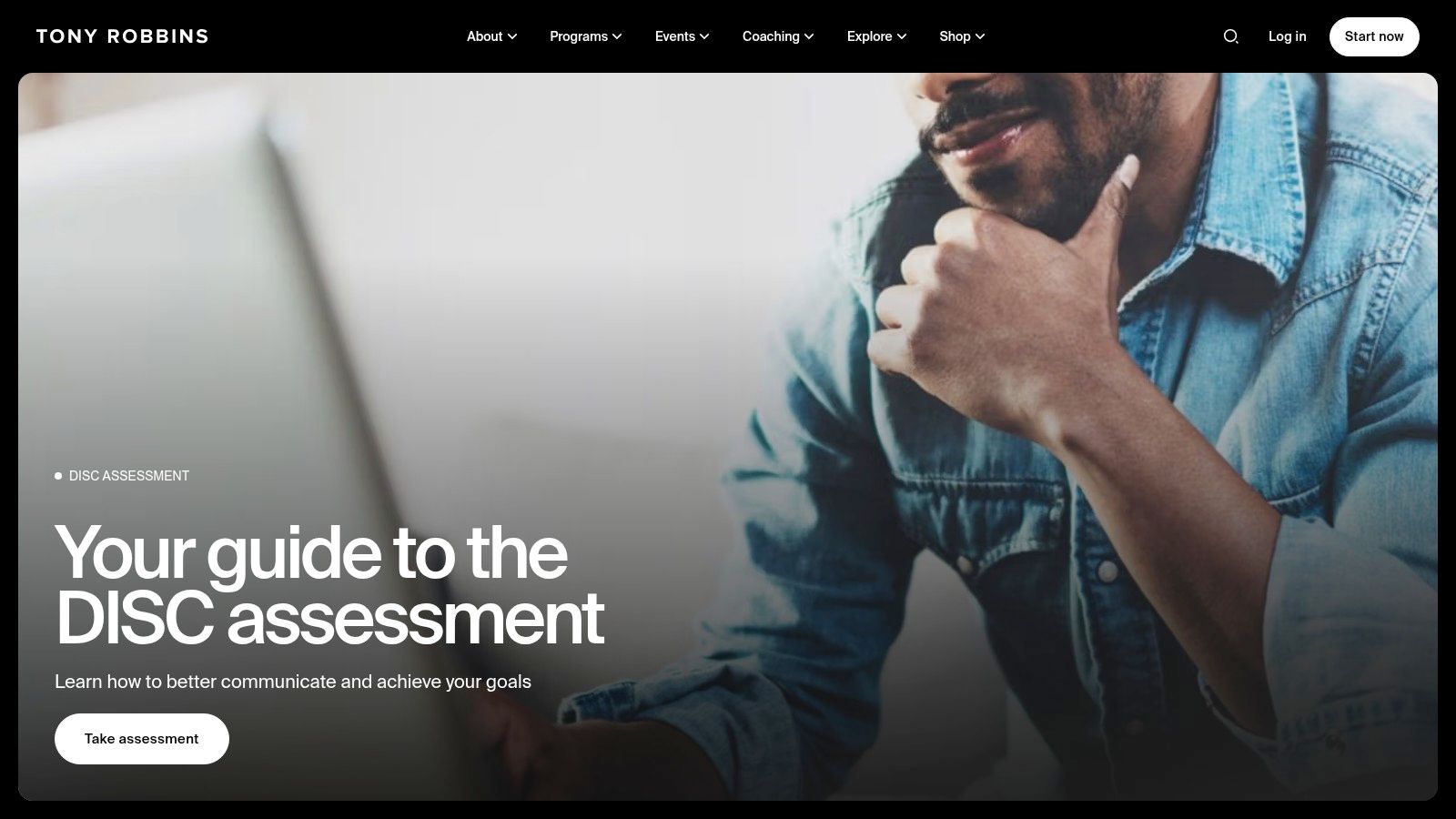
I use tools like this when the core challenge is adoption. A cleaner experience gets better completion rates from busy managers, founders, and high-output individual contributors who would ignore a longer workbook. The trade-off is depth. You get a usable snapshot, not the kind of detail I would want for a serious development plan or any employment decision.
Best for Fast Buy-In and Coaching Handoffs
This report works well when you need a tidy PDF-style takeaway that supports a live conversation. The assessment is online, the feedback is immediate, and the output is easy to carry into a one-on-one, a manager training session, or workshop prep. That makes it a strong “quick workshop” option in this field guide, especially when the goal is reflection, shared language, and a few behavior adjustments people can try this week.
Here is the kind of use case where it earns its place. A sales manager dominates account reviews, cuts people off, and mistakes hesitation for lack of commitment. This report gives you enough material to say, “Your directness is useful. Your pace is creating drag for the team. Ask one more question before you push for the answer.” That is the right level of interpretation for a free tool.
• Best use case: • Executive coaching, manager development, founder teams, and pre-work for a communication workshop
• Strength: • Clear language that points people toward behavior change
• Limitation: • Sign-up is required, and the experience keeps pulling you back into the Robbins brand ecosystem
• Skip it for: • Hiring screens, promotion decisions, or any situation where you need stronger documentation and scoring transparency
My coach’s read is simple. Use this when completion matters more than nuance.
The ethical guardrail matters too. DISC describes behavioral preferences. It does not measure intelligence, mental health, or legal fitness for a role. If your client wants broader personality context, pair the discussion with a plain-English explainer on what the Enneagram is and how it differs from workplace behavior tools , then keep the boundaries clear. In practice, that means using the report to improve communication and self-awareness, not to label people or box them into fixed roles.
One more caution. Free DISC reports often smooth over ambiguity and mixed styles. Treat this one as a conversation starter with good packaging, not as a final judgment on someone’s capability or future.
2. Crystal Knows Free DISC Personality Test
Crystal Knows’ DISC personality test is the most workplace-native option on this list.
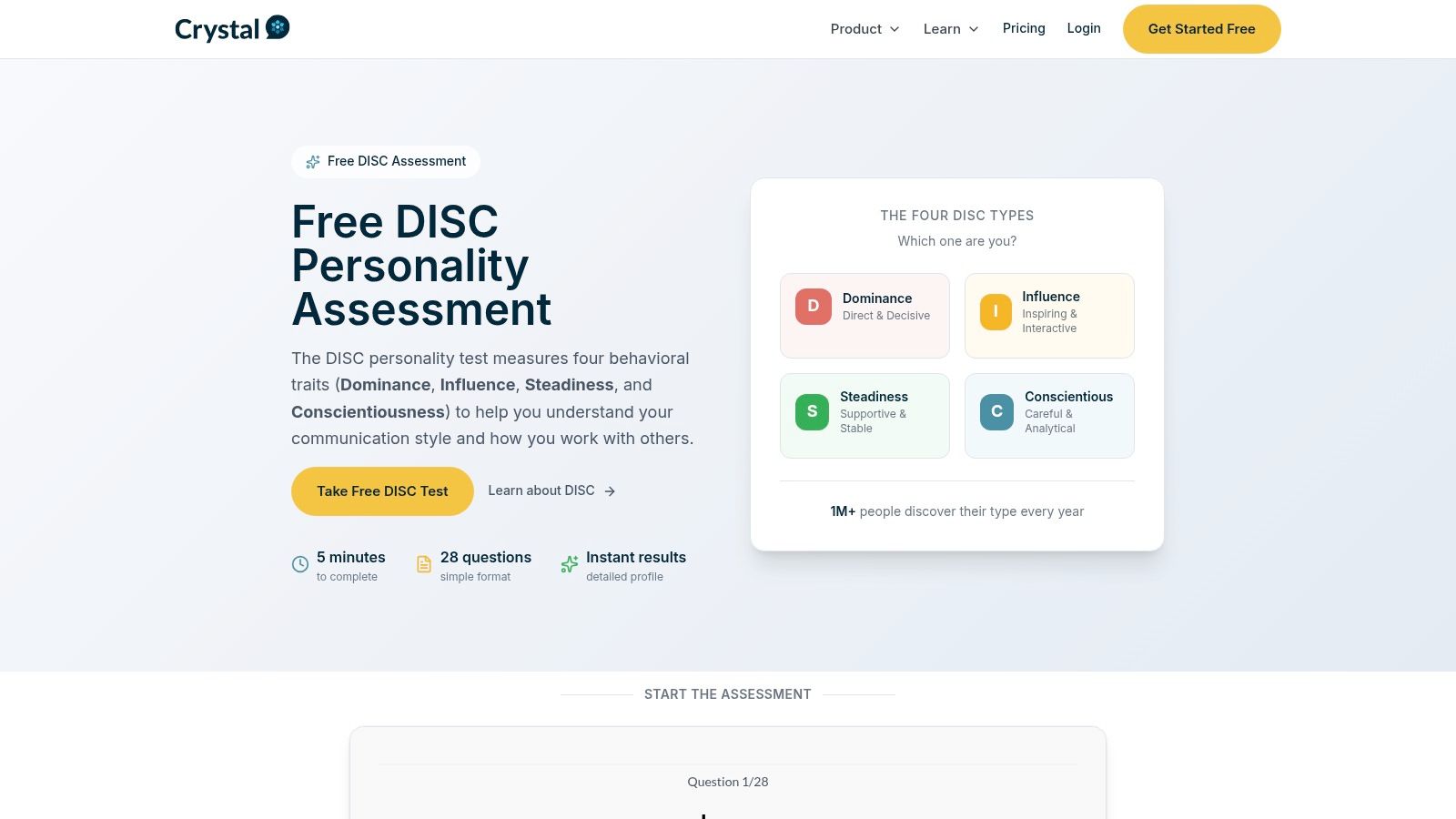
Some DISC tools sound like they were written for a conference binder in 2009. Crystal doesn’t. The interface is modern, the wording lands better with revenue teams and hiring managers, and the free profile download is useful when you want to circulate a simple summary before a coaching or team session.
Best for Teams that Live at Work
Crystal’s advantage is context. It frames DISC in the language of collaboration, communication, sales conversations, and role fit. If you’re working with account executives, customer success leads, recruiters, or cross-functional managers, that framing matters because people can immediately connect the output to real meetings and real friction.
Say you’re coaching a product manager who keeps writing painfully careful updates while their director wants concise recommendations. Crystal’s workplace emphasis helps you turn “high C tendencies” into a practical move: tighten the preamble, lead with a recommendation, park supporting detail below. That’s how a free disc assessment PDF becomes useful instead of decorative.
If you already work across frameworks, Crystal also pairs well with deeper motivational models. DISC tells you how someone tends to show up behaviorally. The Enneagram explores why those patterns feel so loaded. If you want that contrast, what the Enneagram is , is a good primer.
• Strong point: • The wording is business-friendly without sounding robotic.
• Trade-off: • You’ll create an account, and richer team features sit behind paid plans.
• Sweet spot: • Sales enablement, hiring conversations, onboarding, and manager communication training.
I wouldn’t use Crystal’s free report as stand-alone evidence for a high-stakes decision. I would absolutely use it to help a team stop misreading each other’s tempo, bluntness, and need for detail.
3. Professional Leadership Institute Free DISC Assessment plus Printable Test
A familiar workshop problem: 18 managers are in the room, Wi-Fi is shaky, two people are late, and you still need a usable DISC conversation started before the first break. The Professional Leadership Institute DISC assessment fits that kind of day because it gives you both an online option and a printable test.
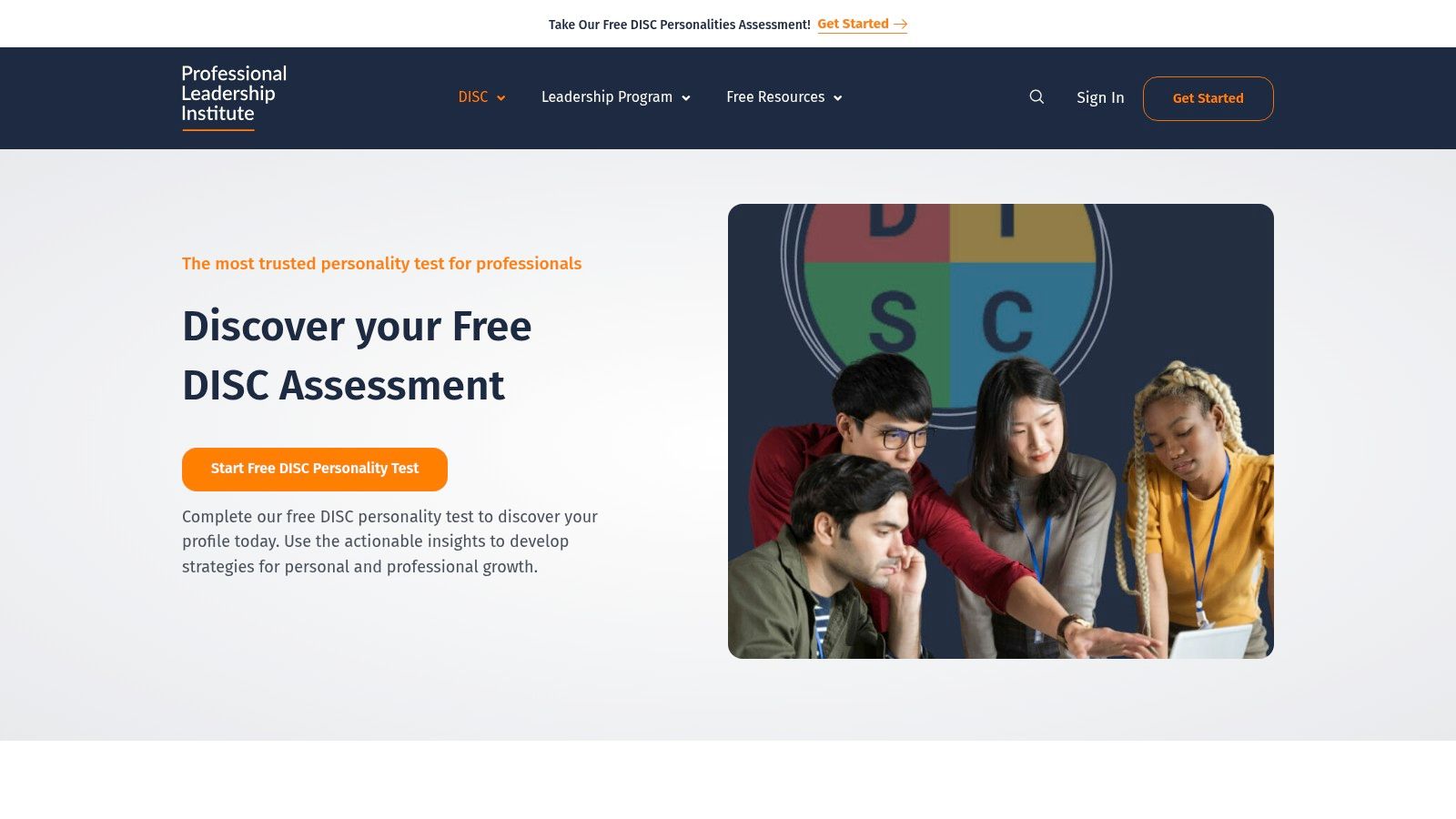
That matters for a simple reason. Delivery format changes how useful a free DISC tool is. If I am coaching one leader, a digital report is convenient. If I am running a supervisor cohort, paper still wins because it keeps the session moving and avoids turning a training room into an IT support desk.
Best for Facilitators Who Need a Workshop-Friendly DISC PDF
The printable test is the reason this resource makes the list. Plenty of free DISC tools are built for solo takers sitting at a laptop. Fewer are set up for facilitators who need handouts, quick self-scoring, and a shared language fast enough to use in a live session.
Here is the best use case. A frontline leadership class does not need polished personality prose in the first hour. It needs a practical frame that people can apply to conflict, delegation, pace, and follow-through before lunch. This PDF works well for that. Then the online version can serve as an optional follow-up for participants who want a cleaner summary after the workshop.
There is a trade-off. The site also introduces you to the provider's broader training and certification offers. That is normal in this category. It only becomes a problem if you expected a pure worksheet with no account prompts or sales context.
I would use this one in a quick workshop, a leadership retreat, or a manager training where discussion matters more than measurement precision. I would not use it as the only input for hiring, promotion, or performance decisions.
• Best for: • Facilitator-led sessions, classroom delivery, leadership cohorts, and off-sites
• Less ideal for: • Buyers who want a no-signup experience and zero upsell cues
• Coach's note: • If a client asks how DISC differs from other type of tools, this • • comparison of Enneagram vs MBTI • • helps clarify what each framework is trying to measure
Coach's Playbook
Use the printable version as a conversation starter, not a label generator. Ask participants where the profile feels accurate at work, where context changes their behavior, and what teammates tend to misread. That keeps the discussion grounded in observable behavior instead of amateur diagnosis.
A legal and ethical rule matters here. DISC is useful for communication coaching and team development. It is a weak choice for making employment decisions on its own. If you are facilitating in an HR or L&D setting, present results as self-report input, keep participation appropriate to the context, and avoid turning a short free PDF into a verdict about capability or fit.
Used that way, this is a practical field tool. Not fancy. Useful.
4. Online DISC Profile Free Introductory DISC Assessment
Online DISC Profile’s introductory assessment is the grown-up option.
It’s less flashy than some consumer-facing tools, but I trust boring competence more than glossy confidence in this category. This provider makes its research material visible and gives you sample PDFs so you can inspect the format before you commit to anything bigger.
Best for Practitioners Who Care How the Thing Was Built
I would refer an HR leader, L&D manager, or coach who asks, “Fine, but is this method stable enough to use repeatedly?” to the underlying DiSC Classic 2.0 research, which reports Cronbach’s alpha coefficients ranging from .83 to .93 across its primary dimensions in this DiSC research summary . That matters because it points to internal consistency rather than vibes and branding.
In plain English, if someone takes a tool built on a strong DISC framework and gets a profile, you’d expect less random wobble than you’d get from a personality quiz written by a content team chasing clicks. That doesn’t make every free result perfect. It does mean the provider is speaking the language practitioners should want to hear.
Here’s how I’d use it. A people leader wants to pilot DISC before expanding to team-level work. The free introductory version gives them enough to understand the structure and the report style. The sample PDFs help them judge whether the eventual paid output is worth introducing across managers.
The downside is equally clear. If you specifically need a fully personalized free disc assessment PDF, this one is more of a preview path than a full free download. For cautious buyers and serious practitioners, that’s acceptable. For someone who wants an instant branded PDF with no caveats, it’ll feel restrained.
5. IDRlabs Free DISC Test Classic Version
IDRlabs’ classic DISC test is the low-drama pick.
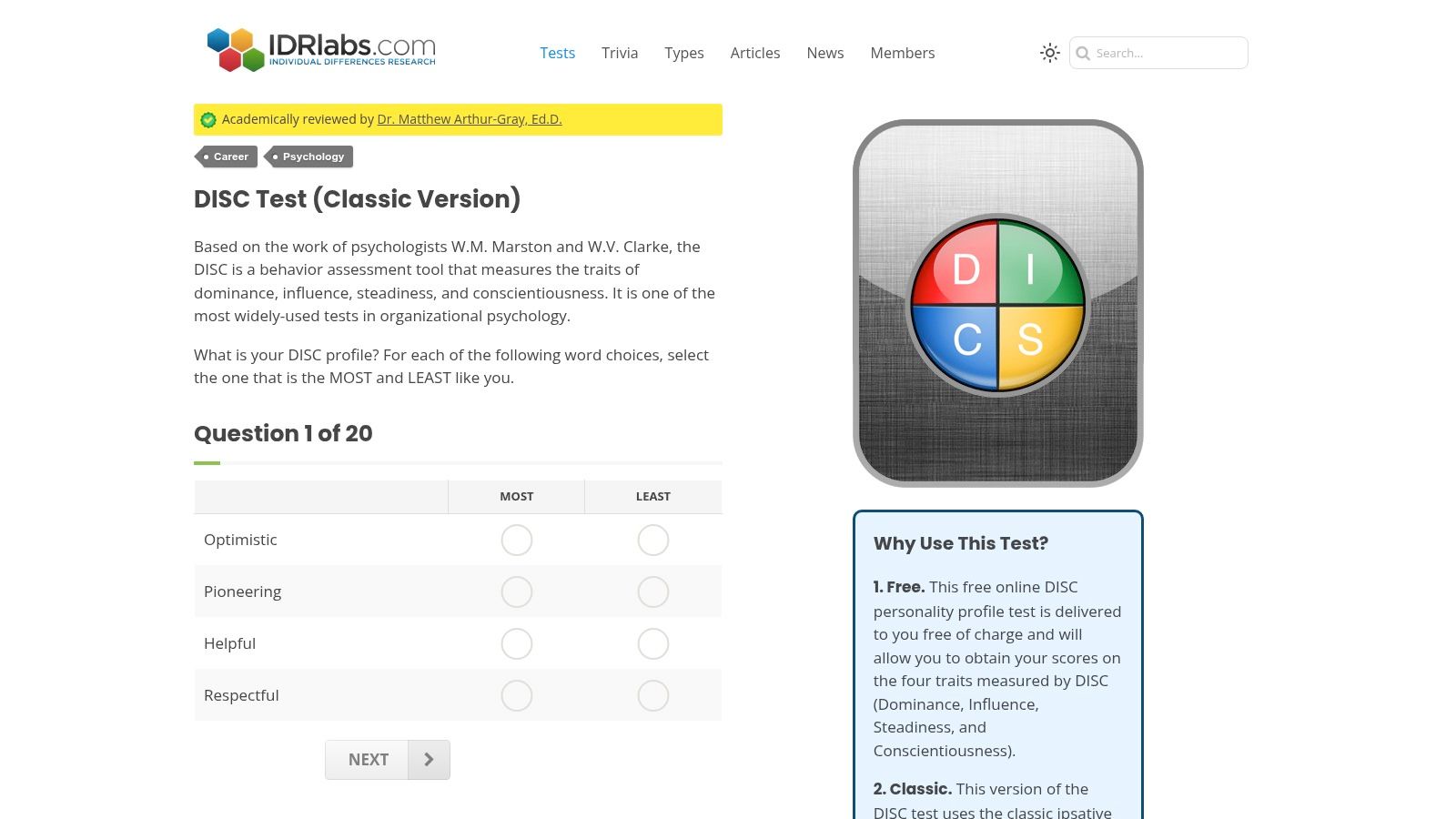
No heavy corporate perfume. No giant “transform your destiny” language. It’s just a quick classic-format assessment with accessible results and public methodology notes. That simplicity is useful when you need a fast read and don’t want to drag someone through a full platform setup.
Best for Low-Friction Individual Use
This one works well for solo reflection, coaching homework, and early-stage team experiments. Because there isn’t a branded PDF button, you’ll typically use the browser’s print-to-PDF function. Slightly clunky, yes. Still practical.
The stronger case for IDRlabs is speed. If I’m prepping a client for a coaching session and they’ve ignored my previous emails until the night before, this is the kind of tool I can still use. Take the test. Save the result. Bring the PDF. We can work with that.
A simple example: an operations manager says, “People keep telling me I’m intimidating, but I’m just being efficient.” A quick DISC output lets you separate intent from impact. If their pattern points toward direct, task-focused communication, you now have something concrete to work on. Pause before rebutting. Ask one clarifying question. Add one sentence of acknowledgment. Tiny changes, better meetings.
• Why people like it: • Core results are available without a paywall circus.
• Why facilitators may not: • It lacks the business framing and team-ready packaging of B2B vendors.
• Practical fix: • Save the result with print-to-PDF and add your own notes before sharing.
This is not the tool I’d bring to a CHRO who wants enterprise-ready language. It is a perfectly good tool for “we need a quick behavioral lens, and we need it now.”
6. Gyfted Free DISC Assessment with PDF
Gyfted’s DISC assessment sits right in the middle of personal insight and talent workflow.
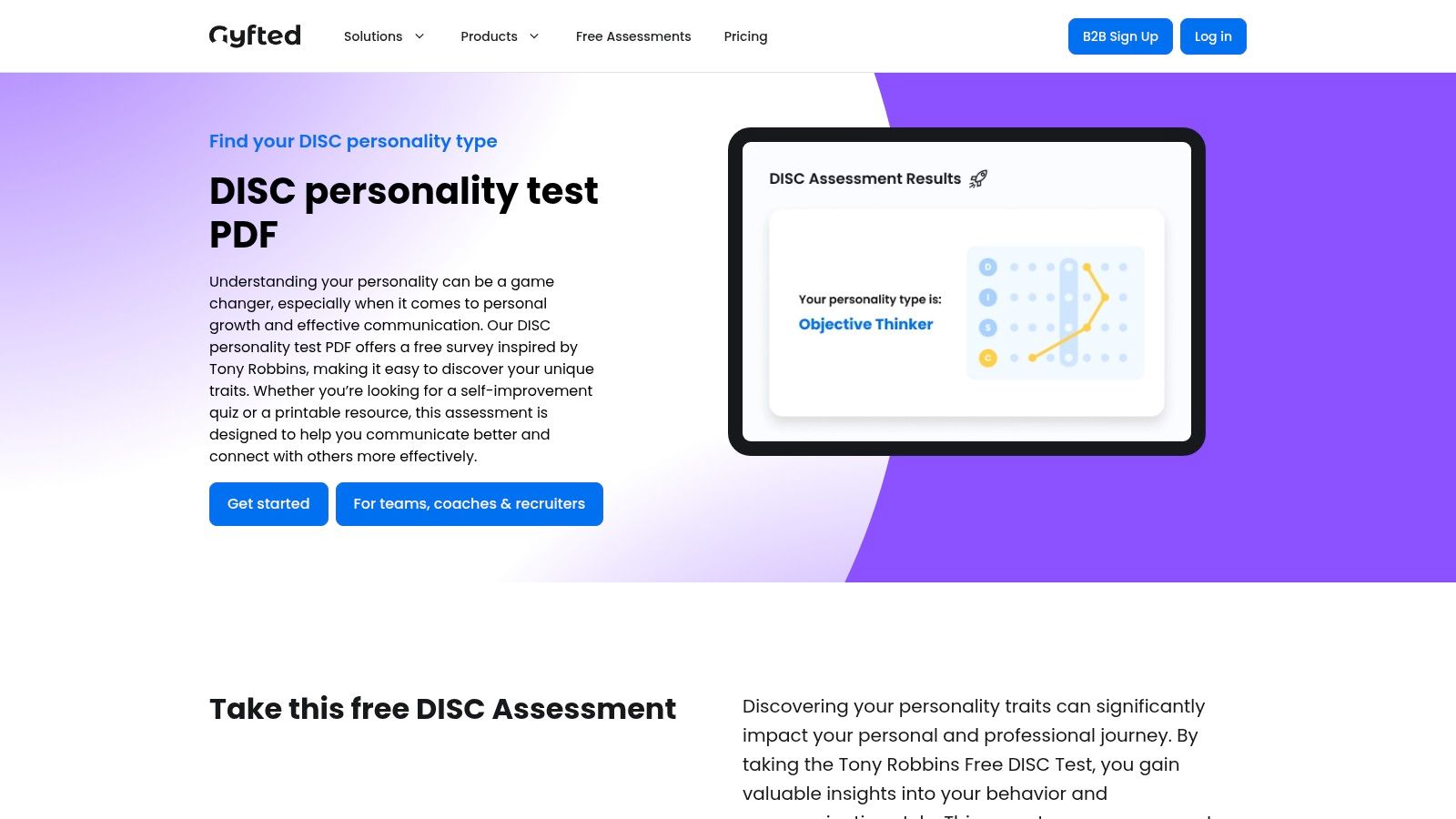
That’s useful if you’re in HR and you want a free disc assessment PDF that doesn’t feel purely consumer-oriented. The site talks to both individuals and organizations, which means the result feels easier to slot into recruiting, development, or internal mobility conversations.
Best for HR teams that want shareable output fast
The explicit PDF angle is the attraction here. A lot of people searching this topic don’t want to “take a quiz and stare at a dashboard.” They want a file they can send, store, or discuss. Gyfted understands that.
A practical example: a recruiter is trying to prepare a hiring manager for panel interviews. The manager wants everyone to be “confident and proactive,” which usually means they’re about to hire three versions of themselves. A DISC report won’t solve bias, but it can help reframe the conversation. Confidence can look forceful, persuasive, patient, or methodical. Different styles bring different strengths to the same role.
If you use multiple assessments, this is also where stacking can help. DISC is good at observable behavior and communication style. For deeper motivation and growth patterns, you might pair it with a broader personality tool such as the free Enneagram test . One tells you how someone tends to move through work. The other can illuminate what they’re protecting, pursuing, or avoiding underneath that pattern.
• Good fit: • Recruiting teams, talent partners, coaches who want a downloadable client handout.
• Less ideal: • Buyers who only trust legacy DISC brands.
• Watch-out: • Hiring-related messaging can tempt teams to overuse lightweight reports.
Gyfted is strongest when you use it as an organized conversation tool inside a broader process.
7. Lavi Institute DISC Mini-Assessment Self-Scoring PDF
The Lavi Institute mini-assessment PDF is the workshop workhorse.
There’s no signup ritual. No account maze. No “check your inbox for the magic link.” You download it, print it, and use it. That alone earns respect.
Best for Live Workshops and Classrooms
This is the kind of free disc assessment PDF I keep around for facilitator situations where technology is more liability than luxury. Team offsites. Classroom sessions. Volunteer trainings. New manager cohorts. Anywhere you need people interacting with each other instead of staring at their phones.
The mini format also creates the right expectation. It’s quick and self-scored, so participants don’t assume they’re receiving a full psychological profile with all the bells and whistles. They know they’re doing an exercise. That honesty is refreshing.
Here’s a good use case: you’re training a service team that keeps clashing over pace. Some members want to move now and clean up later. Others want more process and fewer surprises. Hand out the PDF, let everyone score it, then ask each group what they need from the others during a busy customer escalation. The conversation gets concrete fast.
• Big advantage: • No signup required, which is gold in group settings.
• Built for: • Facilitators, teachers, trainers, and anyone running a short session.
• Main limitation: • It’s a mini-assessment. You won’t get nuance. You’ll get a usable starting point.
If someone tells me they need one free DISC PDF for a room full of people by this afternoon, this is one of the first files I’d send.
8. TeamRxC Basic DISC Self-Assessment Printable PDF
The TeamRxC basic DISC self-assessment PDF is plain, functional, and gloriously unromantic.

That’s a compliment. Not every facilitator needs glossy branding. Sometimes you need a clean worksheet that can survive a photocopier, a stapler, and a room full of skeptical supervisors drinking weak hotel coffee.
Best for No-Frills Group Administration
This PDF is ideal when you want people to spend their energy on discussion, not on navigating a platform. It’s especially useful in environments where personal devices aren’t practical or welcome, such as shift-based work, manufacturing settings, or some healthcare trainings.
A practical example: a nursing unit manager wants to address handoff tension between detail-heavy staff and faster-moving colleagues. You don’t need a cinematic report. You need a common language that says, “You’re not difficult. You prioritize different things under pressure.” A basic worksheet gets you there.
What this won’t do is impress someone who wants polished graphics or advanced interpretation. But that’s the wrong standard. A wrench is not a bad hammer. It’s just built for a different job.
• Best use: • Operations teams, compliance-heavy environments, practical workshops.
• Why it helps: • No accounts, no email gates, easy on-the-spot scoring.
• Why it falls short: • The layout is utilitarian, and the depth of interpretation is light.
When people search for a free disc assessment PDF, this is often what they really need, not a branded portal. A printable worksheet. A pen. A competent facilitator. Done.
9. The Training Connection DISC Self-Directed Workbook PDF
The Training Connection workbook is more than a test. It’s a teaching tool.
That distinction matters. Some teams don’t just need a score. They need help understanding what the framework means, how to reflect on it, and what to do with it after the novelty fades. A workbook can do that better than a one-page result.
Best for Structured Learning and Follow-Through
This PDF works well for self-study, manager training, and facilitator-led sessions where you want exercises and reflection prompts built in. It’s more time-intensive than a quick online assessment, but the payoff is depth of conversation rather than speed of completion.
Think of a leadership development cohort. If you hand them a short report, they’ll skim it, circle three adjectives, and move on with their lives. If you give them a workbook with prompts and application exercises, they’re more likely to connect style patterns to actual friction. How they run meetings. How do they give feedback? Why does one direct report keep shutting down?
This workbook shines when you want people to process the material, not just consume it. It’s less helpful when you’re under a tight time limit or dealing with an audience that already groans at homework.
• Strong fit: • Cohorts, training programs, classroom settings, and facilitated leadership work.
• Weak fit: • Fast diagnostic use or impatient teams that need immediate summaries.
• Practical upside: • The activities create easier debriefs because people arrive with examples, not just labels.
If your goal is “teach the model while using the model,” this is one of the better free PDF resources in the mix.
10. Carepatron DISC Assessment Record Sheet and Scoring Guide PDF Template
The Carepatron DISC scoring guide PDF template is not a stand-alone assessment, and that’s exactly why some practitioners will love it.
A lot of coaches, therapists, and HR partners don’t need another quiz. They need a clean way to document results, record observations, and connect style insights to action steps. This template handles that job neatly.
Best for Documentation and Ethical Follow-Up
If you already use a DISC questionnaire and you want better notes, this is useful. It gives you a record sheet structure that can support session planning, coaching summaries, and practical next steps. If you’re trying to create PDF forms for your own process, this kind of template is also a good model for what belongs in a follow-up document.
Here’s where it earns its place. A coach runs a DISC session with a new manager. The insight itself is fine, but its primary value comes from documenting what the manager will do differently next week. Shorter emails to high-D stakeholders. More context and appreciation for high-S direct reports. Clearer deadlines for colleagues who crave structure. A record sheet turns “interesting” into “assigned.”
• Most useful for: • Coaches, therapists, HR business partners, leadership consultants.
• Least useful for: • Someone who wants a completely free DISC test from scratch.
• Why it matters: • Documentation reduces fuzzy follow-up and makes reassessment easier.
This is the adult in the room tool. Not flashy. Not exciting. Very handy if you care whether the insight gets used.
Top 10 Free DISC PDF Assessments Compared
| Assessment | Core Features ✨ | UX & Quality ★ | Value & Pricing 💰 | Target Audience 👥 / 🏆 USP |
|---|---|---|---|---|
| Tony Robbins DISC Assessment | Free full DISC; instant downloadable report (PDF) ✨ | ★★★★ Polished, action‑oriented | 💰 Free (signup; brand follow‑up) | 👥 Individuals & coaches, 🏆 Strong brand trust, shareable report |
| Crystal Knows – Free DISC Test | Free DISC + PDF; workplace tips & team features ✨ | ★★★★ Modern UX; B2B focus | 💰 Free (account; paid tiers for teams) | 👥 Sales/HR teams, 🏆 Workplace guidance & documentation |
| Professional Leadership Institute | 10–15 min test; claims 18‑page free report; printable PDF ✨ | ★★★ Practitioner‑focused, informative | 💰 Free (email required; marketing funnel) | 👥 Coaches & practitioners, 🏆 Full report + printable tools |
| Online DISC Profile – Free Intro | Introductory assessment; research & sample reports ✨ | ★★★★ Credible, transparent provider | 💰 Free preview; full PDF paid | 👥 Teams & orgs scaling later, 🏆 Research links & upgrade path |
| IDRlabs – Free DISC (Classic) | 20 forced‑choice classic DISC; transparent methods ✨ | ★★★ Fast, low‑friction access | 💰 Free (no paywall; print‑to‑PDF) | 👥 Quick self‑assessors & researchers, 🏆 Transparent methodology |
| Gyfted – Free DISC Assessment | Free test with downloadable PDF; HR integrations ✨ | ★★★★ Modern UI; hiring features | 💰 Free (some business tools paid) | 👥 HR/organizations & individuals, 🏆 Built for talent workflows |
| Lavi Institute – DISC Mini | Downloadable mini PDF; self‑scoring worksheet ✨ | ★★★ Simple, print‑ready for workshops | 💰 Free (no signup) | 👥 Facilitators & classrooms, 🏆 Ready‑to‑use paper tool |
| TeamRxC – Basic Self‑Assessment | Basic PDF questionnaire; self‑scoring directions ✨ | ★★ Utility‑focused, minimal design | 💰 Free (no account) | 👥 Group facilitators, 🏆 Quick, no‑friction worksheet |
| The Training Connection – Workbook | Multi‑page workbook with exercises & reflections ✨ | ★★★ Comprehensive but time‑intensive | 💰 Free (self‑study resource) | 👥 Trainers & learners, 🏆 Structured learning materials |
| Carepatron – Record Sheet Template | Scoring & record sheet; action‑plan template ✨ | ★★★ Practical for documentation | 💰 Free (companion template) | 👥 Coaches/therapists/HR, 🏆 Handy client/session documentation tool |
From PDF to People: Putting Your DISC Insights into Action
A free disc assessment PDF is not the outcome. It’s the receipt for starting a better conversation.
That’s the piece people miss. They collect reports like fitness trackers. Then nothing changes. The direct manager still interrupts everyone. The cautious analyst still gets labeled “negative” for asking obvious risk questions. The people-pleasing team lead still says yes to impossible deadlines and pays for it later. The PDF didn’t fail. The follow-through did.
If you’re choosing among the tools above, use the least complicated option that fits your situation. For a live workshop, printable self-scoring PDFs like Lavi Institute or TeamRxC are often enough. For individual reflection and easy sharing, Tony Robbins, Crystal Knows, or Gyfted make more sense. For practitioner review and previewing more detailed reports, the Online DISC Profile is stronger. For training and learning transfer, the workbook route wins.
A true measure is whether the output helps someone do something different on Tuesday morning.
A few examples make this practical. If a manager scores high in direct, fast-paced tendencies, don’t tell them to “be nicer.” Tell them to ask one question before pushing a decision through. If a team member shows more steadiness or conscientiousness, don’t say they “lack urgency.” Clarify what decision is needed, by when, and what level of detail is enough. That is how DISC stops being office astrology and starts becoming management hygiene.
There’s also an ethics piece that deserves more airtime. Free assessments are tempting because they’re easy to scale. Easy to forward. Easy to overinterpret. Resist that urge. Don’t use lightweight free tools as hiring filters, mental health screens, or evidence that someone “isn’t leadership material.” DISC describes behavioral tendencies. It doesn’t tell you a person’s value, intelligence, integrity, or future ceiling.
That matters even more in coaching and therapy-adjacent work. A DISC result can help explain why one client prefers direct challenge and another needs more pacing and trust-building. It should not become a shortcut for understanding trauma, motivation, attachment, or clinical needs. Keep the framework in its lane, and it becomes useful. Let it pretend to be everything, and it becomes sloppy.
For HR teams, the legal and practical rule is simple. Use DISC for development, communication, and team understanding. Be careful using free versions for selection decisions. If a role decision really matters, add structured interviews, job-relevant criteria, work samples, and documented evaluation standards. A personality snapshot should support judgment, not replace it.
For coaches, I’d build every DISC debrief around three questions:
• What behavior helps this person succeed right now
• What behavior creates friction for other people
• What one adjustment is worth practicing this week
That’s enough to get movement without drowning people in theory.
DISC also gets stronger when paired thoughtfully with other frameworks. It’s very good at showing how behavior shows up in groups. It is less focused on deeper motivations and inner patterns. If you want to discover what type of leader you are , pairing behavioral tools with a more motivation-centered framework can make the insight feel much less generic and much more actionable.
Use the PDF. Debrief the result. Translate it into one visible behavior change. Then revisit it after a real meeting, a hard conversation, or a conflict. That’s where the insight earns its keep.
The best assessment isn’t the fanciest one. It’s the one people understand, trust, and use.
If DISC helps you understand how people behave, Enneagram Universe helps you understand why those patterns feel so personal. Its free Enneagram assessment is built for deeper self-awareness, with insights into core motivations, fears, Wings, Triads, and growth patterns that DISC alone won’t surface. If you’re a coach, HR leader, therapist, or just someone trying to make sense of your own patterns without the corporate wallpaper, it’s a smart next step.