The Ultimate Free Couples Compatibility Test to Decode Your Love
So, what exactly is a free couples compatibility test? At its best, it’s an online tool designed to shine a light on how you and your partner click—your core personality traits, your deepest values, and the unique ways you communicate. The really good ones use established psychological frameworks, like the Enneagram, to give you deep, actionable insights that can genuinely bring you closer.
Tired of Silly Love Calculators? Discover What Truly Matters
Let's be real. You've probably stumbled across those quirky "love calculators" online. You punch in your names, maybe your zodiac signs, and poof —a flashy percentage pops up. It’s a fun little distraction for a minute, but does it actually tell you anything meaningful about your relationship?
Those quizzes are the cotton candy of the compatibility world: a quick, sugary rush with zero substance. Real, lasting compatibility isn’t found in a random number generator. It’s discovered by digging in and truly understanding what makes each of you tick.

From Fleeting Fun to Lasting Insight
Think about it. You and your partner are scrolling through social media one lazy afternoon and a silly quiz gives you an 87% compatibility score. You laugh, share it, and completely forget about it five minutes later. That's the story for most people. These quizzes have exploded in popularity, but they’re almost all pure entertainment with no real psychological chops behind them.
A 2022 survey actually found that 41% of U.S. adults under 30 had taken an online compatibility quiz. But here’s the kicker: only 15% said the results influenced any real relationship decisions. Why? Because they can't answer the important questions. For example, they can’t explain why one partner, say a software engineer from Austin, needs two hours of quiet gaming time to decompress after work, while their partner, a teacher, needs to talk about their day to feel connected.
A genuine compatibility test isn't a pass/fail grade for your relationship. It’s more like a flashlight. It illuminates the hidden corners of your personalities, helping you navigate your connection with more empathy, clarity, and compassion.
Fun Quizzes vs Deep Dive Tests At a Glance
It's crucial to know the difference between a five-minute distraction and a tool for genuine growth. Here’s a quick breakdown.
| Feature | Typical Free 'Love Calculator' | Enneagram Universe Test |
|---|---|---|
| Core Purpose | Quick entertainment, social media sharing | Deep self-discovery and mutual understanding |
| Psychological Basis | None. Often based on names or zodiac signs. | Based on the Enneagram, a respected personality typology system. |
| Results Provided | A single, often random, percentage score. | A comprehensive report on motivations, fears, and growth paths. |
| Actionable Insights | Zero. Doesn't explain why or offer next steps. | Provides specific guidance for communication and empathy. |
| Goal for Couples | A momentary laugh. | To build a stronger, more conscious, and compassionate bond. |
The table makes it pretty clear: one is for fun, the other is for your future.
What Really Builds a Strong Connection
A rock-solid bond is built on something far deeper than sharing a favorite TV show or liking the same pizza toppings. It’s about understanding the fundamental wiring of your personalities. A truly meaningful free couples compatibility test should help you and your partner explore:
• Core Motivations: • What drives you to get out of bed? For one person, it might be the desire for security, leading them to meticulously manage the household budget. For another, it's the need for adventure, prompting them to plan spontaneous weekend getaways.
• Core Fears: • What keeps you up at night? One partner might fear being seen as a failure, causing them to work long hours. The other might fear being controlled, leading them to resist making joint decisions.
• Communication Styles: • How do you talk • and • listen? One partner might be direct and logical during a disagreement, while the other needs to express their feelings to feel heard.
This is exactly where a scientifically-backed approach like the Enneagram changes the game. Instead of spitting out a number, it hands you a detailed map to your inner worlds. You stop having the same frustrating fights over surface-level stuff and start seeing the why behind your partner’s actions. Suddenly, confusion turns into compassion. This guide will show you exactly how to find a test that provides those kinds of real answers.
So, What Does a Real Compatibility Test Actually Measure?
Think of a proper compatibility test as a relationship MRI. Sure, a simple quiz might give you a surface-level X-ray—"You both like pineapple on pizza! You're 87% compatible!"—but a real test goes layers deep to show you what's actually going on underneath. It digs past the superficial stuff, like a shared love for tacos or a mutual hatred of cilantro, and gets right to the heart of what makes you tick.
It’s designed to map the hidden landscape of your inner worlds. The goal is to reveal the powerful, often invisible, forces that shape how you connect with each other every single day.
Getting to Your Core Motivations and Fears
At the end of the day, any good compatibility test is trying to answer two massive questions about you and your partner: What drives you, and what scares you? These are your core motivations and core fears . They’re basically the engine and the emergency brake of your personality.
• Core Motivations: • This is the deep-down "why" that fuels everything you do. For example, a lawyer in Chicago might be motivated by a need for justice and order, while their partner, an artist, is driven by a desire for self-expression and beauty.
• Core Fears: • These are the big anxieties you’re always trying to avoid. The lawyer might fear being seen as incompetent, while the artist fears their work will be judged as meaningless.
A solid test doesn't just list these out; it shows you how your unique motivations and fears bump up against your partner's. This is where a system like the Enneagram really shines. It provides a brilliant map of nine fundamental personality types, each defined by its own distinct motivation and fear.
A truly useful test reveals the hidden logic behind your partner's behavior. The point isn’t to slap a label on each other, but to finally understand the operating system running in the background. It helps you find empathy where you used to feel frustration.
When Inner Worlds Collide (and How to Fix It)
Once you understand these hidden dynamics, you can start turning arguments into moments of connection. Let’s look at a classic example with a fictional American couple, Michael from Boston and Jessica from California.
Michael is an Enneagram Type 1 , "The Reformer." His whole world revolves around a core motivation to be good, right, and balanced. He's driven by a deep need for order and improvement, and his core fear is of being defective or morally corrupt. You'll see this play out in his structured, principled approach to just about everything.
Jessica, his partner, is an Enneagram Type 7 , "The Enthusiast." Her core motivation is to be happy and satisfied. Her core fear? Being deprived or trapped in pain. This is what fuels her absolute love for spontaneity, new adventures, and keeping all her options wide open.
On the surface, they seem like a great, fun-loving pair. But a genuine compatibility test would flag a major friction point: planning a vacation.
• Michael (Type 1) • wants to book their flights to Hawaii and their hotel in Maui months in advance. He wants a detailed itinerary to make sure everything is "perfect." For him, this isn't about being a killjoy; it's about minimizing the risk of things going wrong (which triggers his core fear).
• Jessica (Type 7) • wants to just book a one-way ticket to Honolulu and see where the wind takes them. A rigid plan feels like a cage, poking directly at her core fear of being trapped and missing out on something better.
Without this deeper insight, Michael just sees Jessica as "flaky and irresponsible." She, in turn, sees him as "controlling and rigid." The test would show them they aren't really fighting about the vacation at all—they're fighting from their core psychological drivers.
That single insight changes everything. Suddenly, the conversation can shift from blame to genuine understanding. They can find a compromise that respects both his need for a little security and her need for freedom. Maybe they agree to book the main flights and the first hotel, but leave the rest of the trip completely open for spontaneous adventures. Problem solved, connection deepened.
Using the Enneagram for Couples Compatibility
Alright, let's talk about one of the most insightful tools you'll find in a free couples compatibility test : the Enneagram. Now, if you're thinking this is just another personality quiz that slaps a label on you, think again.
It’s less of a box and more of a dynamic, personalized map to your inner world—and your partner's. The Enneagram's real magic isn't in telling you what you do, but in brilliantly explaining why you do it. It digs past surface-level habits to uncover the hidden motivations and fears steering the ship.
This gives you a shared, compassionate language to finally understand why one of you craves security while the other chases the next big thrill. Suddenly, moments of frustration can become opportunities for connection.
Understanding the Nine Relational Styles
The Enneagram breaks down personality into nine core types, each with a distinct lens for viewing the world. Getting a handle on your type and your partner's can feel like someone just handed you the secret instruction manual for your relationship.
Let’s make this real. Imagine a couple from Dallas, David and Megan.
David is a classic Type 3, 'The Achiever.' He’s driven, ambitious, and his engine runs on feeling valuable and worthwhile. For him, life is about setting goals, crushing them, and presenting a successful image to the world.
Megan, on the other hand, is a quintessential Type 2, 'The Helper.' Her world revolves around being loved and needed. She’s warm, supportive, and has an almost psychic ability to tune into what others need, finding her joy in being indispensable to her loved ones.
See the potential for friction? On the surface, they're a power couple. But when David throws himself into a huge project at work, he sees it as building a better future for them. Megan, however, might feel his absence as emotional distance, poking at her deep-seated fear of being unwanted. The Enneagram helps them realize this isn't about a lack of love; it’s a direct clash of their core wiring.
Going Deeper Than Just a Number
The real beauty of the Enneagram is its depth. You're never just a number. Concepts like Wings and Triads add rich, detailed layers that paint a much more complete picture of what makes you both tick.
• Wings: • These are the two numbers on either side of your main type, and you'll lean on one more than the other. A Type 9 'Peacemaker' with an 8-Wing, like a laid-back but firm project manager from Denver, is going to be far more assertive than a 9 with a 1-Wing, who might be a more principled and orderly librarian from the same city.
• Triads: • This concept groups the nine types into three "centers of intelligence"—Head (Types 5, 6, 7), Heart (Types 2, 3, 4), and Body (Types 8, 9, 1). It answers the question: what’s your first reaction to life? Do you think, feel, or act first?
Think of it like a relationship MRI. You're not just looking at the surface; you're examining the underlying motivations, fears, and communication patterns that make your dynamic unique.
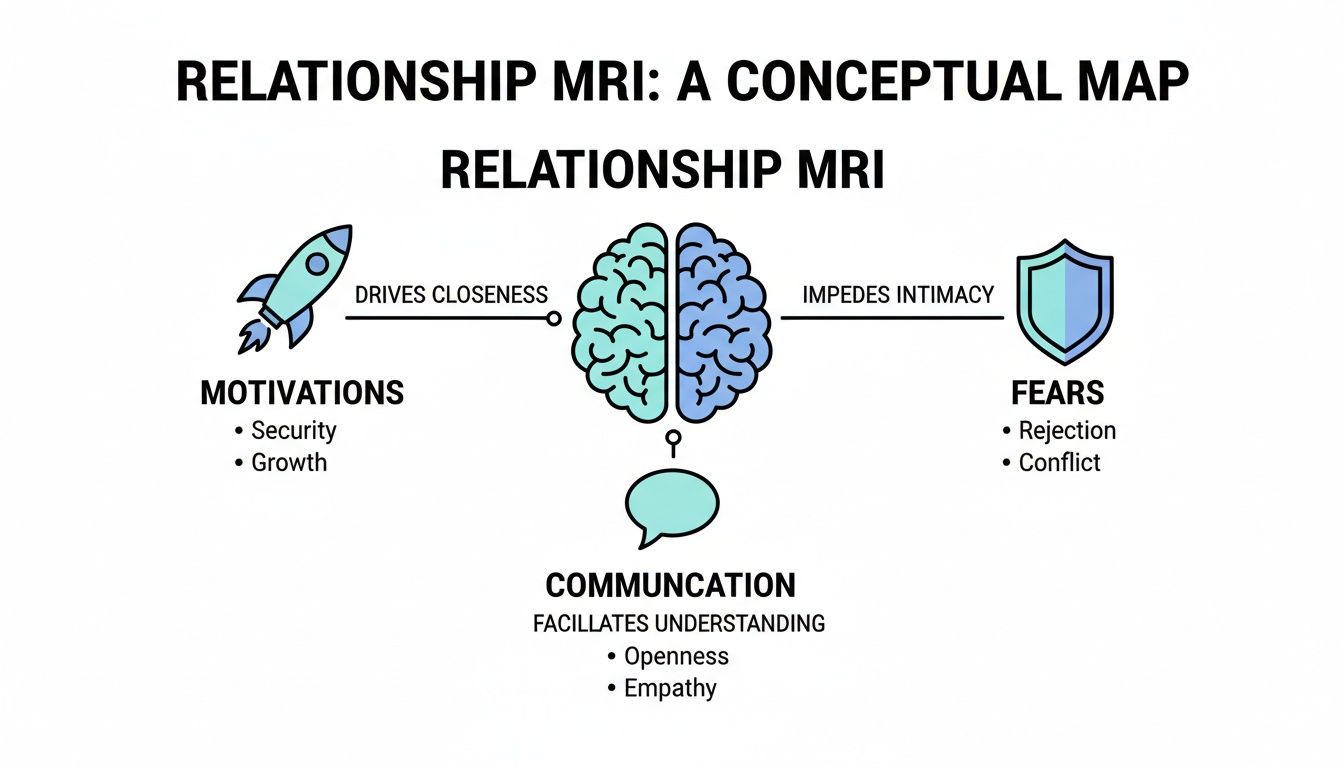
As the visual shows, true compatibility isn't just about liking the same movies. It’s about understanding the deep psychological currents that shape how you connect, communicate, and clash.
The Enneagram has been around for a while, with its principles formalized around 1915, but its use in relationships really took off in the 1990s. The results speak for themselves. A 2024 survey of 10,000 users revealed that couples who learned their Enneagram types together saw their relationship satisfaction scores jump by an incredible 40% . Even better, this understanding led to a 25% reduction in breakups over a two-year period.
By exploring these deeper layers, you get a much clearer map of your relationship's terrain. You’ll see the smooth highways, the scenic routes, and the spots where you might hit a few bumps—and you'll have the tools to navigate them as a team. If you're ready to get started, you can take a deeper dive with our own comprehensive and free Enneagram test .
How to Take a Compatibility Test for the Best Results
Let’s get one thing straight: a compatibility test isn't a final exam for your relationship. There's no pass/fail, and there’s definitely no trophy for a perfect score.
Think of it more like a conversation starter. It's a fun, new way to map out your connection. The real magic isn't in the final report—it's in the process of taking the test together.
The trick is to treat it like a collaborative adventure, not an evaluation. If you set the right tone from the very beginning, a simple online quiz can become a genuinely meaningful experience that actually makes you stronger. It's all about making room for curiosity, honesty, and a little bit of fun.
Set the Stage for Connection
Your environment and your mindset matter way more than you think. Trying to cram a test in on a hectic Tuesday morning while paying bills and walking the dog? That's just a recipe for rushed answers and zero connection.
Instead, make an event out of it.
• Schedule a "Test Date Night." • Seriously, put it on the calendar. This tells both of you that this little exploration is a priority.
• Create a No-Distraction Zone. • Kill the TV, silence your phones (and maybe even stick them in another room), and get comfortable. You need to focus on each other.
• Bring Curiosity, Not Judgment. • Agree upfront that this isn't about proving a point or winning an argument. The goal is to learn, not to lecture.
Picture a couple, Jake and Emily from Seattle. Jake could say, "Hey, Friday night, let's order some takeout from that Thai place we love, pour some local microbrews, and do this compatibility thing. No pressure, just for kicks to see what it says." That simple, low-stakes invitation immediately sets a positive, fun-loving tone.
Answering with Your Authentic Self
Oh, the temptation to game the test is real. It's so easy to think, "I know my partner wishes I were more outgoing, so I'll just click that option..." Don't do it! The only way to get anything useful out of this is for both of you to be completely, radically honest.
The best results don't come from answering "correctly"—they come from answering truthfully . Your authentic answers, even the messy ones, are what create the roadmap to deeper understanding and real growth.
Remember, the test isn't judging you. It's just a mirror reflecting the information you give it. A good test is built to dig into your core motivations and fears. If you answer based on who you think you should be , you're just asking the test to analyze a fictional character. That's not going to help your actual relationship one bit.
Your Guide to Taking the Test Together
To really squeeze all the juice out of this experience, just follow a few simple guidelines. They’re designed to spark connection and honesty from start to finish.
Following these steps transforms the test from a passive quiz into an active, engaging process that can genuinely bring you closer.
2. Decoding Your Results: From Percentages to Pathways
Alright, you’ve both taken the plunge and finished the test. The results are in. Maybe you’re looking at a big, bold percentage, a couple of personality labels, or a multi-page report. So… now what?
This is where the real work—and the real fun—begins. The single biggest mistake couples make is seeing these results as a final grade on their relationship. They’re not.
Think of your compatibility report less like a report card and more like a personalized travel guide for your relationship. It doesn’t stamp your journey as "good" or "bad." Instead, it points out the scenic coastal roads where you’ll cruise along effortlessly and highlights the tricky mountain passes that might demand a bit more teamwork and skillful navigation.
Beyond the Compatibility Score
A single percentage is just the cover of the book; the real story is waiting inside. The most valuable part of any decent free couples compatibility test isn’t the number, but the narrative it weaves about your dynamic together. Hunt for the sections that break down your shared strengths and your potential growth areas.
These insights are pure gold. Seriously. They give you a neutral, objective language to talk about things that might otherwise feel loaded, personal, or even accusatory. It’s a total game-changer for tough conversations.
The goal isn't to get a perfect score. The goal is to get a deeper understanding. Your results are the start of a conversation, not the end of one.
Let’s make this real. Imagine Ben from Florida, an Enneagram Type 8 "Challenger," is partnered with Sarah from Oregon, a Type 5 "Investigator." Their report might pop up with a "moderate" compatibility score, which, let's be honest, could feel a little deflating at first.
But when they dig deeper, a powerful dynamic emerges. Ben’s decisive, take-charge nature is the perfect complement to Sarah’s thoughtful, deep-diving analysis. Put them together, and they can make well-researched, confident decisions that neither would arrive at alone. The report also flags a growth area: Ben needs to learn to give Sarah the space to process information, and Sarah needs to practice sharing her insights before she feels 100% ready. This isn’t a flaw in their relationship; it's just the unique rhythm of their partnership dance.
Identifying Strengths and Growth Areas
Your report is a roadmap to a stronger, more conscious connection. The best way to start is by focusing on the good stuff. Celebrating what you already do well together reinforces your bond and reminds you that you’re a fantastic team.
Next, turn your attention to the growth areas, but do it with genuine curiosity, not criticism. These aren’t personality flaws or indictments of your character. They are simply the natural friction points where your two unique styles might rub against each other.
• Shared Strengths: • Maybe you’re both incredibly conscientious, making you a powerhouse at saving for a down payment on a house in Nashville. High-five each other for that!
• Potential Growth Areas: • Perhaps one of you is a classic introvert who'd rather spend Friday night reading, while the other, an extrovert, wants to hit a concert. This isn't a "problem," but an opportunity to create a weekend that honors both of your social energy needs.
Hard data shows why scientifically-backed tests excel at this. Robust tests with over 100 questions deliver 3x higher accuracy in forecasting relationship success compared to those short, snappy online quizzes. For instance, a 2023 study found that couples who used validated tools like the Enneagram before marriage had 33% lower divorce rates . It just goes to show how powerful understanding these dynamics can be, right from the start.
From Data to Dialogue
Now it’s time to take these insights off the screen and into a real conversation. The trick is to use the report as a gentle, third-party mediator. It’s the difference between saying, "You always shut down when I bring this up," and saying, "Hey, the report pointed out something interesting about our communication styles. What do you think about that?"
See the difference? One is an accusation, the other is an invitation.
If you used an Enneagram-based test, you can get even more specific language for your chat by checking out our guide on Enneagram Type Compatibility . It’s a great resource for digging into the nitty-gritty of how your types interact.
After you've had that initial chat, it's time to put what you've learned into practice. The table below offers some concrete next steps to help you turn those "growth areas" into genuine strengths.
Post-Test Action Plan: Your Next Steps
This isn't about "fixing" each other; it's about building new bridges of understanding. Pick one area to focus on this week and see how it feels.
| Growth Area | Conversation Starter | Actionable Exercise |
|---|---|---|
| Communication Styles | "The report said I tend to be direct, and you're more reflective. How does that feel to you in our daily conversations?" | The "5-Minute Rule": When discussing a tough topic, each person gets 5 uninterrupted minutes to speak their mind while the other actively listens (no rebuttals!). |
| Conflict Resolution | "It seems like when we argue, I want to solve it right away, but you need space. How can we create a 'pause button' that works for both of us?" | "Code Word" Ceasefire: Agree on a silly, neutral word (like "pineapple" or "wombat") that either of you can say to pause a heated argument for 20 minutes to cool off. |
| Emotional Expression | "I learned that I process emotions internally, while you're more externally expressive. What's one thing I could do to help you feel more heard?" | The "Feeling Wheel" Check-in: Once a day, use a feeling wheel (you can find one online) to each pick 3 words that describe your current emotional state. It's a simple way to expand your emotional vocabulary together. |
| Social Energy Needs | "What does your ideal weekend look like in terms of social time versus downtime? Let's try to build a weekend that has a little of both." | Design-a-Date Night: One person plans a night out, and the other plans a cozy night in for the same week. This honors both the extroverted and introverted needs in the relationship. |
Ultimately, decoding your results is about a fundamental shift in perspective. You stop seeing your differences as problems to be solved and start seeing them as integral parts of the unique, beautiful, and sometimes quirky system you’ve built together. It’s a pathway to loving your partner not in spite of who they are, but because you finally, truly understand them.
Putting Insights Into Action for a Stronger Bond
Alright, let's talk about the most important part. Knowledge without action is just trivia. You've taken a free couples compatibility test , unpacked the results, and probably had a few "aha!" moments. Now what?
It's time to roll up your sleeves and turn those insights into real, everyday habits that actually make your bond stronger. This is where you go from theory to practice, creating small, intentional shifts that build a foundation of empathy and connection. Think of your test results as the sheet music; now, you get to learn how to play the beautiful song together .
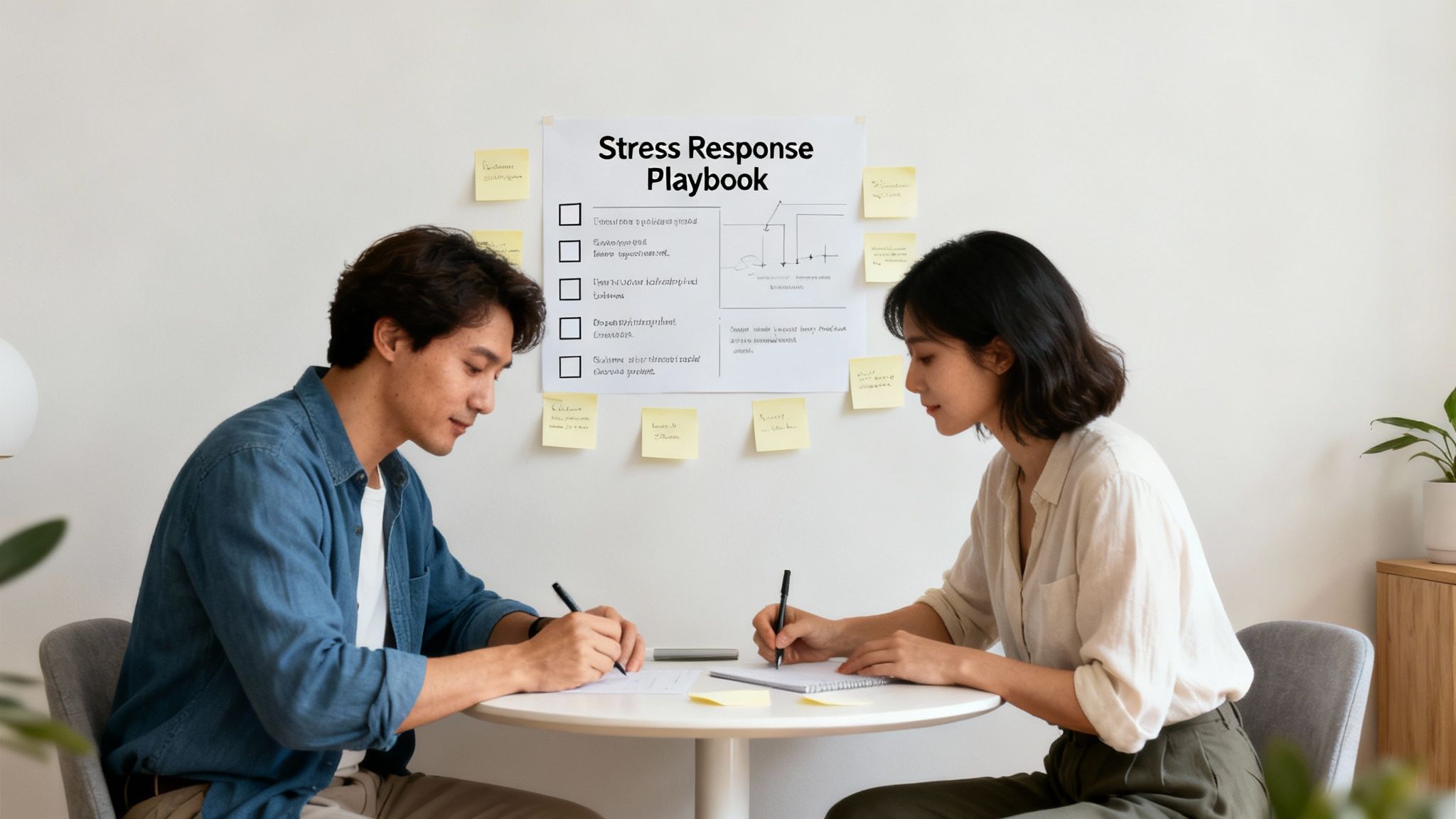
Create a Stress Response Playbook
When we're under pressure, our core personality types go into overdrive. This exercise is all about mapping those knee-jerk reactions and creating a game plan to support each other when stress inevitably hits. It’s how you turn a potential conflict into a moment of connection.
Here’s how you do it:
This isn't about trying to "fix" your partner's stress response; it's about learning how to love them through it. You're basically agreeing on the rules of engagement before the battle even starts, which is a massive win for your relationship.
Try the Motivation Swap Exercise
This one is a fun empathy-builder. It challenges you to see the world through your partner's Enneagram type for a day—or even just for a single task. It’s a powerful shortcut to move from intellectually knowing their motivation to emotionally feeling it.
Here’s the game plan:
This simple swap can build a bridge of compassion faster than a dozen conversations. For more ideas to improve your daily back-and-forth, check out these fantastic relationship communication exercises .
Plan a "Type-Aware" Date Night
Actionable insights should also be fun! This last exercise is about using your newfound knowledge to plan experiences that will genuinely light your partner up because they honor their core personality.
After all, once you have a deeper understanding of your dynamics, you can keep the spark alive and make new memories with some unique date ideas for couples . For example, if your partner is a Type 2 "Helper" who thrives on feeling appreciated, plan a surprise date night that’s all about pampering them—maybe a home-cooked meal of their favorite food followed by a movie they love. If they’re a Type 4 "Individualist" who craves unique experiences, skip the chain restaurant and take them to an obscure art gallery, a poetry slam, or a ghost tour in your city.
This shows you're not just hearing the words—you're understanding the person behind them and putting that love into action. It’s how you make them feel truly seen.
Your Burning Questions About Couples Compatibility Tests, Answered
Alright, so you're ready to dive into a free couples compatibility test. You're probably feeling a mix of excitement and maybe a little bit of "uh oh, what are we going to find out?" That's totally normal. Let's tackle some of the biggest questions and worries people have so you can go into this with confidence, not fear.
"Help! Our Compatibility Score Is Super Low."
Okay, first things first: don't panic . A low score is not a relationship death sentence. Seriously. It's not a grade you failed or a prediction of doom.
Think of it more like a treasure map where 'X' marks the spot—not for buried treasure, but for your biggest opportunities for growth.
A genuinely good test, especially one based on a system like the Enneagram, won't just slap a number on your relationship. It’ll show you the why behind the friction. For instance, a "low score" might just mean that one partner's need for security (a Type 6) bumps up against the other's love for spontaneity (a Type 7). That's not a fatal flaw; it's just a dynamic you get to learn how to navigate together.
Honestly, some of the strongest couples I know are the ones who had "challenging" pairings on paper. They built an incredible bond precisely because they had to be intentional about understanding each other, rather than just coasting on easy-peasy chemistry.
"So, Should We Be Taking These Tests All the Time?"
Your core personality isn't going to do a 180 every few months, but your relationship? That thing is alive, constantly changing and evolving. So, no, you definitely don't need to be taking a full-blown test every other weekend.
A great rhythm is to revisit your results every 6 to 12 months . It’s also brilliant to pull them out when life throws a big change your way—think a major move from Miami to Chicago, a new career path, or bringing kids into the picture.
This turns the test from a one-and-done quiz into a powerful annual relationship check-in. It's a built-in time to look back, celebrate how far you've come, and talk about how your needs and priorities might have shifted.
"Can a Test Actually Predict if We’ll Break Up?"
In a word: no. Absolutely, positively not. Any test that claims it can predict the future of your relationship with 100% certainty is selling you snake oil. Be very skeptical of those. Your relationship is built on choice, effort, and commitment—things no algorithm can ever truly measure.
Think of a free couples compatibility test as a diagnostic tool, not a crystal ball.
• It spots potential speed bumps, not guaranteed crashes. • The test might highlight that you have wildly different ways of handling conflict, but it has no idea if you're both willing to learn and work on bridging that gap.
• It gives you the gift of awareness. • The results hand you a personalized playbook, showing you exactly where you can love each other better and sidestep preventable arguments. For example, knowing your partner is a Type 9 who avoids conflict at all costs helps you approach difficult conversations more gently.
At the end of the day, a couple with a "perfect" score can easily drift apart if they don't put in the effort. And a couple with a "difficult" score can build something absolutely unbreakable because they're committed to understanding each other. It’s all about what you do with the information.
Ready to get a real, in-depth look at what makes you and your partner tick? At Enneagram Universe , our scientifically validated assessment looks past the surface to reveal the core motivations that drive you both. Start your journey of discovery today .