Free Compatibility Test for Couples: A Complete Guide to Understanding Your Match

Ever wondered what makes you and your partner really tick? A free compatibility test for couples is basically an online quiz that peeks under the hood of your relationship to see how well you align on the big stuff—values, communication quirks, and personality. These can range from lighthearted, fun quizzes to more serious assessments rooted in real psychology, all designed to get you talking and strengthen your bond.
Your Quick Guide to Couples Compatibility Tests
So, you're curious if you and your partner are a match made in heaven. It's a question as old as time, and taking a compatibility test is the 21st-century way to find some answers. But let's get one thing straight: this isn't a final exam on your relationship. Think of it more like a flashlight you can use to explore the fascinating, sometimes hidden, corners of your connection.
Some quizzes are just for kicks—a bit like a fun-house mirror that gives you an amusing, slightly warped view of yourselves. Others are more like a crystal-clear, full-length mirror, reflecting your dynamics with uncanny accuracy. Either way, the objective isn't to get a "You're doomed!" or "You'll live happily ever after!" verdict. It's about getting a new tool for starting some really great conversations.
What to Expect From a Compatibility Test
Think of taking a compatibility test as an adventure for two, not an evaluation. It's your chance to learn something new, share a laugh, and maybe even see your partner in a whole new light. A good test will help you:
• Discover Shared Values: • Pinpoint the fundamental beliefs that bond you. For instance, do you both agree that financial security is more important than spontaneous travel?
• Identify Growth Areas: • Gently reveal where your styles clash. A practical example: a test might show that one partner is a "planner" who needs a schedule, while the other is a "go-with-the-flow" type, explaining your constant friction over weekend plans.
• Spark Meaningful Dialogue: • Give you a neutral jumping-off point for topics that don’t always come up over dinner, like "What does 'success' look like to you in five years?"
• Understand Each Other's Wiring: • Get to the bottom of • why • you both do the things you do, which is the fast track to real empathy.

Take my friends, an American couple named Chloe and Ben. They took a test and discovered that his drive for security was constantly at odds with her craving for adventure. Suddenly, their endless debates about saving for a down payment versus booking a trip to Costa Rica weren't about one person being "boring" and the other being "reckless." They finally understood each other's core needs, and it changed everything.
A great compatibility test isn't about scoring your relationship. It’s about giving you a shared language to better understand the beautiful, complex system you’re building together.
If you're ready to start exploring, here's a quick rundown of the main types of tests out there. And if you're new to all this, it can be super helpful to understand your own personality first. Many people start with our free Enneagram test to get a handle on their own type before diving into couple dynamics.
Quick Guide to Compatibility Test Types
To help you pick the right starting point, here’s a look at the most common types of free compatibility tests for couples, what they focus on, and who they’re perfect for.
| Test Type | What It Measures | Best For |
|---|---|---|
| Personality Frameworks | Core motivations, fears, and desires (e.g., Enneagram, MBTI) | Couples looking to understand why they behave the way they do. |
| Attachment & Love Styles | How you express and receive affection (e.g., Love Languages) | Couples who feel a disconnect in emotional expression. |
| Habit & Skill Quizzes | Communication patterns and conflict resolution habits (e.g., Gottman-style) | Couples who want practical tools to improve daily interactions. |
Each type offers a different lens through which to view your relationship, so think about what you’re most curious about and dive in
So, You're Thinking About an Online Relationship Quiz?
Diving into the world of online relationship quizzes is a bit like wandering through a giant carnival. Over by the entrance, you've got the flashy, quick-win games with big prizes. Deeper inside, you find the skill-based challenges that take a little more focus. The internet is packed with both, and your first job is figuring out which game you're actually playing with any free compatibility test for couples .
Let's be clear: not all quizzes are built the same. They really fall into two big categories: the ones designed for a quick laugh and the ones built for genuine growth. Millions of people click on these things every year, from silly "love calculators" to serious psychological deep dives. Knowing what you've stumbled upon is everything. (If you want a fun take on this, check out this insightful travel blog post that categorizes these tools in a unique way).
"Popcorn Quizzes": Fun Fluff, Not Real Facts
First, you have what I like to call the "Popcorn Quizzes." You know the ones. You take them on a whim, probably while lounging on the sofa, just to see what happens. Think zodiac sign matchups, "what's your couple theme song?" quizzes, or those calculators that mash your names together. They’re built for a quick dopamine hit, spitting out a fun percentage or a cute label in seconds.
Take an American couple like Sarah and Tom from Chicago. They might pop their names into a "love calculator" and get an 87% compatibility score . They'll have a chuckle, maybe post it online, and completely forget about it five minutes later. These quizzes are the cotton candy of the compatibility world—all sugar, no substance. They have zero basis in real psychology and are purely for a bit of fun.
Quick gut check: If a quiz only asks for your names, star signs, or birthdays, it isn't analyzing your relationship. It's just a bit of code running a simple algorithm for kicks. Enjoy it for what it is, but please don't base any life decisions on it!
"Growth Assessments": The Real Deal for Deeper Insight
On the other side of the carnival are the "Growth Assessments." These are the serious simulators, the ones designed to give you genuine insights and kickstart real conversations. Unlike their fluffy counterparts, these tools are usually grounded in established psychological theories and sometimes decades of research. They ask for more of your time and honesty, but what you get back is so much richer.
These are the tests that can actually move the needle in your relationship. They don't just hand you a score; they give you a new language to talk about your life together.
• The Enneagram: • This isn't just about what you do; it's about • why • you do it. It digs into your core motivations, fears, and desires, helping you finally understand the hidden logic behind your partner's actions.
• The 5 Love Languages: • A true classic. This assessment pinpoints how each of you prefers to give and receive love. It's a lifesaver for couples who feel like they’re shouting affection into the void.
• Gottman-Inspired Quizzes: • These quizzes are born from years of hardcore research into what makes relationships last. They look at the nuts and bolts: how you argue, how you connect, and the real strength of your friendship.
Let's go back to Sarah and Tom. Imagine they try a 5 Love Languages quiz instead. Tom, who shows his love through "Acts of Service" (like taking her car for an oil change), finally gets why Sarah, whose main language is "Quality Time," just wants him to put down his phone and be present with her. That’s a practical insight. He realizes the hour he spent detailing her car didn't mean as much to her as spending 20 minutes on the couch, just talking about their day with no distractions.
That single "aha!" moment is what separates a silly distraction from a powerful tool. It’s how you turn nagging frustration into genuine empathy and start building a relationship that’s stronger than ever.
Comparing the Most Popular Compatibility Frameworks
So, you've graduated from the silly "What Kind of Pizza Are You as a Couple?" quizzes, and you're ready for something with a bit more substance. Fantastic. Welcome to the main event: a showdown between the heavyweights of the relationship psychology world.
Finding the right free compatibility test for couples is a lot like picking the right tool for a project. You wouldn't use a sledgehammer to hang a picture frame, right? Each of these frameworks offers a totally different lens to look at your relationship, highlighting unique parts of your shared life. Let’s break down the big three so you can find the perfect fit for where you and your partner are right now.
The Enneagram: Digging into Your Core Motivations
Think of the Enneagram as the ultimate "why" detector. It’s not so much about what you do, but the deep-seated, often unconscious reasons why you do it. This system brilliantly maps out nine core personality types, each one driven by a fundamental desire and a core fear. It's like finally getting a look at the hidden operating system running in the background for both you and your partner.
Suddenly, behaviors that used to baffle you start to make sense. A practical example: that Type 6 partner who questions every restaurant choice? It’s not that they're difficult; it's a profound need for security and wanting to avoid a bad experience. That Type 2 partner who always offers to help, even when exhausted? It's not about being a martyr; it comes from a deep desire to be needed. This kind of insight is the secret ingredient for next-level empathy.
Key takeaway: The Enneagram helps you stop reacting to what your partner does on the surface and start responding to who they are at their core. It’s a game-changer for compassion.
This framework is a godsend for couples who feel like they’re constantly miscommunicating or getting stuck in the same old, frustrating arguments. It pulls back the curtain on the invisible forces driving both your conflicts and your connections. If you're curious how it stacks up against other personality models, our guide on the Enneagram vs. MBTI is a great place to start.
The 5 Love Languages: Finally Speaking the Same Language of Affection
Ever feel like you’re shouting your love from the rooftops, but your partner can't seem to hear it? You might just be speaking different "Love Languages." This incredibly popular framework from Dr. Gary Chapman proposes that we each have a primary way we prefer to give and receive affection.
The five languages are:
• Words of Affirmation: • You feel most loved when you hear it—compliments, encouragement, and kind words.
• Acts of Service: • For you, actions truly speak louder than words. "Let me take care of that for you" is music to your ears.
• Receiving Gifts: • It's not about materialism. It's the thought and effort behind a tangible gift that makes you feel cherished.
• Quality Time: • Nothing says "I love you" like undivided, focused attention. Phone down, eyes up.
• Physical Touch: • From holding hands to a hug after a long day, you feel most connected through touch.
Imagine an American couple, Jasmine and Chris. Chris was constantly buying Jasmine thoughtful gifts, but he was baffled as to why she still seemed distant. After taking a quiz, the lightbulb went on. His love language is Receiving Gifts , but hers is Quality Time . His presents were sweet, sure, but what her heart truly craved was for him to just put his phone away and be fully present with her for an hour. That one tiny insight fixed months of misunderstanding.
Gottman-Style Quizzes: The Health Check-Up for Your Relationship Habits
If the Enneagram is the "why" and Love Languages are the "how," then Gottman-style quizzes are all about the "what." Born from decades of legendary research by Drs. John and Julie Gottman, these assessments are like a physical for your relationship. They zero in on the observable, everyday behaviors and habits that are scientifically proven to predict long-term success or failure.
A practical example: a quiz might ask, "How do you start a difficult conversation?" Your answer reveals if you use a "soft startup" (e.g., "Honey, I'm worried about our budget, can we talk?") or a "harsh startup" (e.g., "You spent way too much money again!"). The goal isn't to slap a label on you, but to pinpoint specific, actionable areas where you can grow. A Gottman-style assessment can spot if you’re slipping into destructive patterns like criticism or defensiveness and give you a roadmap back to healthier habits.
Comparing Major Relationship Compatibility Frameworks
Each of these tools gives you a different piece of the relationship puzzle, and the best one really depends on what you're trying to figure out. To make it super simple, here's a quick side-by-side comparison of these psychometrically-informed models.
| Framework | Core Focus | Key Strength for Couples | Potential Blind Spot |
|---|---|---|---|
| The Enneagram | Deep-seated motivations, fears, and desires. The "why" behind your behavior. | Builds profound empathy and helps break recurring conflict cycles by revealing core needs. | Can feel complex at first and requires a willingness to look at your own shadow side. |
| The 5 Love Languages | How affection is expressed and received. The "how" of showing love. | Provides a simple, immediately actionable way to make your partner feel seen and cherished. | Can oversimplify emotional needs if not paired with deeper communication. |
| Gottman-Style Quiz | Daily habits, communication patterns, and conflict resolution skills. The "what" you do. | Offers practical, evidence-based strategies to improve your interactions right away. | Focuses more on behavior than the underlying emotional reasons for those habits. |
At the end of the day, no single free compatibility test for couples is a silver bullet. The real magic isn't in the results themselves, but in using them as a launchpad for the open, curious, and kind conversations that make a relationship truly thrive.
How to Turn Test Results Into Real Connection
Alright, you did it. You took a free compatibility test for couples , and now you're looking at a screen that feels like a secret decoder ring for your relationship. So... what now? The biggest mistake most couples make is treating these results like a final grade. In reality, this is the starting line.
Think of yourselves as co-pilots who just got a brand-new navigation map. This isn't a scorecard to prove who's the better pilot or to rehash that time you both know who got you lost. It’s a tool to help you navigate the skies ahead, together. The key is to approach this map with curiosity, not criticism.
Setting the Scene for a Great Conversation
Before you even peek at the results, create a space that feels safe and comfortable. This is not a task you can squeeze in between folding laundry and paying bills. Turn off the TV, silence the phones, maybe pour a glass of wine. The environment you create signals that this conversation matters.
Remember, you're on the same team. The goal isn’t to win an argument; it's to understand each other on a whole new level. This is about discovery, not debate.
To get your minds warmed up, this little infographic shows what some of the most popular compatibility models are really focused on.
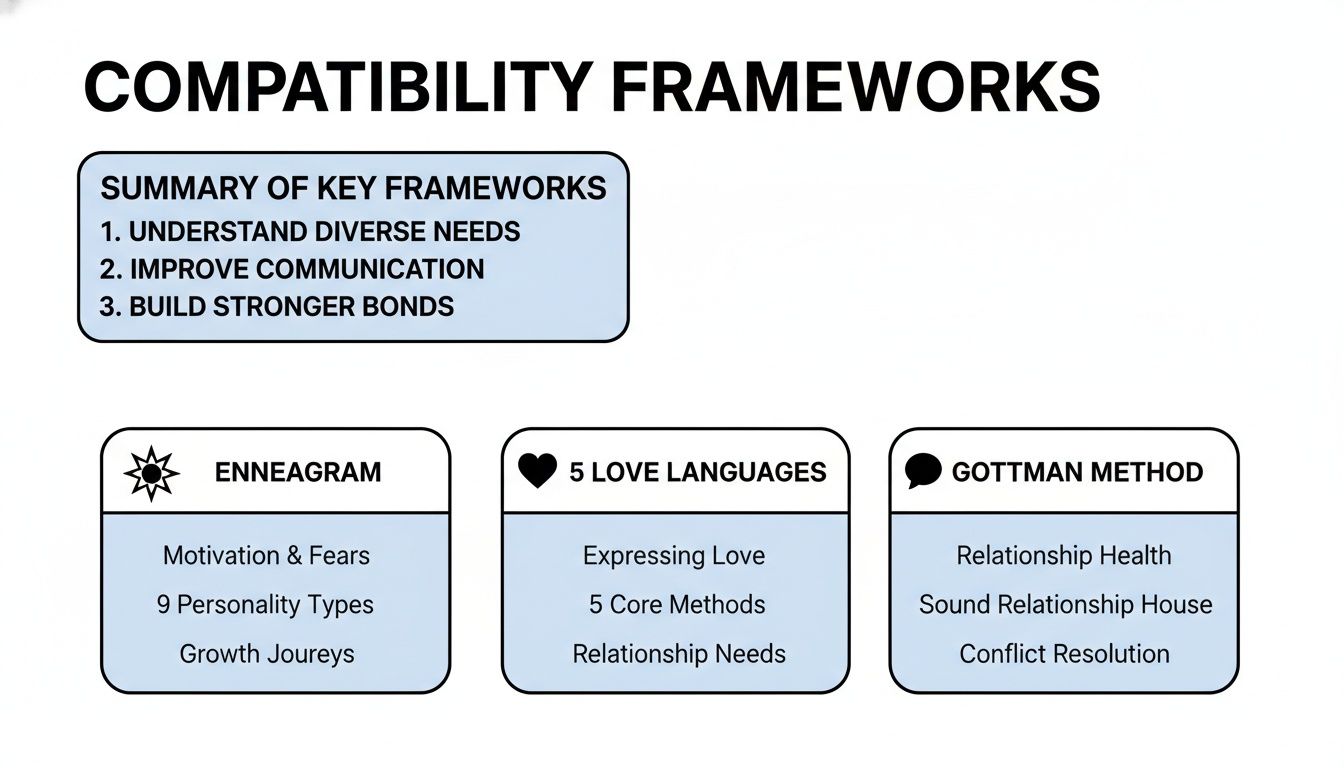
It’s a great reminder that each test gives you a different piece of the puzzle—whether it’s the "why" behind your actions (Enneagram), how you give and receive love (Love Languages), or your day-to-day habits (Gottman).
The Dos and Don'ts of Discussing Your Results
How you talk about your results is so much more important than the results themselves. Let’s follow a fictional American couple, Maria and David. They just found out Maria is a security-focused Enneagram Type 6, while David is an adventurous Enneagram Type 7.
Here’s how they can turn that tidbit into a real connection:
• DO use "I" statements. • Maria could start with, "It's fascinating that the test pointed out my need for security. It helps me understand why I get so anxious when our plans are up in the air." This is about her experience, not his behavior.
• DON'T use the results as a weapon. • A terrible move for David would be to say, "See? This proves you're way too reckless with our savings!" That just turns a learning moment into a fight.
• DO ask open-ended questions. • A brilliant question from David would be, "The test mentioned your adventurous side. Can you tell me more about what that feels like for you? What kind of new things are you craving?"
• DON'T jump to conclusions. • Maria shouldn't assume, "So you'll never want to settle down and be serious." Instead, she can get curious about how their very different styles might actually work together.
The most powerful shift you can make is from judgment to curiosity. Replace "Why are you like that?" with "Help me understand what it's like to be you." This simple change transforms conflict into connection.
Turning Insights into Actionable Steps
A-ha moments are great, but it’s what you do after them that builds a stronger bond. Once you've landed on a key insight, create a small, fun experiment around it. If Maria and David's test highlighted their different takes on risk, they could create a "bravery budget"—a small, agreed-upon amount of money David can use for a spontaneous adventure each month, like a last-minute weekend camping trip. This feeds his need for novelty without triggering Maria’s anxiety about their long-term financial goals.
These conversations are the real work of a healthy relationship. For more ideas on keeping the dialogue flowing, you can find a whole bunch of relationship communication exercises that build on these very principles. After all, understanding your compatibility is just the first step. To keep things fresh, you could also explore some fun and practical romantic activities for couples to spark connection .
The goal is simple: use your test results not as a final report card, but as the perfect study guide for becoming experts on each other.
What Makes a Good Compatibility Test Actually
Good
?
Ever wonder what separates a genuinely useful free compatibility test for couples from a glorified online coin toss? The secret sauce isn't some mystical algorithm; it's a bit of straightforward science. Don’t worry, we’re not about to break out the lab coats and textbooks. This is science you can actually use.
Think of it like baking a cake. To get a perfect result every single time, you need two things from your measuring cup: it has to be reliable, and it has to be valid .
• A • reliable • measuring cup gives you the exact same amount of flour every time you scoop. Consistency is key.
• A • valid • measuring cup gives you the • correct • amount of flour—one true cup. It actually measures what it says it measures.
A flimsy, misshapen cup might be reliable (it consistently gives you too little flour), but it’s not valid. A good compatibility test needs to be both. It has to consistently measure your traits ( reliability ) and accurately measure what it claims to measure ( validity ).
Why More Questions Equal Clearer Answers
This is precisely why those quick, 10-question "Are You Soulmates?" quizzes, while fun, often fall flat. They just don't have the depth to be truly reliable or valid.
It’s like trying to understand a whole movie by watching a 15-second trailer. You get a vibe, sure, but you miss the entire plot, the character development, and all the nuance.
A more detailed assessment with 100 or even 180 questions, on the other hand, provides a much richer, more dependable picture of your personalities and how you mesh. Each question acts like a pixel; the more pixels you have, the sharper and more detailed the final image of your relationship becomes.
A truly insightful test doesn't just ask if you feel a certain way, but how often and how strongly . This nuance is where the real "aha!" moments are found.
A simple "yes" or "no" question, "Are you adventurous?" is way too limiting. What if you're adventurous about trying new foods but a total homebody when it comes to travel? A practical example: someone from a small town in Ohio might love hiking local trails but find the idea of navigating New York City terrifying. A binary choice just can't capture that.
The Power of the Scale
This is where scaled questions come in. You've definitely seen them before: they ask you to rate something on a scale from "almost never" to "almost always." This format, often called a Likert scale, is the gold standard for a reason.
It captures the subtle shades of your personality instead of forcing you into a black-or-white box. It’s the difference between describing a color as just "blue" versus being able to specify "sky blue," "navy blue," or "teal." The extra detail makes all the difference.
Longer, psychometrically sound free compatibility tests are designed to produce statistically meaningful results. The best assessments, often modeled on proven psychological frameworks, cover four to six key relationship domains and are built on decades of research. These robust tests use Likert-style items and a higher number of questions—typically 100–180 items —to boost their reliability and give you a far more accurate reflection of your relationship. You can get a deeper look into how these types of tests are constructed on Personality Quizzes .
By keeping these simple principles in mind, you can confidently choose a free compatibility test for couples that’s built on a solid foundation—one that will give you real, meaningful information to help your relationship thrive.
Using Your Results to Strengthen Your Bond
Alright, you’ve both taken a free compatibility test for couples , and the results are sitting in your inbox. So… now what? The biggest trap couples fall into is seeing the final score as some kind of judgment. It’s not. In reality, your results aren’t the finish line; they're the starting pistol for a whole new, fascinating conversation about your relationship.
Think of it like getting a personalized recipe book. It shows you the ingredients you’re working with, highlights your signature dishes (your strengths), and points out some adventurous flavor combos you might want to try (your growth areas). The point isn’t to judge the ingredients; it’s to start cooking something amazing together.

Turning Insights into Actionable Fun
Let's get this off the screen and into your real life. The goal is to make this feel less like homework and more like a fun date night.
• The Love Language Challenge Week: • Did the test reveal you have different primary Love Languages? Awesome. For one week, make it a playful mission to • only • speak your partner’s language. A practical example: If their language is "Acts of Service," you could make their coffee just the way they like it before they wake up. If "Words of Affirmation" is their thing, send them a text in the middle of the day praising something specific you love about them.
• The Enneagram Empathy Map: • What if the Enneagram showed a classic friction point—like a super-cautious Type 6 partnered with a thrill-seeking Type 7? Grab two pieces of paper and think of a recent disagreement over a weekend plan. Then, swap papers and write down how you imagine • your partner • experienced that situation, keeping their core fears and desires in mind. It's a ridiculously simple exercise that builds empathy faster than almost anything else.
Once you have these insights, a great next step is to find new ways to connect. Exploring some fun experience gifts for couples that align with your shared interests can be a fantastic way to put what you've learned into practice.
What if Our Results Say We're a Bad Match?
This is the big one, isn't it? The question that keeps people from clicking "start" in the first place. What if the results are... bad?
First, just breathe. A "low compatibility" score is not a relationship death sentence. In fact, it's a goldmine of valuable information.
Think of "incompatibility" not as a red flag, but as a roadmap. It highlights the exact areas where a little intentional effort will create the strongest connection.
Differences are not deficits. A saver and a spender aren't doomed; they just have a brilliant opportunity to create a financial plan that honors both security and spontaneity. A practical example: they could create three bank accounts—"yours," "mine," and "ours." The "ours" account covers shared bills, while their personal accounts give them freedom to spend or save as they wish, judgment-free. The test results just give you a neutral, data-backed place to start that conversation without pointing fingers.
When to Bring in a Professional
An online test is a phenomenal tool for self-discovery, but it has its limits. Think of it like a well-stocked first-aid kit. It's perfect for handling minor scrapes and gives you the tools to patch up common issues on your own.
But if you find that your talks about the results are hitting a wall, escalating into the same old arguments, or digging up much deeper wounds, it might be time to call in a pro. A couples counselor is like a skilled surgeon; they can help you navigate the tricky stuff with an expert hand in a safe, structured space.
Bringing your test results to a therapy session can actually give you a huge head start. It gives the counselor a snapshot of your dynamic right away, letting you jump into the truly meaningful work that much faster.
A Few Common Questions We Get About Compatibility Tests
Let's be honest, diving into relationship tools can feel a little weird. You've probably got some questions buzzing around. Let’s tackle the big ones head-on so you can feel confident using a free compatibility test for couples to explore your unique connection.
Can a Free Compatibility Test Predict Our Future?
Nope, and you should run from any test that claims it can. There's no crystal ball for relationships.
Think of a good compatibility test less like a prophecy and more like a weather report. It highlights your potential sunny days (where you two just click ) and gives you a heads-up about possible storms brewing on the horizon (your growth spots). A practical example: a test might show you have different conflict styles, with one partner who "fights" and another who "flees." This doesn't predict a breakup; it predicts that you need to intentionally create a communication plan for disagreements. It gives you a map, but you two are still the ones driving the car.
What if My Partner Thinks This Stuff Is Weird and Won't Take a Test?
This happens all the time. Pushing it is usually the fastest way to get a hard "no." So, don't make it a demand; make it a fun, low-pressure invitation.
A practical approach: try framing it as a quirky date night idea. Something like, "Hey, I saw this free quiz online about how couples connect. Might be a fun, silly thing to do tonight over a pizza?" If they’re still hesitant, don’t sweat it. You can always take a personality test like the Enneagram on your own. Just understanding your own wiring—your motivations, your blind spots, your communication quirks—brings a whole new level of self-awareness to the relationship. That alone can be a game-changer.
Your relationship's health isn’t defined by a test score. It's built on your willingness to understand each other more deeply. A test is just one tool in a giant toolbox to help you do that.
Are My Answers Actually Private on These Free Online Tests?
Such a great question, and one you should always ask. When it comes to privacy, not all tests are created equal. Those simple "Which Disney Couple Are You?" quizzes? Yeah, they probably don't have iron-clad data security, so it’s wise to avoid sharing anything too personal.
On the other hand, reputable platforms that offer assessments backed by real research will have a clear privacy policy you can easily find. Before you start clicking answers, scroll to the bottom of the page and look for that "Privacy Policy" link. A trustworthy site will tell you exactly how they handle your data and will never share it without your permission.
Ready to see what makes you and your partner tick? Enneagram Universe offers a free, scientifically validated Enneagram assessment that sheds light on your core motivations, paving the way for a much stronger connection. Start your journey of discovery today at Enneagram Universe , and take the Enneagram Test for free.