Enneagram Stress and Growth: How Each Type Reacts and Evolves

Ever had one of those days where you barely recognize yourself? When you're crushing it, you feel on top of the world, but under stress, you feel like a completely different person. That Jekyll-and-Hyde experience is exactly what enneagram stress and growth is all about. It's the secret roadmap to how your personality shifts when life gets real.
The Secret Map of Your Personality Under Pressure
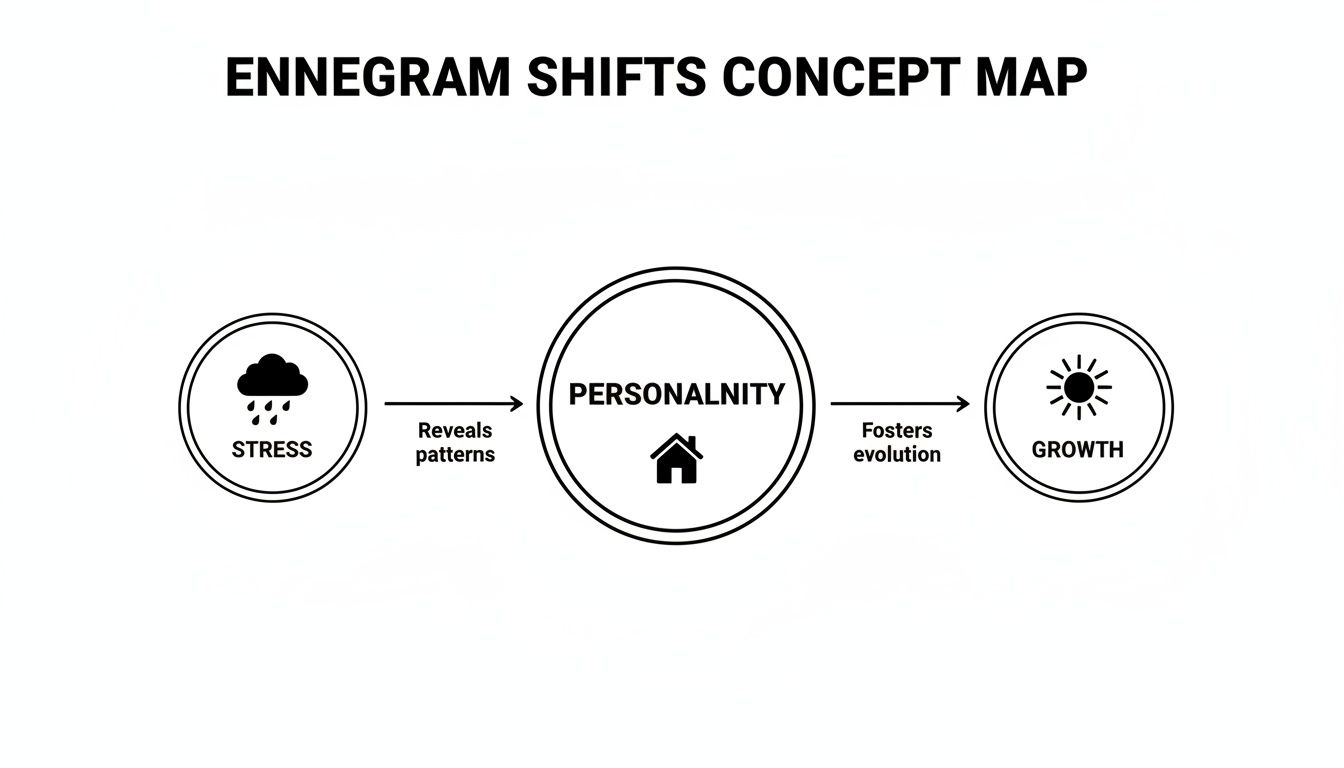
Let's think of your Enneagram type as your home base. It's where you're most comfortable, with all your usual motivations, knee-jerk reactions, and blind spots. It's your default setting. But what happens when the pressure cooker gets turned up, or on the flip side, when you feel totally secure and inspired?
This is where the Enneagram really shows its magic. Your personality isn't some fixed, static thing. It has built-in escape hatches and secret passages that lead to other Enneagram types.
When Stress Takes Over
Imagine your boss drops a nightmare project on your desk with an impossible deadline. Suddenly, you might find yourself acting in ways that feel totally out of character. This is your "stress path," what we call disintegration . When the heat is on, you unconsciously start channeling the less healthy side of another Enneagram type.
For instance, a take-charge American professional, a classic Type 8 (The Challenger), might feel their grip on a project slipping. All of a sudden, they’re not being direct and assertive anymore. Instead, they become secretive and withdrawn, hoarding information like an unhealthy Type 5 (The Investigator). It’s not a full personality transplant; it's a predictable stress response.
When Growth Is The Goal
Now, let's flip the script. You’re feeling safe, supported, and you're actively working on becoming a better version of yourself. You might start noticing some amazing new qualities popping up. This is your "growth path," or integration . In these moments of clarity, you get to borrow the healthiest traits from another Enneagram number.
Think of a deeply creative American entrepreneur, a Type 4 (The Individualist), who usually rides the waves of their intense emotions. As they focus on personal growth, they might find a new sense of structure and discipline emerging. They start organizing their brilliant ideas and following through, taking on the best qualities of a healthy Type 1 (The Reformer) to make their visions a reality.
Getting a handle on your unique patterns of enneagram stress and growth is like being handed a treasure map to your own psyche. It helps you:
• Catch yourself before you slide down that slippery slope of stress.
• Finally understand why your friends, family, or coworkers act so... weird under pressure.
• Intentionally steer yourself toward the person you want to be.
This guide is your compass. Let's use it to explore these hidden paths with more wisdom and a lot less judgment.
Understanding Your Enneagram Growth and Stress Arrows
So, you’ve figured out your Enneagram type. Awesome. But here’s where it gets really interesting. Your personality isn't static; it’s constantly shifting in predictable ways, especially when you’re feeling the heat or, conversely, when you're thriving.
Think of your core Enneagram type as your home base in a video game. It's where you're most comfortable. But the game has other levels. You have a "stress level" you get zapped to when things go wrong, and a "growth level" you unlock when you're at your best. These built-in pathways are what we call the arrows of disintegration (stress) and integration (growth) .
This isn’t about a personality transplant. You're not becoming another number. You're just temporarily borrowing some of its behaviors—for better or for worse.
The map shows how you’re never truly stuck. Your personality has these escape hatches and secret passages leading away from your core type, offering both challenges and some incredible opportunities.
Your Arrow of Disintegration (Stress)
Ever notice how you act completely out of character when you’re under pressure? That’s your arrow of disintegration at work. It’s an unconscious, knee-jerk reaction that points to the Enneagram type whose unhealthiest traits you take on when you feel cornered or overwhelmed.
Let's say we have a Type 1 teacher—dedicated, principled, and a perfectionist. She’s prepping for parent-teacher conferences and gets some unexpectedly harsh feedback. Suddenly, that organized teacher becomes moody, withdrawn, and self-pitying. She’s borrowing the unhealthy behaviors of a Type 4 . She’s still a Type 1, but she’s running a stress program from the Type 4 playbook.
Your Arrow of Integration (Growth)
On the flip side is your arrow of integration. This is the fun one. This path points toward the type whose healthiest qualities you begin to embody when you feel secure, happy, and are consciously working on your own self-awareness. It’s not something you have to force; it’s a natural unfolding.
Picture a classic Type 7 dad, a fun-loving adventurer who’s always chasing the next big thrill. As he starts practicing mindfulness and feels more content in his life, he finds himself becoming more focused and present. He can now patiently sit with his kid and work through a tough math problem—a task that would have previously felt like torture. He’s tapping into the healthy, disciplined energy of a Type 5 .
This idea that we shift between types isn't just a fun theory. Research has shown that a whopping 72% of people show these exact directional patterns when they're under sustained stress or in periods of real growth. It confirms that the model of enneagram stress and growth is a surprisingly reliable map for our inner world. You can dig into the research behind these dynamic movements on sites like the International Enneagram Association.
The Stress Spiral: How Each Enneagram Type Reacts
We’ve all had those moments. You’re cruising along, and then—BAM. A project implodes, a relationship gets rocky, or you're just plain worn out. Suddenly, it feels like someone else is driving your bus, and they’re a terrible driver.
This, my friends, is your Enneagram stress path in action. It’s a totally automatic, usually unconscious, reaction where you start borrowing the worst habits of a completely different Enneagram type. It’s your personality’s version of pulling the fire alarm. The only problem? The "help" that arrives often just adds fuel to the flames.
But here’s the good news. Once you learn to spot your specific stress spiral, you can catch that hijacker before they take the wheel. You can choose a better road.

So, what does this personality meltdown look like in the real world? Let’s take a tour through the types.
Type 1: The Reformer (Moves to Unhealthy 4)
When a Type 1 is stressed, their usual discipline dissolves into the moody melancholy of an unhealthy Type 4 . Their powerful inner critic, normally aimed at fixing the world, turns inward and gets nasty.
Take Sarah, a classic Type 1 project manager from Chicago. Her team blows a huge deadline. Instead of her usual logical problem-solving, she retreats into a fog of frustration. She feels deeply misunderstood and alone, thinking, "Why am I the only one who holds the standard?" She might get lost in a fantasy of how things should have gone or lash out with surprising emotionality.
Type 2: The Helper (Moves to Unhealthy 8)
That warm, generous Type 2 ? Under pressure, they can snap and become shockingly aggressive and controlling, just like an unhealthy Type 8 . All that repressed resentment from giving too much finally boils over.
Look at David, a Type 2 manager from Austin who lives to support his people. After weeks of sacrificing his own time, he feels completely taken for granted. When a team member questions a tiny decision, David explodes. He becomes demanding and bossy, barking, "After everything I do for you all, you question me? We're doing it my way, period." The sudden shift from caring mentor to forceful dictator is jarring for everyone, especially him.
Type 3: The Achiever (Moves to Unhealthy 9)
When the high-flying Type 3 hits a wall of failure or burnout, they can suddenly become listless and apathetic, like an unhealthy Type 9 . Their relentless drive to succeed simply vanishes, replaced by a powerful urge to just check out.
Meet Jessica, a Type 3 startup founder from San Francisco whose lead investor just pulled out. Poof. Her trademark energy is gone. Instead of pivoting and strategizing, she spends the weekend zoned out, binge-watching a show she doesn’t even care about and doom-scrolling on her phone. She’s a ghost of her usual dynamic self, feeling totally disconnected and numb.
Type 4: The Individualist (Moves to Unhealthy 2)
Under stress, the deeply introspective Type 4 can become surprisingly clingy and people-pleasing, like an unhealthy Type 2 . Their core fear of abandonment goes into overdrive, and they start scrambling for outside approval.
Picture Leo, a Type 4 artist from New York City whose new gallery show gets a "meh" review. Instead of retreating to process, he starts frantically calling friends, fishing for praise and reassurance. He becomes almost desperately helpful, trying to earn affection by doing things for others. It’s a frantic attempt to prove his worth when he feels worthless inside.
Type 5: The Investigator (Moves to Unhealthy 7)
The typically focused, minimalist Type 5 gets a huge shock when stress hits. Feeling incompetent or overwhelmed, they can become scattered and hyperactive, like an unhealthy Type 7 . Their brain, usually a quiet library, turns into a chaotic amusement park.
Dr. Evans, a Type 5 researcher at a Boston university, discovers a major flaw in her life's work. Instead of methodically digging into the problem, her mind goes into hyperdrive. She flits from one half-baked idea to the next, starts a dozen distracting side projects, and fills her days with frantic, pointless activity to avoid the one thing that matters.
Type 6: The Loyalist (Moves to Unhealthy 3)
When a Type 6 ’s anxiety kicks into high gear, they can put on the slick, competitive mask of an unhealthy Type 3 . To fight their fear, they try to project an image of untouchable success, often by taking shortcuts.
Consider Maria, a Type 6 team lead from Miami. Anxious about an upcoming review, she becomes obsessed with appearances. She starts fudging reports and pushing her team to hit arbitrary numbers, all while acting like she has everything under control. The focus shifts from creating genuine security to just looking secure, which ends up alienating the very team she wants to protect.
Type 7: The Enthusiast (Moves to Unhealthy 1)
The fun-loving, optimistic Type 7 , feeling trapped or limited, suddenly becomes rigid and critical, like an unhealthy Type 1 . All the joy drains away, replaced by a sharp, nit-picky perfectionism.
Kevin, a quintessential Type 7 from Denver, has his dream vacation canceled. His easygoing vibe vanishes. He becomes irritable, finding fault with everything and everyone around him. He starts obsessively cleaning and complaining that "nothing is ever done right in this house!" His world has shrunk, and he’s taking it out on the details.
Type 8: The Challenger (Moves to Unhealthy 5)
When the powerful, assertive Type 8 feels like they're losing control, they do the last thing you'd expect: they retreat into secrecy and isolation, like an unhealthy Type 5 . They pull back to a hidden bunker to plot their next move.
Imagine a Type 8 CEO in Washington D.C. facing a corporate mutiny. Instead of confronting it head-on, she locks her office door. She cuts off communication, hoards information, and grows paranoid. In her mind, she’s the only one who can solve this, and everyone else is a potential saboteur.
Type 9: The Peacemaker (Moves to Unhealthy 6)
The calm, easygoing Type 9 , when put under enough prolonged stress, can become riddled with anxiety, just like an unhealthy Type 6 . That inner peace they guard so carefully shatters into a million worst-case scenarios.
Ben, a classic Type 9 from a small town in Ohio, fails to mediate a nasty fight between two friends. His tranquil demeanor evaporates. He’s up all night, worrying about every possible disastrous outcome and replaying every conversation. He’s swamped by anxiety, constantly seeking reassurance that he didn't somehow make everything worse. To see just how this works, you can dive deeper into the Enneagram 9 in stress .
The Growth Path: How Each Enneagram Type Truly Shines
If stress is the personality’s blaring fire alarm, then the growth path is the fire escape leading to a surprisingly breathtaking view. This is where the whole point of enneagram stress and growth really comes to life. It’s not about ditching your personality and becoming someone else; it's about unlocking the most resourceful, balanced, and inspiring parts of you that have been waiting in the wings all along.
When you feel safe, supported, and are putting in the work to know yourself better, you start to naturally take on the best traits of your integration number. This isn't a grind. Think of it more like a flower unfurling in the sun—a blooming into a more whole, vibrant version of you.
Let’s take a walk on the sunny side of the street and see what thriving looks like for all nine types.

Type 1: The Reformer (Finds Joy in Healthy 7)
For the principled Type 1 , growth feels like a huge sigh of relief. By tapping into the healthy side of Type 7 , they discover a beautiful sense of ease and optimism. That relentless inner critic finally packs its bags and goes on a long-overdue vacation, replaced by a spirit of joyful acceptance.
Instead of seeing the world as a flawed project that constantly needs fixing, they begin to see it as a wonderful adventure to be savored. They become more spontaneous, less rigid, and—gasp!—even able to laugh at their own perfectionism. This doesn't mean they ditch their high standards; it just means they hold them with a lighter grip, finding joy in the journey, not just the flawless destination.
Real-World Example: A Type 1 American parent, who usually plans family weekends down to the minute, might suddenly scrap the schedule. In a moment of growth, they decide on a whim to have a massive water balloon fight in the backyard, finding pure, unadulterated delight in the chaos and connecting with their kids with a newfound lightness.
Type 2: The Helper (Finds Selfhood in Healthy 4)
When the devoted Type 2 feels secure and loved for who they are, they move toward the self-aware, authentic Type 4 . This integration is a game-changer, allowing them to finally turn their powerful empathy inward and listen to their own needs and feelings.
They stop chasing validation from others because they’ve finally found it within themselves. This allows them to love more freely and authentically, without the unconscious hook of expecting something in return. They cultivate a rich inner life and become comfortable with their own unique identity, discovering that they are deeply lovable for who they are, not just for what they do.
Real-World Example: A Type 2 volunteer coordinator from Nashville, always busy organizing events for others, starts carving out one hour each morning for journaling. This simple act of self-care, tapping into the introspective nature of a healthy Type 4 , helps her understand her own feelings and desires, making her volunteer work feel more genuine and less depleting.
Type 3: The Achiever (Finds Connection in Healthy 6)
The driven, image-conscious Type 3 finds authentic connection and genuine commitment when they integrate the qualities of a healthy Type 6 . The constant performance for applause gives way to a desire for real cooperation for the greater good.
They become more invested in the people on their team, valuing loyalty and mutual support over individual trophies. This allows them to slow down and build genuine, lasting relationships that aren't based on what someone can do for them. A growing Type 3 realizes their self-worth isn’t tied to their latest win, which frees them up to be an incredibly supportive, committed, and trustworthy friend or leader.
Real-World Example: An American Type 3 sales executive, after securing a major deal, passes up the individual bonus. Instead, she lobbies for a team-wide celebration and profit-sharing plan, recognizing that her success was a collective effort. This move, echoing a healthy Type 6 's loyalty, builds incredible trust and morale within her department.
Type 4: The Individualist (Finds Purpose in Healthy 1)
The emotionally rich Type 4 discovers a sense of discipline and purpose when they integrate the positive traits of Type 1 . That deep well of feeling and creativity finally gets a channel, pouring into practical, structured action.
Instead of getting swept away by waves of melancholy, they use their unique perspective to bring tangible order and beauty to the world around them. A growing Type 4 learns to be objective and principled, taking their incredible creative visions and turning them into reality through consistent effort. They find that structure doesn't kill their creativity; it gives it a backbone.
Type 5: The Investigator (Finds Confidence in Healthy 8)
The observant, cerebral Type 5 becomes a surprisingly confident and decisive leader when they move toward a healthy Type 8 . After spending so much time gathering knowledge in the safety of their mind, they feel ready to step out and put that wisdom into action.
They become more embodied and assertive, unafraid to take charge and make things happen. This integration gives them the guts to share their brilliant insights with the world, not from a place of arrogance, but from a grounded sense of "I've got this." A healthy Type 5 can become a true visionary leader who not only sees the big picture but can confidently command the resources to make it happen.
Real-World Example: A Type 5 American software developer, who usually prefers to work alone, feels secure in her expertise. She confidently steps up to lead a project, clearly articulating her vision and decisively managing the workflow to launch a successful product. Her team, in turn, feels empowered by her clear-headed, no-nonsense leadership.
Type 6: The Loyalist (Finds Peace in Healthy 9)
The ever-vigilant Type 6 finally finds a deep sense of inner peace and trust by integrating the calm of a healthy Type 9 . The internal storm of "what-ifs" and worst-case scenarios finally subsides, replaced by a quiet faith in themselves and in the flow of life.
They learn to relax and trust their own inner guidance instead of constantly scanning for external approval. This allows them to become more open, less defensive, and an incredibly steadying presence for others. A growing Type 6 stops seeing the world as a minefield of potential threats and starts to experience a profound sense of inner stability and wholeness. Pinpointing your own journey through these levels can be incredibly insightful; you can learn more by taking a dedicated Enneagram health test to see where you currently stand.
Real-World Example: An anxious Type 6 father from suburban America, who constantly worries about his children's safety, decides to trust them to go on their first solo camping trip. Instead of texting them every hour, he practices mindfulness, accepting the uncertainty and finding a deep sense of peace in letting go. This move toward Type 9 's calm trust benefits both him and his kids.
Type 7: The Enthusiast (Finds Depth in Healthy 5)
The fun-loving, forward-lurching Type 7 finds profound satisfaction and focus when they tap into the healthy side of Type 5 . The frantic chase for the next exciting thing finally quiets down, allowing them to appreciate the depth and richness of the present moment.
They discover that true joy isn't just in having endless options but in the quiet satisfaction of focused concentration. A growing Type 7 becomes more thoughtful, able to stick with projects and people long enough to find immense fulfillment in mastery and completion. They become brilliantly productive, pairing their visionary ideas with the focus required to actually see them through.
Real-World Example: A Type 7 travel blogger, known for whirlwind trips through multiple countries, decides to spend an entire month exploring a single small town in Vermont. By embracing the focus of a healthy Type 5 , she discovers hidden stories and deep connections, producing her most insightful and well-received work to date.
Type 8: The Challenger (Finds Compassion in Healthy 2)
The powerful, assertive Type 8 discovers the immense strength in vulnerability and compassion as they move toward the healthy Type 2 . They learn that true power isn't just about control; it's about using their strength to protect and lift others up.
Their hard, protective shell softens, revealing a big-hearted, magnanimous, and generous nature. They become heroic champions for the underdog, using their influence not for personal gain, but for the good of their people. This integration allows them to connect with others on a heart level, transforming them from intimidating bosses into truly inspiring and beloved leaders.
Real-World Example: A tough-as-nails Type 8 construction foreman notices one of his young American workers is struggling with personal issues. Instead of just telling him to "suck it up," he pulls him aside, shares some of his own past struggles, and connects him with a support program. This act of quiet, heartfelt help, drawing on healthy Type 2 energy, strengthens the whole team's loyalty.
Type 9: The Peacemaker (Finds Value in Healthy 3)
The easygoing, self-effacing Type 9 finally steps into their own power and value by integrating the dynamic energy of a healthy Type 3 . They rouse themselves from their comfortable slumber and realize that they, too, have an important and vital role to play in the world.
A growing Type 9 stops merging with the desires of others and starts developing their own goals and talents. They become energetic, focused, and self-assured, bringing their peaceful nature into dynamic, purposeful action. For a Nine, this is the ultimate expression of enneagram stress and growth —they don’t just keep the peace anymore; they actively create it through their own incredible engagement with life.
Real-World Example: A Type 9 stay-at-home dad from Seattle, who has always put his own hobbies last, decides to finally pursue his dream of starting a woodworking business. He sets clear goals, creates a business plan, and starts marketing his creations with confidence. This Type 3 energy transforms his passive hobby into an active, fulfilling enterprise.
Practical Strategies for Your Growth Journey
Alright, let's get our hands dirty. Knowing your Enneagram map is one thing, but actually getting behind the wheel and driving is where the real adventure begins. It's time to move from "Aha!" moments to real, in-the-moment action.
We're going to build your personal toolkit of what I call "pattern interrupters." Think of them as small, deliberate moves you can make to stop a stress spiral before it even gets going. This isn't about generic, feel-good advice; it's about targeted strategies that hit your type's specific weak spots and turn them into strengths.
These tiny interventions can completely change the flavor of your day.
Type-Specific Pattern Interrupters
Think of these as your personal reset button—that little red button you can hit when you feel the old, familiar stress patterns creeping in. Try one of these coaching-style challenges to shift your energy.
• For the Overachieving Type 3: • I dare you to take a 'five-minute do-nothing' break. Seriously. No phone, no to-do list, no mental gymnastics. Just sit. This is the ultimate antidote to your compulsion to numb out with constant activity.
• For the Melancholic Type 4: • Kickstart a simple 'gratitude practice.' The moment you feel that familiar tug of what's missing, pause and name three small, real things you're grateful for • right now • . It yanks you out of the fantasy of lack and into the reality of the present.
• For the Conflict-Avoidant Type 9: • Give the 'speak your truth' exercise a shot. In a totally low-stakes situation, state a simple preference. "I'd actually prefer Italian food tonight." That's it. You're building the muscle for honoring your own voice.
And don't forget, stress loves to hang out in the body. As you work on your inner world, consider practices that release physical tension. Things like deep tissue massage therapy can be an incredible ally, helping your body let go of the stress your mind is working so hard to process.
Turning Insight Into Daily Practice
When you start weaving these strategies into your daily life, the change isn't just theoretical—it's real. The science is starting to catch up, too! A 2023 study found that healthy personality development was linked to a whopping 45% reduction in stress reactivity across all nine types.
For instance, the study noted that around 68% of participants who really understood their Enneagram Type 7 patterns showed much better stress management. It’s proof that leaning into your type's natural gifts, like a Seven's optimism, can create a powerful, positive ripple effect. You can dive into the fascinating network analysis of these findings and what they mean for our resilience in the full study on personality and stress .
To make this super practical, here are a few coaching questions to keep in your back pocket for when the pressure starts to build:
By consistently playing with these personalized strategies and self-coaching prompts, you turn the Enneagram from a cool party trick into a life-changing tool. And for those ready to take an even bigger leap, professional guidance can be a game-changer. You can learn more about how Enneagram coaching can accelerate personal growth right here on our blog.
Frequently Asked Questions About Enneagram Growth
Once you start exploring the Enneagram's lines and arrows, a few questions inevitably pop up. It's easy to get tangled in the theory, but I find that a few key distinctions can clear things up fast.
Let's dig into a few of the big ones I hear all the time.
Can My Stress and Growth Numbers Change?
This is probably the most common question, and it gets right to the core of how this all works. The short answer? Nope. Your arrows are locked in. If you're a Type 9, you’ll always feel the pull toward Type 6 in stress and the invitation toward Type 3 for growth.
But here’s the magic: while the path is fixed, your response is not . As you build self-awareness, you won't stop feeling the initial tug toward your stress point—that’s just human. The difference is, you’ll catch it happening. Instead of getting hijacked by old habits, you can consciously hit the brakes and steer toward the healthy qualities of your growth number.
What's the Difference Between My Wing and My Growth Point?
Great question. Think of your Wing as your permanent co-pilot. It's always riding shotgun, adding its own flavor to your core personality. A Type 9 with an 8-wing (9w8) naturally has a bit more assertive, take-charge energy than a 9 with a 1-wing (9w1), who might lean more toward idealism and doing things the "right" way. The Wing is just there .
Your growth point, on the other hand, is more like a training ground. It's a place you consciously go to develop new skills and round out your personality. It represents the very qualities you need to practice to become a more balanced, resourceful version of yourself.
How Quickly Can I Move from Stress to Growth?
The shift from a stress reaction to a growth response can happen in a split second or unfold over a lifetime. Sometimes, it’s a tiny, deliberate course correction in the middle of a rough afternoon.
For example: Let's say Kevin, a Type 7 professional from America, is on a project that feels restrictive. His options are shrinking, and he feels himself becoming nitpicky and critical, just like an unhealthy Type 1. He recognizes that familiar, tense feeling, steps away for a five-minute walk, and deliberately shifts his mind to what he can solve. By doing this, he’s borrowing the healthy, focused energy of his growth point, Type 5. That's a micro-shift.
Real, lasting change happens when you make those small choices over and over again. Eventually, the path to your growth point becomes a well-worn trail, and accessing its strengths starts to feel like second nature.
Ready to stop guessing and start growing? Discover your unique path with a free, in-depth personality assessment from Enneagram Universe . Uncover your type, wings, and the specific dynamics of your stress and growth arrows. Take the first step toward a more self-aware you at Enneagram Universe .