Enneagram Personality Types Explained for Self-Discovery

Ever feel like you're just reacting to life on autopilot? The Enneagram is a fascinating system that helps explain those automatic responses. It's built around nine core personality types, each with its own unique way of seeing the world.
Think of it less like a label and more like a detailed map of your inner landscape. It doesn't just show you what you do; it reveals the deep-seated why that drives your thoughts, feelings, and actions. It’s a powerful tool for self-discovery.
What Are the Enneagram Personality Types?

Have you ever wondered why you instinctively dive into a problem head-first while your partner prefers to hang back and analyze it from every angle? Or why certain situations stress you out but barely register for your best friend? The Enneagram shines a light on these fundamental differences.
At its heart, the system proposes that we each have a dominant personality type that acts as a sort of "home base," shaping our worldview and our automatic reactions.
But here’s the key: unlike so many personality quizzes that just stick you in a category, the Enneagram is all about growth. It’s a dynamic tool designed to build genuine self-awareness and, just as importantly, empathy for the people around you. Understanding the system is the first real step toward seeing your own patterns in action.
A Modern Tool with Ancient Roots
While the symbol itself has ancient origins, the Enneagram as we know it today really took shape in the 1970s . Pioneers like Oscar Ichazo and Claudio Naranjo were instrumental in translating this ancient wisdom into a practical psychological framework.
They moved it from esoteric symbolism to something we can actually use. Naranjo’s work with live interview panels, where people of the same type were interviewed together, was a game-changer, bringing the distinct energy and worldview of each type to life.
The Enneagram is not about putting you in a box. It’s about showing you the box you’re already in and giving you the tools to get out.
Getting a handle on what is the Enneagram is really about recognizing your own default settings. What are the unconscious motivations pulling your strings? Is it a deep need to be good and right? A desire to be loved and wanted? Or maybe a fear of being powerless?
Each of the nine types offers a distinct lens through which to view the world. Exploring them helps you understand not just your own quirks and challenges, but also your greatest gifts. This journey leads to better relationships, a more fulfilling work life, and a deeper, more honest connection with yourself.
The Nine Enneagram Types at a Glance
To get started, it's helpful to see a quick snapshot of each type. This table breaks down their common names along with the core desire and fear that sits at the heart of their personality structure.
| Type Number | Common Name | Core Desire | Core Fear |
|---|---|---|---|
| 1 | The Reformer | To be good, balanced, and have integrity. | Of being corrupt, evil, or defective. |
| 2 | The Helper | To feel loved and wanted. | Of being unwanted or unworthy of love. |
| 3 | The Achiever | To feel valuable and worthwhile. | Of being worthless or without inherent value. |
| 4 | The Individualist | To find their identity and significance. | Of having no identity or personal significance. |
| 5 | The Investigator | To be capable and competent. | Of being useless, helpless, or incapable. |
| 6 | The Loyalist | To have security and support. | Of being without support or guidance. |
| 7 | The Enthusiast | To be satisfied and content. | Of being deprived and in pain. |
| 8 | The Challenger | To protect themselves (to be in control). | Of being controlled or harmed by others. |
| 9 | The Peacemaker | To have inner stability and peace of mind. | Of loss, separation, and fragmentation. |
Remember, this is just the starting point. The real magic happens when you begin to see how these motivations play out in your daily life.
Understanding Your Center of Intelligence

Picture your mind as a C-suite with three key executives: a Doer who leaps into action, a Feeler who navigates the emotional landscape, and a Thinker who maps out every possible angle. We all have these three voices inside us, but one of them is the CEO. This head honcho sets the initial tone for how you react to everything life throws at you.
This is the brilliant idea behind the Enneagram's Centers of Intelligence.
Every type falls into one of three groups—the Gut, Heart, or Head Triad—based on which "executive" is running the show. Figuring out your dominant center is like finding the Rosetta Stone for your personality; it reveals the filter you instinctively use to see the world. Getting a handle on this primary driver can also do wonders for your emotional intelligence .
The Gut Triad: The Doers
Welcome to the home of Types Eight , Nine , and One . These folks live from a place of raw, bodily instinct. Their first response isn't a thought or a feeling, but a gut-level knowing. And the core emotion they’re all wrestling with? Anger .
• Type 8 (The Challenger): • Wears their anger on their sleeve. They push it outward to take control and carve out their space in the world.
• Type 9 (The Peacemaker): • Acts like anger doesn't exist. They push it way, way down to keep the peace, both inside and out.
• Type 1 (The Reformer): • Turns their anger inward. It becomes a relentless inner critic, fueling a drive for perfection and "doing the right thing."
Imagine a team of American project managers getting hit with a last-minute, impossible deadline. The Eight storms into the boss's office to challenge it. The Nine starts mediating between panicked team members, trying to restore calm. The One immediately pulls out a spreadsheet, reorganizing everything to meet the new, frustrating standard. Same problem, three completely different gut reactions.
The Heart Triad: The Feelers
Types Two , Three , and Four operate from the Heart Center, meaning their world is all about connection, image, and value. They’re constantly asking, "How do others see me?" and "Am I loved?" The emotion lurking beneath it all is shame .
These types are masters of perception, often shaping their identity to get the validation and connection they crave. This isn't about being fake; it’s a deeply ingrained strategy to manage an underlying fear of being worthless or insignificant.
“The Heart Types are constantly trying to connect with others by crafting an image they hope will be loved, admired, or seen as unique. Their whole focus is on presenting an identity that will earn them a place in the world.”
Picture a classic American neighborhood block party. The Type Two is making sure everyone has a plate and a drink, earning affection by being indispensable. The Type Three is sharing a story about a recent promotion, demonstrating their value through success. And the Type Four is in the corner, wearing a vintage hat, showcasing an identity that is utterly, uniquely their own.
The Head Triad: The Thinkers
Last but not least, we have the Head Triad: Types Five , Six , and Seven . For them, life is a mental chess game. Their first instinct is to think, plan, and analyze to feel prepared for what’s coming. The emotion driving this flurry of mental activity is fear .
• Type 5 (The Investigator): • Retreats from fear. They withdraw into their minds, gathering knowledge as a shield against a world they feel is intrusive.
• Type 6 (The Loyalist): • Wrestles with fear head-on. They are constantly scanning the horizon for potential threats, seeking security and certainty.
• Type 7 (The Enthusiast): • Runs from fear. They externalize it, staying in motion and chasing positive experiences to keep anxiety at bay.
Their minds are always whirring, mapping out scenarios and creating contingency plans to stay safe in a world that feels uncertain. This constant thinking is their way of managing a low-grade hum of anxiety. Pinpointing which of these Triads you call home is a massive leap toward truly getting your Enneagram type.
Meet the 9 Enneagram Personality Types
Alright, now that we've covered the three Centers of Intelligence, it's time to meet the stars of the show: the nine Enneagram personality types. Think of this as walking into a party and getting a real sense of what makes each person in the room tick. Each type isn't just a label; it's a complete, distinct worldview with its own internal logic, motivations, and fears.
This isn't about stuffing people into boxes. Far from it. It’s about marveling at the incredible diversity of human nature. You’ll probably see your friends, family, and coworkers in these descriptions—and most importantly, you’ll start to see a much clearer picture of yourself.
Let's dive in.
Type 1: The Reformer
First up is the person with an unshakeable inner compass that always points toward what’s right. The Reformer is driven by a deep need to be good, to live with integrity, and to make the world a better, more orderly place. They’re principled, responsible, and almost allergic to anything they see as corrupt or flawed.
Their mind is often home to a nagging inner critic , a relentless voice pointing out what could be improved. This isn't just about straightening crooked picture frames; it's a constant, powerful drive for self-improvement, too.
A Real-World Example Imagine Sarah, an American project manager and a classic Type One. Her team just wrapped a massive report, and everyone's ready to pop the champagne. But Sarah stays late, poring over every single page. Not because her boss asked, but because she feels a deep, personal duty to make sure it's perfect . To her, a single typo can feel like a moral failing.
Type 2: The Helper
Warm, generous, and utterly people-focused, the Helper’s world spins on the axis of connection and relationships. Their core desire is to feel loved and wanted, and they’ve learned that the surest way to get there is by making themselves indispensable. They are masters of empathy, intuitively sensing what others need and rushing in to provide it.
The shadow side of this beautiful impulse is that Twos can completely lose track of their own needs while serving everyone else. Their deepest fear? Being unwanted or feeling unworthy of love if they aren't constantly giving.
A Real-World Example Consider David, an American Type Two who is the heart and soul of his friend group. When a friend mentions they're moving, David doesn't just say, "Let me know if you need anything." He organizes the entire packing schedule, shows up with coffee and donuts, and even researches the best moving companies. His sense of value is tied to being the one everyone can always count on.
Type 3: The Achiever
Meet the charismatic, high-energy, success-oriented star of the Enneagram. Driven by a core need to be valuable and worthwhile, Threes believe their worth is a direct result of their accomplishments. They are chameleons, able to effortlessly read a room and present the most impressive, polished version of themselves.
This laser focus on success can sometimes cause them to prioritize their public image over their authentic feelings, because they secretly fear they'd be worthless without a list of achievements to their name.
A Real-World Example Picture Michael, a Type Three sales executive from Chicago. Before a big client pitch, he researches their college alumni network to find a shared connection, picks an outfit that mirrors the company’s brand colors, and tailors his presentation to highlight goals they mentioned in a press release six months ago. He isn't just selling a product; he's crafting an image of success that is irresistible.
For the Achiever, life is a series of goals. They are masters of productivity and efficiency, always looking for the next win that will validate their existence and prove their worth to the world.
A key challenge for Threes is learning to slow down and connect with who they are , not just what they do . Their journey is about discovering their inherent value isn't tied to their last big win.
Type 4: The Individualist
Deeply introspective and emotionally vibrant, the Individualist is on a lifelong search for identity and personal significance. They are driven by a desire to be unique and authentic, and they fear having no distinct identity or being fundamentally flawed. Fours experience the full spectrum of emotions and aren't afraid to sit with melancholy, seeing it as part of life's rich tapestry.
This emotional depth often fuels incredible creativity. They’re drawn to beauty and often use art, music, or writing to express the complex worlds living inside them.
A Real-World Example Think of Maria, an American artist and a classic Type Four. While her friends might book a trip to a popular beach resort, Maria plans a solo journey to a remote, little-known village in Appalachia. She craves an experience that is uniquely hers—one that can’t be easily replicated or understood by the masses, reinforcing her sense of a special, distinct identity.
Type 5: The Investigator
The Investigator is the perceptive, analytical, and often private intellectual of the Enneagram. Motivated by a need to be capable and competent, Fives operate on the belief that knowledge is power. They seek to understand the world by detaching from it emotionally and observing it from a safe distance.
Their deepest fear is of being useless, helpless, or overwhelmed by the demands of others. To combat this, they fiercely conserve their energy and resources, often retreating into the sanctuary of their own minds to think and learn.
A Real-World Example Consider Ben, an American software engineer and Type Five. A friend asks for help setting up a new smart home system. Instead of just plugging it in, Ben spends the next three days reading every technical manual, watching dozens of instructional videos, and creating a detailed spreadsheet comparing security protocols. He needs to become a complete expert before he feels competent enough to act.
• Key Behavior: • Fives are masters of compartmentalization, keeping different areas of their life separate to prevent one from draining the energy needed for another.
• Social Style: • Forget the small talk. They thrive in deep, one-on-one conversations about niche topics but can quickly fade in large, superficial group settings.
• Challenge: • Their growth path involves learning to move from the sidelines of detached observation to becoming an engaged participant in the game of life.
Type 6: The Loyalist
Meet the reliable, hardworking, and security-oriented anchor of the Enneagram. The Loyalist’s world is built around a need for support and guidance. They are constantly scanning the horizon for potential threats and worst-case scenarios. Their core fear is being without support, which drives them to build strong alliances and trust in reliable systems.
Sixes are incredible troubleshooters precisely because they can anticipate problems before anyone else. The flip side is that their minds can get stuck in anxious "what-if" loops. They value loyalty above all else and are fiercely committed to the people, ideas, and causes they believe in.
A Real-World Example Let's look at Mark, a Type Six from Texas, planning a family road trip. He doesn’t just pack a suitcase. He gets the car serviced, checks the 10-day weather forecast for the entire route, packs a comprehensive emergency kit, and maps out three backup routes in case of traffic. This meticulous preparation is his way of creating a feeling of safety and control in an uncertain world.
Type 7: The Enthusiast
The Enthusiast is the fun-loving, spontaneous, and endlessly optimistic adventurer of the group. Driven by a desire to be satisfied and content, Sevens are on a mission to experience every good thing life has to offer. Their core fear is being trapped in emotional pain or deprivation, so they keep themselves busy, entertained, and always looking forward to the next exciting plan.
Their minds are like brilliant pinball machines, constantly making new connections and generating a flood of possibilities. The big challenge for Sevens is learning to stay present with all of their feelings, not just the happy ones.
A Real-World Example Meet Jessica, a Type Seven from California working in a corporate job. When a long, boring meeting appears on the calendar, she doesn't just groan. She brings colorful markers, turns the whiteboard into an "idea-scape," and reframes the tedious agenda as a "creative sprint." She injects fun and energy into any situation to escape the potential for boredom and pain.
Type 8: The Challenger
Powerful, decisive, and fiercely protective, the Challenger is the natural leader of the Enneagram. Motivated by a core need to control their own lives and destinies, Eights are assertive, confident, and never, ever shy away from a conflict. Their greatest fear is being controlled or harmed by others, which fuels their intense drive for self-reliance and strength.
Beneath that tough exterior, Eights have a tender side they protect with everything they’ve got. They are often passionate champions for the underdog, using their power to shield the vulnerable. Their growth comes from learning that true strength includes embracing vulnerability and trusting others.
A Real-World Example Imagine Emily, a Type Eight who runs a small non-profit. When she learns a local landlord is unfairly evicting tenants, she doesn't just write a letter. She organizes a public protest, calls every local news station, and personally confronts the landlord with a team of pro-bono lawyers. She uses her intensity to protect those who can't protect themselves.
At their best, Eights are courageous, inspiring leaders who empower everyone around them. They have a massive capacity for both strength and generosity, creating a space where others feel safe to thrive.
Learning about the nine core profiles is a huge step, and you can go even deeper with our complete guide to the Enneagram types . It's a great resource to keep open as you continue to explore.
Type 9: The Peacemaker
Last but not least, we have the Peacemaker: the easygoing, agreeable, and receptive soul of the Enneagram. Their core desire is to maintain inner peace and external harmony. To that end, they will go to great lengths to avoid conflict and tension. Nines have a natural gift for seeing all sides of an issue, making them fantastic mediators.
Their deepest fear is of loss and separation, which can cause them to "fall asleep" to their own needs and desires in order to keep the peace. Their journey is about waking up to themselves, learning that their own voice matters, and discovering that healthy conflict can actually lead to deeper connection.
A Real-World Example Consider Tom, a Type Nine, whose family is having a heated debate about where to go for dinner. One person wants Italian, another wants Mexican. Instead of voicing his own preference for Thai food, Tom says, "Both sound great! I'm happy with whatever everyone else decides." He merges with the group's desire to avoid creating any ripples of conflict, even at the cost of his own choice.
It's fascinating how these types are distributed. While the system is balanced, population studies show some interesting patterns. One of the most compelling insights reveals a fairly even spread globally, with no single type making up more than 15-20% of the population. Type 9 (The Peacemaker) often shows up as the most common at around 14-18% , with Type 6 (The Loyalist) close behind at 12-15% . This reflects a kind of collective human balance between avoiding conflict and seeking security. On the other end, the rarer types tend to be Type 4 (The Individualist) and Type 5 (The Investigator), each making up just 5-8% . You can dig into more of this data in resources on the business applications of the Enneagram .
A Quick Word on Wings
Finally, no profile is complete without talking about Wings. Your Wing is one of the two types directly next to your core type on the Enneagram symbol. So, if you're a Type 9, your Wings are Type 8 and Type 1. You'll usually lean more heavily on one, which adds a unique flavor to your core personality.
• A • 9w8 (Nine with an Eight Wing) • is a peacemaker who is also more assertive, grounded, and decisive.
• A • 9w1 (Nine with a One Wing) • is a peacemaker who is more idealistic, orderly, and principled.
Think of it like adding a pinch of a different spice to a familiar recipe. It doesn’t change the main dish, but it absolutely influences the final taste. Understanding your Wing is a key step to seeing the full, nuanced picture of who you are.
Finding Nuance with Wings and Instincts
Alright, so you’ve met the nine core personalities. But if you think that's all there is to it, you're missing the best part. The Enneagram isn't about slapping one of nine labels on yourself and calling it a day. Now we get to add the layers of color and texture that make your personality profile uniquely yours . Two of the most important layers are your Wings and Instincts .
Think of your core Enneagram type as the main event of a meal—say, a steak. Your Wing is the signature sauce you pour over it. It doesn't change the fact that it's a steak, but it gives it a completely distinct flavor. Your wing is one of the two types directly next to yours on the Enneagram symbol, and you'll almost always find yourself leaning more heavily on one than the other.
This diagram shows how your core type gets influenced and flavored by the two numbers on either side. It's a blend, not a box.
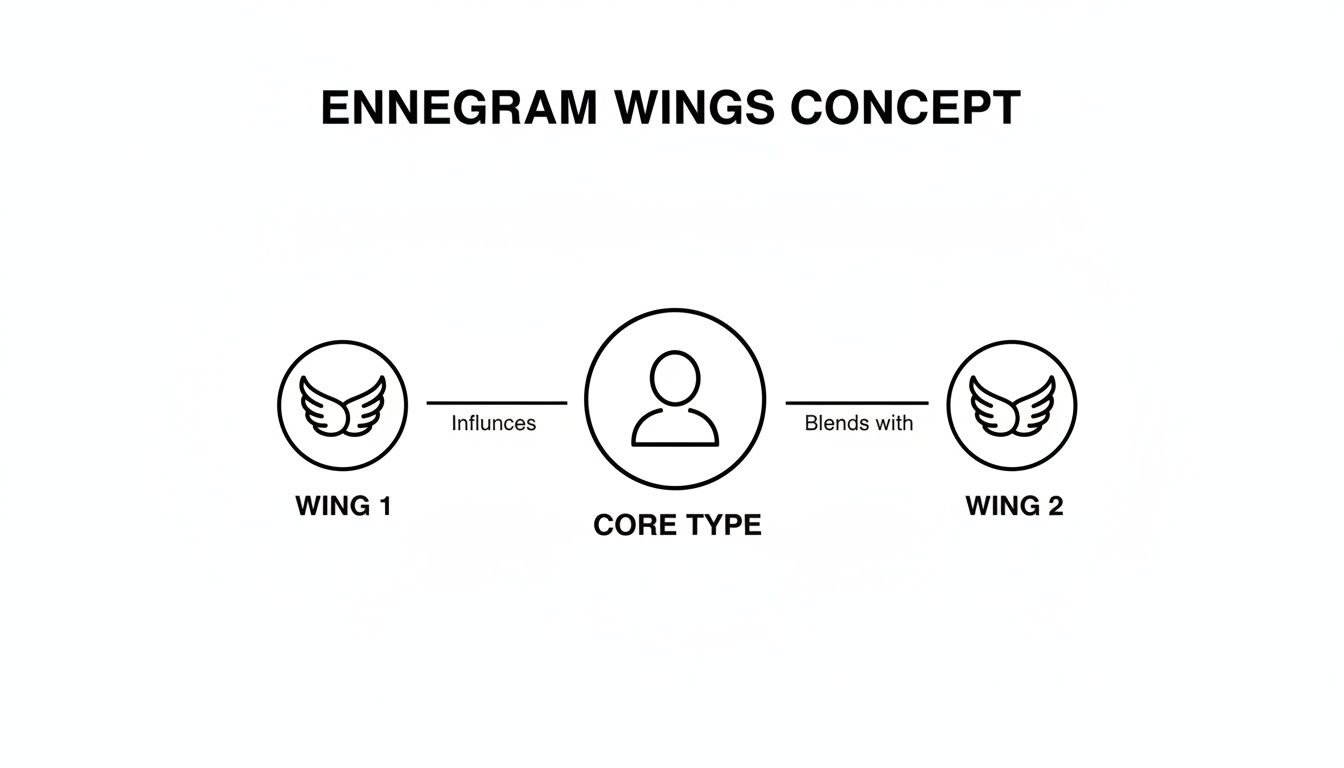
This is a huge reason why two people with the same core type can seem so different. A Type Two with a Three wing (2w3) will be more ambitious and tuned into their image, while a Two with a One wing (2w1) will be more principled and dutiful in their desire to help. Curious how this plays out for you? You can get the full scoop by reading our detailed guide on Enneagram wings .
The Three Instinctual Variants
If your core type is what drives you, your Instinctual Variant is the arena where that drive plays out. We all have three primal instincts hardwired into us—Self-Preservation, Social, and One-to-One—but one of them tends to call the shots, dictating where we focus our energy to feel secure.
• Self-Preservation (SP): • This is all about physical safety, comfort, and having enough resources. The internal monologue for an SP-dominant person is constantly asking, "Am I okay? Do I have what I need to survive and be comfortable?"
• Social (SO): • This instinct is tuned into belonging, community, and knowing where you stand with others. Their focus is on connection and their place in the group, always wondering, "Where do I fit in here?"
• One-to-One (SX): • Often called the Sexual instinct, this one isn't just about romance. It's about seeking intense connection, chemistry, and energetic charge. It’s a constant hunt for depth and impact, asking, "Where's the fire? Where's the real connection?"
Putting It All Together: A Real-World Example
Let's imagine three American coworkers, all Type Twos (The Helper), at the annual office party.
The Self-Preservation Two might show up a little early to make sure the food is set up perfectly and that there are enough comfortable chairs for everyone. Their help is practical and focused on well-being.
The Social Two is the ultimate host, even if they aren't officially in charge. They'll be mingling, making introductions, and making sure the overall group vibe is warm and inclusive.
Meanwhile, the One-to-One Two will likely find that one person standing awkwardly in the corner and spend the entire night locked in a deep, meaningful conversation, forging a powerful one-on-one bond. See? Same core drive, totally different expression.
The Levels of Health
Finally, the Enneagram isn't a static snapshot of who you are. It’s a dynamic map for growth. The Levels of Health show how each type expresses itself when they are thriving (healthy), just getting by (average), or struggling under pressure (unhealthy).
This concept is what turns the Enneagram from a personality quiz into a powerful tool for self-development. A healthy Type Eight, for example, is a generous, protective, and empowering leader. But an unhealthy Eight can become domineering and confrontational, using their strength to control people instead of lifting them up.
Understanding your level of health is recognizing that your personality is not a life sentence. It’s an invitation to move toward your best self by becoming more aware of your automatic patterns and choosing a more conscious path.
By layering Wings, Instincts, and Levels of Health onto your core type, you get a rich, detailed portrait of your inner world. This is where the true power of the Enneagram personality types really comes alive—not in boxing you in, but in showing you the way out.
So, How Do You Find Your Real Enneagram Type?
Alright, this is the fun part—the big reveal! But let's be real, it's also where a lot of people get tripped up. You've probably seen a dozen free Enneagram quizzes pop up on your social media feed, and while they're tempting, most of them are a one-way ticket to Mistype-ville.
Why do they miss the mark so often? Simple. They’re looking at what you do, not why you do it. They’ll ask if you’re organized, but they won’t ask why you organize. Are you alphabetizing your spice rack because you crave a perfect, orderly world (hello, Type 1!), or because you're worried you won't be able to find the paprika when you need it and everything will go wrong (a classic Type 6 thought)? The motivation is everything.
Genuine self-discovery is never about just ticking boxes. It’s an archeological dig into your own soul to find the hidden drivers behind your everyday choices. It’s about figuring out what makes you you . Taking some time to discover your natural strengths can be a great starting point for this kind of introspection.
Forget the Simplistic Quizzes
A truly reliable Enneagram assessment won't ask you surface-level questions like "Are you a leader?" Instead, it will put you in situations that poke at your deepest fears and desires. That's the only way to get a clear, honest snapshot of what's really going on inside.
A scientifically validated test, like the Enneagram Universe assessment, is designed to do just that. It's built to zero in on those core motivations. The goal isn't to slap a number on you and call it a day. It's to hand you a rich, personalized report that sheds light on your Type, Wing, Triad, and even where you are on the Levels of Health.
Your Enneagram type isn’t about what you do; it’s about the why behind what you do. Grasping this is the single most important key to unlocking your true type.
Think of a good assessment as your official invitation to a much deeper journey. It gives you a trustworthy map and a reliable compass, setting you up to use the Enneagram for what it was meant for: real personal growth, stronger relationships, and a much kinder, more honest relationship with yourself.
Putting Your Enneagram to Work in the Real World
So, you’ve figured out your Enneagram type. Awesome. It’s like someone finally handed you the owner's manual for your own brain. But here's the thing: that manual doesn't do you any good just sitting on the shelf. The real magic kicks in when you stop just knowing your type and start using that knowledge to make real changes in your life, your relationships, and your career.
This isn’t just a fun personality quiz; it’s a practical roadmap. Once you see your own patterns—the good, the bad, and the ugly—you can finally catch yourself before you go on autopilot. You get a split-second choice to do something different, something healthier, instead of tripping into the same old emotional potholes.
Growing Into Yourself, Not Out of Yourself
Every Enneagram type has its own unique path to growth. It's not about becoming a totally different person, but about stretching the personality you already have. It often means doing the exact opposite of what feels easy and comfortable, moving away from your core fear and leaning into what you truly desire.
• For a Type 2, the Helper: • Growth looks like learning to say "no" and not feeling like the world will end. A practical first step? Before you automatically say "yes!" to a request, just pause. Ask yourself: "Do I actually have the bandwidth for this? Do I even • want • to do this?"
• For a Type 5, the Investigator: • The challenge is to get out of your head and into the world. Instead of endlessly analyzing an idea, try sharing just one thought in the next meeting. Trust that you already know enough to contribute something valuable.
• For a Type 9, the Peacemaker: • Growth is all about waking up to what • you • want. A simple but powerful practice is to be the one to choose the restaurant or the movie for a change, even if it feels a little awkward to state a preference.
Finally Understanding Why People Do What They Do
When it comes to relationships, the Enneagram is an absolute game-changer. It’s a masterclass in empathy. Suddenly, you realize that your partner's most frustrating habit probably isn't a personal attack designed to drive you insane. It's just their type's strategy for navigating the world, driven by a motivation you can now understand.
Understanding is the first step to acceptance, and acceptance is the condition for growth. Your Enneagram personality isn’t an excuse for bad behavior, but it’s a powerful explanation that fosters compassion and better communication.
Think about a classic American couple: a security-seeking Type 6 husband and his spontaneous, fun-loving Type 7 wife. Their fights over vacation planning used to be epic. But once they see the Enneagram at play, it clicks. He isn't trying to be a buzzkill; he just needs a detailed itinerary to feel safe and relax. She isn't trying to be chaotic; she just needs a little wiggle room for adventure to feel alive. Now, they can build a trip that works for both of them—a solid plan with a few "let's see what happens" days baked in.
Building Teams That Actually Work Well Together
These insights are pure gold in the workplace. A manager who gets the Enneagram can assemble a team where people aren't just punching the clock, but are genuinely thriving. They know to give the final report to the detail-obsessed Type 1 for proofreading, and to put the bold, big-picture Type 8 in charge of that ambitious new project.
It creates a culture where people feel seen for who they are and are put in positions where their natural talents can shine. And when that happens, everyone does better work.
Ready to get your own user manual? The Enneagram Universe assessment is the best first step you can take. It’s more than just a quiz; it’s a validated, in-depth look at your personality that gives you the specific insights you need to start growing. Begin your journey of self-discovery today .