Enneagram 8 In Stress: From Fury to Focus

You walk into a meeting ready to handle things. Then someone shifts blame, questions your judgment, or starts micromanaging your work. Ten minutes later, you're still standing tall on the outside, but inside, something has changed.
You don't feel powerful. You feel cornered.
If you're an Enneagram 8 in stress , that shift can be confusing. You're used to moving toward problems, not shrinking back from them. Yet under enough pressure, many Eights stop trusting people, pull away, start gathering information in private, and act like they can only rely on themselves.
That doesn't mean you're broken. It means your stress pattern has kicked in. The Enneagram becomes useful here, not as a label, but as a map. If you're a Type 8, or you love, coach, or work with one, understanding this map can turn a messy stress spiral into something much more manageable.
The Unraveling of the Confident Challenger
Anne had a reputation for being the one who could handle chaos. Tight deadline. Political infighting. Public pressure. Fine. Give her the problem and get out of the way.
Then a rough stretch hit. People second-guessed her decisions. A few teammates stopped being direct and started whispering. One person tried to make her look like the problem instead of the pressure itself.
She didn't fall apart in a dramatic way. She hardened.

She stopped sharing what she was thinking. She stayed up late researching people, motives, risks, and backup plans. She answered simple questions like they were traps. The same woman who usually took up space with confidence started acting like she had to protect the control room from an invisible breach.
From the outside, it looked like anger. Inside, it felt more like siege. That experience is common for an enneagram 8 in stress. Eights are often described as forceful, decisive, and protective. But the hidden part of the story is how jarring stress feels to them when their normal strength stops working the way it usually does.
When stress doesn't look like weakness
Many Eights assume stress should look obvious. Crying. Panicking. Falling apart.
Often it doesn't.
It can look like this:
• More intensity: • louder opinions, sharper reactions, less patience
• Less trust: • reading hidden motives into ordinary interactions
• Private overdrive: • researching, preparing, and planning in secret
• Emotional lockdown: • refusing help because help feels like exposure
That last one throws people off. Especially the Eight.
The strange feeling of becoming someone else
One reason Type 8 stress feels so unsettling is that it doesn't just make the Eight "more Eight-ish." It often pushes them into a different style altogether. The person who normally acts fast may suddenly hesitate. The person who values strength may become preoccupied with threats. The person who hates being controlled may build such high walls that nobody can get close enough to help.
That's not random. It's a pattern. And once you can spot it, you can interrupt it sooner.
The Fortress Under Siege: Why Eights Retreat to Five
The cleanest way to understand this shift is to picture an Eight as a fortress commander.
On a good day, the commander is out on the wall, scanning the horizon, making fast calls, protecting the people inside, and meeting danger head-on. That's classic Eight energy. Active. bold. embodied.
When stress hits hard enough, the commander doesn't stop caring about safety. They just change strategy.
They seal the gates and disappear into the map room.
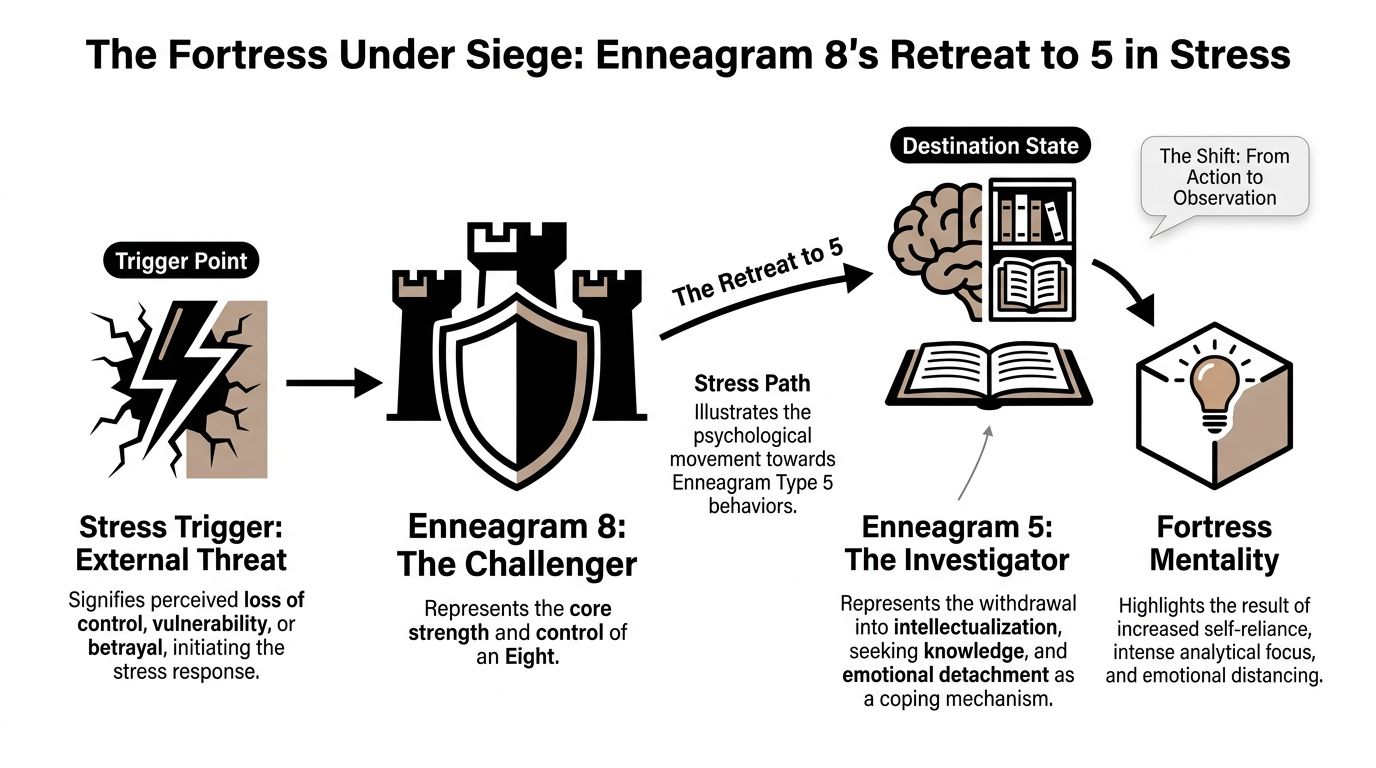
From direct action to guarded observation
In the Enneagram model, Type 8 disintegrates under stress toward Type 5 . The pattern follows the fixed sequence 1-4-2-8-5-7-1 , and the shift shows up as a move from bold assertiveness into secretive withdrawal, according to the Enneagram Institute's explanation of how the Enneagram system works .
That same source notes that Type 8s make up 6.9% of the population , which makes this a minority pattern, but one with an outsized impact in teams, families, and leadership settings. It also describes how stress can push Eights from Level 5's domineering swagger toward Level 7's ruthless dictatorialism and Level 8's delusional megalomania .
That language is intense, but the logic is simple. The Eight feels threat. Threat triggers protection. Protection becomes overcontrol. Overcontrol becomes isolation.
The Gut Triad leaves the room
At their center, Eights are gut people. They trust instinct, momentum, and force. They like to feel where they stand and act from there.
Under strain, they can flip into a more head-based style. Instead of "I'll deal with it," the inner script becomes:
• What are they really doing?
• What am I missing?
• Who can I trust?
• How do I stay three steps ahead?
At this point, an Eight starts to resemble an unhealthy Five: more removed, more private, more cerebral, less relational.
If you want to understand that destination state better, this page on Enneagram Type 5 The Investigator , gives a useful contrast.
Why this matters for self-compassion
A lot of Eights shame themselves at this stage. They think, "Why am I acting paranoid?" or "Why can't I just handle this?"
That reaction usually makes the spiral worse.
A better interpretation is this. Your system believes the battlefield is no longer safe. So it orders a retreat, gathers resources, and limits exposure. It's a protective maneuver. An expensive one, but still protective.
Once that clicks, the goal changes. You're not trying to bully yourself back into normal. You're learning how to tell the nervous system that the fortress doesn't need to stay sealed forever.
Decoding the Distress Signals for Enneagram Type 8
Some stress signs are loud. Others are sneaky.
With Type 8, the early signs often look socially acceptable at first. More drive. Less patience. Stronger opinions. Longer work hours. Nobody panics when an Eight gets intense because intensity is part of the usual package.
The issue is direction.
Under prolonged stress, Enneagram 8s can move from confident leadership into unhealthy Type 5 traits like isolation, paranoia, and desperate control grabs , with unhealthy Level 7 described as ruthless, violent renegades and Level 8 as omnipotent delusions , as outlined in this Type 8 stress overview . That same source notes this pattern in the 6.3% to 6.9% of the population identified as Type 8.
Early signals people miss
At first, the Eight often looks productive rather than distressed.
You might notice:
• Argument as armor: • They debate harder, not because the topic matters that much, but because backing down feels dangerous.
• Hyper-independence: • They stop delegating and decide nobody else can be trusted to do it right.
• Private fact-finding: • They start collecting information on people, timelines, and possible threats.
• Reduced warmth: • Their protective side vanishes first. Their combative side stays visible.
A partner might ask, "Are you okay?" and get a clipped "I'm fine." A coworker might offer help and get treated like an obstacle.
The middle of the spiral
The next phase usually involves both anger and distance.
The Eight may still confront people directly, but now the confrontation has a different flavor. It isn't clean or clear. It feels loaded. Suspicious. Preemptive.
Common examples include snapping at a loved one for a harmless question, assuming a colleague is trying to undermine them, or treating neutral feedback like an attack.
Many Eights start cutting off access at this phase, not always physically, but often emotionally.
Enneagram 8 Stress Levels At a Glance
| Stress Level | Internal State | Observable Behavior |
|---|---|---|
| Early stress | Irritated, overactivated, determined to regain control | Talks over others, pushes harder, works longer, dismisses softer emotions |
| Moderate stress | Guarded, distrustful, mentally preoccupied | Secretive planning, sharp sarcasm, less collaboration, pulling away from support |
| Heavy stress | Cornered, suspicious, emotionally isolated | Accusations, loyalty tests, shutting people out, overcontrolling decisions |
| Severe unhealthy stress | Fearful but armored, power-focused, disconnected from reality checks | Ruthless reactions, extreme domination, reckless overreach, relational destruction |
What allies often notice first
The Eight usually notices stress late. Other people often catch it sooner.
They may say things like:
• "You're not telling me what you're really thinking."
• "Everything feels like a test lately."
• "You used to be direct. Now you're distant."
• "You're fighting everyone, even the people on your side."
None of those comments feels good to hear. But they're often accurate.
If an Eight wants a sharper language for unhealthy patterns, this page on Enneatype 8 unhealthy results can be a useful mirror.
A plain-language test
Ask four questions:
If the answer is yes to several of these, you're probably not just tired. You're in a stress pattern that needs intervention.
The Pressure Points Common Triggers for an Enneagram 8
Type 8 stress rarely starts with "too much to do." It usually starts with a felt threat.
Not just workload. Threat.

According to this video analysis of Enneagram Type 8 stress triggers , stress spikes when Eights perceive control threats , such as a team shifting blame, or vulnerability risks , which can lead to preemptive rejection of others. It also notes that this response shifts them from the Gut Triad toward the Head Triad and can reduce social engagement by up to 90% as they retreat into isolation.
Work triggers
Mark runs a team. He can handle disagreement. He can't stand passive blame.
A project fails, and instead of owning their part, two coworkers subtly frame him as the reason. Mark goes cold. He stops brainstorming out loud, starts documenting every interaction, and mentally moves everyone into one of two categories. Useful or dangerous.
For an Eight, blame-shifting feels like a warning shot.
Other common work triggers include:
• Micromanagement: • especially from someone they don't respect
• Power games: • hidden agendas, vague communication, political maneuvering
• Blocked autonomy: • being told how to do something they already know how to do
• Public undermining: • being corrected or challenged in a way that feels performative
Relationship triggers
Jasmine doesn't mind conflict. She prefers clean conflict to weird silence.
But when her partner says, "I never know if you're really with me," she hears something more profound. You are not safe to trust. You will be rejected soon. Before her partner can say more, Jasmine shuts down, gets sharp, and pulls away for two days.
To an Eight, vulnerability can feel less like softness and more like exposure.
That means relationship stress often flares around:
• Perceived betrayal
• Questioned loyalty
• Feeling emotionally cornered
• Being handled instead of spoken to directly
The hidden trigger beneath all the others
Most surface triggers connect to one core fear. Being controlled or harmed by other people.
That's why an Eight can look "overreactive" to situations that don't seem severe to others. The nervous system isn't responding only to the moment. It's responding to what the moment represents.
A Practical Toolkit for the Stressed Challenger
Most writing about Type 8 stress stops at description. It says Eights withdraw, get suspicious, and need to become more vulnerable.
That's true. It's also not enough.
A stressed Eight usually needs tools that work through the body , not just the intellect. Practitioner insights note that many descriptions of Type 8 focus on the retreat to Five but leave out practical somatic and relational recovery tools, even though the body-based Eight often experiences stress as physical tension and needs trusted support to prevent isolation, as discussed on the Enneagram Institute Type 8 page .

Start with the body, not the story
When an Eight is flooded, asking them to "talk about feelings" too early can backfire. Their body is already braced for impact.
Try this sequence instead:
• Scan for armor: • jaw, shoulders, chest, fists, stomach
• Lower physical intensity: • unclench hands, drop shoulders, put both feet on the floor
• Add movement: • brisk walk, stretching, push against a wall, slow exhale after exertion
• Name only one sensation: • "My chest is tight" is enough
This sounds small. It isn't. A body-based personality often regains access to wisdom through sensation first.
Redefine power
Under stress, Eights often define power as control. Control the room. Control the outcome. Control the exposure.
A healthier definition is better. Power is the ability to stay present without becoming hard.
Try replacing these scripts:
| Old script | Stronger script |
|---|---|
| "I need to handle this alone." | "I can choose support without giving up authority." |
| "If I soften, I lose." | "Regulation gives me more range, not less." |
| "I need answers before I trust anyone." | "I can ask one direct question instead of building a private case." |
A resource that can help with this shift is how to stop being defensive , especially when stress has turned every interaction into a courtroom.
Practice strategic vulnerability
Eights often hear "be vulnerable" as "spill your guts to unreliable people."
No wonder they resist it.
A better approach is strategic vulnerability . Small. chosen. direct.
Try this progression:
That format gives the Eight structure. Structure lowers the threat.
For some people, a calming ritual also helps create enough mental space to do this well. If focus gets scattered under stress, this overview of l-theanine and caffeine for sharper focus may be a useful read alongside other self-regulation practices.
Borrow a ritual, not a personality transplant
An Eight doesn't need to become a different person to recover. They need repeatable practices that fit their wiring.
A few that tend to work:
• Decision delay: • wait before sending the scorching text or making the irreversible call
• Private decompression: • ten quiet minutes alone before re-entering a tense conversation
• Mentor mode: • help someone else solve a problem without dominating them
• Honest exertion: • lift, walk, clean, build, or move your body on purpose
This short practice can support that reset:
Move toward Two without becoming mushy
Growth for Eight points toward Type 2. That doesn't mean becoming sentimental. It means becoming more open-hearted, receptive, and relationally generous.
Useful exercises:
• Offer help without control: • support someone without taking over
• Say one caring thing out loud: • especially when your instinct is to keep it hidden
• Let someone support you in a practical way: • a ride, a meal, a second set of eyes
• Use one relational sentence a day: • "I appreciate you," "That hurt," or "I need backup"
One practical option for structured self-observation is Enneagram Universe, which offers a 180-question assessment focused on type, wings, triads, and health levels. For an Eight, that kind of framework can help separate "This is who I am" from "This is what stress is doing to me."
How to Support an Enneagram 8 Without Getting Burned
Supporting a stressed Eight is tricky because they often need connection and resist it at the same time. If you come in too soft, they may dismiss you. If you come in too controlling, they'll push back harder. If you come in vague, they'll assume you aren't trustworthy. The sweet spot is direct, calm, and non-intrusive.
What helps?
An Eight in stress usually responds best to people who are steady and clear.
Useful phrases include:
• "I can see you're under pressure."
• "I'm on your side, and I'm going to be direct."
• "Do you want input, backup, or just space right now?"
• "You don't have to do this alone, but you do get to choose how I help."
Those statements do two important things. They respect autonomy and reduce guesswork.
What backfires?
These phrases tend to go badly:
• "Calm down."
• "You're being too much."
• "Why are you making everything a fight?"
• "You just need to trust people."
All of them increase shame or pressure. Neither helps.
Do this, not that
| Do this | Not that |
|---|---|
| Be concise and direct | Ramble, hint, or circle the point |
| Offer choices | Issue commands |
| Name observable behavior | Diagnose their motives |
| Stay calm under heat | Match their intensity |
| Follow through | Promise support and disappear |
Space versus contact
Allies often get confused at this point: Should you give a stressed Eight room, or should you lean in?
Usually both, in sequence.
Give them enough room to de-escalate. Then return with a clear, low-pressure invitation. Something like, "I'm around later if you want to talk straight about what happened."
That works better than repeated emotional poking.
For partners, coaches, and teams
A stressed Eight often tests whether people are solid. Not always on purpose. Sometimes by being blunt. Sometimes by going quiet. Sometimes by acting like they don't care whether anyone stays.
Don't make the test bigger by becoming slippery.
If you're working through repeated conflict, shared language helps. Compatibility reports and type-based discussions can make it easier to separate intent from impact and turn "You're impossible" into "We're triggering each other's defenses."
The best support doesn't try to overpower the Eight. It helps them feel safe enough to put the armor down voluntarily.
Building Lasting Resilience and Healthy Power
The 8 to 5 stress move isn't a character flaw. It's a warning light.
It tells you that your system has moved from strength into self-protection, and from presence into siege mode. That's useful information. Not pleasant, but useful.
A resilient Eight learns to catch the pattern earlier. Notice the body tightening. Notice the private suspicion. Notice the urge to shut the gates and run the whole battle alone. Then interrupt it with regulation, honest support, and deliberate softness that still honors strength.
Healthy power isn't intimidation. It isn't isolation either.
It's force with self-awareness. Boundaries with warmth. Assertiveness without unnecessary damage. If that distinction is something you want to think about more, this piece on Teaching Assertiveness Vs Aggressiveness offers a useful lens.
An Eight at their best doesn't lose intensity. They gain range.
They can act when action is needed, pause when pausing is wiser, and let trusted people stand with them instead of against a wall they've built in panic. That's not less powerful. That's more.
If you want to understand your own patterns more clearly, take the free assessment at Enneagram Universe . It can help you identify your type, health patterns, and the specific stress dynamics that shape how you lead, relate, and recover.