When “Helpers” Get Hostile: Your Guide to Enneagram 2 in Stress

Ever seen the most caring, selfless person you know suddenly flip a switch and become... well, a little terrifying? If you've ever watched your favorite Type 2 go from warm and fuzzy to sharp and prickly, you know exactly what I'm talking about. It can be jarring for everyone involved.
When Helpers get hostile, it’s a shock to the system. But this isn't a random personality transplant. For the typically generous Enneagram Type 2 , this shift is a desperate flare sent up from a depleted soul, signaling that they've given until there's absolutely nothing left.
The Helper's Hostile Shift Explained
So, what's really going on here? The Enneagram calls this movement "disintegration," and for our beloved Twos, stress means taking an unconscious trip over to the neighborhood of the Type 8 Challenger. It’s an automatic, protective reaction when they feel completely overwhelmed and unappreciated.
Think of it like this: Imagine a kind-hearted gardener, let's call him Frank from Ohio, who pours his entire being into a magnificent rose garden. He does it for the joy of sharing its beauty with everyone in his neighborhood. But then, people start taking it for granted. They trample the flowers, let their dogs wander through, and never once say thank you.
After a while, Frank's open heart begins to ache. Hurt and resentment build until one day, he builds a massive, thorny fence around the entire garden. The fence isn't there to be mean—it's a defense mechanism, a desperate attempt to protect what's left of his beautiful creation. This is the perfect picture of an Enneagram 2 in stress .

From Giving to Grumbling
This transformation from Giver to Grievance-Collector doesn't happen overnight. It starts with a tiny, bitter seed of resentment.
A healthy Two finds genuine delight in meeting the needs of others. But when that giving is consistently met with entitlement or, worse, complete indifference, they start keeping a mental tally. Their inner voice shifts from a cheerful "How can I help you?" to a muttered, "Don't they even see everything I do for them?"
Practical Example: Consider Brenda, a Type 2 mom in Texas. She lovingly packs gourmet lunches for her teenage son every day, complete with a handwritten note. For weeks, the lunchbox comes back untouched, and her son just shrugs when she asks. The first few times, she's just sad. But after a while, a quiet resentment builds. She starts muttering under her breath while packing his lunch, her loving gestures now tinged with a feeling of being completely unseen.
This secret score-keeping is a massive red flag. When a Two feels their endless river of generosity is flowing into a desert, never to be returned or even acknowledged, their helpful nature sours into a deep sense of injustice.
Type 2 Stress Shift At a Glance
The table below breaks down the stark contrast between a Two's usual warm-hearted approach and how they show up when they've moved toward Type 8 in a state of stress.
| Characteristic | Healthy Type 2 (The Helper) | Stressed Type 2 (Moving to Type 8) |
|---|---|---|
| Primary Focus | Others' needs and feelings | Their own unacknowledged needs |
| Communication | Supportive, encouraging, flattering | Demanding, confrontational, accusatory |
| Behavior | Generous, giving, self-sacrificing | Controlling, possessive, manipulative |
| Emotional State | Empathetic, warm, loving | Angry, resentful, cynical |
| View of Self | "I am helpful and loving." | "I am unappreciated and used." |
| Core Drive | To be loved and wanted | To protect themselves and demand what's "owed" |
Seeing the behaviors laid out like this really highlights just how dramatic the change can be. The once-selfless giver feels forced to adopt the tactics of a score-keeping accuser.
Their core fear—of being unwanted or unloved—goes into overdrive. In a last-ditch effort to get the love and appreciation they crave, they unconsciously put on the assertive, commanding armor of an unhealthy Type 8. It's a cry for help, disguised as a declaration of war. Recognizing this is the first step to helping a stressed Two (or yourself!) find the way back to their true, loving nature.
Why Stress Turns Helpers Into Challengers
So, what on earth is going on when your sweet, ever-helpful Type 2 friend suddenly goes on the warpath? It’s jarring, to say the least. But this isn't just a random mood swing; it's a profound, hard-wired survival response kicking into gear. This dramatic shift from the gentle Helper to the demanding Challenger is what the Enneagram calls moving in the "direction of disintegration," or more simply, following a stress arrow.
Picture a healthy, happy Enneagram 2 as having a fully charged smartphone battery at 100% . They're full of energy, generously running everyone else’s apps—offering a listening ear, organizing get-togethers, and sending supportive texts without a second thought. It's what they do best.
But all that giving drains the battery, especially when there’s no "charging" coming back in the form of genuine appreciation or returned effort. When a Two feels their constant giving is being ignored or taken for granted, their energy starts to plummet.
When that battery finally hits a critical low—we're talking 5% territory—the phone freaks out. It goes into an aggressive "low power mode," shutting down all non-essential kindness, stops offering to help, and starts loudly, angrily demanding a charger. That, right there, is the Enneagram 2 in stress . It's an unconscious, desperate lunge toward the commanding, take-charge energy of a Type 8 Challenger.
The Emotional Journey From Giving To Demanding
This transformation doesn't happen overnight. It follows a painful, simmering path that starts with over-giving and slowly curdles into resentment. A healthy Two’s actions spring from a real, genuine desire to connect with people and feel loved in return. But when they feel like they’re the only one putting in the effort, their whole internal story starts to change.
Every Enneagram type is driven by a deep inner need. You can dive deeper into these in our guide to Enneagram core motivations . For our Twos, that core need is to be needed.
When that fundamental need isn't met, all their helpful gestures start to feel less like gifts and more like unacknowledged debts. Their internal logic shifts to, "I've done all of this for you, so you owe me love and appreciation." When that payment doesn't show up, they switch gears and decide it’s time to collect.
Why The Type 8 Armor Fits
The move to Type 8 isn’t a random choice. Type 8s are defined by their powerful drive to control their own lives, protect themselves, and resist being controlled. For a stressed-out Type 2 who feels utterly powerless and invisible, adopting the assertive, no-nonsense stance of an 8 feels like the only way to get back in the driver's seat.
• Taking Charge: • Where they were once accommodating and flexible, they suddenly become domineering, trying to force the situation to • finally • get their needs met.
• Direct Confrontation: • The gentle hints and people-pleasing vanish, replaced by blunt, often accusatory statements that can completely blindside the people around them.
• Building Walls: • Instead of trying to pull people closer, they start pushing them away. It’s a self-protective move to shield their wounded heart from any more hurt.
Practical Example: Let's talk about Mark, a classic Type 2 dad from Colorado. He spends his entire Saturday chauffeuring his kids to soccer and baseball, then pops over to help his neighbor fix a leaky faucet, all while missing the Broncos game he really wanted to watch. When he finally walks in the door, exhausted, nobody even looks up to say thanks. Later that night, his wife asks him to help with one more small chore, and he just blows up: "Doesn't anyone see I do everything around here? From now on, you're all on your own!"
That volcanic eruption isn't who Mark really is. It’s his completely drained system borrowing the loud, controlling tactics of a Type 8 in a last-ditch effort to demand the appreciation he feels he has more than earned. This isn't about him becoming a different person; it's a survival instinct kicking into overdrive.
Spotting the Red Flags of a Stressed Type 2

So, how can you tell when the endlessly giving Type 2 in your life is about to pop? The shift from the warm, nurturing Helper to the demanding, controlling Challenger isn't like flipping a switch. It's more like a slow burn. Learning to spot the early signs of an Enneagram 2 in stress can be the difference between a minor course correction and a full-blown emotional meltdown.
Think of it like a storm brewing on the horizon. At first, there are just a few dark clouds, but if you know what to look for, you can tell things are about to get turbulent. These red flags are really just desperate pleas for acknowledgment, often disguised as passive aggression and a simmering resentment. Spotting them early is your key to offering support before the dam finally breaks.
The Most Common Triggers
For a Type 2, certain situations are emotional kryptonite. They are wired to be hyper-attuned to the needs of others, and a lack of positive feedback can feel less like an oversight and more like a personal attack on their very worth. These are the sparks that will almost always ignite their stress response.
• Feeling Taken for Granted: • This is the big one. Numero uno. A Two pours their heart and soul into relationships, so when their efforts are met with a shrug of indifference, it feels like a profound, personal rejection.
• Having Their Advice Ignored: • They don't offer guidance to be bossy; they do it because they genuinely want to see you thrive. When their thoughtful advice gets dismissed, the message they hear is that their perspective—and by extension, • they • —aren't valued.
• Their Sacrifices Going Unnoticed: • Did they cancel their own plans to help you move? Stay up half the night baking for the office potluck? If these acts of service aren't even mentioned, it pokes at their deepest fear: that they are ultimately unimportant and unloved.
This mounting frustration is especially visible at work. Recent multilingual data from over 200,000 Enneagram Universe assessments shows that stressed Twos in leadership roles are involved in 33% more conflict incidents . This is what happens when their martyr-like giving curdles into aggressive demands for appreciation, a trend that's spiked by 25% since the shift to remote work in 2024.
Escalating Behaviors from Subtle to Overt
As a Two’s stress builds, their behavior follows a predictable, escalating path. What starts as quiet, subtle discontent can quickly morph into overt hostility and a need for control. It’s a sad progression from a quiet, wounded look to a loud, pointed accusation.
If you're a Two and this sounds painfully familiar, taking a moment to check in with yourself is a powerful first step. Using a tool like a burnout calculator can give you some real data on where you stand.
Here are a couple of real-world examples of how this escalation plays out:
Scenario 1: Sarah, the Project Manager Sarah, a classic Type 2 manager from New York, pulls an all-nighter over the weekend to perfect a presentation, making sure every team member's contribution is highlighted beautifully. Monday morning, her team barely gives it a glance before jumping into their own to-do lists without a single word of thanks.
• Initial Sign (Bill-Keeping): • Sarah starts dropping passive-aggressive bombs in the team chat. "Hope everyone had a nice, relaxing weekend. Some of us were working hard to make sure • we • all look good."
• Escalation (Micromanagement): • She then starts hovering, questioning every tiny decision and demanding constant updates. This is a clear move into the controlling side of Type 8, an attempt to force the acknowledgment she feels she's owed.
Scenario 2: David, the Dad David, a devoted Type 2 dad from Florida, spends months planning the "perfect" Disney World vacation for his family. He crafts a minute-by-minute itinerary with everyone’s favorite rides and restaurants. When they finally get there, his kids are way more excited about the hotel pool than his color-coded schedule.
• Initial Sign (Guilt-Inducing Comments): • David lets out a dramatic, heavy sigh. "I guess it doesn't matter how much planning I did," he says to no one in particular. "Just do whatever you want."
• Escalation (Playing the Martyr): • Later, he erupts. "Fine! I do all of this for you people, and nobody even cares! This whole trip was a complete waste of my time!"
In both scenarios, the loving, helpful person transforms into a wounded, angry accuser. Recognizing these patterns is the first step toward a healthier response. If you want to dive deeper, you can learn more about the behaviors of an unhealthy Type 2 in our detailed guide .
The Fallout of a Helper's Burnout
When an Enneagram 2 hits their breaking point, it’s rarely a quiet, dignified affair. The dramatic shift from the selfless, nurturing Helper to the demanding, confrontational Challenger sends emotional shockwaves through every corner of their life. Their generosity, once a source of warmth and connection, can suddenly feel like a weapon.
The fallout of an enneagram 2 in stress is no small thing. Their entire world, carefully constructed to create harmony and earn love through giving, becomes a battleground. They feel forced to fight for the appreciation they so desperately crave, leaving a trail of broken trust and strained relationships in their wake.
At Home: The Relationship Fallout
Nowhere does this shift cut deeper than in their closest personal relationships. A partner who once marveled at the Two's seemingly endless well of generosity now finds themselves constantly on the defensive, feeling like nothing they do is ever enough. Suddenly, every helpful act comes with invisible strings attached, and the stressed Two isn't afraid to point out when they feel the debt hasn't been paid.
This creates a tense, almost transactional dynamic where love and support are no longer given freely but are tallied on a secret scoreboard only the Two can see. The home, once a sanctuary, becomes thick with unspoken accusations, guilt trips, and the feeling that everyone is walking on eggshells.
Let's see what this looks like in the real world.
A Tale of Two Partners: Maria and Tom
Maria (a Type 2) and Tom live in Chicago. For years, one of the things Tom loved most about Maria was how she seemed to anticipate his every need—his favorite dinner waiting after a long day, his coffee brewed just right in the morning. But lately, Maria's been under a mountain of stress, feeling taken for granted at work and at home.
The entire dynamic has soured. Last week, Tom came home completely drained and forgot to comment on how nice the house looked. Instead of her usual warmth, Maria met him with an icy stare. "I spent all afternoon cleaning this place for you, and you don't even notice," she said, her voice dripping with resentment. The fight that erupted lasted for hours. Maria recited a laundry list of every single thing she'd done for him that month, making Tom feel less like a beloved partner and more like a defendant on trial. This constant score-keeping is pushing him away, carving an emotional chasm where intimacy used to live.
At Work: The Professional Fallout
It's a similar story at work, where the consequences can be just as severe. When a Type 2 manager, team lead, or even just the go-to helpful colleague hits their stress point, the whole team culture can turn toxic. What was once a collaborative, supportive environment can quickly fill with anxiety and resentment.
This is especially dangerous in people-first fields like nursing, teaching, or human resources. Professionals in these roles are expected to be empathetic and giving, which makes them prime candidates for burnout when they feel their efforts go unnoticed or unreciprocated. In fact, global workplace data from over 150,000 assessments showed that stressed Twos in HR and therapy roles suffered 28% higher burnout rates than average. This was directly tied to the crushing weight of their own unmet giving expectations. You can learn more by exploring the full research about these findings .
Once these stressed Twos can no longer give from a genuine place of care, their behavior often curdles into passive-aggression or outright control. This might look like:
• "Forgetting" to pass on crucial information to a colleague who they feel slighted them.
• Dropping sarcastic comments in meetings about how "some people" aren't pulling their weight.
• Suddenly micromanaging projects they previously delegated with complete trust.
These actions don't just hurt feelings; they erode morale, kill productivity, and show just how high the stakes are when a Type 2's stress signals are ignored. To head this off, it's vital to implement solid burnout prevention strategies for the Two and for the health of the entire organization.
Getting a Grip: Real-World Moves for the Stressed Helper
Okay, so you’ve figured it out. You see the warning signs of your own stress-arrow to Type 8 flashing bright red. That’s a huge first step! But knowing isn't the same as doing. Now it’s time to get our hands dirty and actually do something about it.
Let's skip the fluffy, useless advice like "just take a bubble bath." We're talking about real, practical strategies that help you, the Helper, redirect all that incredible energy away from resentment and back toward your own well-being.
The fascinating thing about the move to Type 8 is that it’s not all bad. When a Two gets stressed, it can feel like a hostile takeover by your inner bully. But what if you could just borrow the good parts of the Eight? Instead of falling into that pit of anger and control, you can tap into the healthy Eight's incredible self-advocacy, decisiveness, and rock-solid boundaries. This isn’t about changing who you are—it’s about using your stress response to reclaim your own power.
Turn That Frustration Into Fuel
The secret is learning to channel the raw, fiery energy of your stress reaction into something productive. When you feel that all-too-familiar wave of resentment starting to build, that's your cue! It's a signal to act—not by snapping at someone you love, but by turning inward and taking care of your own business first.
One of the best ways to do this is to give all that pent-up frustration a physical exit ramp. Instead of letting it simmer until it boils over into a nasty argument, get it out of your body.
• Get Physical: • Seriously. Try boxing, kickboxing, or just a hard, fast run where you leave it all on the pavement. These activities are incredibly cathartic. Imagine literally punching your frustrations into a heavy bag instead of aiming them at your partner or coworker. It works.
This kind of physical release acts like a circuit breaker, burning off the chaotic energy of the 8-stress so you have the mental space to make a better choice.
The Two-Letter Word That Will Save You: "No"
For a Type 2, "no" can feel like the cruelest word in the dictionary. It feels like you're slamming a door in someone's face. But here’s the truth: learning to say it is one of the most loving things you can do for yourself and for the people you care about. A well-placed "no" today prevents the soul-crushing resentment that poisons everything tomorrow.
You don't have to be harsh or cold. You can be firm and still be kind. Try keeping a few of these scripts in your back pocket.
Real-Life Examples:
• When a coworker dumps a last-minute project on you: • "I'd genuinely love to help, but I'm completely swamped and need to protect my energy to get my own work done. Can we look at this first thing in the morning when I'm fresh?"
• When a friend asks for a big favor, you just can't manage: • "I really appreciate you thinking of me for this! But I'm overcommitted right now and have to say no this time. I desperately need to recharge this weekend."
See? These aren't flimsy excuses. They are simple, honest statements that put your well-being on the map. You're not rejecting the person; you're just protecting your own peace.
From Unhealthy Reaction to Healthy Action
When stress hits, the unhealthy 8 behaviors can feel automatic. But with a little practice, you can consciously choose a healthier, more constructive response that honors both your needs and your relationships.
This table shows how to transform those reactive, destructive habits into powerful acts of self-advocacy.
| Unhealthy Stress Behavior (Like Type 8) | Constructive Action (Healthy Self-Advocacy) |
|---|---|
| Explosive anger and blaming others | Physically releasing energy (like a workout) to calm down first |
| Becoming controlling and demanding of others' time | Clearly and kindly stating your own needs and limits |
| Withdrawing affection to punish someone | Expressing your hurt or disappointment directly and calmly |
| Saying a resentful "yes" while fuming inside | Saying a firm but compassionate "no" to protect your energy |
| Keeping a running tally of everything you've done | Focusing on what you need now instead of past grievances |
By consciously choosing the actions in the right-hand column, you start to build a new muscle—the muscle of healthy self-respect. It feels awkward at first, but it gets easier with every rep.
Make a Contract With Yourself
To finally break the exhausting cycle of over-giving, you have to treat your own self-care with the same seriousness as a doctor's appointment. It's time to stop being dependent on others for validation and start generating your own sense of worth from the inside out.
Burnout is the inevitable endgame for a stressed Helper, creating a domino effect that topples both your work and home life.
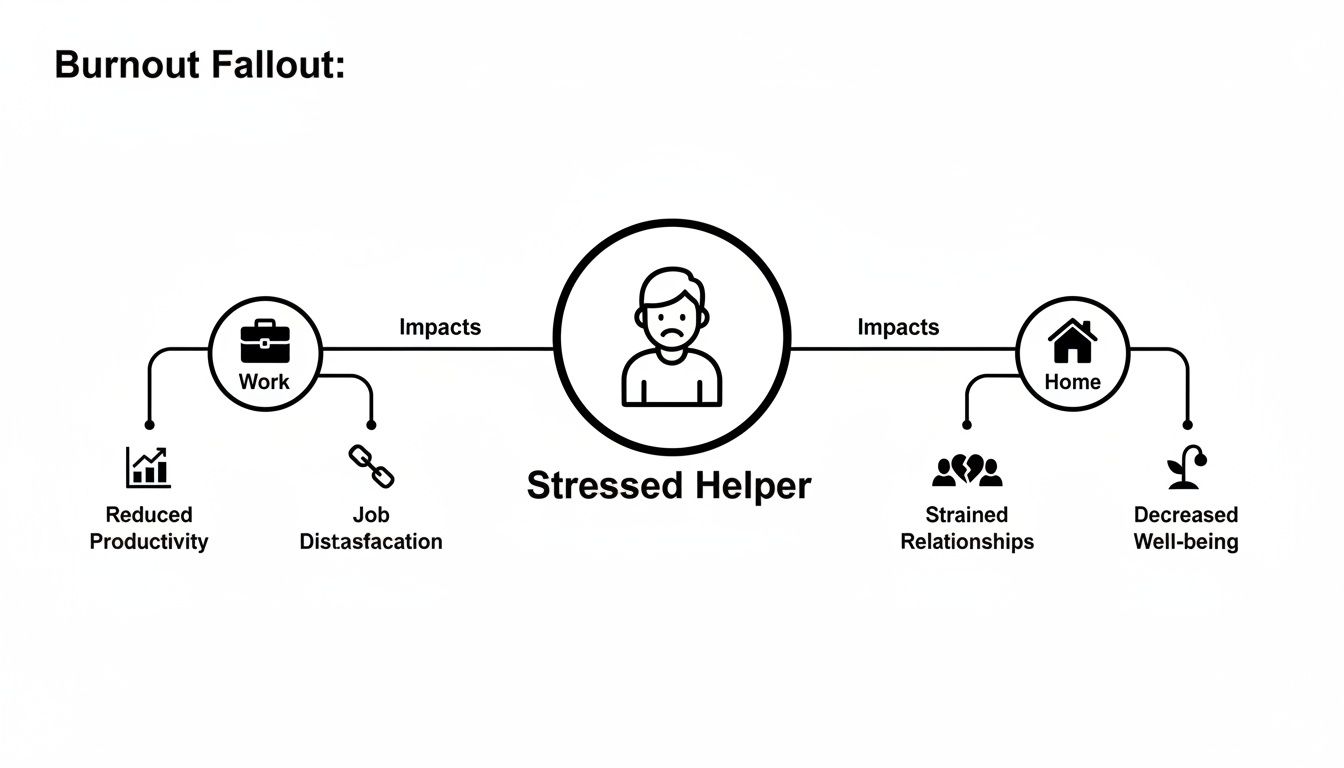
As you can see, this isn't some minor inconvenience. It's a full-blown crisis that requires a structured, proactive plan.
Here are two fantastic tools to build that plan:
To fight that slide into unhealthy 8-ish control, we can channel the Eight’s healthy side by directly expressing our needs and protecting our boundaries. In fact, a 2025 mindfulness trial with 500 Type 2 professionals showed that implementing scheduled solo self-care reduced stress markers by a whopping 25% . You can discover more insights about these stress-reduction findings and see the data for yourself.
By putting these strategies into play, a stressed Type 2 can learn to finally hear their own needs, state them clearly, and take care of themselves. This is how you find your way back to being the truly loving, generous, and balanced person you are—a Helper who is just as good at caring for themselves as they are at caring for everyone else.
Alright, so we've covered the basics of the Helper's shocking stress shift. But let's be real—watching a warm, generous Type Two suddenly morph into a demanding powerhouse can be jarring, to say the least. It’s the kind of personality whiplash that leaves you with a ton of questions.
Let's tackle some of the big ones that are probably still rattling around in your head. We'll clear the air so you can handle this tricky territory with a lot more confidence and a lot less confusion, whether you're the Two in question or you're just trying to keep up with one.
Can a Type 2 Permanently Change Into a Type 8?
Let's get this one out of the way first: absolutely not. An Enneagram 2 will never, ever permanently become a Type 8. Your core Enneagram type is set, like the foundation of your house. You can redecorate, you can even have a chaotic party that makes a huge mess, but you can't pick up the foundation and move it.
This move to Type 8 is a temporary, unconscious defense mechanism. Think of it like a cat that's been startled. One second it's a purring ball of fluff, and the next it’s an arched-back, hissing creature of fury. The cat hasn't become a different animal; it's just reacting instinctively to a perceived threat.
Once the threat is gone and it feels safe again, it goes right back to being a purring fluffball. It's the exact same principle for a stressed Two. When they finally feel seen, appreciated, and loved—or better yet, when they learn to give that to themselves—they settle right back into their true, giving nature.
What Is the Difference Between a Stressed 2 and a True 8?
This is where the real head-scratching begins. On the surface, a stressed-out Two can look, sound, and feel scarily similar to an unhealthy Type 8. They both bring the intensity, the demands, and a controlling vibe. But if you look under the hood, you’ll find their engines are running on completely different fuel.
It’s like two people pounding on a locked door. One is doing it because they think their family is in danger on the other side and they're desperate to get in to save them. The other is doing it because they feel trapped and are desperate to get out to be free. The action is identical, but the motivation is the polar opposite.
Here’s how to tell them apart:
• A Stressed Type 2 • gets aggressive to pull you • closer • . All that anger is a twisted, last-ditch effort to get the love and appreciation they're starving for. Their core drive is • to be wanted • , and they're terrified of being unloved. The bossiness is a clumsy attempt to force the connection they feel they've earned.
• A True Type 8 • gets aggressive to maintain their • independence • . Their anger is a wall to keep people from controlling or hurting them. Their core drive is • to be in control • of their own world, and they're terrified of being controlled by others. Their behavior is meant to push you away to protect their freedom.
How Can I Support a Stressed Type 2?
Watching a Two you love go into full stress mode is tough. It’s natural to want to either run for the hills or just give them whatever they want to make the anger stop. The problem is, neither of those tactics actually helps. Supporting a stressed Two is a delicate dance—one that requires both a soft heart and a strong spine.
Your mission is to show them they are loved without feeding the demanding, unhealthy behavior. You have to speak to the hurt person hiding beneath the rage, not the rage itself.
Here are a few ways to do that without losing your mind:
Ultimately, helping an enneagram 2 in stress is about sending one clear message: you are loved for who you are, not for what you do. With genuine appreciation and gentle boundaries, you can be the lighthouse that guides them back to their own big, beautiful heart.
Ready to understand yourself and the people in your life on a deeper level? The Enneagram Universe free personality assessment is your first step. Discover your core motivations and unlock the path to healthier relationships and personal growth. Take the test today at Enneagram Universe .