Empathetic Person Meaning: Unlocking a Deeper Connection

So, what does it really mean to be an empathetic person? We throw that word around a lot, but it’s more than just feeling sorry for someone. True empathy is the remarkable ability to climb into someone else's world and see things from their perspective . It's about tuning into their emotional broadcast, even for just a moment, and hearing the music they hear.
Decoding the Heart of Empathy
Ever been watching a movie and your heart actually ached when the hero lost, or you felt a real surge of triumph when they finally succeeded? That’s empathy in action. But being a truly empathetic person isn’t just a fleeting feeling you get from a good film. It's a fundamental way of moving through the world, weaving connection and understanding into the fabric of your everyday life.
There’s a common mix-up that empathy just means being “nice” or overly "sensitive." While kind people are often empathetic, the two aren't the same. Empathy is a far more active process. It’s not about slapping your own feelings onto a situation; it's about consciously taking off your own shoes to try on someone else’s. Imagine you’re trying on their prescription glasses—suddenly, the world looks blurry or sharp in a way you couldn't have understood otherwise.
A practical example: Your coworker seems withdrawn and snaps at a simple question. The non-empathetic response is to get offended. The empathetic one is to pause and consider, "They're normally so easygoing. Maybe they're dealing with a sick kid at home or are stressed about a looming project." This shift in perspective changes everything.
This skill is the bedrock of emotional intelligence and the secret sauce for building relationships that last. Study after study confirms it: empathy builds bridges, melts away conflict, and is absolutely essential for anyone who wants to lead or collaborate effectively.
The Three Flavors of Empathy
To really get what makes an empathetic person tick, it helps to break empathy down into its three core types. Think of it as a journey from your head, to your heart, and finally to your hands.
• Cognitive Empathy (The Head): • This is the “I get it” part. It’s when you can intellectually understand someone’s point of view without necessarily • feeling • what they feel. • For example • , a manager in Boston might use this to grasp why a direct report is freaking out about a deadline, even if the manager herself isn't stressed at all. She understands the • why • .
• Emotional Empathy (The Heart): • This is where you feel • with • someone. It’s that gut-punch of shared emotion. • For example • , when your friend in Austin gets bad news and you feel a genuine wave of sadness right there with them, that’s emotional empathy. You're riding the same emotional rollercoaster.
• Compassionate Empathy (The Hands): • This is empathy in motion. It takes understanding and feeling one step further into action. • For example • , a neighbor in Seattle who sees a family struggling with a new baby and organizes a meal train for them is showing compassionate empathy. It’s not just feeling for them; it’s • doing • for them.
The Three Flavors of Empathy You Experience Daily
Most people think empathy is just one thing—a vague sense of "feeling for" someone else. But that’s like saying all food tastes like "food." In reality, empathy comes in three distinct flavors .
Understanding these different types is a game-changer. It helps you see how we connect with others by moving from our head, to our heart, and finally to our hands. Let’s break down this journey from simply understanding an idea to actually doing something about it.
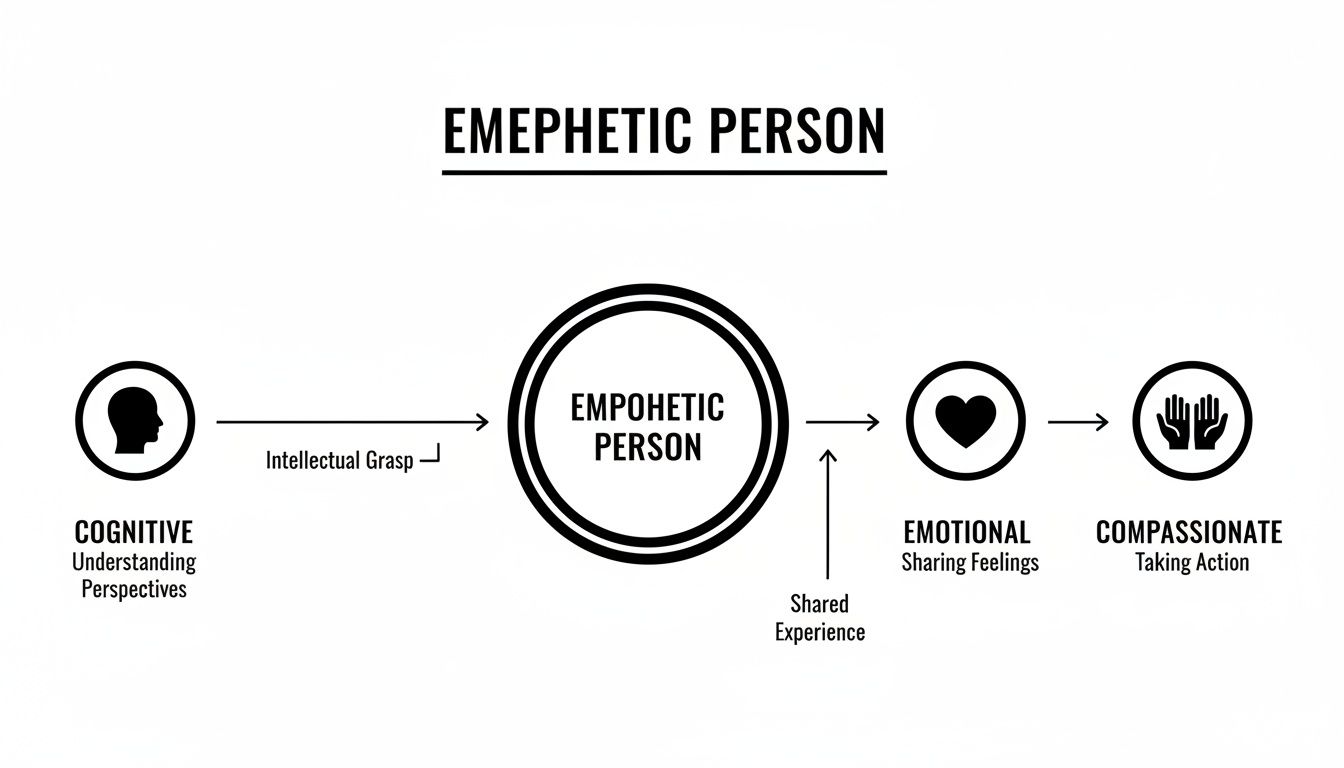
As you can see, a complete empathetic response is a process. It’s a journey that often involves all three types working together.
Cognitive Empathy: The Thinker
Think of this as empathy from the neck up. Cognitive empathy is the ability to understand someone's point of view on an intellectual level. You can put yourself in their shoes and see the world through their eyes, even if you don't feel what they're feeling.
It’s the skill that allows a therapist to grasp a client's thought patterns or a negotiator to understand the other side's demands. You can say, "Okay, I get why you're thinking that," while maintaining the emotional distance needed to solve a problem. It’s about perspective-taking, plain and simple.
Emotional Empathy: The Feeler
Now we’re moving from the head to the heart. Emotional empathy is what most of us picture when we hear the word. It's when you literally feel with someone else.
Their joy becomes your joy. Their sadness puts a lump in your throat. It's that automatic, gut-level response you get when your friend lands their dream job and you feel a genuine surge of excitement for them. You aren't just thinking, "She must be so happy"—you're actually sharing in that happiness.
Compassionate Empathy: The Doer
This is where the rubber meets the road. Compassionate empathy takes the understanding from your head and the feeling from your heart and turns them into action. It’s the impulse that says, "I understand, I feel for you, and now I’m going to do something to help."
This is the friend who doesn't just listen to you vent about a tough week but shows up with takeout. It's the neighbor who sees a family struggling and organizes a meal train. It’s empathy made tangible, active, and incredibly powerful.
Comparing the Three Types of Empathy
This table provides a quick side-by-side look at how these three types of empathy function in the real world.
| Type of Empathy | What It Is (The 'How') | Key Question | Example in Action |
|---|---|---|---|
| Cognitive Empathy | Intellectually understanding someone's perspective. It's about thinking your way into their reality. | "What is this person thinking or seeing?" | A manager listens to an employee's frustration about their workload and understands why they feel overwhelmed, allowing for a practical discussion about solutions. |
| Emotional Empathy | Physically feeling someone else's emotions. It's an automatic, shared emotional experience. | "What is this person feeling right now?" | When a colleague gets laid off, you feel a pang of genuine sadness and anxiety for them, as if it were happening to you. |
| Compassionate Empathy | Being moved to action by another's situation. It combines understanding and feeling with the desire to help. | "How can I help this person?" | After seeing a news report about a local family losing their home in a fire, you donate to their GoFundMe and share the link on social media. |
Each type has its place, and a truly well-rounded empathetic person learns to move between all three—knowing when to just listen and understand, when to share a feeling, and when it’s time to roll up their sleeves and help.
How to Spot an Empathetic Person in the Wild
Alright, so we've talked about what empathy is , but what does an empathetic person actually look like in day-to-day life? Forget the grand, sweeping gestures you see in movies. Spotting real empathy is more like a quiet-but-powerful scavenger hunt.
It's all in the little things—the small, consistent ways someone shows they’re truly dialed into your world.

First up, empathetic people are masters of active listening . They aren't just waiting for a gap in the conversation to jump in with their own story. They’re actually absorbing what you say. Their body language is a dead giveaway: they lean in, they make eye contact, and—most crucially—the phone disappears when things get serious. They listen to understand , not just to reply.
And that leads us to the next clue: they ask fantastic follow-up questions. Instead of hitting you with a generic "Oh, that's tough," they show they're genuinely curious and trying to grasp your experience.
Here are some practical examples:
• At work: • A colleague might notice you're unusually quiet and catch you later. "Hey, you seemed a bit off in that meeting. Everything alright?"
• With friends: • You tell a friend you had a horrible day, and instead of one-upping you with their own bad day, they ask, "What was the single hardest part of it for you?"
Questions like these are proof they’re trying to see the world from your side of the fence. It's the core of empathy, and it's a massive part of what we call emotional intelligence. In fact, you can find out more about how to measure emotional intelligence in our detailed guide.
Empathy Is Not Just Being Nice
Now, here’s a crucial distinction. Don't mistake politeness for empathy. Someone can be perfectly "nice"—holding doors, smiling, avoiding conflict—without having an empathetic bone in their body. Niceness is often about social lubricant; empathy is about genuine connection.
Sympathy is another common lookalike. Think of it this way: sympathy is feeling for someone. It’s standing at the edge of a pit they’ve fallen into and shouting down, "Wow, that looks awful down there!" Empathy is climbing down into the pit with them and saying, "I'm here with you. This is really tough."
One expresses pity from a safe distance. The other builds a bridge of shared humanity. Nailing this difference is the secret to spotting true empathy and, more importantly, learning to offer it yourself.
The Unspoken Link Between Empathy and Action
Feeling what someone else is going through is a powerful human connection. But let’s be real—the magic happens when that feeling sparks real, tangible action. An empathetic person isn't just a spectator to your struggles; they're moved to jump in the arena with you.
This is the crucial leap from simply feeling with someone to actively doing for them. It's what turns passive emotion into practical support.
Think about it this way: one friend might hear about your terrible week and say, "Oh wow, that sounds really hard." Another friend says the exact same thing... while dropping off a pizza because they know you’re too wiped out to even think about cooking. Both gestures come from a place of care, but the second one builds a bridge from feeling to doing. That’s practical empathy, and it’s the engine that truly changes things in our lives, our offices, and our communities.
From Empty Words to Tangible Support
Nowhere is this gap more obvious than in the workplace. We’ve all heard leaders say they “care about their people,” but teams have a built-in radar for when those are just empty words. A truly empathetic leader doesn’t just talk the talk; they build real support systems that make people feel genuinely seen, preventing burnout and creating a place where people actually want to work.
The 2026 Global Culture Report from O.C. Tanner exposed a massive disconnect here. While most leaders think they’re showing empathy, only 59% of employees feel that empathy is backed by any meaningful action. For a staggering 41% , it rings hollow—the corporate equivalent of "thoughts and prayers" with no real help attached. You can dive deeper into these findings about the power of practical empathy at work.
When leaders get this right, the payoff is huge. The report found that employees who feel that practical support are:
• 64% • more likely to feel seen and truly valued.
• 40% • more likely to feel fulfilled by their work.
• Likely to stick around for • 3 years longer • on average.
Practical Empathy in the Enneagram
This drive to do something is wired deeply into certain personality types, and the Enneagram gives us a brilliant map for seeing how. For our Enneagram Universe readers, this probably brings one type to mind immediately: Enneagram Type 2s (The Helpers) . Their entire motivation is built around spotting a need and instinctively moving to fill it.
For a Type 2, empathy isn’t a state of being—it's a call to action. They define their own empathy by what they do for others. This is the coworker who not only sees you're drowning in work but offers to take a task off your plate. They don't just understand; they act.
A practical example: Picture a team lead in Chicago—a classic Type 2—who learns an employee is battling a miserable, soul-crushing commute. A simple "I'm sorry to hear that" isn't in her DNA. Instead, she uses that empathetic insight to go to bat for a new hybrid work model for the entire department. That is practical empathy in its purest, most powerful form.
The Enneagram: Your Personalized Empathy Guide
If you've ever felt like "empathy" is a one-size-fits-all term that doesn't quite capture your experience, you're not wrong. The Enneagram is the tool that cracks this code, acting less like a dictionary and more like a personalized map to your own emotional world. It shows you exactly where your empathy shines and—just as crucially—where you might be walking around with a blind spot.
Think of it like this: we all have the capacity for empathy, but our personality wiring determines how it shows up. The Enneagram doesn’t try to change your wiring; it helps you work with it.
Your Type as Your Empathy Blueprint
Let's get specific. An Enneagram Type 2, famously known as The Helper, is the poster child for emotional empathy. They practically have an antenna for other people's feelings and are instinctively driven to jump in and help. You can read more about their caring nature in our detailed guide on the Enneagram Type 2 . The flip side? This superpower can easily become their kryptonite, leading to total burnout as they soak up everyone else's distress without saving any energy for themselves.
Now, let's swing over to an Enneagram Type 5, The Investigator. They are often absolute wizards of cognitive empathy . A Type 5 can take apart someone's problem, analyze it from every angle, and completely understand the logic behind their feelings. But ask them to feel it with you? That can be a whole different, and often uncomfortable, ballgame.
Empathy Across the Enneagram
This dynamic isn't just limited to a few types; it creates a fascinating spectrum of empathetic styles across all nine points of the Enneagram.
Here are a few more practical examples:
• The Enneagram Type 4 (The Individualist): • These folks live and breathe emotional resonance. They don't just understand someone's sadness; they’ve probably explored its every nuance in their own rich inner world. Their challenge is learning to surface for air instead of getting lost in the emotional deep end with someone.
• The Enneagram Type 9 (The Peacemaker): • The masters of seeing all sides. Their empathy is all about creating harmony. They can effortlessly step into someone else’s shoes, not just to feel their pain, but to understand their perspective and defuse the conflict.
Getting to know your Enneagram type is like finally getting the owner's manual for your own heart. It explains why you might be amazing at offering a practical solution but feel awkward just sitting with someone's grief, or the other way around. This is why a validated assessment, like the one from Enneagram Universe, is so valuable. It gives you the specific insights you need to embrace your natural strengths while intentionally working on the areas that don't come as easily, helping you become a more balanced and effective empathetic person.
Practical Ways to Grow Your Empathy Muscle
Good news! The idea that you’re either born an “empathetic person” or you’re not is a total myth. Empathy isn't some fixed trait—it's a skill you can build. Think of it like a muscle: with the right exercises, it gets stronger, more flexible, and far more effective.
Ready to hit the gym for your heart and mind? Here are some real-world exercises you can start using today.

1. Start with Perspective-Taking
This is all about mentally stepping into someone else’s world. Don’t just guess what they’re feeling; try to imagine their entire day leading up to the moment you meet them.
Practical exercise: Let’s say you’re on the phone with a frustrated, angry customer from Phoenix. Instead of just bracing against their tone, pause for a second. Imagine their day. Maybe they were late for work, got some bad news, and now this product issue is just the final straw. That tiny shift from reaction to understanding is what being an empathetic person is all about.
2. Practice Active Listening
If you really want to level up your empathy, focus on active listening and mastering the art of conversation . The two go hand in hand. This means listening to understand , not just to cook up your reply.
Practical exercise: In your next conversation, put your phone away. Make eye contact. Ask questions that show you’re actually engaged and trying to get it right. Try to use this phrase:
3. Diversify Your Inputs
It’s way too easy for our world to become echo chambers. You have to intentionally break out of them.
Practical exercise:
• Follow people on social media from totally different backgrounds.
• Read books by authors with life experiences that are nothing like your own.
• Watch documentaries that challenge your worldview.
This isn’t just about being well-rounded; it’s about broadening your entire understanding of the human experience. For even more strategies, you can check out our guide on how to increase your EQ .
The workplace is also a fantastic training ground. The 2026 State of Workplace Empathy Report found that 42% of employees feel their direct manager has the most impact on fostering empathy at work. This shows a big shift away from generic corporate initiatives and toward the real power of everyday leadership. You can read more about the future of workplace empathy to see where things are headed.
Frequently Asked Questions About Empathy
Alright, let's tackle some of the big questions that always come up when we talk about empathy. If you've been nodding along but still have a few "what-ifs" bouncing around in your head, you're in the right place. Let's get them sorted.
Can A Person Be Too Empathetic?
You bet. And there’s a name for it: empathy fatigue . It’s the emotional equivalent of a dead battery.
This happens when you’re constantly taking on everyone else's stress, sadness, and anxiety without having a way to process it or protect your own energy. For example , a nurse in a busy ER might start to feel numb or detached after months of absorbing the trauma of his patients. It’s a fast track to complete burnout. The solution isn’t to stop caring, but to build stronger emotional boundaries and practice some serious self-care.
What Is The Difference Between Empathy and Sympathy?
This is a huge one, and it’s a game-changer once you get it. The simplest way to frame it is:
• Empathy • is feeling • with • someone. You're willing to climb down into the metaphorical hole they're stuck in, sit with them in the dark, and say, "I'm here with you."
• Sympathy • is feeling • for • someone. You're standing at the top of that same hole, peering down and shouting, "Wow, it looks awful down there! Hope you figure it out!"
Is Being An Empath The Same As Being An Empathetic Person?
Not quite, though they definitely come from the same family. Being an "empathetic person" is a quality anyone can have or develop—it means you have the capacity to understand and share what someone else is feeling.
The term "empath," on the other hand, is a more modern label for someone on the extreme end of the sensitivity spectrum. Empaths often describe their experience as involuntarily absorbing the emotions and even physical sensations of those around them. For example , an empath might walk into a room and feel anxious simply because someone else in the room is anxious, even without talking to them. So, while anyone can practice being more empathetic, not everyone identifies with the intense, porous experience of being an empath.
Ready to uncover your unique empathetic style? The Enneagram Universe assessment provides a clear map to your inner world, showing you how to harness your natural strengths and build a more balanced emotional life. Discover your type and start your journey toward deeper self-understanding today .