Do I Hate My Job? How to Find Your Answer and What to Do Next

Sunday afternoon goes sideways in small ways first. You open your laptop “just to check Monday.” Your chest tightens. You start bargaining with time. If I meal prep, maybe tomorrow won’t feel so bad. If I go to bed early, maybe I can outrun the dread. Then the true question slips in.
Do I hate my job, or am I just tired?
That question matters because the answer changes what you do next. Some people need sleep. Some need boundaries. Some need a new boss, a new team, or a new field entirely. The hard part is that all three can feel similar at 9:17 p.m. on a Sunday.
You’re not being dramatic for asking it. A 2024 Pew Research Center survey on job satisfaction found that 12% of U.S. workers are not too or not at all satisfied with their job , while satisfaction with pay is at 30% and satisfaction with promotion opportunities is at 26% . A lot of people are going through the motions while wondering whether they picked the wrong job, the wrong workplace, or the wrong version of success.
Some of that pain is external. Pay, promotion, workload, and leadership are real. But some of it is internal too. Two people can work in the same office, under the same manager, with the same title, and one feels challenged while the other feels trapped. That difference doesn’t make one person weak. It means personality matters.
That Sunday Feeling The Question That Haunts Your Weekend
Maya is a middle school assistant principal in Ohio. On paper, she looks fine. Stable job. Respectable title. Solid benefits. But every Sunday around dinner, she starts feeling angry at ordinary things. The dog barks too much. Her partner chews too loudly. The laundry becomes a personal insult.
By 8 p.m., she’s scrolling job boards she doesn’t believe in and fantasizing about opening a bookstore, becoming a florist, or disappearing into a cabin with no Wi-Fi and no district emails.
That’s the part people miss. Job dislike doesn’t always show up as sadness. Sometimes it shows up as irritability, numbness, procrastination, or a weird urge to reorganize your kitchen instead of opening Outlook.
Why the Sunday Feeling Matters
Your weekend dread is information. It’s not a courtroom verdict. It doesn’t prove you must quit immediately. But it does tell you something that your work life is draining more than it gives back.
For some people, the problem is obvious. Their boss humiliates them in meetings. Their workload never stops. Their pay feels insulting. For others, the problem is slipperier. They can’t point to one catastrophe, but their whole body says no.
A lot of readers get stuck here because they think disliking work only “counts” if the office is openly toxic. That’s false. A job can be respectable, well-paid, and still be a terrible fit for your wiring.
A Better Question Than: Do I Hate My Job?
Instead of asking one giant, emotional question, ask smaller ones:
• When does the dread start: • Sunday night, every morning, or only during certain tasks?
• What exactly feels bad: • the people, the pace, the lack of meaning, or the way you’ve become in this role?
• What still feels okay: • one coworker, one project, one hour of the day, one skill you still enjoy using?
• What do you envy: • people who create, lead, teach, analyze, sell, help, or work alone?
Those answers create a map. You’re trying to separate a passing storm from a structural problem.
Hate Burnout or Just a Bad Week
When your car makes a horrible sound, you don’t diagnose it by vibes alone. You ask: Is the engine failing? Is it overheating? Did I just hit a pothole?
Work is similar. Job hate is the car you no longer want to drive. Burnout is the overheated engine. Temporary frustration is the flat tire.
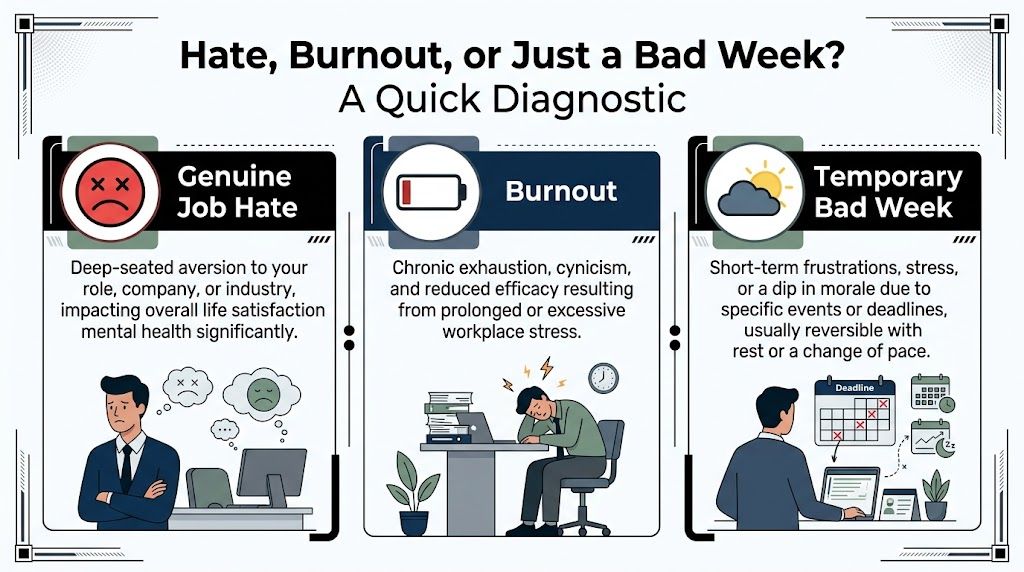
The Quick Distinction
Burnout deserves special attention because it distorts your thinking. A Lean Blog article discussing burnout and quitting data cites a PwC study showing 95% of workers are thinking of quitting and 65% are actively looking . It also notes that burnout can create an allostatic load from chronic stress that can impair executive function by as much as 13% . In plain English, your stressed brain gets worse at planning, deciding, and seeing options.
That’s why burnt-out people often say, “I can’t think straight.” They’re not being lazy. Their mental bandwidth is getting eaten alive.
Job Hate vs Burnout vs Temporary Frustration
| Indicator | Job Hate | Burnout | Temporary Frustration |
|---|---|---|---|
| Main feeling | Aversion | Exhaustion | Annoyance |
| What you dislike | The role, culture, or field itself | The sustained load and pressure | A project, conflict, deadline, or rough patch |
| How long it lasts | Persistent | Persistent, often worsening | Short-lived |
| What rest does | Helps a little, then dread returns | Helps briefly but not enough | Usually restores perspective |
| Your inner talk | “I don’t want this life.” | “I can’t keep doing this.” | “This week is ridiculous.” |
| Body clues | Tension before specific work tasks or environments | Heavy fatigue, brain fog, emotional flatness | Stress spikes tied to events |
| Vacation test | You dread returning even during the break | You spend the break recovering | You come back mostly okay |
| Best next move | Reassess fit and future direction | Reduce load and recover capacity | Solve the specific issue |
Three Examples People Confuse All the Time
Case one. Daniel is a physical therapist in Arizona. He still loves working with patients, but he’s buried in documentation and starts every morning already tired. That points more to burnout than job hate.
Case two. Priya is a marketing manager in Chicago. She can complete the work, but she feels hollow after every campaign. She doesn’t care about the product, the meetings bore her, and the praise means nothing. That sounds more like a genuine misfit.
Case three. Luis is an accountant in New Jersey during deadline season. He’s cranky, sleeping badly, and snapping at everyone. But every year, once the rush ends, he feels normal again. That’s probably temporary frustration.
The Three-Question Test
Ask yourself this, and answer fast:
If your answers keep circling back to “I just don’t want this kind of work,” listen carefully. That’s not the same as having a bad month.
Seven Signs You Genuinely Dislike Your Job
Some people don’t realize they hate their job because they’re still functioning. They hit deadlines. They answer Slack. They even crack jokes in meetings. Meanwhile, their inner life is falling apart due for divorce.
A 2024 analysis covered by CBS News found that only 40% of U.S. workers have “quality jobs” with fair pay, growth, and autonomy. It also reported that over half of workers find their jobs too demanding and 79% of those who quit felt undervalued by their employer . So if your misery connects to low autonomy, stalled growth, or feeling ignored, you’re not inventing a problem.

The Clock is Your Emotional Support Animal
Ben works in procurement in Atlanta. He doesn’t measure his day by outcomes. He measures it by how many minutes remain until lunch, then how many remain until he can leave. If the only bright spot in your job is escape, pay attention.
That’s different from normal anticipation. Everyone looks forward to being done. But if checking the time is the only thing that gives you relief, your job is probably draining your sense of aliveness.
You Fantasize About Quitting in Absurdly Cinematic Ways
Tasha is a dental office manager in Denver. She doesn’t merely think about leaving. She imagines placing her badge on the desk, making a speech no one asked for, and walking out to a soundtrack.
Humor can hide truth. Repetitive quitting fantasies often mean your mind is rehearsing freedom because your real life feels stuck.
Tiny Requests Feel Insulting
A normal task lands like an attack. “Can you update this spreadsheet?” and your whole nervous system says, absolutely not.
Meet Eric, a nonprofit program coordinator in Michigan. He used to be flexible. Now every “quick ask” makes him irrationally angry. Sometimes that means workload. Sometimes it means he has no emotional margin left because the job has already taken too much.
You Feel Oddly Invisible Even When Praised
This one confuses people. “But my boss says I’m doing great.” Praise isn’t the same as being known. Monica, a retail district trainer in Texas, gets compliments for her reliability. What she really wants is input, trust, and room to shape better systems. Instead, people celebrate her for cleaning up chaos without drawing attention. That kind of praise can feel like a trap.
Your Body Votes Before Your Brain Does
Before the meeting starts, your shoulders tighten. Before the commute, your stomach drops. Before opening your email, you suddenly need a snack, a nap, and a complete personality transplant. When your body keeps bracing, don’t wave it off. Stress has physical signatures.
You’ve Stopped Caring About Getting Better At Work
Early in a rough job, people usually try harder. They read, optimize, organize, and hope. Later, something changes. They stop wanting to improve because improvement no longer feels meaningful.
That’s what happened to Janelle, a software trainer in North Carolina. She used to save tutorials and test new tools for fun. Now she does the minimum and closes the laptop. The spark didn’t just dim. It withdrew.
You Dislike Who You Become At Work
This is the big one. You’re shorter. More guarded. More fake. Less curious. Less kind. Sometimes the cleanest sign is not “I hate my tasks.” It’s “I hate the version of me that survives this place.”
When It’s Not Just Your Role
If several of these signs hit hard, check the environment too. A role can be decent inside a lousy system. If your workplace rewards fear, politics, silence, or constant urgency, you may be dealing with bad company culture , not just personal dissatisfaction.
Here’s the catch. Culture problems and fit problems often travel together. A controlling workplace can crush almost anyone, but it will crush some personalities faster than others. That’s where the deeper “why” matters.
Find Your Deeper Why with the Enneagram
Most job advice treats people like interchangeable office furniture. You dislike work, so the advice says to fix your resume, set boundaries, take a walk, or ask for a raise. Those can help. But they don’t answer a sharper question.
Why does this job feel unbearable to you in particular?
A piece on personality and career dissatisfaction notes that 59% of workers are “quiet quitting” due to disengagement , while much of the advice people get still focuses mostly on external issues. That misses something important. Two people can hate the same job for opposite reasons.

Your Job May be Poking Your Core Fear
The Enneagram is useful here because it doesn’t just describe behavior. It points to core motivations, fears, and coping patterns . That matters at work.
A Type 1 may hate a job because the place feels sloppy, unethical, or chaotic. A Type 7 may hate the same job because it feels repetitive and boxed in. A Type 2 may stay in a draining role too long because being needed feels morally important. A Type 5 may look “fine” while dying inside from constant interruption and shallow collaboration.
If you’ve never explored the system before, this step-by-step guide to finding your Enneagram type can help you start sorting signal from noise.
How Job Hate Can Look by Each Enneagram Personality Type
- Type 1 The Reformer
You don’t just dislike mess. You feel morally irritated by it.
A Type 1 in a disorganized workplace often says things like, “No one here cares,” or “Everything is backwards.” The pain isn’t only inefficiency. It’s the sense that standards don’t matter. That can turn every workday into a running argument inside your head.
Example: A school operations manager sees preventable errors every week. She becomes the unpaid conscience of the office, then grows resentful that she’s carrying standards nobody else protects.
- Type 2 The Helper
You may hate your job because your caring has become a vending machine. Everyone presses a button. You dispense support. Nobody asks what it costs you.
Type 2s often confuse being valued with being used. If your role trains people to come to you for emotional labor, rescue, or constant availability, you may call it “service” long after it has become depletion.
- Type 3 The Achiever
This one gets sneaky. Type 3s can stay in a miserable role because the title looks good, the company name plays well at family gatherings, or the performance reviews are flattering.
But achievement without alignment feels dead after a while. You win, and the win tastes like cardboard.
- Type 5 The Investigator
You may not hate the work itself. You may hate the access people think they’re entitled to.
Open office plans, nonstop meetings, vague priorities, and performative collaboration can make a Type 5 feel mentally robbed. Then people misunderstand the withdrawal as aloofness, which makes the whole thing worse.
- Type 7 The Enthusiast
You can tolerate hard work. What you can’t tolerate for long is stagnation.
A Type 7 often says they’re “bored,” but boredom may be covering panic. Restrictive roles can feel like a cage. If your work gives you no novelty, no creativity, and no room to experiment, your dislike may be less about laziness and more about suffocation.
A short explainer can help if you want another lens on how motivation shapes career frustration.
- Type 8 The Challenger
You probably don’t hate work. You hate feeling controlled.
Type 8s can withstand pressure, conflict, and responsibility. But micromanagement, hidden agendas, and weak leadership can make them furious fast. If your workplace asks for obedience without honesty, the job can become unbearable even when the role itself is fine.
- Type 9 The Peacemaker
Type 9s often miss the moment dislike became disconnection. Instead of saying “I hate this,” they go numb, procrastinate, lose energy, and tell themselves it’s not that bad.
But suppressing your preferences doesn’t erase them. It buries them alive.
The Pattern Underneath The Complaint
If you keep asking only “What’s wrong with my job?”, you may miss “What does this job keep triggering in me?”
Try these prompts:
• What part of this job offends my nature most
• What do I keep tolerating that leaves me resentful
• What kind of praise feels empty to me
• What kind of work makes me feel more like myself
• Where am I over-adapting just to survive
Those questions give you better answers than generic career quizzes. They help you see whether your issue is workload, values, autonomy, recognition, meaning, stimulation, safety, or identity.
And once you know that, your next move gets cleaner.
Your Short-Term Survival Plan to Cope Right Now
Quitting tomorrow sounds satisfying. Rent still exists.
If you’re stuck for now, the goal is not to love the job instantly. The goal is to protect your energy , stop unnecessary damage, and create enough breathing room to think clearly.

Detach With Purpose
This isn’t the same as giving up. It’s a selective investment. If every email gets your full emotional reaction, you’ll be exhausted by 10 a.m. Instead, separate what is urgent , what is important , and what is just someone else’s panic .
Try a simple rule: answer routine friction with a calm, boring tone. Don’t donate extra emotion to nonsense.
Script: “I can get that to you by Thursday.”Not: “Oh no, absolutely, sorry, I’ll jump on it right now.”
Find One Daily Anchor
You may hate large parts of your day and still need one thing that steadies you. That anchor could be a coworker, your walk at lunch, fifteen quiet minutes before meetings, or one task that still uses your strengths.
For a Type 5, the anchor might be protected solo time to think. For a Type 2, it might be one supportive conversation that isn’t draining. For a Type 7, it might be blocking time for brainstorming instead of staying in reactive mode all day.
Build a Smaller Emotional Perimeter
People in rough jobs often let work spill into every room of their lives. Push back.
Use concrete boundaries:
• Shut down ritual: • Close tabs, write tomorrow’s top three tasks, and physically leave the workspace.
• No rehash zone: • Give yourself a set amount of time to vent, then stop replaying the day.
• Commute reset: • Use music, silence, or a short walk to signal “work is over.”
• After-hours rule: • If it can wait until morning, let it wait until morning.
Use EQ, Not Just Endurance
A lot of coping advice boils down to “be tougher.” That’s lazy advice. What helps more is emotional clarity. Can you tell the difference between anger, disappointment, fear, and grief? Can you spot when you’re people-pleasing, conflict-avoiding, or catastrophizing?
If that’s hard, this guide on how to increase EQ is useful because better emotional literacy makes bad jobs easier to manage without losing yourself inside them.
Start the Quiet Exit Prep Even If You Stay
Open a note on your phone and track three things for two weeks:
That note becomes evidence. Later, when you’re tempted to gaslight yourself back into “it’s fine,” you’ll have your own record.
The Long-Term Game Plan: Reshape or Resign
Once the fog lifts, you have two honest options. Reshape the job or leave the job . Both can be smart. The mistake is staying passive.
Option 1: Reshape The Role You Have
Reshaping means job crafting. You change parts of your work so the role fits you better. Not perfectly. Better.
That can include:
• Task crafting: • Ask for more of the work that uses your strengths and less of the work that crushes you.
• Relationship crafting: • Spend more time with the people who make good work possible and less with unnecessary energy drains.
• Meaning crafting: • Reconnect the job to a person, outcome, or value you care about.
A Type 2 might need to stop being everyone’s emotional help desk. A Type 5 might negotiate more independent project time. A Type 8 might ask for decision rights instead of vague responsibility with no authority.
This path works best when the workplace is imperfect but flexible. It fails when leadership punishes honesty, ignores boundaries, or refuses to adjust to an obvious misfit.
Option 2: Resign Strategically, Not Dramatically
Sometimes the role is the problem. Sometimes the field is. Sometimes your job dislike is a clue that the work has become hollow.
A contrarian but useful idea comes from the “pointless job” conversation. A piece discussing that phenomenon argues that dissatisfaction can sometimes signal job obsolescence , especially as AI changes administrative work, and says that purpose-aligned workers are twice as resilient to AI disruption ( discussion here ). Don’t treat every bad feeling as a mindset issue. Some roles are losing meaning.
If you decide to leave, leave with a filter. Don’t run from one bad fit into another.
What to Screen For At Your Next Job?
Ask interview questions that reflect your wiring.
• If you’re Type 1: • Ask how the team handles mistakes, accountability, and conflicting standards.
• If you’re Type 2: • Ask what support looks like and how workloads are protected from constant emotional overreach.
• If you’re Type 5: • Ask about meeting load, independent work time, and how decisions get documented.
• If you’re Type 7: • Ask how much experimentation, variety, and initiative the role allows.
• If you’re Type 8: • Ask who makes decisions, how conflict is handled, and whether leaders communicate directly.
• If you’re Type 9: • Ask how input is invited and how disagreement is managed on the team.
Those questions reveal more than “What’s the culture like?” which usually earns you polished nonsense.
Build a Plan Before You Bolt
Use a written process. Write down what you’re leaving, what you’re moving toward, and what conditions your next role must meet.
A structured personal development plan template can help you turn a vague “I need out” feeling into actual criteria, habits, and next steps.
If you do resign, do it cleanly. Don’t send a rage paragraph from your Notes app. A practical guide on how to write a resignation letter can help you leave professionally without overexplaining.
From Hating Your Job to Owning Your Career
Hating your job can make you feel childish, ungrateful, or weak. It can also be one of the most useful signals in your adult life.
A bad fit exposes your values. A draining boss exposes your boundaries. A boring role exposes your need for meaning, challenge, freedom, or impact. The discomfort is awful, but it’s also revealing.
If you’ve been asking “do i hate my job,” you don’t need a dramatic answer today. You need an honest one. Honest enough to notice whether this is exhaustion, misalignment, or a role that no longer deserves your loyalty.
Questions Worth Sitting With:
Write these down. Answer them without trying to sound impressive.
• What part of my current work do I no longer want to normalize
• Where am I betraying my own wiring to look competent
• What kind of stress can I handle well, and what kind breaks me down
• What do I want more of in my next chapter
• What am I afraid would be true if I admitted this job isn’t right for me
• Which matters more right now, recovery, redesign, or exit
One of the clearest shifts in career growth happens when you stop asking, “What job should a successful person have?” and start asking, “What environment helps me become a healthier version of myself?”
That’s a different standard. It’s better.
If you stay, stay on purpose and reshape what you can. If you leave, leave with self-knowledge so you don’t recreate the same pain in a shinier office. Either way, your career becomes easier to own when you stop treating your personality as a side note.
If you want a clearer read on your patterns at work, Enneagram Universe offers a thoughtful place to start. Its assessment can help you understand the motivations, fears, and habits that shape how you respond to pressure, conflict, meaning, and career fit, so your next move comes from self-knowledge instead of pure frustration.